CAKE MAKING
By
MRS. M. PITT
LEARNING OBJECTIVES
i. Name the basic methods of cake making
ii. List the equipment used in cake making.
iii. State at least two ways of introducing air in
cake mixtures.
iv. Demonstrate an understanding of the
different methods of cake making.
v. Identify remedies for various faults that can
occur in cake making.
BASIC CAKE MAKING METHODS
• Rubbing in method-Rock buns, scones,
• Creaming-Victoria sandwich, Christmas cakes,
fairy cakes.
• Whisking-Swiss rolls, sandwich cakes, sponge
fingers, flan cases.
• Melting-Chocolate brownies, flapjacks,
gingerbread.
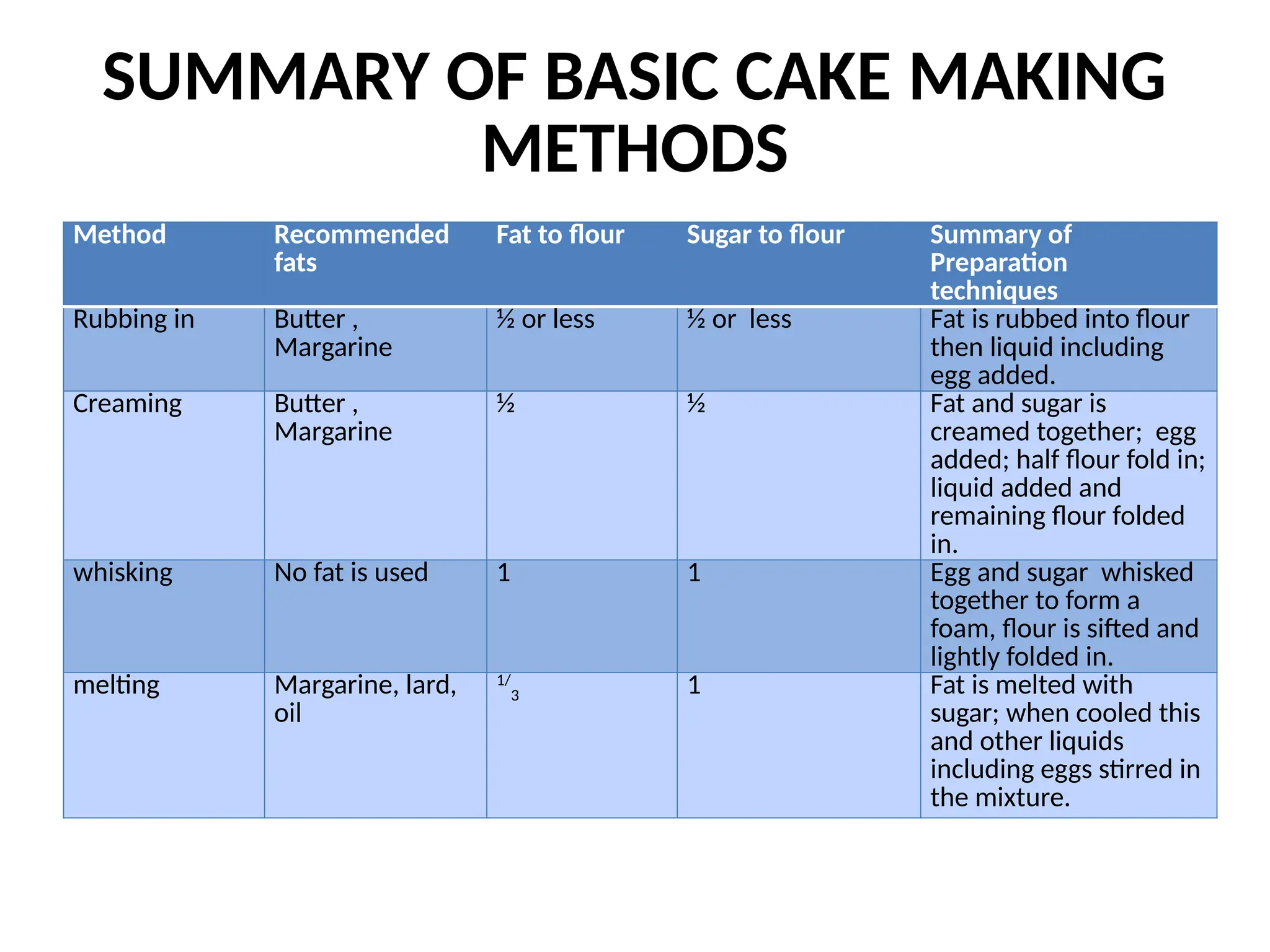
SUMMARY OF BASIC CAKE MAKING
METHODS
Method Recommended
fats
Fat to flour Sugar to flour Summary of
Preparation
techniques
Rubbing in Butter ,
Margarine
½ or less ½ or less Fat is rubbed into flour
then liquid including
egg added.
Creaming Butter ,
Margarine
½ ½ Fat and sugar is
creamed together; egg
added; half flour fold in;
liquid added and
remaining flour folded
in.
whisking No fat is used 1 1 Egg and sugar whisked
together to form a
foam, flour is sifted and
lightly folded in.
melting Margarine, lard,
oil
1/
3 1 Fat is melted with
sugar; when cooled this
and other liquids
including eggs stirred in
the mixture.
WHAT ARE THE MAIN INGREDIENTS USED IN
CAKE MAKING?
FUNCTIONS OF FLOUR IN CAKE MAKING
• Forms the structure of the cake.
• Dextrinization of starch helps to give cake its
colour.
• bulk ingredient.
FUNCTIONS OF FAT IN CAKE MAKING
• Improves flavour and colour
• To provide ‘shortness’ to cake mixture. This
• Extends shelf life.
• Traps air when creamed with sugar, which acts
as a raising agent.
FUNCTIONS OF SUGAR IN CAKE MAKING
• Adds flavour.
• Add colour as the sugar caramelises on
heating.
• Helps to trap air with fat during heating.
• Softens the structure.
FUNCTIONS OF EGGS IN CAKE MAKING
• Trap air to help the mixture rise,
• Emulsify the fat in creamed mixtures. (lecithin
found in egg yolk acts as the emulsifier).
• Add colour.
• Add nutrients.
• Help to set the cake in the risen position by
the coagulation of egg protein.
• Provide moisture which converts to steam on
heating.
FUNCTIONS OF LIQUID IN CAKE MAKING
• Provides moisture for the gelatinization of starch.
• Helps the development of gluten.
• Forms steam to help the mixture rise.
• Helps blend ingredients
• Examples:
– Milk
– Buttermilk
– Orange juice
– Water
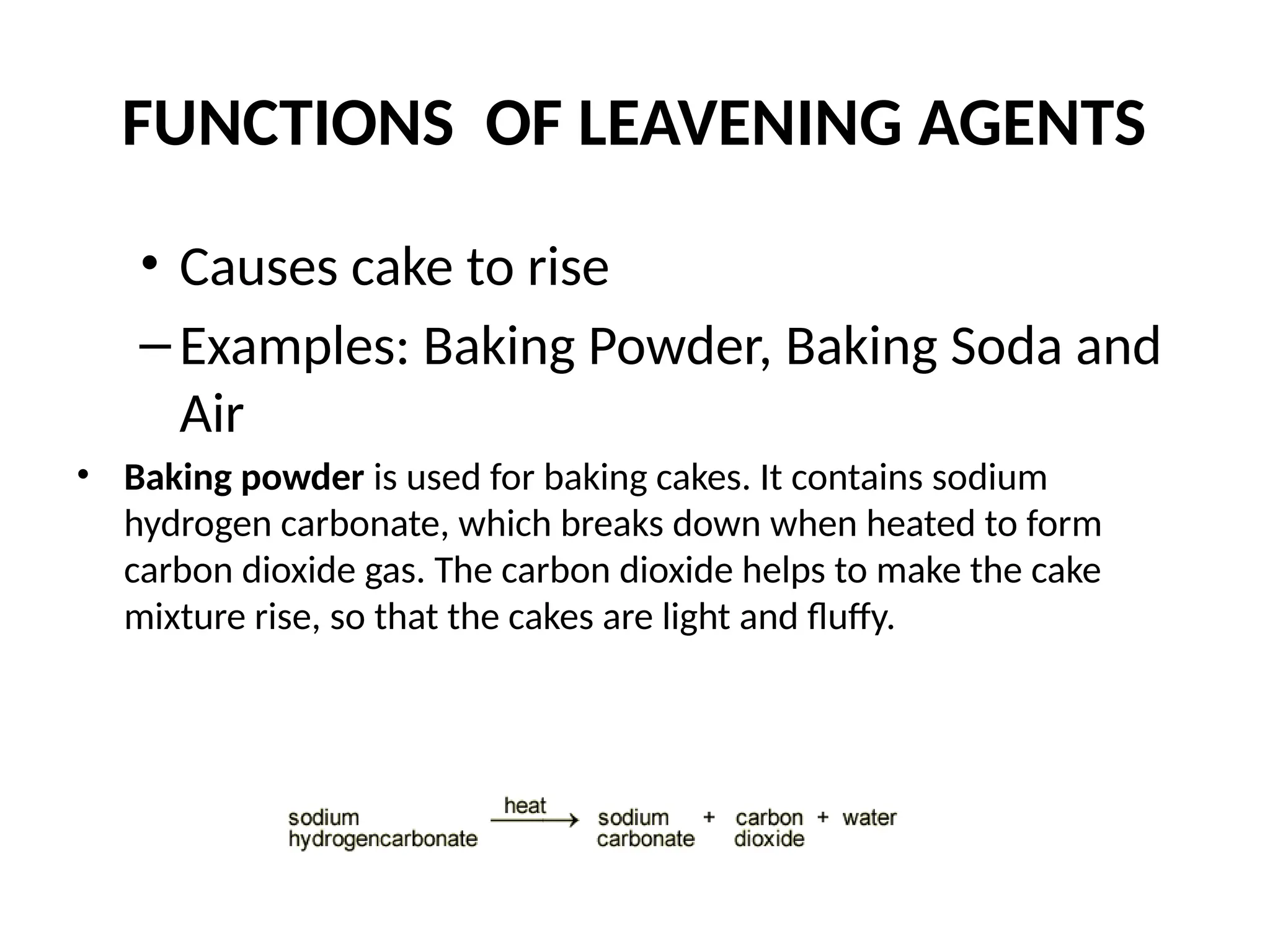
FUNCTIONS OF LEAVENING AGENTS
• Causes cake to rise
–Examples: Baking Powder, Baking Soda and
Air
• Baking powder is used for baking cakes. It contains sodium
hydrogen carbonate, which breaks down when heated to form
carbon dioxide gas. The carbon dioxide helps to make the cake
mixture rise, so that the cakes are light and fluffy.
FUNCTIONS OF FLAVORINGS IN CAKE
MAKING
Flavoring:
– Improve the taste of the product
– Example: vanilla, almond essence, nutmeg,
cinnamon, raisins, orange zest.
CAKE MAKING EQUIPMENT
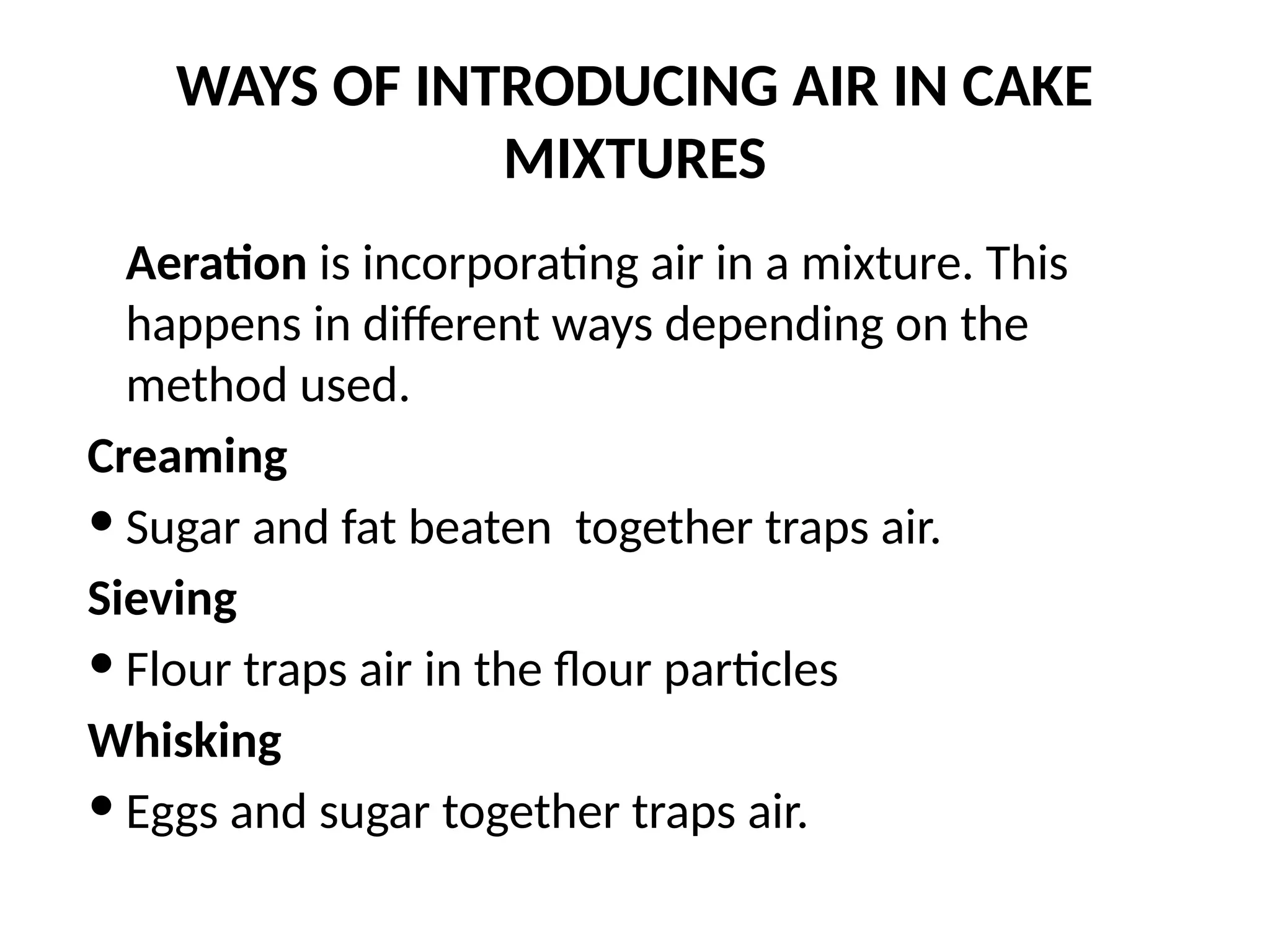
WAYS OF INTRODUCING AIR IN CAKE
MIXTURES
Aeration is incorporating air in a mixture. This
happens in different ways depending on the
method used.
Creaming
 Sugar and fat beaten together traps air.
Sieving
 Flour traps air in the flour particles
Whisking
 Eggs and sugar together traps air.
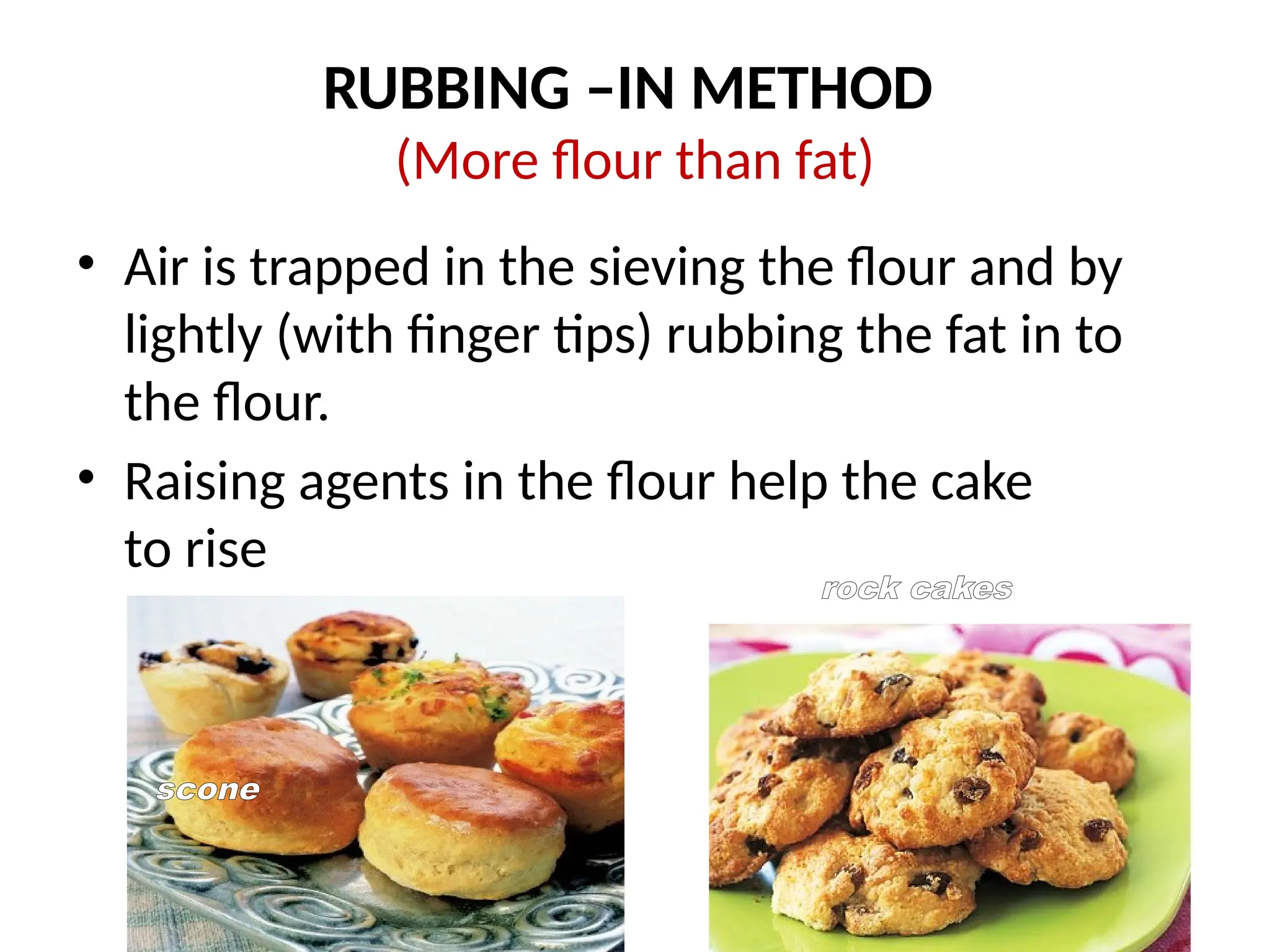
RUBBING –IN METHOD
(More flour than fat)
• Air is trapped in the sieving the flour and by
lightly (with finger tips) rubbing the fat in to
the flour.
• Raising agents in the flour help the cake
to rise
scone
rock cakes
CREAMINING
(Half or more than half fat to flour)
• Air is trapped by creaming the sugar and fat
together
• This give a lighter texture
WHISKING METHOD
(No fat. relies on air trapped by the whisk)
• Eggs and sugar whisked together to trap air
(aerate). Example in sponge cakes and Swiss
rolls.
MELTING
• Fat & syrup/sugar are melted in a pan and
poured into the other ingredients.
STEPS IN MAKING A CAKE USING
THE CREAMING METHOD
20
Basic Mixing Methods
Creaming Method
Cream the butter and sugar
until the mixture is light and
fluffy.
Beat in the eggs a little at a
time.
Understanding Cake Making
21
Basic Mixing Methods
Add one-fourth of the dry
ingredients and mix in.
Add one-third of the liquid
ingredients and mix in. Repeat
until all the dry and liquid
ingredients are incorporated.
Creaming Method
Understanding Cake Making
22
Basic Mixing Methods
Foaming or Sponge Method
With a wire whip or the whip
attachment of a mixer, beat
the eggs until they are very
thick and light.
Fold in the sifted flour in three
or four stages, until all the
flour is blended in.
MAKING A CAKE USING THE CREAMING
METHOD
• Fat & sugar are creamed together using a
wooden spoon. It is better to use soft
margarine as it is easier to cream.
• Caster sugar has smaller crystals than
granulated, so it mixes better.
MAKING A CAKE USING THE CREAMING
METHOD
• Self-raising flour is used to make the cakes rise
so there is no need to add baking powder.
• Flavourings such as cocoa can be added to the
mixture must be dissolved before adding to
prevent speckling.
• These cakes are cooked at a lower
temperature, Gas 4 or 5 (180° - 190°C) for 20 –
25 minutes.
GUIDELINES TO ENSURE SUCCESS
• Preparing Pans
–Prepare as directed
• Grease & lightly dust with flour
• Shake out extra
• Or line with waxed paper cut to size
• Remove egg from refrigerator to bring them at
room temperature before use.
• Always sift flour and any powdered ingredients
such as baking powder or spices.
ADAPTING A CAKE RECIPE
• What could you add to cakes to change
• the flavour
• the texture
• the colour
• What could you change to make cakes
healthier? (think about what you need to eat
more of and what you need to eat less of)
FAULTS IN CAKE MAKING
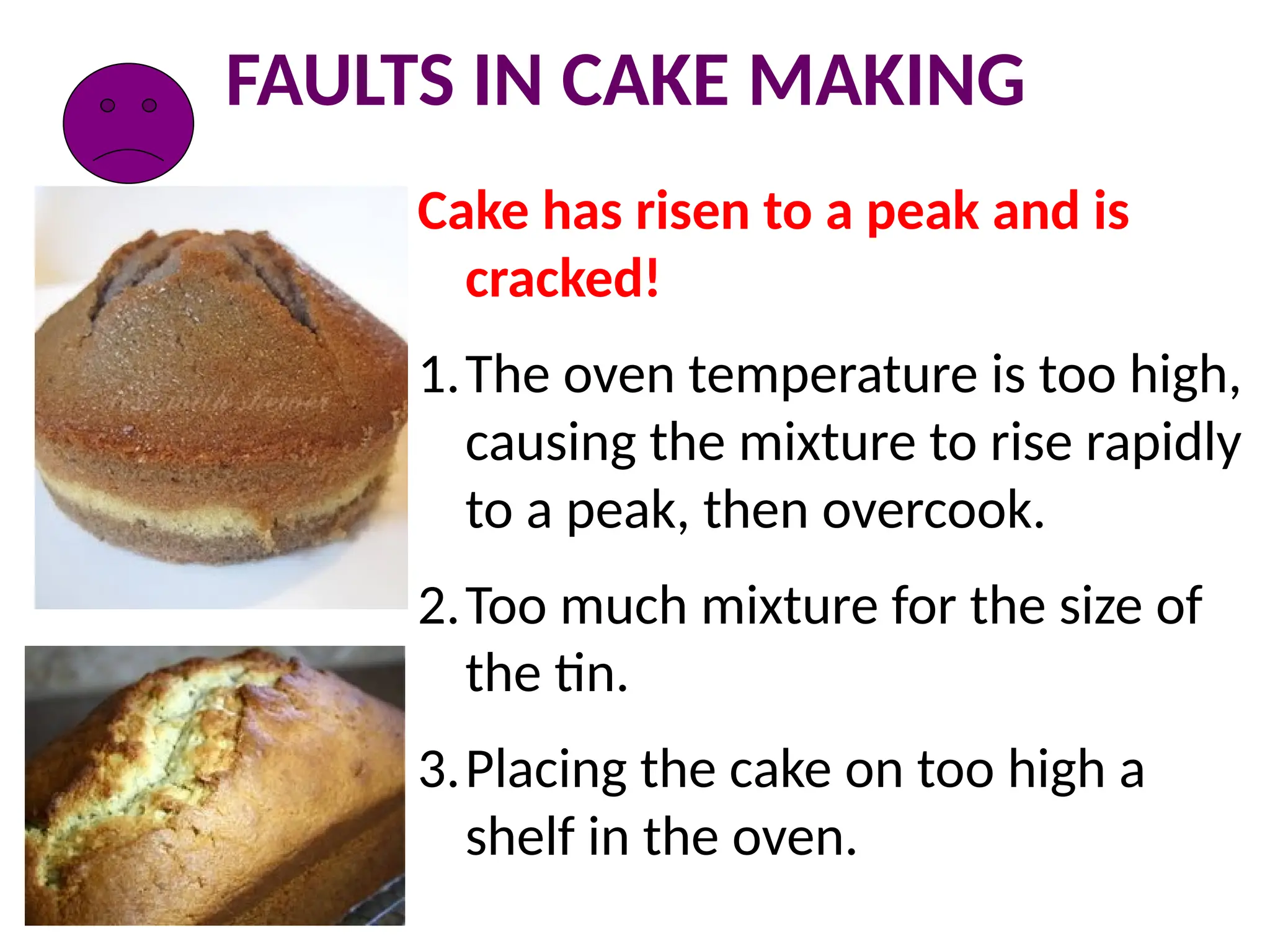
Cake has risen to a peak and is
cracked!
1.The oven temperature is too high,
causing the mixture to rise rapidly
to a peak, then overcook.
2.Too much mixture for the size of
the tin.
3.Placing the cake on too high a
shelf in the oven.
Cake has sunk in the middle!
 Undercooking by the wrong
temperature or cooking time.
 Too much sugar or syrup
causing the gluten to over-
soften and collapse.
Too much raising agent, causing the
gluten to over stretch and collapse.
Opening the oven door before the
gluten has set, so that the heavy
cold air makes it sink.
The oven shelf is not level.
The cake mixture was placed too close to the
source of heat, which has caused it to rise too
quickly on one side.
Cake has risen unevenly!
Cake has a hard, sugary
crust!
The sugar is too course
and does not dissolve in
time.
Too much sugar has
been used.
Cake is dry.
Cake baked for too long.
Too little liquid used
Too much chemical raising agent used.
Fruit has sunk to the
bottom!
Pieces of fruit were too
large and too heavy.
Fruit was not dusted with flour before being added
to the mixture.
Cake mixture was over beaten or was too wet so it
could not hold the fruit in place.
Oven temperature was too low; the mixture melted
before it could hold the fruit in place.

cakemaking-thirdformsup1-161101225607 (1).pptx

  • 1.
  • 2.
    LEARNING OBJECTIVES i. Namethe basic methods of cake making ii. List the equipment used in cake making. iii. State at least two ways of introducing air in cake mixtures. iv. Demonstrate an understanding of the different methods of cake making. v. Identify remedies for various faults that can occur in cake making.
  • 3.
    BASIC CAKE MAKINGMETHODS • Rubbing in method-Rock buns, scones, • Creaming-Victoria sandwich, Christmas cakes, fairy cakes. • Whisking-Swiss rolls, sandwich cakes, sponge fingers, flan cases. • Melting-Chocolate brownies, flapjacks, gingerbread.
  • 4.
    SUMMARY OF BASICCAKE MAKING METHODS Method Recommended fats Fat to flour Sugar to flour Summary of Preparation techniques Rubbing in Butter , Margarine ½ or less ½ or less Fat is rubbed into flour then liquid including egg added. Creaming Butter , Margarine ½ ½ Fat and sugar is creamed together; egg added; half flour fold in; liquid added and remaining flour folded in. whisking No fat is used 1 1 Egg and sugar whisked together to form a foam, flour is sifted and lightly folded in. melting Margarine, lard, oil 1/ 3 1 Fat is melted with sugar; when cooled this and other liquids including eggs stirred in the mixture.
  • 5.
    WHAT ARE THEMAIN INGREDIENTS USED IN CAKE MAKING?
  • 6.
    FUNCTIONS OF FLOURIN CAKE MAKING • Forms the structure of the cake. • Dextrinization of starch helps to give cake its colour. • bulk ingredient.
  • 7.
    FUNCTIONS OF FATIN CAKE MAKING • Improves flavour and colour • To provide ‘shortness’ to cake mixture. This • Extends shelf life. • Traps air when creamed with sugar, which acts as a raising agent.
  • 8.
    FUNCTIONS OF SUGARIN CAKE MAKING • Adds flavour. • Add colour as the sugar caramelises on heating. • Helps to trap air with fat during heating. • Softens the structure.
  • 9.
    FUNCTIONS OF EGGSIN CAKE MAKING • Trap air to help the mixture rise, • Emulsify the fat in creamed mixtures. (lecithin found in egg yolk acts as the emulsifier). • Add colour. • Add nutrients. • Help to set the cake in the risen position by the coagulation of egg protein. • Provide moisture which converts to steam on heating.
  • 10.
    FUNCTIONS OF LIQUIDIN CAKE MAKING • Provides moisture for the gelatinization of starch. • Helps the development of gluten. • Forms steam to help the mixture rise. • Helps blend ingredients • Examples: – Milk – Buttermilk – Orange juice – Water
  • 11.
    FUNCTIONS OF LEAVENINGAGENTS • Causes cake to rise –Examples: Baking Powder, Baking Soda and Air • Baking powder is used for baking cakes. It contains sodium hydrogen carbonate, which breaks down when heated to form carbon dioxide gas. The carbon dioxide helps to make the cake mixture rise, so that the cakes are light and fluffy.
  • 12.
    FUNCTIONS OF FLAVORINGSIN CAKE MAKING Flavoring: – Improve the taste of the product – Example: vanilla, almond essence, nutmeg, cinnamon, raisins, orange zest.
  • 13.
  • 14.
    WAYS OF INTRODUCINGAIR IN CAKE MIXTURES Aeration is incorporating air in a mixture. This happens in different ways depending on the method used. Creaming  Sugar and fat beaten together traps air. Sieving  Flour traps air in the flour particles Whisking  Eggs and sugar together traps air.
  • 15.
    RUBBING –IN METHOD (Moreflour than fat) • Air is trapped in the sieving the flour and by lightly (with finger tips) rubbing the fat in to the flour. • Raising agents in the flour help the cake to rise scone rock cakes
  • 16.
    CREAMINING (Half or morethan half fat to flour) • Air is trapped by creaming the sugar and fat together • This give a lighter texture
  • 17.
    WHISKING METHOD (No fat.relies on air trapped by the whisk) • Eggs and sugar whisked together to trap air (aerate). Example in sponge cakes and Swiss rolls.
  • 18.
    MELTING • Fat &syrup/sugar are melted in a pan and poured into the other ingredients.
  • 20.
    STEPS IN MAKINGA CAKE USING THE CREAMING METHOD 20 Basic Mixing Methods Creaming Method Cream the butter and sugar until the mixture is light and fluffy. Beat in the eggs a little at a time.
  • 21.
    Understanding Cake Making 21 BasicMixing Methods Add one-fourth of the dry ingredients and mix in. Add one-third of the liquid ingredients and mix in. Repeat until all the dry and liquid ingredients are incorporated. Creaming Method
  • 22.
    Understanding Cake Making 22 BasicMixing Methods Foaming or Sponge Method With a wire whip or the whip attachment of a mixer, beat the eggs until they are very thick and light. Fold in the sifted flour in three or four stages, until all the flour is blended in.
  • 23.
    MAKING A CAKEUSING THE CREAMING METHOD • Fat & sugar are creamed together using a wooden spoon. It is better to use soft margarine as it is easier to cream. • Caster sugar has smaller crystals than granulated, so it mixes better.
  • 24.
    MAKING A CAKEUSING THE CREAMING METHOD • Self-raising flour is used to make the cakes rise so there is no need to add baking powder. • Flavourings such as cocoa can be added to the mixture must be dissolved before adding to prevent speckling. • These cakes are cooked at a lower temperature, Gas 4 or 5 (180° - 190°C) for 20 – 25 minutes.
  • 25.
    GUIDELINES TO ENSURESUCCESS • Preparing Pans –Prepare as directed • Grease & lightly dust with flour • Shake out extra • Or line with waxed paper cut to size • Remove egg from refrigerator to bring them at room temperature before use. • Always sift flour and any powdered ingredients such as baking powder or spices.
  • 26.
    ADAPTING A CAKERECIPE • What could you add to cakes to change • the flavour • the texture • the colour • What could you change to make cakes healthier? (think about what you need to eat more of and what you need to eat less of)
  • 27.
    FAULTS IN CAKEMAKING Cake has risen to a peak and is cracked! 1.The oven temperature is too high, causing the mixture to rise rapidly to a peak, then overcook. 2.Too much mixture for the size of the tin. 3.Placing the cake on too high a shelf in the oven.
  • 28.
    Cake has sunkin the middle!  Undercooking by the wrong temperature or cooking time.  Too much sugar or syrup causing the gluten to over- soften and collapse. Too much raising agent, causing the gluten to over stretch and collapse. Opening the oven door before the gluten has set, so that the heavy cold air makes it sink.
  • 29.
    The oven shelfis not level. The cake mixture was placed too close to the source of heat, which has caused it to rise too quickly on one side. Cake has risen unevenly!
  • 30.
    Cake has ahard, sugary crust! The sugar is too course and does not dissolve in time. Too much sugar has been used. Cake is dry. Cake baked for too long. Too little liquid used Too much chemical raising agent used.
  • 31.
    Fruit has sunkto the bottom! Pieces of fruit were too large and too heavy. Fruit was not dusted with flour before being added to the mixture. Cake mixture was over beaten or was too wet so it could not hold the fruit in place. Oven temperature was too low; the mixture melted before it could hold the fruit in place.

Editor's Notes

  • #25 Remove egg from refrigerator to bring them at room temperature before use. If the egg is very cold , it cools the fat making it difficult for lecithin in the egg yolk to emulsify the fat. This will curdling of the mixture. Always sift flour and any powdered ingredients such as baking powder or spices. This mixes them thoroughly breaks up any lumps and mixes in air.