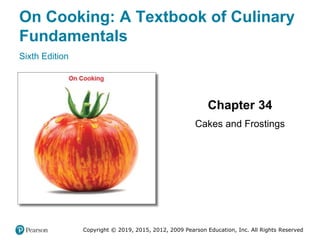
On Cooking: A Textbook of Culinary
Fundamentals
Sixth Edition
Chapter 34
Cakes and Frostings
Copyright © 2019, 2015, 2012, 2009 Pearson Education, Inc. All Rights Reserved
Learning Objectives
After studying this chapter, you will be able to:
34.1 Describe the function of ingredients used to make
cakes
34.2 Prepare a variety of cakes using the creamed fat and
whipped-egg mixing methods
34.3 Prepare a variety of frostings
34.5 Explain basic cake finishing techniques
34.6 Assemble a variety of cakes
Copyright © 2019, 2015, 2012, 2009 Pearson Education, Inc. All Rights Reserved
Cake Ingredients
• Tougheners
– Flour, eggs and milk
• Tenderizers
– Sugar, fats and egg yolks
• Moisteners
– Water, milk, juice and eggs
• Driers
– Flour, starches and milk solids
• Leaveners
– Baking soda and baking powder
• Flavorings
– Extracts, cocoa, chocolate, spices, salt, sugar and butter
Copyright © 2019, 2015, 2012, 2009 Pearson Education, Inc. All Rights Reserved
Mixing Methods: Creamed Fat
• Cakes are mixed using several methods
• Creamed fat method
– Butter cakes: High-fat formula; chemical leavener
used
– High ratio: Emulsified shortening; two-part mixing
method
• These cakes have a fine grain; air cells uniform size;
moist crumb; thin & tender crust
Copyright © 2019, 2015, 2012, 2009 Pearson Education, Inc. All Rights Reserved
Mixing Methods: Whipped Eggs
• Whipped-egg method
– Genoise: Whole eggs whipped with sugar; no chemical leaveners
▪ Dry and spongy
– Spongecakes: Egg yolks mixed with other ingredients, then whipped
egg whites folded in
▪ Moister and more tender than genoise
– Angel food: No fat; large quantity of whipped egg whites; high % sugar
▪ Tall, light and spongy
– Chiffon: Vegetable oil used; egg yolks mixed with other ingredients,
then whipped egg whites folded in; baking powder may be added
▪ Tall, light and fluffy; moister and richer than angel food
Copyright © 2019, 2015, 2012, 2009 Pearson Education, Inc. All Rights Reserved
Creaming Method
• Softened butter or shortening is creamed on low speed in
a mixer to incorporate air
– Creaming leavens the cake
– Creaming creates an emulsion between fats and
liquids
• Final product is tender with a fine texture
Copyright © 2019, 2015, 2012, 2009 Pearson Education, Inc. All Rights Reserved
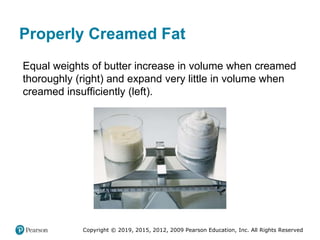
Properly Creamed Fat
Equal weights of butter increase in volume when creamed
thoroughly (right) and expand very little in volume when
creamed insufficiently (left).
Copyright © 2019, 2015, 2012, 2009 Pearson Education, Inc. All Rights Reserved
Whipped Egg
• Air is whipped into eggs to leaven cake; chemical
leavening may be added
– Whipped eggs leaven cake
• Final product is low in fat, spongy and pliable; some egg
foam cakes are suitable for rolling
Copyright © 2019, 2015, 2012, 2009 Pearson Education, Inc. All Rights Reserved
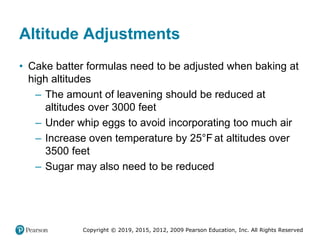
Altitude Adjustments
• Cake batter formulas need to be adjusted when baking at
high altitudes
– The amount of leavening should be reduced at
altitudes over 3000 feet
– Under whip eggs to avoid incorporating too much air
– Increase oven temperature by 25°Fahrenheitat altitudes over
3500 feet
– Sugar may also need to be reduced
Copyright © 2019, 2015, 2012, 2009 Pearson Education, Inc. All Rights Reserved
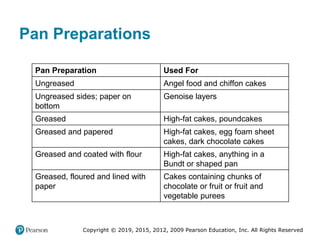
Pan Preparations
Pan Preparation Used For
Ungreased Angel food and chiffon cakes
Ungreased sides; paper on
bottom
Genoise layers
Greased High-fat cakes, poundcakes
Greased and papered High-fat cakes, egg foam sheet
cakes, dark chocolate cakes
Greased and coated with flour High-fat cakes, anything in a
Bundt or shaped pan
Greased, floured and lined with
paper
Cakes containing chunks of
chocolate or fruit or fruit and
vegetable purees
Copyright © 2019, 2015, 2012, 2009 Pearson Education, Inc. All Rights Reserved
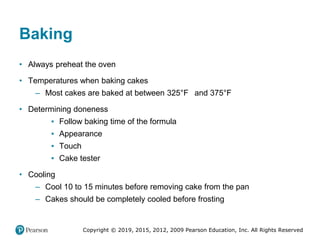
Baking
• Always preheat the oven
• Temperatures when baking cakes
– Most cakes are baked at between 325°Fahrenheit and 375°Fahrenheit
• Determining doneness
▪ Follow baking time of the formula
▪ Appearance
▪ Touch
▪ Cake tester
• Cooling
– Cool 10 to 15 minutes before removing cake from the pan
– Cakes should be completely cooled before frosting
Copyright © 2019, 2015, 2012, 2009 Pearson Education, Inc. All Rights Reserved
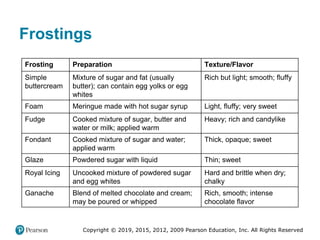
Frostings
Frosting Preparation Texture/Flavor
Simple
buttercream
Mixture of sugar and fat (usually
butter); can contain egg yolks or egg
whites
Rich but light; smooth; fluffy
Foam Meringue made with hot sugar syrup Light, fluffy; very sweet
Fudge Cooked mixture of sugar, butter and
water or milk; applied warm
Heavy; rich and candylike
Fondant Cooked mixture of sugar and water;
applied warm
Thick, opaque; sweet
Glaze Powdered sugar with liquid Thin; sweet
Royal Icing Uncooked mixture of powdered sugar
and egg whites
Hard and brittle when dry;
chalky
Ganache Blend of melted chocolate and cream;
may be poured or whipped
Rich, smooth; intense
chocolate flavor
Copyright © 2019, 2015, 2012, 2009 Pearson Education, Inc. All Rights Reserved
Assembling Cakes (1 of 2)
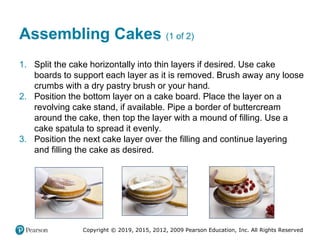
1. Split the cake horizontally into thin layers if desired. Use cake
boards to support each layer as it is removed. Brush away any loose
crumbs with a dry pastry brush or your hand.
2. Position the bottom layer on a cake board. Place the layer on a
revolving cake stand, if available. Pipe a border of buttercream
around the cake, then top the layer with a mound of filling. Use a
cake spatula to spread it evenly.
3. Position the next cake layer over the filling and continue layering
and filling the cake as desired.
Copyright © 2019, 2015, 2012, 2009 Pearson Education, Inc. All Rights Reserved
Assembling Cakes (2 of 2)
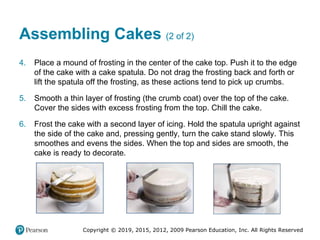
4. Place a mound of frosting in the center of the cake top. Push it to the edge
of the cake with a cake spatula. Do not drag the frosting back and forth or
lift the spatula off the frosting, as these actions tend to pick up crumbs.
5. Smooth a thin layer of frosting (the crumb coat) over the top of the cake.
Cover the sides with excess frosting from the top. Chill the cake.
6. Frost the cake with a second layer of icing. Hold the spatula upright against
the side of the cake and, pressing gently, turn the cake stand slowly. This
smoothes and evens the sides. When the top and sides are smooth, the
cake is ready to decorate.
Copyright © 2019, 2015, 2012, 2009 Pearson Education, Inc. All Rights Reserved
Piping Techniques
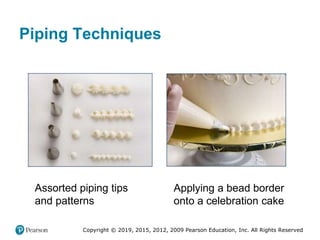
Assorted piping tips
and patterns
Applying a bead border
onto a celebration cake
Copyright © 2019, 2015, 2012, 2009 Pearson Education, Inc. All Rights Reserved
Storing Cakes
• Unfrosted cake layers can be stored at room temperature
for 2-3 days
• Frosted and filled cakes are usually refrigerated
• Unfrosted cakes can be frozen
• Fillings and some frostings do not freeze well
Copyright © 2019, 2015, 2012, 2009 Pearson Education, Inc. All Rights Reserved
Copyright
This work is protected by United States copyright laws and is
provided solely for the use of instructors in teaching their courses
and assessing student learning. Dissemination or sale of any part
of this work (including on the World Wide Web) will destroy the
integrity of the work and is not permitted. The work and materials
from it should never be made available to students except by
instructors using the accompanying text in their classes. All
recipients of this work are expected to abide by these restrictions
and to honor the intended pedagogical purposes and the needs of
other instructors who rely on these materials.

OnCooking6CH34PPLecture_accessible.pptx

  • 1.
    On Cooking: ATextbook of Culinary Fundamentals Sixth Edition Chapter 34 Cakes and Frostings Copyright © 2019, 2015, 2012, 2009 Pearson Education, Inc. All Rights Reserved
  • 2.
    Copyright © 2019,2015, 2012, 2009 Pearson Education, Inc. All Rights Reserved Learning Objectives After studying this chapter, you will be able to: 34.1 Describe the function of ingredients used to make cakes 34.2 Prepare a variety of cakes using the creamed fat and whipped-egg mixing methods 34.3 Prepare a variety of frostings 34.5 Explain basic cake finishing techniques 34.6 Assemble a variety of cakes
  • 3.
    Copyright © 2019,2015, 2012, 2009 Pearson Education, Inc. All Rights Reserved Cake Ingredients • Tougheners – Flour, eggs and milk • Tenderizers – Sugar, fats and egg yolks • Moisteners – Water, milk, juice and eggs • Driers – Flour, starches and milk solids • Leaveners – Baking soda and baking powder • Flavorings – Extracts, cocoa, chocolate, spices, salt, sugar and butter
  • 4.
    Copyright © 2019,2015, 2012, 2009 Pearson Education, Inc. All Rights Reserved Mixing Methods: Creamed Fat • Cakes are mixed using several methods • Creamed fat method – Butter cakes: High-fat formula; chemical leavener used – High ratio: Emulsified shortening; two-part mixing method • These cakes have a fine grain; air cells uniform size; moist crumb; thin & tender crust
  • 5.
    Copyright © 2019,2015, 2012, 2009 Pearson Education, Inc. All Rights Reserved Mixing Methods: Whipped Eggs • Whipped-egg method – Genoise: Whole eggs whipped with sugar; no chemical leaveners ▪ Dry and spongy – Spongecakes: Egg yolks mixed with other ingredients, then whipped egg whites folded in ▪ Moister and more tender than genoise – Angel food: No fat; large quantity of whipped egg whites; high % sugar ▪ Tall, light and spongy – Chiffon: Vegetable oil used; egg yolks mixed with other ingredients, then whipped egg whites folded in; baking powder may be added ▪ Tall, light and fluffy; moister and richer than angel food
  • 6.
    Copyright © 2019,2015, 2012, 2009 Pearson Education, Inc. All Rights Reserved Creaming Method • Softened butter or shortening is creamed on low speed in a mixer to incorporate air – Creaming leavens the cake – Creaming creates an emulsion between fats and liquids • Final product is tender with a fine texture
  • 7.
    Copyright © 2019,2015, 2012, 2009 Pearson Education, Inc. All Rights Reserved Properly Creamed Fat Equal weights of butter increase in volume when creamed thoroughly (right) and expand very little in volume when creamed insufficiently (left).
  • 8.
    Copyright © 2019,2015, 2012, 2009 Pearson Education, Inc. All Rights Reserved Whipped Egg • Air is whipped into eggs to leaven cake; chemical leavening may be added – Whipped eggs leaven cake • Final product is low in fat, spongy and pliable; some egg foam cakes are suitable for rolling
  • 9.
    Copyright © 2019,2015, 2012, 2009 Pearson Education, Inc. All Rights Reserved Altitude Adjustments • Cake batter formulas need to be adjusted when baking at high altitudes – The amount of leavening should be reduced at altitudes over 3000 feet – Under whip eggs to avoid incorporating too much air – Increase oven temperature by 25°Fahrenheitat altitudes over 3500 feet – Sugar may also need to be reduced
  • 10.
    Copyright © 2019,2015, 2012, 2009 Pearson Education, Inc. All Rights Reserved Pan Preparations Pan Preparation Used For Ungreased Angel food and chiffon cakes Ungreased sides; paper on bottom Genoise layers Greased High-fat cakes, poundcakes Greased and papered High-fat cakes, egg foam sheet cakes, dark chocolate cakes Greased and coated with flour High-fat cakes, anything in a Bundt or shaped pan Greased, floured and lined with paper Cakes containing chunks of chocolate or fruit or fruit and vegetable purees
  • 11.
    Copyright © 2019,2015, 2012, 2009 Pearson Education, Inc. All Rights Reserved Baking • Always preheat the oven • Temperatures when baking cakes – Most cakes are baked at between 325°Fahrenheit and 375°Fahrenheit • Determining doneness ▪ Follow baking time of the formula ▪ Appearance ▪ Touch ▪ Cake tester • Cooling – Cool 10 to 15 minutes before removing cake from the pan – Cakes should be completely cooled before frosting
  • 12.
    Copyright © 2019,2015, 2012, 2009 Pearson Education, Inc. All Rights Reserved Frostings Frosting Preparation Texture/Flavor Simple buttercream Mixture of sugar and fat (usually butter); can contain egg yolks or egg whites Rich but light; smooth; fluffy Foam Meringue made with hot sugar syrup Light, fluffy; very sweet Fudge Cooked mixture of sugar, butter and water or milk; applied warm Heavy; rich and candylike Fondant Cooked mixture of sugar and water; applied warm Thick, opaque; sweet Glaze Powdered sugar with liquid Thin; sweet Royal Icing Uncooked mixture of powdered sugar and egg whites Hard and brittle when dry; chalky Ganache Blend of melted chocolate and cream; may be poured or whipped Rich, smooth; intense chocolate flavor
  • 13.
    Copyright © 2019,2015, 2012, 2009 Pearson Education, Inc. All Rights Reserved Assembling Cakes (1 of 2) 1. Split the cake horizontally into thin layers if desired. Use cake boards to support each layer as it is removed. Brush away any loose crumbs with a dry pastry brush or your hand. 2. Position the bottom layer on a cake board. Place the layer on a revolving cake stand, if available. Pipe a border of buttercream around the cake, then top the layer with a mound of filling. Use a cake spatula to spread it evenly. 3. Position the next cake layer over the filling and continue layering and filling the cake as desired.
  • 14.
    Copyright © 2019,2015, 2012, 2009 Pearson Education, Inc. All Rights Reserved Assembling Cakes (2 of 2) 4. Place a mound of frosting in the center of the cake top. Push it to the edge of the cake with a cake spatula. Do not drag the frosting back and forth or lift the spatula off the frosting, as these actions tend to pick up crumbs. 5. Smooth a thin layer of frosting (the crumb coat) over the top of the cake. Cover the sides with excess frosting from the top. Chill the cake. 6. Frost the cake with a second layer of icing. Hold the spatula upright against the side of the cake and, pressing gently, turn the cake stand slowly. This smoothes and evens the sides. When the top and sides are smooth, the cake is ready to decorate.
  • 15.
    Copyright © 2019,2015, 2012, 2009 Pearson Education, Inc. All Rights Reserved Piping Techniques Assorted piping tips and patterns Applying a bead border onto a celebration cake
  • 16.
    Copyright © 2019,2015, 2012, 2009 Pearson Education, Inc. All Rights Reserved Storing Cakes • Unfrosted cake layers can be stored at room temperature for 2-3 days • Frosted and filled cakes are usually refrigerated • Unfrosted cakes can be frozen • Fillings and some frostings do not freeze well
  • 17.
    Copyright © 2019,2015, 2012, 2009 Pearson Education, Inc. All Rights Reserved Copyright This work is protected by United States copyright laws and is provided solely for the use of instructors in teaching their courses and assessing student learning. Dissemination or sale of any part of this work (including on the World Wide Web) will destroy the integrity of the work and is not permitted. The work and materials from it should never be made available to students except by instructors using the accompanying text in their classes. All recipients of this work are expected to abide by these restrictions and to honor the intended pedagogical purposes and the needs of other instructors who rely on these materials.