







Vasuki Silva
Cage birds
Why do we rear cage birds
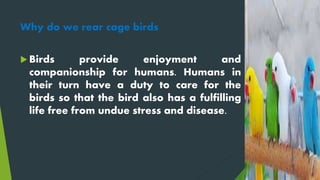
 Birds provide enjoyment and
companionship for humans. Humans in
their turn have a duty to care for the
birds so that the bird also has a fulfilling
life free from undue stress and disease.
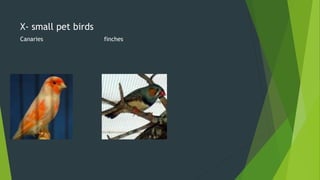
X- small pet birds
Canaries finches
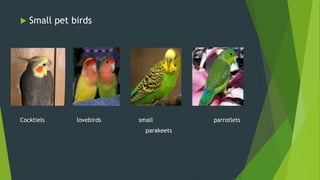
 Small pet birds
Cocktiels lovebirds small parrotlets
parakeets
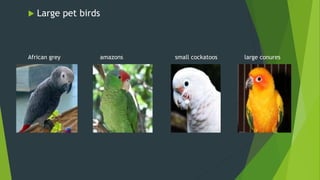
 Large pet birds
African grey amazons small cockatoos large conures
 X-large pet birds
Large cockatoos macaws
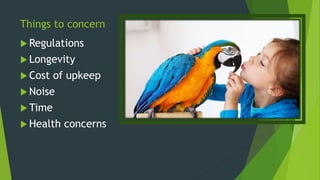
Things to concern
 Regulations
 Longevity
 Cost of upkeep
 Noise
 Time
 Health concerns
Morphology of cage
birds
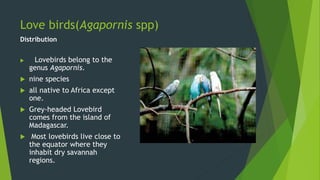
Love birds(Agapornis spp)
Distribution
 Lovebirds belong to the
genus Agapornis.
 nine species
 all native to Africa except
one.
 Grey-headed Lovebird
comes from the island of
Madagascar.
 Most lovebirds live close to
the equator where they
inhabit dry savannah
regions.
Description
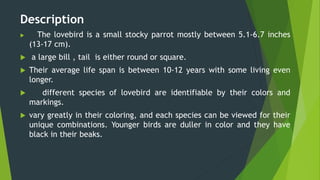
 The lovebird is a small stocky parrot mostly between 5.1-6.7 inches
(13-17 cm).
 a large bill , tail is either round or square.
 Their average life span is between 10-12 years with some living even
longer.
 different species of lovebird are identifiable by their colors and
markings.
 vary greatly in their coloring, and each species can be viewed for their
unique combinations. Younger birds are duller in color and they have
black in their beaks.
Description cont.
 The young birds coloring intensifies as they reach
maturity.
 Regardless of the species, mature lovebirds are gorgeous
parrots.
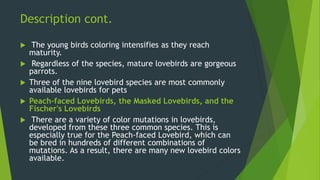
 Three of the nine lovebird species are most commonly
available lovebirds for pets
 Peach-faced Lovebirds, the Masked Lovebirds, and the
Fischer's Lovebirds
 There are a variety of color mutations in lovebirds,
developed from these three common species. This is
especially true for the Peach-faced Lovebird, which can
be bred in hundreds of different combinations of
mutations. As a result, there are many new lovebird colors
available.
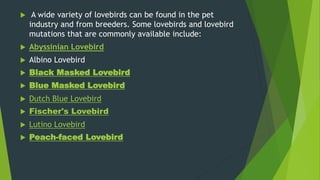
 A wide variety of lovebirds can be found in the pet
industry and from breeders. Some lovebirds and lovebird
mutations that are commonly available include:
 Abyssinian Lovebird
 Albino Lovebird
 Black Masked Lovebird
 Blue Masked Lovebird
 Dutch Blue Lovebird
 Fischer's Lovebird
 Lutino Lovebird
 Peach-faced Lovebird
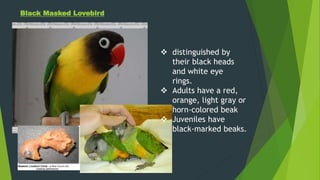
Black Masked Lovebird
 distinguished by
their black heads
and white eye
rings.
 Adults have a red,
orange, light gray or
horn-colored beak
 Juveniles have
black-marked beaks.
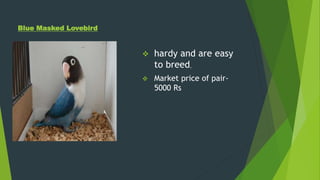
Blue Masked Lovebird
 hardy and are easy
to breed,
 Market price of pair-
5000 Rs
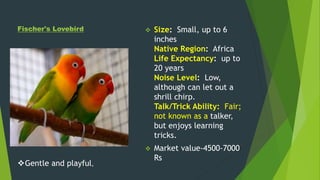
Fischer's Lovebird  Size: Small, up to 6
inches
Native Region: Africa
Life Expectancy: up to
20 years
Noise Level: Low,
although can let out a
shrill chirp.
Talk/Trick Ability: Fair;
not known as a talker,
but enjoys learning
tricks.
 Market value-4500-7000
Rs
Gentle and playful,
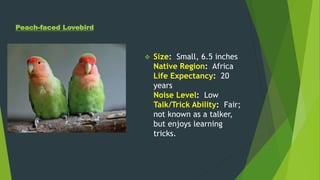
Peach-faced Lovebird
 Size: Small, 6.5 inches
Native Region: Africa
Life Expectancy: 20
years
Noise Level: Low
Talk/Trick Ability: Fair;
not known as a talker,
but enjoys learning
tricks.
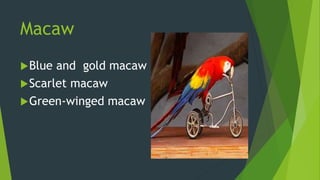
Blue and gold macaw
Scarlet macaw
Green-winged macaw
Macaw
Where does the Macaw come from
Originated from Mexico,Central and
South America
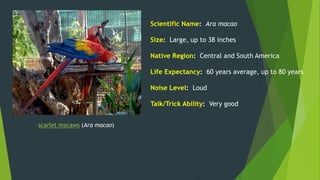
scarlet macaws (Ara macao)
Scientific Name: Ara macao
Size: Large, up to 38 inches
Native Region: Central and South America
Life Expectancy: 60 years average, up to 80 years
Noise Level: Loud
Talk/Trick Ability: Very good
 81 cm (32 in) long
 Average mass: 1200 g.
 sexual Dimorphism: sexes alike
 pointed, graduated tail
 has a larger percentage of tail than the other large
macaws
 average weight is about 1 kilogram (2.2 lb)
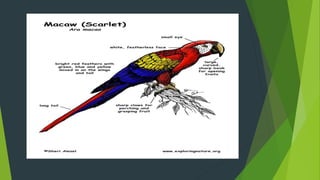
 The plumage is mostly scarlet, but the rump and tail-
covert feathers are light blue, the greater upper
wing coverts are yellow, the upper sides of the flight
feathers of the wings are dark blue as are the ends of the
tail feathers, and the undersides of the wing and
tail flight feathers are dark red with metallic gold
iridescence. Some individuals may have green in the
wings.
 bare white skin around the eye and from there to the
bill. Tiny white feathers are contained on the face patch.
The upper mandible is mostly pale horn in color and the
lower is black. Juveniles have dark eyes; adults have light
yellow eyes.
 frequently confused with the slightly larger green-winged
macaw, which has more distinct red lines in the face and
no yellow in the wing.
Scarlet Macaws Reproduction
Like most parrots, the female Scarlet
Macaw lays 2 to 4 white eggs in a tree
cavity. The young hatch after 24 to 25
days. They fledge about 105 days later
and leave their parents a year later.
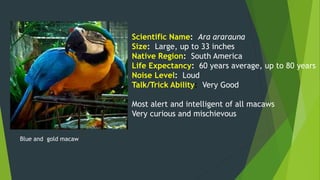
Blue and gold macaw
Scientific Name: Ara ararauna
Size: Large, up to 33 inches
Native Region: South America
Life Expectancy: 60 years average, up to 80 years
Noise Level: Loud
Talk/Trick Ability: Very Good
Most alert and intelligent of all macaws
Very curious and mischievous
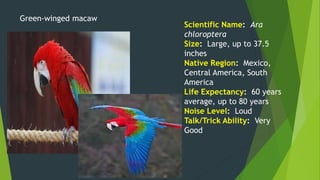
Scientific Name: Ara
chloroptera
Size: Large, up to 37.5
inches
Native Region: Mexico,
Central America, South
America
Life Expectancy: 60 years
average, up to 80 years
Noise Level: Loud
Talk/Trick Ability: Very
Good
Green-winged macaw
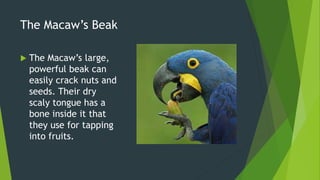
The Macaw’s Beak
 The Macaw’s large,
powerful beak can
easily crack nuts and
seeds. Their dry
scaly tongue has a
bone inside it that
they use for tapping
into fruits.
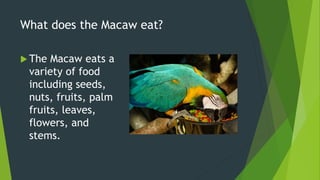
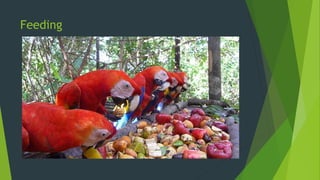
What does the Macaw eat?
 The Macaw eats a
variety of food
including seeds,
nuts, fruits, palm
fruits, leaves,
flowers, and
stems.
Feeding
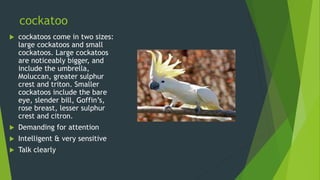
cockatoo
 cockatoos come in two sizes:
large cockatoos and small
cockatoos. Large cockatoos
are noticeably bigger, and
include the umbrella,
Moluccan, greater sulphur
crest and triton. Smaller
cockatoos include the bare
eye, slender bill, Goffin’s,
rose breast, lesser sulphur
crest and citron.
 Demanding for attention
 Intelligent & very sensitive
 Talk clearly
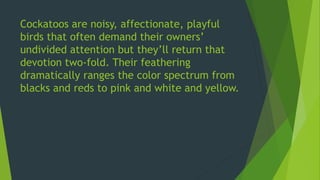
Cockatoos are noisy, affectionate, playful
birds that often demand their owners’
undivided attention but they’ll return that
devotion two-fold. Their feathering
dramatically ranges the color spectrum from
blacks and reds to pink and white and yellow.
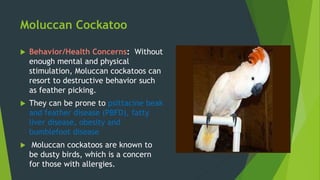
Moluccan Cockatoo
 Behavior/Health Concerns: Without
enough mental and physical
stimulation, Moluccan cockatoos can
resort to destructive behavior such
as feather picking.
 They can be prone to psittacine beak
and feather disease (PBFD), fatty
liver disease, obesity and
bumblefoot disease
 Moluccan cockatoos are known to
be dusty birds, which is a concern
for those with allergies.
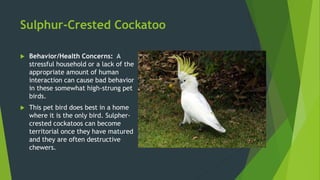
Sulphur-Crested Cockatoo
 Behavior/Health Concerns: A
stressful household or a lack of the
appropriate amount of human
interaction can cause bad behavior
in these somewhat high-strung pet
birds.
 This pet bird does best in a home
where it is the only bird. Sulpher-
crested cockatoos can become
territorial once they have matured
and they are often destructive
chewers.
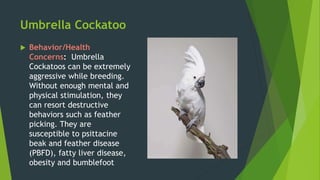
Umbrella Cockatoo
 Behavior/Health
Concerns: Umbrella
Cockatoos can be extremely
aggressive while breeding.
Without enough mental and
physical stimulation, they
can resort destructive
behaviors such as feather
picking. They are
susceptible to psittacine
beak and feather disease
(PBFD), fatty liver disease,
obesity and bumblefoot
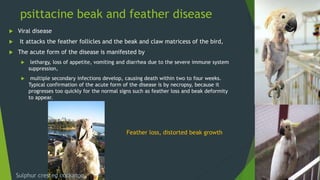
psittacine beak and feather disease
 Viral disease
 It attacks the feather follicles and the beak and claw matricess of the bird,
 The acute form of the disease is manifested by
 lethargy, loss of appetite, vomiting and diarrhea due to the severe immune system
suppression,
 multiple secondary infections develop, causing death within two to four weeks.
Typical confirmation of the acute form of the disease is by necropsy, because it
progresses too quickly for the normal signs such as feather loss and beak deformity
to appear.
Feather loss, distorted beak growth
Sulphur crested cockatoo
Budgerigar
 American
Parakeet
 English Type
Budgie
 Normal green
type Budgie
How to feed budgies
1. Seeds- Seeds should only
make up 1/6 of your
budgie's diet.
2. Buy pellets
3. Use fruits and vegetables
apples, pumpkin, grapes,
carrot, parsley, broccoli,
mango, sweet potato,
squash, and spinach.
fruits and vegetables that
you should never feed your
bird are avocado, the pits
and seeds of fruit,
chocolate, mushrooms,
uncooked beans, and the
leaves and stems of
tomatoes.
Cage birds

Cage birds

  • 1.
  • 2.
    Why do werear cage birds  Birds provide enjoyment and companionship for humans. Humans in their turn have a duty to care for the birds so that the bird also has a fulfilling life free from undue stress and disease.
  • 3.
    X- small petbirds Canaries finches
  • 4.
     Small petbirds Cocktiels lovebirds small parrotlets parakeets
  • 5.
     Large petbirds African grey amazons small cockatoos large conures
  • 6.
     X-large petbirds Large cockatoos macaws
  • 7.
    Things to concern Regulations  Longevity  Cost of upkeep  Noise  Time  Health concerns
  • 8.
  • 9.
    Love birds(Agapornis spp) Distribution Lovebirds belong to the genus Agapornis.  nine species  all native to Africa except one.  Grey-headed Lovebird comes from the island of Madagascar.  Most lovebirds live close to the equator where they inhabit dry savannah regions.
  • 10.
    Description  The lovebirdis a small stocky parrot mostly between 5.1-6.7 inches (13-17 cm).  a large bill , tail is either round or square.  Their average life span is between 10-12 years with some living even longer.  different species of lovebird are identifiable by their colors and markings.  vary greatly in their coloring, and each species can be viewed for their unique combinations. Younger birds are duller in color and they have black in their beaks.
  • 11.
    Description cont.  Theyoung birds coloring intensifies as they reach maturity.  Regardless of the species, mature lovebirds are gorgeous parrots.  Three of the nine lovebird species are most commonly available lovebirds for pets  Peach-faced Lovebirds, the Masked Lovebirds, and the Fischer's Lovebirds  There are a variety of color mutations in lovebirds, developed from these three common species. This is especially true for the Peach-faced Lovebird, which can be bred in hundreds of different combinations of mutations. As a result, there are many new lovebird colors available.
  • 12.
     A widevariety of lovebirds can be found in the pet industry and from breeders. Some lovebirds and lovebird mutations that are commonly available include:  Abyssinian Lovebird  Albino Lovebird  Black Masked Lovebird  Blue Masked Lovebird  Dutch Blue Lovebird  Fischer's Lovebird  Lutino Lovebird  Peach-faced Lovebird
  • 13.
    Black Masked Lovebird distinguished by their black heads and white eye rings.  Adults have a red, orange, light gray or horn-colored beak  Juveniles have black-marked beaks.
  • 16.
    Blue Masked Lovebird hardy and are easy to breed,  Market price of pair- 5000 Rs
  • 17.
    Fischer's Lovebird Size: Small, up to 6 inches Native Region: Africa Life Expectancy: up to 20 years Noise Level: Low, although can let out a shrill chirp. Talk/Trick Ability: Fair; not known as a talker, but enjoys learning tricks.  Market value-4500-7000 Rs Gentle and playful,
  • 18.
    Peach-faced Lovebird  Size:Small, 6.5 inches Native Region: Africa Life Expectancy: 20 years Noise Level: Low Talk/Trick Ability: Fair; not known as a talker, but enjoys learning tricks.
  • 20.
    Blue and goldmacaw Scarlet macaw Green-winged macaw Macaw
  • 21.
    Where does theMacaw come from Originated from Mexico,Central and South America
  • 22.
    scarlet macaws (Aramacao) Scientific Name: Ara macao Size: Large, up to 38 inches Native Region: Central and South America Life Expectancy: 60 years average, up to 80 years Noise Level: Loud Talk/Trick Ability: Very good
  • 24.
     81 cm(32 in) long  Average mass: 1200 g.  sexual Dimorphism: sexes alike  pointed, graduated tail  has a larger percentage of tail than the other large macaws  average weight is about 1 kilogram (2.2 lb)
  • 25.
     The plumageis mostly scarlet, but the rump and tail- covert feathers are light blue, the greater upper wing coverts are yellow, the upper sides of the flight feathers of the wings are dark blue as are the ends of the tail feathers, and the undersides of the wing and tail flight feathers are dark red with metallic gold iridescence. Some individuals may have green in the wings.  bare white skin around the eye and from there to the bill. Tiny white feathers are contained on the face patch. The upper mandible is mostly pale horn in color and the lower is black. Juveniles have dark eyes; adults have light yellow eyes.  frequently confused with the slightly larger green-winged macaw, which has more distinct red lines in the face and no yellow in the wing.
  • 26.
    Scarlet Macaws Reproduction Likemost parrots, the female Scarlet Macaw lays 2 to 4 white eggs in a tree cavity. The young hatch after 24 to 25 days. They fledge about 105 days later and leave their parents a year later.
  • 28.
    Blue and goldmacaw Scientific Name: Ara ararauna Size: Large, up to 33 inches Native Region: South America Life Expectancy: 60 years average, up to 80 years Noise Level: Loud Talk/Trick Ability: Very Good Most alert and intelligent of all macaws Very curious and mischievous
  • 29.
    Scientific Name: Ara chloroptera Size:Large, up to 37.5 inches Native Region: Mexico, Central America, South America Life Expectancy: 60 years average, up to 80 years Noise Level: Loud Talk/Trick Ability: Very Good Green-winged macaw
  • 30.
    The Macaw’s Beak The Macaw’s large, powerful beak can easily crack nuts and seeds. Their dry scaly tongue has a bone inside it that they use for tapping into fruits.
  • 31.
    What does theMacaw eat?  The Macaw eats a variety of food including seeds, nuts, fruits, palm fruits, leaves, flowers, and stems.
  • 32.
  • 33.
    cockatoo  cockatoos comein two sizes: large cockatoos and small cockatoos. Large cockatoos are noticeably bigger, and include the umbrella, Moluccan, greater sulphur crest and triton. Smaller cockatoos include the bare eye, slender bill, Goffin’s, rose breast, lesser sulphur crest and citron.  Demanding for attention  Intelligent & very sensitive  Talk clearly
  • 34.
    Cockatoos are noisy,affectionate, playful birds that often demand their owners’ undivided attention but they’ll return that devotion two-fold. Their feathering dramatically ranges the color spectrum from blacks and reds to pink and white and yellow.
  • 35.
    Moluccan Cockatoo  Behavior/HealthConcerns: Without enough mental and physical stimulation, Moluccan cockatoos can resort to destructive behavior such as feather picking.  They can be prone to psittacine beak and feather disease (PBFD), fatty liver disease, obesity and bumblefoot disease  Moluccan cockatoos are known to be dusty birds, which is a concern for those with allergies.
  • 36.
    Sulphur-Crested Cockatoo  Behavior/HealthConcerns: A stressful household or a lack of the appropriate amount of human interaction can cause bad behavior in these somewhat high-strung pet birds.  This pet bird does best in a home where it is the only bird. Sulpher- crested cockatoos can become territorial once they have matured and they are often destructive chewers.
  • 37.
    Umbrella Cockatoo  Behavior/Health Concerns:Umbrella Cockatoos can be extremely aggressive while breeding. Without enough mental and physical stimulation, they can resort destructive behaviors such as feather picking. They are susceptible to psittacine beak and feather disease (PBFD), fatty liver disease, obesity and bumblefoot
  • 38.
    psittacine beak andfeather disease  Viral disease  It attacks the feather follicles and the beak and claw matricess of the bird,  The acute form of the disease is manifested by  lethargy, loss of appetite, vomiting and diarrhea due to the severe immune system suppression,  multiple secondary infections develop, causing death within two to four weeks. Typical confirmation of the acute form of the disease is by necropsy, because it progresses too quickly for the normal signs such as feather loss and beak deformity to appear. Feather loss, distorted beak growth Sulphur crested cockatoo
  • 39.
    Budgerigar  American Parakeet  EnglishType Budgie  Normal green type Budgie
  • 40.
    How to feedbudgies 1. Seeds- Seeds should only make up 1/6 of your budgie's diet. 2. Buy pellets 3. Use fruits and vegetables apples, pumpkin, grapes, carrot, parsley, broccoli, mango, sweet potato, squash, and spinach. fruits and vegetables that you should never feed your bird are avocado, the pits and seeds of fruit, chocolate, mushrooms, uncooked beans, and the leaves and stems of tomatoes.