Utility of ‘real world evidence’ in creating and capturing
measurable value; a provider’s practical perspective.
April 14, 2015
CADTH National Conference
Session E6: Panel Discussion
The evolving role of real-world assessment to support policy
and practice
Peter Fenwick, CHE, MBA, BSME
Senior Provincial Director, Major Initiatives
Research, Innovation and Analytics Portfolio AHS
2
Q: Why live in reality when fiction is so much more appealing?
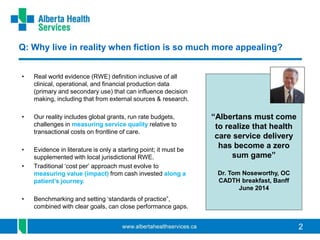
“Albertans must come
to realize that health
care service delivery
has become a zero
sum game”
Dr. Tom Noseworthy, OC
CADTH breakfast, Banff
June 2014
• Real world evidence (RWE) definition inclusive of all
clinical, operational, and financial production data
(primary and secondary use) that can influence decision
making, including that from external sources & research.
• Our reality includes global grants, run rate budgets,
challenges in measuring service quality relative to
transactional costs on frontline of care.
• Evidence in literature is only a starting point; it must be
supplemented with local jurisdictional RWE.
• Traditional ‘cost per’ approach must evolve to
measuring value (impact) from cash invested along a
patient’s journey.
• Benchmarking and setting ‘standards of practice”,
combined with clear goals, can close performance gaps.
3
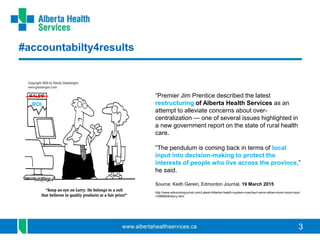
“Premier Jim Prentice described the latest
restructuring of Alberta Health Services as an
attempt to alleviate concerns about over-
centralization — one of several issues highlighted in
a new government report on the state of rural health
care.
“The pendulum is coming back in terms of local
input into decision-making to protect the
interests of people who live across the province,”
he said.
Source: Keith Gerein, Edmonton Journal, 19 March 2015
http://www.edmontonjournal.com/Latest+Alberta+health+system+overhaul+aims+allow+more+local+input
/10899836/story.html
#accountabilty4results
ROI
4
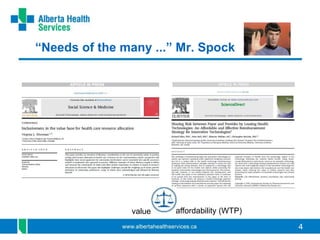
“Needs of the many ...” Mr. Spock
value affordability (WTP)
5
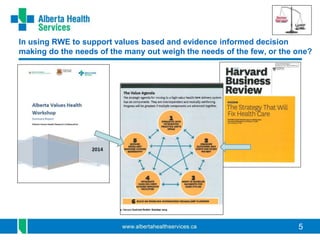
In using RWE to support values based and evidence informed decision
making do the needs of the many out weigh the needs of the few, or the one?
6
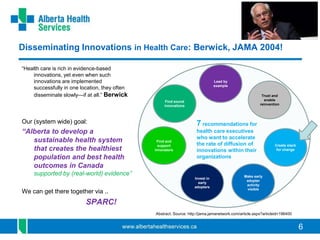
Disseminating Innovations in Health Care: Berwick, JAMA 2004!
“Health care is rich in evidence-based
innovations, yet even when such
innovations are implemented
successfully in one location, they often
disseminate slowly—if at all.” Berwick
Our (system wide) goal:
“Alberta to develop a
sustainable health system
that creates the healthiest
population and best health
outcomes in Canada
supported by (real-world) evidence”
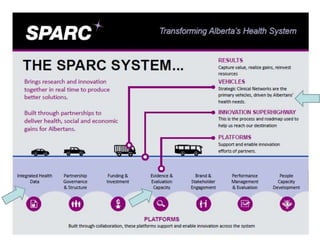
We can get there together via ..
SPARC!
Find sound
innovations
Find and
support
innovators
Invest in
early
adopters
Make early
adopter
activity
visible
Trust and
enable
reinvention
Create slack
for change
Lead by
example
7 recommendations for
health care executives
who want to accelerate
the rate of diffusion of
innovations within their
organizations
Abstract. Source: http://jama.jamanetwork.com/article.aspx?articleid=196400
7
It’s time to view health care as an economic asset. Dr. Cy Frank. 28 December 2012.
http://www.theglobeandmail.com/report-on-business/economy/economy-lab/its-time-to-view-health-care-as-an-
economic-asset/article6764431/
8
A means forward to system performance improvement
via health research and innovation collaboration
9
Case A: Collaborating with a clinical (provincial) community of
practice; a means to leverage RWE and optimize impact
• Strategic Clinical Network driven,
adopting evidence from abroad.
• Clear “measure of better”
• Literature guided initial projections.
• First two pilots yielded local RWE to
allow for a re-forecasting of cost -
benefit; process evolving.
• RWE proved conditional (notional)
break even/ payback in 22 months.
• Speed of innovation diffusion can be
at odds with research agendas.
• Risk free gains, verses practical value
creation. [Re-investment algorithm]
Source: published and approved ‘14-15
Operational Plan AHS Major Initiatives
10
Case B: Creating a value case for the triple aim approach using
RWE; better service for those complex high needs of the system.
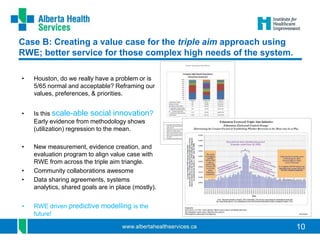
• Houston, do we really have a problem or is
5/65 normal and acceptable? Reframing our
values, preferences, & priorities.
• Is this scale-able social innovation?
Early evidence from methodology shows
(utilization) regression to the mean.
• New measurement, evidence creation, and
evaluation program to align value case with
RWE from across the triple aim triangle.
• Community collaborations awesome
• Data sharing agreements, systems
analytics, shared goals are in place (mostly).
• RWE driven predictive modelling is the
future!
11
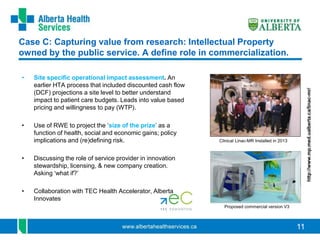
Case C: Capturing value from research: Intellectual Property
owned by the public service. A define role in commercialization.
• Site specific operational impact assessment. An
earlier HTA process that included discounted cash flow
(DCF) projections a site level to better understand
impact to patient care budgets. Leads into value based
pricing and willingness to pay (WTP).
• Use of RWE to project the ‘size of the prize’ as a
function of health, social and economic gains; policy
implications and (re)defining risk.
• Discussing the role of service provider in innovation
stewardship, licensing, & new company creation.
Asking ‘what if?’
• Collaboration with TEC Health Accelerator, Alberta
Innovates
Clinical Linac-MR Installed in 2013
Proposed commercial version V3
http://www.mp.med.ualberta.ca/linac-mr/

Cadth 2015 e6 2 fenwick

  • 1.
    Utility of ‘realworld evidence’ in creating and capturing measurable value; a provider’s practical perspective. April 14, 2015 CADTH National Conference Session E6: Panel Discussion The evolving role of real-world assessment to support policy and practice Peter Fenwick, CHE, MBA, BSME Senior Provincial Director, Major Initiatives Research, Innovation and Analytics Portfolio AHS
  • 2.
    2 Q: Why livein reality when fiction is so much more appealing? “Albertans must come to realize that health care service delivery has become a zero sum game” Dr. Tom Noseworthy, OC CADTH breakfast, Banff June 2014 • Real world evidence (RWE) definition inclusive of all clinical, operational, and financial production data (primary and secondary use) that can influence decision making, including that from external sources & research. • Our reality includes global grants, run rate budgets, challenges in measuring service quality relative to transactional costs on frontline of care. • Evidence in literature is only a starting point; it must be supplemented with local jurisdictional RWE. • Traditional ‘cost per’ approach must evolve to measuring value (impact) from cash invested along a patient’s journey. • Benchmarking and setting ‘standards of practice”, combined with clear goals, can close performance gaps.
  • 3.
    3 “Premier Jim Prenticedescribed the latest restructuring of Alberta Health Services as an attempt to alleviate concerns about over- centralization — one of several issues highlighted in a new government report on the state of rural health care. “The pendulum is coming back in terms of local input into decision-making to protect the interests of people who live across the province,” he said. Source: Keith Gerein, Edmonton Journal, 19 March 2015 http://www.edmontonjournal.com/Latest+Alberta+health+system+overhaul+aims+allow+more+local+input /10899836/story.html #accountabilty4results ROI
  • 4.
    4 “Needs of themany ...” Mr. Spock value affordability (WTP)
  • 5.
    5 In using RWEto support values based and evidence informed decision making do the needs of the many out weigh the needs of the few, or the one?
  • 6.
    6 Disseminating Innovations inHealth Care: Berwick, JAMA 2004! “Health care is rich in evidence-based innovations, yet even when such innovations are implemented successfully in one location, they often disseminate slowly—if at all.” Berwick Our (system wide) goal: “Alberta to develop a sustainable health system that creates the healthiest population and best health outcomes in Canada supported by (real-world) evidence” We can get there together via .. SPARC! Find sound innovations Find and support innovators Invest in early adopters Make early adopter activity visible Trust and enable reinvention Create slack for change Lead by example 7 recommendations for health care executives who want to accelerate the rate of diffusion of innovations within their organizations Abstract. Source: http://jama.jamanetwork.com/article.aspx?articleid=196400
  • 7.
    7 It’s time toview health care as an economic asset. Dr. Cy Frank. 28 December 2012. http://www.theglobeandmail.com/report-on-business/economy/economy-lab/its-time-to-view-health-care-as-an- economic-asset/article6764431/
  • 8.
    8 A means forwardto system performance improvement via health research and innovation collaboration
  • 9.
    9 Case A: Collaboratingwith a clinical (provincial) community of practice; a means to leverage RWE and optimize impact • Strategic Clinical Network driven, adopting evidence from abroad. • Clear “measure of better” • Literature guided initial projections. • First two pilots yielded local RWE to allow for a re-forecasting of cost - benefit; process evolving. • RWE proved conditional (notional) break even/ payback in 22 months. • Speed of innovation diffusion can be at odds with research agendas. • Risk free gains, verses practical value creation. [Re-investment algorithm] Source: published and approved ‘14-15 Operational Plan AHS Major Initiatives
  • 10.
    10 Case B: Creatinga value case for the triple aim approach using RWE; better service for those complex high needs of the system. • Houston, do we really have a problem or is 5/65 normal and acceptable? Reframing our values, preferences, & priorities. • Is this scale-able social innovation? Early evidence from methodology shows (utilization) regression to the mean. • New measurement, evidence creation, and evaluation program to align value case with RWE from across the triple aim triangle. • Community collaborations awesome • Data sharing agreements, systems analytics, shared goals are in place (mostly). • RWE driven predictive modelling is the future!
  • 11.
    11 Case C: Capturingvalue from research: Intellectual Property owned by the public service. A define role in commercialization. • Site specific operational impact assessment. An earlier HTA process that included discounted cash flow (DCF) projections a site level to better understand impact to patient care budgets. Leads into value based pricing and willingness to pay (WTP). • Use of RWE to project the ‘size of the prize’ as a function of health, social and economic gains; policy implications and (re)defining risk. • Discussing the role of service provider in innovation stewardship, licensing, & new company creation. Asking ‘what if?’ • Collaboration with TEC Health Accelerator, Alberta Innovates Clinical Linac-MR Installed in 2013 Proposed commercial version V3 http://www.mp.med.ualberta.ca/linac-mr/

Editor's Notes

  • #2 Panel Session Proposal – 90 minute panel (10 min moderator followed by 3x15 min presentations) then 35 min discussion   Title: The evolving role of real-world assessment to support policy and practice   Abstract: Routinely collected data within health systems is increasingly being viewed as a means to increase payer certainty by conducting assessments of performance in the “real world”. There are considerable issues that arise when considering how to best use real-world evidence: these include the need for a clear framework of priority setting; shifting attitudes about the roles of health care research and delivery; aligning these activities with patient preferences and political priorities; and overcoming technical challenges related to information technology as well as applying appropriate epidemiologic methods. The last 10 years in Canada has seen a shift toward the use of real world evidence in some areas. As this use of real-world evidence becomes routine, it will have a real impact on payers and the HTA bodies that support them, as well as providers, patients and industry. This panel will discuss current and future trends and how health care, industry, and academic leaders along with HTA bodies might best prepare for it.     Moderator: Neil Corner, IMS Brogan, Director, Innovative Solutions IMS Brogan Canada   Panelists:   (1) Don Husereau Senior Associate, Institute of Health Economics,   (2) Julia Brown Vice President Access at Janssen Inc.   (3) Peter Fenwick Senior Provincial Director, Major Initiatives Research, Innovation, & Analytics Portfolio  
  • #3 Collaboration is needed. Standards that are clinical, operational Global grants, run rate budgets, transparency challenges of actual service quality & cost. We need to pivot the traditional health economic approach to measuring value along the patient journey. Price of oil being a forcing function of priority setting and sharing resources Need for collaboration or, ‘this too shall pass’? Benchmarking. What is the ‘standard of practice”; according to whom? “Bending the curve” of health service demand and related spending. Gain sharing, plowback ratios, and creating an ability to re-invest into better performance
  • #4 This slide and next slide notes .. Speak to local decision making; Mooney and Mr. Spock; willingness of community leaders and patient / family advisers to play a role in advancing system performance thru a value lens. Touch on operational benchmarking and CEO goals for identifying positive deviants and moving performance needle towards them .. “It’s of real concern to rural Albertans, small towns and remote parts of the province who have felt disenfranchised by the way the system has been operating, and to me it’s extremely important to change that.”
  • #6 This slide and previous slide notes .. Speak to local decision making; Mooney and Mr. Spock; willingness of community leaders and patient / family advisers to play a role in advancing system performance thru a value lens. Touch on operational benchmarking and CEO goals for identifying positive deviants and moving performance needle towards them ..
  • #7 Health care is rich in evidence-based innovations, yet even when such innovations are implemented successfully in one location, they often disseminate slowly—if at all. Diffusion of innovations is a major challenge in all industries including health care. This article examines the theory and research on the dissemination of innovations and suggests applications of that theory to health care. It explores in detail 3 clusters of influence on the rate of diffusion of innovations within an organization: the perceptions of the innovation, the characteristics of the individuals who may adopt the change, and contextual and managerial factors within the organization. This theory makes plausible at least 7 recommendations for health care executives who want to accelerate the rate of diffusion of innovations within their organizations: find sound innovations, find and support "innovators," invest in "early adopters," make early adopter activity observable, trust and enable reinvention, create slack for change, and lead by example.
  • #9 A means forward to system performance improvement via health research and innovation collaboration Scaling and spreading innovation is NOT about more randomized control trials, in a traditioanl sense. It could be about design of experiments; done through a quality improvement lense. It is about rigorous upfront planning and forecasting, based on the realities of (sub)system level complexities, that allow for more rapid adoption of technologies.
  • #11 Strategy as is was launched, wasn't compelling enough to shift behaviour beyond acute care into community. Houston, do we really have a problem? (acceptable service quality, to whom?) 2% primary care attachment gap. Is this social innovation scale-able when (early) evidence shows regression to the mean? Reframing ‘value’. Community collaborations (EDN Eastwood: 26 organizations, 4623 people, AHS alone spends $168M) Importance of clear belief statements. New measurement, evidence creation, and evaluation program to align value case with RWE from across the triple aim triangle. Data sharing agreements, systems analytics, shared goals are in place (mostly). Predictive modelling is the future!
  • #12 Replicating another high performing systems .. Proxies Cleveland Clinic and Partners Health. Speak to try first, buy first .. Supporting an entrepreneurial environment inside the health service ... Elements of business rigor, discipline, upfront planning, committing to executing a plan, value for money. Forecasting, use of DCF and NPV to compliment HTA (benefits realization in how quality and innovation initiatives are tested and scaled)