Introduction of
Luxury Buses in
      India
          Group 5
   Atman, Siddharth, Milin,
       Mona, Prasan
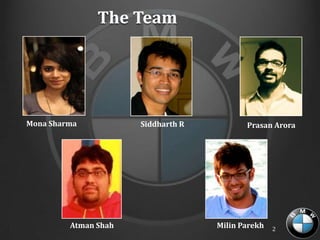
The Team


Mona Sharma           Siddharth R          Prasan Arora


         Atman Shah                 Milin Parekh   2
BMW Background
   BMW stands for Bavarian Motor Works is a German
   automobile, motorcycle and engine manufacturing company

   Founded in 1917 and headquartered in Munich, Bavaria,
   Germany

   Initially, BMW started off manufacturing aircraft engines and
   subsequently after WWI moved onto automobiles

   Accolades
      In June 2012, BMW was ranked the #1 most reputable
      company in the world by Forbes
      The BMW Group is ranked #61 in the list of Forbes Fortune
      100 Companies (2012)


Sources: http://www.forbes.com, http://www.bmw.com          3
BMW’s Portfolio


Source: http://www.bmw.com             4
Strategy & Product Positioning
STRATEGY

  BMW should diversify its portfolio by opting for a line
  extension

  Create a new brand in the luxury bus market to take
  advantage of a growing market

  Leverage its iconic brand identity

  ZERO Cannibilization – New Product

  Strong promotion should ensure an improved brand image


                                                            5
Strategy & Product Positioning
POSITIONING

  Market: Initially focus on India, and later expand to Asia
  (China, Vietnam, Malaysia, Indonesia)

  Product Competitors: Volvo, Mercedes Benz, Tata

  Service Competitors: Indian Railways

  Pricing: On par with the likes of Volvo and Mercedes Benz

  Customer Interface: Bus operators, Government Corporations

  End Consumer: Urban population having medium levels of
  disposable income

  Network: Urban area connectivity
                                                               6
India’s Transport System
  Air, Rail & Road

  With respect to the average middle class Indian
      Airways – Time saving but extremely
      expensive
      Railways – Cheap, but erratic and extremely
      crowded
      Roadways – Reasonably priced but lack of
      options

  The Golden Quadrilateral and the NSEW
  Corridor and the emergence of the luxury bus
  market has changed the landscape

  India has the 2nd largest road network in the
  world (4,320,000kms)

  India planned to spend approximately US$500
  Billion according to the 11th Five Year Plan to
  modernize its highway network


Source: http://www.nhai.org, http://web.worldbank.org, KPMG Report 2011   7
Luxury Bus Market in India
       Currently 41% Indians use buses as their primary mode of
       transport (NHAI Report 2010)

       The bus penetration is amongst the lowest in India at 0.75 bus for
       every 1000 people (NHAI Report 2010)

       India - 2nd largest luxury bus market, after China selling over
       46,000 buses in 2011

       The luxury bus segment, is expected to grow by 20 per cent, year-
       on-year

       With increasing urbanization, the demand for luxury buses is
       growing at a rapid rate

       Hartmut Schick (Global Head, Daimler Buses) expects it to reach
       80,000 units by 2020

Source: http://www.hindustantimes.com/News-Feed/Auto/Indian-bus-market-will-
                                                                             8
almost-double-by-2020-Daimler
BMW’s footprint in India
        #1 brand in the premier car segment in India

        Market share rose up from 9% in 2006 to 42% in 2011

        3 Series, X1 and 5 Series are CKDs while the rest are CBUs

        Assembly plant in Chennai

        Will start sourcing components from Indian vendors by 2013

        Confidence in Quality – BMW Service Inclusive (BSI)

        Extensive dealer network

        Promotions: Golf tournaments, wine tasting events and
        fashion shows


Source: http://www.team-bhp.com/forum/commercial-vehicles-india/117459-detailed-
                                                                              9
look-tatas-divo-starbus-ultra-buses
BMW’s Competitors in India
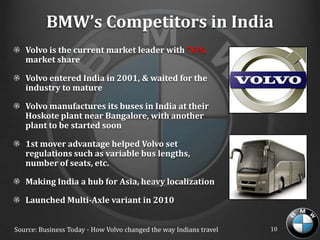
   Volvo is the current market leader with 76%
   market share

   Volvo entered India in 2001, & waited for the
   industry to mature

   Volvo manufactures its buses in India at their
   Hoskote plant near Bangalore, with another
   plant to be started soon

   1st mover advantage helped Volvo set
   regulations such as variable bus lengths,
   number of seats, etc.

   Making India a hub for Asia, heavy localization

   Launched Multi-Axle variant in 2010


Source: Business Today - How Volvo changed the way Indians travel   10
BMW’s Competitors in India
   Claim to fame: Invented the bus

   Mercedes-Benz has 13 per cent market
   share globally in the luxury bus market

   Manufacturers buses in India through a
   local JV partner in Sutlej Motors

   Priced at (Multi Axle) – Rs. 9 Million (Ex
   New Delhi)


Source: http://www.business-standard.com/india/news/mercedes-plans-to-enter-city-
                                                                              11
bus-market-in-india/397023/
BMW’s Competitors in India
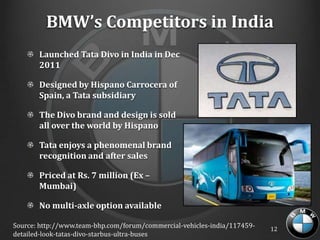
       Launched Tata Divo in India in Dec
       2011

       Designed by Hispano Carrocera of
       Spain, a Tata subsidiary

       The Divo brand and design is sold
       all over the world by Hispano

       Tata enjoys a phenomenal brand
       recognition and after sales

       Priced at Rs. 7 million (Ex –
       Mumbai)

       No multi-axle option available

Source: http://www.team-bhp.com/forum/commercial-vehicles-india/117459-   12
detailed-look-tatas-divo-starbus-ultra-buses
References
http://www.forbes.com

http://www.bmw.com

http://www.hindustantimes.com/News-Feed/Auto/Indian-bus-
market-will-almost-double-by-2015-Daimler

http://www.business-standard.com/india/news/mercedes-plans-
to-enter-city-bus-market-in-india/397023/

http://www.nhai.org

http://web.worldbank.org

http://www.business-standard.com/india/news/mercedes-plans-
to-enter-city-bus-market-in-india/397023/


                                                      13
WHY BMW ?
       Despite volatile business conditions, the BMW Group
       experienced the best year in 2011 selling 1.67 million vehicles
       in 2011
       BMW Group is world’s leading premium manufacturer in terms
       of sales volume
       Manufacture extremely fuel efficient and powerful diesel
       engines

   WHY LUXURY BUSES ?
       Rising population in countries like India, China
       Rising oil prices
       Inefficient government ticketing systems
       Improving road conditions
       Increasing tourism

Sources: BMW Annual Report 2011 , Group5_Gutfeel                  14

BMW's Portfolio Diversification

  • 1.
    Introduction of Luxury Busesin India Group 5 Atman, Siddharth, Milin, Mona, Prasan
  • 2.
    The Team Mona Sharma Siddharth R Prasan Arora Atman Shah Milin Parekh 2
  • 3.
    BMW Background BMW stands for Bavarian Motor Works is a German automobile, motorcycle and engine manufacturing company Founded in 1917 and headquartered in Munich, Bavaria, Germany Initially, BMW started off manufacturing aircraft engines and subsequently after WWI moved onto automobiles Accolades In June 2012, BMW was ranked the #1 most reputable company in the world by Forbes The BMW Group is ranked #61 in the list of Forbes Fortune 100 Companies (2012) Sources: http://www.forbes.com, http://www.bmw.com 3
  • 4.
  • 5.
    Strategy & ProductPositioning STRATEGY BMW should diversify its portfolio by opting for a line extension Create a new brand in the luxury bus market to take advantage of a growing market Leverage its iconic brand identity ZERO Cannibilization – New Product Strong promotion should ensure an improved brand image 5
  • 6.
    Strategy & ProductPositioning POSITIONING Market: Initially focus on India, and later expand to Asia (China, Vietnam, Malaysia, Indonesia) Product Competitors: Volvo, Mercedes Benz, Tata Service Competitors: Indian Railways Pricing: On par with the likes of Volvo and Mercedes Benz Customer Interface: Bus operators, Government Corporations End Consumer: Urban population having medium levels of disposable income Network: Urban area connectivity 6
  • 7.
    India’s Transport System Air, Rail & Road With respect to the average middle class Indian Airways – Time saving but extremely expensive Railways – Cheap, but erratic and extremely crowded Roadways – Reasonably priced but lack of options The Golden Quadrilateral and the NSEW Corridor and the emergence of the luxury bus market has changed the landscape India has the 2nd largest road network in the world (4,320,000kms) India planned to spend approximately US$500 Billion according to the 11th Five Year Plan to modernize its highway network Source: http://www.nhai.org, http://web.worldbank.org, KPMG Report 2011 7
  • 8.
    Luxury Bus Marketin India Currently 41% Indians use buses as their primary mode of transport (NHAI Report 2010) The bus penetration is amongst the lowest in India at 0.75 bus for every 1000 people (NHAI Report 2010) India - 2nd largest luxury bus market, after China selling over 46,000 buses in 2011 The luxury bus segment, is expected to grow by 20 per cent, year- on-year With increasing urbanization, the demand for luxury buses is growing at a rapid rate Hartmut Schick (Global Head, Daimler Buses) expects it to reach 80,000 units by 2020 Source: http://www.hindustantimes.com/News-Feed/Auto/Indian-bus-market-will- 8 almost-double-by-2020-Daimler
  • 9.
    BMW’s footprint inIndia #1 brand in the premier car segment in India Market share rose up from 9% in 2006 to 42% in 2011 3 Series, X1 and 5 Series are CKDs while the rest are CBUs Assembly plant in Chennai Will start sourcing components from Indian vendors by 2013 Confidence in Quality – BMW Service Inclusive (BSI) Extensive dealer network Promotions: Golf tournaments, wine tasting events and fashion shows Source: http://www.team-bhp.com/forum/commercial-vehicles-india/117459-detailed- 9 look-tatas-divo-starbus-ultra-buses
  • 10.
    BMW’s Competitors inIndia Volvo is the current market leader with 76% market share Volvo entered India in 2001, & waited for the industry to mature Volvo manufactures its buses in India at their Hoskote plant near Bangalore, with another plant to be started soon 1st mover advantage helped Volvo set regulations such as variable bus lengths, number of seats, etc. Making India a hub for Asia, heavy localization Launched Multi-Axle variant in 2010 Source: Business Today - How Volvo changed the way Indians travel 10
  • 11.
    BMW’s Competitors inIndia Claim to fame: Invented the bus Mercedes-Benz has 13 per cent market share globally in the luxury bus market Manufacturers buses in India through a local JV partner in Sutlej Motors Priced at (Multi Axle) – Rs. 9 Million (Ex New Delhi) Source: http://www.business-standard.com/india/news/mercedes-plans-to-enter-city- 11 bus-market-in-india/397023/
  • 12.
    BMW’s Competitors inIndia Launched Tata Divo in India in Dec 2011 Designed by Hispano Carrocera of Spain, a Tata subsidiary The Divo brand and design is sold all over the world by Hispano Tata enjoys a phenomenal brand recognition and after sales Priced at Rs. 7 million (Ex – Mumbai) No multi-axle option available Source: http://www.team-bhp.com/forum/commercial-vehicles-india/117459- 12 detailed-look-tatas-divo-starbus-ultra-buses
  • 13.
  • 14.
    WHY BMW ? Despite volatile business conditions, the BMW Group experienced the best year in 2011 selling 1.67 million vehicles in 2011 BMW Group is world’s leading premium manufacturer in terms of sales volume Manufacture extremely fuel efficient and powerful diesel engines WHY LUXURY BUSES ? Rising population in countries like India, China Rising oil prices Inefficient government ticketing systems Improving road conditions Increasing tourism Sources: BMW Annual Report 2011 , Group5_Gutfeel 14