PROSTATE CANCER
Dr Winston Makanga, M.B.Ch.B, M.MEd (Surg)
Consultant General and Laparoscopic Surgeon
Objectives of the lecture
• Surgical anatomy
• Physiology and functions
• Epidemiology
• Etiology
• Work-up (screening, diagnosis, staging)
• Treatment
Surgical anatomy 1
Surgical anatomy 2
Physiology and function
• Testosterone is trophic to the prostate
• DHT is the active form after conversion by 5 alpha
reductase
• LH production by pituitary responds to pulsatile release of
GnRH
• Function = production of seminal fluid, hormone
production and sphincteric function
Epidemiology
Etiology
• High body mass index
• Physical activity
• Smoking
• African-American race
• Positive family history
Pathology
• Microscopic: adenocarcinoma
• Types
• Latent disease found on autopsy
• Incidental disease on TURP/open prostatectomy
• Localized cancer
• Locally advanced
• Metastatic disease
• Spread
• Local to seminal vesicles, trigone, membranous urethra, ureters
• Metastatic: by blood to lumbar vertebrae/pelvis/ribs
• Lymphatic: internal and external iliac nodes, para-aortic, mediastinal
Presentation
• Mostly asymptomatic (screening or opportunistic PSA testing)
• LUTS
• BOO, pain, hematuria, renal failure
• Symptoms due to metastatic disease
• DRE: nodule, hard, irregular, fixed rectal mucosa, sulcus obliteration
Investigation
• General blood tests
• CBC, UEC, LFTs
• PSA
• Trucut biopsy
• Radiology
• CXR, Lumbar and pelvic XR
• Ultrasound - TRUS
• MRI
• Bone scan
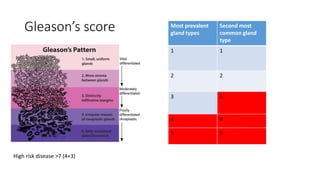
Gleason’s score Most prevalent
gland types
Second most
common gland
type
1 1
2 2
3 3
4 4
5 5
High risk disease >7 (4+3)
Staging
• Clinical vs Pathological staging; Based on TNM
• Nodes: N1 – N2 – N3 (<2-5> cm)
• Met: M0 and M1 (abc)
Treatment options
• Active surveillance
• Radical prostatectomy
• Androgen suppression therapy
• Chemotherapy
• Radiotherapy
• Palliation
Active surveillance
• For low risk disease
• Low PSA
• Small focus
• <Gleason 6 on histology
• Involves:
• 3 monthly DRE and PSA
• Repeat trucut if/when needed
• Avoid use of Alpha reductase inhibitors to treat LUTS
• ~ 30% will require radical treatment in ~3-5 years
Surgery
• Ideally for T1, T2 and ?T3a
• Radical prostatectomy offers potential cure
• Open (perineal/retropubic) vs laparoscopic vs robotic
• Highly dependent on case load, life expectancy, performance status and lifestyle
• Likely complications:
• Erectile dysfunction
• Incontinence
• Hemorrhage
Radiotherapy
• External beam or internal – brachytherapy (T1,T2)
• Can be offered for localized disease
• OS similar to radical prostatectomy
• Complications
• Radiation Cystitis &/or proctitis
• urinary frequency, urgency
• urge incontinence
• Diarrhea
Androgen deprivation therapy ADT
• Used in advanced disease or poor performance status
• As adjuvant therapy in locally advanced disease
• Lessens risk of metastatic advancement
• Controls local and general symptoms
• Combine GnRH agonist with androgen receptor blockers ARB at initiation
• Prevents flare up of mets at initiation of therapy
• Combined androgen blockade for locally advanced disease = long term
GnRH agonist + ARB*
• Abiraterone may be an option in castrate resistance
* Time to CRPC is ~ 5-15 years in CAB
Chemotherapy
• In castrate resistant ca prostate
• Main option = taxanes (docetaxel)
• Early introduction may have better outcome
• Response is generally poor
Palliation
• Radiotherapy for focal mets (pain and risk of fracture)
• Orchidectomy for imminent risk of cord compression in poor status
• Channel TURP for BOO
• Manage castration induced osteoporosis with Vit D, calcium and
bisphosphonates (Alendronate….)
Overview of treatment
Age Low risk Intermediate High risk Metastatic
>70 Watchful waiting Palliate BOO
Androgen suppression
Palliate BOO
Androgen suppression
Palliate BOO
Androgen suppression
Focal radiotherapy
<70 Active surveillance Radical prostatectomy
Radiotherapy
Androgen suppression
Radical prostatectomy
Radiotherapy
Androgen suppression
Chemotherapy
Focal radiotherapy
Palliate BOO
Thank you

Ca Prostate MB6.pptx

  • 1.
    PROSTATE CANCER Dr WinstonMakanga, M.B.Ch.B, M.MEd (Surg) Consultant General and Laparoscopic Surgeon
  • 2.
    Objectives of thelecture • Surgical anatomy • Physiology and functions • Epidemiology • Etiology • Work-up (screening, diagnosis, staging) • Treatment
  • 3.
  • 4.
  • 5.
    Physiology and function •Testosterone is trophic to the prostate • DHT is the active form after conversion by 5 alpha reductase • LH production by pituitary responds to pulsatile release of GnRH • Function = production of seminal fluid, hormone production and sphincteric function
  • 6.
  • 7.
    Etiology • High bodymass index • Physical activity • Smoking • African-American race • Positive family history
  • 8.
    Pathology • Microscopic: adenocarcinoma •Types • Latent disease found on autopsy • Incidental disease on TURP/open prostatectomy • Localized cancer • Locally advanced • Metastatic disease • Spread • Local to seminal vesicles, trigone, membranous urethra, ureters • Metastatic: by blood to lumbar vertebrae/pelvis/ribs • Lymphatic: internal and external iliac nodes, para-aortic, mediastinal
  • 9.
    Presentation • Mostly asymptomatic(screening or opportunistic PSA testing) • LUTS • BOO, pain, hematuria, renal failure • Symptoms due to metastatic disease • DRE: nodule, hard, irregular, fixed rectal mucosa, sulcus obliteration
  • 10.
    Investigation • General bloodtests • CBC, UEC, LFTs • PSA • Trucut biopsy • Radiology • CXR, Lumbar and pelvic XR • Ultrasound - TRUS • MRI • Bone scan
  • 11.
    Gleason’s score Mostprevalent gland types Second most common gland type 1 1 2 2 3 3 4 4 5 5 High risk disease >7 (4+3)
  • 12.
    Staging • Clinical vsPathological staging; Based on TNM • Nodes: N1 – N2 – N3 (<2-5> cm) • Met: M0 and M1 (abc)
  • 13.
    Treatment options • Activesurveillance • Radical prostatectomy • Androgen suppression therapy • Chemotherapy • Radiotherapy • Palliation
  • 14.
    Active surveillance • Forlow risk disease • Low PSA • Small focus • <Gleason 6 on histology • Involves: • 3 monthly DRE and PSA • Repeat trucut if/when needed • Avoid use of Alpha reductase inhibitors to treat LUTS • ~ 30% will require radical treatment in ~3-5 years
  • 15.
    Surgery • Ideally forT1, T2 and ?T3a • Radical prostatectomy offers potential cure • Open (perineal/retropubic) vs laparoscopic vs robotic • Highly dependent on case load, life expectancy, performance status and lifestyle • Likely complications: • Erectile dysfunction • Incontinence • Hemorrhage
  • 16.
    Radiotherapy • External beamor internal – brachytherapy (T1,T2) • Can be offered for localized disease • OS similar to radical prostatectomy • Complications • Radiation Cystitis &/or proctitis • urinary frequency, urgency • urge incontinence • Diarrhea
  • 17.
    Androgen deprivation therapyADT • Used in advanced disease or poor performance status • As adjuvant therapy in locally advanced disease • Lessens risk of metastatic advancement • Controls local and general symptoms • Combine GnRH agonist with androgen receptor blockers ARB at initiation • Prevents flare up of mets at initiation of therapy • Combined androgen blockade for locally advanced disease = long term GnRH agonist + ARB* • Abiraterone may be an option in castrate resistance * Time to CRPC is ~ 5-15 years in CAB
  • 18.
    Chemotherapy • In castrateresistant ca prostate • Main option = taxanes (docetaxel) • Early introduction may have better outcome • Response is generally poor
  • 19.
    Palliation • Radiotherapy forfocal mets (pain and risk of fracture) • Orchidectomy for imminent risk of cord compression in poor status • Channel TURP for BOO • Manage castration induced osteoporosis with Vit D, calcium and bisphosphonates (Alendronate….)
  • 20.
    Overview of treatment AgeLow risk Intermediate High risk Metastatic >70 Watchful waiting Palliate BOO Androgen suppression Palliate BOO Androgen suppression Palliate BOO Androgen suppression Focal radiotherapy <70 Active surveillance Radical prostatectomy Radiotherapy Androgen suppression Radical prostatectomy Radiotherapy Androgen suppression Chemotherapy Focal radiotherapy Palliate BOO
  • 21.