PRINCIPLES OF
TRANSPLANTATION SURGERY
PART 1
Dr Winston Makanga, M.B.Ch.B, M.MEd (Surg)
Consultant General and Laparoscopic Surgeon
Objectives of the lecture
• Definition of transplantation and related terms
• Indications of transplantation
• Types of transplants
• Immunological basis of graft rejection
• Strategies of minimizing rejection
Definitions
• Organ transplantation: A surgical procedure in which a failing organ is
replaced by a functioning one
• Graft types
• Allograft: organ/tissue from an individual to another
• Autograft: same individual
• Isograft: identical twins
• Xenograft: different species
• Location
• Orthotopic transplantation: same anatomical site
• Heterotopic: different anatomical site
• Alloantigens: natural antigens found on human organs
• Alloantibodies: antibodies formed against alloantigens
Indications of transplantation
• End organ failure
• Kidney:Diabetes, Glomerulonephritis, Pyelonephritis, Polycystic kidney
disease, Obstructive uropathy, Hypertensive nephrosclerosis.
• Liver: Cirrhosis, fulminant hepatitis
• Pancrease: chronic pancreatitis
• Heart: severe CCF not manageable by meds
• Malignancy - liver
• Massive tissue/organ necrosis - intestines
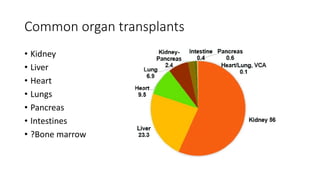
Common organ transplants
• Kidney
• Liver
• Heart
• Lungs
• Pancreas
• Intestines
• ?Bone marrow
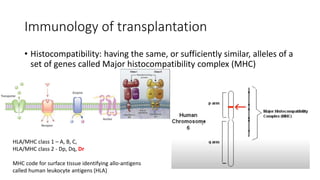
Immunology of transplantation
• Histocompatibility: having the same, or sufficiently similar, alleles of a
set of genes called Major histocompatibility complex (MHC)
HLA/MHC class 1 – A, B, C,
HLA/MHC class 2 - Dp, Dq, Dr
MHC code for surface tissue identifying allo-antigens
called human leukocyte antigens (HLA)
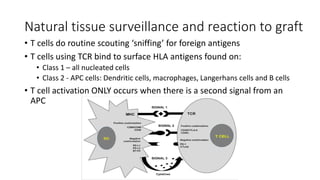
Natural tissue surveillance and reaction to graft
• T cells do routine scouting ‘sniffing’ for foreign antigens
• T cells using TCR bind to surface HLA antigens found on:
• Class 1 – all nucleated cells
• Class 2 - APC cells: Dendritic cells, macrophages, Langerhans cells and B cells
• T cell activation ONLY occurs when there is a second signal from an
APC
Rejection types
• Hyperacute – immediate
• Antibody mediated
• Usually pre-existing antibodies
• Acute – upto 6 months
• Chronic – years
Minimizing rejection
• Reduce possibility of graft recognition as foreign
• Suppress immune response against graft
Review
• Definition of transplantation and related terms
• Indications of transplantation
• Types of transplants
• Immunological basis of transplantation/rejection
• Strategies of minimizing rejection
PRINCIPLES OF
TRANSPLANTATION SURGERY
PART 2
Objectives of the lecture
• Tissue matching
• Principles of immune suppression therapy
• Complications of transplantation
• Organ donation and preservation
Tissue matching
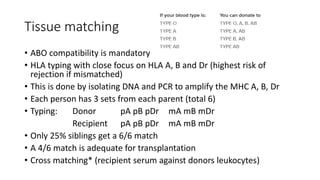
• ABO compatibility is mandatory
• HLA typing with close focus on HLA A, B and Dr (highest risk of
rejection if mismatched)
• This is done by isolating DNA and PCR to amplify the MHC A, B, Dr
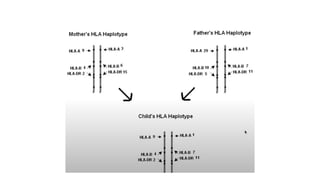
• Each person has 3 sets from each parent (total 6)
• Typing: Donor pA pB pDr mA mB mDr
Recipient pA pB pDr mA mB mDr
• Only 25% siblings get a 6/6 match
• A 4/6 match is adequate for transplantation
• Cross matching* (recipient serum against donors leukocytes)
Principles of immune suppression therapy
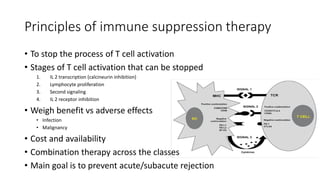
• To stop the process of T cell activation
• Stages of T cell activation that can be stopped
1. IL 2 transcription (calcineurin inhibition)
2. Lymphocyte proliferation
3. Second signaling
4. IL 2 receptor inhibition
• Weigh benefit vs adverse effects
• Infection
• Malignancy
• Cost and availability
• Combination therapy across the classes
• Main goal is to prevent acute/subacute rejection
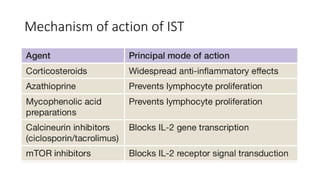
Mechanism of action of IST
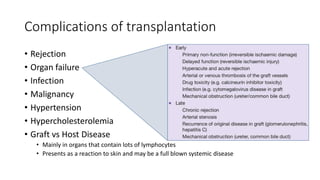
Complications of transplantation
• Rejection
• Organ failure
• Infection
• Malignancy
• Hypertension
• Hypercholesterolemia
• Graft vs Host Disease
• Mainly in organs that contain lots of lymphocytes
• Presents as a reaction to skin and may be a full blown systemic disease
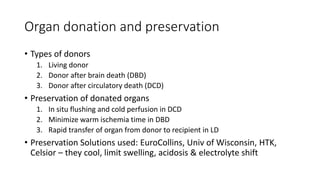
Organ donation and preservation
• Types of donors
1. Living donor
2. Donor after brain death (DBD)
3. Donor after circulatory death (DCD)
• Preservation of donated organs
1. In situ flushing and cold perfusion in DCD
2. Minimize warm ischemia time in DBD
3. Rapid transfer of organ from donor to recipient in LD
• Preservation Solutions used: EuroCollins, Univ of Wisconsin, HTK,
Celsior – they cool, limit swelling, acidosis & electrolyte shift
Review
• Tissue matching
• Principles of immune suppression therapy
• Complications of transplantation
• Organ donation and preservation
Thank you

Transplantation MB6.pptx

  • 1.
    PRINCIPLES OF TRANSPLANTATION SURGERY PART1 Dr Winston Makanga, M.B.Ch.B, M.MEd (Surg) Consultant General and Laparoscopic Surgeon
  • 2.
    Objectives of thelecture • Definition of transplantation and related terms • Indications of transplantation • Types of transplants • Immunological basis of graft rejection • Strategies of minimizing rejection
  • 3.
    Definitions • Organ transplantation:A surgical procedure in which a failing organ is replaced by a functioning one • Graft types • Allograft: organ/tissue from an individual to another • Autograft: same individual • Isograft: identical twins • Xenograft: different species • Location • Orthotopic transplantation: same anatomical site • Heterotopic: different anatomical site • Alloantigens: natural antigens found on human organs • Alloantibodies: antibodies formed against alloantigens
  • 4.
    Indications of transplantation •End organ failure • Kidney:Diabetes, Glomerulonephritis, Pyelonephritis, Polycystic kidney disease, Obstructive uropathy, Hypertensive nephrosclerosis. • Liver: Cirrhosis, fulminant hepatitis • Pancrease: chronic pancreatitis • Heart: severe CCF not manageable by meds • Malignancy - liver • Massive tissue/organ necrosis - intestines
  • 5.
    Common organ transplants •Kidney • Liver • Heart • Lungs • Pancreas • Intestines • ?Bone marrow
  • 6.
    Immunology of transplantation •Histocompatibility: having the same, or sufficiently similar, alleles of a set of genes called Major histocompatibility complex (MHC) HLA/MHC class 1 – A, B, C, HLA/MHC class 2 - Dp, Dq, Dr MHC code for surface tissue identifying allo-antigens called human leukocyte antigens (HLA)
  • 7.
    Natural tissue surveillanceand reaction to graft • T cells do routine scouting ‘sniffing’ for foreign antigens • T cells using TCR bind to surface HLA antigens found on: • Class 1 – all nucleated cells • Class 2 - APC cells: Dendritic cells, macrophages, Langerhans cells and B cells • T cell activation ONLY occurs when there is a second signal from an APC
  • 8.
    Rejection types • Hyperacute– immediate • Antibody mediated • Usually pre-existing antibodies • Acute – upto 6 months • Chronic – years
  • 9.
    Minimizing rejection • Reducepossibility of graft recognition as foreign • Suppress immune response against graft
  • 10.
    Review • Definition oftransplantation and related terms • Indications of transplantation • Types of transplants • Immunological basis of transplantation/rejection • Strategies of minimizing rejection
  • 11.
  • 12.
    Objectives of thelecture • Tissue matching • Principles of immune suppression therapy • Complications of transplantation • Organ donation and preservation
  • 13.
    Tissue matching • ABOcompatibility is mandatory • HLA typing with close focus on HLA A, B and Dr (highest risk of rejection if mismatched) • This is done by isolating DNA and PCR to amplify the MHC A, B, Dr • Each person has 3 sets from each parent (total 6) • Typing: Donor pA pB pDr mA mB mDr Recipient pA pB pDr mA mB mDr • Only 25% siblings get a 6/6 match • A 4/6 match is adequate for transplantation • Cross matching* (recipient serum against donors leukocytes)
  • 15.
    Principles of immunesuppression therapy • To stop the process of T cell activation • Stages of T cell activation that can be stopped 1. IL 2 transcription (calcineurin inhibition) 2. Lymphocyte proliferation 3. Second signaling 4. IL 2 receptor inhibition • Weigh benefit vs adverse effects • Infection • Malignancy • Cost and availability • Combination therapy across the classes • Main goal is to prevent acute/subacute rejection
  • 16.
  • 17.
    Complications of transplantation •Rejection • Organ failure • Infection • Malignancy • Hypertension • Hypercholesterolemia • Graft vs Host Disease • Mainly in organs that contain lots of lymphocytes • Presents as a reaction to skin and may be a full blown systemic disease
  • 18.
    Organ donation andpreservation • Types of donors 1. Living donor 2. Donor after brain death (DBD) 3. Donor after circulatory death (DCD) • Preservation of donated organs 1. In situ flushing and cold perfusion in DCD 2. Minimize warm ischemia time in DBD 3. Rapid transfer of organ from donor to recipient in LD • Preservation Solutions used: EuroCollins, Univ of Wisconsin, HTK, Celsior – they cool, limit swelling, acidosis & electrolyte shift
  • 19.
    Review • Tissue matching •Principles of immune suppression therapy • Complications of transplantation • Organ donation and preservation
  • 20.