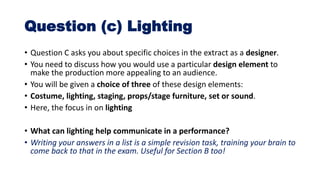
Question (c) Lighting
• Question C asks you about specific choices in the extract as a designer.
• You need to discuss how you would use a particular design element to
make the production more appealing to an audience.
• You will be given a choice of three of these design elements:
• Costume, lighting, staging, props/stage furniture, set or sound.
• Here, the focus in on lighting
• What can lighting help communicate in a performance?
• Writing your answers in a list is a simple revision task, training your brain to
come back to that in the exam. Useful for Section B too!
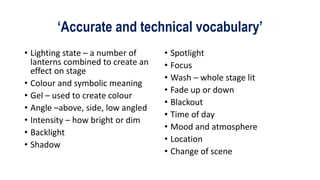
‘Accurate and technical vocabulary’
• Lighting state – a number of
lanterns combined to create an
effect on stage
• Colour and symbolic meaning
• Gel – used to create colour
• Angle –above, side, low angled
• Intensity – how bright or dim
• Backlight
• Shadow
• Spotlight
• Focus
• Wash – whole stage lit
• Fade up or down
• Blackout
• Time of day
• Mood and atmosphere
• Location
• Change of scene
Answering the question
Question (c) is worth 14 marks, so spend around 20 minutes
on this question
Discuss your ideas in detail and
consider different ideas and
opinions.
Show how your ideas enhance
the extract, such as using
costume to signify status.
Make your audience central –
how will your ideas affect the
audience?
Make links to other design
elements and to the play as a
whole.
Justify your ideas and support
them with evidence from the
extract and the wider play.
Show how your ideas represent
or symbolise the play’s themes
or ideas
Keep your ideas practical for the
performer
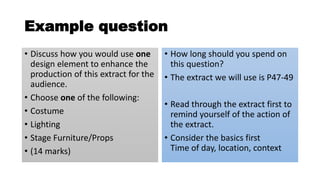
Example question
• Discuss how you would use one
design element to enhance the
production of this extract for the
audience.
• Choose one of the following:
• Costume
• Lighting
• Stage Furniture/Props
• (14 marks)
• How long should you spend on
this question?
• The extract we will use is P47-49
• Read through the extract first to
remind yourself of the action of
the extract.
• Consider the basics first
Time of day, location, context
Example question
• Discuss how you would use one
design element to enhance the
production of this extract for the
audience.
• Choose one of the following:
• Costume
• Lighting
• Stage Furniture/Props
• (14 marks)
• Key questions
• What is happening in this
extract? How can lighting
help the audience
understand what is
happening, or where the
scene is set?
• What are the main themes in
the extract? How do
characters feel?
• What is the mood of the
scene, and how can my
design element enhance
that?
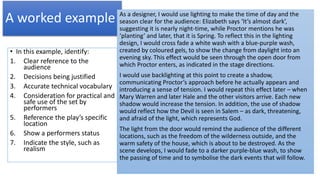
A worked example
• In this example, identify:
1. Clear reference to the
audience
2. Decisions being justified
3. Accurate technical vocabulary
4. Consideration for practical and
safe use of the set by
performers
5. Reference the play’s specific
location
6. Show a performers status
7. Indicate the style, such as
realism
As a designer, I would use lighting to
make the time of day and the season
clear for the audience:
Elizabeth says ‘It’s almost dark’,
suggesting it is nearly night-time, while
Proctor mentions he was ‘planting’ and
later, that it is Spring.
To reflect this in the lighting design, I
would
A worked example
• In this example, identify:
1. Clear reference to the
audience
2. Decisions being justified
3. Accurate technical vocabulary
4. Consideration for practical and
safe use of the set by
performers
5. Reference the play’s specific
location
6. Show a performers status
7. Indicate the style, such as
realism
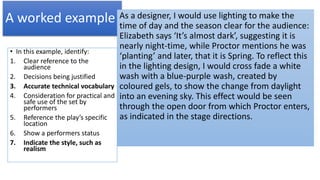
As a designer, I would use lighting to make the
time of day and the season clear for the audience:
Elizabeth says ‘It’s almost dark’, suggesting it is
nearly night-time, while Proctor mentions he was
‘planting’ and later, that it is Spring. To reflect this
in the lighting design, I would cross fade a white
wash with a blue-purple wash, created by
coloured gels, to show the change from daylight
into an evening sky. This effect would be seen
through the open door from which Proctor enters,
as indicated in the stage directions.
A worked example
• In this example, identify:
1. Clear reference to the
audience
2. Decisions being justified
3. Accurate technical vocabulary
4. Consideration for practical and
safe use of the set by
performers
5. Reference the play’s specific
location
6. Show a performers status
7. Indicate the style, such as
realism
As a designer, I would use lighting to make the time of day and the
season clear for the audience: Elizabeth says ‘It’s almost dark’,
suggesting it is nearly night-time, while Proctor mentions he was
‘planting’ and later, that it is Spring. To reflect this in the lighting
design, I would cross fade a white wash with a blue-purple wash,
created by coloured gels, to show the change from daylight into an
evening sky. This effect would be seen through the open door from
which Proctor enters, as indicated in the stage directions.
I would use backlighting at this point to create a shadow,
communicating Proctor’s approach before he actually appears and
introducing a sense of tension. I would repeat this effect later - when
A worked example
• In this example, identify:
1. Clear reference to the
audience
2. Decisions being justified
3. Accurate technical vocabulary
4. Consideration for practical and
safe use of the set by
performers
5. Reference the play’s specific
location
6. Show a performers status
7. Indicate the style, such as
realism
As a designer, I would use lighting to make the time of day and the
season clear for the audience: Elizabeth says ‘It’s almost dark’,
suggesting it is nearly night-time, while Proctor mentions he was
‘planting’ and later, that it is Spring. To reflect this in the lighting
design, I would cross fade a white wash with a blue-purple wash,
created by coloured gels, to show the change from daylight into an
evening sky. This effect would be seen through the open door from
which Proctor enters, as indicated in the stage directions.
I would use backlighting at this point to create a shadow,
communicating Proctor’s approach before he actually appears and
introducing a sense of tension. I would repeat this effect later – when
Mary Warren and later Hale and the other visitors arrive. Each new
shadow would increase the tension. In addition, the use of ------------
would reflect how the ----------is seen in Salem – as dark, threatening,
and afraid of the light, which represents --------.
The light from the door would remind the audience of the different
locations, such as the --------------------------, and the warm safety of -----
--------------, which is about to be destroyed. As the scene develops, I
would fade to a ---------------------wash, to show the -----------of -------
and to symbolise the dark events that will follow.
A worked example
• In this example, identify:
1. Clear reference to the
audience
2. Decisions being justified
3. Accurate technical vocabulary
4. Consideration for practical and
safe use of the set by
performers
5. Reference the play’s specific
location
6. Show a performers status
7. Indicate the style, such as
realism
As a designer, I would use lighting to make the time of day and the
season clear for the audience: Elizabeth says ‘It’s almost dark’,
suggesting it is nearly night-time, while Proctor mentions he was
‘planting’ and later, that it is Spring. To reflect this in the lighting
design, I would cross fade a white wash with a blue-purple wash,
created by coloured gels, to show the change from daylight into an
evening sky. This effect would be seen through the open door from
which Proctor enters, as indicated in the stage directions.
I would use backlighting at this point to create a shadow,
communicating Proctor’s approach before he actually appears and
introducing a sense of tension. I would repeat this effect later – when
Mary Warren and later Hale and the other visitors arrive. Each new
shadow would increase the tension. In addition, the use of shadow
would reflect how the Devil is seen in Salem – as dark, threatening,
and afraid of the light, which represents God.
The light from the door would remind the audience of the different
locations, such as the freedom of the wilderness outside, and the
warm safety of the house, which is about to be destroyed. As the
scene develops, I would fade to a darker purple-blue wash, to show
the passing of time and to symbolise the dark events that will follow.
Repeat and recap – Costume design
Key vocab
• Status
• Material
• Texture
• Colour
• Traditional dress
• Period costume
• Condition of the costume
• Length or fit of the costume
• How costume compares to others
Meaning
• What the costume is made from
• Revealing a sub-textual meaning
• Indicates level of importance
• Links characters together
• Indicates era or location

Design act two lx

  • 2.
    Question (c) Lighting •Question C asks you about specific choices in the extract as a designer. • You need to discuss how you would use a particular design element to make the production more appealing to an audience. • You will be given a choice of three of these design elements: • Costume, lighting, staging, props/stage furniture, set or sound. • Here, the focus in on lighting • What can lighting help communicate in a performance? • Writing your answers in a list is a simple revision task, training your brain to come back to that in the exam. Useful for Section B too!
  • 3.
    ‘Accurate and technicalvocabulary’ • Lighting state – a number of lanterns combined to create an effect on stage • Colour and symbolic meaning • Gel – used to create colour • Angle –above, side, low angled • Intensity – how bright or dim • Backlight • Shadow • Spotlight • Focus • Wash – whole stage lit • Fade up or down • Blackout • Time of day • Mood and atmosphere • Location • Change of scene
  • 4.
    Answering the question Question(c) is worth 14 marks, so spend around 20 minutes on this question Discuss your ideas in detail and consider different ideas and opinions. Show how your ideas enhance the extract, such as using costume to signify status. Make your audience central – how will your ideas affect the audience? Make links to other design elements and to the play as a whole. Justify your ideas and support them with evidence from the extract and the wider play. Show how your ideas represent or symbolise the play’s themes or ideas Keep your ideas practical for the performer
  • 5.
    Example question • Discusshow you would use one design element to enhance the production of this extract for the audience. • Choose one of the following: • Costume • Lighting • Stage Furniture/Props • (14 marks) • How long should you spend on this question? • The extract we will use is P47-49 • Read through the extract first to remind yourself of the action of the extract. • Consider the basics first Time of day, location, context
  • 6.
    Example question • Discusshow you would use one design element to enhance the production of this extract for the audience. • Choose one of the following: • Costume • Lighting • Stage Furniture/Props • (14 marks) • Key questions • What is happening in this extract? How can lighting help the audience understand what is happening, or where the scene is set? • What are the main themes in the extract? How do characters feel? • What is the mood of the scene, and how can my design element enhance that?
  • 7.
    A worked example •In this example, identify: 1. Clear reference to the audience 2. Decisions being justified 3. Accurate technical vocabulary 4. Consideration for practical and safe use of the set by performers 5. Reference the play’s specific location 6. Show a performers status 7. Indicate the style, such as realism As a designer, I would use lighting to make the time of day and the season clear for the audience: Elizabeth says ‘It’s almost dark’, suggesting it is nearly night-time, while Proctor mentions he was ‘planting’ and later, that it is Spring. To reflect this in the lighting design, I would
  • 8.
    A worked example •In this example, identify: 1. Clear reference to the audience 2. Decisions being justified 3. Accurate technical vocabulary 4. Consideration for practical and safe use of the set by performers 5. Reference the play’s specific location 6. Show a performers status 7. Indicate the style, such as realism As a designer, I would use lighting to make the time of day and the season clear for the audience: Elizabeth says ‘It’s almost dark’, suggesting it is nearly night-time, while Proctor mentions he was ‘planting’ and later, that it is Spring. To reflect this in the lighting design, I would cross fade a white wash with a blue-purple wash, created by coloured gels, to show the change from daylight into an evening sky. This effect would be seen through the open door from which Proctor enters, as indicated in the stage directions.
  • 9.
    A worked example •In this example, identify: 1. Clear reference to the audience 2. Decisions being justified 3. Accurate technical vocabulary 4. Consideration for practical and safe use of the set by performers 5. Reference the play’s specific location 6. Show a performers status 7. Indicate the style, such as realism As a designer, I would use lighting to make the time of day and the season clear for the audience: Elizabeth says ‘It’s almost dark’, suggesting it is nearly night-time, while Proctor mentions he was ‘planting’ and later, that it is Spring. To reflect this in the lighting design, I would cross fade a white wash with a blue-purple wash, created by coloured gels, to show the change from daylight into an evening sky. This effect would be seen through the open door from which Proctor enters, as indicated in the stage directions. I would use backlighting at this point to create a shadow, communicating Proctor’s approach before he actually appears and introducing a sense of tension. I would repeat this effect later - when
  • 10.
    A worked example •In this example, identify: 1. Clear reference to the audience 2. Decisions being justified 3. Accurate technical vocabulary 4. Consideration for practical and safe use of the set by performers 5. Reference the play’s specific location 6. Show a performers status 7. Indicate the style, such as realism As a designer, I would use lighting to make the time of day and the season clear for the audience: Elizabeth says ‘It’s almost dark’, suggesting it is nearly night-time, while Proctor mentions he was ‘planting’ and later, that it is Spring. To reflect this in the lighting design, I would cross fade a white wash with a blue-purple wash, created by coloured gels, to show the change from daylight into an evening sky. This effect would be seen through the open door from which Proctor enters, as indicated in the stage directions. I would use backlighting at this point to create a shadow, communicating Proctor’s approach before he actually appears and introducing a sense of tension. I would repeat this effect later – when Mary Warren and later Hale and the other visitors arrive. Each new shadow would increase the tension. In addition, the use of ------------ would reflect how the ----------is seen in Salem – as dark, threatening, and afraid of the light, which represents --------. The light from the door would remind the audience of the different locations, such as the --------------------------, and the warm safety of ----- --------------, which is about to be destroyed. As the scene develops, I would fade to a ---------------------wash, to show the -----------of ------- and to symbolise the dark events that will follow.
  • 11.
    A worked example •In this example, identify: 1. Clear reference to the audience 2. Decisions being justified 3. Accurate technical vocabulary 4. Consideration for practical and safe use of the set by performers 5. Reference the play’s specific location 6. Show a performers status 7. Indicate the style, such as realism As a designer, I would use lighting to make the time of day and the season clear for the audience: Elizabeth says ‘It’s almost dark’, suggesting it is nearly night-time, while Proctor mentions he was ‘planting’ and later, that it is Spring. To reflect this in the lighting design, I would cross fade a white wash with a blue-purple wash, created by coloured gels, to show the change from daylight into an evening sky. This effect would be seen through the open door from which Proctor enters, as indicated in the stage directions. I would use backlighting at this point to create a shadow, communicating Proctor’s approach before he actually appears and introducing a sense of tension. I would repeat this effect later – when Mary Warren and later Hale and the other visitors arrive. Each new shadow would increase the tension. In addition, the use of shadow would reflect how the Devil is seen in Salem – as dark, threatening, and afraid of the light, which represents God. The light from the door would remind the audience of the different locations, such as the freedom of the wilderness outside, and the warm safety of the house, which is about to be destroyed. As the scene develops, I would fade to a darker purple-blue wash, to show the passing of time and to symbolise the dark events that will follow.
  • 12.
    Repeat and recap– Costume design Key vocab • Status • Material • Texture • Colour • Traditional dress • Period costume • Condition of the costume • Length or fit of the costume • How costume compares to others Meaning • What the costume is made from • Revealing a sub-textual meaning • Indicates level of importance • Links characters together • Indicates era or location