Economic Development + Market Intelligence
May 2013
Research Tools and
Methods to Assess
Incentive Applicants
Using Research to Improve Incentive Decisions
May 23, 2013
C2ER Annual Conference - Nashville, TN
Ellen Harpel, President
Business Development Advisors
| 2
Introduction
 Business Development Advisors is an economic development and market
intelligence consulting firm
− Works with economic development leaders at the local, state and national levels to
increase business investment and job growth in their communities
− Provides market intelligence to organizations seeking insights on industries, market
trends, individual companies and locations
 Ellen Harpel, President
− Founded BDA in 1999
− Research interests: Incentives, business outreach methodologies, role of service sectors
in regional economies
 Smart Incentives
− Launched in 2013
− Provides business intelligence to enable better decision-making and accountability in
incentive programs
| 3
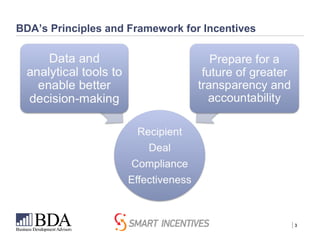
BDA’s Principles and Framework for Incentives
| 4
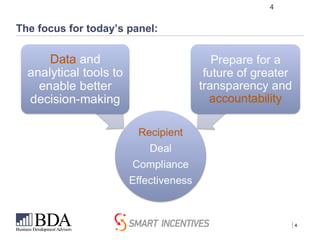
The focus for today’s panel:
4
| 5
Using Company Information for Economic Development
Prequalify leads
 Identify the companies most likely to make a facility change in the near-term
 Select the companies that provide the best match with your community
Make your business outreach effort more effective
 Understand the company-specific factors that will drive a relocation or
expansion decision
 Tailor your marketing message
Conduct due diligence on companies seeking incentives
| 6
Reasons to Conduct Background Research
Reduce risk
 Identify bad actors early
 Avoid surprises
Level the playing field
 Companies study your community – they know a lot about you; what do you
know about them?
 Direct substantial resources to the negotiation
 Less reactive; more assertive
Promote transparency
 Deals increasingly need to be documented and defensible
 Be prepared to respond to questions from media and elected officials
| 7
Gathering In-Depth Information on Companies –
Data to Obtain
For Outreach
 Products and/or functions
 Locations of existing operations
 Major customers
 Growth projections and strategies
 Restructuring and management changes
 Executives
For Due Diligence, also include
 Ownership details
 Credit rating (Experian or D&B)
 Financial structure
 Past incentives negotiations
| 8
Major Data Sources and Their Uses
Company websites
SEC Filings - EDGAR
 10K & 10Q
 Prospectus
Press
 OneSource
 Factiva
 Lexis/Nexis
Business directories
 Hoovers
 Reference USA
 OneSource
| 9
Variations (1)
Public Companies
 Plentiful information
 Challenge is finding the specific information you need
 Financial statements – income statement, balance sheet, cash flow
 Also see quarterly earnings statements, analyst reports, transcripts of analyst
calls, investor relations, corporate presentations
Private Companies
 May be little publicly available information, especially on finances
 Press – especially local newspapers and business journals – will often provide
key data items
 State-level sources
 ReferenceUSA
| 10
Variations (2)
Small Businesses
 Often not even listed in business directories
 State corporation commissions may have some information
 Try searching executive names
 LinkedIn
International Firms
 Some business directories have international listings or modules
 Canada – SEDAR, Industry Canada
 Euromonitor/Passport Global Market Information Database
 Bureau of Industry and Security “Lists to Check”:
http://www.bis.doc.gov/complianceandenforcement/liststocheck.htm
 BDA experience for other countries – find resources on case by case basis
| 11
Contact
Ellen Harpel
571-212-3397
eharpel@businessdevelopmentadvisors.com
www.businessdevelopmentadvisors.com
www.linkedin.com/pub/ellen-harpel/a/448/266
ellen@smartincentives.org
www.smartincentives.org
Twitter @SmartIncentives

C2 er 2013 presentation harpel final

  • 1.
    Economic Development +Market Intelligence May 2013 Research Tools and Methods to Assess Incentive Applicants Using Research to Improve Incentive Decisions May 23, 2013 C2ER Annual Conference - Nashville, TN Ellen Harpel, President Business Development Advisors
  • 2.
    | 2 Introduction  BusinessDevelopment Advisors is an economic development and market intelligence consulting firm − Works with economic development leaders at the local, state and national levels to increase business investment and job growth in their communities − Provides market intelligence to organizations seeking insights on industries, market trends, individual companies and locations  Ellen Harpel, President − Founded BDA in 1999 − Research interests: Incentives, business outreach methodologies, role of service sectors in regional economies  Smart Incentives − Launched in 2013 − Provides business intelligence to enable better decision-making and accountability in incentive programs
  • 3.
    | 3 BDA’s Principlesand Framework for Incentives
  • 4.
    | 4 The focusfor today’s panel: 4
  • 5.
    | 5 Using CompanyInformation for Economic Development Prequalify leads  Identify the companies most likely to make a facility change in the near-term  Select the companies that provide the best match with your community Make your business outreach effort more effective  Understand the company-specific factors that will drive a relocation or expansion decision  Tailor your marketing message Conduct due diligence on companies seeking incentives
  • 6.
    | 6 Reasons toConduct Background Research Reduce risk  Identify bad actors early  Avoid surprises Level the playing field  Companies study your community – they know a lot about you; what do you know about them?  Direct substantial resources to the negotiation  Less reactive; more assertive Promote transparency  Deals increasingly need to be documented and defensible  Be prepared to respond to questions from media and elected officials
  • 7.
    | 7 Gathering In-DepthInformation on Companies – Data to Obtain For Outreach  Products and/or functions  Locations of existing operations  Major customers  Growth projections and strategies  Restructuring and management changes  Executives For Due Diligence, also include  Ownership details  Credit rating (Experian or D&B)  Financial structure  Past incentives negotiations
  • 8.
    | 8 Major DataSources and Their Uses Company websites SEC Filings - EDGAR  10K & 10Q  Prospectus Press  OneSource  Factiva  Lexis/Nexis Business directories  Hoovers  Reference USA  OneSource
  • 9.
    | 9 Variations (1) PublicCompanies  Plentiful information  Challenge is finding the specific information you need  Financial statements – income statement, balance sheet, cash flow  Also see quarterly earnings statements, analyst reports, transcripts of analyst calls, investor relations, corporate presentations Private Companies  May be little publicly available information, especially on finances  Press – especially local newspapers and business journals – will often provide key data items  State-level sources  ReferenceUSA
  • 10.
    | 10 Variations (2) SmallBusinesses  Often not even listed in business directories  State corporation commissions may have some information  Try searching executive names  LinkedIn International Firms  Some business directories have international listings or modules  Canada – SEDAR, Industry Canada  Euromonitor/Passport Global Market Information Database  Bureau of Industry and Security “Lists to Check”: http://www.bis.doc.gov/complianceandenforcement/liststocheck.htm  BDA experience for other countries – find resources on case by case basis
  • 11.