What Kind of Operating
Culture Are You Leading?
The Greatest Leadership Challenge
2
Your most important function as a leader is to help others think about what they’re
doing in such a way that equips, encourage, and inspires them to commit to
our cause and lend their individual gifts and talents to it. Your teams continuing
actions and performance bear witness to your effectiveness as a leader.
Meeting the Challenge
When all the people and pieces are in place
and functioning smoothly, we’re said to
have an organization that is in “alignment.”
Alignment occurs when your purpose, plan,
and people are all pointed in the same direction
and operating from the same playbook. As
a leader, your primary concern is to bring
your team into alignment and keep it there.
Your culture and success depends on it.
As with every area of leadership, Jesus is the
perfect role model. He loved his key team
members enough to always speak the truth.
He never copped out or compromised His truth
or mission. With perfect integrity, He told his
team (and us) that he loves us and the proved
it. He engendered the hope we all need to
navigate in this life with our eyes on a far greater
glory in Heaven. Jesus always pointed to the
future with absolute and unwavering hope.
But how did Jesus lead? He led by asking his
team to follow him. When we lead, allowing Him
to shape us into His image, we take our team
toward a purpose far greater than a paycheck.
The process of diligently doing this through the
ups and downs of life and business is the race
that has been marked out for us. Given our
physical limitations, wisdom calls us to enlist
the help of like-minded key managers along
the way and to care for the often unspoken
needs of our flock by providing Christ-centered
guidance. This radically extends our reach
and goes a long way toward creating a warm,
welcoming, and unifying company culture. Many
other best practices help Spirit-led servant
leaders to create an aligned workplace.
As God’s stewards, we lead most effectively
when we build trust, equip others by speaking
the truth in love and holding high standards, tap
the talents and commitment of our people, foster
teamwork, share vital information, and reinforce/
reward desirable performance. This produces
a culture that combines disciplined execution
and continuous innovation and improvement.
Top-Down vs. Aligned/Team Based Leadership
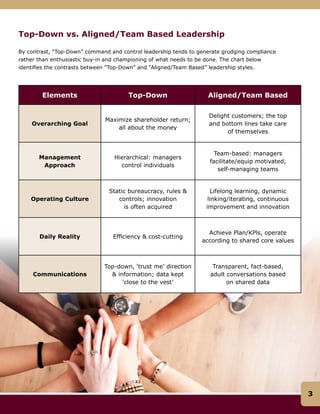
By contrast, “Top-Down” command and control leadership tends to generate grudging compliance
rather than enthusiastic buy-in and championing of what needs to be done. The chart below
identifies the contrasts between “Top-Down” and “Aligned/Team Based” leadership styles.
3
Elements Top-Down Aligned/Team Based
Overarching Goal
Maximize shareholder return;
all about the money
Delight customers; the top
and bottom lines take care
of themselves
Management
Approach
Hierarchical: managers
control individuals
Team-based: managers
facilitate/equip motivated,
self-managing teams
Operating Culture
Static bureaucracy, rules &
controls; innovation
is often acquired
Lifelong learning, dynamic
linking/iterating, continuous
improvement and innovation
Daily Reality Efficiency & cost-cutting
Achieve Plan/KPls, operate
according to shared core values
Communications
Top-down, ‘trust me’ direction
& information; data kept
‘close to the vest’
Transparent, fact-based,
adult conversations based
on shared data
The C12 Group • 336.841.7100 • info@C12Group.com
4101 Piedmont Parkway, Greensboro, NC 27410
Considering C12 Membership?
Start the conversation today.
How About You?
Where do you fall? How do you approach
leadership? In what areas does your team
need help with alignment? At the C12 Group,
our members actively engage each month in
continual learning and personal growth, learning
how to lead their businesses and teams to the
honor and glory of our Lord. How about you?
Are you ready to consider C12 membership?

C12 e book operating culture

  • 1.
    What Kind ofOperating Culture Are You Leading? The Greatest Leadership Challenge
  • 2.
    2 Your most importantfunction as a leader is to help others think about what they’re doing in such a way that equips, encourage, and inspires them to commit to our cause and lend their individual gifts and talents to it. Your teams continuing actions and performance bear witness to your effectiveness as a leader. Meeting the Challenge When all the people and pieces are in place and functioning smoothly, we’re said to have an organization that is in “alignment.” Alignment occurs when your purpose, plan, and people are all pointed in the same direction and operating from the same playbook. As a leader, your primary concern is to bring your team into alignment and keep it there. Your culture and success depends on it. As with every area of leadership, Jesus is the perfect role model. He loved his key team members enough to always speak the truth. He never copped out or compromised His truth or mission. With perfect integrity, He told his team (and us) that he loves us and the proved it. He engendered the hope we all need to navigate in this life with our eyes on a far greater glory in Heaven. Jesus always pointed to the future with absolute and unwavering hope. But how did Jesus lead? He led by asking his team to follow him. When we lead, allowing Him to shape us into His image, we take our team toward a purpose far greater than a paycheck. The process of diligently doing this through the ups and downs of life and business is the race that has been marked out for us. Given our physical limitations, wisdom calls us to enlist the help of like-minded key managers along the way and to care for the often unspoken needs of our flock by providing Christ-centered guidance. This radically extends our reach and goes a long way toward creating a warm, welcoming, and unifying company culture. Many other best practices help Spirit-led servant leaders to create an aligned workplace. As God’s stewards, we lead most effectively when we build trust, equip others by speaking the truth in love and holding high standards, tap the talents and commitment of our people, foster teamwork, share vital information, and reinforce/ reward desirable performance. This produces a culture that combines disciplined execution and continuous innovation and improvement.
  • 3.
    Top-Down vs. Aligned/TeamBased Leadership By contrast, “Top-Down” command and control leadership tends to generate grudging compliance rather than enthusiastic buy-in and championing of what needs to be done. The chart below identifies the contrasts between “Top-Down” and “Aligned/Team Based” leadership styles. 3 Elements Top-Down Aligned/Team Based Overarching Goal Maximize shareholder return; all about the money Delight customers; the top and bottom lines take care of themselves Management Approach Hierarchical: managers control individuals Team-based: managers facilitate/equip motivated, self-managing teams Operating Culture Static bureaucracy, rules & controls; innovation is often acquired Lifelong learning, dynamic linking/iterating, continuous improvement and innovation Daily Reality Efficiency & cost-cutting Achieve Plan/KPls, operate according to shared core values Communications Top-down, ‘trust me’ direction & information; data kept ‘close to the vest’ Transparent, fact-based, adult conversations based on shared data
  • 4.
    The C12 Group• 336.841.7100 • info@C12Group.com 4101 Piedmont Parkway, Greensboro, NC 27410 Considering C12 Membership? Start the conversation today. How About You? Where do you fall? How do you approach leadership? In what areas does your team need help with alignment? At the C12 Group, our members actively engage each month in continual learning and personal growth, learning how to lead their businesses and teams to the honor and glory of our Lord. How about you? Are you ready to consider C12 membership?