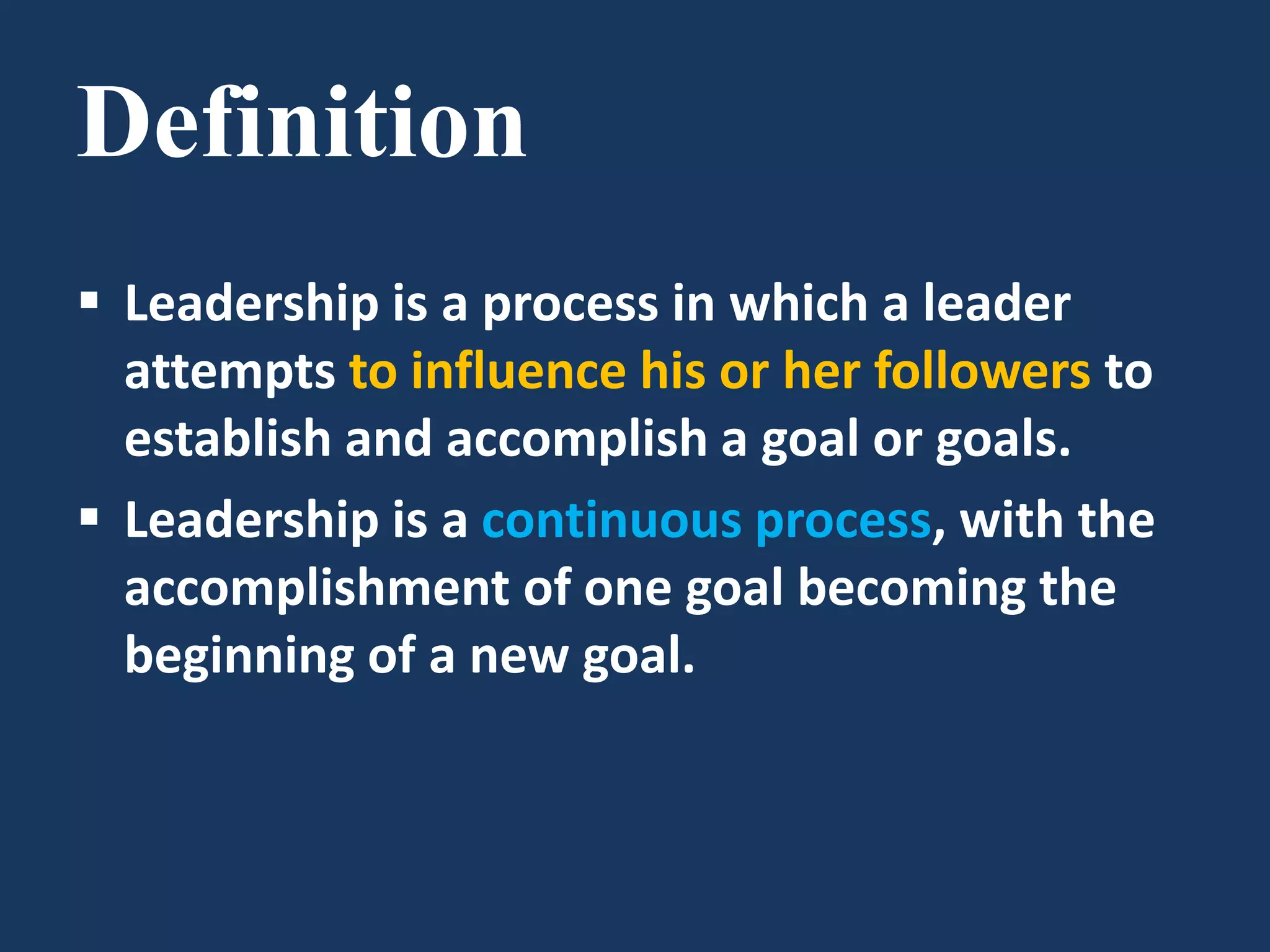
Definition
 Leadership is a process in which a leader
attempts to influence his or her followers to
establish and accomplish a goal or goals.
 Leadership is a continuous process, with the
accomplishment of one goal becoming the
beginning of a new goal.
 In order to accomplish the goal, the leader
exercises his or her power to influence
people
 That power is exercised in earlier stages by
motivating followers to get the job done and
in later stages by rewarding those who
perform to the level of expectation.
Who is a
Christian Leader
• A Christian is person who has
believed in Jesus Christ, accepted
Him as Lord and Saviour, and lives
by His teachings and instructions.
• Biblical leadership and for that
matter, Christian leadership begins
with a divine appointment. (Moses,
David, Peter)
• Training and preparation. eg Moses,
Timothy
• Approved by the Church, eg
replacement of Judas. (Acts 1:20-24)
• Meets the biblical qualification set
for a leader. Refer I Tim 3:1-14.
Analogy
A Leader may be described as:
oManager
oDirector
oCoach
oInstructor
oFacilitator
An efficient leader is good
at the following
1. Team Building
putting in place what it takes to ensure that there is a good
collaboration between leadership and followers. Unity within
leadership team is important.
 Two main challenges that militate against Team Building
 Individualism;
• Our culture esteems individualism over groups,
• Our culture esteems competition over cooperation
o Individualism however cripples team efficiency and effectiveness
 Conflict;
• Conflict is inevitable, but leaders must do well to resolve it.
• False niceness can limit leaders’ credibility, it affects building a
team
2. Conflict resolution
Identify the kind of conflict
• Conflict over facts of situation, eg there is no money
to buy musical instruments we all wish for.
• Conflict over method or means. Do we buy our paint
and engage the services of a painter or allow the
painter to go for materials and add to his charge.
• Conflict over ends or goals, eg. Do we buy robes or
projector after anniversary.
• Conflict over values; eg, should a member go to the
stadium to watch football? Can a member sell
alcoholic drinks.
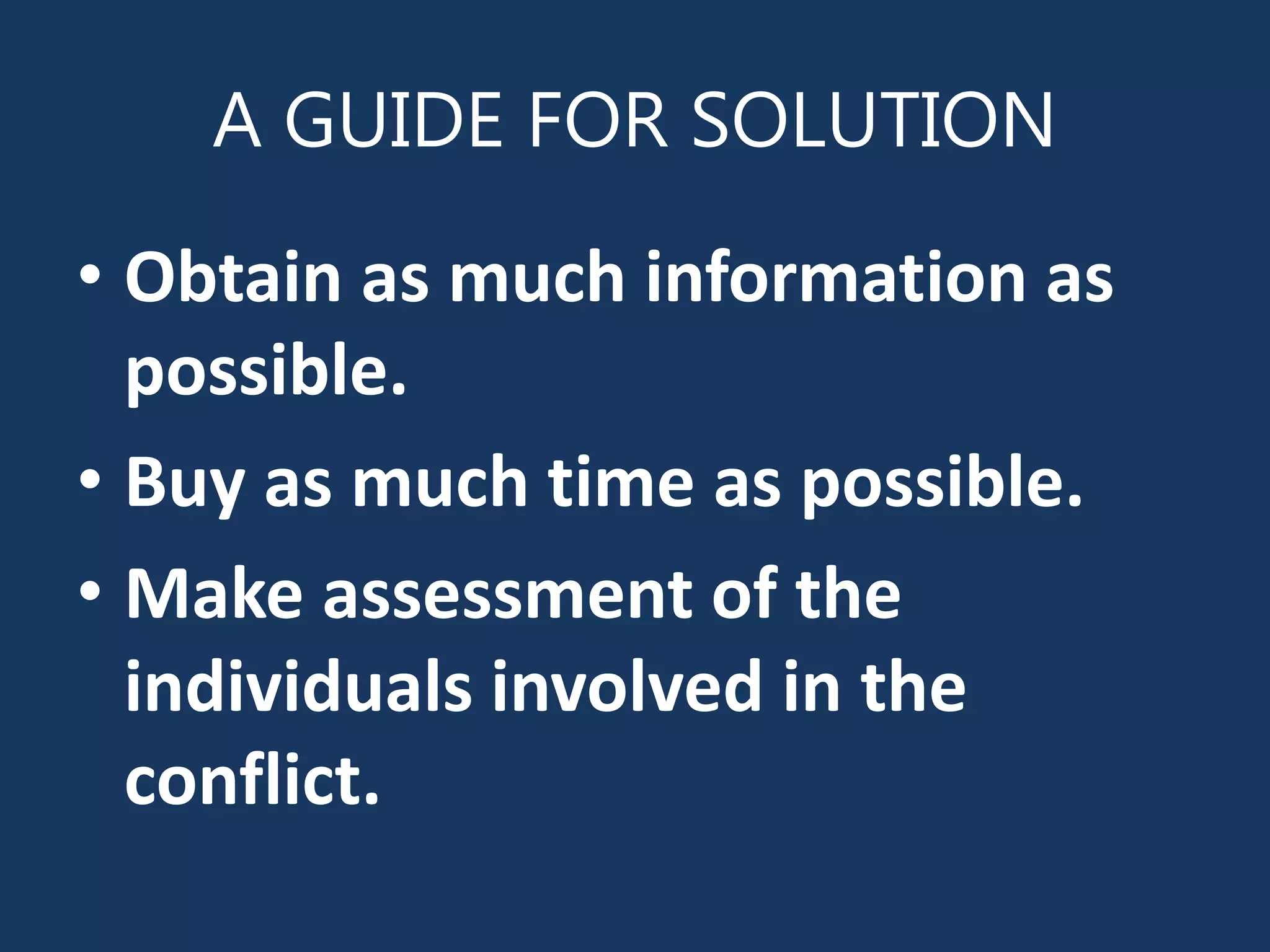
A GUIDE FOR SOLUTION
• Obtain as much information as
possible.
• Buy as much time as possible.
• Make assessment of the
individuals involved in the
conflict.
3. Delegation
• The harvest is plenteous, more hands must be
on deck. There is the need for delegation.
• Delegation means more than giving orders or
simply assigning task. Do not mistake issuing of
commands for delegation.
• to delegate means to involve someone in an
Endeavour by coordinating his or her efforts
with one’s own goals.
• Delegation coordinate people and links them
with the specifics of the plan.
DELEGATION PROCESS
• Write a job description. What kinds of
responsibility will you want to hand over
to that person
• Look for a suitable person (check
competence and availability)
• Give authority to the appointee
• Provide the resources needed to
accomplish the task.
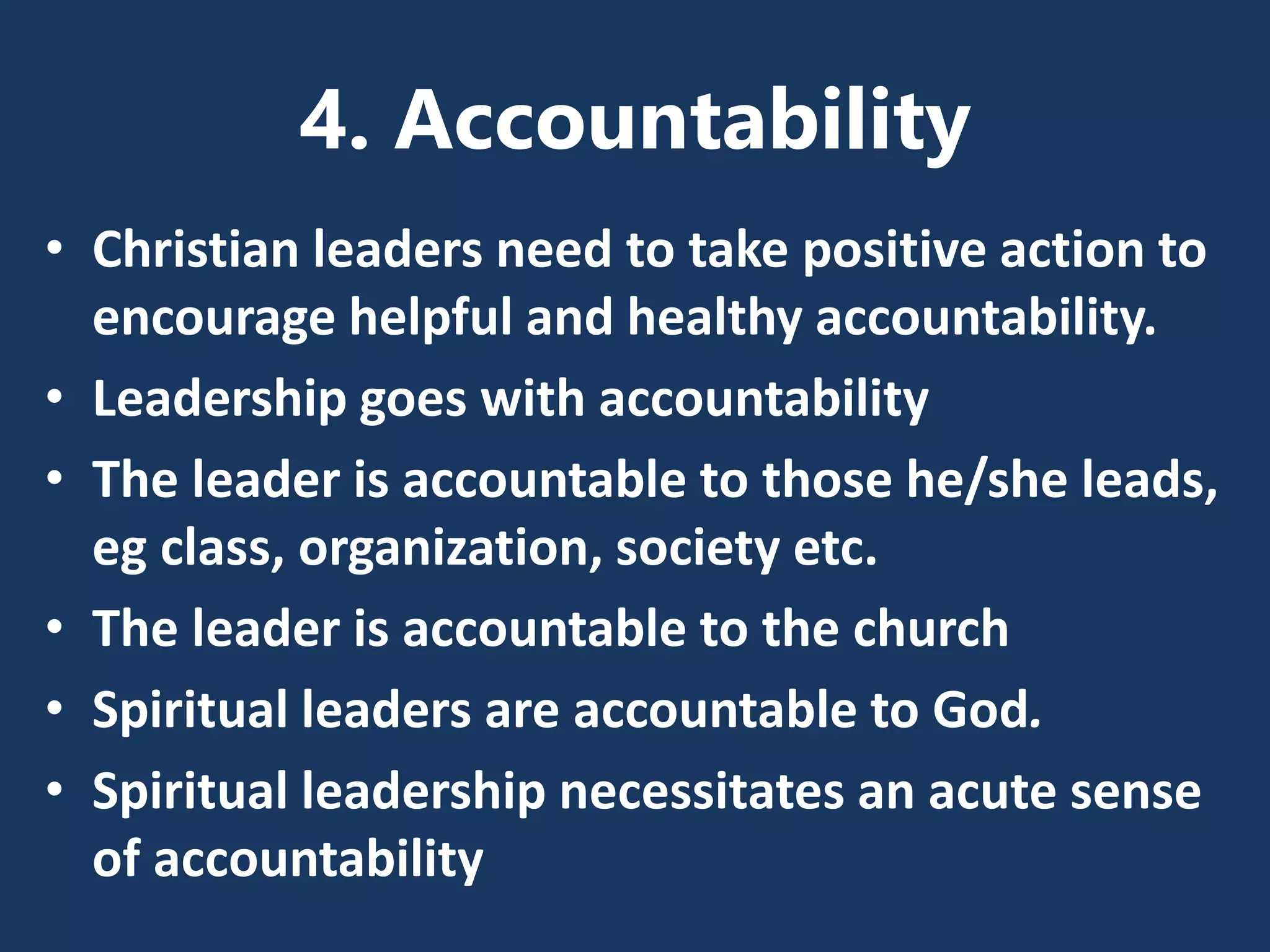
4. Accountability
• Christian leaders need to take positive action to
encourage helpful and healthy accountability.
• Leadership goes with accountability
• The leader is accountable to those he/she leads,
eg class, organization, society etc.
• The leader is accountable to the church
• Spiritual leaders are accountable to God.
• Spiritual leadership necessitates an acute sense
of accountability
5. Capacity Building
• Leadership is a transforming relationship in
which the Leader invests in the growth and
development of the followers, empowering
them to become what God has gifted them to
be.
• Increase the abilities so that they can and
would contribute to achieving the goal of the
organization
• Empower people to own and implement
mission
CHRISTIAN LEADERSHIP
• When most people think of leadership, they
picture a military officer giving out orders or
an employer closely supervising his
employees, making sure all the work gets
done.
• These aspects can be part of leadership, but
they are not the essence of Christian
leadership. Jesus Christ is the ultimate
example of spiritual leadership.
Christian Leadership
Part II
by Very Rev. Christopher Nyarko Andam
welcome from your break
What is
Christian
leadership?
• Christian leadership is shepherd
leadership.
• Christian leadership is Servant
leadership.
• Christian leadership insists on humility.
• Christian Leadership has to do with
relationships
• Christian Leadership has to do with
stewardship.
SHEPHERD LEADERSHIP
• The shepherd is one who has several roles in
regard to his sheep.
• The shepherd leads, feeds, nurtures, comforts,
corrects and protects.
• The shepherd of the Lord’s flock needs to adopt
the leadership style of Jesus.
• The Apostle Paul understood this: “Follow my
example, as I follow the example of Christ”(1
Corinthians 11:1).
• The Christian leader is one who follows Christ
and inspires others to follow Him as well.
SERVANT LEADERSHIP
• Spiritual leadership is servant leadership.
• Jesus taught us, "the Son of Man did not
come to be served, but to serve, and to give
his life as a ransom for many" (Matthew
20:28).
• Jesus did not lead by giving out orders or by
supervising. Jesus led by being a servant
and serving alongside of His followers.
• People want to follow a person who serves
alongside them and sets an example for
them.
Christian leadership
insists on humility
• Humility is the attitude that puts others ahead of
you, that considers others more important than
yourself.
• It was said of Moses, the leader of over one
million Israelites, "Now Moses was a very
humble man, more humble than anyone else on
the face of the earth" (Numbers 12:3). Jesus said,
learn of me because I am meek and humble.
• Leaders who thing too highly of themselves can
not genuinely be caring for others.
• Humility enables one to serve others
wholeheartedly and thereby set an example that
others will follow.
CHRISTIAN
LEADERSHIP IS
ABOUT
RELATIONSHIP
• In its broadest definition, leadership is a
relationship of influence.
• It is a relationship between two people in
which one person seeks to influence the
vision, values, attitudes or behaviours of
the other.
• Leadership is a relationship of power.
• It denotes the character or the resources
that others see in you that cause them to
accept your influence.
• Leadership is a relationship of
influence with a purpose;
• the achievement of the shared
mission and the nurture of the
community.
• Leadership is a relationship of
dependency.
Leaders need followers. They exist
only when people choose to follow.
• Leadership articulates a compelling
vision for tomorrow that captures the
Imagination of the followers and
energizes and actions in the present.
• Leadership is a relationship of
influence that points to a shared vision
that shapes their living today in such a
way that the vision is realized.
• People quits people NOT organisation.
• When relationships are marred, it affects
leadership.
• That is why team building is very
important.
• A good collaboration of leaders and
followers will push the organisation
forward.
• A united executive board is of prime
importance.
LEADERSHIP IS ABOUT
CHARACTER AND
TRUST
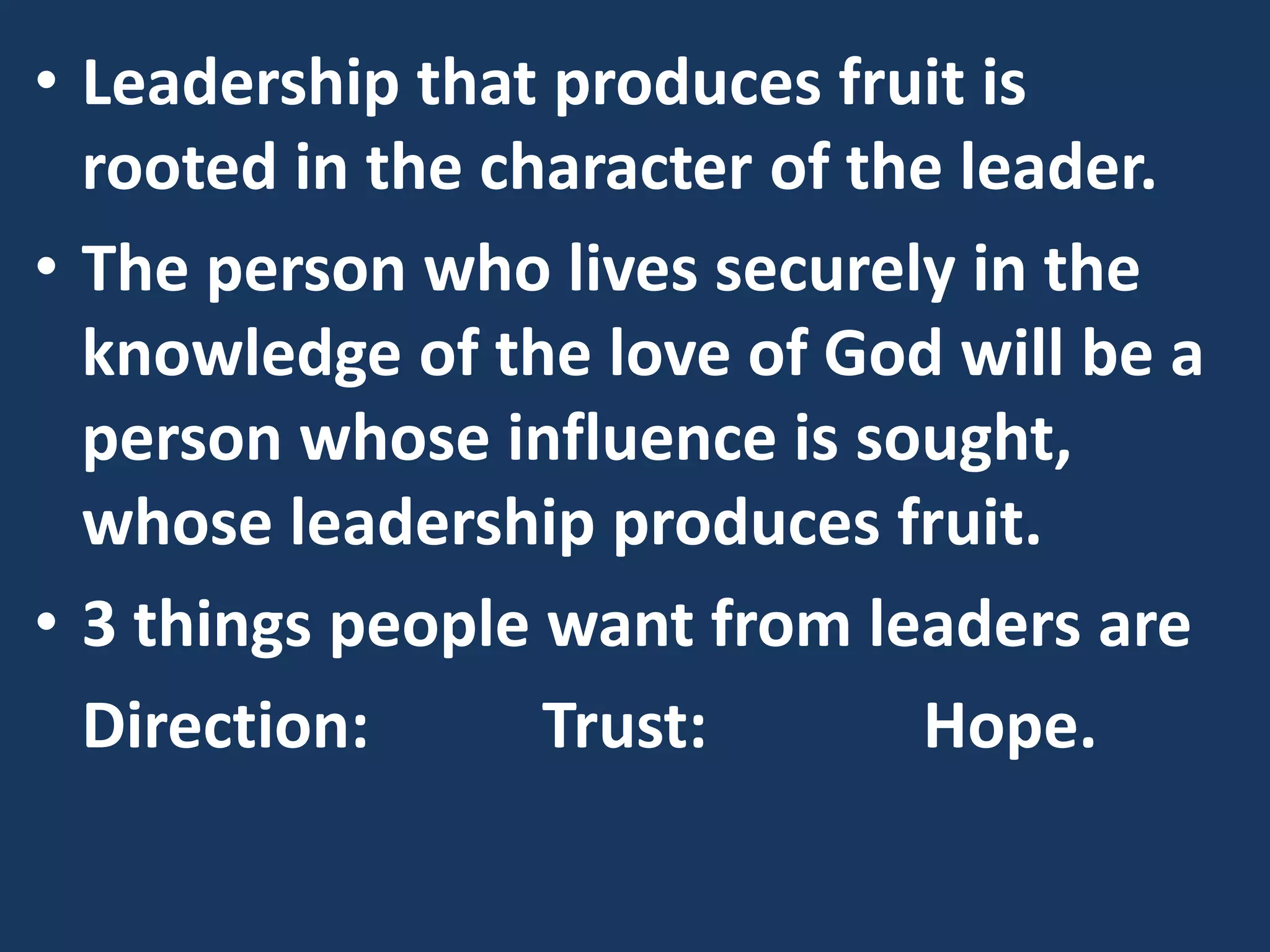
• Leadership that produces fruit is
rooted in the character of the leader.
• The person who lives securely in the
knowledge of the love of God will be a
person whose influence is sought,
whose leadership produces fruit.
• 3 things people want from leaders are
Direction: Trust: Hope.
THE CHRISTIAN LEADERS
AND HIS/HER MORAL
STANDARDS
• Leaders in general, are held to high
moral, ethical, and social standards.
• but as a Christian leader, that bar is
raised even higher. Why? Because he
represents Christ.
• Christian leaders’ character must be
above reproach, they must adhere to
the biblical qualifications for a leader.
CHARACTERISTICS OF
SUCCESSFUL AND
EFFECTIVE LEADERSHIP
What does it take to make leadership
successful or effective?
• determination, emotional stability,
diplomacy, self-confidence, personal
integrity, originality, and creativity.
• Intellectual abilities included judgmental
ability, knowledge, and verbal
communication ability. In addition,
physical traits cannot be ignored, such as
age, weight & size, and physical
attractiveness.
Types of Leaders
• styles and behaviors of the leader is important
• Strong autocratic leaders set their goals without
considering the opinions of their followers,
• Consultative leaders solicit the opinions and ideas of
their followers in the goal-setting process but
ultimately determine important goals and task
assignments on their own.
• Democratic or participative leaders participate
equally in the process with their followers
• Extremely laid-back leaders, so called laissez-faire
leaders, let the group take whatever action its
members feel is necessary.
Christian Leadership
Part III
by Very Rev Christopher Nyarko Andam
Welcome from your break
A LEADER IN THE
METHODIST CHURCH
• “nowhere are the demands and the
rewards of leadership greater than
in the church” – Bill Hybels.
• The leader in the Methodist Church
possesses both a great privileges
and an awesome responsibility.
He/she carries a dual responsibility
to God and to His people.
Tools for the Methodist Leader
• Bible
• Hymnbook
• Constitution
• Weekly Bible Lesson
Activities Crucial to leaders
Bible Studies
Prayer
Church attendance/fellowship
APPOINTING METHODIST LEADERS
• Who ? Ref. S.O. 721(4)
• Why ? Ref. S.O. 722(1)a. cooperation not
oposition.
the Supt Minister/Minister shall have the
final say on all issues, however in the
spirit of Team Building, he/she takes
decision in collaboration with leaders
(Leaders’ Meeting). eg S.O. 725(8)
• Duration. Ref. S.O. 724(2)
Administrative Structures
Committee on Education & Youth
Society Meeting
Committee on Administration
Leaders Meeting Committee on Ministries
Committee on Finance & Development
Class Meeting
committee on Social Responsibility & Rural
development
The 10yrs Strategic Plan
The Methodist Church Ghana
Suame Circuit
Maakro Section
Leadership Seminar
Programme of Activities
1. Arrival and registration of participants
2. Breakfast
3. Devotion
4. Welcome Courtesies
5. Lectures on Leadership (Part I)
6. Short Break
7. Lectures on leadership (Part II)
8. Short Break
9. Brief Lectures on leadership & Workshop
10. Workshop Reports & Questions
11. Closing.
• Good bye And God Richly Bless You
1. Who is qualified to be a leader in the Methodist
Church?
2. Should the leader in the Methodist Church necessarily
be a Spiritual leader?
3. To what extent can relationships affect the well being
of the organisation/Church?
4. How do we, in our own small ways oppose to the goals
and/or vision of the organisation/church
5. Can leaders effectively run the Church with out using
the administrative structures?
6. Should the Church comply to duration provisions in the
constitution?
QUESTIONS FOR
REFLECTION

CHRISTIAN LEADERSHIP.ppt

  • 2.
    Definition  Leadership isa process in which a leader attempts to influence his or her followers to establish and accomplish a goal or goals.  Leadership is a continuous process, with the accomplishment of one goal becoming the beginning of a new goal.
  • 3.
     In orderto accomplish the goal, the leader exercises his or her power to influence people  That power is exercised in earlier stages by motivating followers to get the job done and in later stages by rewarding those who perform to the level of expectation.
  • 4.
  • 5.
    • A Christianis person who has believed in Jesus Christ, accepted Him as Lord and Saviour, and lives by His teachings and instructions. • Biblical leadership and for that matter, Christian leadership begins with a divine appointment. (Moses, David, Peter)
  • 6.
    • Training andpreparation. eg Moses, Timothy • Approved by the Church, eg replacement of Judas. (Acts 1:20-24) • Meets the biblical qualification set for a leader. Refer I Tim 3:1-14.
  • 7.
    Analogy A Leader maybe described as: oManager oDirector oCoach oInstructor oFacilitator
  • 8.
    An efficient leaderis good at the following
  • 9.
    1. Team Building puttingin place what it takes to ensure that there is a good collaboration between leadership and followers. Unity within leadership team is important.  Two main challenges that militate against Team Building  Individualism; • Our culture esteems individualism over groups, • Our culture esteems competition over cooperation o Individualism however cripples team efficiency and effectiveness  Conflict; • Conflict is inevitable, but leaders must do well to resolve it. • False niceness can limit leaders’ credibility, it affects building a team
  • 10.
    2. Conflict resolution Identifythe kind of conflict • Conflict over facts of situation, eg there is no money to buy musical instruments we all wish for. • Conflict over method or means. Do we buy our paint and engage the services of a painter or allow the painter to go for materials and add to his charge. • Conflict over ends or goals, eg. Do we buy robes or projector after anniversary. • Conflict over values; eg, should a member go to the stadium to watch football? Can a member sell alcoholic drinks.
  • 11.
    A GUIDE FORSOLUTION • Obtain as much information as possible. • Buy as much time as possible. • Make assessment of the individuals involved in the conflict.
  • 12.
    3. Delegation • Theharvest is plenteous, more hands must be on deck. There is the need for delegation. • Delegation means more than giving orders or simply assigning task. Do not mistake issuing of commands for delegation. • to delegate means to involve someone in an Endeavour by coordinating his or her efforts with one’s own goals. • Delegation coordinate people and links them with the specifics of the plan.
  • 13.
    DELEGATION PROCESS • Writea job description. What kinds of responsibility will you want to hand over to that person • Look for a suitable person (check competence and availability) • Give authority to the appointee • Provide the resources needed to accomplish the task.
  • 14.
    4. Accountability • Christianleaders need to take positive action to encourage helpful and healthy accountability. • Leadership goes with accountability • The leader is accountable to those he/she leads, eg class, organization, society etc. • The leader is accountable to the church • Spiritual leaders are accountable to God. • Spiritual leadership necessitates an acute sense of accountability
  • 15.
    5. Capacity Building •Leadership is a transforming relationship in which the Leader invests in the growth and development of the followers, empowering them to become what God has gifted them to be. • Increase the abilities so that they can and would contribute to achieving the goal of the organization • Empower people to own and implement mission
  • 16.
    CHRISTIAN LEADERSHIP • Whenmost people think of leadership, they picture a military officer giving out orders or an employer closely supervising his employees, making sure all the work gets done. • These aspects can be part of leadership, but they are not the essence of Christian leadership. Jesus Christ is the ultimate example of spiritual leadership.
  • 17.
    Christian Leadership Part II byVery Rev. Christopher Nyarko Andam welcome from your break
  • 18.
  • 19.
    • Christian leadershipis shepherd leadership. • Christian leadership is Servant leadership. • Christian leadership insists on humility. • Christian Leadership has to do with relationships • Christian Leadership has to do with stewardship.
  • 20.
  • 21.
    • The shepherdis one who has several roles in regard to his sheep. • The shepherd leads, feeds, nurtures, comforts, corrects and protects. • The shepherd of the Lord’s flock needs to adopt the leadership style of Jesus. • The Apostle Paul understood this: “Follow my example, as I follow the example of Christ”(1 Corinthians 11:1). • The Christian leader is one who follows Christ and inspires others to follow Him as well.
  • 22.
  • 23.
    • Spiritual leadershipis servant leadership. • Jesus taught us, "the Son of Man did not come to be served, but to serve, and to give his life as a ransom for many" (Matthew 20:28). • Jesus did not lead by giving out orders or by supervising. Jesus led by being a servant and serving alongside of His followers. • People want to follow a person who serves alongside them and sets an example for them.
  • 24.
  • 25.
    • Humility isthe attitude that puts others ahead of you, that considers others more important than yourself. • It was said of Moses, the leader of over one million Israelites, "Now Moses was a very humble man, more humble than anyone else on the face of the earth" (Numbers 12:3). Jesus said, learn of me because I am meek and humble. • Leaders who thing too highly of themselves can not genuinely be caring for others. • Humility enables one to serve others wholeheartedly and thereby set an example that others will follow.
  • 26.
  • 27.
    • In itsbroadest definition, leadership is a relationship of influence. • It is a relationship between two people in which one person seeks to influence the vision, values, attitudes or behaviours of the other. • Leadership is a relationship of power. • It denotes the character or the resources that others see in you that cause them to accept your influence.
  • 28.
    • Leadership isa relationship of influence with a purpose; • the achievement of the shared mission and the nurture of the community. • Leadership is a relationship of dependency. Leaders need followers. They exist only when people choose to follow.
  • 29.
    • Leadership articulatesa compelling vision for tomorrow that captures the Imagination of the followers and energizes and actions in the present. • Leadership is a relationship of influence that points to a shared vision that shapes their living today in such a way that the vision is realized.
  • 30.
    • People quitspeople NOT organisation. • When relationships are marred, it affects leadership. • That is why team building is very important. • A good collaboration of leaders and followers will push the organisation forward. • A united executive board is of prime importance.
  • 31.
  • 32.
    • Leadership thatproduces fruit is rooted in the character of the leader. • The person who lives securely in the knowledge of the love of God will be a person whose influence is sought, whose leadership produces fruit. • 3 things people want from leaders are Direction: Trust: Hope.
  • 33.
    THE CHRISTIAN LEADERS ANDHIS/HER MORAL STANDARDS
  • 34.
    • Leaders ingeneral, are held to high moral, ethical, and social standards. • but as a Christian leader, that bar is raised even higher. Why? Because he represents Christ. • Christian leaders’ character must be above reproach, they must adhere to the biblical qualifications for a leader.
  • 35.
  • 36.
    What does ittake to make leadership successful or effective? • determination, emotional stability, diplomacy, self-confidence, personal integrity, originality, and creativity. • Intellectual abilities included judgmental ability, knowledge, and verbal communication ability. In addition, physical traits cannot be ignored, such as age, weight & size, and physical attractiveness.
  • 37.
    Types of Leaders •styles and behaviors of the leader is important • Strong autocratic leaders set their goals without considering the opinions of their followers, • Consultative leaders solicit the opinions and ideas of their followers in the goal-setting process but ultimately determine important goals and task assignments on their own. • Democratic or participative leaders participate equally in the process with their followers • Extremely laid-back leaders, so called laissez-faire leaders, let the group take whatever action its members feel is necessary.
  • 38.
    Christian Leadership Part III byVery Rev Christopher Nyarko Andam Welcome from your break
  • 39.
    A LEADER INTHE METHODIST CHURCH
  • 40.
    • “nowhere arethe demands and the rewards of leadership greater than in the church” – Bill Hybels. • The leader in the Methodist Church possesses both a great privileges and an awesome responsibility. He/she carries a dual responsibility to God and to His people.
  • 41.
    Tools for theMethodist Leader • Bible • Hymnbook • Constitution • Weekly Bible Lesson Activities Crucial to leaders Bible Studies Prayer Church attendance/fellowship
  • 42.
    APPOINTING METHODIST LEADERS •Who ? Ref. S.O. 721(4) • Why ? Ref. S.O. 722(1)a. cooperation not oposition. the Supt Minister/Minister shall have the final say on all issues, however in the spirit of Team Building, he/she takes decision in collaboration with leaders (Leaders’ Meeting). eg S.O. 725(8) • Duration. Ref. S.O. 724(2)
  • 43.
    Administrative Structures Committee onEducation & Youth Society Meeting Committee on Administration Leaders Meeting Committee on Ministries Committee on Finance & Development Class Meeting committee on Social Responsibility & Rural development The 10yrs Strategic Plan
  • 44.
    The Methodist ChurchGhana Suame Circuit Maakro Section Leadership Seminar Programme of Activities 1. Arrival and registration of participants 2. Breakfast 3. Devotion 4. Welcome Courtesies 5. Lectures on Leadership (Part I) 6. Short Break 7. Lectures on leadership (Part II) 8. Short Break 9. Brief Lectures on leadership & Workshop 10. Workshop Reports & Questions 11. Closing. • Good bye And God Richly Bless You
  • 45.
    1. Who isqualified to be a leader in the Methodist Church? 2. Should the leader in the Methodist Church necessarily be a Spiritual leader? 3. To what extent can relationships affect the well being of the organisation/Church? 4. How do we, in our own small ways oppose to the goals and/or vision of the organisation/church 5. Can leaders effectively run the Church with out using the administrative structures? 6. Should the Church comply to duration provisions in the constitution?
  • 46.