The document is a course outline for ETEE-207, focusing on circuit and systems waveform synthesis, presented by Mr. Lalit Agarwal. It includes various questions and solutions related to drawing waveforms, synthesizing given waveforms using gate functions, and practice problems with step and ramp signals. The document serves as a guide for students to understand and apply waveform synthesis techniques.
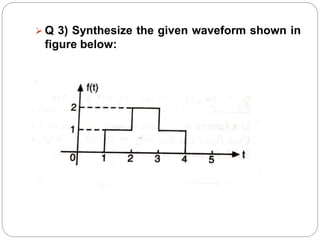
![SOLUTION(3)
Using GATE function the given
waveform can be synthesized as:
f(t) = G1,2(t) + 2* G2,3(t) + G3,4(t)
= 1* [ U(t-1) - U(t-2) ] + 2* [ U(t-2) – U(t-3) ]
+ 1* [ U(t-3)- U(t-4) ]
= U(t-1) + U(t-2) – U(t-3) – U(t-4)](https://image.slidesharecdn.com/csunit-1waveformsynthesization-240502162926-73e32edf/85/C-S-UNIT-1-WAVEFORM-SYNTHESIZATION-pptx-10-320.jpg)
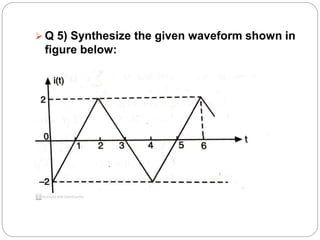
![SOLUTION(6)
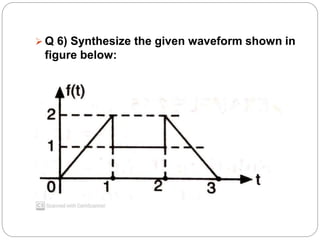
Using the gate function, the given waveform can
be synthesized as:
f(t) = 2t* G0,1(t) + 1 * G1,2(t) + (-2t+6) *G2,3(t)
= 2t[U(t) – U(t-1)] + [U(t-1)- U(t-2)]
+ (-2t+6)[U(t-2)- U(t-3)]
= 2t U(t) – (2t-1) U(t-1) – (2t-5) U(t-2) + (2t-6)
U(t-3)](https://image.slidesharecdn.com/csunit-1waveformsynthesization-240502162926-73e32edf/85/C-S-UNIT-1-WAVEFORM-SYNTHESIZATION-pptx-16-320.jpg)
![ Q 7) Synthesize the given waveform shown in
figure below:
SOLUTION(7):
Using gate functions;
f(t) = t [U(t)-U(t-1)] + (t-1) [U(t-1)- U(t-2)]
= t U(t) – t U(t-1) + (t-1) U(t-1) – (t-1) U(t-2)
= t U(t) – U(t-1) –(t-2+1) U(t-2)
= t U(t) – U(t-1) –(t-2) U(t-2) – U(t-2)
= r(t) – U(t-1) – r(t-2) – U(t-2)](https://image.slidesharecdn.com/csunit-1waveformsynthesization-240502162926-73e32edf/85/C-S-UNIT-1-WAVEFORM-SYNTHESIZATION-pptx-17-320.jpg)
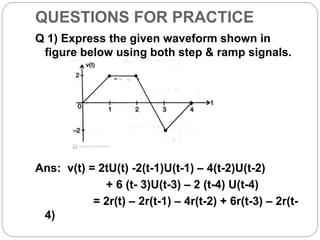
![Q 2) Sketch the following signals:
i. U(t-5) – U(t-8)
ii. U(t-6) + U(t-4)
iii. t2 [U(t-1)- U(t-3)]
Q 3) Synthesize the given waveforms using
standard signals:
(i)](https://image.slidesharecdn.com/csunit-1waveformsynthesization-240502162926-73e32edf/85/C-S-UNIT-1-WAVEFORM-SYNTHESIZATION-pptx-21-320.jpg)
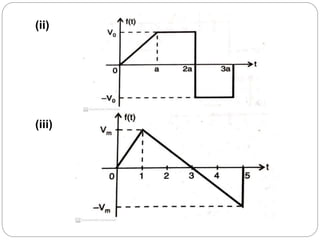
![Ans(3) :
(i) f(t) = U(t)+ U(t-1) + 2U(t-2) – 3U(t-3) + 2U(t-4)
– 3U(t-5)
(ii) f(t) = V0/a[r(t) – r(t-a)] – 2 V0 U(t-2a) + V0 U(t-
3a)
(iii) f(t) = Vm r(t) – 1.5 Vm r(t-1) + 0.5 Vm r(t-5)
+ Vm U(t-5)
Q4) The voltage waveform across the capacitor
0.2μF is shown in fig below. Determine the
current waveform through it.](https://image.slidesharecdn.com/csunit-1waveformsynthesization-240502162926-73e32edf/85/C-S-UNIT-1-WAVEFORM-SYNTHESIZATION-pptx-23-320.jpg)


![Digital Signals and System (April – 2017) [75:25 Pattern | Question Paper]](https://cdn.slidesharecdn.com/ss_thumbnails/dss-75-25-qp-april-2017-180428083754-thumbnail.jpg?width=640&height=640&fit=bounds)


![Digital Signals and Systems (May – 2016) [Question Paper | IDOL: Revised Course]](https://cdn.slidesharecdn.com/ss_thumbnails/idol-dss-may-2016-180708053843-thumbnail.jpg?width=640&height=640&fit=bounds)


