EE-100 Electric Circuits
Lecture 22-23 Chapter 5
Department of Electrical Engineering
University of Engineering and Technology, Lahore
April 15, 2024
(EED, UET, Lahore) Electric Circuits April 15, 2024 1 / 54
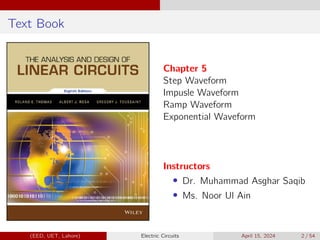
Text Book
Chapter 5
Step Waveform
Impusle Waveform
Ramp Waveform
Exponential Waveform
Instructors
• Dr. Muhammad Asghar Saqib
• Ms. Noor Ul Ain
(EED, UET, Lahore) Electric Circuits April 15, 2024 2 / 54
Chapter 5 Waveforms
Waveforms
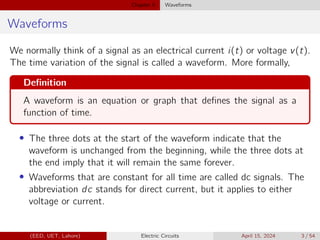
We normally think of a signal as an electrical current i(t) or voltage v(t).
The time variation of the signal is called a waveform. More formally,
Definition
A waveform is an equation or graph that defines the signal as a
function of time.
• The three dots at the start of the waveform indicate that the
waveform is unchanged from the beginning, while the three dots at
the end imply that it will remain the same forever.
• Waveforms that are constant for all time are called dc signals. The
abbreviation dc stands for direct current, but it applies to either
voltage or current.
(EED, UET, Lahore) Electric Circuits April 15, 2024 3 / 54
Chapter 5 Waveforms
DC Waveform
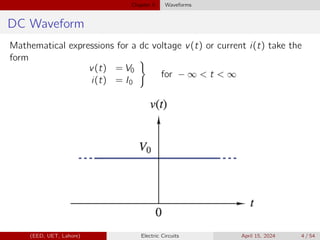
Mathematical expressions for a dc voltage v(t) or current i(t) take the
form
v(t) = V0
i(t) = I0
)
for − ∞ < t < ∞
(EED, UET, Lahore) Electric Circuits April 15, 2024 4 / 54
Chapter 5 Waveforms
Notations
There are two matters of notation and convention.
• Quantities that are constant (non-time-varying) are usually
represented by uppercase letters (VA, I, TO).
• Time-varying electrical quantities are represented by the lowercase
letters i, v, p, q, and w. The time variation is expressly indicated
when we write these quantities as v1(t), iA(t), or wC(t). Time
variation is implicit when they are written as v1, iA, or wC.
(EED, UET, Lahore) Electric Circuits April 15, 2024 5 / 54
Chapter 5 Waveforms
Conventions
• In a circuit diagram, signal variables are normally accompanied by
the reference marks (+, −) for voltage and (→) for current. It is
important to remember that these reference marks do not indicate
the polarity of a voltage or the direction of current. The marks
provide a baseline for determining the sign of the numerical value of
the actual waveform.
• When the actual voltage polarity or current direction coincides with
the reference directions, the signal has a positive value. When the
opposite occurs, the value is negative.
(EED, UET, Lahore) Electric Circuits April 15, 2024 6 / 54
Chapter 5 Waveforms
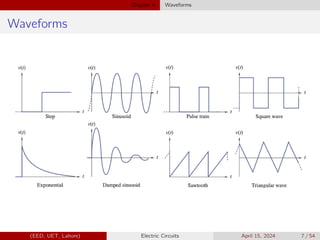
Waveforms
(EED, UET, Lahore) Electric Circuits April 15, 2024 7 / 54
Chapter 5 Step Waveform
Step Waveform
The general step function is based on the unit step function defined as
u(t) =
(
0 for t < 0
1 for t ≥ 0
• The step function waveform is equal to zero when its argument t is
negative, and is equal to unity when its argument is positive.
• Mathematically, the function u(t) has a jump discontinuity at t = 0.
(EED, UET, Lahore) Electric Circuits April 15, 2024 8 / 54
Chapter 5 Step Waveform
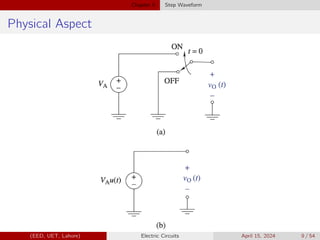
Physical Aspect
(EED, UET, Lahore) Electric Circuits April 15, 2024 9 / 54
Chapter 5 Step Waveform
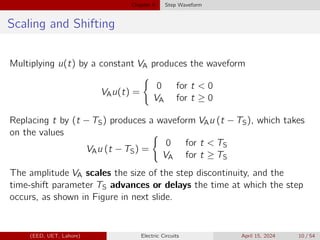
Scaling and Shifting
Multiplying u(t) by a constant VA produces the waveform
VAu(t) =
(
0 for t < 0
VA for t ≥ 0
Replacing t by (t − TS) produces a waveform VAu (t − TS), which takes
on the values
VAu (t − TS) =
(
0 for t < TS
VA for t ≥ TS
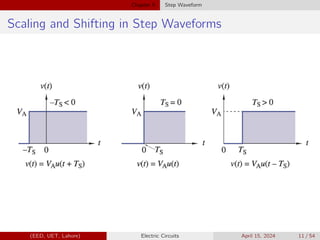
The amplitude VA scales the size of the step discontinuity, and the
time-shift parameter TS advances or delays the time at which the step
occurs, as shown in Figure in next slide.
(EED, UET, Lahore) Electric Circuits April 15, 2024 10 / 54
Chapter 5 Step Waveform
Scaling and Shifting in Step Waveforms
(EED, UET, Lahore) Electric Circuits April 15, 2024 11 / 54
Chapter 5 Step Waveform
Practice
Sketch the waveforms given by
• v(t) = 5u(t + 6) V
• i(t) = 2u(t − 1) A
(EED, UET, Lahore) Electric Circuits April 15, 2024 12 / 54
Chapter 5 Rectangular Function
Waveforms - Example - Rectangular Function
v(t) = 3u(t − 1) − 3u(t − 3)V
A generalized rectangular
function is given as:
v(t) = VA [u (t − T1) − u (t − T2)]
(EED, UET, Lahore) Electric Circuits April 15, 2024 13 / 54
Chapter 5 Unit Step Example
Example
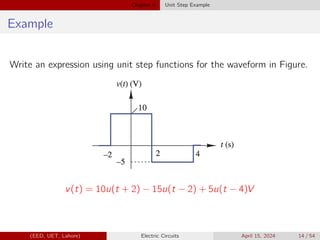
Write an expression using unit step functions for the waveform in Figure.
v(t) = 10u(t + 2) − 15u(t − 2) + 5u(t − 4)V
(EED, UET, Lahore) Electric Circuits April 15, 2024 14 / 54
Chapter 5 Unit Area Pulse
Unit Area Pulse
A unit-area pulse centered on t = 0 is written in terms of step functions
as
v(t) =
1
T

u

t +
T
2

− u

t −
T
2

V
• The pulse in equation is zero everywhere except in the range
−T/2 ≤ t ≤ T/2, where its value is 1/T.
• The area under the pulse is 1 because its scale factor is inversely
proportional to its duration.
(EED, UET, Lahore) Electric Circuits April 15, 2024 15 / 54
Chapter 5 Unit Impulse
Unit Impulse
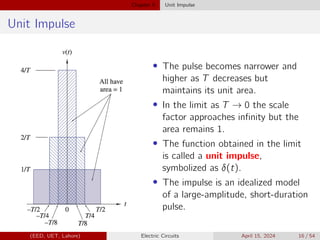
• The pulse becomes narrower and
higher as T decreases but
maintains its unit area.
• In the limit as T → 0 the scale
factor approaches infinity but the
area remains 1.
• The function obtained in the limit
is called a unit impulse,
symbolized as δ(t).
• The impulse is an idealized model
of a large-amplitude, short-duration
pulse.
(EED, UET, Lahore) Electric Circuits April 15, 2024 16 / 54
Chapter 5 Unit Impulse
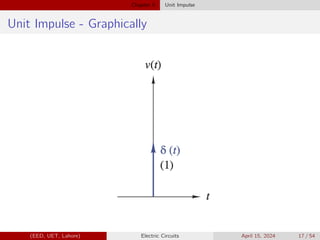
Unit Impulse - Graphically
(EED, UET, Lahore) Electric Circuits April 15, 2024 17 / 54
Chapter 5 Unit Impulse
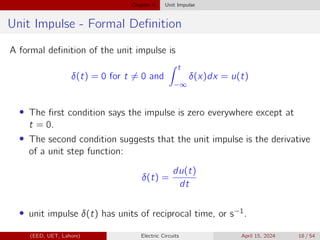
Unit Impulse - Formal Definition
A formal definition of the unit impulse is
δ(t) = 0 for t ̸= 0 and
Z t
−∞
δ(x)dx = u(t)
• The first condition says the impulse is zero everywhere except at
t = 0.
• The second condition suggests that the unit impulse is the derivative
of a unit step function:
δ(t) =
du(t)
dt
• unit impulse δ(t) has units of reciprocal time, or s−1.
(EED, UET, Lahore) Electric Circuits April 15, 2024 18 / 54
Chapter 5 Unit Impulse
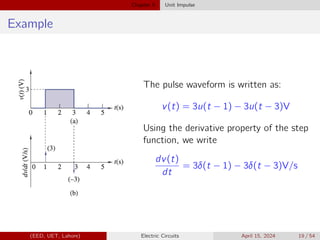
Example
The pulse waveform is written as:
v(t) = 3u(t − 1) − 3u(t − 3)V
Using the derivative property of the step
function, we write
dv(t)
dt
= 3δ(t − 1) − 3δ(t − 3)V/s
(EED, UET, Lahore) Electric Circuits April 15, 2024 19 / 54
Chapter 5 Impulse
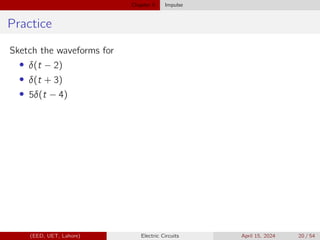
Practice
Sketch the waveforms for
• δ(t − 2)
• δ(t + 3)
• 5δ(t − 4)
(EED, UET, Lahore) Electric Circuits April 15, 2024 20 / 54
Chapter 5 Unit Ramp
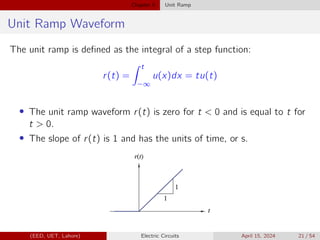
Unit Ramp Waveform
The unit ramp is defined as the integral of a step function:
r(t) =
Z t
−∞
u(x)dx = tu(t)
• The unit ramp waveform r(t) is zero for t  0 and is equal to t for
t  0.
• The slope of r(t) is 1 and has the units of time, or s.
(EED, UET, Lahore) Electric Circuits April 15, 2024 21 / 54
Chapter 5 Ramp
Scaling and Time Shifting
• A ramp of strength K is denoted v(t) = Kr(t), where the scale
factor K has the units of V/s and is the slope of the ramp.
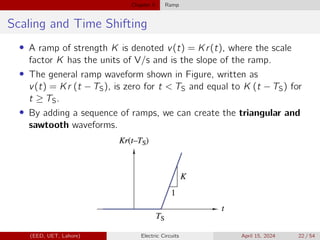
• The general ramp waveform shown in Figure, written as
v(t) = Kr (t − TS), is zero for t  TS and equal to K (t − TS) for
t ≥ TS.
• By adding a sequence of ramps, we can create the triangular and
sawtooth waveforms.
(EED, UET, Lahore) Electric Circuits April 15, 2024 22 / 54
Chapter 5 Singularity Functions
Singularity Functions
The unit impulse, unit step, and unit ramp form a triad of related signals
that are referred to as singularity functions. They are related by
integration as
u(t) =
Z t
−∞
δ(x)dx
r(t) =
Z t
−∞
u(x)dx
or by differentiation as
δ(t) =
du(t)
dt
u(t) =
dr(t)
dt
(EED, UET, Lahore) Electric Circuits April 15, 2024 23 / 54
Chapter 5 Singularity Functions
Singularity Functions
• These signals are used to generate other waveforms and as test
inputs to linear systems to characterize their responses.
• When applying the singularity functions in circuit analysis, it is
important to remember that u(t) is a dimensionless function.
• δ(t) carries the units of s−1 and r(t) carries units of seconds.
(EED, UET, Lahore) Electric Circuits April 15, 2024 24 / 54
Chapter 5 Singularity Functions
Example
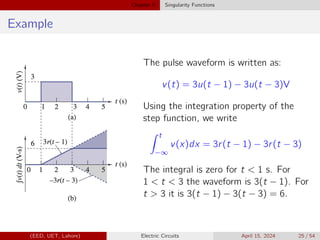
The pulse waveform is written as:
v(t) = 3u(t − 1) − 3u(t − 3)V
Using the integration property of the
step function, we write
Z t
−∞
v(x)dx = 3r(t − 1) − 3r(t − 3)
The integral is zero for t  1 s. For
1  t  3 the waveform is 3(t − 1). For
t  3 it is 3(t − 1) − 3(t − 3) = 6.
(EED, UET, Lahore) Electric Circuits April 15, 2024 25 / 54
Chapter 5 Singularity Functions
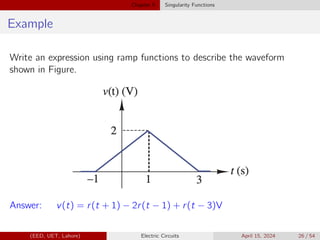
Example
Write an expression using ramp functions to describe the waveform
shown in Figure.
Answer: v(t) = r(t + 1) − 2r(t − 1) + r(t − 3)V
(EED, UET, Lahore) Electric Circuits April 15, 2024 26 / 54
Chapter 5 Singularity Functions
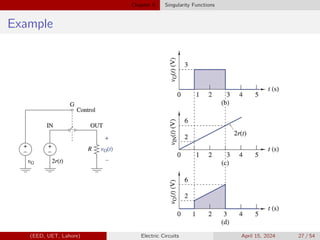
Example
(EED, UET, Lahore) Electric Circuits April 15, 2024 27 / 54
Chapter 5 Singularity Functions
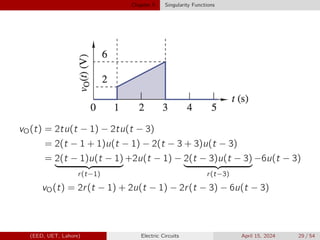
vO(t) =





0 t  1
2t 1  t  3
0 3  t
In terms of gate function:
vO(t) = 2t[u(t − 1) − u(t − 3)]
| {z }
Gate function
(EED, UET, Lahore) Electric Circuits April 15, 2024 28 / 54
Chapter 5 Singularity Functions
vO(t) = 2tu(t − 1) − 2tu(t − 3)
= 2(t − 1 + 1)u(t − 1) − 2(t − 3 + 3)u(t − 3)
= 2(t − 1)u(t − 1)
| {z }
r(t−1)
+2u(t − 1) − 2(t − 3)u(t − 3)
| {z }
r(t−3)
−6u(t − 3)
vO(t) = 2r(t − 1) + 2u(t − 1) − 2r(t − 3) − 6u(t − 3)
(EED, UET, Lahore) Electric Circuits April 15, 2024 29 / 54
Chapter 5 Singularity Functions
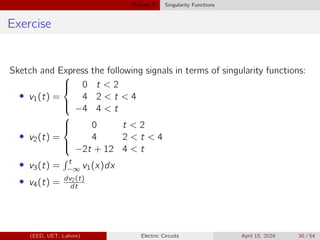
Exercise
Sketch and Express the following signals in terms of singularity functions:
• v1(t) =





0 t  2
4 2  t  4
−4 4  t
• v2(t) =





0 t  2
4 2  t  4
−2t + 12 4  t
• v3(t) =
R t
−∞ v1(x)dx
• v4(t) = dv2(t)
dt
(EED, UET, Lahore) Electric Circuits April 15, 2024 30 / 54
Chapter 5 Singularity Functions
Answers:
1 v1(t) = 4u(t − 2) − 8u(t − 4)
2 v2(t) = 4u(t − 2) − 2r(t − 4)
3 v3(t) = 4r(t − 2) − 8r(t − 4)
4 v4(t) = 4δ(t − 2) − 2u(t − 4)
(EED, UET, Lahore) Electric Circuits April 15, 2024 31 / 54
Chapter 5 Exponential Waveform
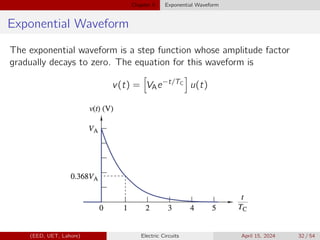
Exponential Waveform
The exponential waveform is a step function whose amplitude factor
gradually decays to zero. The equation for this waveform is
v(t) =
h
VAe−t/TC
i
u(t)
(EED, UET, Lahore) Electric Circuits April 15, 2024 32 / 54
Chapter 5 Exponential Waveform
Exponential Waveform
• It is zero for t  0 and jumps to a maximum amplitude of VA at
t = 0.
• Thereafter it monotonically decays toward zero as time marches on.
• The two parameters that define the waveform are the amplitude VA
(in volts) and the time constant TC (in seconds).
• Time Constant: The time constant is of special interest, since it
determines the rate at which the waveform decays to zero.
• An exponential decays to about 36.8% of its initial amplitude
v(0) = VA in one time constant, because at t = TC, v (TC) = VAe−1,
or approximately 0.368 × VA.
• At t = 5TC, the value of the waveform is VAe−5, or approximately
0.00674VA. An exponential signal decays to less than 1% of its
initial amplitude in a time span of five time constants
(EED, UET, Lahore) Electric Circuits April 15, 2024 33 / 54
Chapter 5 Exponential Waveform
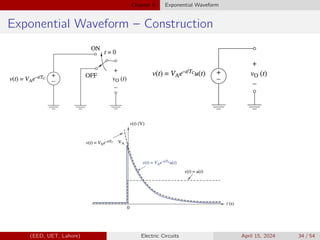
Exponential Waveform – Construction
(EED, UET, Lahore) Electric Circuits April 15, 2024 34 / 54
Chapter 5 Exponential Waveform
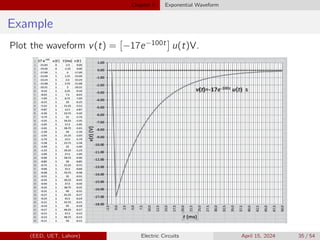
Example
Plot the waveform v(t) =

−17e−100t

u(t)V.
(EED, UET, Lahore) Electric Circuits April 15, 2024 35 / 54
Chapter 5 Exponential Waveform
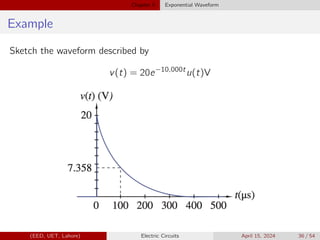
Example
Sketch the waveform described by
v(t) = 20e−10,000t
u(t)V
(EED, UET, Lahore) Electric Circuits April 15, 2024 36 / 54
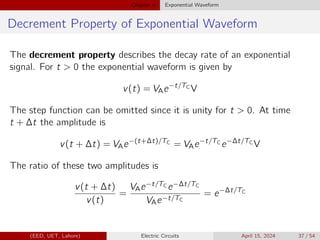
Chapter 5 Exponential Waveform
Decrement Property of Exponential Waveform
The decrement property describes the decay rate of an exponential
signal. For t  0 the exponential waveform is given by
v(t) = VAe−t/TC
V
The step function can be omitted since it is unity for t  0. At time
t + ∆t the amplitude is
v(t + ∆t) = VAe−(t+∆t)/TC
= VAe−t/TC
e−∆t/TC
V
The ratio of these two amplitudes is
v(t + ∆t)
v(t)
=
VAe−t/TC e−∆t/TC
VAe−t/TC
= e−∆t/TC
(EED, UET, Lahore) Electric Circuits April 15, 2024 37 / 54
Chapter 5 Exponential Waveform
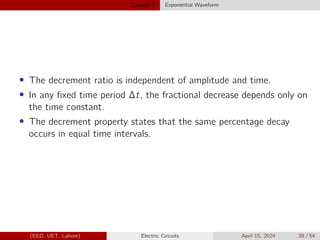
• The decrement ratio is independent of amplitude and time.
• In any fixed time period ∆t, the fractional decrease depends only on
the time constant.
• The decrement property states that the same percentage decay
occurs in equal time intervals.
(EED, UET, Lahore) Electric Circuits April 15, 2024 38 / 54
Chapter 5 Exponential Waveform
Slope Property
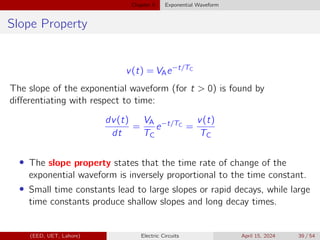
v(t) = VAe−t/TC
The slope of the exponential waveform (for t  0) is found by
differentiating with respect to time:
dv(t)
dt
=
VA
TC
e−t/TC
=
v(t)
TC
• The slope property states that the time rate of change of the
exponential waveform is inversely proportional to the time constant.
• Small time constants lead to large slopes or rapid decays, while large
time constants produce shallow slopes and long decay times.
(EED, UET, Lahore) Electric Circuits April 15, 2024 39 / 54
Chapter 5 Exponential Waveform
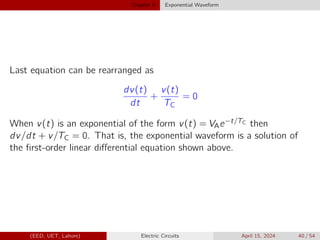
Last equation can be rearranged as
dv(t)
dt
+
v(t)
TC
= 0
When v(t) is an exponential of the form v(t) = VAe−t/TC then
dv/dt + v/TC = 0. That is, the exponential waveform is a solution of
the first-order linear differential equation shown above.
(EED, UET, Lahore) Electric Circuits April 15, 2024 40 / 54
Chapter 5 Exponential Waveform
Time Shifted Exponential
v(t) =
h
VAe−t/TC
i
u(t) V
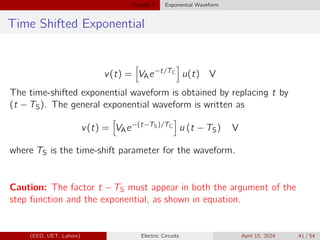
The time-shifted exponential waveform is obtained by replacing t by
(t − TS). The general exponential waveform is written as
v(t) =
h
VAe−(t−TS)/TC
i
u (t − TS) V
where TS is the time-shift parameter for the waveform.
Caution: The factor t − TS must appear in both the argument of the
step function and the exponential, as shown in equation.
(EED, UET, Lahore) Electric Circuits April 15, 2024 41 / 54
Chapter 5 Exponential Waveform
Time Shifted Exponential
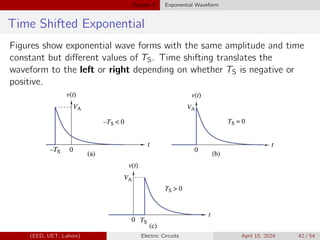
Figures show exponential wave forms with the same amplitude and time
constant but different values of TS. Time shifting translates the
waveform to the left or right depending on whether TS is negative or
positive.
(EED, UET, Lahore) Electric Circuits April 15, 2024 42 / 54
Chapter 5 Exponential Waveform
Example
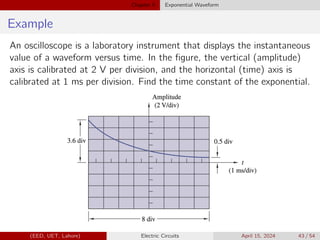
An oscilloscope is a laboratory instrument that displays the instantaneous
value of a waveform versus time. In the figure, the vertical (amplitude)
axis is calibrated at 2 V per division, and the horizontal (time) axis is
calibrated at 1 ms per division. Find the time constant of the exponential.
(EED, UET, Lahore) Electric Circuits April 15, 2024 43 / 54
Chapter 5 Exponential Waveform
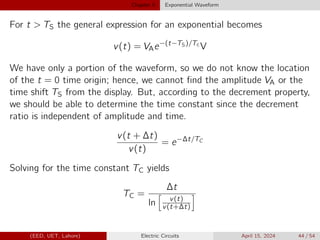
For t  TS the general expression for an exponential becomes
v(t) = VAe−(t−TS)/Tc
V
We have only a portion of the waveform, so we do not know the location
of the t = 0 time origin; hence, we cannot find the amplitude VA or the
time shift TS from the display. But, according to the decrement property,
we should be able to determine the time constant since the decrement
ratio is independent of amplitude and time.
v(t + ∆t)
v(t)
= e−∆t/TC
Solving for the time constant TC yields
TC =
∆t
ln
h
v(t)
v(t+∆t)
i
(EED, UET, Lahore) Electric Circuits April 15, 2024 44 / 54
Chapter 5 Exponential Waveform
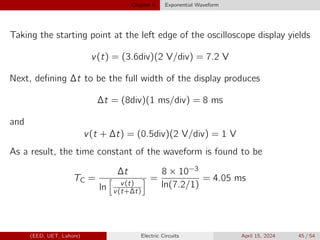
Taking the starting point at the left edge of the oscilloscope display yields
v(t) = (3.6div)(2 V/div) = 7.2 V
Next, defining ∆t to be the full width of the display produces
∆t = (8div)(1 ms/div) = 8 ms
and
v(t + ∆t) = (0.5div)(2 V/div) = 1 V
As a result, the time constant of the waveform is found to be
TC =
∆t
ln
h
v(t)
v(t+∆t)
i =
8 × 10⁻³
ln(7.2/1)
= 4.05 ms
(EED, UET, Lahore) Electric Circuits April 15, 2024 45 / 54
Chapter 5 Exponential Waveform
Example
Figure shows three exponential waveforms. Match each curve with the
appropriate expression.
1 v1(t) = 100e−(t/100µ)u(t − 100µ) V
2 v2(t) = 100e−(t/100µ)u(t) V
3 v3(t) = 100e−[(t−100µ)/100µ]u(t − 100µ) V
(EED, UET, Lahore) Electric Circuits April 15, 2024 46 / 54
Chapter 5 Sinusoidal Waveform
Sinusoidal Waveform
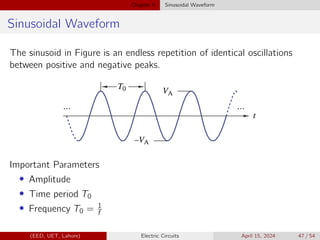
The sinusoid in Figure is an endless repetition of identical oscillations
between positive and negative peaks.
Important Parameters
• Amplitude
• Time period T0
• Frequency T0 = 1
f
(EED, UET, Lahore) Electric Circuits April 15, 2024 47 / 54
Chapter 5 Sinusoidal Waveform
Sinusoidal Waveform
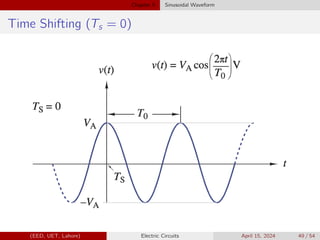
v(t) = VA sin (2πt/T0) V
v(t) = VA cos (2πt/T0) V
The general sinusoid is obtained by replacing t by (t − TS).
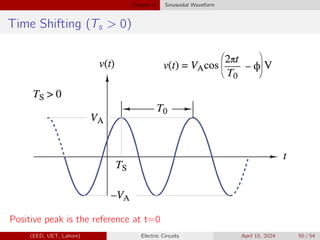
v(t) = VA cos [2π (t − TS) /T0] V
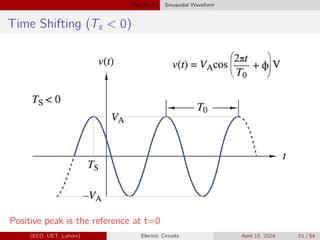
The time-shifting parameter can also be represented by an angle:
v(t) = VA cos [2πt/T0 + φ] V
(EED, UET, Lahore) Electric Circuits April 15, 2024 48 / 54
Chapter 5 Sinusoidal Waveform
Time Shifting (Ts = 0)
(EED, UET, Lahore) Electric Circuits April 15, 2024 49 / 54
Chapter 5 Sinusoidal Waveform
Time Shifting (Ts  0)
Positive peak is the reference at t=0
(EED, UET, Lahore) Electric Circuits April 15, 2024 50 / 54
Chapter 5 Sinusoidal Waveform
Time Shifting (Ts  0)
Positive peak is the reference at t=0
(EED, UET, Lahore) Electric Circuits April 15, 2024 51 / 54
Chapter 5 Sinusoidal Waveform
Phase Angle
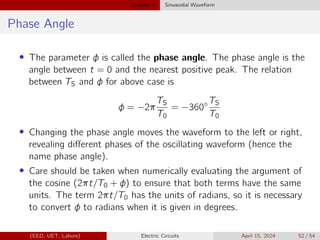
• The parameter φ is called the phase angle. The phase angle is the
angle between t = 0 and the nearest positive peak. The relation
between TS and φ for above case is
φ = −2π
TS
T0
= −360◦ TS
T0
• Changing the phase angle moves the waveform to the left or right,
revealing different phases of the oscillating waveform (hence the
name phase angle).
• Care should be taken when numerically evaluating the argument of
the cosine (2πt/T0 + φ) to ensure that both terms have the same
units. The term 2πt/T0 has the units of radians, so it is necessary
to convert φ to radians when it is given in degrees.
(EED, UET, Lahore) Electric Circuits April 15, 2024 52 / 54
Chapter 5 Sinusoidal Waveform
Alternative Approach
v(t) = VA cos [2πt/T0 + φ] V
Using the identity cos(x + y) = cos(x) cos(y) − sin(x) sin(y),
v(t) = [VA cos φ] cos (2πt/T0) + [−VA sin φ] sin (2πt/T0) V
The quantities inside the brackets are constants; therefore, we can write
the general sinusoid in the following form:
v(t) = a cos (2πt/T0) + b sin (2πt/T0) V
The two amplitude-like parameters a and b have the same units as the
waveform (volts in this case) and are called Fourier coefficients.
a = VA cos φ
b = −VA sin φ
(EED, UET, Lahore) Electric Circuits April 15, 2024 53 / 54
Chapter 5 Sinusoidal Waveform
Thank You
(EED, UET, Lahore) Electric Circuits April 15, 2024 54 / 54

Waveforms EE_100_Chapter_5___Waveforms.pdf

  • 1.
    EE-100 Electric Circuits Lecture22-23 Chapter 5 Department of Electrical Engineering University of Engineering and Technology, Lahore April 15, 2024 (EED, UET, Lahore) Electric Circuits April 15, 2024 1 / 54
  • 2.
    Text Book Chapter 5 StepWaveform Impusle Waveform Ramp Waveform Exponential Waveform Instructors • Dr. Muhammad Asghar Saqib • Ms. Noor Ul Ain (EED, UET, Lahore) Electric Circuits April 15, 2024 2 / 54
  • 3.
    Chapter 5 Waveforms Waveforms Wenormally think of a signal as an electrical current i(t) or voltage v(t). The time variation of the signal is called a waveform. More formally, Definition A waveform is an equation or graph that defines the signal as a function of time. • The three dots at the start of the waveform indicate that the waveform is unchanged from the beginning, while the three dots at the end imply that it will remain the same forever. • Waveforms that are constant for all time are called dc signals. The abbreviation dc stands for direct current, but it applies to either voltage or current. (EED, UET, Lahore) Electric Circuits April 15, 2024 3 / 54
  • 4.
    Chapter 5 Waveforms DCWaveform Mathematical expressions for a dc voltage v(t) or current i(t) take the form v(t) = V0 i(t) = I0 ) for − ∞ < t < ∞ (EED, UET, Lahore) Electric Circuits April 15, 2024 4 / 54
  • 5.
    Chapter 5 Waveforms Notations Thereare two matters of notation and convention. • Quantities that are constant (non-time-varying) are usually represented by uppercase letters (VA, I, TO). • Time-varying electrical quantities are represented by the lowercase letters i, v, p, q, and w. The time variation is expressly indicated when we write these quantities as v1(t), iA(t), or wC(t). Time variation is implicit when they are written as v1, iA, or wC. (EED, UET, Lahore) Electric Circuits April 15, 2024 5 / 54
  • 6.
    Chapter 5 Waveforms Conventions •In a circuit diagram, signal variables are normally accompanied by the reference marks (+, −) for voltage and (→) for current. It is important to remember that these reference marks do not indicate the polarity of a voltage or the direction of current. The marks provide a baseline for determining the sign of the numerical value of the actual waveform. • When the actual voltage polarity or current direction coincides with the reference directions, the signal has a positive value. When the opposite occurs, the value is negative. (EED, UET, Lahore) Electric Circuits April 15, 2024 6 / 54
  • 7.
    Chapter 5 Waveforms Waveforms (EED,UET, Lahore) Electric Circuits April 15, 2024 7 / 54
  • 8.
    Chapter 5 StepWaveform Step Waveform The general step function is based on the unit step function defined as u(t) = ( 0 for t < 0 1 for t ≥ 0 • The step function waveform is equal to zero when its argument t is negative, and is equal to unity when its argument is positive. • Mathematically, the function u(t) has a jump discontinuity at t = 0. (EED, UET, Lahore) Electric Circuits April 15, 2024 8 / 54
  • 9.
    Chapter 5 StepWaveform Physical Aspect (EED, UET, Lahore) Electric Circuits April 15, 2024 9 / 54
  • 10.
    Chapter 5 StepWaveform Scaling and Shifting Multiplying u(t) by a constant VA produces the waveform VAu(t) = ( 0 for t < 0 VA for t ≥ 0 Replacing t by (t − TS) produces a waveform VAu (t − TS), which takes on the values VAu (t − TS) = ( 0 for t < TS VA for t ≥ TS The amplitude VA scales the size of the step discontinuity, and the time-shift parameter TS advances or delays the time at which the step occurs, as shown in Figure in next slide. (EED, UET, Lahore) Electric Circuits April 15, 2024 10 / 54
  • 11.
    Chapter 5 StepWaveform Scaling and Shifting in Step Waveforms (EED, UET, Lahore) Electric Circuits April 15, 2024 11 / 54
  • 12.
    Chapter 5 StepWaveform Practice Sketch the waveforms given by • v(t) = 5u(t + 6) V • i(t) = 2u(t − 1) A (EED, UET, Lahore) Electric Circuits April 15, 2024 12 / 54
  • 13.
    Chapter 5 RectangularFunction Waveforms - Example - Rectangular Function v(t) = 3u(t − 1) − 3u(t − 3)V A generalized rectangular function is given as: v(t) = VA [u (t − T1) − u (t − T2)] (EED, UET, Lahore) Electric Circuits April 15, 2024 13 / 54
  • 14.
    Chapter 5 UnitStep Example Example Write an expression using unit step functions for the waveform in Figure. v(t) = 10u(t + 2) − 15u(t − 2) + 5u(t − 4)V (EED, UET, Lahore) Electric Circuits April 15, 2024 14 / 54
  • 15.
    Chapter 5 UnitArea Pulse Unit Area Pulse A unit-area pulse centered on t = 0 is written in terms of step functions as v(t) = 1 T u t + T 2 − u t − T 2 V • The pulse in equation is zero everywhere except in the range −T/2 ≤ t ≤ T/2, where its value is 1/T. • The area under the pulse is 1 because its scale factor is inversely proportional to its duration. (EED, UET, Lahore) Electric Circuits April 15, 2024 15 / 54
  • 16.
    Chapter 5 UnitImpulse Unit Impulse • The pulse becomes narrower and higher as T decreases but maintains its unit area. • In the limit as T → 0 the scale factor approaches infinity but the area remains 1. • The function obtained in the limit is called a unit impulse, symbolized as δ(t). • The impulse is an idealized model of a large-amplitude, short-duration pulse. (EED, UET, Lahore) Electric Circuits April 15, 2024 16 / 54
  • 17.
    Chapter 5 UnitImpulse Unit Impulse - Graphically (EED, UET, Lahore) Electric Circuits April 15, 2024 17 / 54
  • 18.
    Chapter 5 UnitImpulse Unit Impulse - Formal Definition A formal definition of the unit impulse is δ(t) = 0 for t ̸= 0 and Z t −∞ δ(x)dx = u(t) • The first condition says the impulse is zero everywhere except at t = 0. • The second condition suggests that the unit impulse is the derivative of a unit step function: δ(t) = du(t) dt • unit impulse δ(t) has units of reciprocal time, or s−1. (EED, UET, Lahore) Electric Circuits April 15, 2024 18 / 54
  • 19.
    Chapter 5 UnitImpulse Example The pulse waveform is written as: v(t) = 3u(t − 1) − 3u(t − 3)V Using the derivative property of the step function, we write dv(t) dt = 3δ(t − 1) − 3δ(t − 3)V/s (EED, UET, Lahore) Electric Circuits April 15, 2024 19 / 54
  • 20.
    Chapter 5 Impulse Practice Sketchthe waveforms for • δ(t − 2) • δ(t + 3) • 5δ(t − 4) (EED, UET, Lahore) Electric Circuits April 15, 2024 20 / 54
  • 21.
    Chapter 5 UnitRamp Unit Ramp Waveform The unit ramp is defined as the integral of a step function: r(t) = Z t −∞ u(x)dx = tu(t) • The unit ramp waveform r(t) is zero for t 0 and is equal to t for t 0. • The slope of r(t) is 1 and has the units of time, or s. (EED, UET, Lahore) Electric Circuits April 15, 2024 21 / 54
  • 22.
    Chapter 5 Ramp Scalingand Time Shifting • A ramp of strength K is denoted v(t) = Kr(t), where the scale factor K has the units of V/s and is the slope of the ramp. • The general ramp waveform shown in Figure, written as v(t) = Kr (t − TS), is zero for t TS and equal to K (t − TS) for t ≥ TS. • By adding a sequence of ramps, we can create the triangular and sawtooth waveforms. (EED, UET, Lahore) Electric Circuits April 15, 2024 22 / 54
  • 23.
    Chapter 5 SingularityFunctions Singularity Functions The unit impulse, unit step, and unit ramp form a triad of related signals that are referred to as singularity functions. They are related by integration as u(t) = Z t −∞ δ(x)dx r(t) = Z t −∞ u(x)dx or by differentiation as δ(t) = du(t) dt u(t) = dr(t) dt (EED, UET, Lahore) Electric Circuits April 15, 2024 23 / 54
  • 24.
    Chapter 5 SingularityFunctions Singularity Functions • These signals are used to generate other waveforms and as test inputs to linear systems to characterize their responses. • When applying the singularity functions in circuit analysis, it is important to remember that u(t) is a dimensionless function. • δ(t) carries the units of s−1 and r(t) carries units of seconds. (EED, UET, Lahore) Electric Circuits April 15, 2024 24 / 54
  • 25.
    Chapter 5 SingularityFunctions Example The pulse waveform is written as: v(t) = 3u(t − 1) − 3u(t − 3)V Using the integration property of the step function, we write Z t −∞ v(x)dx = 3r(t − 1) − 3r(t − 3) The integral is zero for t 1 s. For 1 t 3 the waveform is 3(t − 1). For t 3 it is 3(t − 1) − 3(t − 3) = 6. (EED, UET, Lahore) Electric Circuits April 15, 2024 25 / 54
  • 26.
    Chapter 5 SingularityFunctions Example Write an expression using ramp functions to describe the waveform shown in Figure. Answer: v(t) = r(t + 1) − 2r(t − 1) + r(t − 3)V (EED, UET, Lahore) Electric Circuits April 15, 2024 26 / 54
  • 27.
    Chapter 5 SingularityFunctions Example (EED, UET, Lahore) Electric Circuits April 15, 2024 27 / 54
  • 28.
    Chapter 5 SingularityFunctions vO(t) =      0 t 1 2t 1 t 3 0 3 t In terms of gate function: vO(t) = 2t[u(t − 1) − u(t − 3)] | {z } Gate function (EED, UET, Lahore) Electric Circuits April 15, 2024 28 / 54
  • 29.
    Chapter 5 SingularityFunctions vO(t) = 2tu(t − 1) − 2tu(t − 3) = 2(t − 1 + 1)u(t − 1) − 2(t − 3 + 3)u(t − 3) = 2(t − 1)u(t − 1) | {z } r(t−1) +2u(t − 1) − 2(t − 3)u(t − 3) | {z } r(t−3) −6u(t − 3) vO(t) = 2r(t − 1) + 2u(t − 1) − 2r(t − 3) − 6u(t − 3) (EED, UET, Lahore) Electric Circuits April 15, 2024 29 / 54
  • 30.
    Chapter 5 SingularityFunctions Exercise Sketch and Express the following signals in terms of singularity functions: • v1(t) =      0 t 2 4 2 t 4 −4 4 t • v2(t) =      0 t 2 4 2 t 4 −2t + 12 4 t • v3(t) = R t −∞ v1(x)dx • v4(t) = dv2(t) dt (EED, UET, Lahore) Electric Circuits April 15, 2024 30 / 54
  • 31.
    Chapter 5 SingularityFunctions Answers: 1 v1(t) = 4u(t − 2) − 8u(t − 4) 2 v2(t) = 4u(t − 2) − 2r(t − 4) 3 v3(t) = 4r(t − 2) − 8r(t − 4) 4 v4(t) = 4δ(t − 2) − 2u(t − 4) (EED, UET, Lahore) Electric Circuits April 15, 2024 31 / 54
  • 32.
    Chapter 5 ExponentialWaveform Exponential Waveform The exponential waveform is a step function whose amplitude factor gradually decays to zero. The equation for this waveform is v(t) = h VAe−t/TC i u(t) (EED, UET, Lahore) Electric Circuits April 15, 2024 32 / 54
  • 33.
    Chapter 5 ExponentialWaveform Exponential Waveform • It is zero for t 0 and jumps to a maximum amplitude of VA at t = 0. • Thereafter it monotonically decays toward zero as time marches on. • The two parameters that define the waveform are the amplitude VA (in volts) and the time constant TC (in seconds). • Time Constant: The time constant is of special interest, since it determines the rate at which the waveform decays to zero. • An exponential decays to about 36.8% of its initial amplitude v(0) = VA in one time constant, because at t = TC, v (TC) = VAe−1, or approximately 0.368 × VA. • At t = 5TC, the value of the waveform is VAe−5, or approximately 0.00674VA. An exponential signal decays to less than 1% of its initial amplitude in a time span of five time constants (EED, UET, Lahore) Electric Circuits April 15, 2024 33 / 54
  • 34.
    Chapter 5 ExponentialWaveform Exponential Waveform – Construction (EED, UET, Lahore) Electric Circuits April 15, 2024 34 / 54
  • 35.
    Chapter 5 ExponentialWaveform Example Plot the waveform v(t) = −17e−100t u(t)V. (EED, UET, Lahore) Electric Circuits April 15, 2024 35 / 54
  • 36.
    Chapter 5 ExponentialWaveform Example Sketch the waveform described by v(t) = 20e−10,000t u(t)V (EED, UET, Lahore) Electric Circuits April 15, 2024 36 / 54
  • 37.
    Chapter 5 ExponentialWaveform Decrement Property of Exponential Waveform The decrement property describes the decay rate of an exponential signal. For t 0 the exponential waveform is given by v(t) = VAe−t/TC V The step function can be omitted since it is unity for t 0. At time t + ∆t the amplitude is v(t + ∆t) = VAe−(t+∆t)/TC = VAe−t/TC e−∆t/TC V The ratio of these two amplitudes is v(t + ∆t) v(t) = VAe−t/TC e−∆t/TC VAe−t/TC = e−∆t/TC (EED, UET, Lahore) Electric Circuits April 15, 2024 37 / 54
  • 38.
    Chapter 5 ExponentialWaveform • The decrement ratio is independent of amplitude and time. • In any fixed time period ∆t, the fractional decrease depends only on the time constant. • The decrement property states that the same percentage decay occurs in equal time intervals. (EED, UET, Lahore) Electric Circuits April 15, 2024 38 / 54
  • 39.
    Chapter 5 ExponentialWaveform Slope Property v(t) = VAe−t/TC The slope of the exponential waveform (for t 0) is found by differentiating with respect to time: dv(t) dt = VA TC e−t/TC = v(t) TC • The slope property states that the time rate of change of the exponential waveform is inversely proportional to the time constant. • Small time constants lead to large slopes or rapid decays, while large time constants produce shallow slopes and long decay times. (EED, UET, Lahore) Electric Circuits April 15, 2024 39 / 54
  • 40.
    Chapter 5 ExponentialWaveform Last equation can be rearranged as dv(t) dt + v(t) TC = 0 When v(t) is an exponential of the form v(t) = VAe−t/TC then dv/dt + v/TC = 0. That is, the exponential waveform is a solution of the first-order linear differential equation shown above. (EED, UET, Lahore) Electric Circuits April 15, 2024 40 / 54
  • 41.
    Chapter 5 ExponentialWaveform Time Shifted Exponential v(t) = h VAe−t/TC i u(t) V The time-shifted exponential waveform is obtained by replacing t by (t − TS). The general exponential waveform is written as v(t) = h VAe−(t−TS)/TC i u (t − TS) V where TS is the time-shift parameter for the waveform. Caution: The factor t − TS must appear in both the argument of the step function and the exponential, as shown in equation. (EED, UET, Lahore) Electric Circuits April 15, 2024 41 / 54
  • 42.
    Chapter 5 ExponentialWaveform Time Shifted Exponential Figures show exponential wave forms with the same amplitude and time constant but different values of TS. Time shifting translates the waveform to the left or right depending on whether TS is negative or positive. (EED, UET, Lahore) Electric Circuits April 15, 2024 42 / 54
  • 43.
    Chapter 5 ExponentialWaveform Example An oscilloscope is a laboratory instrument that displays the instantaneous value of a waveform versus time. In the figure, the vertical (amplitude) axis is calibrated at 2 V per division, and the horizontal (time) axis is calibrated at 1 ms per division. Find the time constant of the exponential. (EED, UET, Lahore) Electric Circuits April 15, 2024 43 / 54
  • 44.
    Chapter 5 ExponentialWaveform For t TS the general expression for an exponential becomes v(t) = VAe−(t−TS)/Tc V We have only a portion of the waveform, so we do not know the location of the t = 0 time origin; hence, we cannot find the amplitude VA or the time shift TS from the display. But, according to the decrement property, we should be able to determine the time constant since the decrement ratio is independent of amplitude and time. v(t + ∆t) v(t) = e−∆t/TC Solving for the time constant TC yields TC = ∆t ln h v(t) v(t+∆t) i (EED, UET, Lahore) Electric Circuits April 15, 2024 44 / 54
  • 45.
    Chapter 5 ExponentialWaveform Taking the starting point at the left edge of the oscilloscope display yields v(t) = (3.6div)(2 V/div) = 7.2 V Next, defining ∆t to be the full width of the display produces ∆t = (8div)(1 ms/div) = 8 ms and v(t + ∆t) = (0.5div)(2 V/div) = 1 V As a result, the time constant of the waveform is found to be TC = ∆t ln h v(t) v(t+∆t) i = 8 × 10⁻³ ln(7.2/1) = 4.05 ms (EED, UET, Lahore) Electric Circuits April 15, 2024 45 / 54
  • 46.
    Chapter 5 ExponentialWaveform Example Figure shows three exponential waveforms. Match each curve with the appropriate expression. 1 v1(t) = 100e−(t/100µ)u(t − 100µ) V 2 v2(t) = 100e−(t/100µ)u(t) V 3 v3(t) = 100e−[(t−100µ)/100µ]u(t − 100µ) V (EED, UET, Lahore) Electric Circuits April 15, 2024 46 / 54
  • 47.
    Chapter 5 SinusoidalWaveform Sinusoidal Waveform The sinusoid in Figure is an endless repetition of identical oscillations between positive and negative peaks. Important Parameters • Amplitude • Time period T0 • Frequency T0 = 1 f (EED, UET, Lahore) Electric Circuits April 15, 2024 47 / 54
  • 48.
    Chapter 5 SinusoidalWaveform Sinusoidal Waveform v(t) = VA sin (2πt/T0) V v(t) = VA cos (2πt/T0) V The general sinusoid is obtained by replacing t by (t − TS). v(t) = VA cos [2π (t − TS) /T0] V The time-shifting parameter can also be represented by an angle: v(t) = VA cos [2πt/T0 + φ] V (EED, UET, Lahore) Electric Circuits April 15, 2024 48 / 54
  • 49.
    Chapter 5 SinusoidalWaveform Time Shifting (Ts = 0) (EED, UET, Lahore) Electric Circuits April 15, 2024 49 / 54
  • 50.
    Chapter 5 SinusoidalWaveform Time Shifting (Ts 0) Positive peak is the reference at t=0 (EED, UET, Lahore) Electric Circuits April 15, 2024 50 / 54
  • 51.
    Chapter 5 SinusoidalWaveform Time Shifting (Ts 0) Positive peak is the reference at t=0 (EED, UET, Lahore) Electric Circuits April 15, 2024 51 / 54
  • 52.
    Chapter 5 SinusoidalWaveform Phase Angle • The parameter φ is called the phase angle. The phase angle is the angle between t = 0 and the nearest positive peak. The relation between TS and φ for above case is φ = −2π TS T0 = −360◦ TS T0 • Changing the phase angle moves the waveform to the left or right, revealing different phases of the oscillating waveform (hence the name phase angle). • Care should be taken when numerically evaluating the argument of the cosine (2πt/T0 + φ) to ensure that both terms have the same units. The term 2πt/T0 has the units of radians, so it is necessary to convert φ to radians when it is given in degrees. (EED, UET, Lahore) Electric Circuits April 15, 2024 52 / 54
  • 53.
    Chapter 5 SinusoidalWaveform Alternative Approach v(t) = VA cos [2πt/T0 + φ] V Using the identity cos(x + y) = cos(x) cos(y) − sin(x) sin(y), v(t) = [VA cos φ] cos (2πt/T0) + [−VA sin φ] sin (2πt/T0) V The quantities inside the brackets are constants; therefore, we can write the general sinusoid in the following form: v(t) = a cos (2πt/T0) + b sin (2πt/T0) V The two amplitude-like parameters a and b have the same units as the waveform (volts in this case) and are called Fourier coefficients. a = VA cos φ b = −VA sin φ (EED, UET, Lahore) Electric Circuits April 15, 2024 53 / 54
  • 54.
    Chapter 5 SinusoidalWaveform Thank You (EED, UET, Lahore) Electric Circuits April 15, 2024 54 / 54