Compare the representation of women in two music videos of your choice
The topic I will be covering in this essay is how women are represented in two separate
music videos, from separate artists. I will be discussing The Only Exception by Paramore, and
Salute by Little Mix. The Only Exception is a narrative music video, telling the viewers about
a girl and what is going on with her life within the video, and Salute is a performance video,
mainly involving dancing, with no acting.
Little Mix is a group of four girls that were randomly paired together as a group during the
2011 season of the UK’s X Factor, and have become successful all around the world,
completing several tours and opening for Ariana Grande on her tour. The girls in the band
are Perrie, Leigh-Anne, Jade and Jesy. Their videos are usually very feminine and are all in
the pop genre. They also usually like to wear clothes that make them comfortable but are
also quite feminine and emphasise their bodies, as they feel they like to show their
confidence within their videos. Little Mix has been seen as controversial in the past due to
their revealing outfits, but tend to stay out of scandals and are quite likeable. Their target
audience seems to be teenagers and up.
Paramore is a group of several men and one woman, who grouped together in 2004 and are
known for making alternative music. Their target audience varies, but I do not believe it is
suitable for young children and the elderly, as alternative music can sometimes be loud.
They usually produce strange, as I have said, alternative videos, with topics you would not
usually see covered by a mainstream artist (for example, Justin Bieber or Fifth Harmony).
They represent women in a positive light
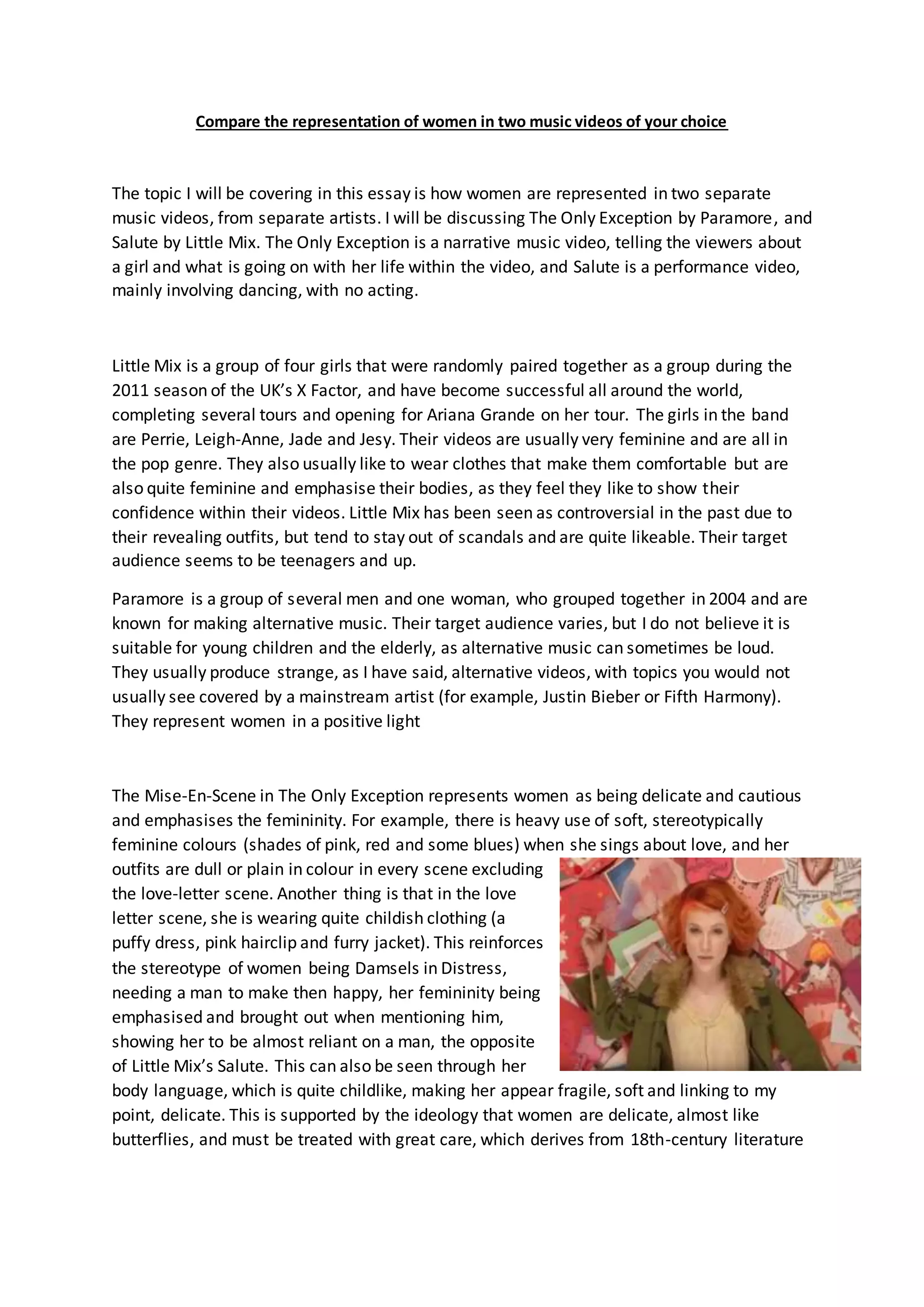
The Mise-En-Scene in The Only Exception represents women as being delicate and cautious
and emphasises the femininity. For example, there is heavy use of soft, stereotypically
feminine colours (shades of pink, red and some blues) when she sings about love, and her
outfits are dull or plain in colour in every scene excluding
the love-letter scene. Another thing is that in the love
letter scene, she is wearing quite childish clothing (a
puffy dress, pink hairclip and furry jacket). This reinforces
the stereotype of women being Damsels in Distress,
needing a man to make then happy, her femininity being
emphasised and brought out when mentioning him,
showing her to be almost reliant on a man, the opposite
of Little Mix’s Salute. This can also be seen through her
body language, which is quite childlike, making her appear fragile, soft and linking to my
point, delicate. This is supported by the ideology that women are delicate, almost like
butterflies, and must be treated with great care, which derives from 18th-century literature
and modern television. This supports my point, and shows contrast to Salute, as the girls
show that they don’t need a man to get by, unlike what is inferred by this video.
The Mise-En-Scene within Salute represents women as authoritative and dominant. We can
find evidence of this in the video, for example during the beginning they are seen holding
men on leashes and pulling them along as they move. This
subverts the nature of patriarchy, as they are the ones
controlling the men and showing dominance. It also links to
their aggressive body language and the props used (for
example, soldier helmets, tyres, bright lights and
construction vehicles). Another example for this would be
the location, makeup and outfits, all of which are dark and
mainly consist of black, silver or gold. The location seems to
be an abandoned construction site at night, and all of the clothes (excluding the men’s) are
quite revealing. This connotes a sense of authority to the audience, especially as they all
wear varying outfits, whilst the men wear the same
clothes, causing the girls to stand out even more. Whilst
some may believe their provocative outfits are there to
please the Male Gaze, the girls have openly stated that
they dress how they want to, and not to impress men.
Another thing that shows their dominance and authority
is their facial expressions, and how they are not afraid to
make eye contact and get up close to the camera,
showing off their power to the viewers. In conclusion,
the Mise-En-Scene, mainly outfits, body language,
expressions, location and makeup represent women as authoritative and dominant, a stark
contrast to the Mise-En-Scene in The Only Exception.
The camerawork in The Only Exception represents women as emotionally unstable and
stubborn. For example, the constant change of emotions that comes with the constant
change of scenery, linking to the Mise-En-Scene in terms of facial expressions and location.
This is shown by how sad she looks when leaving her boyfriend but
instantly becomes happy in the next scene. This
links to the ideology held by men that women have
constant mood swings and are often uncontrollable
within relationships. In terms of stubbornness, this
is shown in a final close-up shot where she admits
she’s “on her way to believing” but avoids eye
contact with the camera, turning her face to the
side. This reinforces the ideology that women are stubborn in relationships, as when she
admits to falling in love, she turns away as if she is too
stubborn to admit she was wrong, whereas if this
happened in Salute, the girls would not be afraid to say to
someone’s face that they were wrong. Therefore, this
represents women as stubborn and emotionally unstable.
The camerawork in Salute constructs the representation of women being assertive and
powerful. This is evident in the video through the use of wide shots and close-ups when
being introduced to the girls, linking to location. This communicates to the audience the
message that they are the most important people in the video,
every shot and close-up (excluding one)
involving them, getting in your face and showing
their status. It also shows a close-up of a man,
showing that they are dominant within the
video. This can also be seen by the fact that
every close-up only involves their face, or at the very least their upper
body. This communicates that they do not feel the need to use their
sexuality to show dominance, and yes they dress provocatively, but that has nothing to do
with what they’re doing or saying. This links back to my point; that women are represented
as assertive and powerful within the video.
The use of sound in The Only Exception represents women as fragile and cautious. For
example, in the video, there is a scene in the beginning where she writes a note for her
boyfriend and leaves, looking regretful, which leads on to the lyrics “When I was younger I
saw my daddy cry and curse at the wind”. Audiences may interpret
this as patriarchy and dominance, as when giving a reason as to why
she’s “sorry” and has walked away from her relationship, she first
uses her father’s heartbreak, a male figure in her life. Another
example is the music remains soft until halfway through, where it
reaches the more low-key lit scenes, and then becomes louder and
more confident as she remembers being with and meeting him. This
constructs this representation because she only becomes more
confident when the remembers her time with her boyfriend, showing her as weak, and
fragile, and having low confidence in herself and her love life. This reinforces the stereotype
of women being fragile and cautious when it comes to love, and often other situations too.
In Salute, the sound and video itself represent women as rebellious and strong. When the
music begins to play, it is soft but has sirens going off loudly as it shows us the girls faces,
some of which make eye contact with the camera. This presents women as rebellious and
strong, connoted by the sirens that go off as we initially see the girls, who act calmly and
make eye contact with the camera, almost challenging us. When it shows Leigh-Anne on the
armchair, she maintains eye contact throughout, where she sings “Ladies we are
everywhere, warriors your country needs you if you’re ready ladies better keep steady
ready aim shoot” and “divas, queens, we don’t need no man”. This constructs the
representation because the lyrics are almost hostile, which is highlighted through the eye
contact, showing dominance and power, linking to “Divas, queens”, linking to female
stereotypes within television and film, where women usually are seen as divas and
constantly go after a man. Therefore, this represents women as strong, rebellious and
dominant.
Within The Only Exception, women are clearly represented as fragile,
as this is portrayed through the editing. This is illustrated through the
use of the fast-paced filming, showing her running away from her
problems (for example, the dates and wedding). This connotes that
she is afraid of love and/or being in a relationship, and runs away
from her problems, portraying her as fragile and vulnerable. This can
also be seen through the cut to black and the use of blurring,
introducing us to her in the love letter scene, and blurring out
everything that isn’t love-related or her. This communicates to the
audience the message that she wants love but is afraid to get hurt,
linking to the Damsel in Distress stereotype, as if the is the Damsel in
Distress of her own mind and heart, running from something she
wants so dearly. This represents women as fragile in heart and mind.
The editing in Salute presents women as confident and in control. This is shown through the
use of cutting to the beat in the beginning of the video, where we are seeing the girls faces
first. Audiences may interpret this as them being in control, where the abrupt cutting-to-
the-beat could signify that they are done negotiating their issues and are taking charge, all
whilst remaining “stony-faced”. This can also be shown through the way the camera shakes
when they all dance, and lights start to flash. This links to the phrase “ground-breaking
revolution”, as their control within the video causes the entire scene to shake, linking to the
confidence as well and their refusal to back down, subverting the “Damsel in Distress”
stereotype that is commonly seen in music videos by female and male artists, including
Paramore’s The Only Exception. This representation of women overall within the video and
shown by the editing is that women are more in control than ever, leading governments and
uniting against sexism.
After assessing the representation of women in both videos, I have learnt that despite
sexismbeing on its way out of our society, there is still a lot more work that needs to be
done, especially with the current changes in politics. I feel that the representation of women
overall in both videos, was quite good, even if The Only Exception showed us to be quite
emotionally fragile, which sometimes, we are. I think the representation of women in The
Only Exception will have a neutral impact on audiences, as it is not as risqué as a lot of the
videos you would find online, and I believe Little Mix’s Salute would have a positive impact
on audiences, making us want to unite more and make the world a better place for both
genders. This makes me feel that the power of the media is incredibly strong, and influences
how society thinks, but is also heavily influenced by what society thinks, which creates a sort
of bitter cycle. The modern media has started to embrace feminism and political views
much more than it did in the past, if anything supporting them now (for example, Katy
Perry’s new song Chained To The Rhythm comes with an extremely controversial video, that
overall has been widely embraced by social media outlets, news sites and the public around
the world).

C grade 2

  • 1.
    Compare the representationof women in two music videos of your choice The topic I will be covering in this essay is how women are represented in two separate music videos, from separate artists. I will be discussing The Only Exception by Paramore, and Salute by Little Mix. The Only Exception is a narrative music video, telling the viewers about a girl and what is going on with her life within the video, and Salute is a performance video, mainly involving dancing, with no acting. Little Mix is a group of four girls that were randomly paired together as a group during the 2011 season of the UK’s X Factor, and have become successful all around the world, completing several tours and opening for Ariana Grande on her tour. The girls in the band are Perrie, Leigh-Anne, Jade and Jesy. Their videos are usually very feminine and are all in the pop genre. They also usually like to wear clothes that make them comfortable but are also quite feminine and emphasise their bodies, as they feel they like to show their confidence within their videos. Little Mix has been seen as controversial in the past due to their revealing outfits, but tend to stay out of scandals and are quite likeable. Their target audience seems to be teenagers and up. Paramore is a group of several men and one woman, who grouped together in 2004 and are known for making alternative music. Their target audience varies, but I do not believe it is suitable for young children and the elderly, as alternative music can sometimes be loud. They usually produce strange, as I have said, alternative videos, with topics you would not usually see covered by a mainstream artist (for example, Justin Bieber or Fifth Harmony). They represent women in a positive light The Mise-En-Scene in The Only Exception represents women as being delicate and cautious and emphasises the femininity. For example, there is heavy use of soft, stereotypically feminine colours (shades of pink, red and some blues) when she sings about love, and her outfits are dull or plain in colour in every scene excluding the love-letter scene. Another thing is that in the love letter scene, she is wearing quite childish clothing (a puffy dress, pink hairclip and furry jacket). This reinforces the stereotype of women being Damsels in Distress, needing a man to make then happy, her femininity being emphasised and brought out when mentioning him, showing her to be almost reliant on a man, the opposite of Little Mix’s Salute. This can also be seen through her body language, which is quite childlike, making her appear fragile, soft and linking to my point, delicate. This is supported by the ideology that women are delicate, almost like butterflies, and must be treated with great care, which derives from 18th-century literature
  • 2.
    and modern television.This supports my point, and shows contrast to Salute, as the girls show that they don’t need a man to get by, unlike what is inferred by this video. The Mise-En-Scene within Salute represents women as authoritative and dominant. We can find evidence of this in the video, for example during the beginning they are seen holding men on leashes and pulling them along as they move. This subverts the nature of patriarchy, as they are the ones controlling the men and showing dominance. It also links to their aggressive body language and the props used (for example, soldier helmets, tyres, bright lights and construction vehicles). Another example for this would be the location, makeup and outfits, all of which are dark and mainly consist of black, silver or gold. The location seems to be an abandoned construction site at night, and all of the clothes (excluding the men’s) are quite revealing. This connotes a sense of authority to the audience, especially as they all wear varying outfits, whilst the men wear the same clothes, causing the girls to stand out even more. Whilst some may believe their provocative outfits are there to please the Male Gaze, the girls have openly stated that they dress how they want to, and not to impress men. Another thing that shows their dominance and authority is their facial expressions, and how they are not afraid to make eye contact and get up close to the camera, showing off their power to the viewers. In conclusion, the Mise-En-Scene, mainly outfits, body language, expressions, location and makeup represent women as authoritative and dominant, a stark contrast to the Mise-En-Scene in The Only Exception. The camerawork in The Only Exception represents women as emotionally unstable and stubborn. For example, the constant change of emotions that comes with the constant change of scenery, linking to the Mise-En-Scene in terms of facial expressions and location. This is shown by how sad she looks when leaving her boyfriend but instantly becomes happy in the next scene. This links to the ideology held by men that women have constant mood swings and are often uncontrollable within relationships. In terms of stubbornness, this is shown in a final close-up shot where she admits she’s “on her way to believing” but avoids eye contact with the camera, turning her face to the side. This reinforces the ideology that women are stubborn in relationships, as when she
  • 3.
    admits to fallingin love, she turns away as if she is too stubborn to admit she was wrong, whereas if this happened in Salute, the girls would not be afraid to say to someone’s face that they were wrong. Therefore, this represents women as stubborn and emotionally unstable. The camerawork in Salute constructs the representation of women being assertive and powerful. This is evident in the video through the use of wide shots and close-ups when being introduced to the girls, linking to location. This communicates to the audience the message that they are the most important people in the video, every shot and close-up (excluding one) involving them, getting in your face and showing their status. It also shows a close-up of a man, showing that they are dominant within the video. This can also be seen by the fact that every close-up only involves their face, or at the very least their upper body. This communicates that they do not feel the need to use their sexuality to show dominance, and yes they dress provocatively, but that has nothing to do with what they’re doing or saying. This links back to my point; that women are represented as assertive and powerful within the video. The use of sound in The Only Exception represents women as fragile and cautious. For example, in the video, there is a scene in the beginning where she writes a note for her boyfriend and leaves, looking regretful, which leads on to the lyrics “When I was younger I saw my daddy cry and curse at the wind”. Audiences may interpret this as patriarchy and dominance, as when giving a reason as to why she’s “sorry” and has walked away from her relationship, she first uses her father’s heartbreak, a male figure in her life. Another example is the music remains soft until halfway through, where it reaches the more low-key lit scenes, and then becomes louder and more confident as she remembers being with and meeting him. This constructs this representation because she only becomes more confident when the remembers her time with her boyfriend, showing her as weak, and fragile, and having low confidence in herself and her love life. This reinforces the stereotype of women being fragile and cautious when it comes to love, and often other situations too. In Salute, the sound and video itself represent women as rebellious and strong. When the music begins to play, it is soft but has sirens going off loudly as it shows us the girls faces, some of which make eye contact with the camera. This presents women as rebellious and strong, connoted by the sirens that go off as we initially see the girls, who act calmly and make eye contact with the camera, almost challenging us. When it shows Leigh-Anne on the
  • 4.
    armchair, she maintainseye contact throughout, where she sings “Ladies we are everywhere, warriors your country needs you if you’re ready ladies better keep steady ready aim shoot” and “divas, queens, we don’t need no man”. This constructs the representation because the lyrics are almost hostile, which is highlighted through the eye contact, showing dominance and power, linking to “Divas, queens”, linking to female stereotypes within television and film, where women usually are seen as divas and constantly go after a man. Therefore, this represents women as strong, rebellious and dominant. Within The Only Exception, women are clearly represented as fragile, as this is portrayed through the editing. This is illustrated through the use of the fast-paced filming, showing her running away from her problems (for example, the dates and wedding). This connotes that she is afraid of love and/or being in a relationship, and runs away from her problems, portraying her as fragile and vulnerable. This can also be seen through the cut to black and the use of blurring, introducing us to her in the love letter scene, and blurring out everything that isn’t love-related or her. This communicates to the audience the message that she wants love but is afraid to get hurt, linking to the Damsel in Distress stereotype, as if the is the Damsel in Distress of her own mind and heart, running from something she wants so dearly. This represents women as fragile in heart and mind. The editing in Salute presents women as confident and in control. This is shown through the use of cutting to the beat in the beginning of the video, where we are seeing the girls faces first. Audiences may interpret this as them being in control, where the abrupt cutting-to- the-beat could signify that they are done negotiating their issues and are taking charge, all whilst remaining “stony-faced”. This can also be shown through the way the camera shakes when they all dance, and lights start to flash. This links to the phrase “ground-breaking revolution”, as their control within the video causes the entire scene to shake, linking to the confidence as well and their refusal to back down, subverting the “Damsel in Distress” stereotype that is commonly seen in music videos by female and male artists, including Paramore’s The Only Exception. This representation of women overall within the video and shown by the editing is that women are more in control than ever, leading governments and uniting against sexism. After assessing the representation of women in both videos, I have learnt that despite sexismbeing on its way out of our society, there is still a lot more work that needs to be done, especially with the current changes in politics. I feel that the representation of women overall in both videos, was quite good, even if The Only Exception showed us to be quite emotionally fragile, which sometimes, we are. I think the representation of women in The Only Exception will have a neutral impact on audiences, as it is not as risqué as a lot of the
  • 5.
    videos you wouldfind online, and I believe Little Mix’s Salute would have a positive impact on audiences, making us want to unite more and make the world a better place for both genders. This makes me feel that the power of the media is incredibly strong, and influences how society thinks, but is also heavily influenced by what society thinks, which creates a sort of bitter cycle. The modern media has started to embrace feminism and political views much more than it did in the past, if anything supporting them now (for example, Katy Perry’s new song Chained To The Rhythm comes with an extremely controversial video, that overall has been widely embraced by social media outlets, news sites and the public around the world).