C++ Examples &Revisions
Hurts - Wonderful Life
Lecture 5
One Dimension Arrays
• // arrays example
• #include <iostream>
• using namespace std;
• int billy [] = {16, 2, 77, 40, 12071};
• int n, result=0;
• int main ()
• {
• for ( n=0 ; n<5 ; n++ )
• {
• result += billy[n];
• }
• cout << result; return 0;
• }
• Output
• 12206
•
Arrays as parameters
• #include <iostream>
• using namespace std;
• void printarray (int arg[], int length)
• {
• for (int n=0; n<length; n++)
• cout << arg[n] << " ";
• cout << "n";
• }
• int main ()
{
int firstarray[] = {5, 10, 15};
int secondarray[] = {2, 4, 6, 8, 10};
printarray (firstarray,3);
printarray (secondarray,5);
return 0;
}
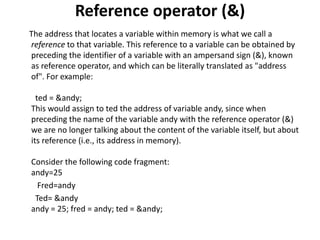
Reference operator (&)
The address that locates a variable within memory is what we call a
reference to that variable. This reference to a variable can be obtained by
preceding the identifier of a variable with an ampersand sign (&), known
as reference operator, and which can be literally translated as "address
of". For example:
ted = &andy;
This would assign to ted the address of variable andy, since when
preceding the name of the variable andy with the reference operator (&)
we are no longer talking about the content of the variable itself, but about
its reference (i.e., its address in memory).
Consider the following code fragment:
andy=25
Fred=andy
Ted= &andy
andy = 25; fred = andy; ted = &andy;
Cont’d
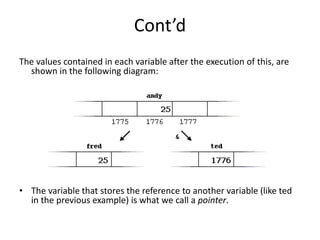
The values contained in each variable after the execution of this, are
shown in the following diagram:
• The variable that stores the reference to another variable (like ted
in the previous example) is what we call a pointer.
Dereference operator (*)
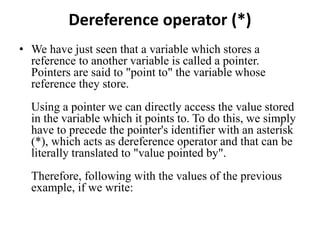
• We have just seen that a variable which stores a
reference to another variable is called a pointer.
Pointers are said to "point to" the variable whose
reference they store.
Using a pointer we can directly access the value stored
in the variable which it points to. To do this, we simply
have to precede the pointer's identifier with an asterisk
(*), which acts as dereference operator and that can be
literally translated to "value pointed by".
Therefore, following with the values of the previous
example, if we write:
Cont’d
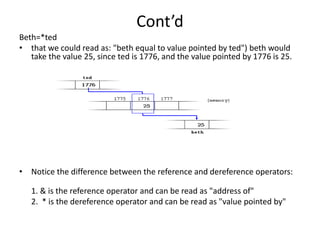
Beth=*ted
• that we could read as: "beth equal to value pointed by ted") beth would
take the value 25, since ted is 1776, and the value pointed by 1776 is 25.
• Notice the difference between the reference and dereference operators:
1. & is the reference operator and can be read as "address of"
2. * is the dereference operator and can be read as "value pointed by"
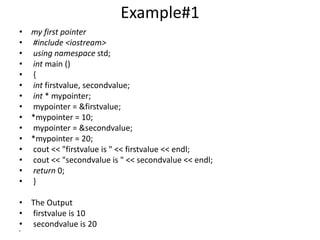
Example#1
• my first pointer
• #include <iostream>
• using namespace std;
• int main ()
• {
• int firstvalue, secondvalue;
• int * mypointer;
• mypointer = &firstvalue;
• *mypointer = 10;
• mypointer = &secondvalue;
• *mypointer = 20;
• cout << "firstvalue is " << firstvalue << endl;
• cout << "secondvalue is " << secondvalue << endl;
• return 0;
• }
• The Output
• firstvalue is 10
• secondvalue is 20
•
Example#2
• // more pointers
• #include <iostream>
• using namespace std;
• int main ()
• {
• int numbers[5];
• int * p;
• p = numbers;
• *p = 10;
• p++;
• *p = 20;
• p = &numbers[2];
• *p = 30;
• p = numbers + 3;
• *p = 40;
• p = numbers;
• *(p+4) = 50;
• for (int n=0; n<5; n++)
• {
• cout << numbers[n] << ", "; }
• }
• return 0;
• }
• The Output
• 10, 20, 30, 40, 50,
•
Arrays
• #include <iostream>
• using namespace std;
• void main()
• {
• int Nums[4];
• int Sum=0;
• cout<<"Enter 4 Numbers :n";
• for(int i=0;i<4;i++)
• cin>>Nums[i];
• for(int j=0;j<4;j++)
• Sum+=Nums[j];
• cout<<"Sum = "<<Sum<<endl;
• }
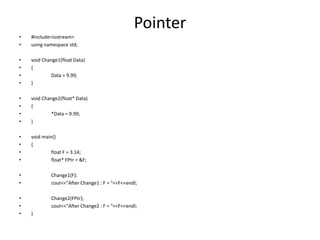
Pointer
• #include<iostream>
• using namespace std;
• void Change1(float Data)
• {
• Data = 9.99;
• }
• void Change2(float* Data)
• {
• *Data = 9.99;
• }
• void main()
• {
• float F = 3.14;
• float* FPtr = &F;
• Change1(F);
• cout<<"After Change1 : F = "<<F<<endl;
• Change2(FPtr);
• cout<<"After Change2 : F = "<<F<<endl;
• }

C++ examples &revisions

  • 1.
    C++ Examples &Revisions Hurts- Wonderful Life Lecture 5
  • 2.
    One Dimension Arrays •// arrays example • #include <iostream> • using namespace std; • int billy [] = {16, 2, 77, 40, 12071}; • int n, result=0; • int main () • { • for ( n=0 ; n<5 ; n++ ) • { • result += billy[n]; • } • cout << result; return 0; • } • Output • 12206 •
  • 3.
    Arrays as parameters •#include <iostream> • using namespace std; • void printarray (int arg[], int length) • { • for (int n=0; n<length; n++) • cout << arg[n] << " "; • cout << "n"; • } • int main () { int firstarray[] = {5, 10, 15}; int secondarray[] = {2, 4, 6, 8, 10}; printarray (firstarray,3); printarray (secondarray,5); return 0; }
  • 4.
    Reference operator (&) Theaddress that locates a variable within memory is what we call a reference to that variable. This reference to a variable can be obtained by preceding the identifier of a variable with an ampersand sign (&), known as reference operator, and which can be literally translated as "address of". For example: ted = &andy; This would assign to ted the address of variable andy, since when preceding the name of the variable andy with the reference operator (&) we are no longer talking about the content of the variable itself, but about its reference (i.e., its address in memory). Consider the following code fragment: andy=25 Fred=andy Ted= &andy andy = 25; fred = andy; ted = &andy;
  • 5.
    Cont’d The values containedin each variable after the execution of this, are shown in the following diagram: • The variable that stores the reference to another variable (like ted in the previous example) is what we call a pointer.
  • 6.
    Dereference operator (*) •We have just seen that a variable which stores a reference to another variable is called a pointer. Pointers are said to "point to" the variable whose reference they store. Using a pointer we can directly access the value stored in the variable which it points to. To do this, we simply have to precede the pointer's identifier with an asterisk (*), which acts as dereference operator and that can be literally translated to "value pointed by". Therefore, following with the values of the previous example, if we write:
  • 7.
    Cont’d Beth=*ted • that wecould read as: "beth equal to value pointed by ted") beth would take the value 25, since ted is 1776, and the value pointed by 1776 is 25. • Notice the difference between the reference and dereference operators: 1. & is the reference operator and can be read as "address of" 2. * is the dereference operator and can be read as "value pointed by"
  • 8.
    Example#1 • my firstpointer • #include <iostream> • using namespace std; • int main () • { • int firstvalue, secondvalue; • int * mypointer; • mypointer = &firstvalue; • *mypointer = 10; • mypointer = &secondvalue; • *mypointer = 20; • cout << "firstvalue is " << firstvalue << endl; • cout << "secondvalue is " << secondvalue << endl; • return 0; • } • The Output • firstvalue is 10 • secondvalue is 20 •
  • 9.
    Example#2 • // morepointers • #include <iostream> • using namespace std; • int main () • { • int numbers[5]; • int * p; • p = numbers; • *p = 10; • p++; • *p = 20; • p = &numbers[2]; • *p = 30; • p = numbers + 3; • *p = 40; • p = numbers; • *(p+4) = 50; • for (int n=0; n<5; n++) • { • cout << numbers[n] << ", "; } • } • return 0; • } • The Output • 10, 20, 30, 40, 50, •
  • 10.
    Arrays • #include <iostream> •using namespace std; • void main() • { • int Nums[4]; • int Sum=0; • cout<<"Enter 4 Numbers :n"; • for(int i=0;i<4;i++) • cin>>Nums[i]; • for(int j=0;j<4;j++) • Sum+=Nums[j]; • cout<<"Sum = "<<Sum<<endl; • }
  • 11.
    Pointer • #include<iostream> • usingnamespace std; • void Change1(float Data) • { • Data = 9.99; • } • void Change2(float* Data) • { • *Data = 9.99; • } • void main() • { • float F = 3.14; • float* FPtr = &F; • Change1(F); • cout<<"After Change1 : F = "<<F<<endl; • Change2(FPtr); • cout<<"After Change2 : F = "<<F<<endl; • }