Nyhoff, ADTs, Data Structures and Problem Solving with C++, Second Edition, © 2005 Pearson
Education, Inc. All rights reserved. 0-13-140909-3
1
More about OOP and ADTs
Classes
Chapter 4
Nyhoff, ADTs, Data Structures and Problem Solving with C++, Second Edition, © 2005 Pearson
Education, Inc. All rights reserved. 0-13-140909-3
2
Chapter Contents
4.1 Procedural vs. Object-Oriented
Programming
4.2 Classes
4.3 Example: A First Version of a User-
Defined Time Class
4.4 Class Constructors
4.5 Other Class Operators
Nyhoff, ADTs, Data Structures and Problem Solving with C++, Second Edition, © 2005 Pearson
Education, Inc. All rights reserved. 0-13-140909-3
3
Chapter Objectives
• Contrast OOP with procedural programming
• Review classes in C++
• Study in detail a specific example of how a class is
built
• Show how operators can be overloaded for new
types
• Show how conditional compilation directives are
used to avoid redundant declarations
• Discuss pointers to class objects – the this
pointer, in particular
Nyhoff, ADTs, Data Structures and Problem Solving with C++, Second Edition, © 2005 Pearson
Education, Inc. All rights reserved. 0-13-140909-3
4
Contrast Procedural, Object Oriented Paradigms
Procedural
• Action-oriented — concentrates
on the verbs
• Programmers:
– Identify basic tasks to solve
problem
– Implement actions to do tasks
as subprograms
(procedures/functions/
subroutines)
– Group subprograms into
programs/modules/libraries,
– together make up a complete
system for solving the problem
Object-oriented
• Focuses on the nouns of problem
specification
• Programmers:
– Determine objects needed for
problem
– Determine how they should
work together to solve the
problem.
– Create types called classes
made up of
• data members
• function members to operate
on the data.
– Instances of a type (class)
called objects.
Nyhoff, ADTs, Data Structures and Problem Solving with C++, Second Edition, © 2005 Pearson
Education, Inc. All rights reserved. 0-13-140909-3
5
Structs and Classes
Similarities
• Essentially the same syntax
• Both are used to model objects with multiple
attributes (characteristics)
– represented as data members
– also called fields … or …
– instance or attribute variables).
• Thus, both are used to process non-
homogeneous data sets.
Nyhoff, ADTs, Data Structures and Problem Solving with C++, Second Edition, © 2005 Pearson
Education, Inc. All rights reserved. 0-13-140909-3
6
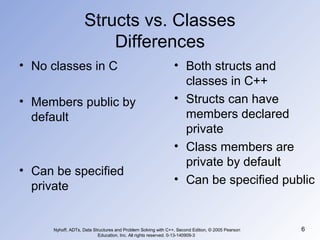
Structs vs. Classes
Differences
• No classes in C
• Members public by
default
• Can be specified
private
• Both structs and
classes in C++
• Structs can have
members declared
private
• Class members are
private by default
• Can be specified public
Nyhoff, ADTs, Data Structures and Problem Solving with C++, Second Edition, © 2005 Pearson
Education, Inc. All rights reserved. 0-13-140909-3
7
Advantages in C++
(structs and Classes)
• C++ structs and classes model objects
which have:
– Attributes represented as data members
– Operations represented as functions (or
methods)
• Leads to object oriented programming
– Objects are self contained
– "I can do it myself" mentality
– They do not pass a parameter to an external
function
Nyhoff, ADTs, Data Structures and Problem Solving with C++, Second Edition, © 2005 Pearson
Education, Inc. All rights reserved. 0-13-140909-3
8
Class Declaration
• Syntax
class ClassName
{
public:
Declarations of public members
private:
Declarations of private members
};
Nyhoff, ADTs, Data Structures and Problem Solving with C++, Second Edition, © 2005 Pearson
Education, Inc. All rights reserved. 0-13-140909-3
9
Designing a Class
• Data members normally placed in private:
section of a class
• Function members usually in public: section
• Typically public: section followed by private:
– although not required by compiler
Nyhoff, ADTs, Data Structures and Problem Solving with C++, Second Edition, © 2005 Pearson
Education, Inc. All rights reserved. 0-13-140909-3
10
Class Libraries
• Class declarations placed in header file
– Given .h extension
– Contains data items and prototypes
• Implementation file
– Same prefix name as header file
– Given .cpp extension
• Programs which use this class library called
client programs
Nyhoff, ADTs, Data Structures and Problem Solving with C++, Second Edition, © 2005 Pearson
Education, Inc. All rights reserved. 0-13-140909-3
11
Translating a Library
Nyhoff, ADTs, Data Structures and Problem Solving with C++, Second Edition, © 2005 Pearson
Education, Inc. All rights reserved. 0-13-140909-3
12
Example of User-Defined
Time Class
• Recall Time struct from previous chapter
– Actions done to Time object required use of Time
parameter in the functions
• Now we create a Time class
– Actions done to Time object, done by the object itself
• Note interface for Time class object,
Fig. 4.2
– Data members private – inaccessible to users of the
class
– Information hiding
Nyhoff, ADTs, Data Structures and Problem Solving with C++, Second Edition, © 2005 Pearson
Education, Inc. All rights reserved. 0-13-140909-3
13
Constructors
• Note constructor definition in Time.cpp
example
• Syntax
ClassName::ClassName (parameter_list)
: member_initializer_list
{
// body of constructor definition
}
Nyhoff, ADTs, Data Structures and Problem Solving with C++, Second Edition, © 2005 Pearson
Education, Inc. All rights reserved. 0-13-140909-3
14
Constructors
• Results of default constructor
• Results of explicit-value
constructor
Nyhoff, ADTs, Data Structures and Problem Solving with C++, Second Edition, © 2005 Pearson
Education, Inc. All rights reserved. 0-13-140909-3
15
Overloading Functions
• Note existence of multiple functions with the
same name
Time();
Time(unsigned initHours,
unsigned initMinutes,
char initAMPM);
– Known as overloading
• Compiler compares numbers and types of
arguments of overloaded functions
– Checks the "signature" of the functions
Nyhoff, ADTs, Data Structures and Problem Solving with C++, Second Edition, © 2005 Pearson
Education, Inc. All rights reserved. 0-13-140909-3
16
Default Arguments
• Possible to specify default values for
constructor arguments
Time(unsigned initHours = 12,
unsigned initMinutes = 0,
char initAMPM = 'A');
• Consider
Time t1, t2(5), t3(6,30), t4(8,15,'P');
Nyhoff, ADTs, Data Structures and Problem Solving with C++, Second Edition, © 2005 Pearson
Education, Inc. All rights reserved. 0-13-140909-3
17
Copy Operations
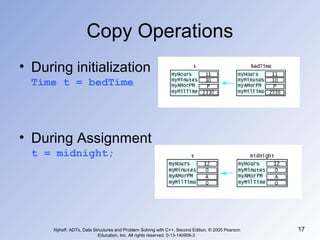
• During initialization
Time t = bedTime
• During Assignment
t = midnight;
Nyhoff, ADTs, Data Structures and Problem Solving with C++, Second Edition, © 2005 Pearson
Education, Inc. All rights reserved. 0-13-140909-3
18
Redundant Declarations
• Note use of #include "Time.h" in
– Time.cpp
– Client program
• Causes "redeclaration" errors at compile
time
• Solution is to use conditional compilation
– Use #ifndef and #define and #endif compiler
directives
Nyhoff, ADTs, Data Structures and Problem Solving with C++, Second Edition, © 2005 Pearson
Education, Inc. All rights reserved. 0-13-140909-3
19
Pointers to Class Objects
• Possible to declare pointers to class objects
Time * timePtr = &t;
• Access with
timePtr->getMilTime() or
(*timePtr).getMilTime()
Nyhoff, ADTs, Data Structures and Problem Solving with C++, Second Edition, © 2005 Pearson
Education, Inc. All rights reserved. 0-13-140909-3
20
The this Pointer
• Every class has a keyword, this
– a pointer whose value is the address of the
object
– Value of *this would be the object itself
Example
• #include<iostream>
• using namespace std;
• class Student
• {
• public:
• int ID;
• void GetID(int Index) //Reads the ID from the User
• {
• cout<<"ID "<<Index<<" : ";
• cin>>ID;
• }
• int Compare(int OtherID) //Compares the Student's ID with another one
• {
• if(ID > OtherID)
• return 1;
• else if ( ID < OtherID)
• return -1;
• else
• return 0; //IDs are equal
• }
• };
Nyhoff, ADTs, Data Structures and Problem Solving with C++, Second Edition,
© 2005 Pearson Education, Inc. All rights reserved. 0-13-140909-3
21
• void main()
• {
• int StudentsNumber;
• Student* Students;
• cout << "Enter the Number of Students : ";
• cin >> StudentsNumber;
• cout<<endl;
• //Create dynamic array of students
• Students = new Student[StudentsNumber];
• for(int i=0 ; i<StudentsNumber ; i++)
• {
• Students[i].GetID(i+1);
• }
•
Nyhoff, ADTs, Data Structures and Problem Solving with C++, Second Edition, © 2005 Pearson
Education, Inc. All rights reserved. 0-13-140909-3
22
• //Sorting
• for(i=0 ; i<StudentsNumber; i++)
• {
• int Min=Students[i].ID;
• int Index = i;
• for(int j=i; j<StudentsNumber; j++)
• {
• if(Students[j].Compare(Min) == -1)
• {
• Min = Students[j].ID;
• Index = j;
• }
• }
• //Swap
• Student Temp = Students[i];
• Students[i] = Students[Index];
• Students[Index] = Temp;
• }
• //Display the sorted IDs
• cout<<"nSorted Students IDs are : n";
• for(i=0; i<StudentsNumber ; i++)
• cout<<Students[i].ID<<endl;
• }
Nyhoff, ADTs, Data Structures and Problem Solving with C++, Second Edition, © 2005 Pearson
Education, Inc. All rights reserved. 0-13-140909-3
23

Lec4

  • 1.
    Nyhoff, ADTs, DataStructures and Problem Solving with C++, Second Edition, © 2005 Pearson Education, Inc. All rights reserved. 0-13-140909-3 1 More about OOP and ADTs Classes Chapter 4
  • 2.
    Nyhoff, ADTs, DataStructures and Problem Solving with C++, Second Edition, © 2005 Pearson Education, Inc. All rights reserved. 0-13-140909-3 2 Chapter Contents 4.1 Procedural vs. Object-Oriented Programming 4.2 Classes 4.3 Example: A First Version of a User- Defined Time Class 4.4 Class Constructors 4.5 Other Class Operators
  • 3.
    Nyhoff, ADTs, DataStructures and Problem Solving with C++, Second Edition, © 2005 Pearson Education, Inc. All rights reserved. 0-13-140909-3 3 Chapter Objectives • Contrast OOP with procedural programming • Review classes in C++ • Study in detail a specific example of how a class is built • Show how operators can be overloaded for new types • Show how conditional compilation directives are used to avoid redundant declarations • Discuss pointers to class objects – the this pointer, in particular
  • 4.
    Nyhoff, ADTs, DataStructures and Problem Solving with C++, Second Edition, © 2005 Pearson Education, Inc. All rights reserved. 0-13-140909-3 4 Contrast Procedural, Object Oriented Paradigms Procedural • Action-oriented — concentrates on the verbs • Programmers: – Identify basic tasks to solve problem – Implement actions to do tasks as subprograms (procedures/functions/ subroutines) – Group subprograms into programs/modules/libraries, – together make up a complete system for solving the problem Object-oriented • Focuses on the nouns of problem specification • Programmers: – Determine objects needed for problem – Determine how they should work together to solve the problem. – Create types called classes made up of • data members • function members to operate on the data. – Instances of a type (class) called objects.
  • 5.
    Nyhoff, ADTs, DataStructures and Problem Solving with C++, Second Edition, © 2005 Pearson Education, Inc. All rights reserved. 0-13-140909-3 5 Structs and Classes Similarities • Essentially the same syntax • Both are used to model objects with multiple attributes (characteristics) – represented as data members – also called fields … or … – instance or attribute variables). • Thus, both are used to process non- homogeneous data sets.
  • 6.
    Nyhoff, ADTs, DataStructures and Problem Solving with C++, Second Edition, © 2005 Pearson Education, Inc. All rights reserved. 0-13-140909-3 6 Structs vs. Classes Differences • No classes in C • Members public by default • Can be specified private • Both structs and classes in C++ • Structs can have members declared private • Class members are private by default • Can be specified public
  • 7.
    Nyhoff, ADTs, DataStructures and Problem Solving with C++, Second Edition, © 2005 Pearson Education, Inc. All rights reserved. 0-13-140909-3 7 Advantages in C++ (structs and Classes) • C++ structs and classes model objects which have: – Attributes represented as data members – Operations represented as functions (or methods) • Leads to object oriented programming – Objects are self contained – "I can do it myself" mentality – They do not pass a parameter to an external function
  • 8.
    Nyhoff, ADTs, DataStructures and Problem Solving with C++, Second Edition, © 2005 Pearson Education, Inc. All rights reserved. 0-13-140909-3 8 Class Declaration • Syntax class ClassName { public: Declarations of public members private: Declarations of private members };
  • 9.
    Nyhoff, ADTs, DataStructures and Problem Solving with C++, Second Edition, © 2005 Pearson Education, Inc. All rights reserved. 0-13-140909-3 9 Designing a Class • Data members normally placed in private: section of a class • Function members usually in public: section • Typically public: section followed by private: – although not required by compiler
  • 10.
    Nyhoff, ADTs, DataStructures and Problem Solving with C++, Second Edition, © 2005 Pearson Education, Inc. All rights reserved. 0-13-140909-3 10 Class Libraries • Class declarations placed in header file – Given .h extension – Contains data items and prototypes • Implementation file – Same prefix name as header file – Given .cpp extension • Programs which use this class library called client programs
  • 11.
    Nyhoff, ADTs, DataStructures and Problem Solving with C++, Second Edition, © 2005 Pearson Education, Inc. All rights reserved. 0-13-140909-3 11 Translating a Library
  • 12.
    Nyhoff, ADTs, DataStructures and Problem Solving with C++, Second Edition, © 2005 Pearson Education, Inc. All rights reserved. 0-13-140909-3 12 Example of User-Defined Time Class • Recall Time struct from previous chapter – Actions done to Time object required use of Time parameter in the functions • Now we create a Time class – Actions done to Time object, done by the object itself • Note interface for Time class object, Fig. 4.2 – Data members private – inaccessible to users of the class – Information hiding
  • 13.
    Nyhoff, ADTs, DataStructures and Problem Solving with C++, Second Edition, © 2005 Pearson Education, Inc. All rights reserved. 0-13-140909-3 13 Constructors • Note constructor definition in Time.cpp example • Syntax ClassName::ClassName (parameter_list) : member_initializer_list { // body of constructor definition }
  • 14.
    Nyhoff, ADTs, DataStructures and Problem Solving with C++, Second Edition, © 2005 Pearson Education, Inc. All rights reserved. 0-13-140909-3 14 Constructors • Results of default constructor • Results of explicit-value constructor
  • 15.
    Nyhoff, ADTs, DataStructures and Problem Solving with C++, Second Edition, © 2005 Pearson Education, Inc. All rights reserved. 0-13-140909-3 15 Overloading Functions • Note existence of multiple functions with the same name Time(); Time(unsigned initHours, unsigned initMinutes, char initAMPM); – Known as overloading • Compiler compares numbers and types of arguments of overloaded functions – Checks the "signature" of the functions
  • 16.
    Nyhoff, ADTs, DataStructures and Problem Solving with C++, Second Edition, © 2005 Pearson Education, Inc. All rights reserved. 0-13-140909-3 16 Default Arguments • Possible to specify default values for constructor arguments Time(unsigned initHours = 12, unsigned initMinutes = 0, char initAMPM = 'A'); • Consider Time t1, t2(5), t3(6,30), t4(8,15,'P');
  • 17.
    Nyhoff, ADTs, DataStructures and Problem Solving with C++, Second Edition, © 2005 Pearson Education, Inc. All rights reserved. 0-13-140909-3 17 Copy Operations • During initialization Time t = bedTime • During Assignment t = midnight;
  • 18.
    Nyhoff, ADTs, DataStructures and Problem Solving with C++, Second Edition, © 2005 Pearson Education, Inc. All rights reserved. 0-13-140909-3 18 Redundant Declarations • Note use of #include "Time.h" in – Time.cpp – Client program • Causes "redeclaration" errors at compile time • Solution is to use conditional compilation – Use #ifndef and #define and #endif compiler directives
  • 19.
    Nyhoff, ADTs, DataStructures and Problem Solving with C++, Second Edition, © 2005 Pearson Education, Inc. All rights reserved. 0-13-140909-3 19 Pointers to Class Objects • Possible to declare pointers to class objects Time * timePtr = &t; • Access with timePtr->getMilTime() or (*timePtr).getMilTime()
  • 20.
    Nyhoff, ADTs, DataStructures and Problem Solving with C++, Second Edition, © 2005 Pearson Education, Inc. All rights reserved. 0-13-140909-3 20 The this Pointer • Every class has a keyword, this – a pointer whose value is the address of the object – Value of *this would be the object itself
  • 21.
    Example • #include<iostream> • usingnamespace std; • class Student • { • public: • int ID; • void GetID(int Index) //Reads the ID from the User • { • cout<<"ID "<<Index<<" : "; • cin>>ID; • } • int Compare(int OtherID) //Compares the Student's ID with another one • { • if(ID > OtherID) • return 1; • else if ( ID < OtherID) • return -1; • else • return 0; //IDs are equal • } • }; Nyhoff, ADTs, Data Structures and Problem Solving with C++, Second Edition, © 2005 Pearson Education, Inc. All rights reserved. 0-13-140909-3 21
  • 22.
    • void main() •{ • int StudentsNumber; • Student* Students; • cout << "Enter the Number of Students : "; • cin >> StudentsNumber; • cout<<endl; • //Create dynamic array of students • Students = new Student[StudentsNumber]; • for(int i=0 ; i<StudentsNumber ; i++) • { • Students[i].GetID(i+1); • } • Nyhoff, ADTs, Data Structures and Problem Solving with C++, Second Edition, © 2005 Pearson Education, Inc. All rights reserved. 0-13-140909-3 22
  • 23.
    • //Sorting • for(i=0; i<StudentsNumber; i++) • { • int Min=Students[i].ID; • int Index = i; • for(int j=i; j<StudentsNumber; j++) • { • if(Students[j].Compare(Min) == -1) • { • Min = Students[j].ID; • Index = j; • } • } • //Swap • Student Temp = Students[i]; • Students[i] = Students[Index]; • Students[Index] = Temp; • } • //Display the sorted IDs • cout<<"nSorted Students IDs are : n"; • for(i=0; i<StudentsNumber ; i++) • cout<<Students[i].ID<<endl; • } Nyhoff, ADTs, Data Structures and Problem Solving with C++, Second Edition, © 2005 Pearson Education, Inc. All rights reserved. 0-13-140909-3 23