Population-level Effects of Bot Fly ( Cuterebra fontinella ) Parasitism on White-footed Mice ( Peromyscus leucopus ) Michael J. Cramer and Guy N. Cameron Department of Biological Sciences University of Cincinnati Cincinnati, OH 45221-0006
Why Study Parasitism? Common interspecific interaction Potential affect on population ecology of both host and parasite species Coevolutionary dynamics Often overlooked despite great potential impact on host biology
Bot Fly Parasitism Common parasite-host system  Studied for decades Occurs in many host taxa worldwide Rodentia:  mice and rats Lagomorpha:  rabbits Perissodactyla:  horses Artiodactyla:  cattle
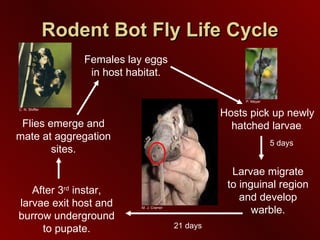
Rodent Bot Fly Life Cycle Females lay eggs in host habitat. Hosts pick up newly hatched larvae . Larvae migrate to inguinal region and develop warble. After 3 rd  instar, larvae exit host and burrow underground to pupate. Flies emerge and mate at aggregation sites. 5 days 21 days P. Meyer C. N. Shiffer M. J. Cramer
Objectives Characterize bot fly parasitism in local host population of  Peromyscus leucopus Determine population patterns in infection Assess potential cost to host population of bot fly parasitism
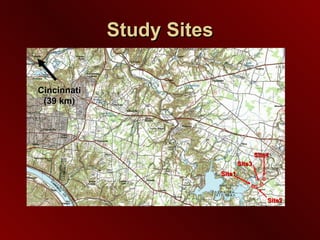
Study Sites Site4 Site3 Site1 Site2 Cincinnati (39 km)
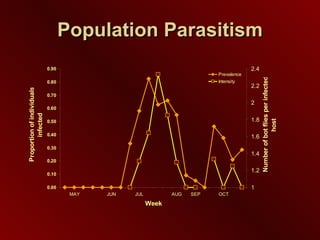
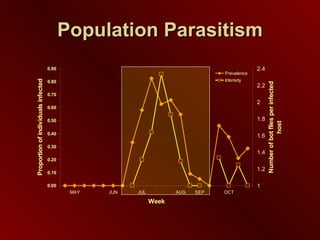
Population Parasitism
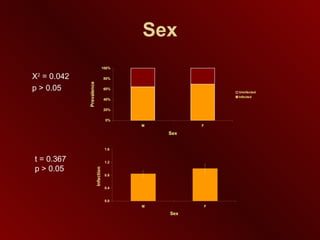
Sex X 2  = 0.042 p > 0.05 t = 0.367 p > 0.05
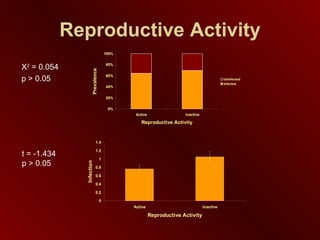
Reproductive   Activity X 2  = 0.054 p > 0.05 t = -1.434 p > 0.05
Age Class X 2  = 2.360 p > 0.05 t = -0.700 p > 0.05
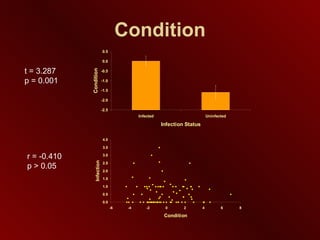
Condition t = 3.287 p = 0.001 r = -0.410 p > 0.05
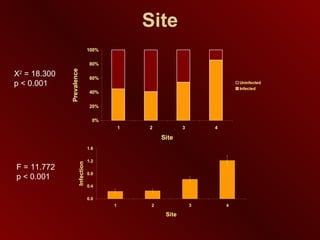
Site X 2  = 18.300 p < 0.001 F = 11.772 p < 0.001
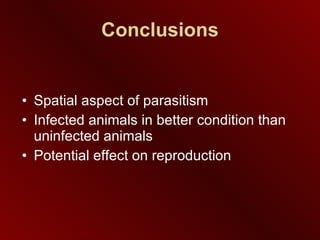
Conclusions Spatial aspect of parasitism Infected animals in better condition than uninfected animals Potential effect on reproduction
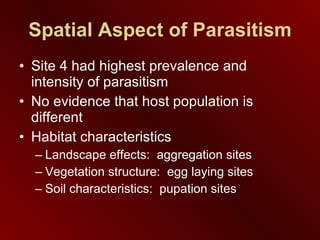
Spatial Aspect of Parasitism Site 4 had highest prevalence and intensity of parasitism No evidence that host population is different Habitat characteristics Landscape effects:  aggregation sites Vegetation structure:  egg laying sites Soil characteristics:  pupation sites
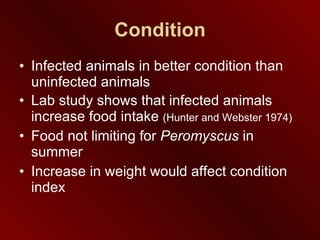
Condition Infected animals in better condition than uninfected animals Lab study shows that infected animals increase food intake  (Hunter and Webster 1974) Food not limiting for  Peromyscus  in summer Increase in weight would affect condition index
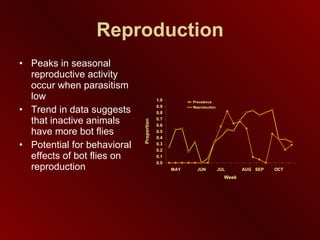
Reproduction Peaks in seasonal reproductive activity occur when parasitism low Trend in data suggests that inactive animals have more bot flies Potential for behavioral effects of bot flies on reproduction
Further Study Habitat characterization of each site Determine if habitat characters are correlated with prevalence and intensity of bot fly infections Landscape analysis  Behavioral studies Aggression studies Mate choice
Acknowledgements Research Advisory Committee George Uetz Ken Petren Michal Polak Thomas Kane Nancy Solomon Permission (ODNR) Todd Haines Randy Morgan Field Assistance Diane McCubbin Kelly Roberts Ashley Mattingly Theresa Pfarr Cory Christopher Alicia Shelton Funding Wieman Summer Research Award

Population-level effects of bot fly (Cuterebra fontinella) parasitism on white-footed mice (Peromyscus leucopus)

  • 1.
    Population-level Effects ofBot Fly ( Cuterebra fontinella ) Parasitism on White-footed Mice ( Peromyscus leucopus ) Michael J. Cramer and Guy N. Cameron Department of Biological Sciences University of Cincinnati Cincinnati, OH 45221-0006
  • 2.
    Why Study Parasitism?Common interspecific interaction Potential affect on population ecology of both host and parasite species Coevolutionary dynamics Often overlooked despite great potential impact on host biology
  • 3.
    Bot Fly ParasitismCommon parasite-host system Studied for decades Occurs in many host taxa worldwide Rodentia: mice and rats Lagomorpha: rabbits Perissodactyla: horses Artiodactyla: cattle
  • 4.
    Rodent Bot FlyLife Cycle Females lay eggs in host habitat. Hosts pick up newly hatched larvae . Larvae migrate to inguinal region and develop warble. After 3 rd instar, larvae exit host and burrow underground to pupate. Flies emerge and mate at aggregation sites. 5 days 21 days P. Meyer C. N. Shiffer M. J. Cramer
  • 5.
    Objectives Characterize botfly parasitism in local host population of Peromyscus leucopus Determine population patterns in infection Assess potential cost to host population of bot fly parasitism
  • 6.
    Study Sites Site4Site3 Site1 Site2 Cincinnati (39 km)
  • 7.
  • 8.
  • 9.
    Sex X 2 = 0.042 p > 0.05 t = 0.367 p > 0.05
  • 10.
    Reproductive Activity X 2 = 0.054 p > 0.05 t = -1.434 p > 0.05
  • 11.
    Age Class X2 = 2.360 p > 0.05 t = -0.700 p > 0.05
  • 12.
    Condition t =3.287 p = 0.001 r = -0.410 p > 0.05
  • 13.
    Site X 2 = 18.300 p < 0.001 F = 11.772 p < 0.001
  • 14.
    Conclusions Spatial aspectof parasitism Infected animals in better condition than uninfected animals Potential effect on reproduction
  • 15.
    Spatial Aspect ofParasitism Site 4 had highest prevalence and intensity of parasitism No evidence that host population is different Habitat characteristics Landscape effects: aggregation sites Vegetation structure: egg laying sites Soil characteristics: pupation sites
  • 16.
    Condition Infected animalsin better condition than uninfected animals Lab study shows that infected animals increase food intake (Hunter and Webster 1974) Food not limiting for Peromyscus in summer Increase in weight would affect condition index
  • 17.
    Reproduction Peaks inseasonal reproductive activity occur when parasitism low Trend in data suggests that inactive animals have more bot flies Potential for behavioral effects of bot flies on reproduction
  • 18.
    Further Study Habitatcharacterization of each site Determine if habitat characters are correlated with prevalence and intensity of bot fly infections Landscape analysis Behavioral studies Aggression studies Mate choice
  • 19.
    Acknowledgements Research AdvisoryCommittee George Uetz Ken Petren Michal Polak Thomas Kane Nancy Solomon Permission (ODNR) Todd Haines Randy Morgan Field Assistance Diane McCubbin Kelly Roberts Ashley Mattingly Theresa Pfarr Cory Christopher Alicia Shelton Funding Wieman Summer Research Award