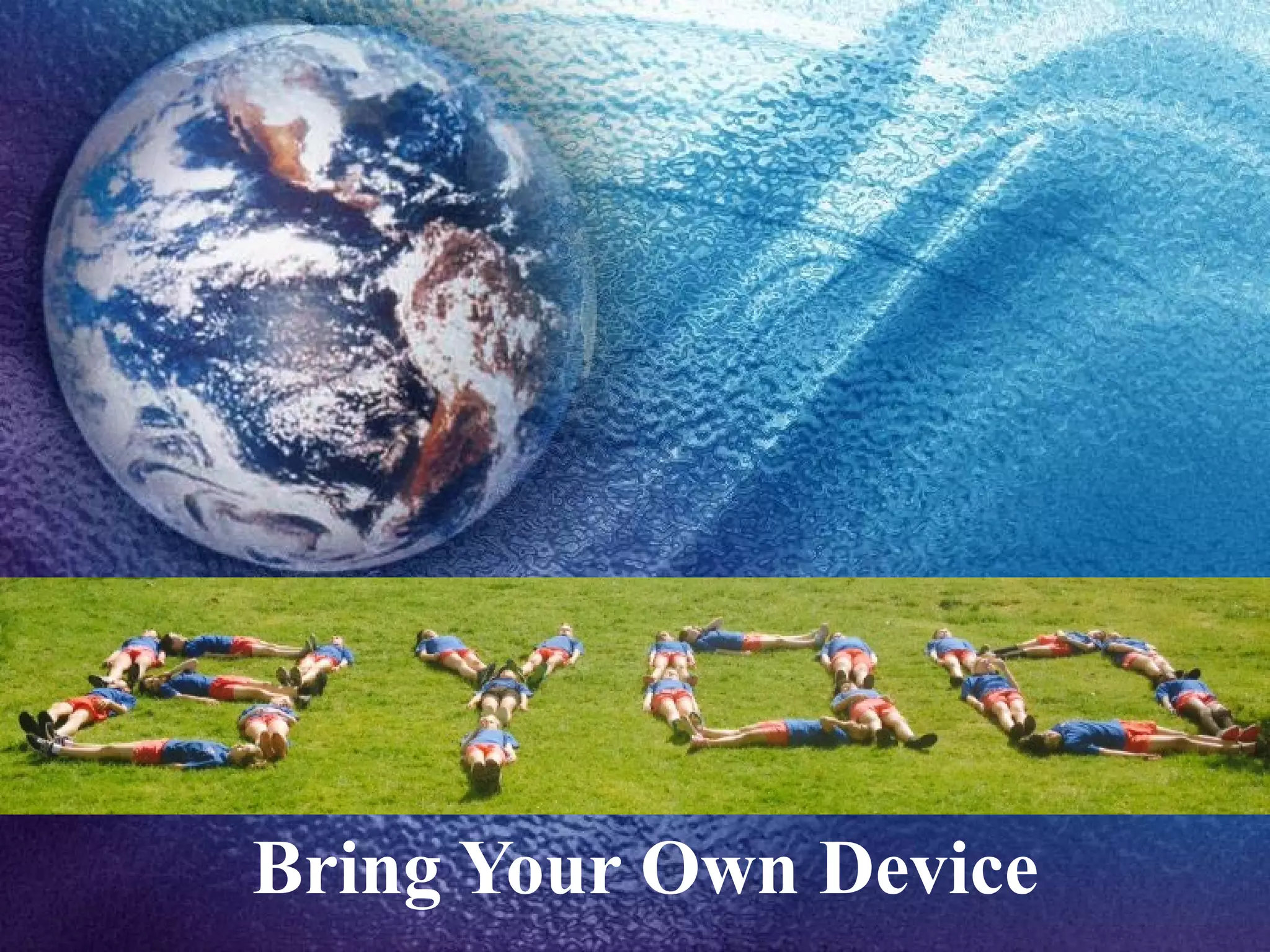
Bring Your Own Device
Agenda of Meeting 7pm-8.30pm
• 21st Century Learning
–
–
–
–

Pedagogy
7.15 Demonstration of Student Collaboration
Students Learning
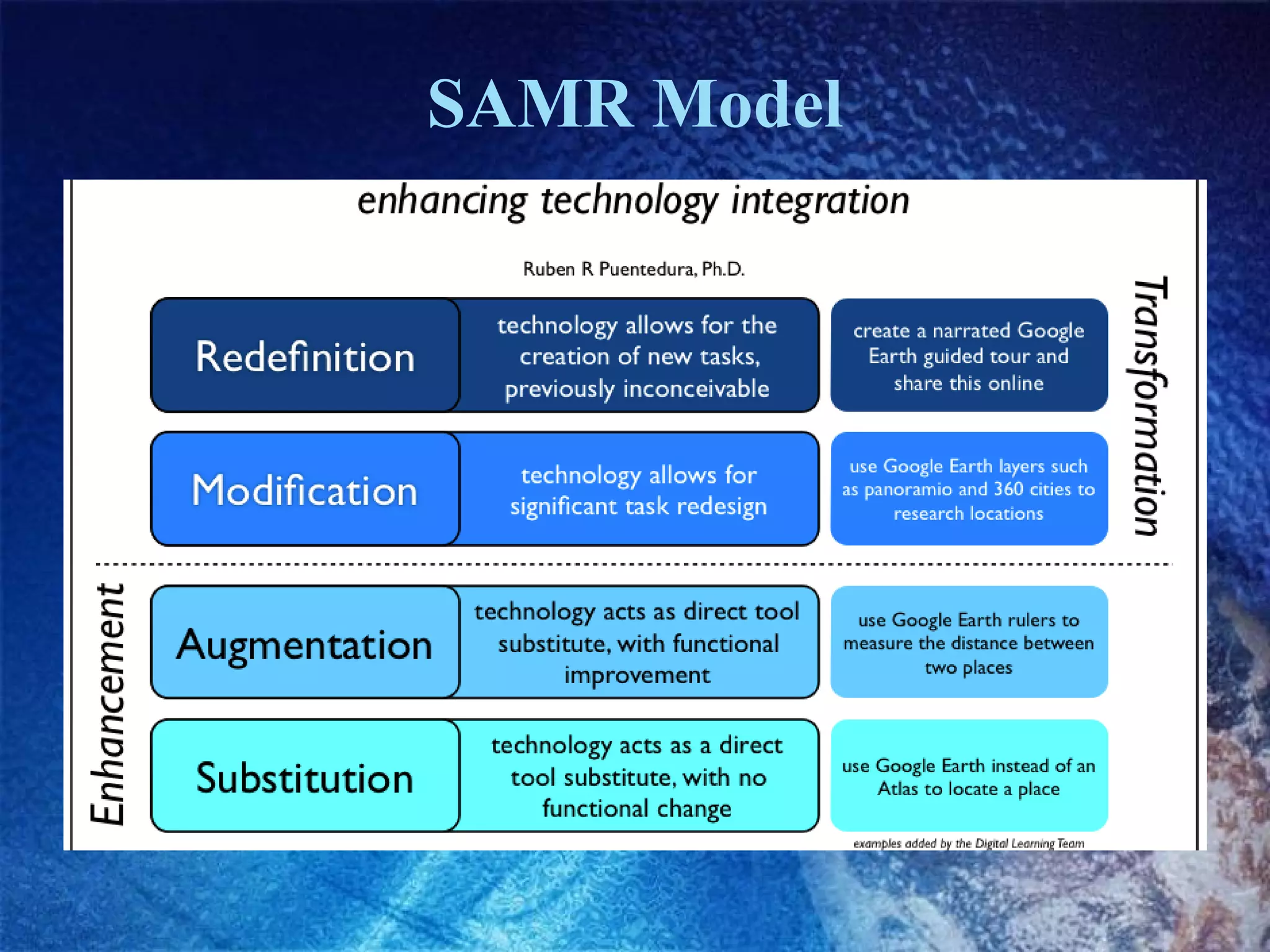
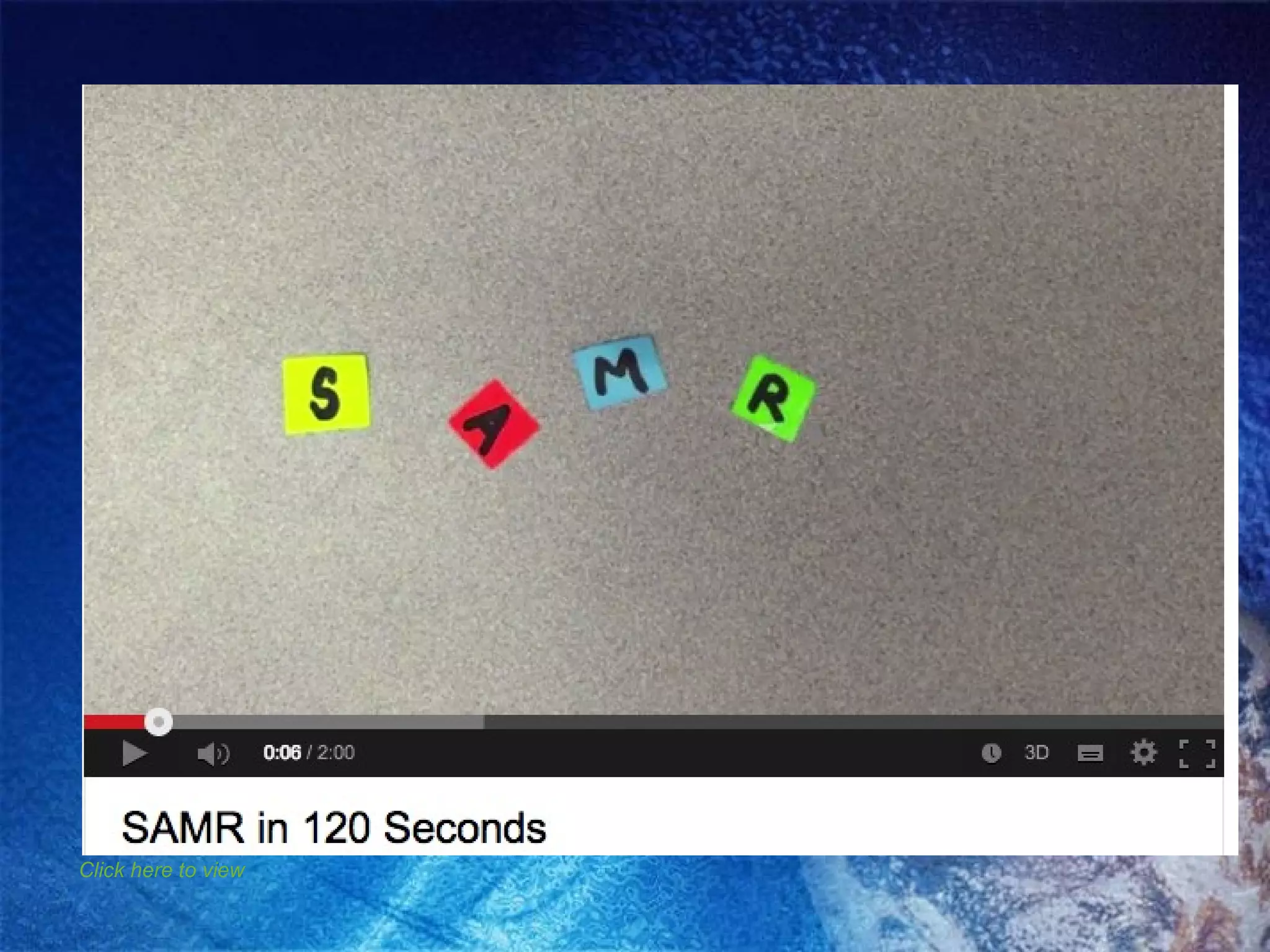
SAMR Model

• Bring Your Own Device (BYOD)
–
–
–
–
–
–

What is BYOD?
Rationale/Myths
2013 Trial
Device Requirements
Security/Safety Guidelines
2014 Draft Timeline

• Question and Answer Time
Pedagogy
• “The curriculum encourages all students
to reflect on their own learning processes
and to learn how to learn.”
The New Zealand Curriculum

• Individual learners are empowered to take
increasingly more responsibility for their
learning
Pedagogy
• Students are able to select their choice of
learning tool from within a flexible learning
environment to best meet their learning needs
• We have already seen a shift in the learning
from having class sets of laptops in trolleys, to
laptops within classrooms and this year
through the BYOD trial
• Having devices in classrooms allows
seamless integration of ICT across the
curriculum
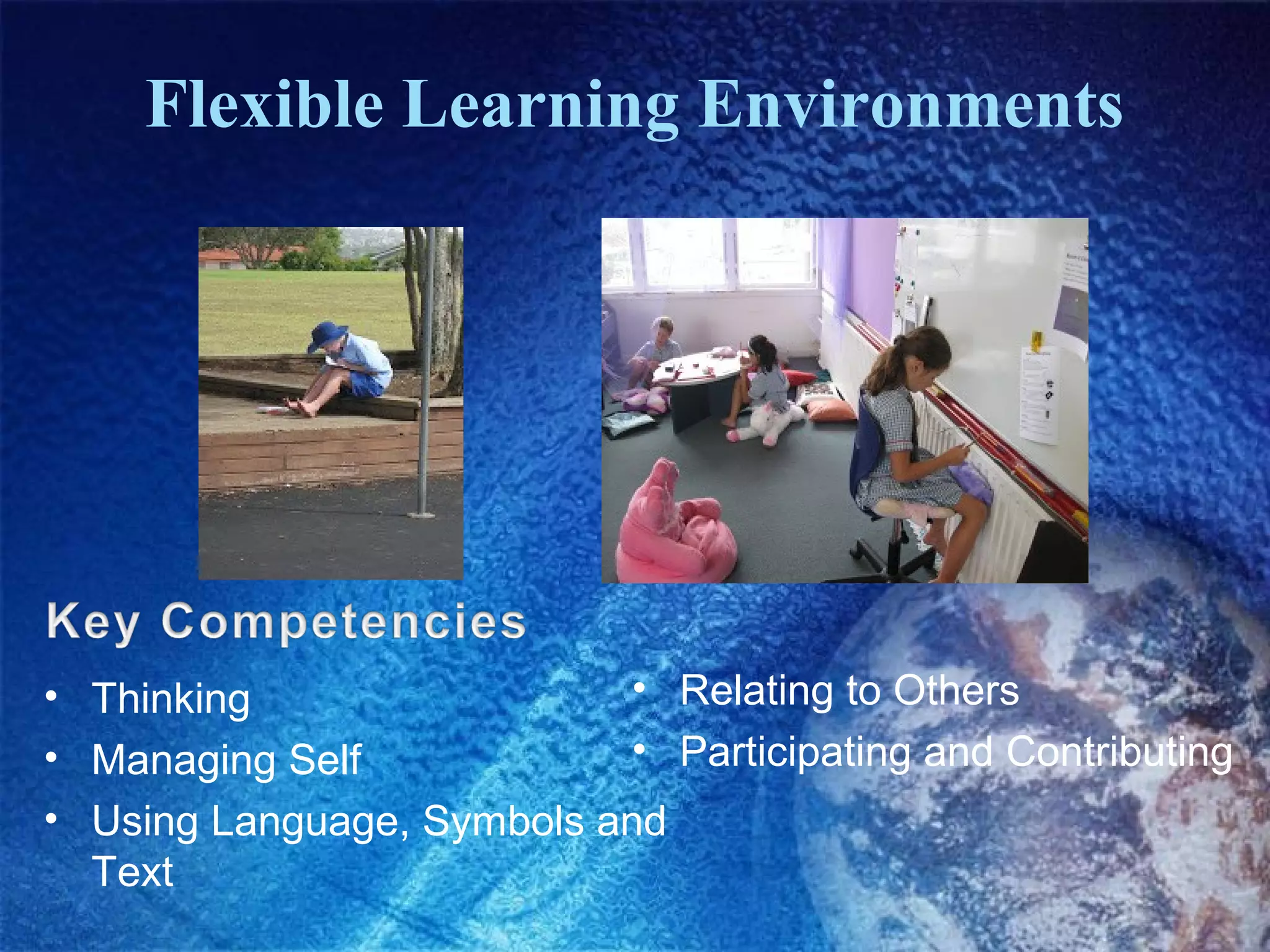
Flexible Learning Environments

• Relating to Others
• Thinking
• Participating and Contributing
• Managing Self
• Using Language, Symbols and
Text
NCEA/NZQA
• NCEA/NZQA is changing.
In 6-10 years all assessments will be
online.
We want our students to succeed in the
21st century environment that is being
developed.
Dr Karen Poutasi, Chief Executive

• .https://groups.google.com/forum/#!topic/mle-reference-group/IN6-UkvHUro
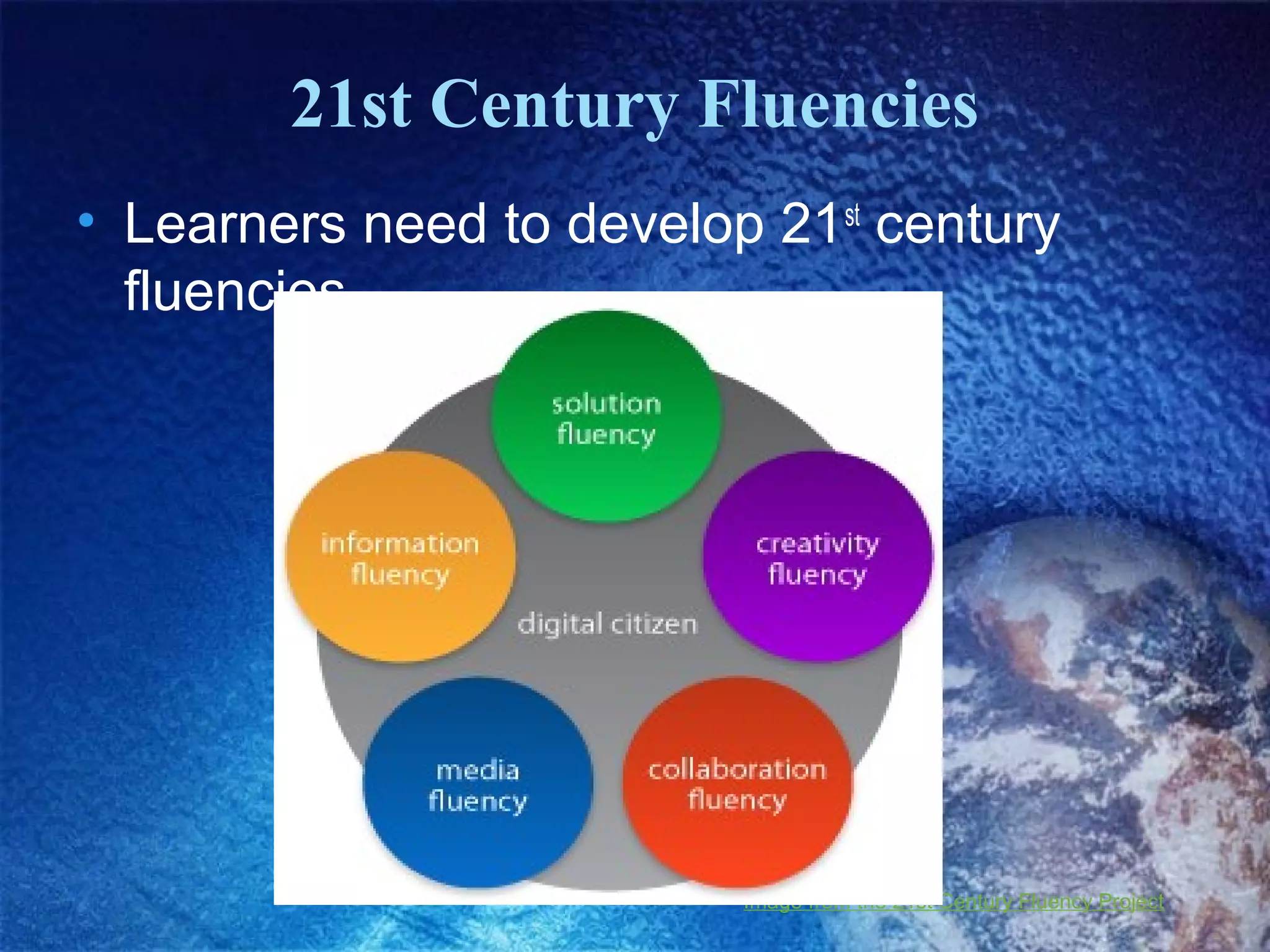
21st Century Fluencies
• Learners need to develop 21st century
fluencies

Image from the 21st Century Fluency Project
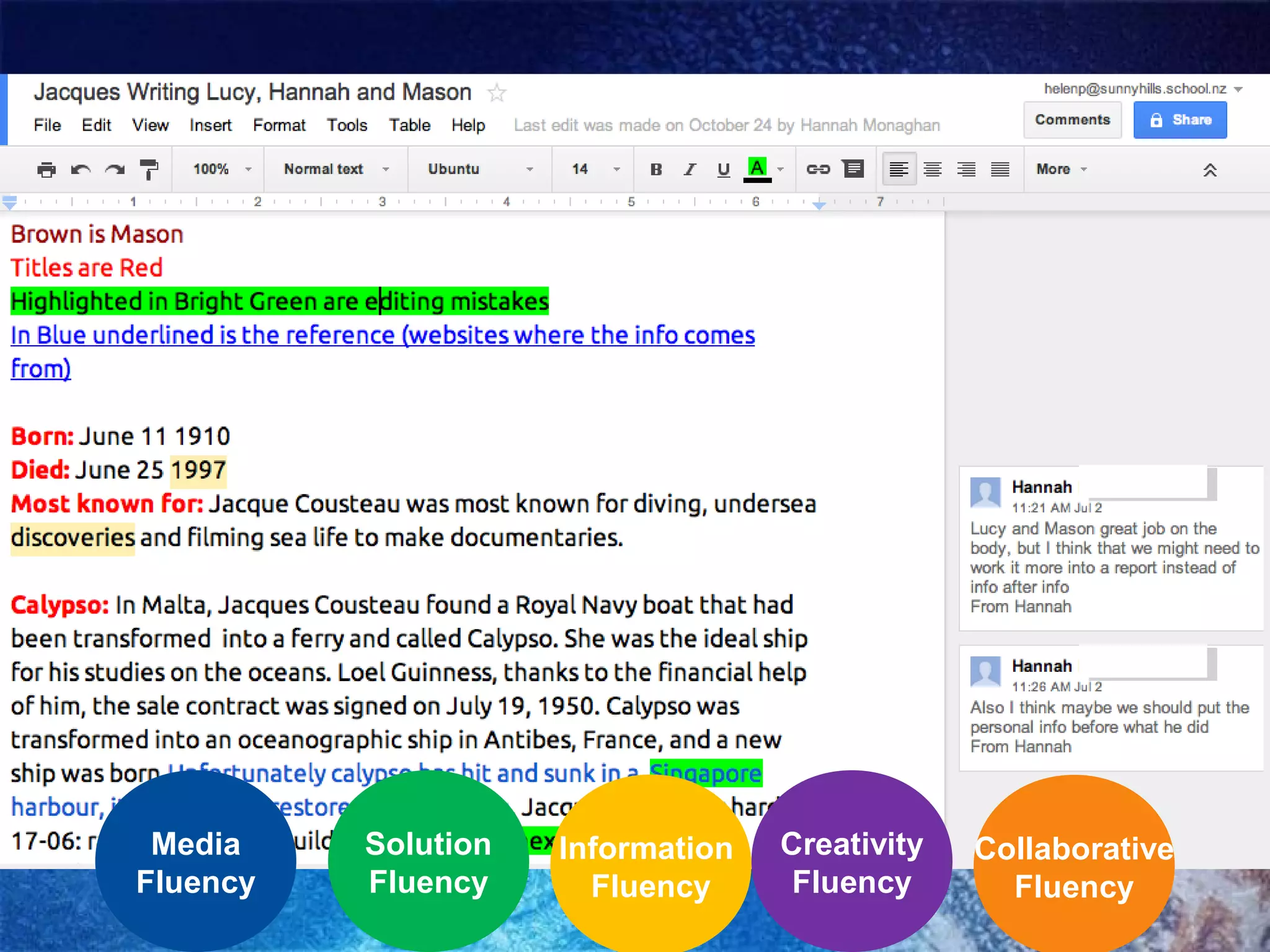
Google Apps/Teacher Dashboard
• Google Apps is an easy-to-use online word processor,
spread sheet and presentation editor
• Enables students to create, store and share
documents instantly and securely, and collaborate
online in real time.
• You can create new documents from scratch or upload
existing documents, spread sheets and presentations
• There’s no software to download, and all your work is
stored safely online and can be accessed from any
computer or student owned device. This will be the
standard web platform with Teacher Dashboard to
Google Apps example

Media
Fluency

Solution
Fluency

Information
Fluency

Creativity
Fluency

Collaborative
Fluency
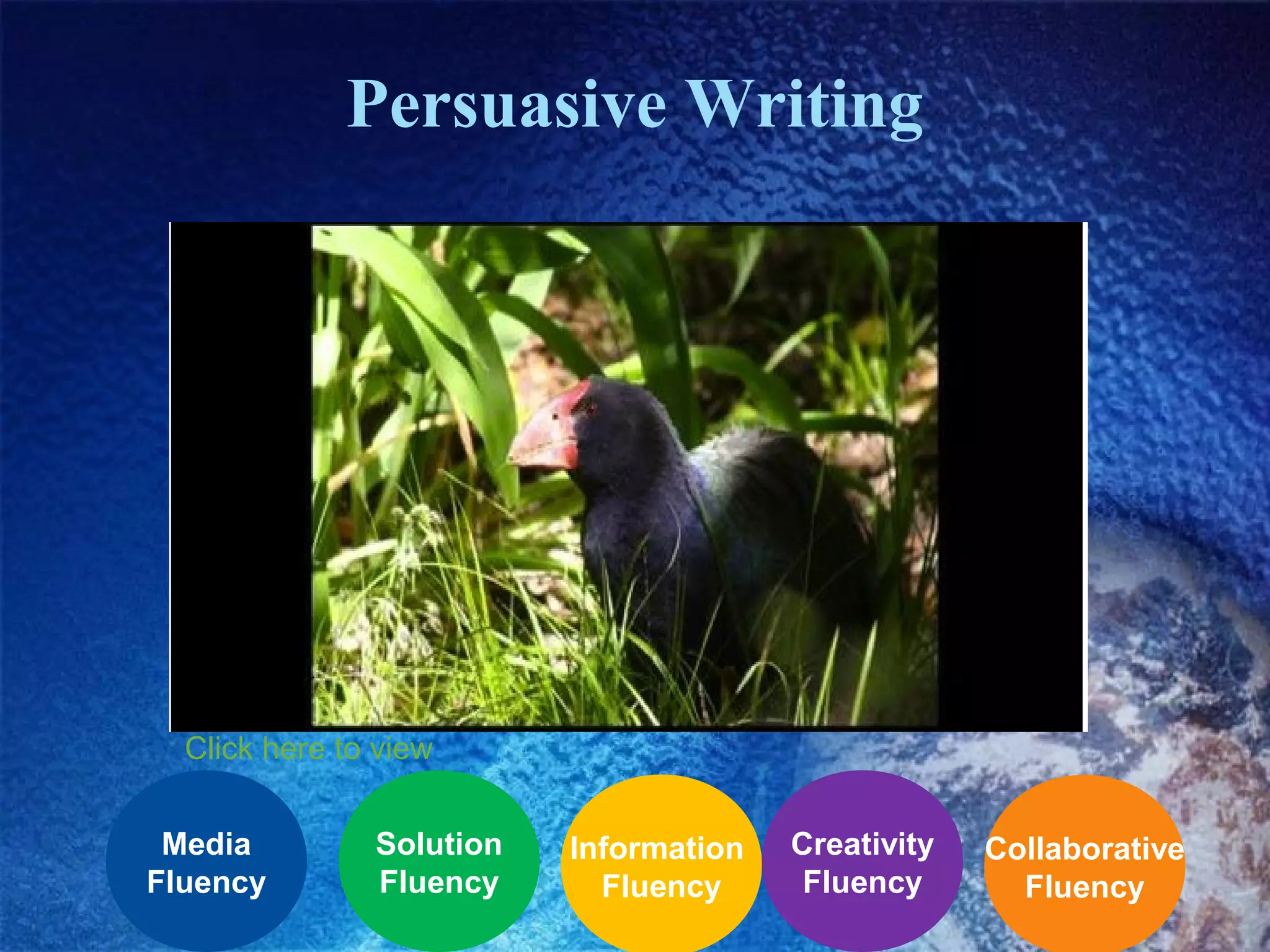
Persuasive Writing

Click here to view
Media
Fluency

Solution
Fluency

Information
Fluency

Creativity
Fluency

Collaborative
Fluency
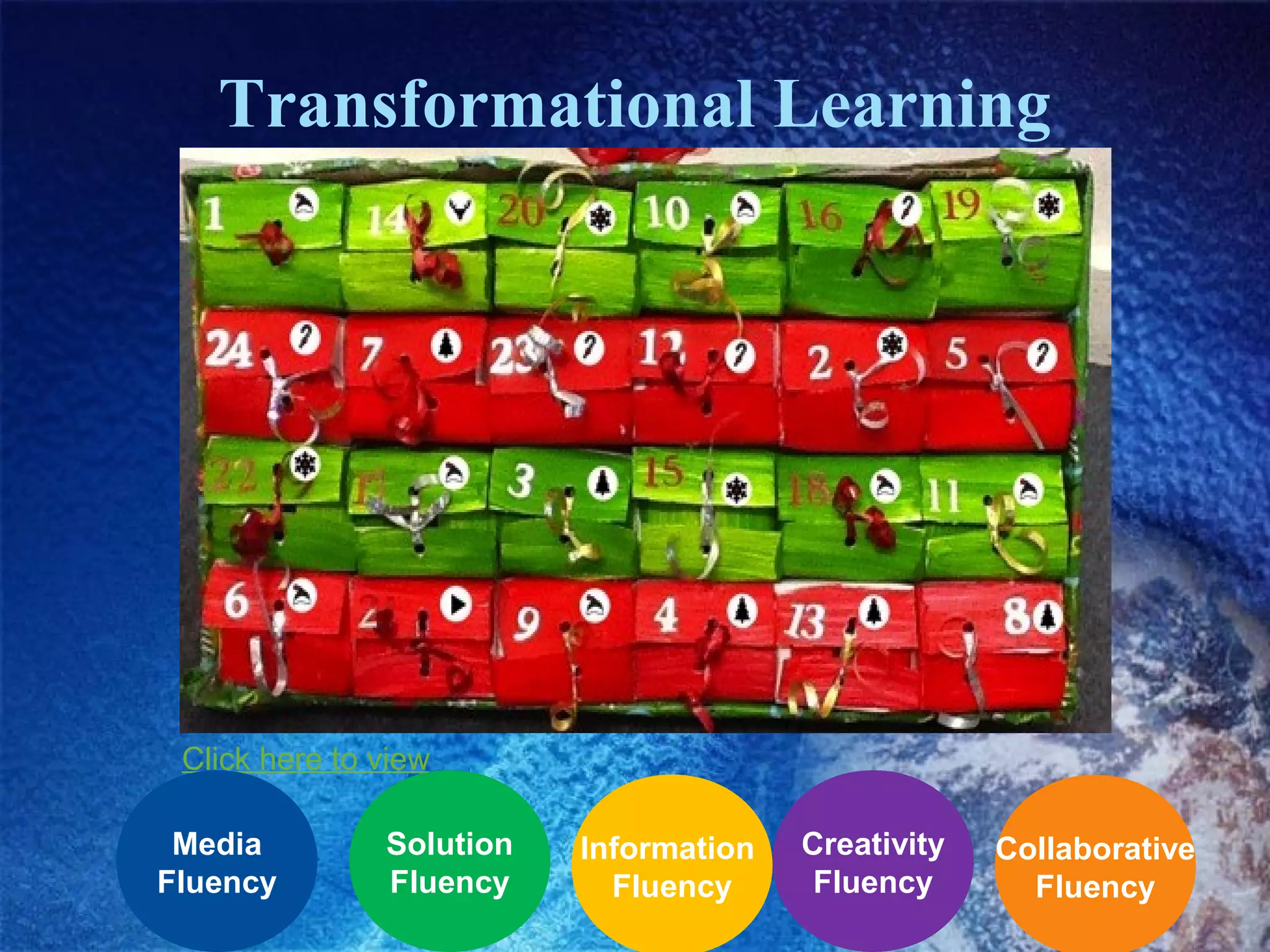
Transformational Learning

Click here to view
Media
Fluency

Solution
Fluency

Information
Fluency

Creativity
Fluency

Collaborative
Fluency
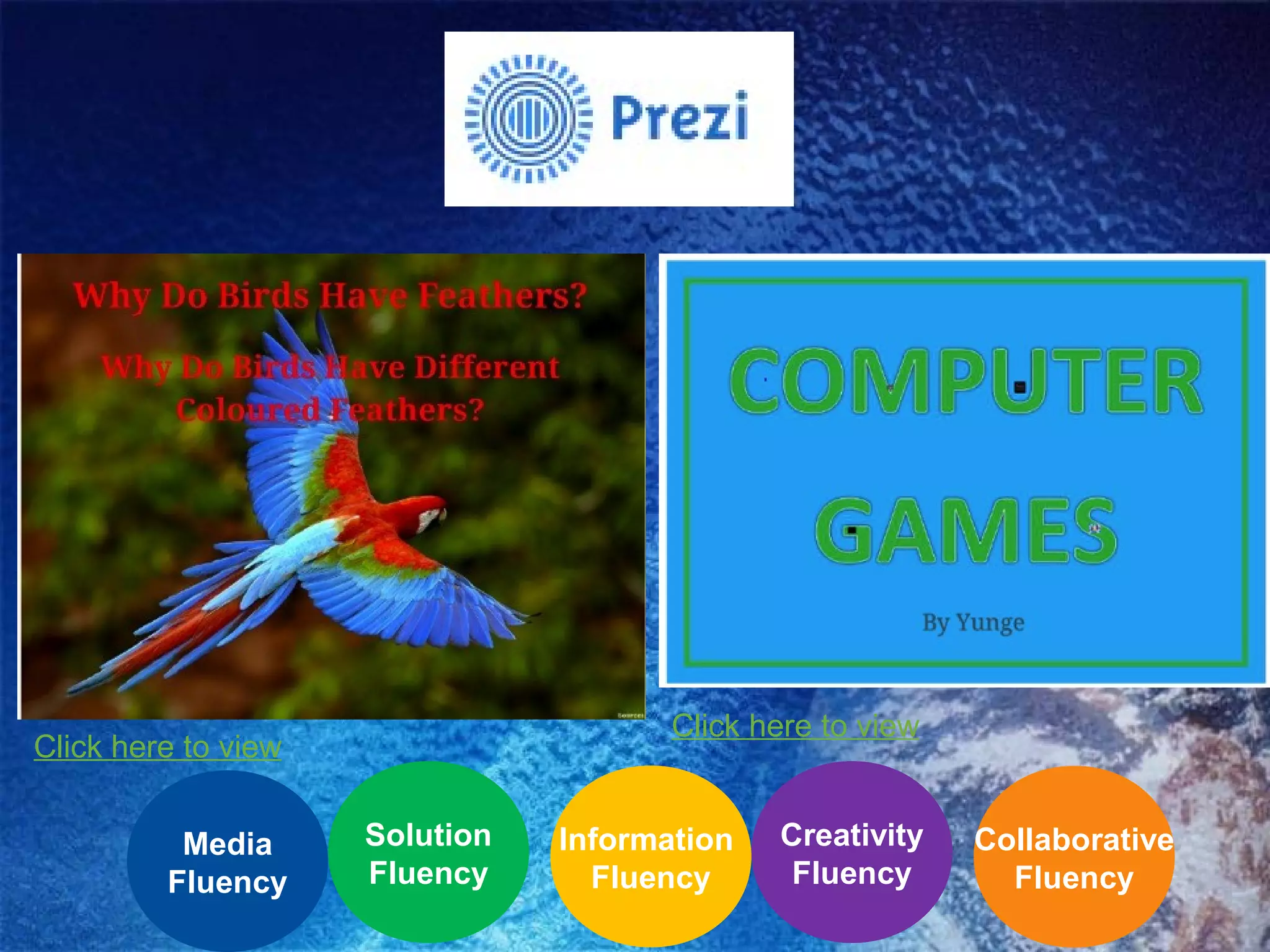
Prezi

Click here to view

Click here to view
Media
Fluency

Solution
Fluency

Information
Fluency

Creativity
Fluency

Collaborative
Fluency
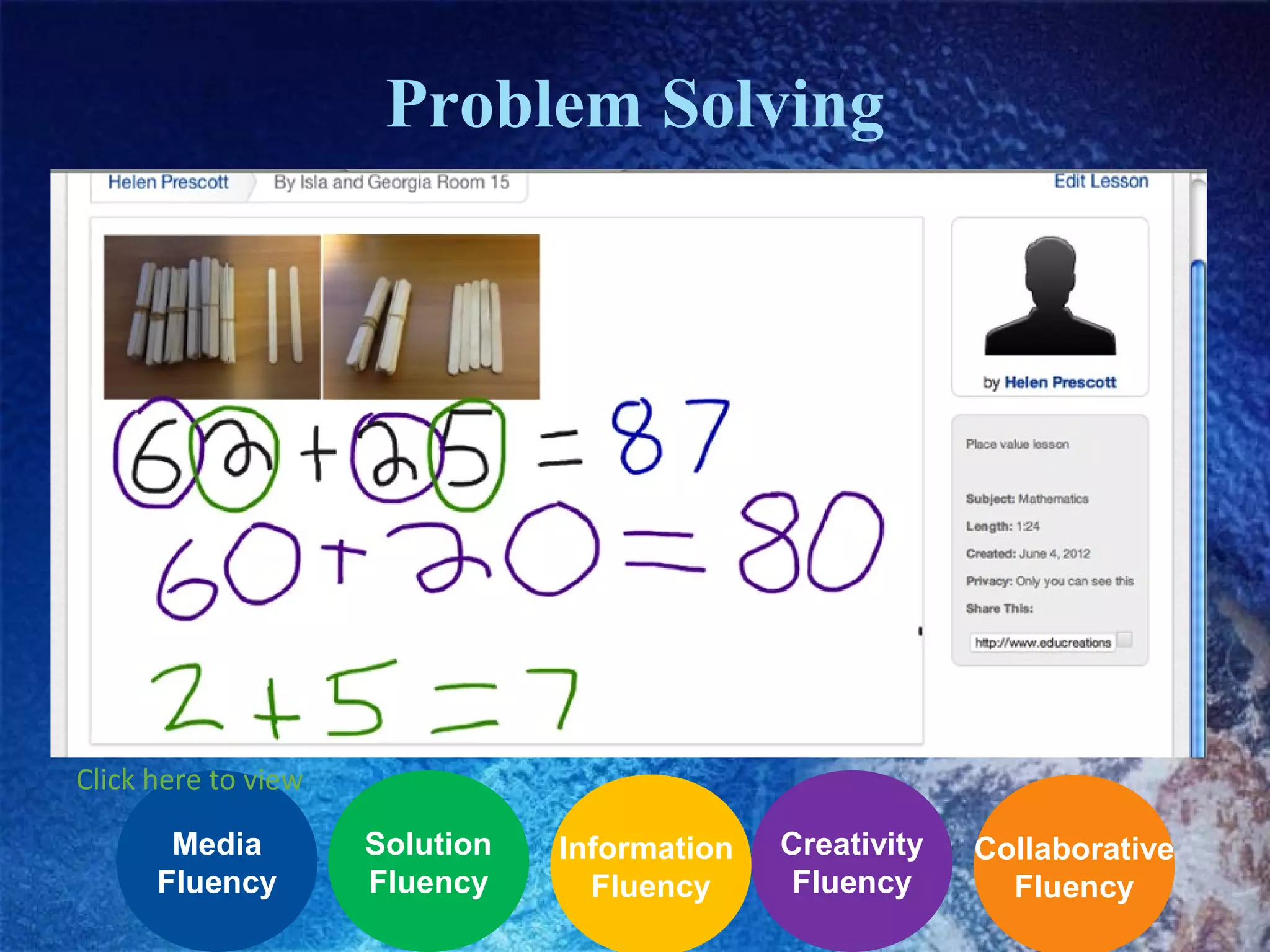
Problem Solving

Click here to view
Media
Fluency

Solution
Fluency

Information
Fluency

Creativity
Fluency

Collaborative
Fluency
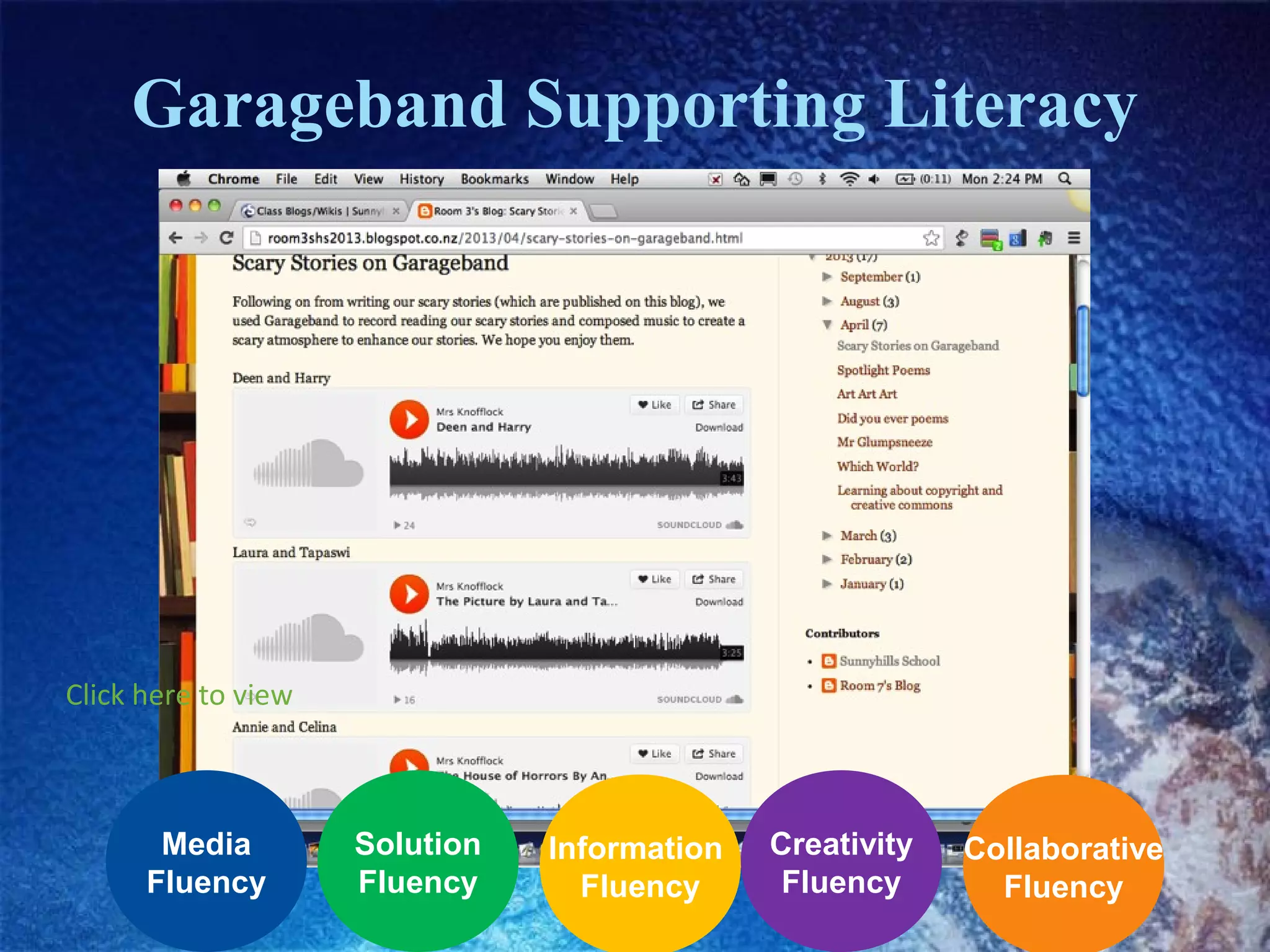
Garageband Supporting Literacy

Click here to view

Media
Fluency

Solution
Fluency

Information
Fluency

Creativity
Fluency

Collaborative
Fluency
SAMR Model
Click here to view
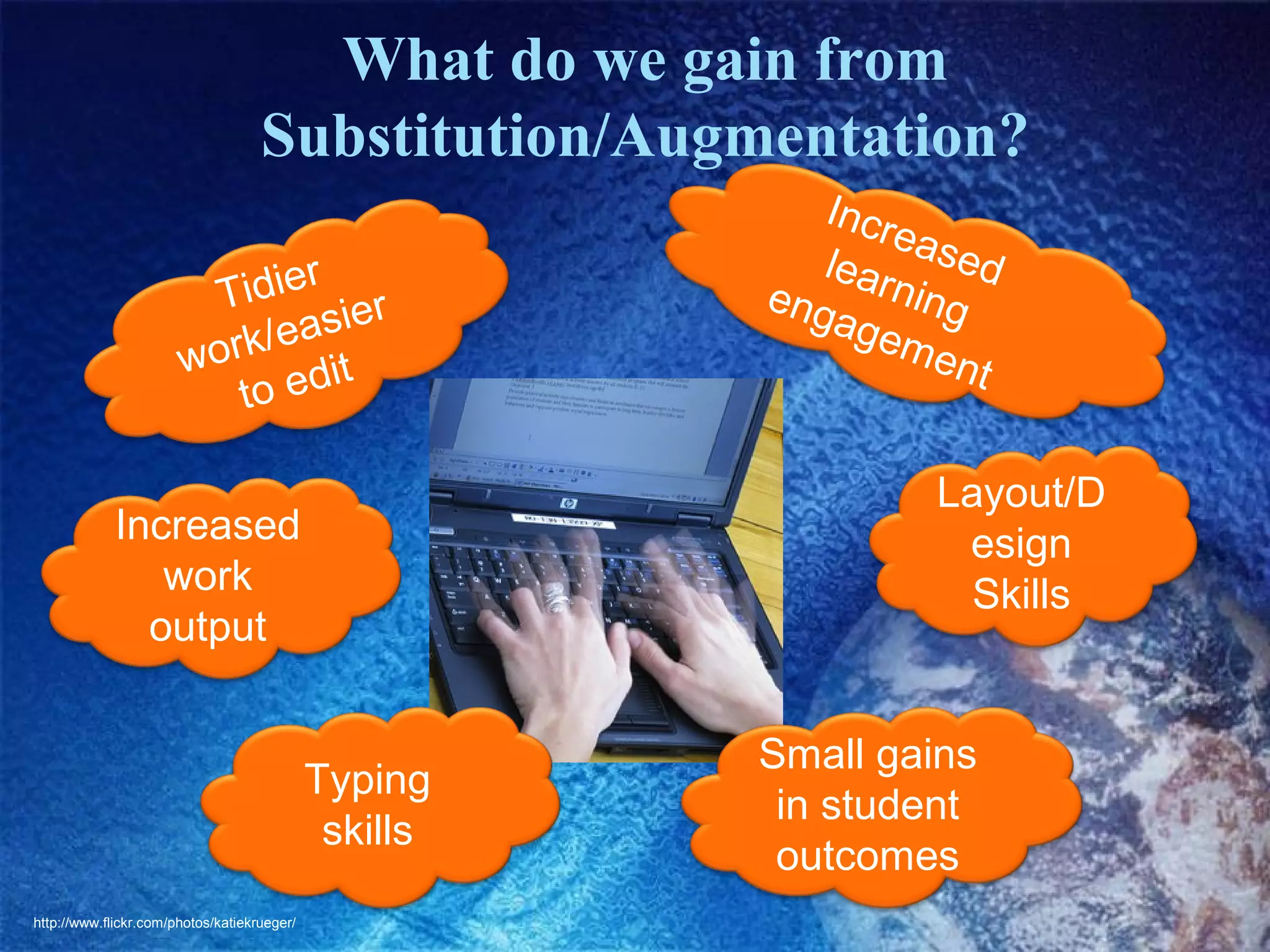
What do we gain from
Substitution/Augmentation?
r
Tidie ier
s
rk/ea
wo
it
o ed
t

Layout/D
esign
Skills

Increased
work
output

Typing
skills
http://www.flickr.com/photos/katiekrueger/

Incr
eas
ed
lear
eng ning
age
men
t

Small gains
in student
outcomes
What do we gain from
Modification/Redefinition?
l
ritica
C
rs
hinke
t
f
no
tio
rea w
C
ne wledg
o
s /k n
e
idea

Wider
audience

Reflective
Students

Collaboration
Development
of new
literacies
Greater gains in
student
outcomes

f
en t o
elopm
Dev Key
es
tenci
pe
Com

elf ing
S g
a
an
M

http://www.google.co.nz/search?
q=free+screen+beans&client=safari&rls=en&tbm=isch&tbo=u&source=univ&sa=X&ei=uLixUbzXHon0lAX19oCICQ&ved=0CDQQsAQ&biw=1021&bih=601#facrc=_&imgrc=SesAinpan86t9M%3A
%3BCVeBfzPjCWizoM%3Bhttp%253A%252F%252F1.bp.blogspot.com%252F_bZpzjZ2cdYo%252FS9Y6OhlWMqI%252FAAAAAAAAAyE%252FIG8MQPQcQds%252Fs320%252Fscreen
%252Bbeans.jpg%3Bhttp%253A%252F%252Fmysparklingevent.com%252F2010%252F04%252F%3B413%3B431
The Big Question
• How can we afford to sustain the level of
technology needed to support this
direction in learning?
• BYOD supports our pedagogical direction
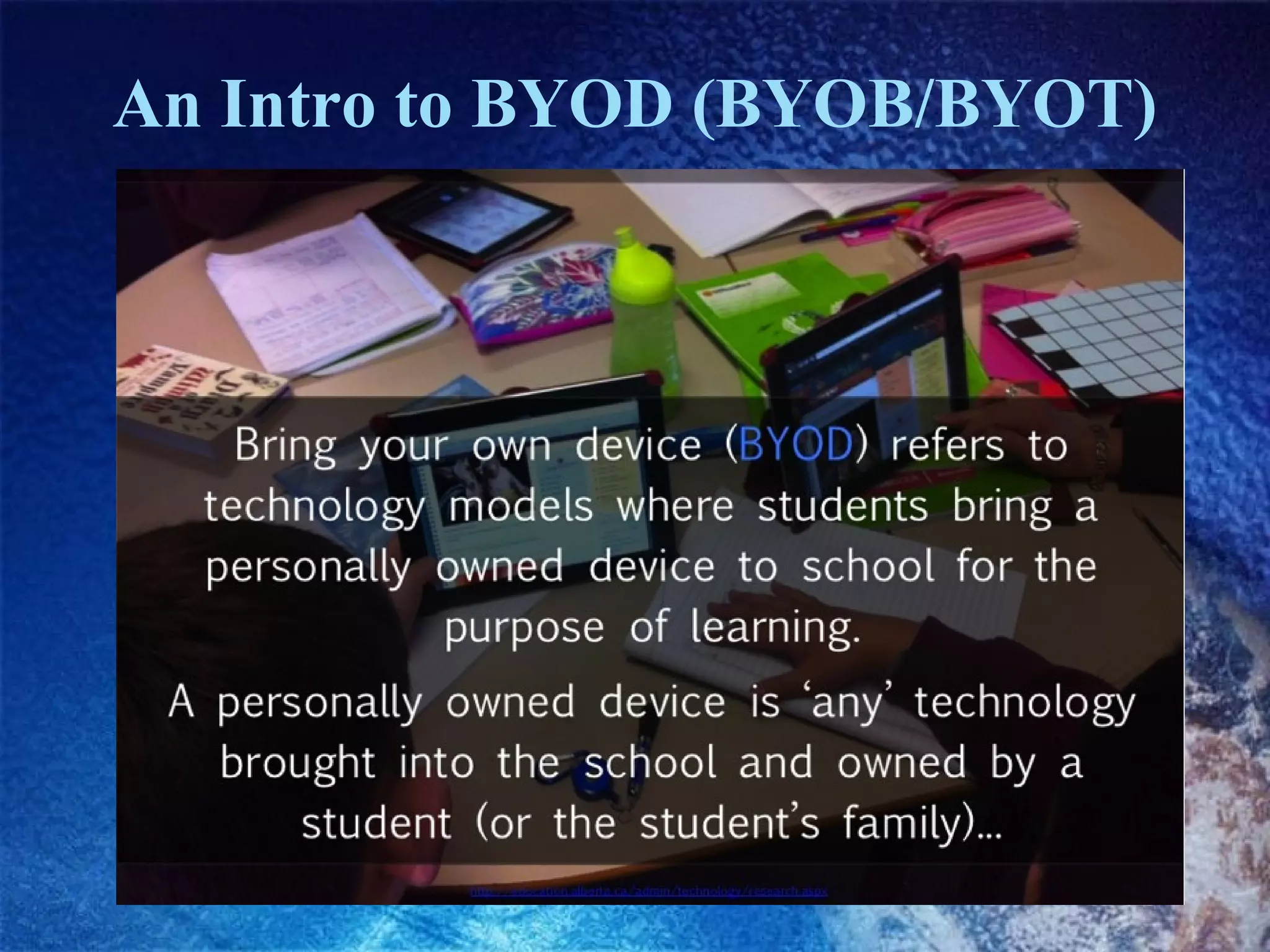
An Intro to BYOD (BYOB/BYOT)
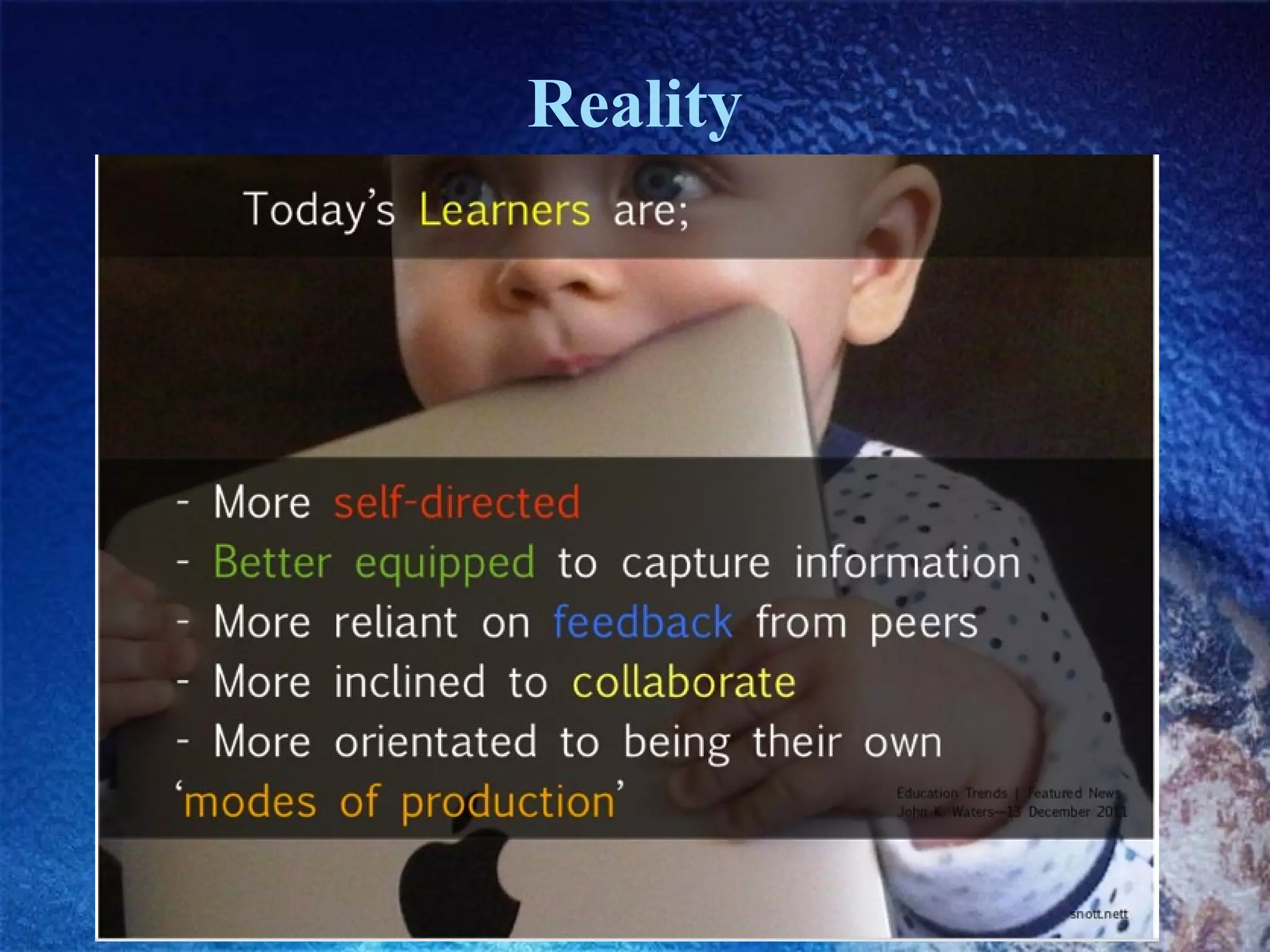
Reality
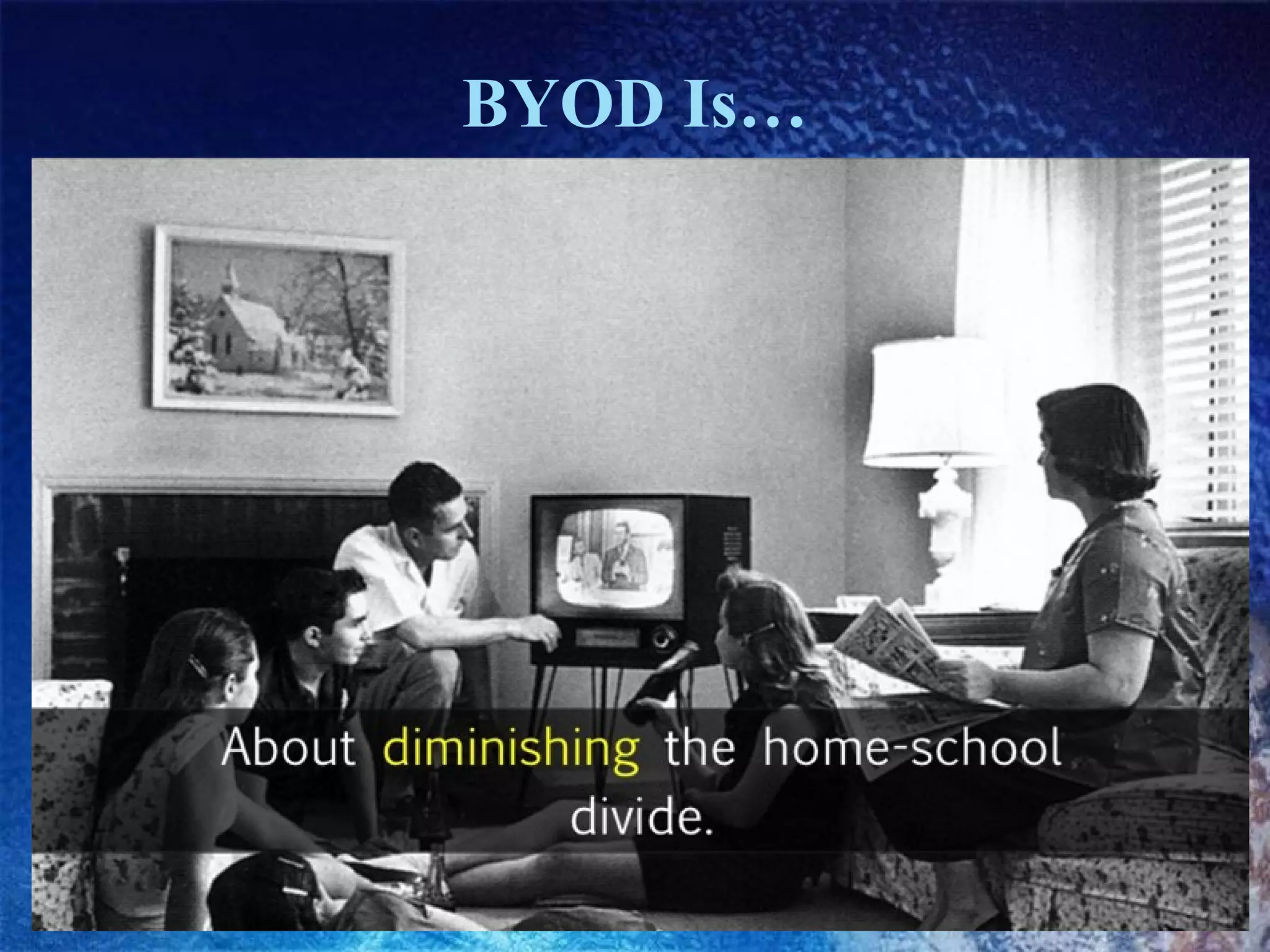
BYOD Is…
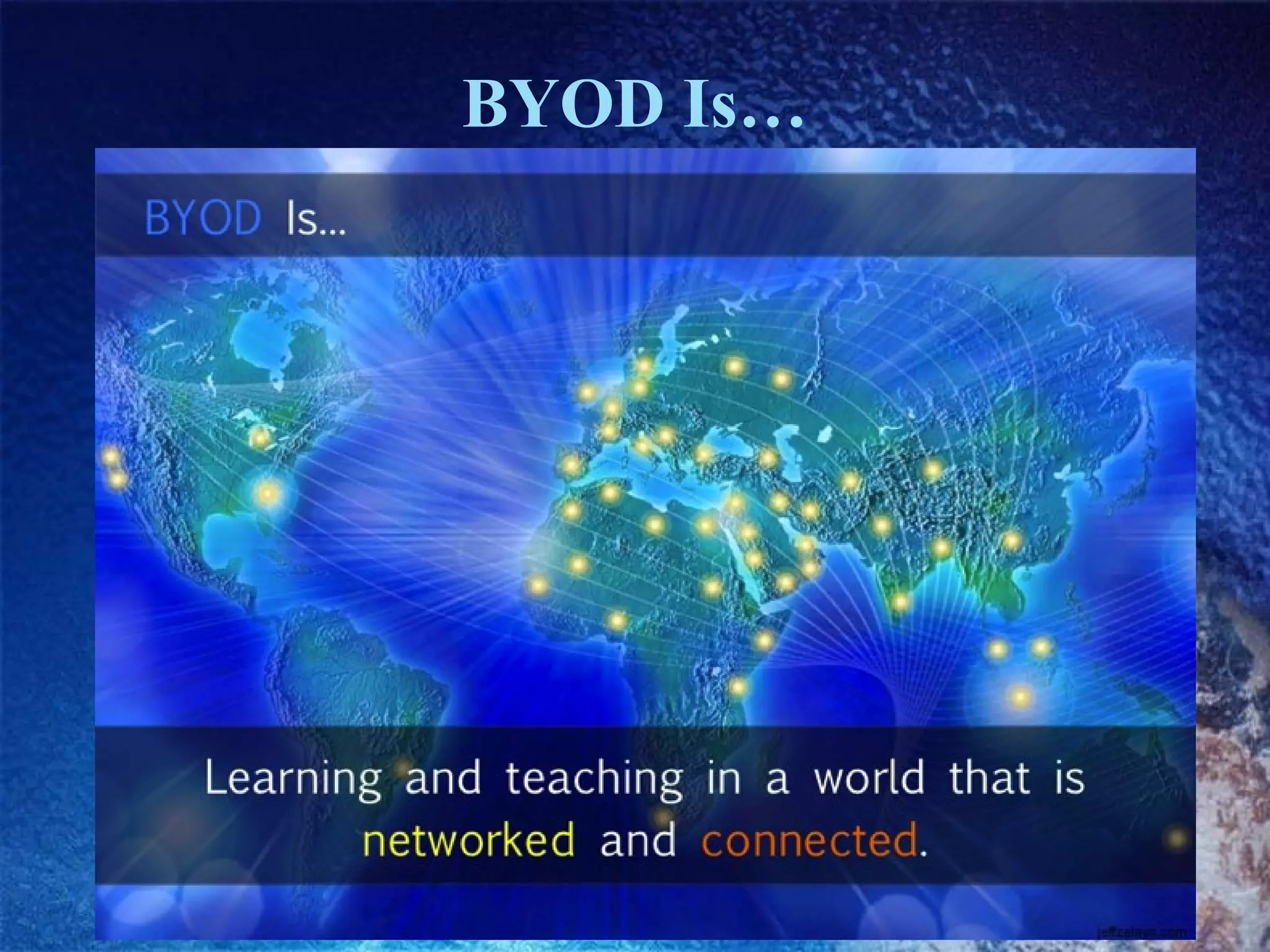
BYOD Is…
BYOD Rationale
• Choice
– Learners are diverse. Learning styles and
preferences vary and we wish to recognise
this by allowing learners to choose the device
and applications most suitable for them.

• Anywhere / Anytime
– Teaching and learning occurs inside and
outside the classroom. We want to empower
learners to utilise tools for learning no matter
where they are.
BYOD Rationale
• Personalised
– By having our own devices we can each have
the tools, shortcuts, widgets and add-ons that
are the most relevant to us. Our desktops and
browsers are the way we want them.

• Preparing for the future
– Our students will move into BYOD
environments at intermediate, college,
university, work place.
BYOD Rationale
• Flexible Learning
– The nature of learning is changing. No longer
do we sit in rows and listen to the teacher. We
are creating flexible learning environments
that facilitate collaborative and individual
learning.

• Digital Fluency
– We are empowering teachers and students to
become digitally fluent and responsible users
of technology.
BYOD Myth 1
• BYOD deepens the digital divide
– “Students who do not have personal
technology devices have greater access to
school-owned technology tools when students
who bring their own devices to school are no
longer competing for that access.”

http://neal.school.nz/community/news/7-myths-about-byod-debunked
BYOD Myth 2
• BYOD will result in students engaging in
dangerous activities
– Our students are living in a digital world with
ubiquitous access to technology. “Without
BYOD, at the end of each school day,
students leave school and immediately turn
on their devices and explore the web, often
unsupervised”. We need to prepare them for
the digital world in which they live.

http://neal.school.nz/community/news/7-myths-about-byod-debunked
BYOD Myth 3
• BYOD will necessitate the standardisation
of apps and software across all devices
– Students are not widgets and don’t have to
use the same tools and do things in the same
way. When teachers work with students to
understand learning goals, they challenge
students with ways to meet them, which
enables real learning to take place.

http://neal.school.nz/community/news/7-myths-about-byod-debunked
Trial
• Rooms 5 and 7 trialed BYOD for two terms in
2013
• Results overall were positive
• Trial review results in pdf format are located at
http://www.sunnyhills.school.nz/e-learning
Trial
• Parents didn’t need to buy a device – children
brought what they already have
• Classes already had a range of equipment
including
– Laptops
– iPads
– Desktops
Minimum Device Requirements
• Battery Life – 5-6 hours to get through a school
day without recharging
• Weight – Light enough for your child to carry easily
• Wireless Access – must have wireless access to
internet
• Must be able to save to the device either via hard
drive or SD Card/USB device
• Laptops – must have up-to-date anti-virus
software
• No gaming hardware such as PSPs or “phones”
• Parents responsibility to make sure device meets
minimum requirements
Future Considerations
• Farm Cove Intermediate
– Working closely with Pakuranga College
regarding BYOD requirements

• Pakuranga College

– Website has recommendations as to device
requirements
– http://www.pakuranga.school.nz/assets/documents
Cloud Based Applications
• Your child will develop a digital toolkit
whereby they will choose which tool to use
for the particular purpose
• There are a vast amount of free tools online
such as Glogster (online poster), ThingLink
(interactive online photo), Animoto (video
slideshows), Prezi (presentations) etc
iPad Apps
• A list of recommended apps is on our
website
(http://www.sunnyhills.school.nz/elearning)
• Paid apps are entirely optional NOT a
necessity
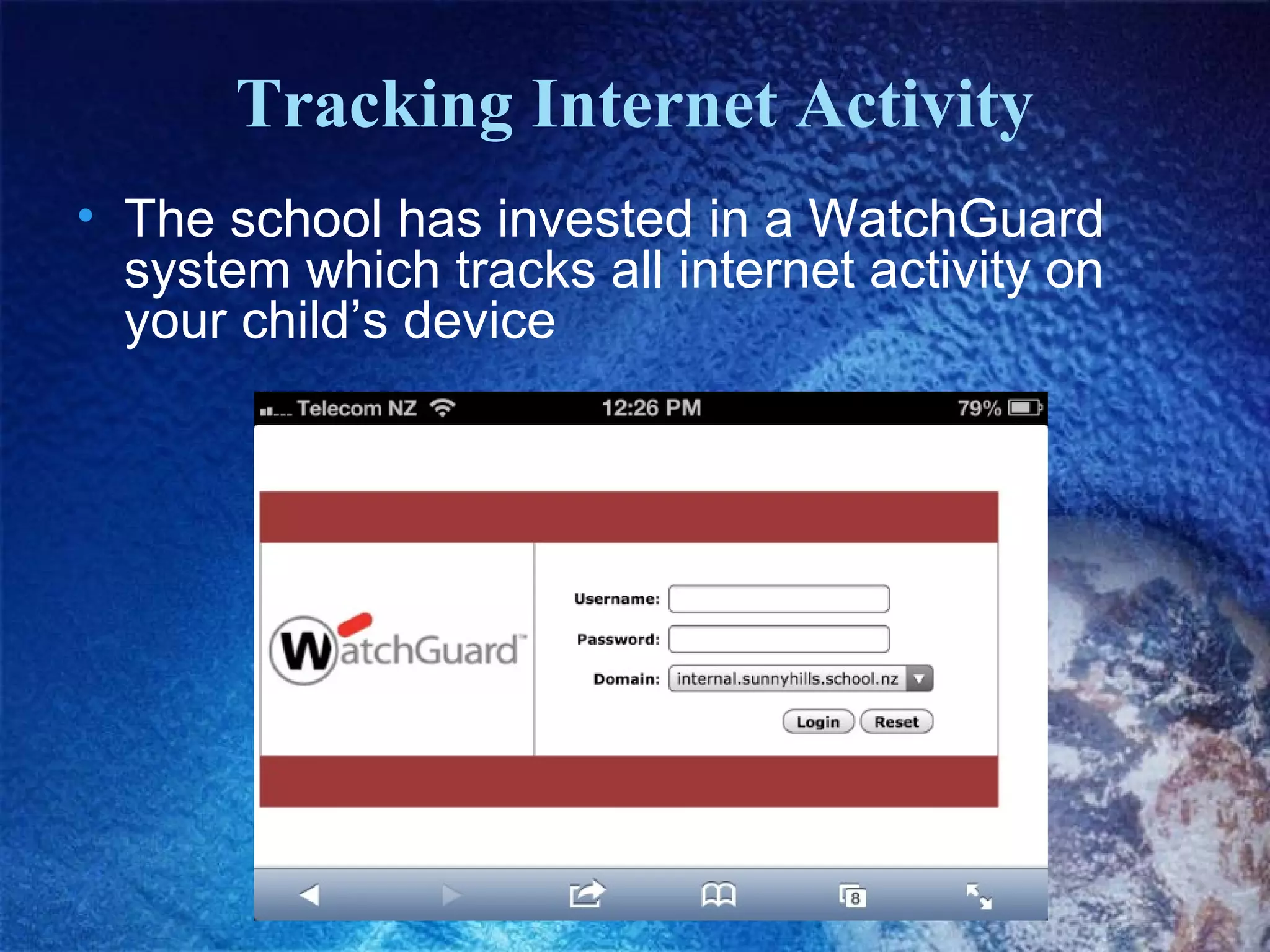
Tracking Internet Activity
• The school has invested in a WatchGuard
system which tracks all internet activity on
your child’s device
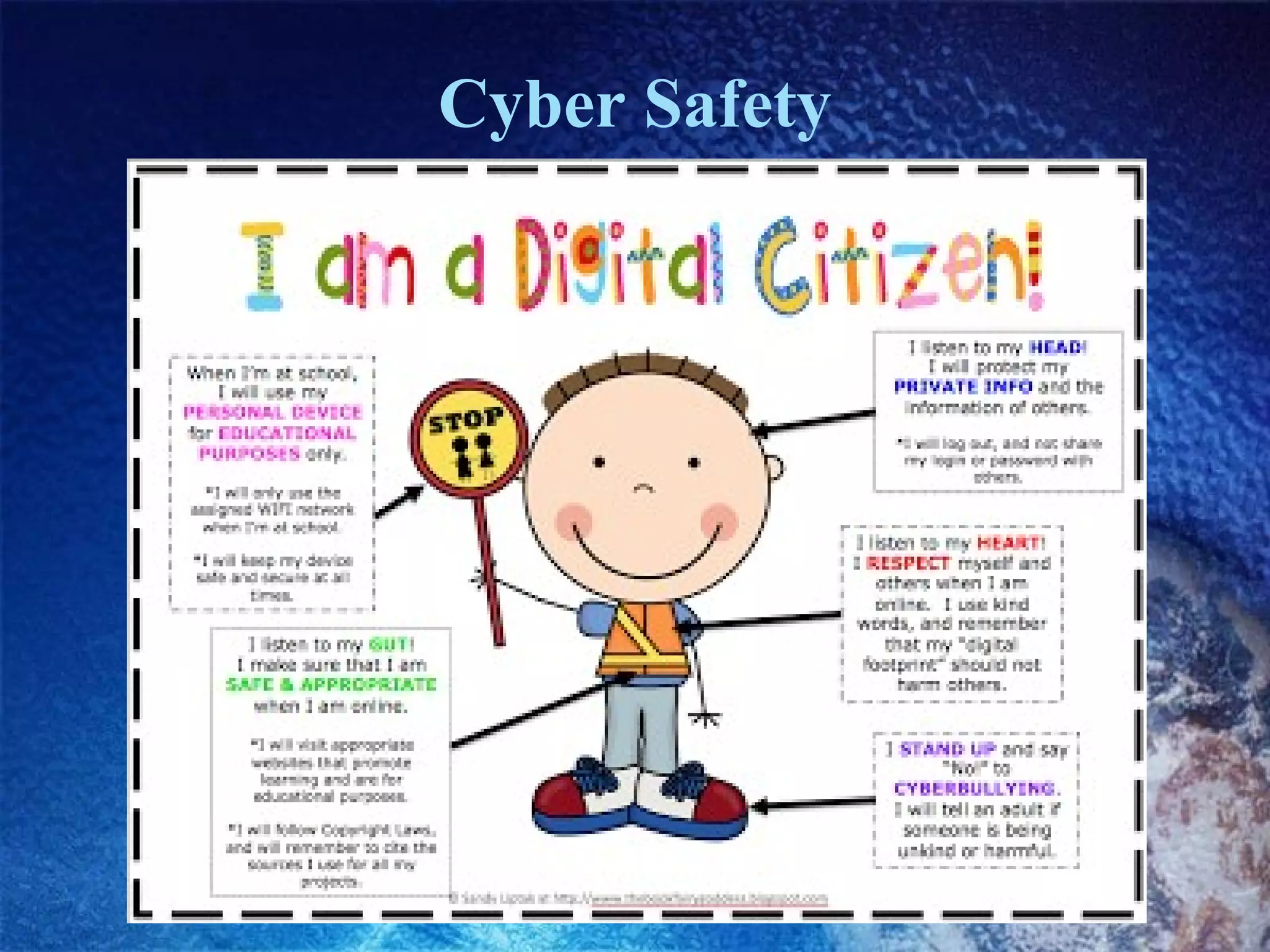
Cyber Safety
Safety Guidelines
• Lockable storage cupboards are provided
in each classroom
-

Children need to be responsible for their own
devices. Other schools have found children
lose their jumpers but never their ‘device’.

• Classroom Culture
-

Expectations will be set as part of the
classroom culture i.e. devices should be kept
in school bags before and after school
- Classroom treaty includes ‘online’
Safety Guidelines
• Sunnyhills School holds no responsibility
for any loss or damage that might occur
• Parental Responsibilities
Parents are responsible for
- insurance for their device (check with your
insurance provider accordingly)
- naming equipment
- sending a device that meets minimum
requirements

• Child Responsibility
- charging device at home
- responsible for device at school
Safety Guidelines
• How do I keep my child safe going to school?
• We recommend devices are kept in bags out
of sight, just as you would with any
equipment such as sports gear, musical
instruments etc
• Children should be walking to school with an
adult/small groups or the walking school bus.
Sharing
• Your child may be involved in collaborative
group work, which could mean, whilst in that
group, your child will be in charge of his/her
device, and with your child’s permission
another child could work on the device with
your child.
• We want to promote a ‘share the screen’
environment
Ergonomics
• Screen time
– 20 minutes then a break looking out window
for 1-2 minutes

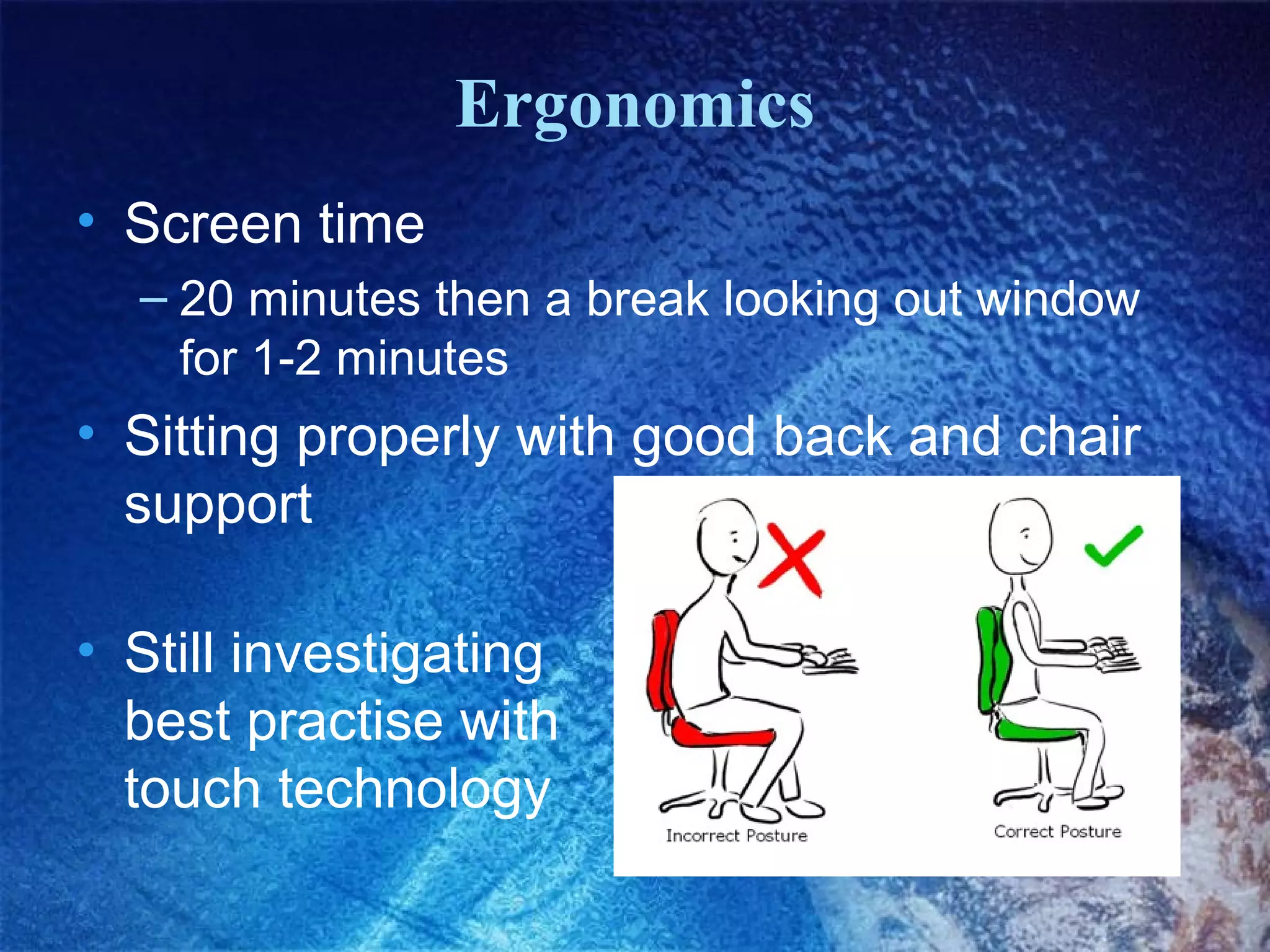
• Sitting properly with good back and chair
support
• Still investigating
best practise with
touch technology
Ergonomics
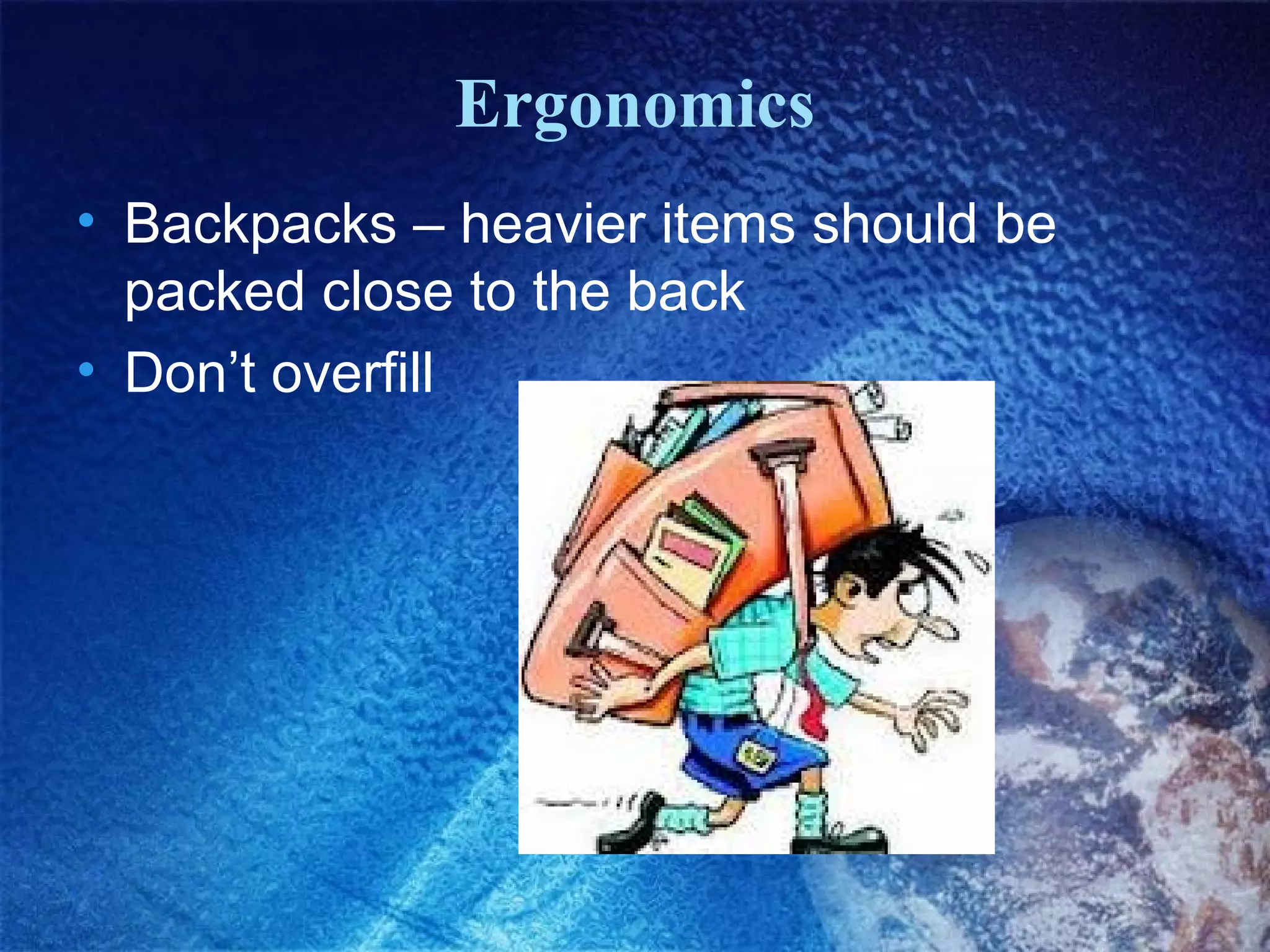
• Backpacks – heavier items should be
packed close to the back
• Don’t overfill
2014 Draft Timeline
• Term 1
– Agreement Forms sent out in Week 1
– Start early term 1 - classes staggered
– Not in week 1
– Term 1 has camp for year 6 in week 4,
swimming sports, N4L etc

• Term 2
– Aim to be fully functional
Documentation
•
•
•
•

Bring Your Own Device agreement
Minimum device requirements
iPad Apps recommendations
Student ICT Agreement
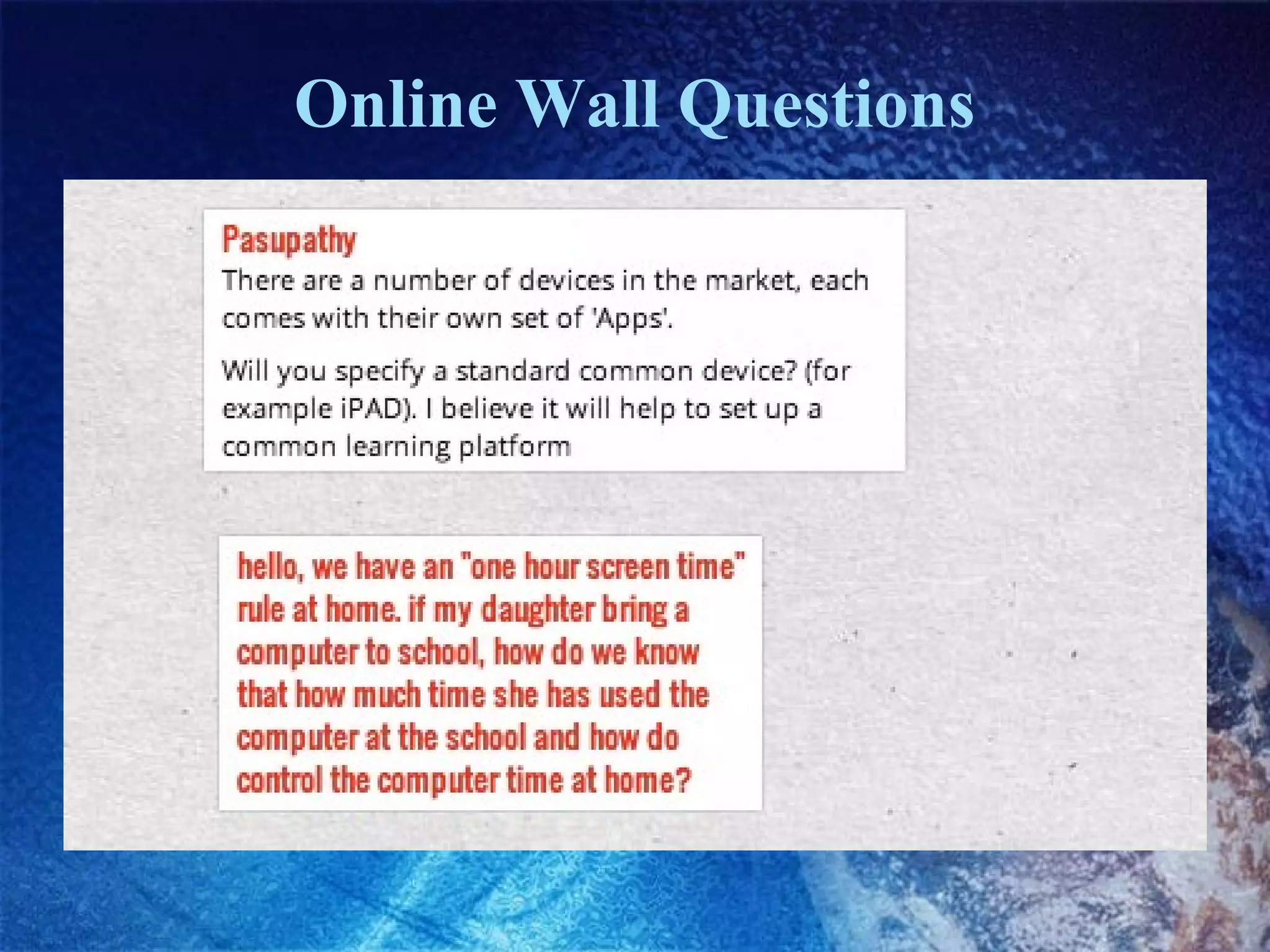
Online Wall Questions
Thank You
Any further questions please contact one
Helen Prescott or Juliet Small

Parent Presentation - BYOD 2014

  • 1.
  • 2.
    Agenda of Meeting7pm-8.30pm • 21st Century Learning – – – – Pedagogy 7.15 Demonstration of Student Collaboration Students Learning SAMR Model • Bring Your Own Device (BYOD) – – – – – – What is BYOD? Rationale/Myths 2013 Trial Device Requirements Security/Safety Guidelines 2014 Draft Timeline • Question and Answer Time
  • 3.
    Pedagogy • “The curriculumencourages all students to reflect on their own learning processes and to learn how to learn.” The New Zealand Curriculum • Individual learners are empowered to take increasingly more responsibility for their learning
  • 4.
    Pedagogy • Students areable to select their choice of learning tool from within a flexible learning environment to best meet their learning needs • We have already seen a shift in the learning from having class sets of laptops in trolleys, to laptops within classrooms and this year through the BYOD trial • Having devices in classrooms allows seamless integration of ICT across the curriculum
  • 5.
    Flexible Learning Environments •Relating to Others • Thinking • Participating and Contributing • Managing Self • Using Language, Symbols and Text
  • 6.
    NCEA/NZQA • NCEA/NZQA ischanging. In 6-10 years all assessments will be online. We want our students to succeed in the 21st century environment that is being developed. Dr Karen Poutasi, Chief Executive • .https://groups.google.com/forum/#!topic/mle-reference-group/IN6-UkvHUro
  • 7.
    21st Century Fluencies •Learners need to develop 21st century fluencies Image from the 21st Century Fluency Project
  • 8.
    Google Apps/Teacher Dashboard •Google Apps is an easy-to-use online word processor, spread sheet and presentation editor • Enables students to create, store and share documents instantly and securely, and collaborate online in real time. • You can create new documents from scratch or upload existing documents, spread sheets and presentations • There’s no software to download, and all your work is stored safely online and can be accessed from any computer or student owned device. This will be the standard web platform with Teacher Dashboard to
  • 9.
  • 10.
    Persuasive Writing Click hereto view Media Fluency Solution Fluency Information Fluency Creativity Fluency Collaborative Fluency
  • 11.
    Transformational Learning Click hereto view Media Fluency Solution Fluency Information Fluency Creativity Fluency Collaborative Fluency
  • 12.
    Prezi Click here toview Click here to view Media Fluency Solution Fluency Information Fluency Creativity Fluency Collaborative Fluency
  • 13.
    Problem Solving Click hereto view Media Fluency Solution Fluency Information Fluency Creativity Fluency Collaborative Fluency
  • 14.
    Garageband Supporting Literacy Clickhere to view Media Fluency Solution Fluency Information Fluency Creativity Fluency Collaborative Fluency
  • 15.
  • 16.
  • 17.
    What do wegain from Substitution/Augmentation? r Tidie ier s rk/ea wo it o ed t Layout/D esign Skills Increased work output Typing skills http://www.flickr.com/photos/katiekrueger/ Incr eas ed lear eng ning age men t Small gains in student outcomes
  • 18.
    What do wegain from Modification/Redefinition? l ritica C rs hinke t f no tio rea w C ne wledg o s /k n e idea Wider audience Reflective Students Collaboration Development of new literacies Greater gains in student outcomes f en t o elopm Dev Key es tenci pe Com elf ing S g a an M http://www.google.co.nz/search? q=free+screen+beans&client=safari&rls=en&tbm=isch&tbo=u&source=univ&sa=X&ei=uLixUbzXHon0lAX19oCICQ&ved=0CDQQsAQ&biw=1021&bih=601#facrc=_&imgrc=SesAinpan86t9M%3A %3BCVeBfzPjCWizoM%3Bhttp%253A%252F%252F1.bp.blogspot.com%252F_bZpzjZ2cdYo%252FS9Y6OhlWMqI%252FAAAAAAAAAyE%252FIG8MQPQcQds%252Fs320%252Fscreen %252Bbeans.jpg%3Bhttp%253A%252F%252Fmysparklingevent.com%252F2010%252F04%252F%3B413%3B431
  • 19.
    The Big Question •How can we afford to sustain the level of technology needed to support this direction in learning? • BYOD supports our pedagogical direction
  • 20.
    An Intro toBYOD (BYOB/BYOT)
  • 21.
  • 22.
  • 23.
  • 24.
    BYOD Rationale • Choice –Learners are diverse. Learning styles and preferences vary and we wish to recognise this by allowing learners to choose the device and applications most suitable for them. • Anywhere / Anytime – Teaching and learning occurs inside and outside the classroom. We want to empower learners to utilise tools for learning no matter where they are.
  • 25.
    BYOD Rationale • Personalised –By having our own devices we can each have the tools, shortcuts, widgets and add-ons that are the most relevant to us. Our desktops and browsers are the way we want them. • Preparing for the future – Our students will move into BYOD environments at intermediate, college, university, work place.
  • 26.
    BYOD Rationale • FlexibleLearning – The nature of learning is changing. No longer do we sit in rows and listen to the teacher. We are creating flexible learning environments that facilitate collaborative and individual learning. • Digital Fluency – We are empowering teachers and students to become digitally fluent and responsible users of technology.
  • 27.
    BYOD Myth 1 •BYOD deepens the digital divide – “Students who do not have personal technology devices have greater access to school-owned technology tools when students who bring their own devices to school are no longer competing for that access.” http://neal.school.nz/community/news/7-myths-about-byod-debunked
  • 28.
    BYOD Myth 2 •BYOD will result in students engaging in dangerous activities – Our students are living in a digital world with ubiquitous access to technology. “Without BYOD, at the end of each school day, students leave school and immediately turn on their devices and explore the web, often unsupervised”. We need to prepare them for the digital world in which they live. http://neal.school.nz/community/news/7-myths-about-byod-debunked
  • 29.
    BYOD Myth 3 •BYOD will necessitate the standardisation of apps and software across all devices – Students are not widgets and don’t have to use the same tools and do things in the same way. When teachers work with students to understand learning goals, they challenge students with ways to meet them, which enables real learning to take place. http://neal.school.nz/community/news/7-myths-about-byod-debunked
  • 30.
    Trial • Rooms 5and 7 trialed BYOD for two terms in 2013 • Results overall were positive • Trial review results in pdf format are located at http://www.sunnyhills.school.nz/e-learning
  • 31.
    Trial • Parents didn’tneed to buy a device – children brought what they already have • Classes already had a range of equipment including – Laptops – iPads – Desktops
  • 32.
    Minimum Device Requirements •Battery Life – 5-6 hours to get through a school day without recharging • Weight – Light enough for your child to carry easily • Wireless Access – must have wireless access to internet • Must be able to save to the device either via hard drive or SD Card/USB device • Laptops – must have up-to-date anti-virus software • No gaming hardware such as PSPs or “phones” • Parents responsibility to make sure device meets minimum requirements
  • 33.
    Future Considerations • FarmCove Intermediate – Working closely with Pakuranga College regarding BYOD requirements • Pakuranga College – Website has recommendations as to device requirements – http://www.pakuranga.school.nz/assets/documents – http://www.pakuranga.school.nz/assets/documents
  • 34.
    Cloud Based Applications •Your child will develop a digital toolkit whereby they will choose which tool to use for the particular purpose • There are a vast amount of free tools online such as Glogster (online poster), ThingLink (interactive online photo), Animoto (video slideshows), Prezi (presentations) etc
  • 35.
    iPad Apps • Alist of recommended apps is on our website (http://www.sunnyhills.school.nz/elearning) • Paid apps are entirely optional NOT a necessity
  • 36.
    Tracking Internet Activity •The school has invested in a WatchGuard system which tracks all internet activity on your child’s device
  • 37.
  • 38.
    Safety Guidelines • Lockablestorage cupboards are provided in each classroom - Children need to be responsible for their own devices. Other schools have found children lose their jumpers but never their ‘device’. • Classroom Culture - Expectations will be set as part of the classroom culture i.e. devices should be kept in school bags before and after school - Classroom treaty includes ‘online’
  • 39.
    Safety Guidelines • SunnyhillsSchool holds no responsibility for any loss or damage that might occur • Parental Responsibilities Parents are responsible for - insurance for their device (check with your insurance provider accordingly) - naming equipment - sending a device that meets minimum requirements • Child Responsibility - charging device at home - responsible for device at school
  • 40.
    Safety Guidelines • Howdo I keep my child safe going to school? • We recommend devices are kept in bags out of sight, just as you would with any equipment such as sports gear, musical instruments etc • Children should be walking to school with an adult/small groups or the walking school bus.
  • 41.
    Sharing • Your childmay be involved in collaborative group work, which could mean, whilst in that group, your child will be in charge of his/her device, and with your child’s permission another child could work on the device with your child. • We want to promote a ‘share the screen’ environment
  • 42.
    Ergonomics • Screen time –20 minutes then a break looking out window for 1-2 minutes • Sitting properly with good back and chair support • Still investigating best practise with touch technology
  • 43.
    Ergonomics • Backpacks –heavier items should be packed close to the back • Don’t overfill
  • 44.
    2014 Draft Timeline •Term 1 – Agreement Forms sent out in Week 1 – Start early term 1 - classes staggered – Not in week 1 – Term 1 has camp for year 6 in week 4, swimming sports, N4L etc • Term 2 – Aim to be fully functional
  • 45.
    Documentation • • • • Bring Your OwnDevice agreement Minimum device requirements iPad Apps recommendations Student ICT Agreement
  • 46.
  • 47.
    Thank You Any furtherquestions please contact one Helen Prescott or Juliet Small

Editor's Notes

  • #13 http://prezi.com/gnzvpthl9axg/computer-games/ http://prezi.com/w1rc9w8d_oif/why-do-birds-have-feathers/ John