eCLASS
& BYOD
2013-2014
Teaching and
Learning Initiatives
What is eCLASS?
 Digital Content, Learning, Assessment &
Support System
 Picture an umbrella with all our current
resources underneath it along with new
resources and applications to enhance
student engagement and the teaching
and learning process
eCLASS
What is eCLASS for Students?
 Students can access assignments and
academic help anytime, online.
 Digital Tools to expand the walls of the
classroom, including the Student Portal
 Digital resources that foster collaboration
 Technology to nurture creativity &
innovation, including BYOD
eCLASS
Some Things to Know
 GCPS is not adopting eCLASS; GCPS is
creating eCLASS along with Houghton Mifflin
Harcourt, Desire2Learn, and other partner
companies
 First pieces began last year, and more will
be phased in as created over the next
several years.
 Harbins is PILOT SCHOOL as part of the
Archer Cluster.
eCLASS
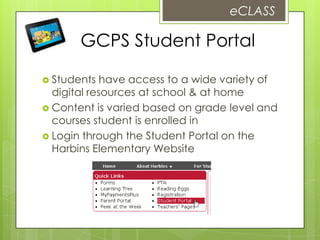
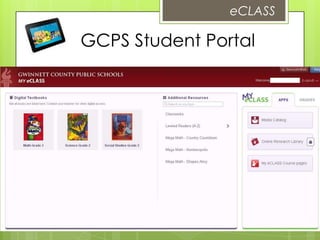
GCPS Student Portal
 Students have access to a wide variety of
digital resources at school & at home
 Content is varied based on grade level and
courses student is enrolled in
 Login through the Student Portal on the
Harbins Elementary Website
eCLASS
GCPS Student Portal
eCLASS
 We are creating eCLASS. We are phasing in
models and trying new things.
 There is much room to grow and many
challenges to overcome.
 It is not a technology initiative. It is a teaching
and learning initiative. And a MAJOR one.
eCLASS
What does it mean to be
a “pilot”?
What it is NOT
 An automated teacher or automated
curriculum (it doesn’t teach)
 Technologically overwhelming
 Primarily a technology initiative – we are
focused on teaching & learning –
technology is a TOOL, not an OUTCOME
eCLASS
BYOD 2013-2014
 Bring Your Own Device is a popular and
expanding phenomenon in American
schools.
 Our data indicate many students have
access to technology outside of school –
which we tell them to turn off when they
arrive in class.
 How can we use this technology to
ENHANCE quality instruction?
eCLASS
What kind of access will
students have?
 Internet access similar to what they have
when they log on to a school computer
 We will have some school-owned devices
in classrooms.
 Devices may not have all the software
students are used to, and all websites
don’t run correctly on all devices.
What about security?
 Network Security
 Hardware Security
 Classroom Management
Which device is best?
 FIRST – we can not recommend, or
endorse, a device for your family, but we
can share some information to help
inform your decision-making. (handout)
 Teachers will share some specific advice
for you at each grade level
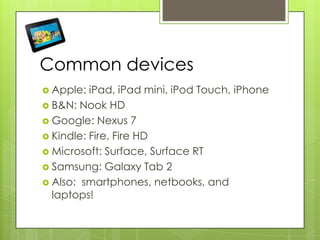
Common devices
 Apple: iPad, iPad mini, iPod Touch, iPhone
 B&N: Nook HD
 Google: Nexus 7
 Kindle: Fire, Fire HD
 Microsoft: Surface, Surface RT
 Samsung: Galaxy Tab 2
 Also: smartphones, netbooks, and
laptops!
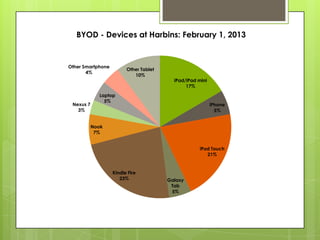
iPad/iPad mini
17%
iPhone
5%
iPod Touch
21%
Galaxy
Tab
5%
Kindle Fire
23%
Nook
7%
Nexus 7
3%
Laptop
5%
Other Smartphone
4%
Other Tablet
10%
BYOD - Devices at Harbins: February 1, 2013
Considerations
 Price
 Risk of loss or damage
 Data (saving, storage space, data plan)
 Ruggedness (protective case)
 Size & clarity of screen display
 Response time
 Operating system
 Plays Adobe Flash?
 Keyboard
 Memory required
 Battery life
 Available apps
Preparing Your Student
 Can your student do the following
independently?
 Turn the device on and off
 Adjust the volume
 Open & close Apps
 Go to settings & select a Wi-Fi network
 Launch & navigate the Web browser
 Bookmark websites to the home screen and access
bookmarks
 Take a screenshot & access the photo library
 Take a video and access the video library
Preparing Your Device
 Suggested for ALL grades
 Drawing app (any free with ability to save photo)
 Response app (Socrative, etc.)
 Suggested for K-2 – see link below
Skills and Apps 2013-2014
 Suggested for 3-5 – see link below
Next Step?
 Personally Owned Device Release Form must
be completed each year for each device the
student might bring
eClass in Action
 Desire 2 Learn Student Modules

BYOD 2013-2014 Presentation Harbins

  • 1.
  • 2.
    What is eCLASS? Digital Content, Learning, Assessment & Support System  Picture an umbrella with all our current resources underneath it along with new resources and applications to enhance student engagement and the teaching and learning process eCLASS
  • 3.
    What is eCLASSfor Students?  Students can access assignments and academic help anytime, online.  Digital Tools to expand the walls of the classroom, including the Student Portal  Digital resources that foster collaboration  Technology to nurture creativity & innovation, including BYOD eCLASS
  • 4.
    Some Things toKnow  GCPS is not adopting eCLASS; GCPS is creating eCLASS along with Houghton Mifflin Harcourt, Desire2Learn, and other partner companies  First pieces began last year, and more will be phased in as created over the next several years.  Harbins is PILOT SCHOOL as part of the Archer Cluster. eCLASS
  • 5.
    GCPS Student Portal Students have access to a wide variety of digital resources at school & at home  Content is varied based on grade level and courses student is enrolled in  Login through the Student Portal on the Harbins Elementary Website eCLASS
  • 6.
  • 7.
     We arecreating eCLASS. We are phasing in models and trying new things.  There is much room to grow and many challenges to overcome.  It is not a technology initiative. It is a teaching and learning initiative. And a MAJOR one. eCLASS What does it mean to be a “pilot”?
  • 8.
    What it isNOT  An automated teacher or automated curriculum (it doesn’t teach)  Technologically overwhelming  Primarily a technology initiative – we are focused on teaching & learning – technology is a TOOL, not an OUTCOME eCLASS
  • 9.
    BYOD 2013-2014  BringYour Own Device is a popular and expanding phenomenon in American schools.  Our data indicate many students have access to technology outside of school – which we tell them to turn off when they arrive in class.  How can we use this technology to ENHANCE quality instruction? eCLASS
  • 10.
    What kind ofaccess will students have?  Internet access similar to what they have when they log on to a school computer  We will have some school-owned devices in classrooms.  Devices may not have all the software students are used to, and all websites don’t run correctly on all devices.
  • 11.
    What about security? Network Security  Hardware Security  Classroom Management
  • 12.
    Which device isbest?  FIRST – we can not recommend, or endorse, a device for your family, but we can share some information to help inform your decision-making. (handout)  Teachers will share some specific advice for you at each grade level
  • 13.
    Common devices  Apple:iPad, iPad mini, iPod Touch, iPhone  B&N: Nook HD  Google: Nexus 7  Kindle: Fire, Fire HD  Microsoft: Surface, Surface RT  Samsung: Galaxy Tab 2  Also: smartphones, netbooks, and laptops!
  • 14.
    iPad/iPad mini 17% iPhone 5% iPod Touch 21% Galaxy Tab 5% KindleFire 23% Nook 7% Nexus 7 3% Laptop 5% Other Smartphone 4% Other Tablet 10% BYOD - Devices at Harbins: February 1, 2013
  • 15.
    Considerations  Price  Riskof loss or damage  Data (saving, storage space, data plan)  Ruggedness (protective case)  Size & clarity of screen display  Response time  Operating system  Plays Adobe Flash?  Keyboard  Memory required  Battery life  Available apps
  • 16.
    Preparing Your Student Can your student do the following independently?  Turn the device on and off  Adjust the volume  Open & close Apps  Go to settings & select a Wi-Fi network  Launch & navigate the Web browser  Bookmark websites to the home screen and access bookmarks  Take a screenshot & access the photo library  Take a video and access the video library
  • 17.
    Preparing Your Device Suggested for ALL grades  Drawing app (any free with ability to save photo)  Response app (Socrative, etc.)  Suggested for K-2 – see link below Skills and Apps 2013-2014  Suggested for 3-5 – see link below
  • 18.
    Next Step?  PersonallyOwned Device Release Form must be completed each year for each device the student might bring
  • 19.
    eClass in Action Desire 2 Learn Student Modules