






By the power of metrics 
LeanKanban Central Europe 2014 - #LKCE14 
Wolfgang Wiedenroth @wwiedenroth
Metrics in the Kanban Method 
Practices 
1.Visualize 
2.Limit WIP 
3.Manage Flow 
4.Make Process Policies Explicit 
5.Develop Feedback Loops 
6.Improve Collaboratively, Evolve Experimentally 
(using models/scientific method)
Metrics in the Kanban Method 
Kanban’s 3 Agendas 
Sustainability 
Service-Oriented 
Survivability
Metrics in the Kanban Method 
Practices 
1.Visualize 
2.Limit WIP 
3.Manage Flow 
4.Make Process Policies Explicit 
5.Develop Feedback Loops 
6.Improve Collaboratively, Evolve Experimentally 
(using models/scientific method) 
Kanban’s 3 Agendas 
Sustainability 
Service-Oriented 
Survivability
115# 
110# 
105# 
100# 
95# 
90# 
85# 
80# 
75# 
70# 
65# 
60# 
55# 
50# 
45# 
40# 
35# 
30# 
25# 
20# 
1#May#2012# 
11#May#2012# 
7#May#2012# 
17#May#2012# 
23#May#2012# 
29#May#2012# 
4#Jun#2012# 
14#Jun#2012# 
8#Jun#2012# 
20#Jun#2012# 
26#Jun#2012# 
2#Jul#2012# 
6#Jul#2012# 
12#Jul#2012# 
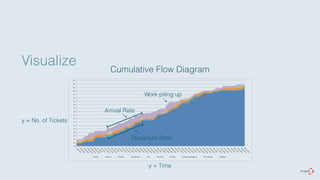
Departure Rate 
24#Jul#2012# 
18#Jul#2012# 
30#Jul#2012# 
3#Aug#2012# 
Work piling up 
15#Aug#2012# 
9#Aug#2012# 
21#Aug#2012# 
27#Aug#2012# 
31#Aug#2012# 
6#Sep#2012# 
12#Sep#2012# 
24#Sep#2012# 
18#Sep#2012# 
28#Sep#2012# 
10#Oct#2012# 
4#Oct#2012# 
16#Oct#2012# 
22#Oct#2012# 
26#Oct#2012# 
1#Nov#2012# 
13#Nov#2012# 
7#Nov#2012# 
19#Nov#2012# 
23#Nov#2012# 
29#Nov#2012# 
5#Dec#2012# 
11#Dec#2012# 
21#Dec#2012# 
17#Dec#2012# 
2#Jan#2013# 
27#Dec#2012# 
8#Jan#2013# 
14#Jan#2013# 
24#Jan#2013# 
18#Jan#2013# 
Analyse# Selected# Planning# Planning#Done# Dev# Dev#Done# TesDng# TesDng#Done/Endgame# to#be#released# Released# 
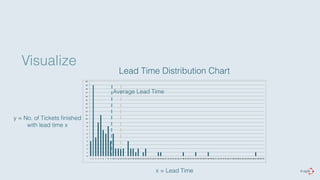
Visualize 
Cumulative Flow Diagram 
y = No. of Tickets 
y = Time 
Arrival Rate
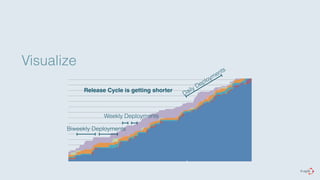
Visualize 
Release Cycle is getting shorter 
Daily Deployments 
Weekly Deployments 
Biweekly Deployments
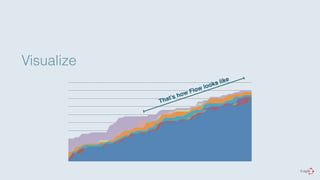
Visualize 
That’s how Flow looks like
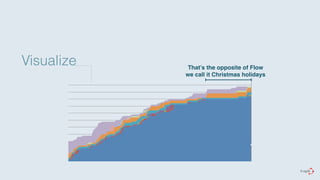
Visualize That’s the opposite of Flow! 
we call it Christmas holidays
Visualize 
20" 
19" 
18" 
17" 
16" 
15" 
14" 
13" 
12" 
11" 
10" 
9" 
8" 
7" 
6" 
5" 
4" 
3" 
2" 
1" 
0" 
Lead Time Distribution Chart 
Average Lead Time 
1" 2" 3" 4" 5" 6" 7" 8" 9" 10"11"12"13"14"15"16"17"18"19"20"21"22"23"24"25"26"27"28"29"30"31"32"33"34"35"36"37"38"39"40"41"42"43"44"45"46"47"48"49"50"51"52"53"54"55"56"57"58"59"60"61"62"63"64"65"66"67"68"69"70" 
y = No. of Tickets finished 
with lead time x 
x = Lead Time
6" 
5" 
4" 
3" 
2" 
1" 
0" 
MEDIAN" 
6" 7" 8" 9" 10" 11" 12" 13" 14" 15" 16" 17" 18" 19" 20" 21" 22" 23" 24" 25" 26" 27" 28" 29" 30" 31" 32" 33" 34" 35" 36" 37" 38" 39" 40" 41" 42" 43" 44" 45" 46" 47" 48" 49" 50" 51" 52" 1" 2" 3" 4" 5" 6" 7" 8" 9" 
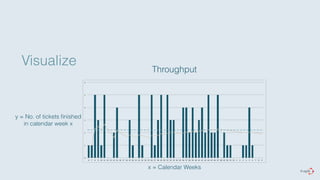
Visualize 
Throughput 
x = Calendar Weeks 
y = No. of tickets finished 
in calendar week x
Visualize
Visualized metrics let you 
see things faster
Visualized metrics let you 
identify pattern
Visualized metrics give 
everyone the same picture
Visualized metrics are 
great feedback loops
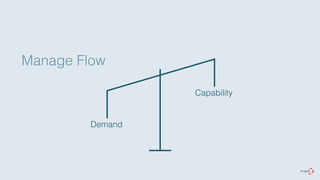
Manage Flow
Manage Flow 
Demand 
Capability
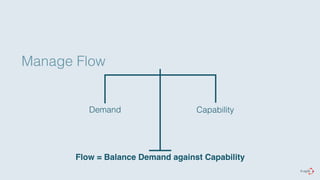
Manage Flow 
Demand Capability 
Flow = Balance Demand against Capability
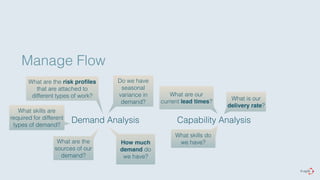
Manage Flow 
Demand Analysis Capability Analysis 
How much 
demand do 
we have? 
What are the 
sources of our 
demand? 
Do we have 
seasonal 
variance in 
demand? 
What are the risk profiles 
that are attached to 
different types of work? 
What skills are 
required for different 
types of demand? 
What are our 
current lead times? 
What is our 
delivery rate? 
What skills do 
we have?
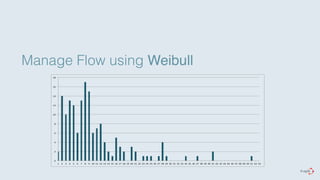
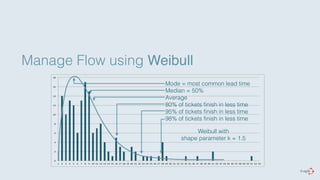
Manage Flow using Weibull 
18" 
16" 
14" 
12" 
10" 
8" 
6" 
4" 
2" 
0" 
1" 2" 3" 4" 5" 6" 7" 8" 9" 10" 11" 12" 13" 14" 15" 16" 17" 18" 19" 20" 21" 22" 23" 24" 25" 26" 27" 28" 29" 30" 31" 32" 33" 34" 35" 36" 37" 38" 39" 40" 41" 42" 43" 44" 45" 46" 47" 48" 49" 50" 51" 52" 53"
Manage Flow using Weibull 
18" 
16" 
14" 
12" 
10" 
8" 
6" 
4" 
2" 
0" 
Mode = most common lead time 
Median = 50% 
Average 
80% of tickets finish in less time 
95% of tickets finish in less time 
98% of tickets finish in less time 
Weibull with 
shape parameter k = 1.5 
1" 2" 3" 4" 5" 6" 7" 8" 9" 10" 11" 12" 13" 14" 15" 16" 17" 18" 19" 20" 21" 22" 23" 24" 25" 26" 27" 28" 29" 30" 31" 32" 33" 34" 35" 36" 37" 38" 39" 40" 41" 42" 43" 44" 45" 46" 47" 48" 49" 50" 51" 52" 53"
Manage Flow using Weibull 
18" 
16" 
14" 
12" 
10" 
8" 
6" 
4" 
2" 
0" 
1" 2" 3" 4" 5" 6" 7" 8" 9" 10" 11" 12" 13" 14" 15" 16" 17" 18" 19" 20" 21" 22" 23" 24" 25" 26" 27" 28" 29" 30" 31" 32" 33" 34" 35" 36" 37" 38" 39" 40" 41" 42" 43" 44" 45" 46" 47" 48" 49" 50" 51" 52" 53" 
4" 
3" 
3" 
2" 
2" 
1" 
1" 
0" 
1" 2" 3" 4" 5" 6" 7" 8" 9" 10" 
5" 
4" 
4" 
3" 
3" 
2" 
2" 
1" 
1" 
0" 
1" 2" 3" 4" 5" 6" 7" 8" 9" 10" 11" 12" 13" 14" 15" 
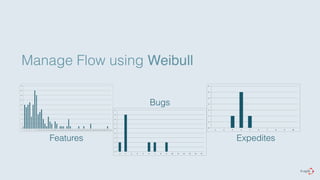
Features 
Bugs 
Expedites
Manage Flow using Weibull 
18" 
16" 
14" 
12" 
10" 
8" 
6" 
4" 
2" 
0" 
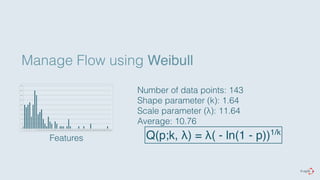
Features Q(p;k, λ) = λ( - ln(1 - p))1/k 
1" 2" 3" 4" 5" 6" 7" 8" 9" 10" 11" 12" 13" 14" 15" 16" 17" 18" 19" 20" 21" 22" 23" 24" 25" 26" 27" 28" 29" 30" 31" 32" 33" 34" 35" 36" 37" 38" 39" 40" 41" 42" 43" 44" 45" 46" 47" 48" 49" 50" 51" 52" 53" 
Number of data points: 143 
Shape parameter (k): 1.64 
Scale parameter (λ): 11.64 
Average: 10.76
Manage Flow using Weibull 
18" 
16" 
14" 
12" 
10" 
8" 
6" 
4" 
2" 
0" 
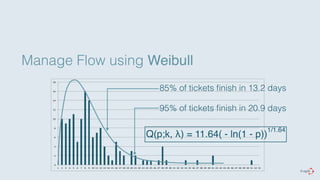
85% of tickets finish in 13.2 days 
95% of tickets finish in 20.9 days 
Q(p;k, λ) = 11.64( - ln(1 - p))1/1.64 
1" 2" 3" 4" 5" 6" 7" 8" 9" 10" 11" 12" 13" 14" 15" 16" 17" 18" 19" 20" 21" 22" 23" 24" 25" 26" 27" 28" 29" 30" 31" 32" 33" 34" 35" 36" 37" 38" 39" 40" 41" 42" 43" 44" 45" 46" 47" 48" 49" 50" 51" 52" 53"
Manage Flow using Weibull 
5" 
4" 
4" 
3" 
3" 
2" 
2" 
1" 
1" 
0" 
1" 2" 3" 4" 5" 6" 7" 8" 9" 10" 11" 12" 13" 14" 15" 
Bugs 
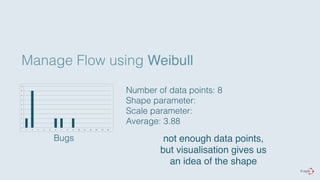
Number of data points: 8 
Shape parameter: 
Scale parameter: 
Average: 3.88 
not enough data points, 
but visualisation gives us 
an idea of the shape
Manage Flow using Weibull 
5" 
4" 
4" 
3" 
3" 
2" 
2" 
1" 
1" 
0" 
1" 2" 3" 4" 5" 6" 7" 8" 9" 10" 11" 12" 13" 14" 15" 
Bugs 
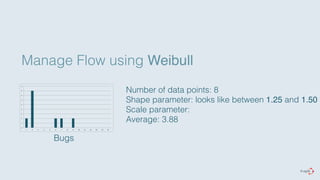
Number of data points: 8 
Shape parameter: looks like between 1.25 and 1.50 
Scale parameter: 
Average: 3.88
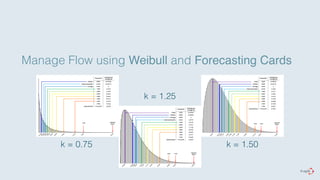
Manage Flow using Weibull and Forecasting Cards 
k = 0.75 
k = 1.25 
k = 1.50
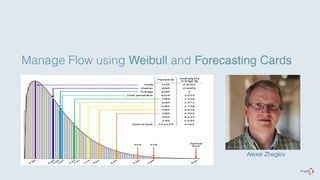
Manage Flow using Weibull and Forecasting Cards 
Alexei Zheglov
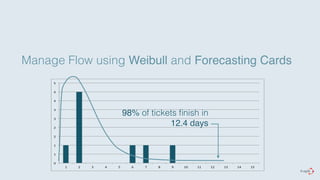
Manage Flow using Weibull and Forecasting Cards 
5" 
4" 
4" 
3" 
3" 
2" 
2" 
1" 
1" 
0" 
98% of tickets finish in 
12.4 days 
1" 2" 3" 4" 5" 6" 7" 8" 9" 10" 11" 12" 13" 14" 15"
Manage Flow using Weibull 
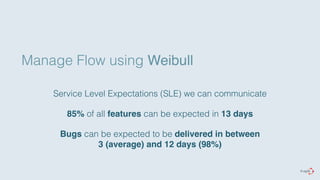
Service Level Expectations (SLE) we can communicate 
85% of all features can be expected in 13 days 
Bugs can be expected to be delivered in between 
3 (average) and 12 days (98%)
Manage Project Flow 
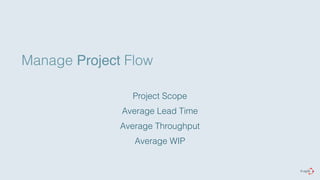
Project Scope 
Average Lead Time 
Average Throughput 
Average WIP
Manage Project Flow using Little’s Law 
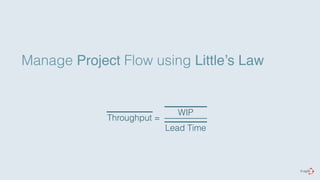
WIP 
Lead Time 
Throughput =
Manage Project Flow using Little’s Law 
Calculate Project Lead Time 
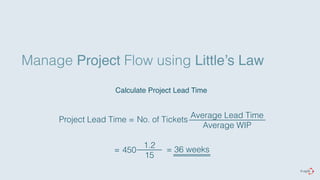
Project Lead Time = No. of Tickets 
Average Lead Time 
Average WIP 
= 450 
1.2 
15 
= 36 weeks
Manage Project Flow using Little’s Law 
Calculate Project Budget 
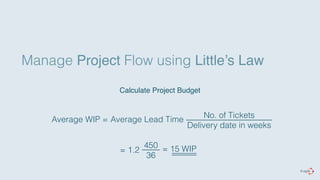
Average WIP = Average Lead Time 
No. of Tickets 
Delivery date in weeks 
= 1.2 
450 
36 
= 15 WIP
Manage Project Flow using Little’s Law 
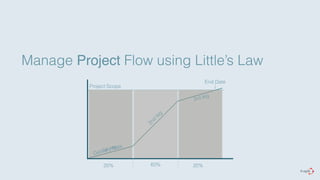
Project Scope 
20% 60% 20% 
End Date 
2nd leg 
1st leg 
3rd leg 
Delivery Rate
Metrics help you 
to better understand your 
demand and capability
Metrics help you 
calculate Service Level Expectations (SLE) 
for different work items
Metrics help you 
forecast your projects# 
without estimating
Metrics to secure survival
Kanban’s 3 Agendas 
Sustainability 
Service-Oriented 
Survivability
Service-Oriented 
Product Development 
Maintenance 
Online Marketing 
Access Management 
Change Management 
Problem Management
Survivability 
What’s the purpose of the services we provide? 
What criteria need to be satisfied 
to call the service fit for this purpose?
Survivability 
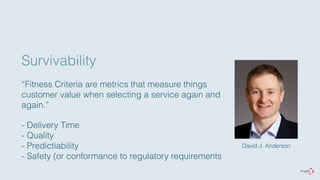
“Fitness Criteria are metrics that measure things 
customer value when selecting a service again and 
again.” 
- Delivery Time 
- Quality 
- Predictiability 
- Safety (or conformance to regulatory requirements 
David J. Anderson
Survivability 
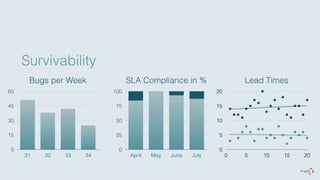
Bugs per Week 
60 
45 
30 
15 
0 
31 32 33 34 
SLA Compliance in % 
100 
75 
50 
25 
0 
April May June July 
Lead Times 
20 
15 
10 
5 
0 
0 5 10 15 20
Ask your customer 
what they care about! 
Make it your core metric# 
you always measure!
Metrics supporting changes
Metrics help us to distinct 
between good and bad 
changes from an objective 
point of view
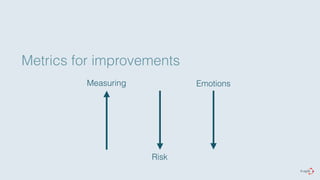
Metrics for improvements 
Emotions 
Risk 
Measuring
Metrics for improvements 
"Sometimes, you just have to roll 
back with your chair to take a 
second look from the back and 
make a good guess how the curve 
will end up." 
- Troy Magennis at LKCE13 reception
Metrics for improvements 
"We do only this until we have 
enough data to provide better 
sample." 
- Troy Magennis at LKCE13 reception
Always support 
change with 
measurements!
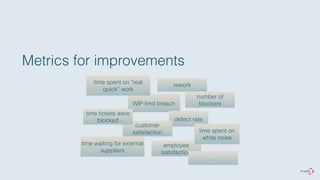
Metrics for improvements 
WIP limit breach 
defect rate 
customer 
satisfaction 
employee 
satisfaction 
number of 
blockers 
time spent on “real 
quick” work 
time tickets were 
blocked 
time waiting for external 
suppliers 
rework 
time spent on 
white noise 
…
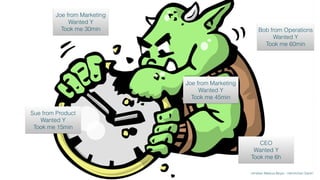
Not like that! Keep it simple!
Bob from Operations 
Wanted Y 
Took me 60min 
# 
Urheber Markus Beyer - Herzlichen Dank! 
Joe from Marketing 
Wanted Y 
Took me 30min 
Sue from Product 
Wanted Y 
Took me 15min 
CEO 
Wanted Y 
Took me 6h 
Joe from Marketing 
Wanted Y 
Took me 45min
Regularly check your metrics, whether 
they have become Chindōgu!
chindōgu are sometimes described 
as "unuseless" – that is, they 
cannot be regarded as "useless" in 
an absolute sense, since they do 
actually solve a problem; however, 
in practical terms, they cannot 
positively be called "useful". 
https://en.wikipedia.org/wiki/Chind%C5%8Dgu
to check if your service 
is fit for purpose 
Metrics help you 
to evaluate your 
changes 
to manage your 
projects 
to manage Flow
to check if your service 
is fit for purpose 
Collect metrics now 
to evaluate your 
changes 
to manage your 
projects 
to manage Flow
Thank you! 
Wolfgang Wiedenroth 
Mail: wolfgang.wiedenroth@it-agile.de 
Twitter: @wwiedenroth

By the power of metrics

  • 1.
    By the powerof metrics LeanKanban Central Europe 2014 - #LKCE14 Wolfgang Wiedenroth @wwiedenroth
  • 2.
    Metrics in theKanban Method Practices 1.Visualize 2.Limit WIP 3.Manage Flow 4.Make Process Policies Explicit 5.Develop Feedback Loops 6.Improve Collaboratively, Evolve Experimentally (using models/scientific method)
  • 3.
    Metrics in theKanban Method Kanban’s 3 Agendas Sustainability Service-Oriented Survivability
  • 4.
    Metrics in theKanban Method Practices 1.Visualize 2.Limit WIP 3.Manage Flow 4.Make Process Policies Explicit 5.Develop Feedback Loops 6.Improve Collaboratively, Evolve Experimentally (using models/scientific method) Kanban’s 3 Agendas Sustainability Service-Oriented Survivability
  • 5.
    115# 110# 105# 100# 95# 90# 85# 80# 75# 70# 65# 60# 55# 50# 45# 40# 35# 30# 25# 20# 1#May#2012# 11#May#2012# 7#May#2012# 17#May#2012# 23#May#2012# 29#May#2012# 4#Jun#2012# 14#Jun#2012# 8#Jun#2012# 20#Jun#2012# 26#Jun#2012# 2#Jul#2012# 6#Jul#2012# 12#Jul#2012# Departure Rate 24#Jul#2012# 18#Jul#2012# 30#Jul#2012# 3#Aug#2012# Work piling up 15#Aug#2012# 9#Aug#2012# 21#Aug#2012# 27#Aug#2012# 31#Aug#2012# 6#Sep#2012# 12#Sep#2012# 24#Sep#2012# 18#Sep#2012# 28#Sep#2012# 10#Oct#2012# 4#Oct#2012# 16#Oct#2012# 22#Oct#2012# 26#Oct#2012# 1#Nov#2012# 13#Nov#2012# 7#Nov#2012# 19#Nov#2012# 23#Nov#2012# 29#Nov#2012# 5#Dec#2012# 11#Dec#2012# 21#Dec#2012# 17#Dec#2012# 2#Jan#2013# 27#Dec#2012# 8#Jan#2013# 14#Jan#2013# 24#Jan#2013# 18#Jan#2013# Analyse# Selected# Planning# Planning#Done# Dev# Dev#Done# TesDng# TesDng#Done/Endgame# to#be#released# Released# Visualize Cumulative Flow Diagram y = No. of Tickets y = Time Arrival Rate
  • 6.
    Visualize Release Cycleis getting shorter Daily Deployments Weekly Deployments Biweekly Deployments
  • 7.
    Visualize That’s howFlow looks like
  • 8.
    Visualize That’s theopposite of Flow! we call it Christmas holidays
  • 9.
    Visualize 20" 19" 18" 17" 16" 15" 14" 13" 12" 11" 10" 9" 8" 7" 6" 5" 4" 3" 2" 1" 0" Lead Time Distribution Chart Average Lead Time 1" 2" 3" 4" 5" 6" 7" 8" 9" 10"11"12"13"14"15"16"17"18"19"20"21"22"23"24"25"26"27"28"29"30"31"32"33"34"35"36"37"38"39"40"41"42"43"44"45"46"47"48"49"50"51"52"53"54"55"56"57"58"59"60"61"62"63"64"65"66"67"68"69"70" y = No. of Tickets finished with lead time x x = Lead Time
  • 10.
    6" 5" 4" 3" 2" 1" 0" MEDIAN" 6" 7" 8" 9" 10" 11" 12" 13" 14" 15" 16" 17" 18" 19" 20" 21" 22" 23" 24" 25" 26" 27" 28" 29" 30" 31" 32" 33" 34" 35" 36" 37" 38" 39" 40" 41" 42" 43" 44" 45" 46" 47" 48" 49" 50" 51" 52" 1" 2" 3" 4" 5" 6" 7" 8" 9" Visualize Throughput x = Calendar Weeks y = No. of tickets finished in calendar week x
  • 11.
  • 12.
    Visualized metrics letyou see things faster
  • 13.
    Visualized metrics letyou identify pattern
  • 14.
    Visualized metrics give everyone the same picture
  • 15.
    Visualized metrics are great feedback loops
  • 16.
  • 17.
    Manage Flow Demand Capability
  • 18.
    Manage Flow DemandCapability Flow = Balance Demand against Capability
  • 19.
    Manage Flow DemandAnalysis Capability Analysis How much demand do we have? What are the sources of our demand? Do we have seasonal variance in demand? What are the risk profiles that are attached to different types of work? What skills are required for different types of demand? What are our current lead times? What is our delivery rate? What skills do we have?
  • 20.
    Manage Flow usingWeibull 18" 16" 14" 12" 10" 8" 6" 4" 2" 0" 1" 2" 3" 4" 5" 6" 7" 8" 9" 10" 11" 12" 13" 14" 15" 16" 17" 18" 19" 20" 21" 22" 23" 24" 25" 26" 27" 28" 29" 30" 31" 32" 33" 34" 35" 36" 37" 38" 39" 40" 41" 42" 43" 44" 45" 46" 47" 48" 49" 50" 51" 52" 53"
  • 21.
    Manage Flow usingWeibull 18" 16" 14" 12" 10" 8" 6" 4" 2" 0" Mode = most common lead time Median = 50% Average 80% of tickets finish in less time 95% of tickets finish in less time 98% of tickets finish in less time Weibull with shape parameter k = 1.5 1" 2" 3" 4" 5" 6" 7" 8" 9" 10" 11" 12" 13" 14" 15" 16" 17" 18" 19" 20" 21" 22" 23" 24" 25" 26" 27" 28" 29" 30" 31" 32" 33" 34" 35" 36" 37" 38" 39" 40" 41" 42" 43" 44" 45" 46" 47" 48" 49" 50" 51" 52" 53"
  • 22.
    Manage Flow usingWeibull 18" 16" 14" 12" 10" 8" 6" 4" 2" 0" 1" 2" 3" 4" 5" 6" 7" 8" 9" 10" 11" 12" 13" 14" 15" 16" 17" 18" 19" 20" 21" 22" 23" 24" 25" 26" 27" 28" 29" 30" 31" 32" 33" 34" 35" 36" 37" 38" 39" 40" 41" 42" 43" 44" 45" 46" 47" 48" 49" 50" 51" 52" 53" 4" 3" 3" 2" 2" 1" 1" 0" 1" 2" 3" 4" 5" 6" 7" 8" 9" 10" 5" 4" 4" 3" 3" 2" 2" 1" 1" 0" 1" 2" 3" 4" 5" 6" 7" 8" 9" 10" 11" 12" 13" 14" 15" Features Bugs Expedites
  • 23.
    Manage Flow usingWeibull 18" 16" 14" 12" 10" 8" 6" 4" 2" 0" Features Q(p;k, λ) = λ( - ln(1 - p))1/k 1" 2" 3" 4" 5" 6" 7" 8" 9" 10" 11" 12" 13" 14" 15" 16" 17" 18" 19" 20" 21" 22" 23" 24" 25" 26" 27" 28" 29" 30" 31" 32" 33" 34" 35" 36" 37" 38" 39" 40" 41" 42" 43" 44" 45" 46" 47" 48" 49" 50" 51" 52" 53" Number of data points: 143 Shape parameter (k): 1.64 Scale parameter (λ): 11.64 Average: 10.76
  • 24.
    Manage Flow usingWeibull 18" 16" 14" 12" 10" 8" 6" 4" 2" 0" 85% of tickets finish in 13.2 days 95% of tickets finish in 20.9 days Q(p;k, λ) = 11.64( - ln(1 - p))1/1.64 1" 2" 3" 4" 5" 6" 7" 8" 9" 10" 11" 12" 13" 14" 15" 16" 17" 18" 19" 20" 21" 22" 23" 24" 25" 26" 27" 28" 29" 30" 31" 32" 33" 34" 35" 36" 37" 38" 39" 40" 41" 42" 43" 44" 45" 46" 47" 48" 49" 50" 51" 52" 53"
  • 25.
    Manage Flow usingWeibull 5" 4" 4" 3" 3" 2" 2" 1" 1" 0" 1" 2" 3" 4" 5" 6" 7" 8" 9" 10" 11" 12" 13" 14" 15" Bugs Number of data points: 8 Shape parameter: Scale parameter: Average: 3.88 not enough data points, but visualisation gives us an idea of the shape
  • 26.
    Manage Flow usingWeibull 5" 4" 4" 3" 3" 2" 2" 1" 1" 0" 1" 2" 3" 4" 5" 6" 7" 8" 9" 10" 11" 12" 13" 14" 15" Bugs Number of data points: 8 Shape parameter: looks like between 1.25 and 1.50 Scale parameter: Average: 3.88
  • 27.
    Manage Flow usingWeibull and Forecasting Cards k = 0.75 k = 1.25 k = 1.50
  • 28.
    Manage Flow usingWeibull and Forecasting Cards Alexei Zheglov
  • 29.
    Manage Flow usingWeibull and Forecasting Cards 5" 4" 4" 3" 3" 2" 2" 1" 1" 0" 98% of tickets finish in 12.4 days 1" 2" 3" 4" 5" 6" 7" 8" 9" 10" 11" 12" 13" 14" 15"
  • 30.
    Manage Flow usingWeibull Service Level Expectations (SLE) we can communicate 85% of all features can be expected in 13 days Bugs can be expected to be delivered in between 3 (average) and 12 days (98%)
  • 31.
    Manage Project Flow Project Scope Average Lead Time Average Throughput Average WIP
  • 32.
    Manage Project Flowusing Little’s Law WIP Lead Time Throughput =
  • 33.
    Manage Project Flowusing Little’s Law Calculate Project Lead Time Project Lead Time = No. of Tickets Average Lead Time Average WIP = 450 1.2 15 = 36 weeks
  • 34.
    Manage Project Flowusing Little’s Law Calculate Project Budget Average WIP = Average Lead Time No. of Tickets Delivery date in weeks = 1.2 450 36 = 15 WIP
  • 35.
    Manage Project Flowusing Little’s Law Project Scope 20% 60% 20% End Date 2nd leg 1st leg 3rd leg Delivery Rate
  • 36.
    Metrics help you to better understand your demand and capability
  • 37.
    Metrics help you calculate Service Level Expectations (SLE) for different work items
  • 38.
    Metrics help you forecast your projects# without estimating
  • 39.
  • 40.
    Kanban’s 3 Agendas Sustainability Service-Oriented Survivability
  • 41.
    Service-Oriented Product Development Maintenance Online Marketing Access Management Change Management Problem Management
  • 42.
    Survivability What’s thepurpose of the services we provide? What criteria need to be satisfied to call the service fit for this purpose?
  • 43.
    Survivability “Fitness Criteriaare metrics that measure things customer value when selecting a service again and again.” - Delivery Time - Quality - Predictiability - Safety (or conformance to regulatory requirements David J. Anderson
  • 44.
    Survivability Bugs perWeek 60 45 30 15 0 31 32 33 34 SLA Compliance in % 100 75 50 25 0 April May June July Lead Times 20 15 10 5 0 0 5 10 15 20
  • 45.
    Ask your customer what they care about! Make it your core metric# you always measure!
  • 46.
  • 50.
    Metrics help usto distinct between good and bad changes from an objective point of view
  • 51.
    Metrics for improvements Emotions Risk Measuring
  • 52.
    Metrics for improvements "Sometimes, you just have to roll back with your chair to take a second look from the back and make a good guess how the curve will end up." - Troy Magennis at LKCE13 reception
  • 53.
    Metrics for improvements "We do only this until we have enough data to provide better sample." - Troy Magennis at LKCE13 reception
  • 54.
    Always support changewith measurements!
  • 55.
    Metrics for improvements WIP limit breach defect rate customer satisfaction employee satisfaction number of blockers time spent on “real quick” work time tickets were blocked time waiting for external suppliers rework time spent on white noise …
  • 56.
    Not like that!Keep it simple!
  • 57.
    Bob from Operations Wanted Y Took me 60min # Urheber Markus Beyer - Herzlichen Dank! Joe from Marketing Wanted Y Took me 30min Sue from Product Wanted Y Took me 15min CEO Wanted Y Took me 6h Joe from Marketing Wanted Y Took me 45min
  • 58.
    Regularly check yourmetrics, whether they have become Chindōgu!
  • 59.
    chindōgu are sometimesdescribed as "unuseless" – that is, they cannot be regarded as "useless" in an absolute sense, since they do actually solve a problem; however, in practical terms, they cannot positively be called "useful". https://en.wikipedia.org/wiki/Chind%C5%8Dgu
  • 60.
    to check ifyour service is fit for purpose Metrics help you to evaluate your changes to manage your projects to manage Flow
  • 61.
    to check ifyour service is fit for purpose Collect metrics now to evaluate your changes to manage your projects to manage Flow
  • 62.
    Thank you! WolfgangWiedenroth Mail: wolfgang.wiedenroth@it-agile.de Twitter: @wwiedenroth