Prioritization
10 different techniques for optimizing what to start next
@t_magennis | troy.magennis@focusedobjective.com
All slides and spreadsheets: Bit.ly/SimResources
@t_magennis
“The problem with any prioritization
decision is [it is a] decision to service one
job and delay another.”
Don Reinertsen
@t_magennis
Easy Fix
DO EVERYTHING NOW
by employing unlimited trained and
talented teams that delivery instantly
Have a doctor of every specialist discipline for every bed in the ER,
and one bed for every citizen in the local area
@t_magennis
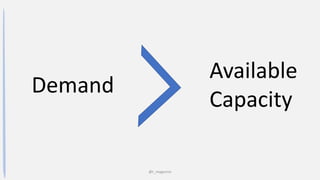
Demand
Available
Capacity
@t_magennis
The Goal – What to start next
Given a set of things we could do next,
is one more economically advantageous
to start next given we can’t do them ALL
The Challenge – Doing one thing delays others
Every item has a different economic impact by being delayed.
The impact will be a product of lost value,
and how long they are delayed.
@t_magennis
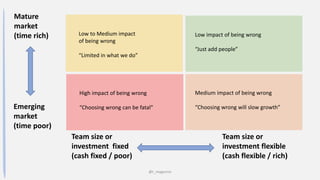
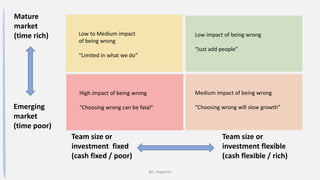
Team size or
investment fixed
(cash fixed / poor)
Team size or
investment flexible
(cash flexible / rich)
Mature
market
(time rich)
Emerging
market
(time poor)
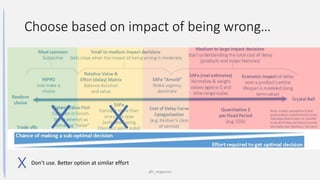
Low to Medium impact
of being wrong
“Limited in what we do”
High impact of being wrong
“Choosing wrong can be fatal”
Medium impact of being wrong
“Choosing wrong will slow growth”
Low impact of being wrong
“Just add people”
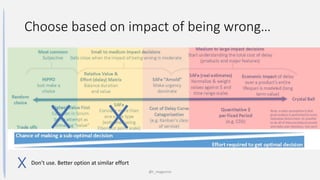
Choose based on impact of being wrong…
@t_magennis
Don’t use. Better option at similar effort
What starts on Twitter…
• Martin Burns, Joshua Arnold, Tony Grout, Chris Matts, Don Reinertsen
• Initial argument was about the SAFE cost of delay formula
• What I wanted to learn
• Document the methods used for prioritization
• Give advice to clients on why use one method versus another
• Uncover why flawed methods still occasionally work (context)
• My goal: Single page cheat-sheet
@t_magennis
@t_magennis
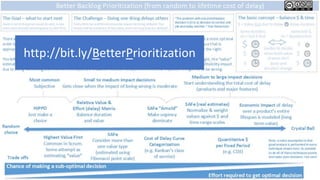
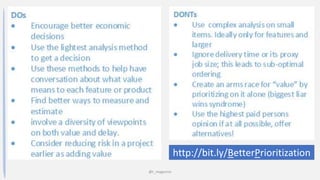
http://bit.ly/BetterPrioritization
@t_magennis
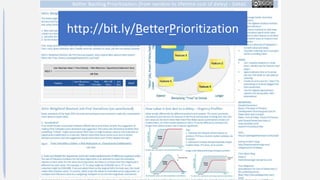
http://bit.ly/BetterPrioritization
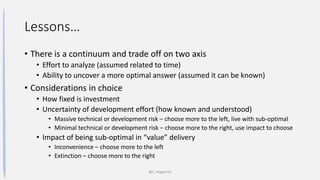
Lessons…
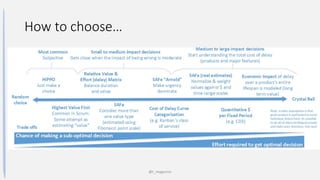
• There is a continuum and trade off on two axis
• Effort to analyze (assumed related to time)
• Ability to uncover a more optimal answer (assumed it can be known)
• Considerations in choice
• How fixed is investment
• Uncertainty of development effort (how known and understood)
• Massive technical or development risk – choose more to the left, live with sub-optimal
• Minimal technical or development risk – choose more to the right, use impact to choose
• Impact of being sub-optimal in “value” delivery
• Inconvenience – choose more to the left
• Extinction – choose more to the right
@t_magennis
@t_magennis
@t_magennis
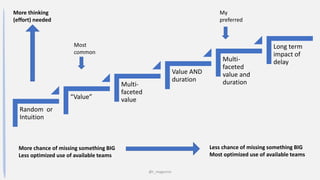
Random or
Intuition
“Value”
Multi-
faceted
value
Value AND
duration
Multi-
faceted
value and
duration
Long term
impact of
delay
More thinking
(effort) needed
Less chance of missing something BIG
Most optimized use of available teams
More chance of missing something BIG
Less optimized use of available teams
Most
common
My
preferred
@t_magennis
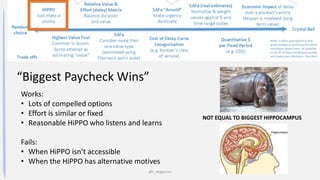
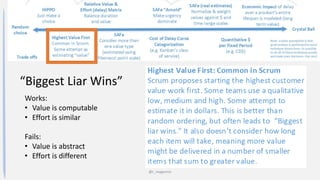
“Biggest Paycheck Wins”
Works:
• Lots of compelled options
• Effort is similar or fixed
• Reasonable HiPPO who listens and learns
Fails:
• When HiPPO isn’t accessible
• When the HiPPO has alternative motives
NOT EQUAL TO BIGGEST HIPPOCAMPUS
@t_magennis
“Biggest Liar Wins”
Works:
• Value is computable
• Effort is similar
Fails:
• Value is abstract
• Effort is different
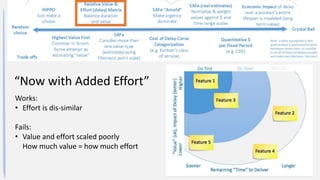
“Now with Added Effort”
Works:
• Effort is dis-similar
Fails:
• Value and effort scaled poorly
How much value = how much effort
@t_magennis
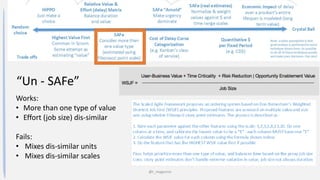
“Un - SAFe”
Works:
• More than one type of value
• Effort (job size) dis-similar
Fails:
• Mixes dis-similar units
• Mixes dis-similar scales
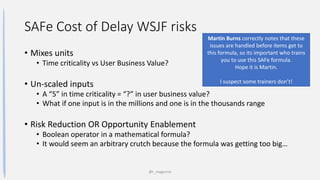
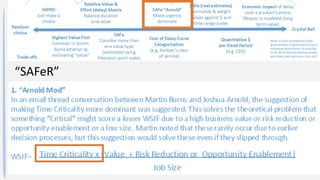
SAFe Cost of Delay WSJF risks
• Mixes units
• Time criticality vs User Business Value?
• Un-scaled inputs
• A “5” in time criticality = “?” in user business value?
• What if one input is in the millions and one is in the thousands range
• Risk Reduction OR Opportunity Enablement
• Boolean operator in a mathematical formula?
• It would seem an arbitrary crutch because the formula was getting too big…
@t_magennis
Martin Burns correctly notes that these
issues are handled before items get to
this formula, so its important who trains
you to use this SAFe formula.
Hope it is Martin.
I suspect some trainers don’t!
@t_magennis
“SAFeR”
@t_magennis
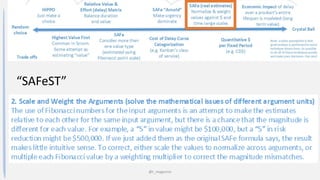
“SAFeST”
Works:
• xxx
Fails:
• xxx
@t_magennis
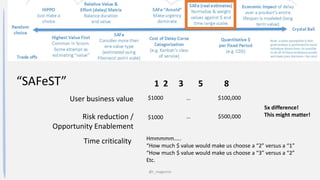
“SAFeST” 1 2 3 5 8
User business value
Time criticality
Risk reduction /
Opportunity Enablement
$1000
$1000 $500,000
$100,000
5x difference!
This might matter!
Hmmmmm…..
“How much $ value would make us choose a “2” versus a “1”
“How much $ value would make us choose a “3” versus a “2”
Etc.
…
…
@t_magennis
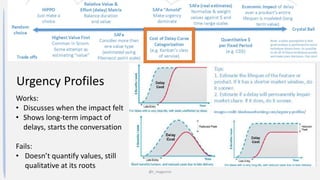
Urgency Profiles
Works:
• Discusses when the impact felt
• Shows long-term impact of
delays, starts the conversation
Fails:
• Doesn’t quantify values, still
qualitative at its roots
@t_magennis
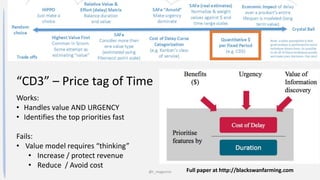
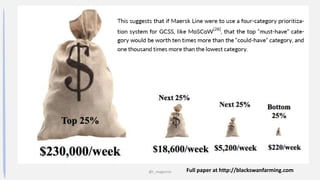
“CD3” – Price tag of Time
Works:
• Handles value AND URGENCY
• Identifies the top priorities fast
Fails:
• Value model requires “thinking”
• Increase / protect revenue
• Reduce / Avoid cost
Full paper at http://blackswanfarming.com
@t_magennis Full paper at http://blackswanfarming.com
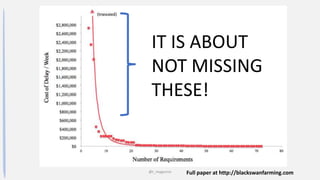
IT IS ABOUT
NOT MISSING
THESE!
@t_magennis
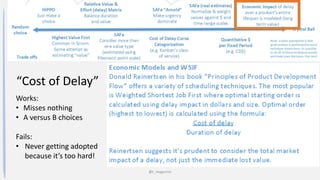
“Cost of Delay”
Works:
• Misses nothing
• A versus B choices
Fails:
• Never getting adopted
because it’s too hard!
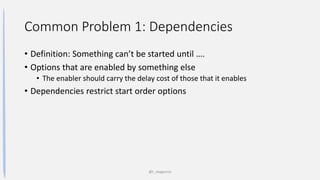
Common Problem 1: Dependencies
• Definition: Something can’t be started until ….
• Options that are enabled by something else
• The enabler should carry the delay cost of those that it enables
• Dependencies restrict start order options
@t_magennis
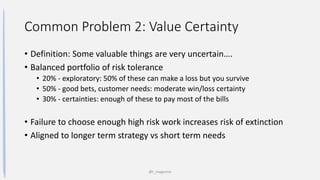
Common Problem 2: Value Certainty
• Definition: Some valuable things are very uncertain….
• Balanced portfolio of risk tolerance
• 20% - exploratory: 50% of these can make a loss but you survive
• 50% - good bets, customer needs: moderate win/loss certainty
• 30% - certainties: enough of these to pay most of the bills
• Failure to choose enough high risk work increases risk of extinction
• Aligned to longer term strategy vs short term needs
@t_magennis
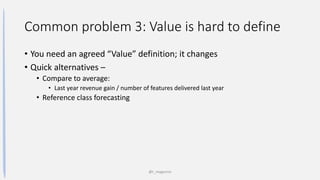
Common problem 3: Value is hard to define
• You need an agreed “Value” definition; it changes
• Quick alternatives –
• Compare to average:
• Last year revenue gain / number of features delivered last year
• Reference class forecasting
@t_magennis
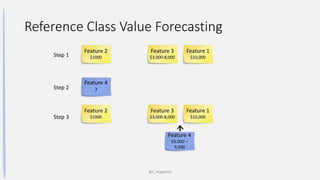
Reference Class Value Forecasting
@t_magennis
Feature 1
$10,000
Feature 2
$1000
Feature 3
$3,000-8,000
Feature 4
?
Feature 4
$5,000 –
9,000
Step 1
Step 2
Step 3
Feature 1
$10,000
Feature 2
$1000
Feature 3
$3,000-8,000
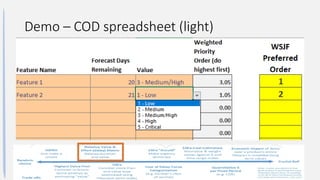
Demo – COD spreadsheet (light)
@t_magennis
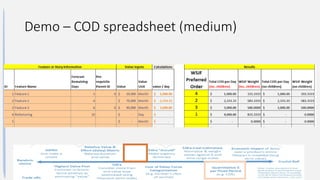
Demo – COD spreadsheet (medium)
@t_magennis
@t_magennis
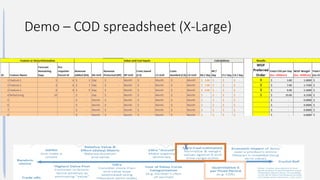
Demo – COD spreadsheet (X-Large)
How to choose…
@t_magennis
@t_magennis
Team size or
investment fixed
(cash fixed / poor)
Team size or
investment flexible
(cash flexible / rich)
Mature
market
(time rich)
Emerging
market
(time poor)
Low to Medium impact
of being wrong
“Limited in what we do”
High impact of being wrong
“Choosing wrong can be fatal”
Medium impact of being wrong
“Choosing wrong will slow growth”
Low impact of being wrong
“Just add people”
Choose based on impact of being wrong…
@t_magennis
Don’t use. Better option at similar effort
@t_magennis
http://bit.ly/BetterPrioritization
Questions and Discussion…
• Too shy now?
• Email: troy.magennis@gmail.com
• Twitter: @t_magennis
• Want the slides or spreadsheets or resources?
• http://Bit.Ly/SimResources
• http://Bit.Ly/BetterPrioritization
• Please consider doing the feedback and review…
@t_magennis

Prioritization – 10 different techniques for optimizing what to start next troy magennis

  • 1.
    Prioritization 10 different techniquesfor optimizing what to start next @t_magennis | troy.magennis@focusedobjective.com All slides and spreadsheets: Bit.ly/SimResources
  • 2.
    @t_magennis “The problem withany prioritization decision is [it is a] decision to service one job and delay another.” Don Reinertsen
  • 3.
    @t_magennis Easy Fix DO EVERYTHINGNOW by employing unlimited trained and talented teams that delivery instantly Have a doctor of every specialist discipline for every bed in the ER, and one bed for every citizen in the local area
  • 4.
  • 5.
    @t_magennis The Goal –What to start next Given a set of things we could do next, is one more economically advantageous to start next given we can’t do them ALL The Challenge – Doing one thing delays others Every item has a different economic impact by being delayed. The impact will be a product of lost value, and how long they are delayed.
  • 6.
    @t_magennis Team size or investmentfixed (cash fixed / poor) Team size or investment flexible (cash flexible / rich) Mature market (time rich) Emerging market (time poor) Low to Medium impact of being wrong “Limited in what we do” High impact of being wrong “Choosing wrong can be fatal” Medium impact of being wrong “Choosing wrong will slow growth” Low impact of being wrong “Just add people”
  • 7.
    Choose based onimpact of being wrong… @t_magennis Don’t use. Better option at similar effort
  • 8.
    What starts onTwitter… • Martin Burns, Joshua Arnold, Tony Grout, Chris Matts, Don Reinertsen • Initial argument was about the SAFE cost of delay formula • What I wanted to learn • Document the methods used for prioritization • Give advice to clients on why use one method versus another • Uncover why flawed methods still occasionally work (context) • My goal: Single page cheat-sheet @t_magennis
  • 9.
  • 10.
  • 11.
    Lessons… • There isa continuum and trade off on two axis • Effort to analyze (assumed related to time) • Ability to uncover a more optimal answer (assumed it can be known) • Considerations in choice • How fixed is investment • Uncertainty of development effort (how known and understood) • Massive technical or development risk – choose more to the left, live with sub-optimal • Minimal technical or development risk – choose more to the right, use impact to choose • Impact of being sub-optimal in “value” delivery • Inconvenience – choose more to the left • Extinction – choose more to the right @t_magennis
  • 12.
  • 13.
    @t_magennis Random or Intuition “Value” Multi- faceted value Value AND duration Multi- faceted valueand duration Long term impact of delay More thinking (effort) needed Less chance of missing something BIG Most optimized use of available teams More chance of missing something BIG Less optimized use of available teams Most common My preferred
  • 14.
    @t_magennis “Biggest Paycheck Wins” Works: •Lots of compelled options • Effort is similar or fixed • Reasonable HiPPO who listens and learns Fails: • When HiPPO isn’t accessible • When the HiPPO has alternative motives NOT EQUAL TO BIGGEST HIPPOCAMPUS
  • 15.
    @t_magennis “Biggest Liar Wins” Works: •Value is computable • Effort is similar Fails: • Value is abstract • Effort is different
  • 16.
    “Now with AddedEffort” Works: • Effort is dis-similar Fails: • Value and effort scaled poorly How much value = how much effort
  • 17.
    @t_magennis “Un - SAFe” Works: •More than one type of value • Effort (job size) dis-similar Fails: • Mixes dis-similar units • Mixes dis-similar scales
  • 18.
    SAFe Cost ofDelay WSJF risks • Mixes units • Time criticality vs User Business Value? • Un-scaled inputs • A “5” in time criticality = “?” in user business value? • What if one input is in the millions and one is in the thousands range • Risk Reduction OR Opportunity Enablement • Boolean operator in a mathematical formula? • It would seem an arbitrary crutch because the formula was getting too big… @t_magennis Martin Burns correctly notes that these issues are handled before items get to this formula, so its important who trains you to use this SAFe formula. Hope it is Martin. I suspect some trainers don’t!
  • 19.
  • 20.
  • 21.
    @t_magennis “SAFeST” 1 23 5 8 User business value Time criticality Risk reduction / Opportunity Enablement $1000 $1000 $500,000 $100,000 5x difference! This might matter! Hmmmmm….. “How much $ value would make us choose a “2” versus a “1” “How much $ value would make us choose a “3” versus a “2” Etc. … …
  • 22.
    @t_magennis Urgency Profiles Works: • Discusseswhen the impact felt • Shows long-term impact of delays, starts the conversation Fails: • Doesn’t quantify values, still qualitative at its roots
  • 23.
    @t_magennis “CD3” – Pricetag of Time Works: • Handles value AND URGENCY • Identifies the top priorities fast Fails: • Value model requires “thinking” • Increase / protect revenue • Reduce / Avoid cost Full paper at http://blackswanfarming.com
  • 24.
    @t_magennis Full paperat http://blackswanfarming.com
  • 25.
    @t_magennis Full paperat http://blackswanfarming.com IT IS ABOUT NOT MISSING THESE!
  • 26.
    @t_magennis “Cost of Delay” Works: •Misses nothing • A versus B choices Fails: • Never getting adopted because it’s too hard!
  • 27.
    Common Problem 1:Dependencies • Definition: Something can’t be started until …. • Options that are enabled by something else • The enabler should carry the delay cost of those that it enables • Dependencies restrict start order options @t_magennis
  • 28.
    Common Problem 2:Value Certainty • Definition: Some valuable things are very uncertain…. • Balanced portfolio of risk tolerance • 20% - exploratory: 50% of these can make a loss but you survive • 50% - good bets, customer needs: moderate win/loss certainty • 30% - certainties: enough of these to pay most of the bills • Failure to choose enough high risk work increases risk of extinction • Aligned to longer term strategy vs short term needs @t_magennis
  • 29.
    Common problem 3:Value is hard to define • You need an agreed “Value” definition; it changes • Quick alternatives – • Compare to average: • Last year revenue gain / number of features delivered last year • Reference class forecasting @t_magennis
  • 30.
    Reference Class ValueForecasting @t_magennis Feature 1 $10,000 Feature 2 $1000 Feature 3 $3,000-8,000 Feature 4 ? Feature 4 $5,000 – 9,000 Step 1 Step 2 Step 3 Feature 1 $10,000 Feature 2 $1000 Feature 3 $3,000-8,000
  • 31.
    Demo – CODspreadsheet (light) @t_magennis
  • 32.
    Demo – CODspreadsheet (medium) @t_magennis
  • 33.
    @t_magennis Demo – CODspreadsheet (X-Large)
  • 34.
  • 35.
    @t_magennis Team size or investmentfixed (cash fixed / poor) Team size or investment flexible (cash flexible / rich) Mature market (time rich) Emerging market (time poor) Low to Medium impact of being wrong “Limited in what we do” High impact of being wrong “Choosing wrong can be fatal” Medium impact of being wrong “Choosing wrong will slow growth” Low impact of being wrong “Just add people”
  • 36.
    Choose based onimpact of being wrong… @t_magennis Don’t use. Better option at similar effort
  • 37.
  • 38.
    Questions and Discussion… •Too shy now? • Email: troy.magennis@gmail.com • Twitter: @t_magennis • Want the slides or spreadsheets or resources? • http://Bit.Ly/SimResources • http://Bit.Ly/BetterPrioritization • Please consider doing the feedback and review… @t_magennis

Editor's Notes

  • #2 Welcome the Forecasting using Data session. I’m Troy Magennis, and I’ve got 40 minutes to convince you that Forecasting is both easier than you think, and likely to outperform your intuition.