BUSINESS RESEARCH
PRESENTED BY
ANBAZHAGAN
1.1What is research?
Research is the process of
finding solutions to a problem
after a thorough study and
analysis of the situational
factors.
http://www.usg.edu/galileo/skills/unit01/infoage01_03.phtml
http://www.google.co.th/search?hl=th&defl=en&q=define:research&sa=X&oi=glossary_definiti
on&ct=title
1 Introduction to Research
1.2.WHAT IS BUSINESS
RESEARCH?
Research provides the needed
information that guides managers
to make informed decisions to
successfully deal with problems.
The information provided could
be the result of a careful analysis of
data gathered firsthand or of data
that are already available (in the
company).
1.3.TYPES OF BUSINESS
RESEARCH.
1.Applied research
Is to solve a current problem faced by the manager in the work
setting,demanding a timely solution.
2.Basic research (fundamental, pure)
Is to generate a body of knowledge by trying to comprehend
how certain problems that occur in organizations can be solved.
The findings of such research contribute to the building of
knowledge in the various functional areas of business.
1.4. WHY IS IT IMPORTANT FOR MANAGERS
TO KNOW ABOUT RESEARCH?
Solve problems
Decision making tool
Competition
Risk
Investment
Hire researchers and consultants
more effectively
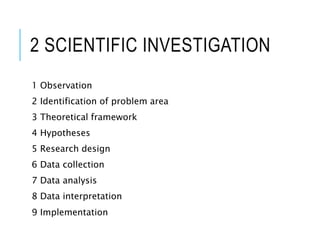
2 SCIENTIFIC INVESTIGATION
1 Observation
2 Identification of problem area
3 Theoretical framework
4 Hypotheses
5 Research design
6 Data collection
7 Data analysis
8 Data interpretation
9 Implementation
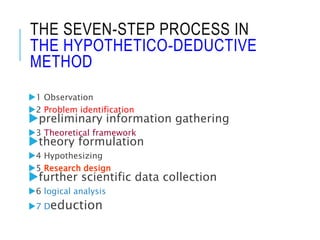
THE SEVEN-STEP PROCESS IN
THE HYPOTHETICO-DEDUCTIVE
METHOD
1 Observation
2 Problem identification
preliminary information gathering
3 Theoretical framework
theory formulation
4 Hypothesizing
5 Research design
further scientific data collection
6 logical analysis
7 Deduction
THE SEVEN-STEP PROCESS
problem statement is a clear, precise, and succinct statement
of the question or issue that is to be investigated with the
goal of finding an answer or solution.
Theoretical framework is the foundation on which the entire
research project is based.It is logically
developed,described,and elaborated network of associations
among the variables relevant to the problem situation.
A hypothesis is a tentative statement that proposes a
possible explanation to some phenomenon or event. A useful
hypothesis is a testable statement which may include a
prediction. A hypotheses should not be confused with a
theory.
Data analysis: the data gathered are statistically analyzed to see if the
hypotheses that were generated have been supported.
Measurement is the process observing and recording the
observations that are collected as part of a research effort.
Deduction is the process of arriving at conclusions by interpreting the
meaning of the data analysis results.
PROBLEM FORMULATION
"Well begun is half done" --Aristotle, quoting an old
proverb
Where do research topics come from?
The idea for a research project?
one of the most common sources of research ideas is the
experience of practical problems in the field?
The Literature Review
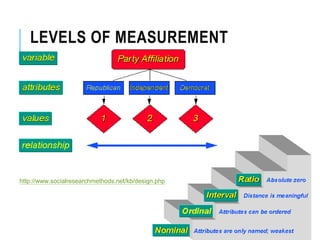
LEVELS OF MEASUREMENT
http://www.socialresearchmethods.net/kb/design.php
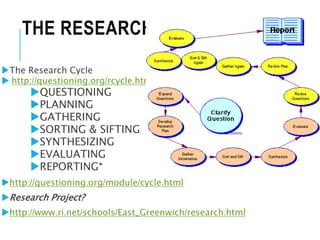
THE RESEARCH CYCLE
The Research Cycle
 http://questioning.org/rcycle.html
QUESTIONING
PLANNING
GATHERING
SORTING & SIFTING
SYNTHESIZING
EVALUATING
REPORTING*
http://questioning.org/module/cycle.html
Research Project?
http://www.ri.net/schools/East_Greenwich/research.html
INFORMATION NEEDS IN
BUSINESS
Almost every organization has to engage in research at some
level to stay competitive.
Companies gather data both from within and outside the
organization.
The methods used to gather,analyze,and synthesize information
from the external and internal environments are becoming
increasingly sophisticated to the immense scope of computer
technology.
COMPUTER TECHNOLOGY AND
BUSINESS
ICT
Information
Communication
Technology
http://tutor2u.net/business/ict/intro_what_is_ict.htm
http://www.bbc.co.uk/schools/gcsebitesize/ict/implications/0moralandsocialissuesrev1.shtml
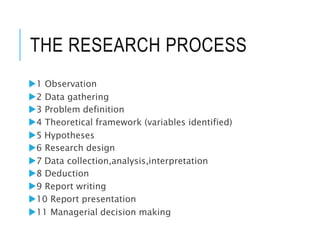
THE RESEARCH PROCESS
1 Observation
2 Data gathering
3 Problem definition
4 Theoretical framework (variables identified)
5 Hypotheses
6 Research design
7 Data collection,analysis,interpretation
8 Deduction
9 Report writing
10 Report presentation
11 Managerial decision making
RESEARCH DESIGN
Purpose of the study:
 Exploratory study
Is undertaken when no information is available on how
similar problems or research issues have been solved in the
past
 Descriptive study
Is to able to describe the characteristics of the variables of
interest in a situation.
 Hypotheses testing
Is undertaken to explain the variance in the dependent
variable or to predict organizational outcomes.
 Case studies
 Research design can be thought of as the structure of
research -- it is the "glue" that holds all of the elements in a
research project together
MEASUREMENT
The rating scale
 Have several response catagories
 Likert scale is designed o exermine how strongly subject agree or
disagree with statements on a 5-point scale
Ranking scale
 Are used to tap preferences between two or more objects or items
Goodness of measure : reliability,validity
DATA COLLECTION METHODS
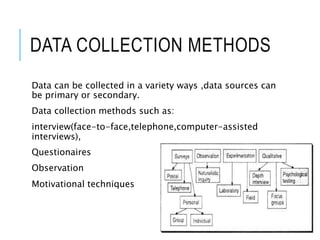
Data can be collected in a variety ways ,data sources can
be primary or secondary.
Data collection methods such as:
interview(face-to-face,telephone,computer-assisted
interviews),
Questionaires
Observation
Motivational techniques
SAMPLING
A sample is a subset of the population.
Sample is the process of selecting a sufficient
number of elements from the population.
Studying a sample rather the entire population
is sometimes to lead to more reliable results,
mostly because fatigue is reduced,resulting in
fewer errors on collection data. (time,
cost,human resources)
Surveys are useful and powerful in finding
answers to research question but if data are
not collected from the people or objects that
can provide the correct answers to solve the
problem, the survey will be in vain.
DATA ANALYSIS AND
INTERPRETATION
The data analysis involves three major steps,
done in roughly this order:
Cleaning and organizing the data for analysis
(Data Preparation)
Describing the data (Descriptive Statistics)
http://www.socialresearchmethods.net/kb/stat
desc.php
Testing Hypotheses and Models (Inferential
Statistics)
DESCRIPTIVE STATISTICS
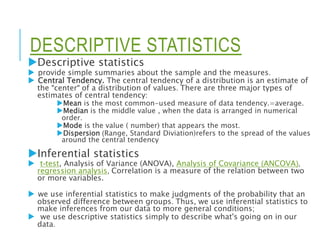
Descriptive statistics
 provide simple summaries about the sample and the measures.
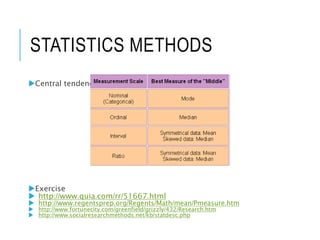
 Central Tendency. The central tendency of a distribution is an estimate of
the "center" of a distribution of values. There are three major types of
estimates of central tendency:
Mean is the most common-used measure of data tendency.=average.
Median is the middle value , when the data is arranged in numerical
order.
Mode is the value ( number) that appears the most.
Dispersion (Range, Standard Diviation)refers to the spread of the values
around the central tendency
Inferential statistics
 t-test, Analysis of Variance (ANOVA), Analysis of Covariance (ANCOVA),
regression analysis, Correlation is a measure of the relation between two
or more variables.
 we use inferential statistics to make judgments of the probability that an
observed difference between groups. Thus, we use inferential statistics to
make inferences from our data to more general conditions;
 we use descriptive statistics simply to describe what's going on in our
data.
STATISTICS METHODS
Central tendency
Exercise
 http://www.quia.com/rr/51667.html
 http://www.regentsprep.org/Regents/Math/mean/Pmeasure.htm
 http://www.fortunecity.com/greenfield/grizzly/432/Research.htm
 http://www.socialresearchmethods.net/kb/statdesc.php
THE RESEARCH REPORT
Researh proposal
Research report
Research presentation
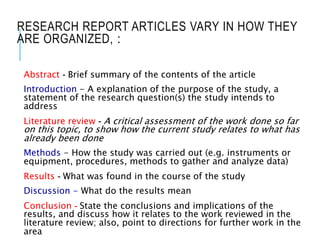
RESEARCH REPORT ARTICLES VARY IN HOW THEY
ARE ORGANIZED, :
Abstract - Brief summary of the contents of the article
Introduction - A explanation of the purpose of the study, a
statement of the research question(s) the study intends to
address
Literature review - A critical assessment of the work done so far
on this topic, to show how the current study relates to what has
already been done
Methods - How the study was carried out (e.g. instruments or
equipment, procedures, methods to gather and analyze data)
Results - What was found in the course of the study
Discussion - What do the results mean
Conclusion - State the conclusions and implications of the
results, and discuss how it relates to the work reviewed in the
literature review; also, point to directions for further work in the
area
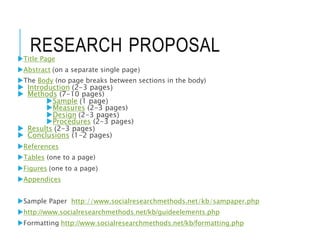
RESEARCH PROPOSAL
Title Page
Abstract (on a separate single page)
The Body (no page breaks between sections in the body)
 Introduction (2-3 pages)
 Methods (7-10 pages)
Sample (1 page)
Measures (2-3 pages)
Design (2-3 pages)
Procedures (2-3 pages)
 Results (2-3 pages)
 Conclusions (1-2 pages)
References
Tables (one to a page)
Figures (one to a page)
Appendices
Sample Paper http://www.socialresearchmethods.net/kb/sampaper.php
http://www.socialresearchmethods.net/kb/guideelements.php
Formatting http://www.socialresearchmethods.net/kb/formatting.php
STUDENT PRESENTATION
http://blog.spu.ac.th/readmore/2008/04/22/entr
y-2
http://blog.spu.ac.th/readmore/gallery/394
http://dekkid.blogspot.com/search?q=business+research
QUESTION?
How can you solve business problem?
Why do you need to know how to write the
research proposal?
Do you understand the research process?
Do you know why do you have to identify problem
statement clearly before doing research?
Do you know why sampling and statistics are
important to the research result?
Why do you have to identify the limitation of your
study?
Why the research report and presentation are
important?
Do you know how to apply the steps of the
research process ?
QUESTIONS
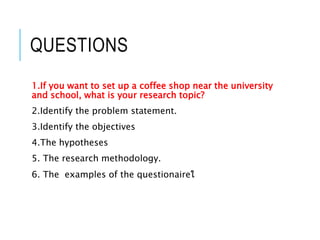
1.If you want to set up a coffee shop near the university
and school, what is your research topic?
2.Identify the problem statement.
3.Identify the objectives
4.The hypotheses
5. The research methodology.
6. The examples of the questionaireใ

business-research

  • 1.
  • 2.
    1.1What is research? Researchis the process of finding solutions to a problem after a thorough study and analysis of the situational factors. http://www.usg.edu/galileo/skills/unit01/infoage01_03.phtml http://www.google.co.th/search?hl=th&defl=en&q=define:research&sa=X&oi=glossary_definiti on&ct=title 1 Introduction to Research
  • 3.
    1.2.WHAT IS BUSINESS RESEARCH? Researchprovides the needed information that guides managers to make informed decisions to successfully deal with problems. The information provided could be the result of a careful analysis of data gathered firsthand or of data that are already available (in the company).
  • 4.
    1.3.TYPES OF BUSINESS RESEARCH. 1.Appliedresearch Is to solve a current problem faced by the manager in the work setting,demanding a timely solution. 2.Basic research (fundamental, pure) Is to generate a body of knowledge by trying to comprehend how certain problems that occur in organizations can be solved. The findings of such research contribute to the building of knowledge in the various functional areas of business.
  • 5.
    1.4. WHY ISIT IMPORTANT FOR MANAGERS TO KNOW ABOUT RESEARCH? Solve problems Decision making tool Competition Risk Investment Hire researchers and consultants more effectively
  • 6.
    2 SCIENTIFIC INVESTIGATION 1Observation 2 Identification of problem area 3 Theoretical framework 4 Hypotheses 5 Research design 6 Data collection 7 Data analysis 8 Data interpretation 9 Implementation
  • 7.
    THE SEVEN-STEP PROCESSIN THE HYPOTHETICO-DEDUCTIVE METHOD 1 Observation 2 Problem identification preliminary information gathering 3 Theoretical framework theory formulation 4 Hypothesizing 5 Research design further scientific data collection 6 logical analysis 7 Deduction
  • 8.
    THE SEVEN-STEP PROCESS problemstatement is a clear, precise, and succinct statement of the question or issue that is to be investigated with the goal of finding an answer or solution. Theoretical framework is the foundation on which the entire research project is based.It is logically developed,described,and elaborated network of associations among the variables relevant to the problem situation. A hypothesis is a tentative statement that proposes a possible explanation to some phenomenon or event. A useful hypothesis is a testable statement which may include a prediction. A hypotheses should not be confused with a theory. Data analysis: the data gathered are statistically analyzed to see if the hypotheses that were generated have been supported. Measurement is the process observing and recording the observations that are collected as part of a research effort. Deduction is the process of arriving at conclusions by interpreting the meaning of the data analysis results.
  • 9.
    PROBLEM FORMULATION "Well begunis half done" --Aristotle, quoting an old proverb Where do research topics come from? The idea for a research project? one of the most common sources of research ideas is the experience of practical problems in the field? The Literature Review
  • 10.
  • 11.
    THE RESEARCH CYCLE TheResearch Cycle  http://questioning.org/rcycle.html QUESTIONING PLANNING GATHERING SORTING & SIFTING SYNTHESIZING EVALUATING REPORTING* http://questioning.org/module/cycle.html Research Project? http://www.ri.net/schools/East_Greenwich/research.html
  • 12.
    INFORMATION NEEDS IN BUSINESS Almostevery organization has to engage in research at some level to stay competitive. Companies gather data both from within and outside the organization. The methods used to gather,analyze,and synthesize information from the external and internal environments are becoming increasingly sophisticated to the immense scope of computer technology.
  • 13.
  • 14.
    THE RESEARCH PROCESS 1Observation 2 Data gathering 3 Problem definition 4 Theoretical framework (variables identified) 5 Hypotheses 6 Research design 7 Data collection,analysis,interpretation 8 Deduction 9 Report writing 10 Report presentation 11 Managerial decision making
  • 15.
    RESEARCH DESIGN Purpose ofthe study:  Exploratory study Is undertaken when no information is available on how similar problems or research issues have been solved in the past  Descriptive study Is to able to describe the characteristics of the variables of interest in a situation.  Hypotheses testing Is undertaken to explain the variance in the dependent variable or to predict organizational outcomes.  Case studies  Research design can be thought of as the structure of research -- it is the "glue" that holds all of the elements in a research project together
  • 16.
    MEASUREMENT The rating scale Have several response catagories  Likert scale is designed o exermine how strongly subject agree or disagree with statements on a 5-point scale Ranking scale  Are used to tap preferences between two or more objects or items Goodness of measure : reliability,validity
  • 17.
    DATA COLLECTION METHODS Datacan be collected in a variety ways ,data sources can be primary or secondary. Data collection methods such as: interview(face-to-face,telephone,computer-assisted interviews), Questionaires Observation Motivational techniques
  • 18.
    SAMPLING A sample isa subset of the population. Sample is the process of selecting a sufficient number of elements from the population. Studying a sample rather the entire population is sometimes to lead to more reliable results, mostly because fatigue is reduced,resulting in fewer errors on collection data. (time, cost,human resources) Surveys are useful and powerful in finding answers to research question but if data are not collected from the people or objects that can provide the correct answers to solve the problem, the survey will be in vain.
  • 19.
    DATA ANALYSIS AND INTERPRETATION Thedata analysis involves three major steps, done in roughly this order: Cleaning and organizing the data for analysis (Data Preparation) Describing the data (Descriptive Statistics) http://www.socialresearchmethods.net/kb/stat desc.php Testing Hypotheses and Models (Inferential Statistics)
  • 20.
    DESCRIPTIVE STATISTICS Descriptive statistics provide simple summaries about the sample and the measures.  Central Tendency. The central tendency of a distribution is an estimate of the "center" of a distribution of values. There are three major types of estimates of central tendency: Mean is the most common-used measure of data tendency.=average. Median is the middle value , when the data is arranged in numerical order. Mode is the value ( number) that appears the most. Dispersion (Range, Standard Diviation)refers to the spread of the values around the central tendency Inferential statistics  t-test, Analysis of Variance (ANOVA), Analysis of Covariance (ANCOVA), regression analysis, Correlation is a measure of the relation between two or more variables.  we use inferential statistics to make judgments of the probability that an observed difference between groups. Thus, we use inferential statistics to make inferences from our data to more general conditions;  we use descriptive statistics simply to describe what's going on in our data.
  • 21.
    STATISTICS METHODS Central tendency Exercise http://www.quia.com/rr/51667.html  http://www.regentsprep.org/Regents/Math/mean/Pmeasure.htm  http://www.fortunecity.com/greenfield/grizzly/432/Research.htm  http://www.socialresearchmethods.net/kb/statdesc.php
  • 22.
    THE RESEARCH REPORT Researhproposal Research report Research presentation
  • 23.
    RESEARCH REPORT ARTICLESVARY IN HOW THEY ARE ORGANIZED, : Abstract - Brief summary of the contents of the article Introduction - A explanation of the purpose of the study, a statement of the research question(s) the study intends to address Literature review - A critical assessment of the work done so far on this topic, to show how the current study relates to what has already been done Methods - How the study was carried out (e.g. instruments or equipment, procedures, methods to gather and analyze data) Results - What was found in the course of the study Discussion - What do the results mean Conclusion - State the conclusions and implications of the results, and discuss how it relates to the work reviewed in the literature review; also, point to directions for further work in the area
  • 24.
    RESEARCH PROPOSAL Title Page Abstract(on a separate single page) The Body (no page breaks between sections in the body)  Introduction (2-3 pages)  Methods (7-10 pages) Sample (1 page) Measures (2-3 pages) Design (2-3 pages) Procedures (2-3 pages)  Results (2-3 pages)  Conclusions (1-2 pages) References Tables (one to a page) Figures (one to a page) Appendices Sample Paper http://www.socialresearchmethods.net/kb/sampaper.php http://www.socialresearchmethods.net/kb/guideelements.php Formatting http://www.socialresearchmethods.net/kb/formatting.php
  • 25.
  • 26.
    QUESTION? How can yousolve business problem? Why do you need to know how to write the research proposal? Do you understand the research process? Do you know why do you have to identify problem statement clearly before doing research? Do you know why sampling and statistics are important to the research result? Why do you have to identify the limitation of your study? Why the research report and presentation are important? Do you know how to apply the steps of the research process ?
  • 27.
    QUESTIONS 1.If you wantto set up a coffee shop near the university and school, what is your research topic? 2.Identify the problem statement. 3.Identify the objectives 4.The hypotheses 5. The research methodology. 6. The examples of the questionaireใ