MANAGERIAL ECONOMICS
PRESENTED BY
ARUNKUMAR
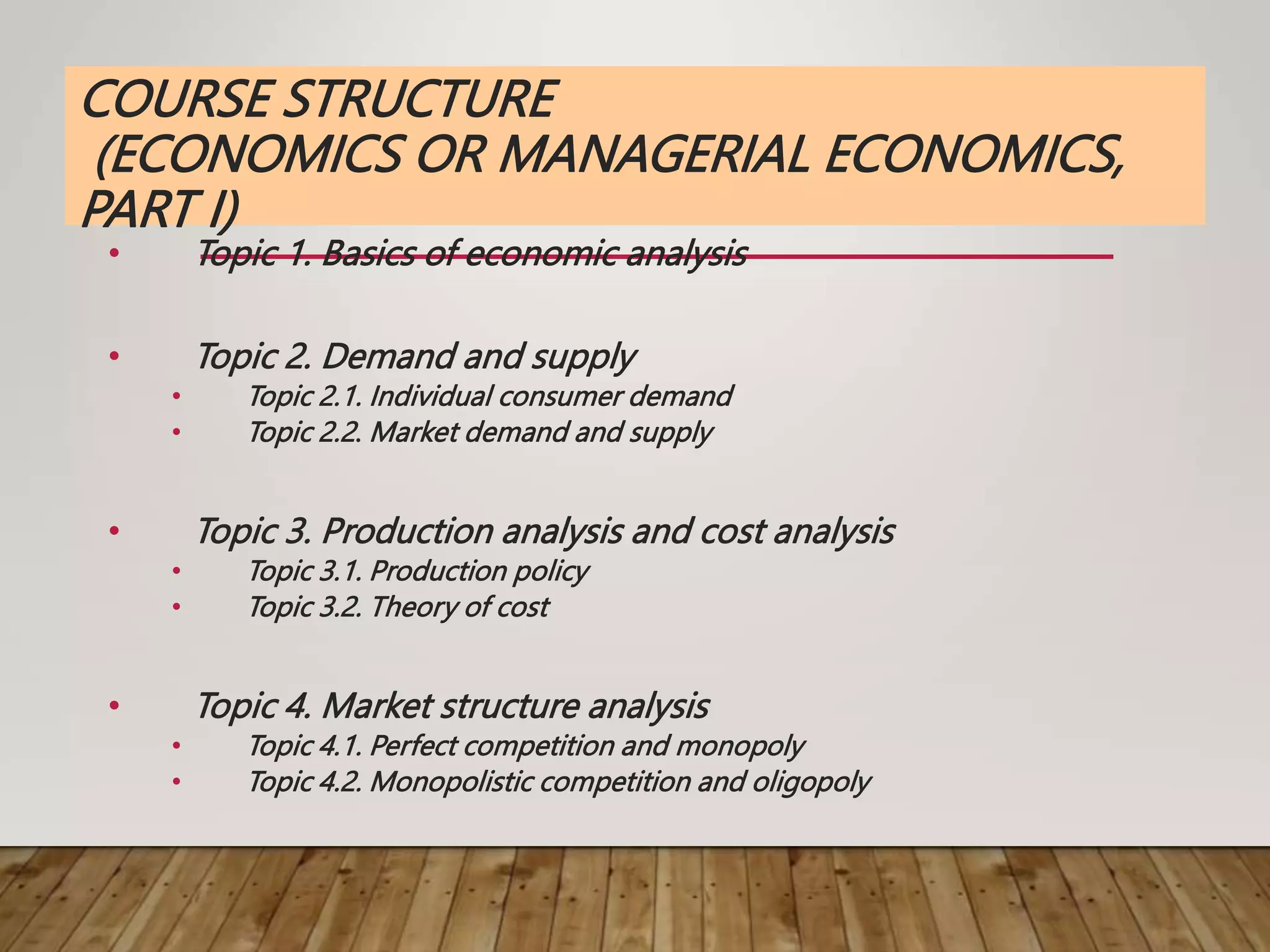
COURSE STRUCTURE
(ECONOMICS OR MANAGERIAL ECONOMICS,
PART I)
• Topic 1. Basics of economic analysis
• Topic 2. Demand and supply
• Topic 2.1. Individual consumer demand
• Topic 2.2. Market demand and supply
• Topic 3. Production analysis and cost analysis
• Topic 3.1. Production policy
• Topic 3.2. Theory of cost
• Topic 4. Market structure analysis
• Topic 4.1. Perfect competition and monopoly
• Topic 4.2. Monopolistic competition and oligopoly
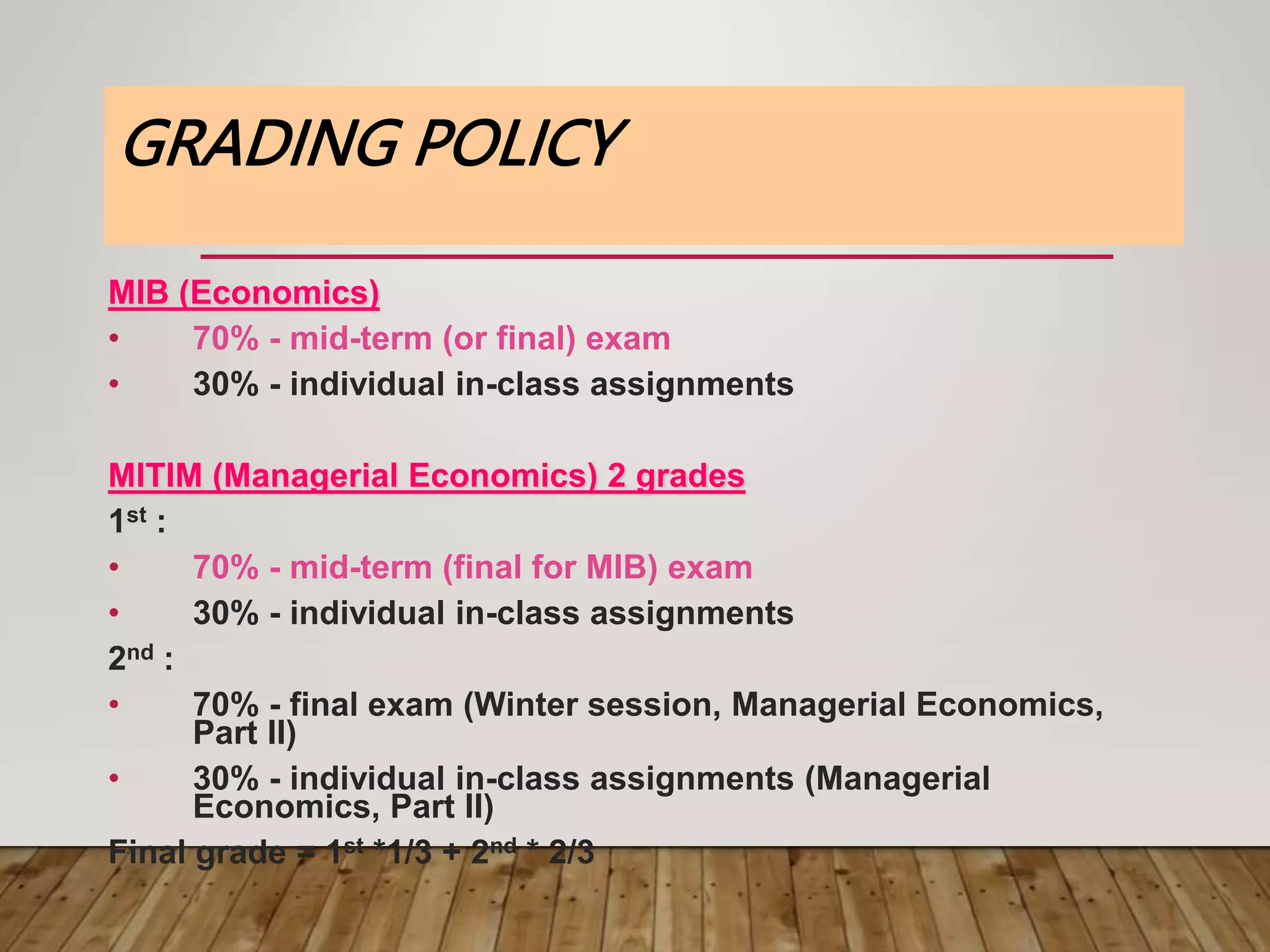
GRADING POLICY
MIB (Economics)
• 70% - mid-term (or final) exam
• 30% - individual in-class assignments
MITIM (Managerial Economics) 2 grades
1st :
• 70% - mid-term (final for MIB) exam
• 30% - individual in-class assignments
2nd :
• 70% - final exam (Winter session, Managerial Economics,
Part II)
• 30% - individual in-class assignments (Managerial
Economics, Part II)
Final grade = 1st *1/3 + 2nd * 2/3
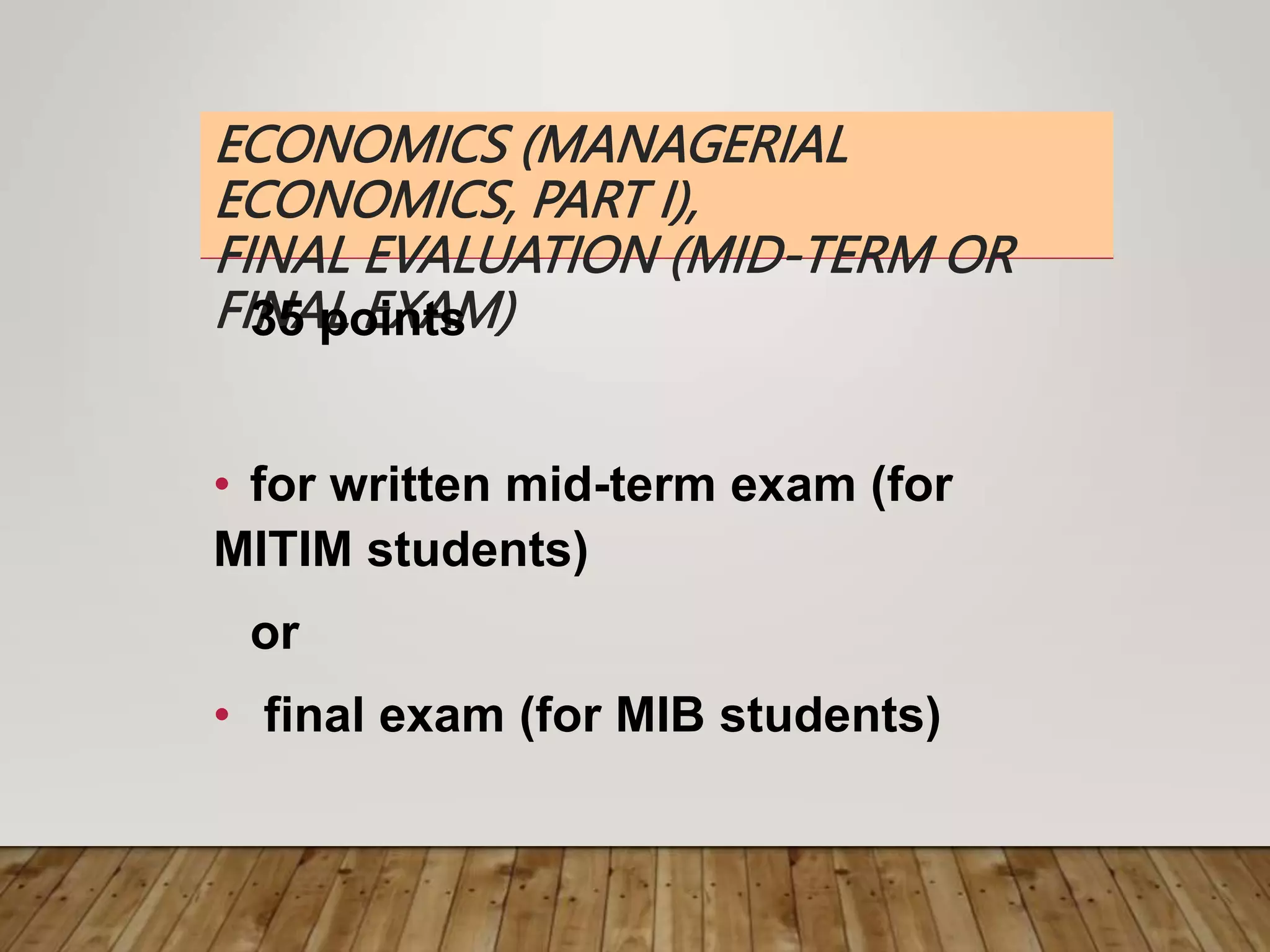
ECONOMICS (MANAGERIAL
ECONOMICS, PART I),
FINAL EVALUATION (MID-TERM OR
FINAL EXAM)
35 points
• for written mid-term exam (for
MITIM students)
or
• final exam (for MIB students)
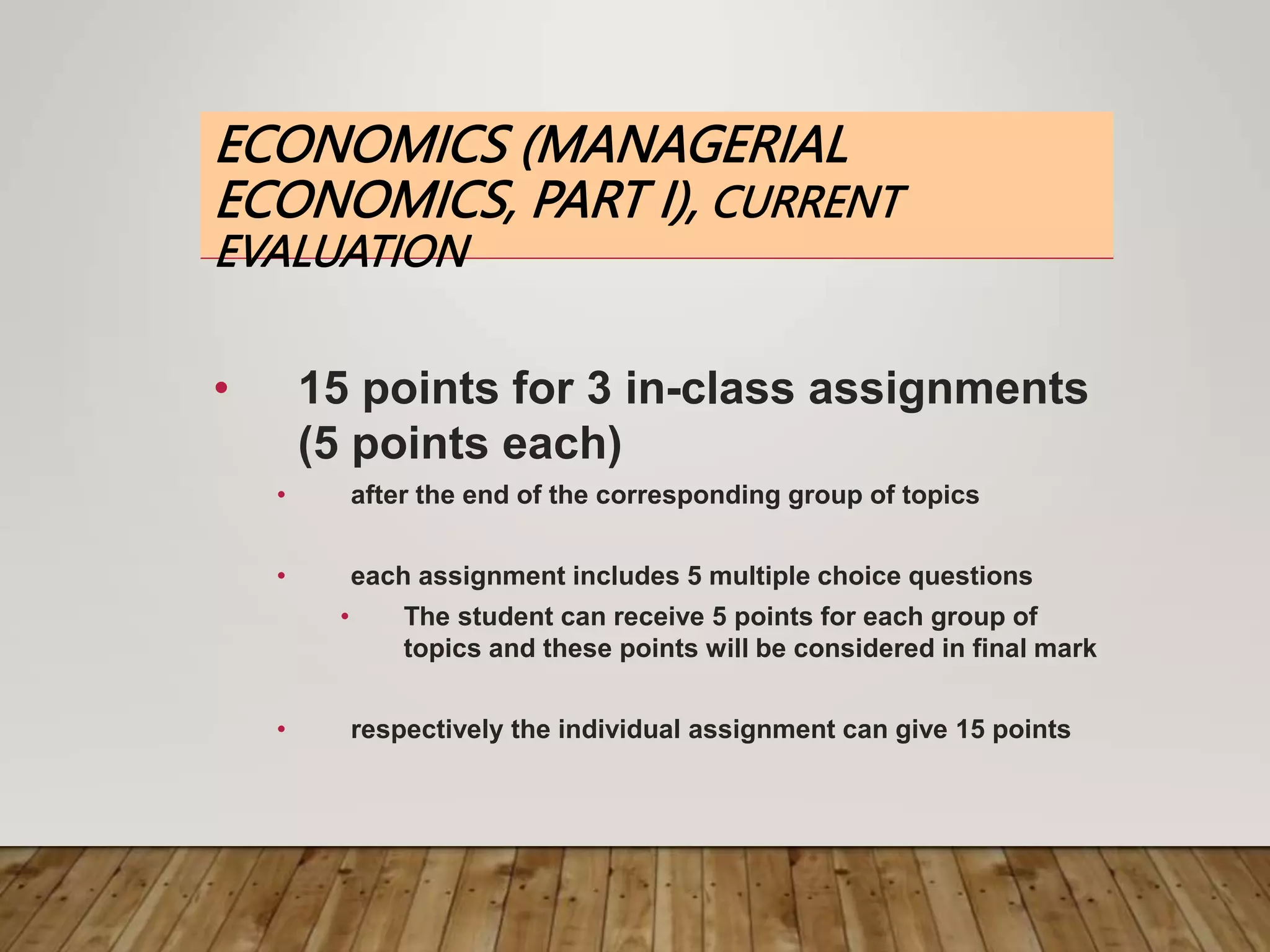
ECONOMICS (MANAGERIAL
ECONOMICS, PART I), CURRENT
EVALUATION
• 15 points for 3 in-class assignments
(5 points each)
• after the end of the corresponding group of topics
• each assignment includes 5 multiple choice questions
• The student can receive 5 points for each group of
topics and these points will be considered in final mark
• respectively the individual assignment can give 15 points
ECONOMICS (MANAGERIAL ECONOMICS,
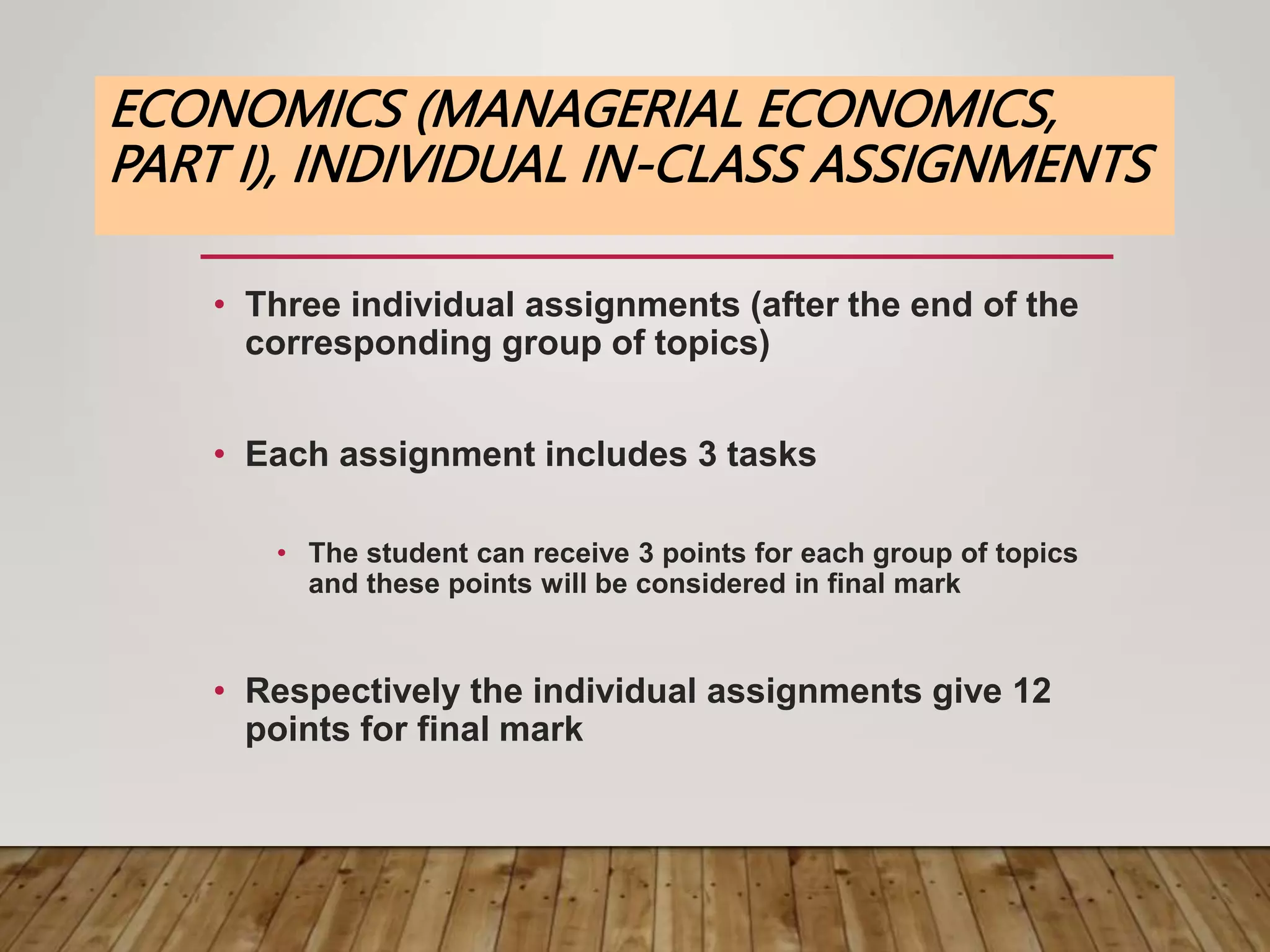
PART I), INDIVIDUAL IN-CLASS ASSIGNMENTS
• Three individual assignments (after the end of the
corresponding group of topics)
• Each assignment includes 3 tasks
• The student can receive 3 points for each group of topics
and these points will be considered in final mark
• Respectively the individual assignments give 12
points for final mark
IN-CLASS GROUP WORK
• In-class group work will take place at seminars
• Discussion of cases and answering given
questions
• Doesn’t give any points for final mark
LITERATURE
• Microeconomics: Optimization, Experiments,
and Behaviour. Burkett, John P. 2006. Oxford
Univ. Press., Source: http://site.ebrary.com/
• Microeconomics Demystified. Depken,
Craig. 2005. The McGraw-Hill Companies.,
Source: http://site.ebrary.com/
• Baye M. Managerial Economics and Business
Strategy [Text] / M. Baye. – McGraw-Hill, 2006.
– 620 p.
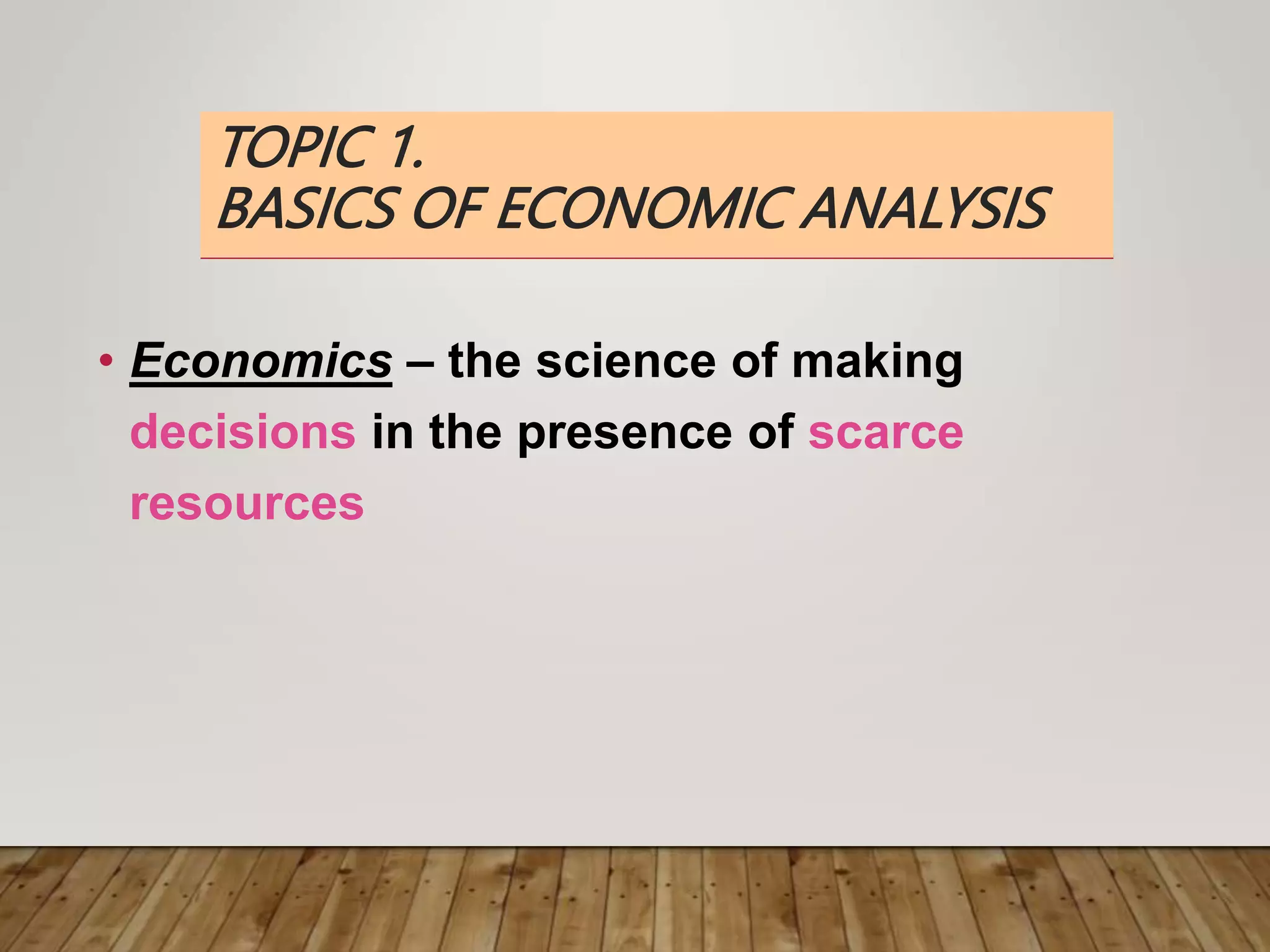
TOPIC 1.
BASICS OF ECONOMIC ANALYSIS
• Economics – the science of making
decisions in the presence of scarce
resources
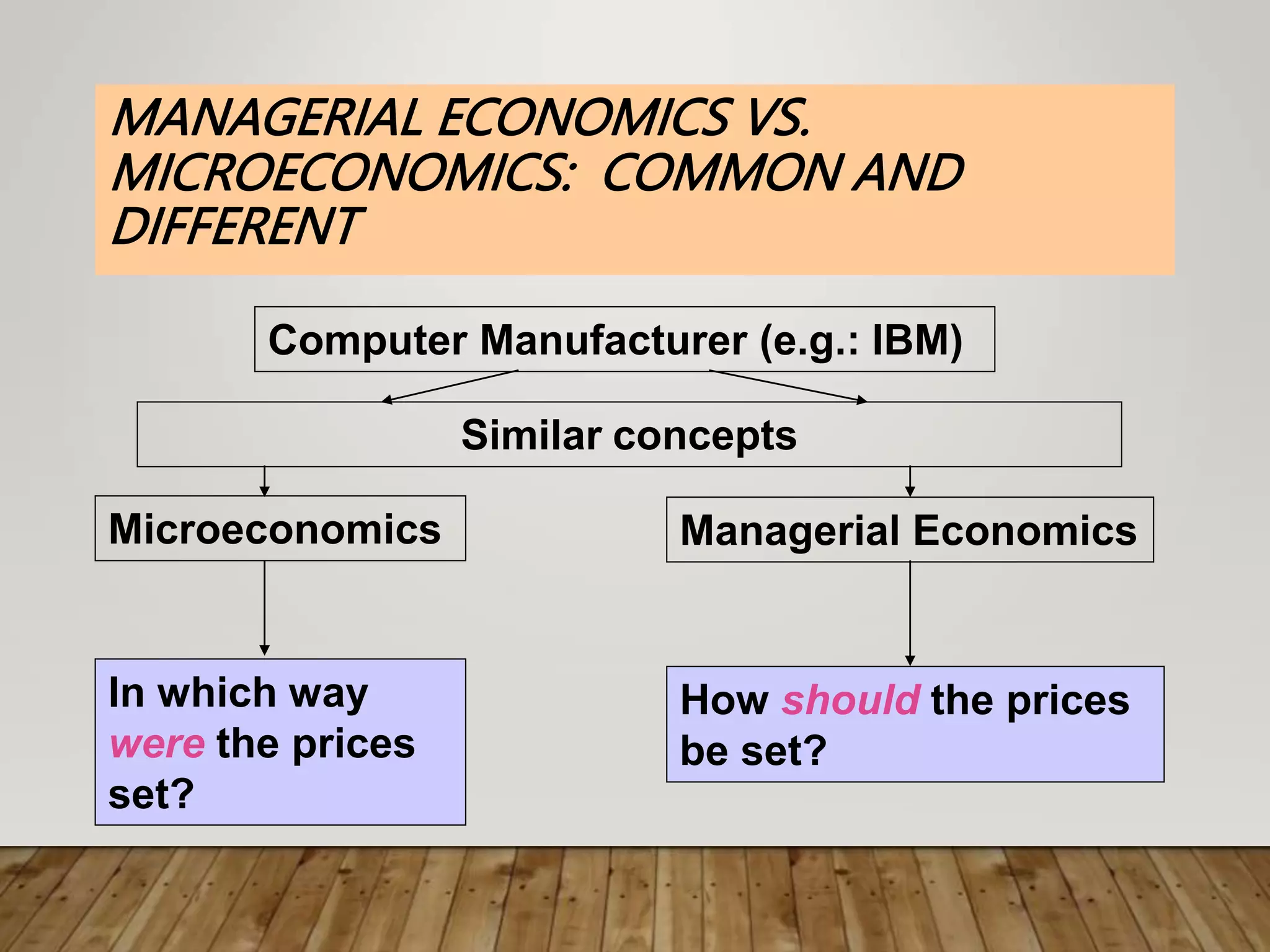
MANAGERIAL ECONOMICS VS.
MICROECONOMICS: COMMON AND
DIFFERENT
Microeconomics Managerial Economics
How should the prices
be set?
In which way
were the prices
set?
Computer Manufacturer (e.g.: IBM)
Similar concepts
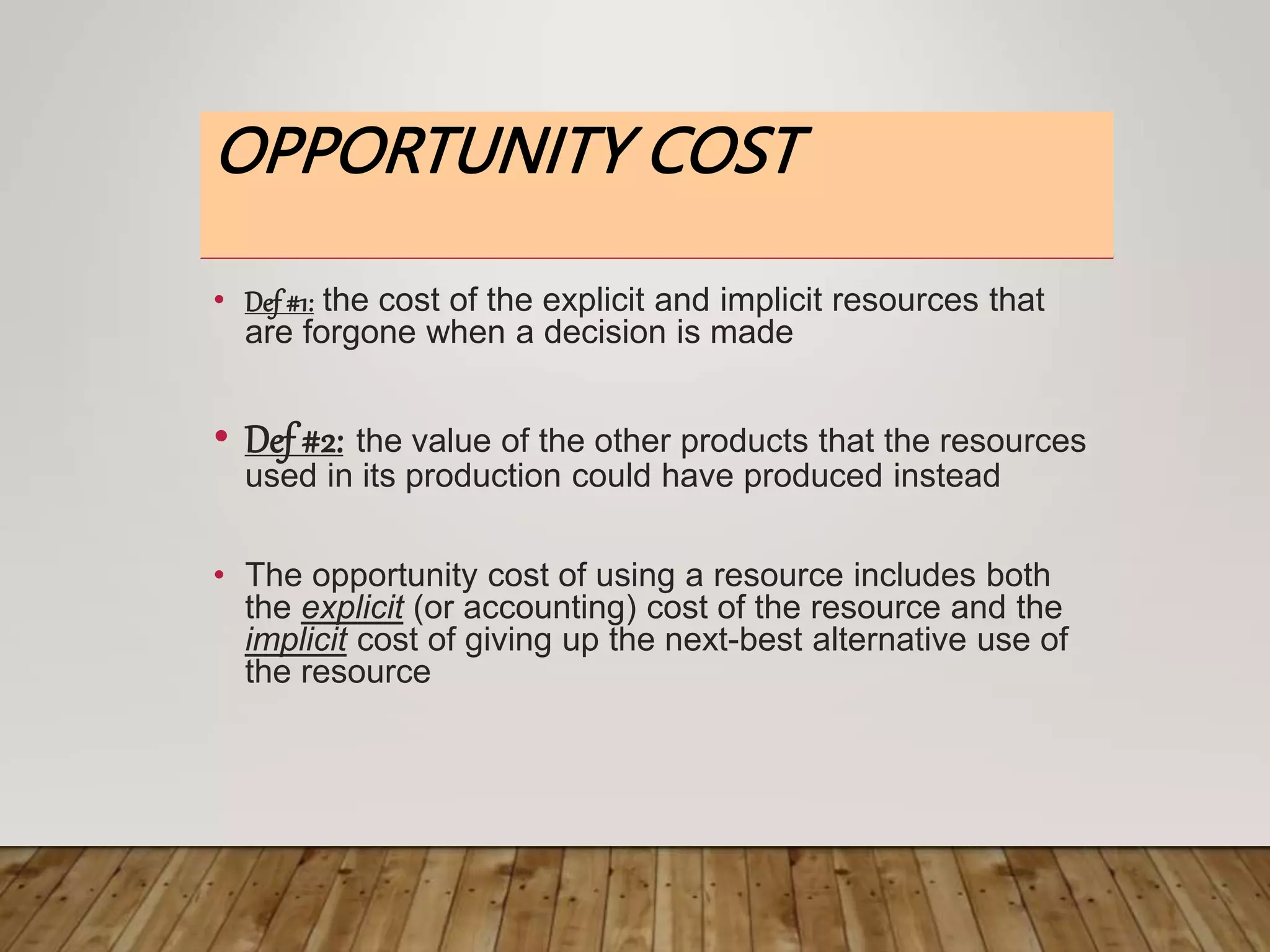
OPPORTUNITY COST
• Def #1: the cost of the explicit and implicit resources that
are forgone when a decision is made
• Def #2: the value of the other products that the resources
used in its production could have produced instead
• The opportunity cost of using a resource includes both
the explicit (or accounting) cost of the resource and the
implicit cost of giving up the next-best alternative use of
the resource
ECONOMIC VS. ACCOUNTING
PROFITS
• Def: Accounting profit – the total amount of money
taken in from sales (total revenue, or prices times
quantity sold) minus the money cost of producing
goods or services
• Def: Economic profit – the difference between total
revenue (TR) and total opportunity cost (TC)
REASONS FOR THE EXISTENCE OF
PROFIT
• Innovation
• Risk
• Monopoly power
THE FIVE FORCES FRAMEWORK AND
INDUSTRY PROFITABILITY
• Entry
• Power of input suppliers
• Industry (market) rivalry
• Substitutes and complements.
• Power of buyers
INCENTIVES
• Def: Incentives – affect how resources are
used and how hard employees work
• E.g.: “A manager should be doing a good job”
– mistake
• But!: the effect of a per hour salary for workers
to increase output
MARKETS
• Consumer-producer rivalry
• Consumer-consumer rivalry
• Producer-producer rivalry
• Government and the market
MANAGERIAL INTERESTS AND SALES
MAXIMIZATION
• Separation of ownership from control in large corporations
• Sales represent a measure of management’s success, especially
since many observers focus attention on a firm’s share of the
market as an indicator of its performance
ECONOMIC OPTIMIZATION PROCESS
ECONOMIC OPTIMIZATION
PROCESS
• Choices involve benefits and costs
• Optimal decision – choice alternative that produces a
result most consistent with managerial objectives
PROFIT MAXIMIZATION
• Maximizing profit means maximizing the value of the
firm, which is the present value of current and future
profits
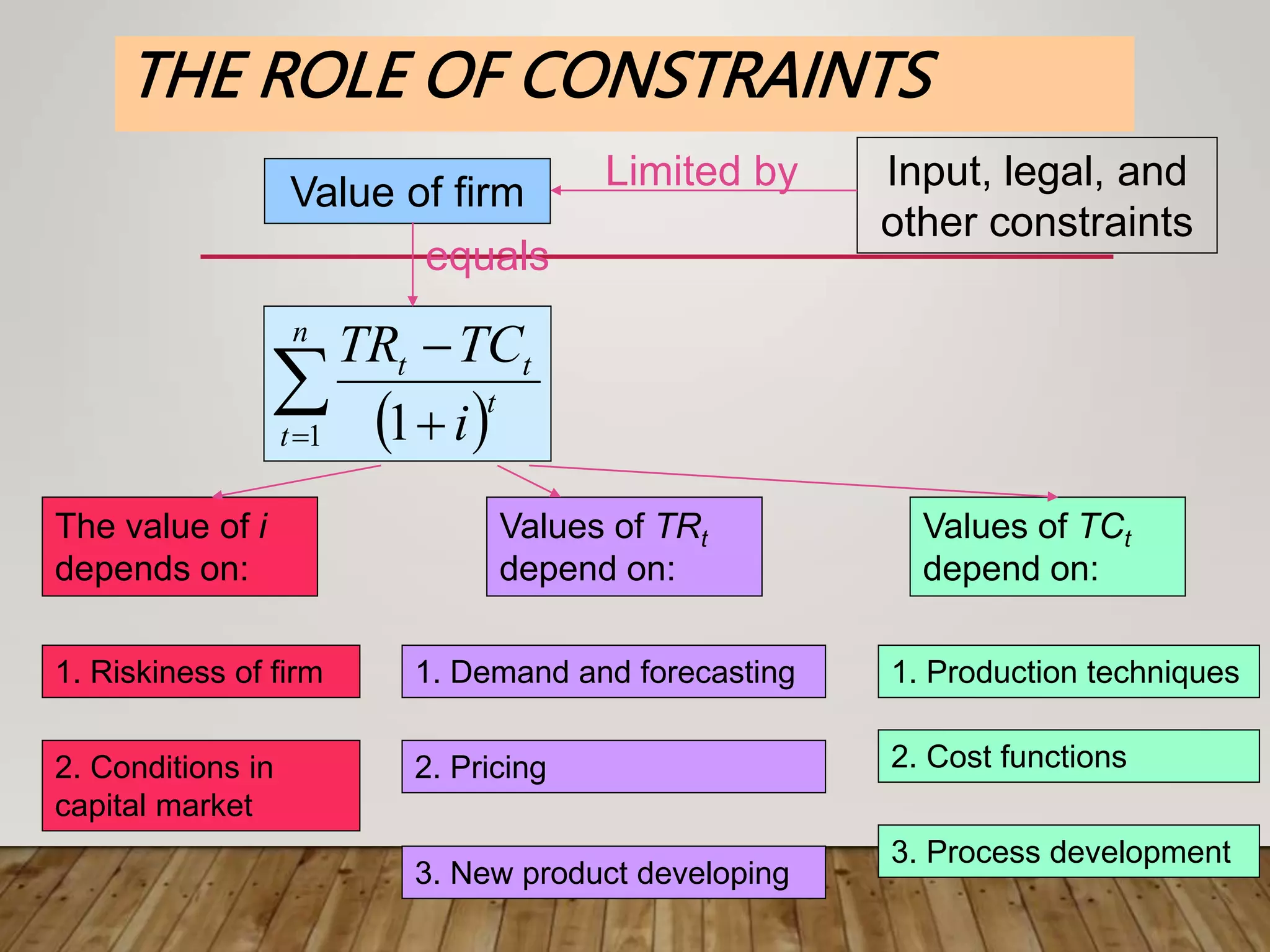
THE ROLE OF CONSTRAINTS
Value of firm
Input, legal, and
other constraints
Limited by
 

 

n
t
t
t
t
i
TC
TR
1 1
equals
The value of i
depends on:
Values of TRt
depend on:
Values of TCt
depend on:
1. Riskiness of firm
2. Conditions in
capital market
1. Demand and forecasting
2. Pricing
3. New product developing
1. Production techniques
2. Cost functions
3. Process development
EXPRESSING ECONOMIC
RELATIONS
• spreadsheet – table of electronically stored data
• graph – visual representation of data
• equation – analytical expression of functional
relationship
• dependent variable – Y variable determined by X
values
• independent variable – X variable determined
separately from the Y variable
TOTAL, AVERAGE, AND MARGINAL
RELATIONS (1)
• Marginal – change in the dependent variable caused
by a 1-unit change in an independent variable
• Marginal revenue
• Marginal cost
• Marginal profit
TOTAL, AVERAGE, AND MARGINAL
RELATIONS (2)
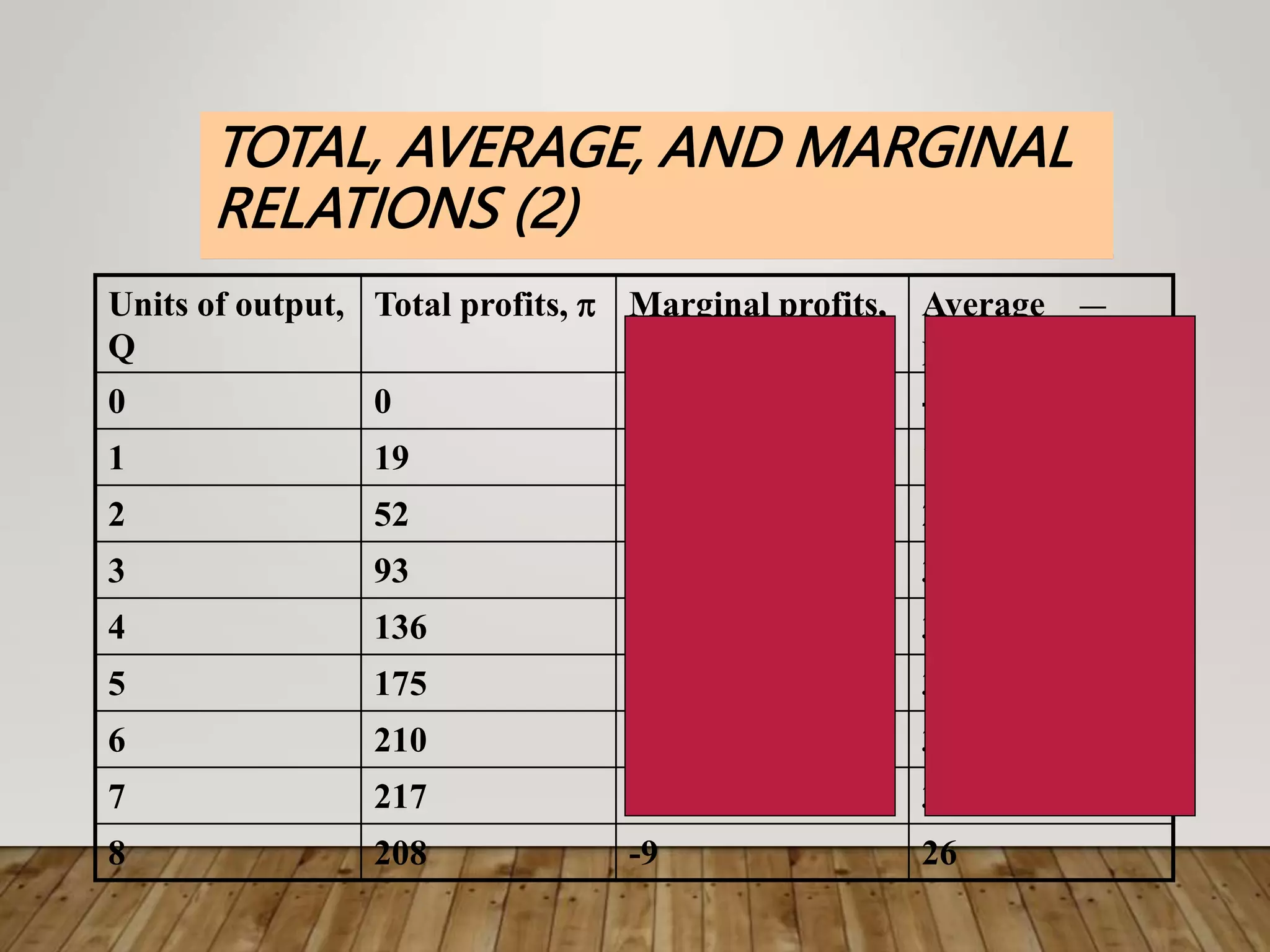
Units of output,
Q
Total profits,  Marginal profits,

Average
profits,
0 0 0 -
1 19 19 19
2 52 33 26
3 93 41 31
4 136 43 34
5 175 39 35
6 210 35 35
7 217 7 31
8 208 -9 26

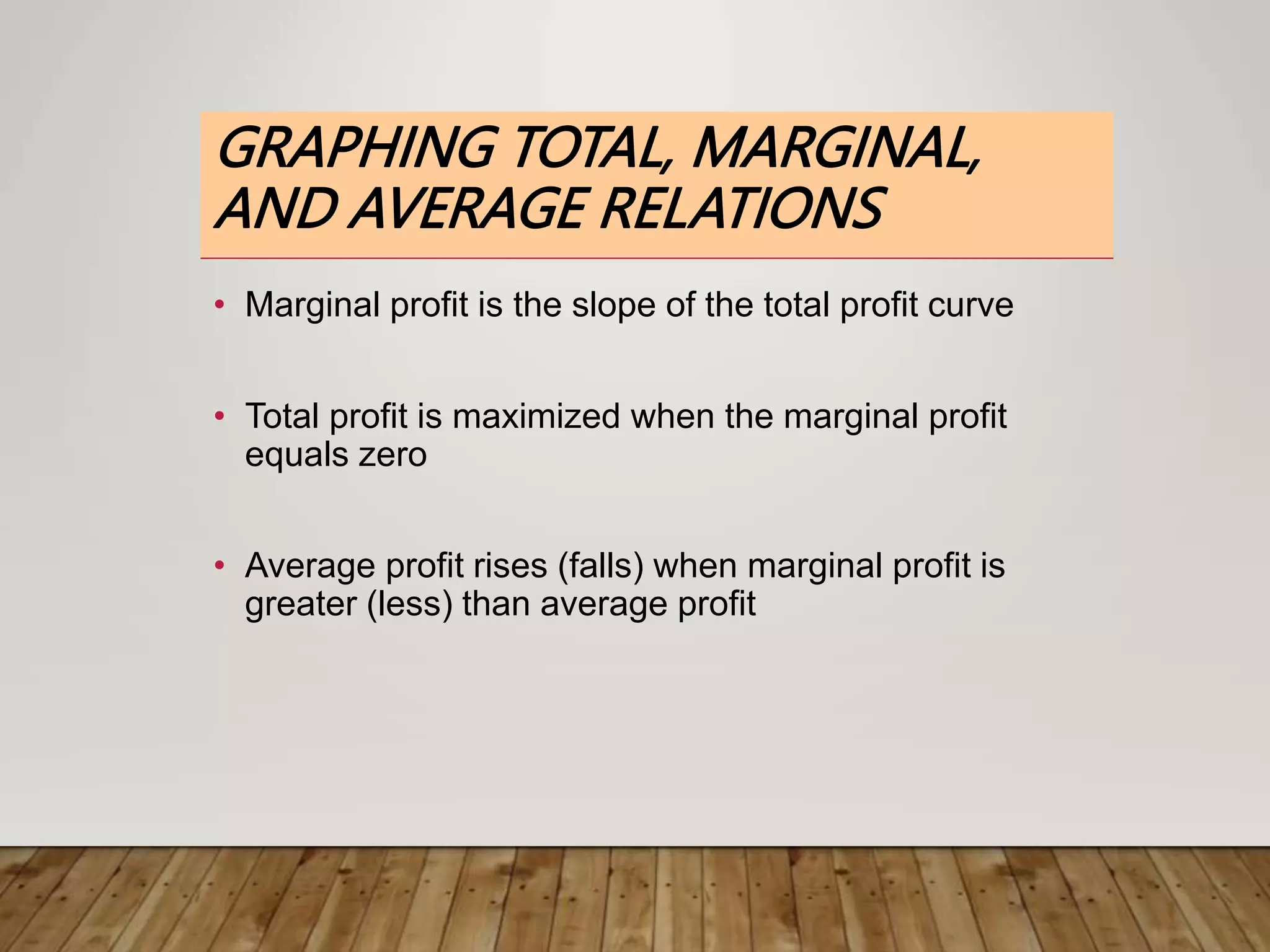
GRAPHING TOTAL, MARGINAL,
AND AVERAGE RELATIONS
• Marginal profit is the slope of the total profit curve
• Total profit is maximized when the marginal profit
equals zero
• Average profit rises (falls) when marginal profit is
greater (less) than average profit
MARGINAL ANALYSIS IN DECISION
MAKING
• Finding maximums or minimums
• Distinguishing maximums from minimums
• Maximizing the difference between two functions
MULTIVARIATE OPTIMIZATION
• The marginal effect of each independent variable on
the dependent variable
• holding constant the effect of all other independent variables
• Partial derivatives
• The unchanged variables are treated as constants in the
differentiation process
INCREMENTAL CONCEPT IN
ECONOMIC ANALYSIS
• Marginal relations measure only the effect associated with unitary
changes in variables
• The incremental concept is often used as the practical equivalent
of marginal analysis
• Def: Incremental change is the total change resulting from a
decision
• E.g.: Incremental profit is the profit gain or loss associated with a given
decision

Arunkumar MBA.ppt

  • 1.
  • 2.
    COURSE STRUCTURE (ECONOMICS ORMANAGERIAL ECONOMICS, PART I) • Topic 1. Basics of economic analysis • Topic 2. Demand and supply • Topic 2.1. Individual consumer demand • Topic 2.2. Market demand and supply • Topic 3. Production analysis and cost analysis • Topic 3.1. Production policy • Topic 3.2. Theory of cost • Topic 4. Market structure analysis • Topic 4.1. Perfect competition and monopoly • Topic 4.2. Monopolistic competition and oligopoly
  • 3.
    GRADING POLICY MIB (Economics) •70% - mid-term (or final) exam • 30% - individual in-class assignments MITIM (Managerial Economics) 2 grades 1st : • 70% - mid-term (final for MIB) exam • 30% - individual in-class assignments 2nd : • 70% - final exam (Winter session, Managerial Economics, Part II) • 30% - individual in-class assignments (Managerial Economics, Part II) Final grade = 1st *1/3 + 2nd * 2/3
  • 4.
    ECONOMICS (MANAGERIAL ECONOMICS, PARTI), FINAL EVALUATION (MID-TERM OR FINAL EXAM) 35 points • for written mid-term exam (for MITIM students) or • final exam (for MIB students)
  • 5.
    ECONOMICS (MANAGERIAL ECONOMICS, PARTI), CURRENT EVALUATION • 15 points for 3 in-class assignments (5 points each) • after the end of the corresponding group of topics • each assignment includes 5 multiple choice questions • The student can receive 5 points for each group of topics and these points will be considered in final mark • respectively the individual assignment can give 15 points
  • 6.
    ECONOMICS (MANAGERIAL ECONOMICS, PARTI), INDIVIDUAL IN-CLASS ASSIGNMENTS • Three individual assignments (after the end of the corresponding group of topics) • Each assignment includes 3 tasks • The student can receive 3 points for each group of topics and these points will be considered in final mark • Respectively the individual assignments give 12 points for final mark
  • 7.
    IN-CLASS GROUP WORK •In-class group work will take place at seminars • Discussion of cases and answering given questions • Doesn’t give any points for final mark
  • 8.
    LITERATURE • Microeconomics: Optimization,Experiments, and Behaviour. Burkett, John P. 2006. Oxford Univ. Press., Source: http://site.ebrary.com/ • Microeconomics Demystified. Depken, Craig. 2005. The McGraw-Hill Companies., Source: http://site.ebrary.com/ • Baye M. Managerial Economics and Business Strategy [Text] / M. Baye. – McGraw-Hill, 2006. – 620 p.
  • 9.
    TOPIC 1. BASICS OFECONOMIC ANALYSIS • Economics – the science of making decisions in the presence of scarce resources
  • 10.
    MANAGERIAL ECONOMICS VS. MICROECONOMICS:COMMON AND DIFFERENT Microeconomics Managerial Economics How should the prices be set? In which way were the prices set? Computer Manufacturer (e.g.: IBM) Similar concepts
  • 11.
    OPPORTUNITY COST • Def#1: the cost of the explicit and implicit resources that are forgone when a decision is made • Def #2: the value of the other products that the resources used in its production could have produced instead • The opportunity cost of using a resource includes both the explicit (or accounting) cost of the resource and the implicit cost of giving up the next-best alternative use of the resource
  • 12.
    ECONOMIC VS. ACCOUNTING PROFITS •Def: Accounting profit – the total amount of money taken in from sales (total revenue, or prices times quantity sold) minus the money cost of producing goods or services • Def: Economic profit – the difference between total revenue (TR) and total opportunity cost (TC)
  • 13.
    REASONS FOR THEEXISTENCE OF PROFIT • Innovation • Risk • Monopoly power
  • 14.
    THE FIVE FORCESFRAMEWORK AND INDUSTRY PROFITABILITY • Entry • Power of input suppliers • Industry (market) rivalry • Substitutes and complements. • Power of buyers
  • 15.
    INCENTIVES • Def: Incentives– affect how resources are used and how hard employees work • E.g.: “A manager should be doing a good job” – mistake • But!: the effect of a per hour salary for workers to increase output
  • 16.
    MARKETS • Consumer-producer rivalry •Consumer-consumer rivalry • Producer-producer rivalry • Government and the market
  • 17.
    MANAGERIAL INTERESTS ANDSALES MAXIMIZATION • Separation of ownership from control in large corporations • Sales represent a measure of management’s success, especially since many observers focus attention on a firm’s share of the market as an indicator of its performance
  • 18.
  • 19.
    ECONOMIC OPTIMIZATION PROCESS • Choicesinvolve benefits and costs • Optimal decision – choice alternative that produces a result most consistent with managerial objectives
  • 20.
    PROFIT MAXIMIZATION • Maximizingprofit means maximizing the value of the firm, which is the present value of current and future profits
  • 21.
    THE ROLE OFCONSTRAINTS Value of firm Input, legal, and other constraints Limited by       n t t t t i TC TR 1 1 equals The value of i depends on: Values of TRt depend on: Values of TCt depend on: 1. Riskiness of firm 2. Conditions in capital market 1. Demand and forecasting 2. Pricing 3. New product developing 1. Production techniques 2. Cost functions 3. Process development
  • 22.
    EXPRESSING ECONOMIC RELATIONS • spreadsheet– table of electronically stored data • graph – visual representation of data • equation – analytical expression of functional relationship • dependent variable – Y variable determined by X values • independent variable – X variable determined separately from the Y variable
  • 23.
    TOTAL, AVERAGE, ANDMARGINAL RELATIONS (1) • Marginal – change in the dependent variable caused by a 1-unit change in an independent variable • Marginal revenue • Marginal cost • Marginal profit
  • 24.
    TOTAL, AVERAGE, ANDMARGINAL RELATIONS (2) Units of output, Q Total profits,  Marginal profits,  Average profits, 0 0 0 - 1 19 19 19 2 52 33 26 3 93 41 31 4 136 43 34 5 175 39 35 6 210 35 35 7 217 7 31 8 208 -9 26 
  • 25.
    GRAPHING TOTAL, MARGINAL, ANDAVERAGE RELATIONS • Marginal profit is the slope of the total profit curve • Total profit is maximized when the marginal profit equals zero • Average profit rises (falls) when marginal profit is greater (less) than average profit
  • 26.
    MARGINAL ANALYSIS INDECISION MAKING • Finding maximums or minimums • Distinguishing maximums from minimums • Maximizing the difference between two functions
  • 27.
    MULTIVARIATE OPTIMIZATION • Themarginal effect of each independent variable on the dependent variable • holding constant the effect of all other independent variables • Partial derivatives • The unchanged variables are treated as constants in the differentiation process
  • 28.
    INCREMENTAL CONCEPT IN ECONOMICANALYSIS • Marginal relations measure only the effect associated with unitary changes in variables • The incremental concept is often used as the practical equivalent of marginal analysis • Def: Incremental change is the total change resulting from a decision • E.g.: Incremental profit is the profit gain or loss associated with a given decision