RESEARCH:
MAKING A PLAN AND FINDING
RESOURCES
      Ms. Cheby, Teacher Librarian, November
Information Literacy

         Informatio
                  n
         + Literacy
Information Literacy

 “To be information literate, a person
   must be able to recognize when
 information is needed and have the
  ability to locate, evaluate, and use
  effectively the needed information.”
                      American Library Association, 1989
™
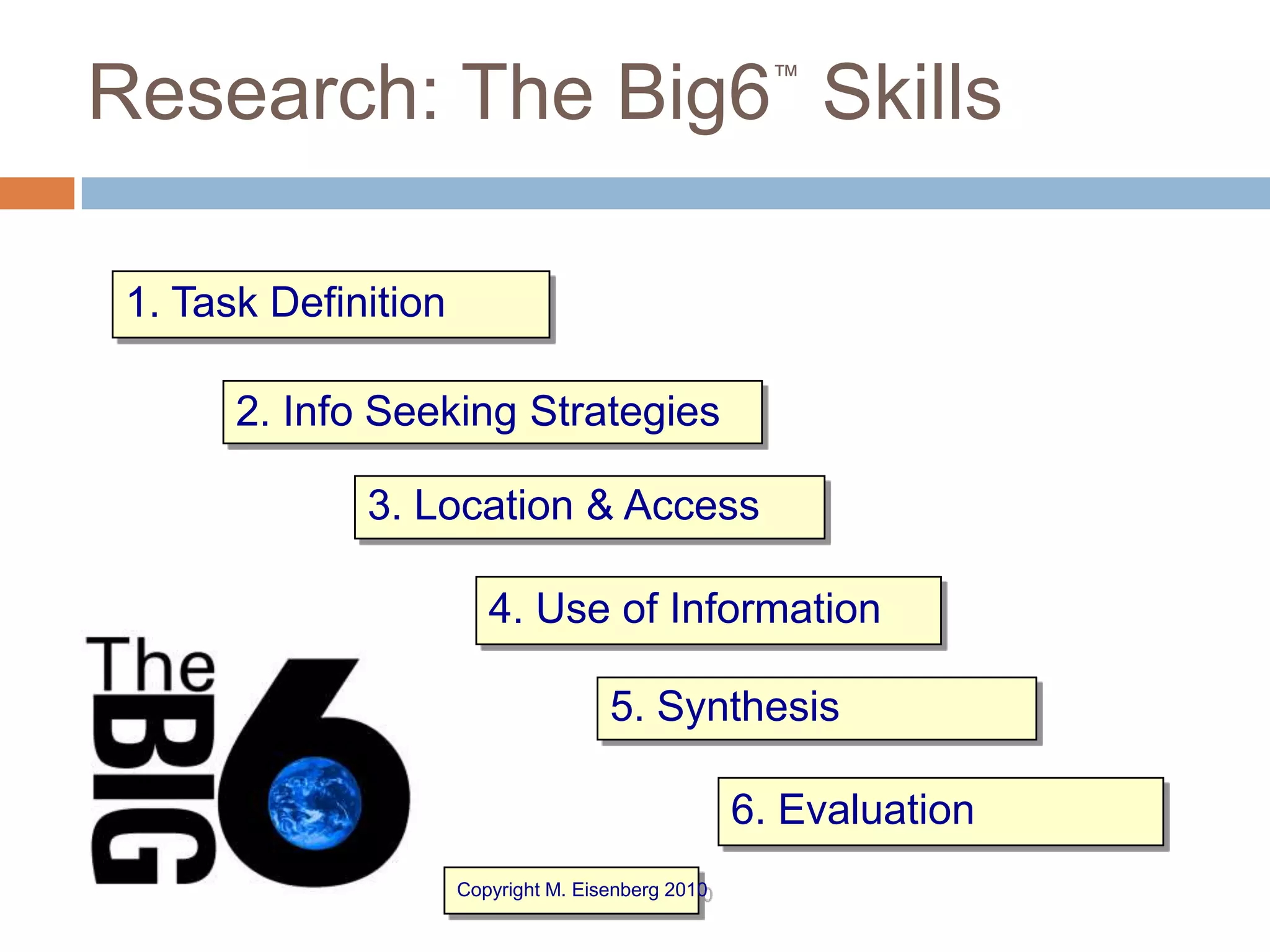
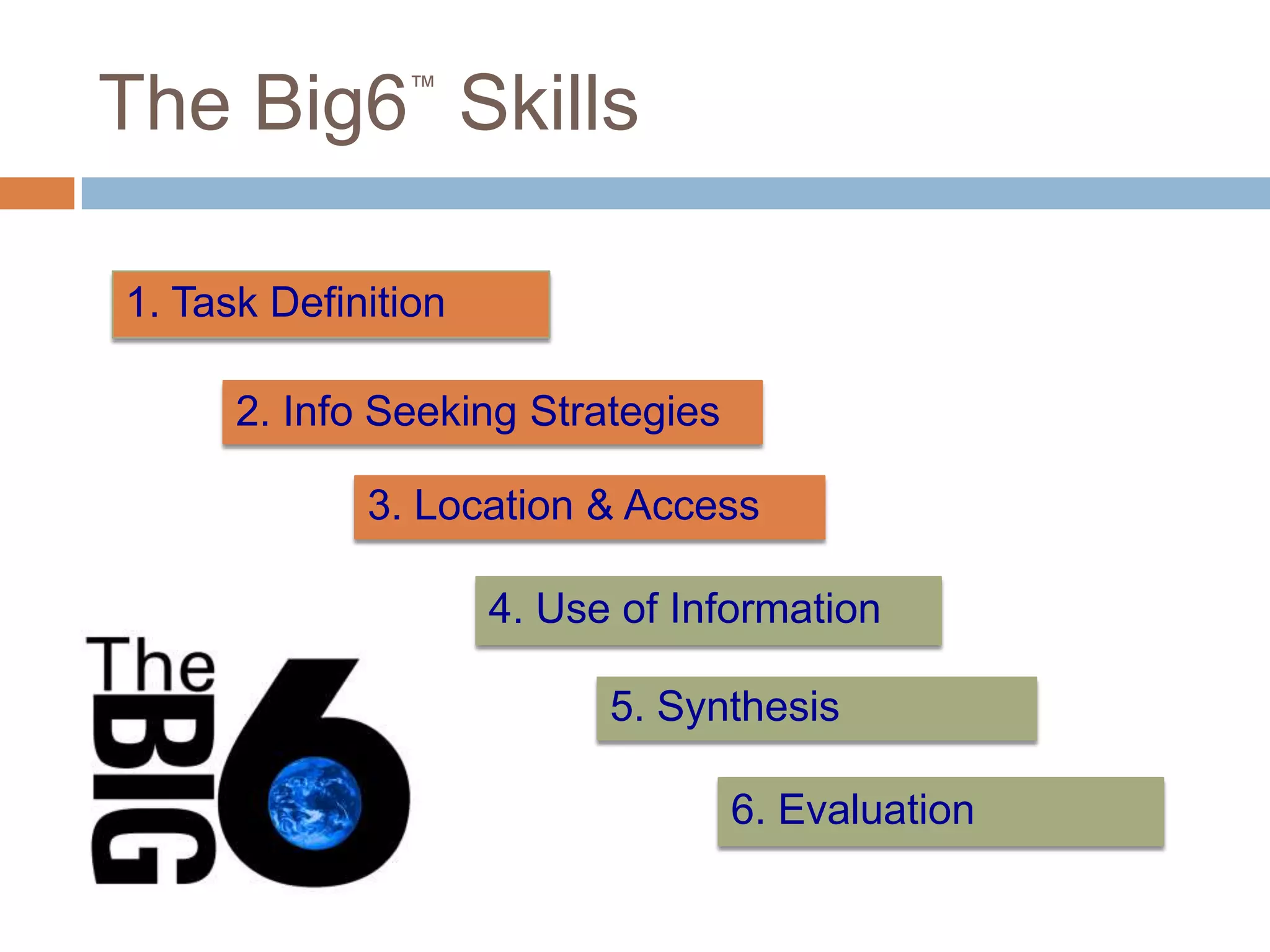
Research: The Big6 Skills

 1. Task Definition

       2. Info Seeking Strategies

              3. Location & Access

                         4. Use of Information

                                      5. Synthesis

                                                    6. Evaluation
                      Copyright M. Eisenberg 2010
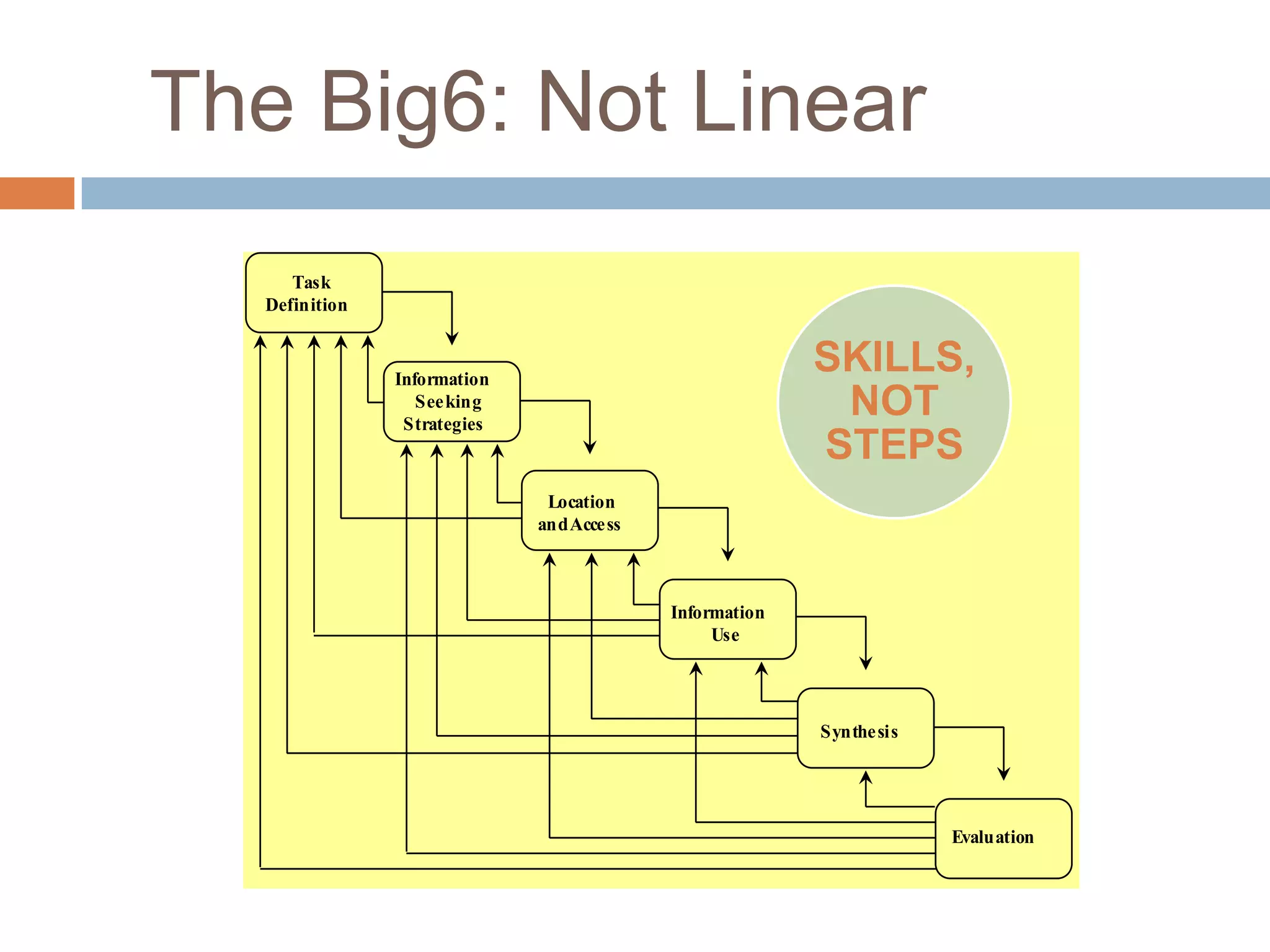
The Big6: Not Linear
     Task
  Definition


               Information
                                                        SKILLS,
                  See king
                Strategies
                                                         NOT
                                                        STEPS
                              Location
                             and Access


                                          Information
                                               Use


                                                        Synthesis


                                                                    Evaluation
™
The Big6 Skills

1. Task Definition

      2. Info Seeking Strategies

             3. Location & Access

                     4. Use of Information

                           5. Synthesis

                                   6. Evaluation
Task Definition

   Define the problem:
       What is the topic I have chosen? (BE
        SPECIFIC)
     Write   down your topic as a
        question that can later be
        restated as a thesis.
           i.e. How did the Warsaw Ghetto Uprising
            resist the injustice horrors of the
            Holocaust? Did it lead to the end of the
            Holocaust?
     Howmany/what kind of sources
SOURCEI need according to the
   do : http://big6.com/pages/free-stuff.php, Accessed 4/19/2012
   rubric?
Task Definition

   Become a question generator
     See   an example here.
   Identify keywords in your questions.
   Generate more keyword options:
     Synonym:  means the same
     Hyponym: same meaning, but more specific (to
      narrow search)
     Hypernym: same meaning, but more general
      (to broaden search)
SOURCE:      How To Do Research – World Book Student, Accessed 4/24/2012
Task Definition

Construct Web Search
 Query
  Prioritize keywords
  Use “Optimal Query
   Checklist”
  Combine using Boolean
   Terms & Keywords.
SOURCE: How To Do Research – World Book Student, Accessed 4/24/2012
Information Seeking Strategies
   Determine all possible sources
     Types of sources
     Primary vs. secondary sources

     Popular vs. Scholarly Sources
Information Seeking Strategies
   Determine all possible sources
     Types of sources

 Newspapers
 Scholarly Journals
 Magazines/Periodicals
 Books
 Reference Books
 Websites
 People
       Primary vs. secondary sources
       Popular vs. Scholarly Sources


    SOURCE: http://big6.com/pages/free-stuff.php, Accessed 4/19/2012
Information Seeking Strategies
   Determine all possible sources
     Types of sources

 Newspapers
 Scholarly Journals
 Magazines/Periodicals
 Books
 Reference Books
 Websites
 People
       Primary vs. secondary sources
       Popular vs. Scholarly Sources


    SOURCE: http://big6.com/pages/free-stuff.php, Accessed 4/19/2012
Information Seeking Strategies
   Determine all possible sources
       Types of sources

     Primary
          examples:     Birth Certificates, Diaries,
            Diplomatic Correspondence, Executive
            Orders, Legal Records, Letters, News Film
            Footage, Government Records,
            Literary texts
     secondary                 sources
          Examples:   Historical accounts,
            encyclopedia articles, literary criticism
       Popular vs. Scholarly Sources

SOURCE: How to Do Research –World Book Student, accessed 4/27/2012
Information Seeking Strategies
   Determine all possible sources
       Types of sources
       Primary vs. secondary sources

     Popular              vs. Scholary
        Sources
         Scholarly sources:
              •   evaluated by experts
                  /"peer reviewed"
              •   Based on research
              •   Written for researchers /
                  students
              •    Clearly and accurately
                  lists/sites references
    SOURCE: http://big6.com/pages/free-stuff.php, Accessed 4/19/2012
Location & Access
   Locate sources
     Library
            Catalog
     LAUSD Digital Library

     Ms. Cheby’s Resource Blogs
Location & Access
   Locate sources
     Library   Catalog
       Books
       Websites
       Databases

     LAUSD  Digital Library
     Ms. Cheby’s Resource Blogs
Location & Access
   Locate sources
     Library
           Catalog
     LAUSD Digital Library
       What is a Database?
       How to use a database?

     Ms.   Cheby’s Resource Blogs
Location & Access
   Locate sources
     Library
            Catalog
     LAUSD Digital Library

     Ms. Cheby’s Resource
      Blogs
Location & Access
   Find Information within
    sources
     SourceCards/Bibliographic
     Information
       Record  information for
        bibliography
       Use MLA Style Guides

     Evidence   for assignment
Information Seeking Strategies
   Choosing the Best Sources
     Why not Wikipedia?
     CARRDSS

     Academic Sources vs. Popular Sources
Information Seeking Strategies
   Choosing the Best Sources
     Why not Wikipedia?


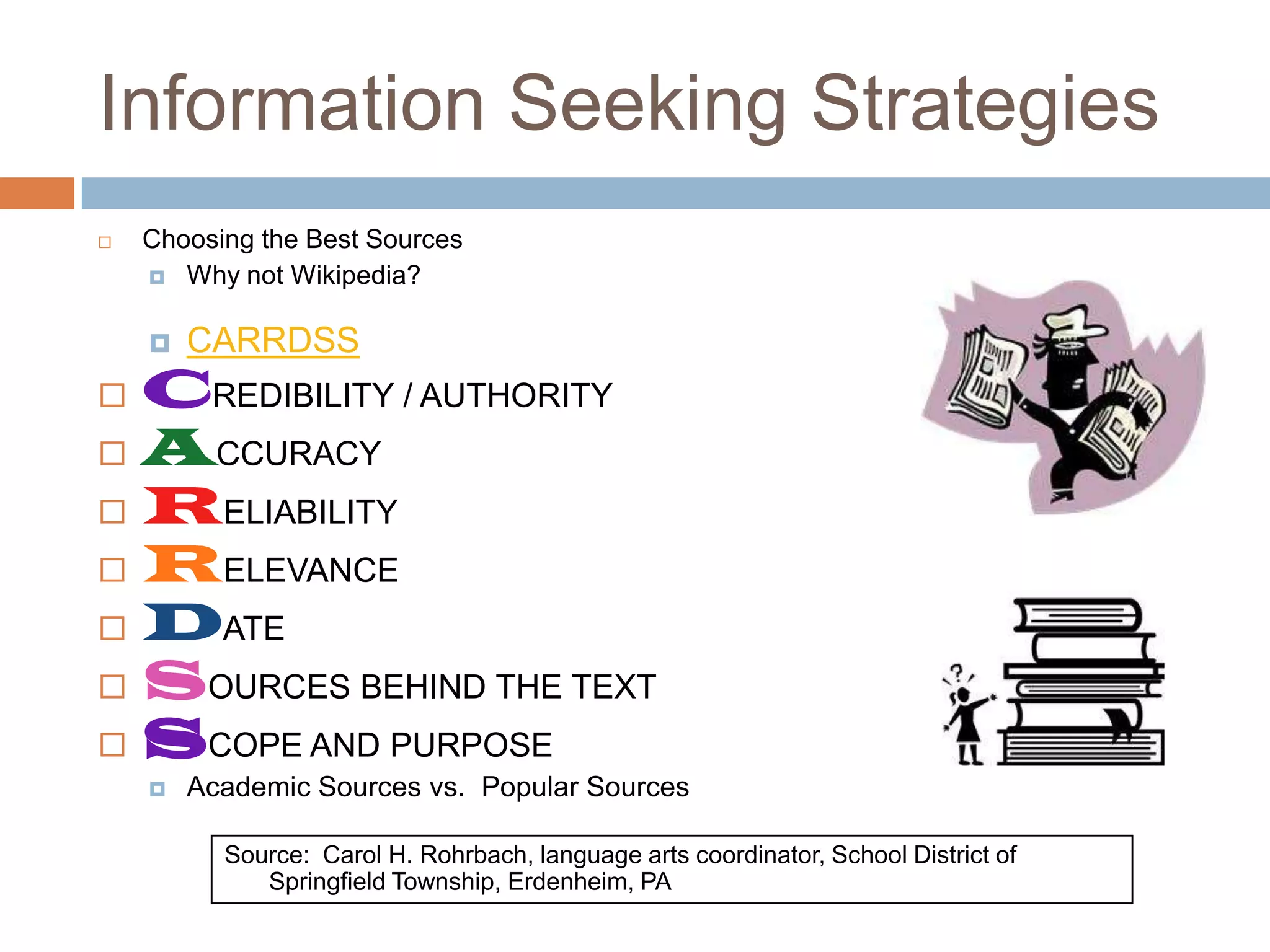
       CARRDSS
 CREDIBILITY / AUTHORITY
 ACCURACY
 RELIABILITY
 RELEVANCE
 DATE
 SOURCES BEHIND THE TEXT
 SCOPE AND PURPOSE
       Academic Sources vs. Popular Sources

          Source: Carol H. Rohrbach, language arts coordinator, School District of
             Springfield Township, Erdenheim, PA
Information Seeking Strategies
   Determine all possible sources
       Types of sources
       Primary vs. secondary sources
   Choosing the Best Sources
       Why not Wikipedia?
       CARRDSS

     Academic                  Sources vs. Popular
        Sources
          You         can determine if a source
            is
            scholarly or popular by looking
            at the author, audience,
            language use, organization,
            and references cited.
The Virtual Library

            Resource Blog:
    http://chebyteacher937.word
              press.com/

      Verdugo Hills High School
      Library and Media Center

    http://twitter.com/LibrarianCh
                   eby

How to get started on Research

  • 1.
    RESEARCH: MAKING A PLANAND FINDING RESOURCES Ms. Cheby, Teacher Librarian, November
  • 2.
    Information Literacy Informatio n + Literacy
  • 3.
    Information Literacy “Tobe information literate, a person must be able to recognize when information is needed and have the ability to locate, evaluate, and use effectively the needed information.” American Library Association, 1989
  • 4.
    ™ Research: The Big6Skills 1. Task Definition 2. Info Seeking Strategies 3. Location & Access 4. Use of Information 5. Synthesis 6. Evaluation Copyright M. Eisenberg 2010
  • 5.
    The Big6: NotLinear Task Definition Information SKILLS, See king Strategies NOT STEPS Location and Access Information Use Synthesis Evaluation
  • 6.
    ™ The Big6 Skills 1.Task Definition 2. Info Seeking Strategies 3. Location & Access 4. Use of Information 5. Synthesis 6. Evaluation
  • 7.
    Task Definition  Define the problem:  What is the topic I have chosen? (BE SPECIFIC)  Write down your topic as a question that can later be restated as a thesis.  i.e. How did the Warsaw Ghetto Uprising resist the injustice horrors of the Holocaust? Did it lead to the end of the Holocaust?  Howmany/what kind of sources SOURCEI need according to the do : http://big6.com/pages/free-stuff.php, Accessed 4/19/2012 rubric?
  • 8.
    Task Definition  Become a question generator  See an example here.  Identify keywords in your questions.  Generate more keyword options:  Synonym: means the same  Hyponym: same meaning, but more specific (to narrow search)  Hypernym: same meaning, but more general (to broaden search) SOURCE: How To Do Research – World Book Student, Accessed 4/24/2012
  • 9.
    Task Definition Construct WebSearch Query Prioritize keywords Use “Optimal Query Checklist” Combine using Boolean Terms & Keywords. SOURCE: How To Do Research – World Book Student, Accessed 4/24/2012
  • 10.
    Information Seeking Strategies  Determine all possible sources  Types of sources  Primary vs. secondary sources  Popular vs. Scholarly Sources
  • 11.
    Information Seeking Strategies  Determine all possible sources  Types of sources  Newspapers  Scholarly Journals  Magazines/Periodicals  Books  Reference Books  Websites  People  Primary vs. secondary sources  Popular vs. Scholarly Sources SOURCE: http://big6.com/pages/free-stuff.php, Accessed 4/19/2012
  • 12.
    Information Seeking Strategies  Determine all possible sources  Types of sources  Newspapers  Scholarly Journals  Magazines/Periodicals  Books  Reference Books  Websites  People  Primary vs. secondary sources  Popular vs. Scholarly Sources SOURCE: http://big6.com/pages/free-stuff.php, Accessed 4/19/2012
  • 13.
    Information Seeking Strategies  Determine all possible sources  Types of sources  Primary  examples: Birth Certificates, Diaries, Diplomatic Correspondence, Executive Orders, Legal Records, Letters, News Film Footage, Government Records, Literary texts  secondary sources  Examples: Historical accounts, encyclopedia articles, literary criticism  Popular vs. Scholarly Sources SOURCE: How to Do Research –World Book Student, accessed 4/27/2012
  • 14.
    Information Seeking Strategies  Determine all possible sources  Types of sources  Primary vs. secondary sources  Popular vs. Scholary Sources  Scholarly sources: • evaluated by experts /"peer reviewed" • Based on research • Written for researchers / students • Clearly and accurately lists/sites references SOURCE: http://big6.com/pages/free-stuff.php, Accessed 4/19/2012
  • 15.
    Location & Access  Locate sources  Library Catalog  LAUSD Digital Library  Ms. Cheby’s Resource Blogs
  • 16.
    Location & Access  Locate sources  Library Catalog  Books  Websites  Databases  LAUSD Digital Library  Ms. Cheby’s Resource Blogs
  • 17.
    Location & Access  Locate sources  Library Catalog  LAUSD Digital Library  What is a Database?  How to use a database?  Ms. Cheby’s Resource Blogs
  • 18.
    Location & Access  Locate sources  Library Catalog  LAUSD Digital Library  Ms. Cheby’s Resource Blogs
  • 19.
    Location & Access  Find Information within sources  SourceCards/Bibliographic Information  Record information for bibliography  Use MLA Style Guides  Evidence for assignment
  • 20.
    Information Seeking Strategies  Choosing the Best Sources  Why not Wikipedia?  CARRDSS  Academic Sources vs. Popular Sources
  • 21.
    Information Seeking Strategies  Choosing the Best Sources  Why not Wikipedia?  CARRDSS  CREDIBILITY / AUTHORITY  ACCURACY  RELIABILITY  RELEVANCE  DATE  SOURCES BEHIND THE TEXT  SCOPE AND PURPOSE  Academic Sources vs. Popular Sources Source: Carol H. Rohrbach, language arts coordinator, School District of Springfield Township, Erdenheim, PA
  • 22.
    Information Seeking Strategies  Determine all possible sources  Types of sources  Primary vs. secondary sources  Choosing the Best Sources  Why not Wikipedia?  CARRDSS  Academic Sources vs. Popular Sources  You can determine if a source is scholarly or popular by looking at the author, audience, language use, organization, and references cited.
  • 23.
    The Virtual Library Resource Blog: http://chebyteacher937.word press.com/ Verdugo Hills High School Library and Media Center http://twitter.com/LibrarianCh eby