由NordriDesign™提供
www.nordridesign.com
Doan Trieu Duong
Nov 2014
Business Process &
System Integration
in a context
of legacy systems
Page  2
LOGO Agenda
1. Traditional Applications
2. Integration Strategy
3. Business Process & System Integration
4. Applying Business Process Orientation
5. BPMS in the market
6. References
Page  3
LOGO 1. Traditional Applications
Helpful for 2 past decades
Remaining in business and important parts of business
Getting more pressure on business to be more agile
Inadaptable the pace of market changes
Page  4
LOGO 2. Integration Strategy
Traditional Integration Overview
Connects data across applications directly.
Same data exists in two or more siloed applications
Traditional integration blocks
Duplicated data in separated siloed applications.
Multi integration technology for siloed applications.
Traditional integration focuses on technology of integration and isolated data
flows.
Page  5
LOGO 2. Integration Strategy
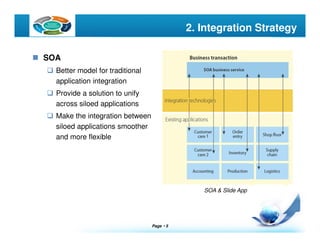
SOA
Better model for traditional
application integration
Provide a solution to unify
across siloed applications
Make the integration between
siloed applications smoother
and more flexible
SOA & Slide App
Page  6
LOGO 3. Business Process & System Integration
Stronger agility of business with process centric
A approach of integration to unify the transactions in a business service, streamline
business processes and mitigate duplicated data in order to strengthen business
agility.
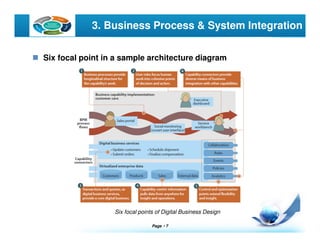
6 focal points for applications in business nowadays
1. Business processes
2. User roles
3. Business transactions and queries
4. Capability-centric information views
5. Business control, insight, and flexibility
6. Business capability connectors
Page  7
LOGO 3. Business Process & System Integration
Six focal point in a sample architecture diagram
Six focal points of Digital Business Design
Page  8
LOGO 3. Business Process & System Integration
Necessary features
SOA support
Modularization
Mobility
Certain wide-supportable integration
Collaboration
Sociality
Cloud-base and on-premised support
Page  9
LOGO 3. Business Process & System Integration
Technology concerns
Process flow decision points based on business rules or embedded
analytics
Complex event processing that encompasses activity flowing through
digital business services
SOA processing policies that are informed by embedded analytics
Page  10
LOGO 4. Applying Business Process Orientation
Objectives
Design first for business outcome
Revenue Generation & Cost Saving.
Business Agility & Time to Market.
Customer Retention and Loyalty.
Reusability
Mitigating investment in rewriting or purchasing software.
Leverage existing applications effectively rather than creating other
redundant applications.
Openness of Architecture
Ability of applications to adopt open standard and technology in a flexibility
and agility platform.
Agility
Scalability of technology and infrastructure
Adoptability of technology and infrastructure
Flexibility of technology and infrastructure
Page  11
LOGO 4. Applying Business Process Orientation
Reusability
Solutions for vintage and monolithic applications to achieve your
best business design
Subsume vintage UIs
Subsume vintage business logic
Subsume vintage data
Extract business events
Continue to directly access monolithic application Uis
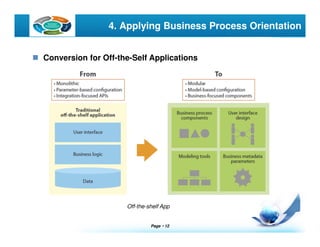
Off-the-self application conversion
Configurable, model-based processes and workflow
Built-in digital business services
Flexible UI tooling that supports role-based workspaces
Page  12
LOGO 4. Applying Business Process Orientation
Conversion for Off-the-Self Applications
Off-the-shelf App
Page  13
LOGO 4. Applying Business Process Orientation
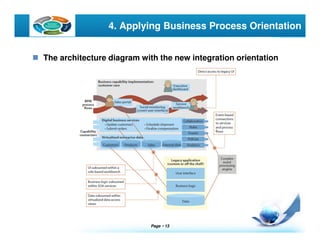
The architecture diagram with the new integration orientation
Page  14
LOGO 4. Applying Business Process Orientation
Openness of Architecture
Adopting open standards and technology to reduce dependency in
vendors and provide a flexible and agility platform.
Standardizing in-house software to adopt open standards.
Open system standards is an interface specification that describes
services provided by software. The most common one nowadays is the
SOA standard.
Page  15
LOGO
Agility
Building an architecture to adapt business process oriented. Which
includes separated layers, persistent layer, business logic layer, control
layer, process management layer and user interface layer.
Deploying EBS.
Standardizing connections.
Modifying current in-house systems to adopt SOA standard.
Upgrading off-the-self applications to adopt SOA standard.
Applying a reliable business process management suite to assure
performance between layers of the architecture.
4. Applying Business Process Orientation
Page  16
LOGO 5. BPMS in the market
BonitaSoft
Capable to apply the architecture mentioned above
BPM and embedded analytics
Provides a variety of system integration
SOA
Rapid process building tool - GUI for process design
Reduce coding/developing cost
Process simulator
Mobility, clouding support.
Capable to work with Red Hat Jboss, Sun Glassfish, IBM WebSphere
Application Server 8, Oracle WebLogic Server 11gR1, Apache Tomcat
6/7.
Page  17
LOGO 5. BPMS in the market
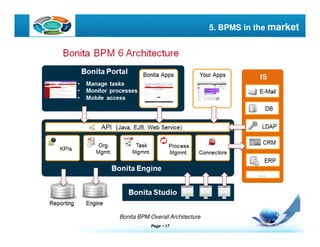
Bonita BPM Overall Architecture
Page  18
LOGO 5. BPMS in the market
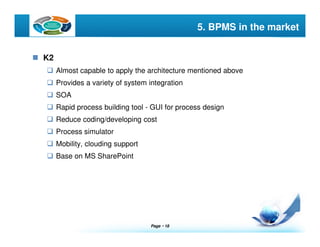
K2
Almost capable to apply the architecture mentioned above
Provides a variety of system integration
SOA
Rapid process building tool - GUI for process design
Reduce coding/developing cost
Process simulator
Mobility, clouding support
Base on MS SharePoint
Page  19
LOGO 5. BPMS in the market
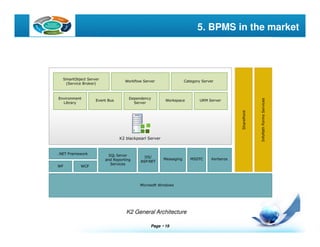
K2 General Architecture
Page  20
LOGO 5. BPMS in the market
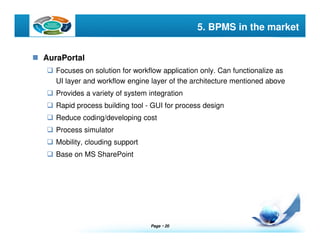
AuraPortal
Focuses on solution for workflow application only. Can functionalize as
UI layer and workflow engine layer of the architecture mentioned above
Provides a variety of system integration
Rapid process building tool - GUI for process design
Reduce coding/developing cost
Process simulator
Mobility, clouding support
Base on MS SharePoint
Page  21
LOGO 5. BPMS in the market
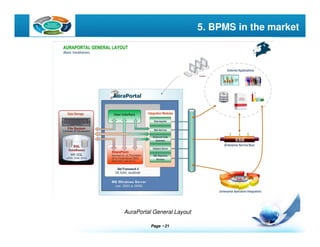
AuraPortal General Layout
Page  22
LOGO 5. BPMS in the market
Activiti
Focuses on building a core process management module
Capable to apply the architecture mentioned above as a process
management layer.
Have to integrate with other software to build other layers to get an
entire architecture.
Provides a variety of system integration
SOA
Mobility, clouding support
Capable to work with Red Hat Jboss, Apache Tomcat 6/7.
Page  23
LOGO 5. BPMS in the market
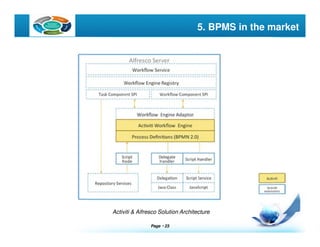
Activiti & Alfresco Solution Architecture
Page  24
LOGO 5. BPMS in the market
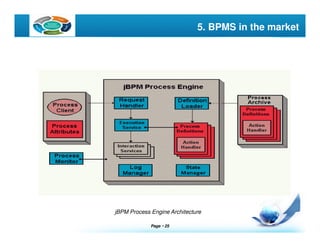
JBoss JBPM
Focus on building a core process management module. Only can take
functionalities of process management layer.
Have to integrate with other software to build other layers to get an
entire architecture.
Provides a variety of system integration
SOA
Mobility, clouding support
Capable to work with Red Hat JBoss, Apache Tomcat 6/7.
Page  25
LOGO 5. BPMS in the market
jBPM Process Engine Architecture
Page  26
LOGO 5. BPMS in the market
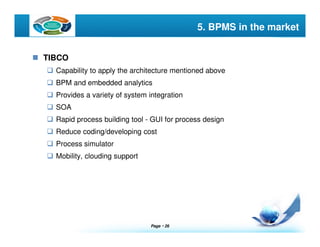
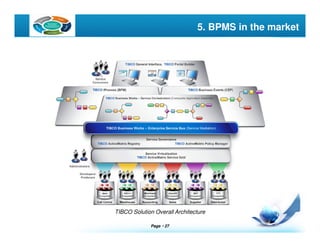
TIBCO
Capability to apply the architecture mentioned above
BPM and embedded analytics
Provides a variety of system integration
SOA
Rapid process building tool - GUI for process design
Reduce coding/developing cost
Process simulator
Mobility, clouding support
Page  27
LOGO 5. BPMS in the market
TIBCO Solution Overall Architecture
Page  28
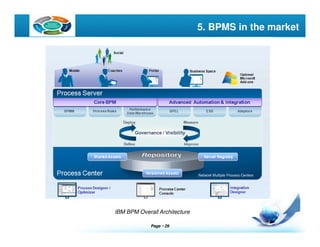
LOGO 5. BPMS in the market
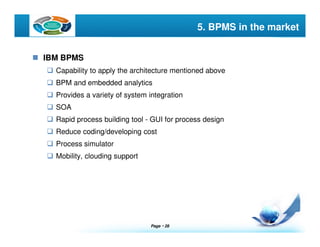
IBM BPMS
Capability to apply the architecture mentioned above
BPM and embedded analytics
Provides a variety of system integration
SOA
Rapid process building tool - GUI for process design
Reduce coding/developing cost
Process simulator
Mobility, clouding support
Page  29
LOGO 5. BPMS in the market
IBM BPM Overall Architecture
Page  30
LOGO 6. References
- Forester reports.
- Website & other referent sources from BonitaSoft.
- Website & other referent sources from K2.
- Website & other referent sources from AuraPortal.
- IBM’s website.
- TIPCO’s website.
- Activiti’s website.
31
Thank You

Business process & system integration v2

  • 1.
    由NordriDesign™提供 www.nordridesign.com Doan Trieu Duong Nov2014 Business Process & System Integration in a context of legacy systems
  • 2.
    Page  2 LOGOAgenda 1. Traditional Applications 2. Integration Strategy 3. Business Process & System Integration 4. Applying Business Process Orientation 5. BPMS in the market 6. References
  • 3.
    Page  3 LOGO1. Traditional Applications Helpful for 2 past decades Remaining in business and important parts of business Getting more pressure on business to be more agile Inadaptable the pace of market changes
  • 4.
    Page  4 LOGO2. Integration Strategy Traditional Integration Overview Connects data across applications directly. Same data exists in two or more siloed applications Traditional integration blocks Duplicated data in separated siloed applications. Multi integration technology for siloed applications. Traditional integration focuses on technology of integration and isolated data flows.
  • 5.
    Page  5 LOGO2. Integration Strategy SOA Better model for traditional application integration Provide a solution to unify across siloed applications Make the integration between siloed applications smoother and more flexible SOA & Slide App
  • 6.
    Page  6 LOGO3. Business Process & System Integration Stronger agility of business with process centric A approach of integration to unify the transactions in a business service, streamline business processes and mitigate duplicated data in order to strengthen business agility. 6 focal points for applications in business nowadays 1. Business processes 2. User roles 3. Business transactions and queries 4. Capability-centric information views 5. Business control, insight, and flexibility 6. Business capability connectors
  • 7.
    Page  7 LOGO3. Business Process & System Integration Six focal point in a sample architecture diagram Six focal points of Digital Business Design
  • 8.
    Page  8 LOGO3. Business Process & System Integration Necessary features SOA support Modularization Mobility Certain wide-supportable integration Collaboration Sociality Cloud-base and on-premised support
  • 9.
    Page  9 LOGO3. Business Process & System Integration Technology concerns Process flow decision points based on business rules or embedded analytics Complex event processing that encompasses activity flowing through digital business services SOA processing policies that are informed by embedded analytics
  • 10.
    Page  10 LOGO4. Applying Business Process Orientation Objectives Design first for business outcome Revenue Generation & Cost Saving. Business Agility & Time to Market. Customer Retention and Loyalty. Reusability Mitigating investment in rewriting or purchasing software. Leverage existing applications effectively rather than creating other redundant applications. Openness of Architecture Ability of applications to adopt open standard and technology in a flexibility and agility platform. Agility Scalability of technology and infrastructure Adoptability of technology and infrastructure Flexibility of technology and infrastructure
  • 11.
    Page  11 LOGO4. Applying Business Process Orientation Reusability Solutions for vintage and monolithic applications to achieve your best business design Subsume vintage UIs Subsume vintage business logic Subsume vintage data Extract business events Continue to directly access monolithic application Uis Off-the-self application conversion Configurable, model-based processes and workflow Built-in digital business services Flexible UI tooling that supports role-based workspaces
  • 12.
    Page  12 LOGO4. Applying Business Process Orientation Conversion for Off-the-Self Applications Off-the-shelf App
  • 13.
    Page  13 LOGO4. Applying Business Process Orientation The architecture diagram with the new integration orientation
  • 14.
    Page  14 LOGO4. Applying Business Process Orientation Openness of Architecture Adopting open standards and technology to reduce dependency in vendors and provide a flexible and agility platform. Standardizing in-house software to adopt open standards. Open system standards is an interface specification that describes services provided by software. The most common one nowadays is the SOA standard.
  • 15.
    Page  15 LOGO Agility Buildingan architecture to adapt business process oriented. Which includes separated layers, persistent layer, business logic layer, control layer, process management layer and user interface layer. Deploying EBS. Standardizing connections. Modifying current in-house systems to adopt SOA standard. Upgrading off-the-self applications to adopt SOA standard. Applying a reliable business process management suite to assure performance between layers of the architecture. 4. Applying Business Process Orientation
  • 16.
    Page  16 LOGO5. BPMS in the market BonitaSoft Capable to apply the architecture mentioned above BPM and embedded analytics Provides a variety of system integration SOA Rapid process building tool - GUI for process design Reduce coding/developing cost Process simulator Mobility, clouding support. Capable to work with Red Hat Jboss, Sun Glassfish, IBM WebSphere Application Server 8, Oracle WebLogic Server 11gR1, Apache Tomcat 6/7.
  • 17.
    Page  17 LOGO5. BPMS in the market Bonita BPM Overall Architecture
  • 18.
    Page  18 LOGO5. BPMS in the market K2 Almost capable to apply the architecture mentioned above Provides a variety of system integration SOA Rapid process building tool - GUI for process design Reduce coding/developing cost Process simulator Mobility, clouding support Base on MS SharePoint
  • 19.
    Page  19 LOGO5. BPMS in the market K2 General Architecture
  • 20.
    Page  20 LOGO5. BPMS in the market AuraPortal Focuses on solution for workflow application only. Can functionalize as UI layer and workflow engine layer of the architecture mentioned above Provides a variety of system integration Rapid process building tool - GUI for process design Reduce coding/developing cost Process simulator Mobility, clouding support Base on MS SharePoint
  • 21.
    Page  21 LOGO5. BPMS in the market AuraPortal General Layout
  • 22.
    Page  22 LOGO5. BPMS in the market Activiti Focuses on building a core process management module Capable to apply the architecture mentioned above as a process management layer. Have to integrate with other software to build other layers to get an entire architecture. Provides a variety of system integration SOA Mobility, clouding support Capable to work with Red Hat Jboss, Apache Tomcat 6/7.
  • 23.
    Page  23 LOGO5. BPMS in the market Activiti & Alfresco Solution Architecture
  • 24.
    Page  24 LOGO5. BPMS in the market JBoss JBPM Focus on building a core process management module. Only can take functionalities of process management layer. Have to integrate with other software to build other layers to get an entire architecture. Provides a variety of system integration SOA Mobility, clouding support Capable to work with Red Hat JBoss, Apache Tomcat 6/7.
  • 25.
    Page  25 LOGO5. BPMS in the market jBPM Process Engine Architecture
  • 26.
    Page  26 LOGO5. BPMS in the market TIBCO Capability to apply the architecture mentioned above BPM and embedded analytics Provides a variety of system integration SOA Rapid process building tool - GUI for process design Reduce coding/developing cost Process simulator Mobility, clouding support
  • 27.
    Page  27 LOGO5. BPMS in the market TIBCO Solution Overall Architecture
  • 28.
    Page  28 LOGO5. BPMS in the market IBM BPMS Capability to apply the architecture mentioned above BPM and embedded analytics Provides a variety of system integration SOA Rapid process building tool - GUI for process design Reduce coding/developing cost Process simulator Mobility, clouding support
  • 29.
    Page  29 LOGO5. BPMS in the market IBM BPM Overall Architecture
  • 30.
    Page  30 LOGO6. References - Forester reports. - Website & other referent sources from BonitaSoft. - Website & other referent sources from K2. - Website & other referent sources from AuraPortal. - IBM’s website. - TIPCO’s website. - Activiti’s website.
  • 31.