Business Process Analysis
to Simplify Trade Procedures
Tengfei Wang
Economic Affairs Officer, Trade Facilitation Unit
Trade, Investment and Innovation Division
United Nations Economic and Social Commission for Asia and the Pacific
wangt@un.org
National workshop on TTFMM, Suva, Fiji, 14 July 2016
Outline of presentation
1. What/Why?: Business Process Analysis to simplify trade
procedures
2. Graphical Notations: Unified Modeling Language (UML)
3. Scope setting
4. Planning
5. National Experiences
6. Summary & Conclusions
2
Session based on the UNNExT Business Process
Analysis Guide for the Simplification of Trade
Procedures (2010/12)
unnext.unescap.org
What is a Business Process?
• A Business Process is a collection of related and
structured activities or tasks that produce a
specific service or product.
• Examples
– Procedures (including document transactions) of importing
processed fruits to Kazakhstan from Kyrgyzstan
– Export Customs Declaration and Clearance Procedures
at the Border Point
– Applying & Issuing Process for a Certificate of Origin
(e.g. as needed to import goods to Azerbaijan)
– Applying & Issuing Process for a Phyto-sanitary Certificate
3
What is…
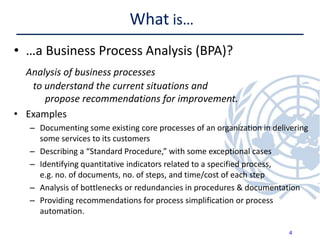
• …a Business Process Analysis (BPA)?
Analysis of business processes
to understand the current situations and
propose recommendations for improvement.
• Examples
– Documenting some existing core processes of an organization in delivering
some services to its customers
– Describing a “Standard Procedure,” with some exceptional cases
– Identifying quantitative indicators related to a specified process,
e.g. no. of documents, no. of steps, and time/cost of each step
– Analysis of bottlenecks or redundancies in procedures & documentation
– Providing recommendations for process simplification or process
automation.
4
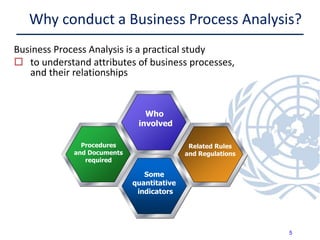
Why conduct a Business Process Analysis?
Business Process Analysis is a practical study
 to understand attributes of business processes,
and their relationships
Who
involved
Procedures
and Documents
required
Related Rules
and Regulations
Some
quantitative
indicators
5
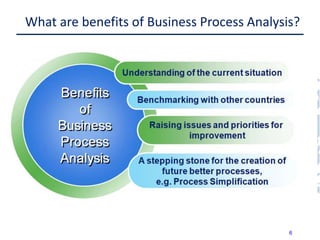
What are benefits of Business Process Analysis?
6
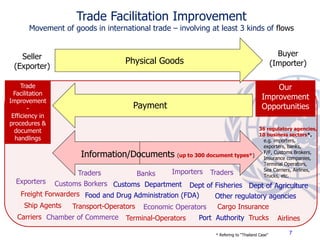
Trade Facilitation Improvement
Movement of goods in international trade – involving at least 3 kinds of flows
Seller
(Exporter)
Buyer
(Importer)Physical Goods
Payment
Information/Documents
Customs Department Dept of Agriculture
Ship Agents Transport-Operators
Terminal-OperatorsCarriers
Banks
Information/Documents (up to 300 document types*)
Freight Forwarders
Cargo Insurance
Traders
Exporters
Importers Traders
Economic Operators
Food and Drug Administration (FDA)
Chamber of Commerce
Our
Improvement
Opportunities
Trade
Facilitation
Improvement
-
Efficiency in
procedures &
document
handlings
Other regulatory agencies
Customs Borkers Dept of Fisheries
36 regulatory agencies,
10 business sectors*,
e.g. importers,
exporters, banks,
F/F, Customs Brokers,
Insurance companies,
Terminal Operators,
Sea Carriers, Airlines,
Trucks, etc.
* Refering to “Thailand Case”
AirlinesTrucksPort Authority
7
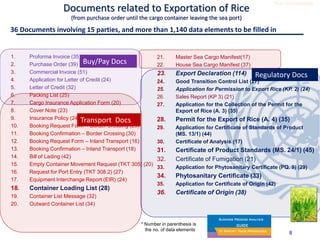
Documents related to Exportation of Rice
(from purchase order until the cargo container leaving the sea port)
21. Master Sea Cargo Manifest(17)
22. House Sea Cargo Manifest (37)
23. Export Declaration (114)
24. Good Transition Control List (27)
25. Application for Permission to Export Rice (KP. 2) (24)
26. Sales Report (KP 3) (21)
27. Application for the Collection of the Permit for the
Export of Rice (A. 3) (35)
28. Permit for the Export of Rice (A. 4) (35)
29. Application for Certificate of Standards of Product
(MS. 13/1) (44)
30. Certificate of Analysis (17)
31. Certificate of Product Standards (MS. 24/1) (45)
32. Certificate of Fumigation (21)
33. Application for Phytosanitary Certificate (PQ. 9) (29)
34. Phytosanitary Certificate (33)
35. Application for Certificate of Origin (42)
36. Certificate of Origin (38)
1. Proforma Invoice (35)
2. Purchase Order (39)
3. Commercial Invoice (51)
4. Application for Letter of Credit (24)
5. Letter of Credit (32)
6. Packing List (25)
7. Cargo Insurance Application Form (20)
8. Cover Note (23)
9. Insurance Policy (24)
10. Booking Request Form – Border Crossing (25)
11. Booking Confirmation – Border Crossing (30)
12. Booking Request Form – Inland Transport (16)
13. Booking Confirmation – Inland Transport (18)
14. Bill of Lading (42)
15. Empty Container Movement Request (TKT 305) (20)
16. Request for Port Entry (TKT 308.2) (27)
17. Equipment Interchange Report (EIR) (24)
18. Container Loading List (28)
19. Container List Message (32)
20. Outward Container List (34)
* Number in parenthesis is
the no. of data elements
36 Documents involving 15 parties, and more than 1,140 data elements to be filled in
Thai Case Example
Regulatory Docs
Transport Docs
Buy/Pay Docs
8
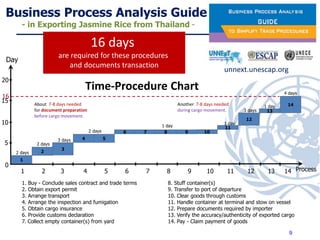
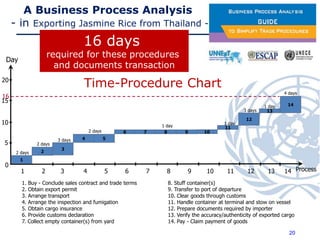
Business Process Analysis Guide
- in Exporting Jasmine Rice from Thailand -
1. Buy - Conclude sales contract and trade terms
2. Obtain export permit
3. Arrange transport
4. Arrange the inspection and fumigation
5. Obtain cargo insurance
6. Provide customs declaration
7. Collect empty container(s) from yard
8. Stuff container(s)
9. Transfer to port of departure
10. Clear goods through customs
11. Handle container at terminal and stow on vessel
12. Prepare documents required by importer
13. Verify the accuracy/authenticity of exported cargo
14. Pay - Claim payment of goods
1 2 3 4 5 6 7 8 9 10 11 12 13 14
Day
Process
20
10
0
5
15
3 days
2 days
3 days
4 days
1 day
1
3
5
6 7 8 9
12
14
2
2 days
4
2 days 10
1 day
13
1 day
16
11
Time-Procedure Chart
16 days
are required for these procedures
and documents transaction
About 7-8 days needed
for document preparation
before cargo movement.
Another 7-8 days needed
during cargo movement.
unnext.unescap.org
9
e-Single Window
and paperless
trading
National Data Harmonization
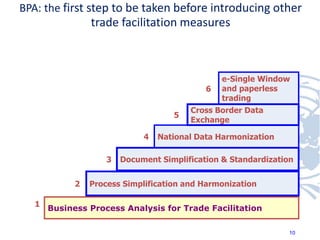
BPA: the first step to be taken before introducing other
trade facilitation measures
Document Simplification & Standardization
Cross Border Data
Exchange
Business Process Analysis for Trade Facilitation
1
6
5
3
2
4
Process Simplification and Harmonization
10
Outline of presentation
1. What/Why?: Business Process Analysis to simplify trade
procedures
2. Graphical Notations: Unified Modeling Language (UML)
3. Scope setting
4. Planning
5. National Experiences
6. Summary & Conclusions
11
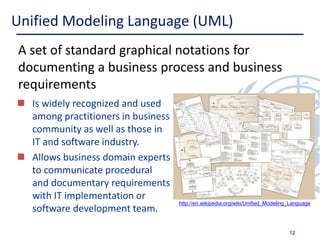
Unified Modeling Language (UML)
A set of standard graphical notations for
documenting a business process and business
requirements
http://en.wikipedia.org/wiki/Unified_Modeling_Language
 Is widely recognized and used
among practitioners in business
community as well as those in
IT and software industry.
 Allows business domain experts
to communicate procedural
and documentary requirements
with IT implementation or
software development team.
12
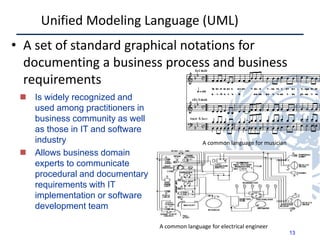
Unified Modeling Language (UML)
• A set of standard graphical notations for
documenting a business process and business
requirements
 Is widely recognized and
used among practitioners in
business community as well
as those in IT and software
industry
 Allows business domain
experts to communicate
procedural and documentary
requirements with IT
implementation or software
development team
A common language for electrical engineer
A common language for musician
13
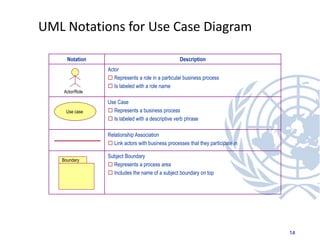
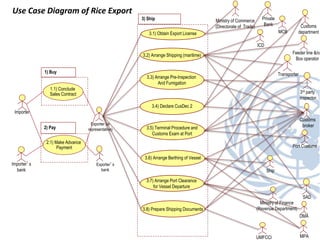
UML Notations for Use Case Diagram
Notation Description
Actor
 Represents a role in a particular business process
 Is labeled with a role name
Use Case
 Represents a business process
 Is labeled with a descriptive verb phrase
Relationship Association
 Link actors with business processes that they participate in
Subject Boundary
 Represents a process area
 Includes the name of a subject boundary on top
Boundary
Actor/Role
Use case
14
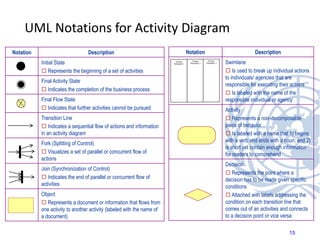
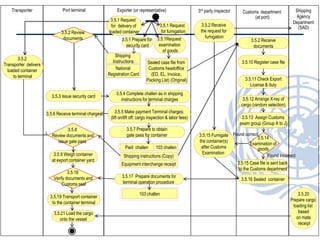
UML Notations for Activity Diagram
Notation Description
Initial State
 Represents the beginning of a set of activities
Final Activity State
 Indicates the completion of the business process
Final Flow State
 Indicates that further activities cannot be pursued
Transition Line
 Indicates a sequential flow of actions and information
in an activity diagram
Fork (Splitting of Control)
 Visualizes a set of parallel or concurrent flow of
actions
Join (Synchronization of Control)
 Indicates the end of parallel or concurrent flow of
activities
Object
 Represents a document or information that flows from
one activity to another activity (labeled with the name of
a document)
Notation Description
Swimlane
 Is used to break up individual actions
to individuals/ agencies that are
responsible for executing their actions
 Is labeled with the name of the
responsible individual or agency
Activity
 Represents a non-decomposable
piece of behavior
 Is labeled with a name that 1) begins
with a verb and ends with a noun; and 2)
is short yet contain enough information
for readers to comprehend
Decision
 Represents the point where a
decision has to be made given specific
conditions
 Attached with labels addressing the
condition on each transition line that
comes out of an activities and connects
to a decision point or vice versa
Process
Participant 1
Process
Participant 2
Process
Participant n
15
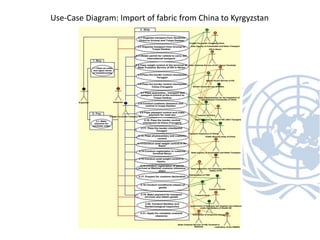
Use-Case Diagram: Import of fabric from China to Kyrgyzstan
1.1) Conclude
Sales Contract
2.1) Make Advance
Payment
3.1) Obtain Export License
3.5) Terminal Procedure and
Customs Exam at Port
Exporter (or
representative)
Importer
Exporter’s
bank
Importer’s
bank
ICD
SAD
Ministry of Commerce
(Directorate of Trade)
Customs
broker
3) Ship
3.8) Prepare Shipping Documents
1) Buy
2) Pay
Use Case Diagram of Rice Export
Customs
department
Ministry of Finance
(Revenue Department)
Feeder line &/or
Box operator
3.7) Arrange Port Clearance
for Vessel Departure
3.4) Declare CusDec 2
3.2) Arrange Shipping (maritime)
3.3) Arrange Pre-Inspection
And Fumigation
3.6) Arrange Berthing of Vessel
Private
Bank
Transporter
UMFCCI
DMA
MPA
Port Customs
Ship
3rd party
inspector
MCB
Customs department
(at port)
Exporter (or representative)
3.5.1Request
examination
of goods
3.5.19 Transport container
to the container terminal
Found Incorrect
3rd party inspector
Found correct
3.5.10 Register case file
3.5.12 Arrange X-ray of
cargo (random selection)
3.5.2 Receive
documents
3.5.11 Check Export
License & duty
3.5.15 Fumigate
the container(s)
after Customs
Examination
3.5.1 Request
for fumigation
3.5.2 Receive
the request for
fumigation
Port terminal
3.5.1 Request
for delivery of
loaded container
Transporter
3.5.2
Transporter delivers
loaded container
to terminal
3.5.3 Issue security card
3.5.1 Prepare for
security card
3.5.6 Receive terminal charges
3.5.16 Sealed container
3.5.13 Assign Customs
exam group (Group A to J)
3.5.14
Examination of
goods
Shipping
Instructions
3.5.21 Load the cargo
onto the vessel
3.5.5 Make payment Terminal charges;
(lift on/lift off; cargo inspection & labor fees)
National
Registration Card
3.5.7 Prepare to obtain
gate pass for container
Paid challen 103 challen
Equipment interchange receipt
Shipping instructions (Copy)
3.5.8
Review documents and
issue gate pass
3.5.9 Weigh container
at export container yard
3.5.17 Prepare documents for
terminal operation procedure
103 challen
3.5.18
Verify documents and
Customs seal
3.5.2 Review
documents
3.5.4 Complete challen as in shipping
instructions for terminal charges
Sealed case file from
Customs headoffice
(ED, EL, Invoice,
Packing List) (Original)
Shipping
Agency
Department
(SAD)
3.5.20
Prepare cargo
loading list
based
on mate
receipt
3.5.15 Case file is sent back
to the Customs department
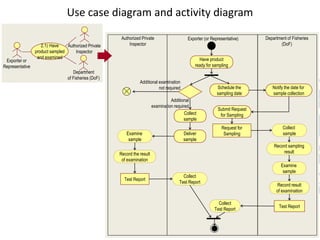
Use case diagram and activity diagram
Exporter (or Representative) Department of Fisheries
(DoF)
Authorized Private
Inspector2.1) Have
product sampled
and examined
Exporter or
Representative
Department
of Fisheries (DoF)
Authorized Private
Inspector
Collect
sample
Examine
sample
Record the result
of examination
Test Report
Deliver
sample
Collect
Test Report
Additional
examination required
Additional examination
not required Schedule the
sampling date
Record result
of examination
Examine
sample
Collect
Test Report
Test Report
Have product
ready for sampling
Notify the date for
sample collection
Submit Request
for Sampling
Record sampling
result
Request for
Sampling
Collect
sample
A Business Process Analysis
- in Exporting Jasmine Rice from Thailand -
1. Buy - Conclude sales contract and trade terms
2. Obtain export permit
3. Arrange transport
4. Arrange the inspection and fumigation
5. Obtain cargo insurance
6. Provide customs declaration
7. Collect empty container(s) from yard
8. Stuff container(s)
9. Transfer to port of departure
10. Clear goods through customs
11. Handle container at terminal and stow on vessel
12. Prepare documents required by importer
13. Verify the accuracy/authenticity of exported cargo
14. Pay - Claim payment of goods
1 2 3 4 5 6 7 8 9 10 11 12 13 14
Day
Process
20
10
0
5
15
3 days
2 days
3 days
4 days
1 day
1
3
5
6 7 8 9
12
14
2
2 days
4
2 days 10
1 day
13
1 day
16
11
Time-Procedure Chart
16 days
required for these procedures
and documents transaction
20
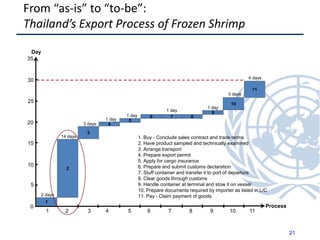
From “as-is” to “to-be”:
Thailand’s Export Process of Frozen Shrimp
1 2 3 4 5 6 7 8 9 10 11
Day
Process
30
20
10
0
5
25
15
35
14 days
3 days
2 days
1 day
3 days
4 days
1 day
1
2
4
3
5
6 7 8
9
10
11
1 day
1 day
1. Buy - Conclude sales contract and trade terms
2. Have product sampled and technically examined
3. Arrange transport
4. Prepare export permit
5. Apply for cargo insurance
6. Prepare and submit customs declaration
7. Stuff container and transfer it to port of departure
8. Clear goods through customs
9. Handle container at terminal and stow it on vessel
10. Prepare documents required by importer as listed in L/C
11. Pay - Claim payment of goods
21
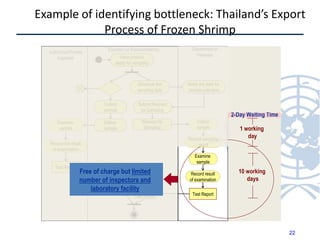
2-Day Waiting Time
Example of identifying bottleneck: Thailand’s Export
Process of Frozen Shrimp
Exporter (or Representative) Department of
FisheriesHave product
ready for sampling
Submit Request
for Sampling
Notify the date for
sample collection
Authorized Private
Inspector
Collect
sample
Schedule the
sampling date
Examine
sample
Record the result
of examination
Test Report
Deliver
sample
Collect
Test Report
Record result
of examination
Collect
sample
Record sampling
result
Examine
sample
Collect
Test Report
Test Report
Request for
Sampling
10 working
days
1 working
day
1 working
day
Free of charge but limited
number of inspectors and
laboratory facility
22
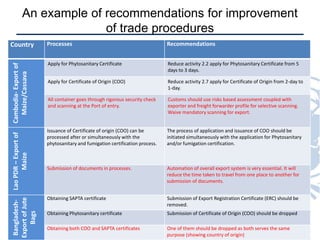
An example of recommendations for improvement
of trade procedures
Country Processes Recommendations
Cambodia-Exportof
Maize/Cassava
Apply for Phytosanitary Certificate Reduce activity 2.2 apply for Phytosanitary Certificate from 5
days to 3 days.
Apply for Certificate of Origin (COO) Reduce activity 2.7 apply for Certificate of Origin from 2-day to
1-day.
All container goes through rigorous security check
and scanning at the Port of entry.
Customs should use risks based assessment coupled with
exporter and freight forwarder profile for selective scanning.
Waive mandatory scanning for export.
LaoPDR–Exportof
Maize
Issuance of Certificate of origin (COO) can be
processed after or simultaneously with the
phytosanitary and fumigation certification process.
The process of application and issuance of COO should be
initiated simultaneously with the application for Phytosanitary
and/or fumigation certification.
Submission of documents in processes. Automation of overall export system is very essential. It will
reduce the time taken to travel from one place to another for
submission of documents.
Bangladesh-
ExportofJute
Bags
Obtaining SAPTA certificate Submission of Export Registration Certificate (ERC) should be
removed.
Obtaining Phytosanitary certificate Submission of Certificate of Origin (COO) should be dropped
Obtaining both COO and SAPTA certificates One of them should be dropped as both serves the same
purpose (showing country of origin)
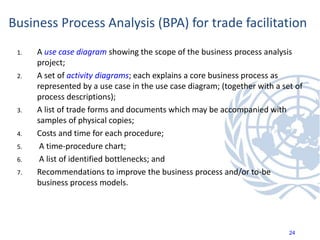
Business Process Analysis (BPA) for trade facilitation
1. A use case diagram showing the scope of the business process analysis
project;
2. A set of activity diagrams; each explains a core business process as
represented by a use case in the use case diagram; (together with a set of
process descriptions);
3. A list of trade forms and documents which may be accompanied with
samples of physical copies;
4. Costs and time for each procedure;
5. A time-procedure chart;
6. A list of identified bottlenecks; and
7. Recommendations to improve the business process and/or to-be
business process models.
24
Outline of presentation
1. What/Why?: Business Process Analysis to simplify trade
procedures
2. Graphical Notations: Unified Modeling Language (UML)
3. Scope setting
4. Planning
5. National Experiences
6. Summary & Conclusions
25
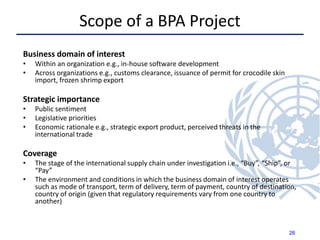
Scope of a BPA Project
Business domain of interest
• Within an organization e.g., in-house software development
• Across organizations e.g., customs clearance, issuance of permit for crocodile skin
import, frozen shrimp export
Strategic importance
• Public sentiment
• Legislative priorities
• Economic rationale e.g., strategic export product, perceived threats in the
international trade
Coverage
• The stage of the international supply chain under investigation i.e., “Buy”, “Ship”, or
“Pay”
• The environment and conditions in which the business domain of interest operates
such as mode of transport, term of delivery, term of payment, country of destination,
country of origin (given that regulatory requirements vary from one country to
another)
26
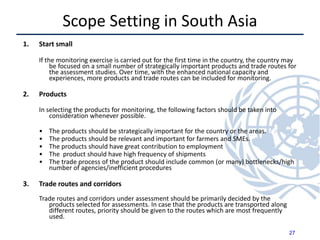
Scope Setting in South Asia
1. Start small
If the monitoring exercise is carried out for the first time in the country, the country may
be focused on a small number of strategically important products and trade routes for
the assessment studies. Over time, with the enhanced national capacity and
experiences, more products and trade routes can be included for monitoring.
2. Products
In selecting the products for monitoring, the following factors should be taken into
consideration whenever possible.
• The products should be strategically important for the country or the areas.
• The products should be relevant and important for farmers and SMEs.
• The products should have great contribution to employment
• The product should have high frequency of shipments
• The trade process of the product should include common (or many) bottlenecks/high
number of agencies/inefficient procedures
3. Trade routes and corridors
Trade routes and corridors under assessment should be primarily decided by the
products selected for assessments. In case that the products are transported along
different routes, priority should be given to the routes which are most frequently
used.
27
Outline of presentation
1. What/Why?: Business Process Analysis to simplify trade
procedures
2. Graphical Notations: Unified Modeling Language (UML)
3. Scope setting
4. Planning
5. National Experiences
6. Summary & Conclusions
28
29
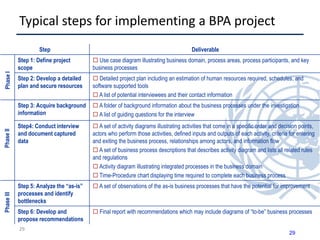
Typical steps for implementing a BPA project
Step Deliverable
Step 1: Define project
scope
 Use case diagram illustrating business domain, process areas, process participants, and key
business processes
Step 2: Develop a detailed
plan and secure resources
 Detailed project plan including an estimation of human resources required, schedules, and
software supported tools
 A list of potential interviewees and their contact information
Step 3: Acquire background
information
 A folder of background information about the business processes under the investigation
 A list of guiding questions for the interview
Step4: Conduct interview
and document captured
data
 A set of activity diagrams illustrating activities that come in a specific order and decision points,
actors who perform those activities, defined inputs and outputs of each activity, criteria for entering
and exiting the business process, relationships among actors, and information flow
 A set of business process descriptions that describes activity diagram and lists all related rules
and regulations
 Activity diagram illustrating integrated processes in the business domain
 Time-Procedure chart displaying time required to complete each business process
Step 5: Analyze the “as-is”
processes and identify
bottlenecks
 A set of observations of the as-is business processes that have the potential for improvement
Step 6: Develop and
propose recommendations
 Final report with recommendations which may include diagrams of “to-be” business processes
PhaseIPhaseIIPhaseIII
29
Outline of presentation
1. What/Why?: Business Process Analysis to simplify trade
procedures
2. Graphical Notations: Unified Modeling Language (UML)
3. Scope setting
4. Planning
5. National Experiences
6. Summary & Conclusions
30
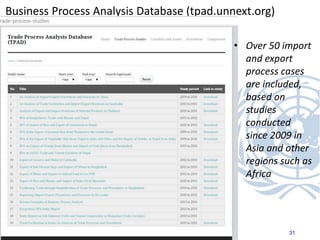
Business Process Analysis Database (tpad.unnext.org)
• Over 50 import
and export
process cases
are included,
based on
studies
conducted
since 2009 in
Asia and other
regions such as
Africa
31
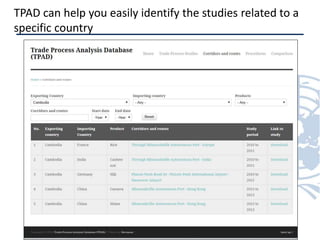
TPAD can help you easily identify the studies related to a
specific country
• Data typically available for each trade
process case, includes
– number of steps/procedures involved,
– stakeholders involved,
– number and type of documents,
– activity diagrams,
– time and cost of the procedures, as
well as
– time-procedure chart.
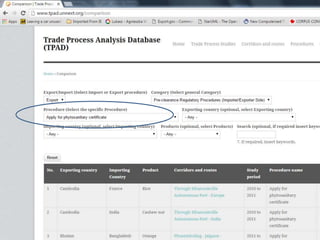
• Enables TF practitioners to compare
procedures across countries as a
basis for making improvement
Trade Process Analysis Database
tpad.unnext.org
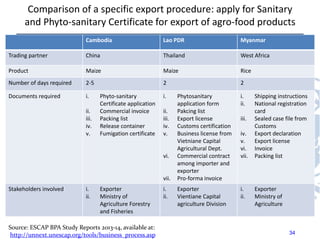
Comparison of a specific export procedure: apply for Sanitary
and Phyto-sanitary Certificate for export of agro-food products
Cambodia Lao PDR Myanmar
Trading partner China Thailand West Africa
Product Maize Maize Rice
Number of days required 2-5 2 2
Documents required i. Phyto-sanitary
Certificate application
ii. Commercial invoice
iii. Packing list
iv. Release container
v. Fumigation certificate
i. Phytosanitary
application form
ii. Pakcing list
iii. Export license
iv. Customs certification
v. Business license from
Vietniane Capital
Agricultural Dept.
vi. Commercial contract
among importer and
exporter
vii. Pro-forma invoice
i. Shipping instructions
ii. National registration
card
iii. Sealed case file from
Customs
iv. Export declaration
v. Export license
vi. Invoice
vii. Packing list
Stakeholders involved i. Exporter
ii. Ministry of
Agriculture Forestry
and Fisheries
i. Exporter
ii. Vientiane Capital
agriculture Division
i. Exporter
ii. Ministry of
Agriculture
Source: ESCAP BPA Study Reports 2013-14, available at:
http://unnext.unescap.org/tools/business_process.asp 34
Benefits of the BPA studies: An example in Cambodia
• Output of BPA projects in Cambodia was
instrumental in raising awareness and building
political will for on-going trade facilitation
reform
• The outcome of the studies provided direct
feedback for senior policy makers to effect
trade facilitation reform, which, in turn,
decreased the costs of rice exports
Source: http://tfig.unece.org/cases/Cambodia.pdf
35
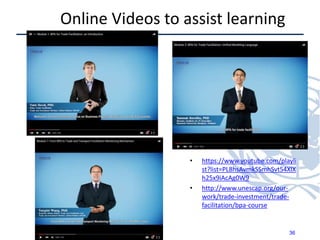
Online Videos to assist learning
• https://www.youtube.com/playli
st?list=PL8hsAvmkSSmhSvt54XlX
h25x9iAcAg0W9
• http://www.unescap.org/our-
work/trade-investment/trade-
facilitation/bpa-course
36
Summary: Key considerations for Implementing BPA
• Get Buy-in from policy makers and
government officials
• Secure Adequate resources
• Define Clear Roles and responsibilities of the
project stakeholders
• Institutional arrangement
• Start Small, and then Evolve
• Invest in Training and capacity building
37
Thank you
http://www.unescap.org/
http://www.unescap.org/our-work/trade-
investment-innovation
unnext.unescap.org
Email: wangt@un.org
38

Business Process Analysis to Simplify Trade Procedures

  • 1.
    Business Process Analysis toSimplify Trade Procedures Tengfei Wang Economic Affairs Officer, Trade Facilitation Unit Trade, Investment and Innovation Division United Nations Economic and Social Commission for Asia and the Pacific wangt@un.org National workshop on TTFMM, Suva, Fiji, 14 July 2016
  • 2.
    Outline of presentation 1.What/Why?: Business Process Analysis to simplify trade procedures 2. Graphical Notations: Unified Modeling Language (UML) 3. Scope setting 4. Planning 5. National Experiences 6. Summary & Conclusions 2 Session based on the UNNExT Business Process Analysis Guide for the Simplification of Trade Procedures (2010/12) unnext.unescap.org
  • 3.
    What is aBusiness Process? • A Business Process is a collection of related and structured activities or tasks that produce a specific service or product. • Examples – Procedures (including document transactions) of importing processed fruits to Kazakhstan from Kyrgyzstan – Export Customs Declaration and Clearance Procedures at the Border Point – Applying & Issuing Process for a Certificate of Origin (e.g. as needed to import goods to Azerbaijan) – Applying & Issuing Process for a Phyto-sanitary Certificate 3
  • 4.
    What is… • …aBusiness Process Analysis (BPA)? Analysis of business processes to understand the current situations and propose recommendations for improvement. • Examples – Documenting some existing core processes of an organization in delivering some services to its customers – Describing a “Standard Procedure,” with some exceptional cases – Identifying quantitative indicators related to a specified process, e.g. no. of documents, no. of steps, and time/cost of each step – Analysis of bottlenecks or redundancies in procedures & documentation – Providing recommendations for process simplification or process automation. 4
  • 5.
    Why conduct aBusiness Process Analysis? Business Process Analysis is a practical study  to understand attributes of business processes, and their relationships Who involved Procedures and Documents required Related Rules and Regulations Some quantitative indicators 5
  • 6.
    What are benefitsof Business Process Analysis? 6
  • 7.
    Trade Facilitation Improvement Movementof goods in international trade – involving at least 3 kinds of flows Seller (Exporter) Buyer (Importer)Physical Goods Payment Information/Documents Customs Department Dept of Agriculture Ship Agents Transport-Operators Terminal-OperatorsCarriers Banks Information/Documents (up to 300 document types*) Freight Forwarders Cargo Insurance Traders Exporters Importers Traders Economic Operators Food and Drug Administration (FDA) Chamber of Commerce Our Improvement Opportunities Trade Facilitation Improvement - Efficiency in procedures & document handlings Other regulatory agencies Customs Borkers Dept of Fisheries 36 regulatory agencies, 10 business sectors*, e.g. importers, exporters, banks, F/F, Customs Brokers, Insurance companies, Terminal Operators, Sea Carriers, Airlines, Trucks, etc. * Refering to “Thailand Case” AirlinesTrucksPort Authority 7
  • 8.
    Documents related toExportation of Rice (from purchase order until the cargo container leaving the sea port) 21. Master Sea Cargo Manifest(17) 22. House Sea Cargo Manifest (37) 23. Export Declaration (114) 24. Good Transition Control List (27) 25. Application for Permission to Export Rice (KP. 2) (24) 26. Sales Report (KP 3) (21) 27. Application for the Collection of the Permit for the Export of Rice (A. 3) (35) 28. Permit for the Export of Rice (A. 4) (35) 29. Application for Certificate of Standards of Product (MS. 13/1) (44) 30. Certificate of Analysis (17) 31. Certificate of Product Standards (MS. 24/1) (45) 32. Certificate of Fumigation (21) 33. Application for Phytosanitary Certificate (PQ. 9) (29) 34. Phytosanitary Certificate (33) 35. Application for Certificate of Origin (42) 36. Certificate of Origin (38) 1. Proforma Invoice (35) 2. Purchase Order (39) 3. Commercial Invoice (51) 4. Application for Letter of Credit (24) 5. Letter of Credit (32) 6. Packing List (25) 7. Cargo Insurance Application Form (20) 8. Cover Note (23) 9. Insurance Policy (24) 10. Booking Request Form – Border Crossing (25) 11. Booking Confirmation – Border Crossing (30) 12. Booking Request Form – Inland Transport (16) 13. Booking Confirmation – Inland Transport (18) 14. Bill of Lading (42) 15. Empty Container Movement Request (TKT 305) (20) 16. Request for Port Entry (TKT 308.2) (27) 17. Equipment Interchange Report (EIR) (24) 18. Container Loading List (28) 19. Container List Message (32) 20. Outward Container List (34) * Number in parenthesis is the no. of data elements 36 Documents involving 15 parties, and more than 1,140 data elements to be filled in Thai Case Example Regulatory Docs Transport Docs Buy/Pay Docs 8
  • 9.
    Business Process AnalysisGuide - in Exporting Jasmine Rice from Thailand - 1. Buy - Conclude sales contract and trade terms 2. Obtain export permit 3. Arrange transport 4. Arrange the inspection and fumigation 5. Obtain cargo insurance 6. Provide customs declaration 7. Collect empty container(s) from yard 8. Stuff container(s) 9. Transfer to port of departure 10. Clear goods through customs 11. Handle container at terminal and stow on vessel 12. Prepare documents required by importer 13. Verify the accuracy/authenticity of exported cargo 14. Pay - Claim payment of goods 1 2 3 4 5 6 7 8 9 10 11 12 13 14 Day Process 20 10 0 5 15 3 days 2 days 3 days 4 days 1 day 1 3 5 6 7 8 9 12 14 2 2 days 4 2 days 10 1 day 13 1 day 16 11 Time-Procedure Chart 16 days are required for these procedures and documents transaction About 7-8 days needed for document preparation before cargo movement. Another 7-8 days needed during cargo movement. unnext.unescap.org 9
  • 10.
    e-Single Window and paperless trading NationalData Harmonization BPA: the first step to be taken before introducing other trade facilitation measures Document Simplification & Standardization Cross Border Data Exchange Business Process Analysis for Trade Facilitation 1 6 5 3 2 4 Process Simplification and Harmonization 10
  • 11.
    Outline of presentation 1.What/Why?: Business Process Analysis to simplify trade procedures 2. Graphical Notations: Unified Modeling Language (UML) 3. Scope setting 4. Planning 5. National Experiences 6. Summary & Conclusions 11
  • 12.
    Unified Modeling Language(UML) A set of standard graphical notations for documenting a business process and business requirements http://en.wikipedia.org/wiki/Unified_Modeling_Language  Is widely recognized and used among practitioners in business community as well as those in IT and software industry.  Allows business domain experts to communicate procedural and documentary requirements with IT implementation or software development team. 12
  • 13.
    Unified Modeling Language(UML) • A set of standard graphical notations for documenting a business process and business requirements  Is widely recognized and used among practitioners in business community as well as those in IT and software industry  Allows business domain experts to communicate procedural and documentary requirements with IT implementation or software development team A common language for electrical engineer A common language for musician 13
  • 14.
    UML Notations forUse Case Diagram Notation Description Actor  Represents a role in a particular business process  Is labeled with a role name Use Case  Represents a business process  Is labeled with a descriptive verb phrase Relationship Association  Link actors with business processes that they participate in Subject Boundary  Represents a process area  Includes the name of a subject boundary on top Boundary Actor/Role Use case 14
  • 15.
    UML Notations forActivity Diagram Notation Description Initial State  Represents the beginning of a set of activities Final Activity State  Indicates the completion of the business process Final Flow State  Indicates that further activities cannot be pursued Transition Line  Indicates a sequential flow of actions and information in an activity diagram Fork (Splitting of Control)  Visualizes a set of parallel or concurrent flow of actions Join (Synchronization of Control)  Indicates the end of parallel or concurrent flow of activities Object  Represents a document or information that flows from one activity to another activity (labeled with the name of a document) Notation Description Swimlane  Is used to break up individual actions to individuals/ agencies that are responsible for executing their actions  Is labeled with the name of the responsible individual or agency Activity  Represents a non-decomposable piece of behavior  Is labeled with a name that 1) begins with a verb and ends with a noun; and 2) is short yet contain enough information for readers to comprehend Decision  Represents the point where a decision has to be made given specific conditions  Attached with labels addressing the condition on each transition line that comes out of an activities and connects to a decision point or vice versa Process Participant 1 Process Participant 2 Process Participant n 15
  • 16.
    Use-Case Diagram: Importof fabric from China to Kyrgyzstan
  • 17.
    1.1) Conclude Sales Contract 2.1)Make Advance Payment 3.1) Obtain Export License 3.5) Terminal Procedure and Customs Exam at Port Exporter (or representative) Importer Exporter’s bank Importer’s bank ICD SAD Ministry of Commerce (Directorate of Trade) Customs broker 3) Ship 3.8) Prepare Shipping Documents 1) Buy 2) Pay Use Case Diagram of Rice Export Customs department Ministry of Finance (Revenue Department) Feeder line &/or Box operator 3.7) Arrange Port Clearance for Vessel Departure 3.4) Declare CusDec 2 3.2) Arrange Shipping (maritime) 3.3) Arrange Pre-Inspection And Fumigation 3.6) Arrange Berthing of Vessel Private Bank Transporter UMFCCI DMA MPA Port Customs Ship 3rd party inspector MCB
  • 18.
    Customs department (at port) Exporter(or representative) 3.5.1Request examination of goods 3.5.19 Transport container to the container terminal Found Incorrect 3rd party inspector Found correct 3.5.10 Register case file 3.5.12 Arrange X-ray of cargo (random selection) 3.5.2 Receive documents 3.5.11 Check Export License & duty 3.5.15 Fumigate the container(s) after Customs Examination 3.5.1 Request for fumigation 3.5.2 Receive the request for fumigation Port terminal 3.5.1 Request for delivery of loaded container Transporter 3.5.2 Transporter delivers loaded container to terminal 3.5.3 Issue security card 3.5.1 Prepare for security card 3.5.6 Receive terminal charges 3.5.16 Sealed container 3.5.13 Assign Customs exam group (Group A to J) 3.5.14 Examination of goods Shipping Instructions 3.5.21 Load the cargo onto the vessel 3.5.5 Make payment Terminal charges; (lift on/lift off; cargo inspection & labor fees) National Registration Card 3.5.7 Prepare to obtain gate pass for container Paid challen 103 challen Equipment interchange receipt Shipping instructions (Copy) 3.5.8 Review documents and issue gate pass 3.5.9 Weigh container at export container yard 3.5.17 Prepare documents for terminal operation procedure 103 challen 3.5.18 Verify documents and Customs seal 3.5.2 Review documents 3.5.4 Complete challen as in shipping instructions for terminal charges Sealed case file from Customs headoffice (ED, EL, Invoice, Packing List) (Original) Shipping Agency Department (SAD) 3.5.20 Prepare cargo loading list based on mate receipt 3.5.15 Case file is sent back to the Customs department
  • 19.
    Use case diagramand activity diagram Exporter (or Representative) Department of Fisheries (DoF) Authorized Private Inspector2.1) Have product sampled and examined Exporter or Representative Department of Fisheries (DoF) Authorized Private Inspector Collect sample Examine sample Record the result of examination Test Report Deliver sample Collect Test Report Additional examination required Additional examination not required Schedule the sampling date Record result of examination Examine sample Collect Test Report Test Report Have product ready for sampling Notify the date for sample collection Submit Request for Sampling Record sampling result Request for Sampling Collect sample
  • 20.
    A Business ProcessAnalysis - in Exporting Jasmine Rice from Thailand - 1. Buy - Conclude sales contract and trade terms 2. Obtain export permit 3. Arrange transport 4. Arrange the inspection and fumigation 5. Obtain cargo insurance 6. Provide customs declaration 7. Collect empty container(s) from yard 8. Stuff container(s) 9. Transfer to port of departure 10. Clear goods through customs 11. Handle container at terminal and stow on vessel 12. Prepare documents required by importer 13. Verify the accuracy/authenticity of exported cargo 14. Pay - Claim payment of goods 1 2 3 4 5 6 7 8 9 10 11 12 13 14 Day Process 20 10 0 5 15 3 days 2 days 3 days 4 days 1 day 1 3 5 6 7 8 9 12 14 2 2 days 4 2 days 10 1 day 13 1 day 16 11 Time-Procedure Chart 16 days required for these procedures and documents transaction 20
  • 21.
    From “as-is” to“to-be”: Thailand’s Export Process of Frozen Shrimp 1 2 3 4 5 6 7 8 9 10 11 Day Process 30 20 10 0 5 25 15 35 14 days 3 days 2 days 1 day 3 days 4 days 1 day 1 2 4 3 5 6 7 8 9 10 11 1 day 1 day 1. Buy - Conclude sales contract and trade terms 2. Have product sampled and technically examined 3. Arrange transport 4. Prepare export permit 5. Apply for cargo insurance 6. Prepare and submit customs declaration 7. Stuff container and transfer it to port of departure 8. Clear goods through customs 9. Handle container at terminal and stow it on vessel 10. Prepare documents required by importer as listed in L/C 11. Pay - Claim payment of goods 21
  • 22.
    2-Day Waiting Time Exampleof identifying bottleneck: Thailand’s Export Process of Frozen Shrimp Exporter (or Representative) Department of FisheriesHave product ready for sampling Submit Request for Sampling Notify the date for sample collection Authorized Private Inspector Collect sample Schedule the sampling date Examine sample Record the result of examination Test Report Deliver sample Collect Test Report Record result of examination Collect sample Record sampling result Examine sample Collect Test Report Test Report Request for Sampling 10 working days 1 working day 1 working day Free of charge but limited number of inspectors and laboratory facility 22
  • 23.
    An example ofrecommendations for improvement of trade procedures Country Processes Recommendations Cambodia-Exportof Maize/Cassava Apply for Phytosanitary Certificate Reduce activity 2.2 apply for Phytosanitary Certificate from 5 days to 3 days. Apply for Certificate of Origin (COO) Reduce activity 2.7 apply for Certificate of Origin from 2-day to 1-day. All container goes through rigorous security check and scanning at the Port of entry. Customs should use risks based assessment coupled with exporter and freight forwarder profile for selective scanning. Waive mandatory scanning for export. LaoPDR–Exportof Maize Issuance of Certificate of origin (COO) can be processed after or simultaneously with the phytosanitary and fumigation certification process. The process of application and issuance of COO should be initiated simultaneously with the application for Phytosanitary and/or fumigation certification. Submission of documents in processes. Automation of overall export system is very essential. It will reduce the time taken to travel from one place to another for submission of documents. Bangladesh- ExportofJute Bags Obtaining SAPTA certificate Submission of Export Registration Certificate (ERC) should be removed. Obtaining Phytosanitary certificate Submission of Certificate of Origin (COO) should be dropped Obtaining both COO and SAPTA certificates One of them should be dropped as both serves the same purpose (showing country of origin)
  • 24.
    Business Process Analysis(BPA) for trade facilitation 1. A use case diagram showing the scope of the business process analysis project; 2. A set of activity diagrams; each explains a core business process as represented by a use case in the use case diagram; (together with a set of process descriptions); 3. A list of trade forms and documents which may be accompanied with samples of physical copies; 4. Costs and time for each procedure; 5. A time-procedure chart; 6. A list of identified bottlenecks; and 7. Recommendations to improve the business process and/or to-be business process models. 24
  • 25.
    Outline of presentation 1.What/Why?: Business Process Analysis to simplify trade procedures 2. Graphical Notations: Unified Modeling Language (UML) 3. Scope setting 4. Planning 5. National Experiences 6. Summary & Conclusions 25
  • 26.
    Scope of aBPA Project Business domain of interest • Within an organization e.g., in-house software development • Across organizations e.g., customs clearance, issuance of permit for crocodile skin import, frozen shrimp export Strategic importance • Public sentiment • Legislative priorities • Economic rationale e.g., strategic export product, perceived threats in the international trade Coverage • The stage of the international supply chain under investigation i.e., “Buy”, “Ship”, or “Pay” • The environment and conditions in which the business domain of interest operates such as mode of transport, term of delivery, term of payment, country of destination, country of origin (given that regulatory requirements vary from one country to another) 26
  • 27.
    Scope Setting inSouth Asia 1. Start small If the monitoring exercise is carried out for the first time in the country, the country may be focused on a small number of strategically important products and trade routes for the assessment studies. Over time, with the enhanced national capacity and experiences, more products and trade routes can be included for monitoring. 2. Products In selecting the products for monitoring, the following factors should be taken into consideration whenever possible. • The products should be strategically important for the country or the areas. • The products should be relevant and important for farmers and SMEs. • The products should have great contribution to employment • The product should have high frequency of shipments • The trade process of the product should include common (or many) bottlenecks/high number of agencies/inefficient procedures 3. Trade routes and corridors Trade routes and corridors under assessment should be primarily decided by the products selected for assessments. In case that the products are transported along different routes, priority should be given to the routes which are most frequently used. 27
  • 28.
    Outline of presentation 1.What/Why?: Business Process Analysis to simplify trade procedures 2. Graphical Notations: Unified Modeling Language (UML) 3. Scope setting 4. Planning 5. National Experiences 6. Summary & Conclusions 28
  • 29.
    29 Typical steps forimplementing a BPA project Step Deliverable Step 1: Define project scope  Use case diagram illustrating business domain, process areas, process participants, and key business processes Step 2: Develop a detailed plan and secure resources  Detailed project plan including an estimation of human resources required, schedules, and software supported tools  A list of potential interviewees and their contact information Step 3: Acquire background information  A folder of background information about the business processes under the investigation  A list of guiding questions for the interview Step4: Conduct interview and document captured data  A set of activity diagrams illustrating activities that come in a specific order and decision points, actors who perform those activities, defined inputs and outputs of each activity, criteria for entering and exiting the business process, relationships among actors, and information flow  A set of business process descriptions that describes activity diagram and lists all related rules and regulations  Activity diagram illustrating integrated processes in the business domain  Time-Procedure chart displaying time required to complete each business process Step 5: Analyze the “as-is” processes and identify bottlenecks  A set of observations of the as-is business processes that have the potential for improvement Step 6: Develop and propose recommendations  Final report with recommendations which may include diagrams of “to-be” business processes PhaseIPhaseIIPhaseIII 29
  • 30.
    Outline of presentation 1.What/Why?: Business Process Analysis to simplify trade procedures 2. Graphical Notations: Unified Modeling Language (UML) 3. Scope setting 4. Planning 5. National Experiences 6. Summary & Conclusions 30
  • 31.
    Business Process AnalysisDatabase (tpad.unnext.org) • Over 50 import and export process cases are included, based on studies conducted since 2009 in Asia and other regions such as Africa 31
  • 32.
    TPAD can helpyou easily identify the studies related to a specific country
  • 33.
    • Data typicallyavailable for each trade process case, includes – number of steps/procedures involved, – stakeholders involved, – number and type of documents, – activity diagrams, – time and cost of the procedures, as well as – time-procedure chart. • Enables TF practitioners to compare procedures across countries as a basis for making improvement Trade Process Analysis Database tpad.unnext.org
  • 34.
    Comparison of aspecific export procedure: apply for Sanitary and Phyto-sanitary Certificate for export of agro-food products Cambodia Lao PDR Myanmar Trading partner China Thailand West Africa Product Maize Maize Rice Number of days required 2-5 2 2 Documents required i. Phyto-sanitary Certificate application ii. Commercial invoice iii. Packing list iv. Release container v. Fumigation certificate i. Phytosanitary application form ii. Pakcing list iii. Export license iv. Customs certification v. Business license from Vietniane Capital Agricultural Dept. vi. Commercial contract among importer and exporter vii. Pro-forma invoice i. Shipping instructions ii. National registration card iii. Sealed case file from Customs iv. Export declaration v. Export license vi. Invoice vii. Packing list Stakeholders involved i. Exporter ii. Ministry of Agriculture Forestry and Fisheries i. Exporter ii. Vientiane Capital agriculture Division i. Exporter ii. Ministry of Agriculture Source: ESCAP BPA Study Reports 2013-14, available at: http://unnext.unescap.org/tools/business_process.asp 34
  • 35.
    Benefits of theBPA studies: An example in Cambodia • Output of BPA projects in Cambodia was instrumental in raising awareness and building political will for on-going trade facilitation reform • The outcome of the studies provided direct feedback for senior policy makers to effect trade facilitation reform, which, in turn, decreased the costs of rice exports Source: http://tfig.unece.org/cases/Cambodia.pdf 35
  • 36.
    Online Videos toassist learning • https://www.youtube.com/playli st?list=PL8hsAvmkSSmhSvt54XlX h25x9iAcAg0W9 • http://www.unescap.org/our- work/trade-investment/trade- facilitation/bpa-course 36
  • 37.
    Summary: Key considerationsfor Implementing BPA • Get Buy-in from policy makers and government officials • Secure Adequate resources • Define Clear Roles and responsibilities of the project stakeholders • Institutional arrangement • Start Small, and then Evolve • Invest in Training and capacity building 37
  • 38.