Entrepreneurship
Assignment By
MohrizSyed
(BSEE13003)
SWOT ANALYSIS
History
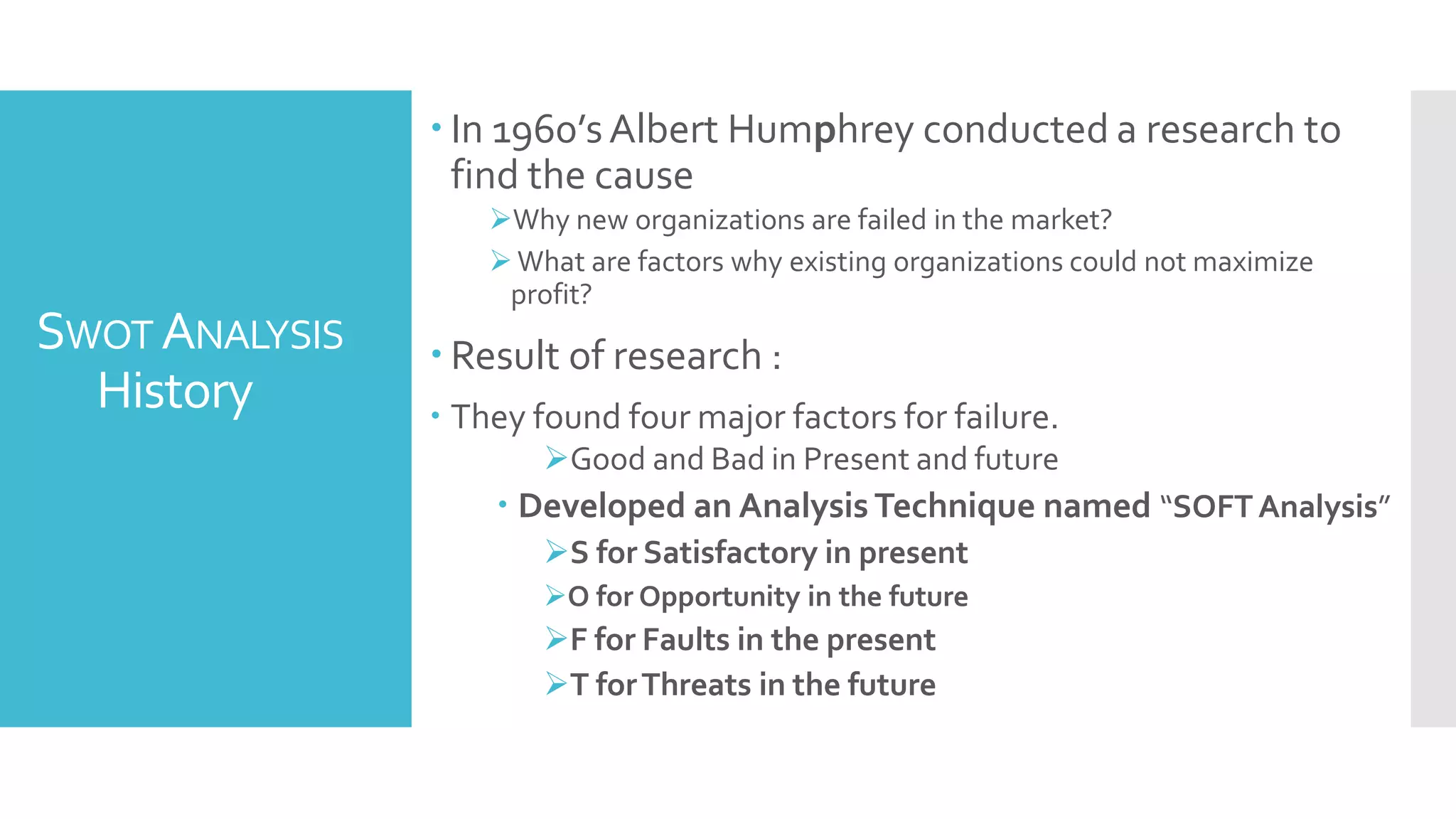
 In 1960’sAlbert Humphrey conducted a research to
find the cause
Why new organizations are failed in the market?
What are factors why existing organizations could not maximize
profit?
 Result of research :
 They found four major factors for failure.
Good and Bad in Present and future
 Developed an Analysis Technique named “SOFTAnalysis”
S for Satisfactory in present
O for Opportunity in the future
F for Faults in the present
T forThreats in the future
SWOT ANALYSIS
History
 After That in 1964
Concept of SWOT came
 What is SWOT?
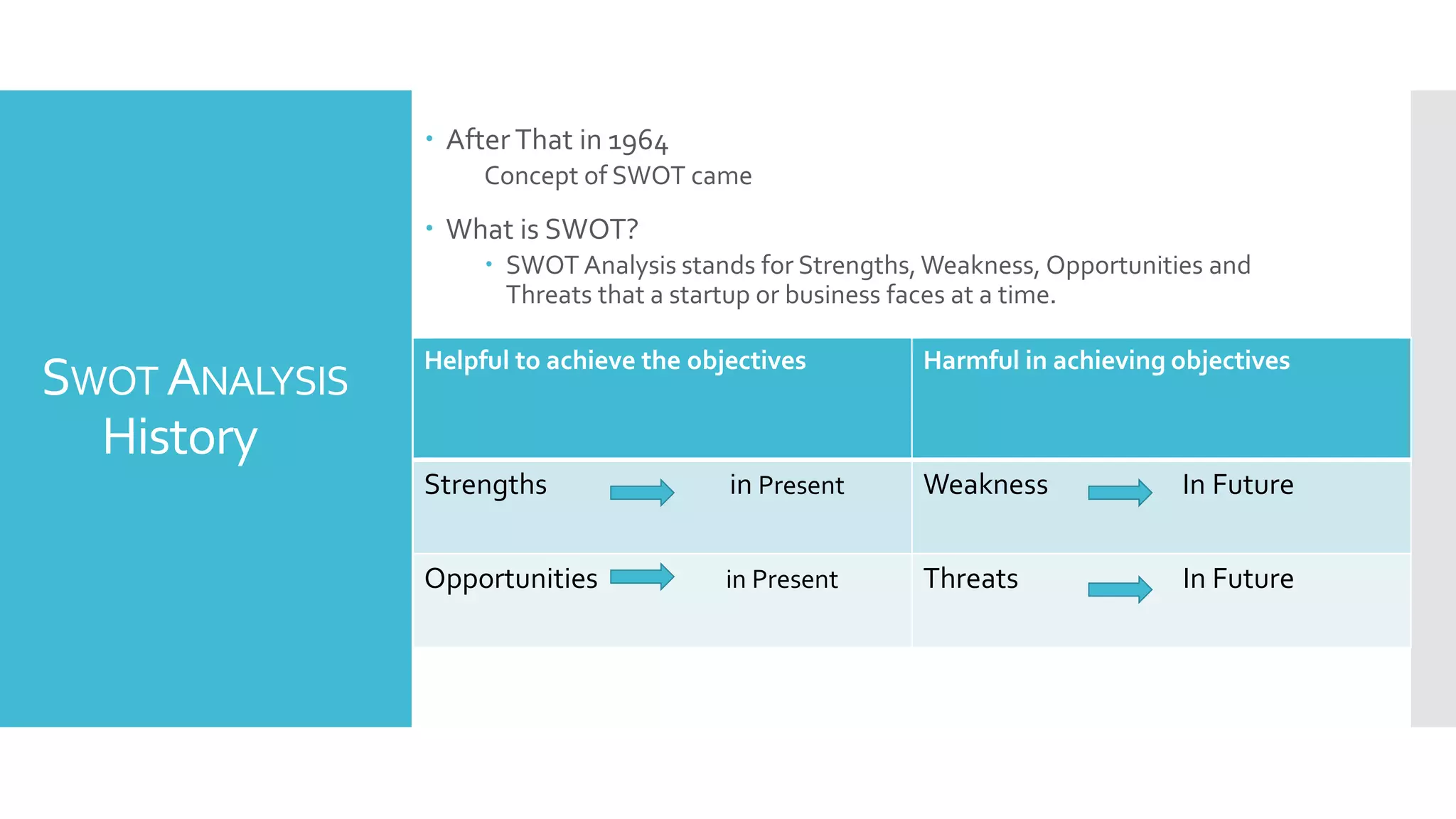
 SWOT Analysis stands for Strengths,Weakness, Opportunities and
Threats that a startup or business faces at a time.
Helpful to achieve the objectives Harmful in achieving objectives
Strengths in Present Weakness In Future
Opportunities in Present Threats In Future
Purpose of the
SWOTAnalysis
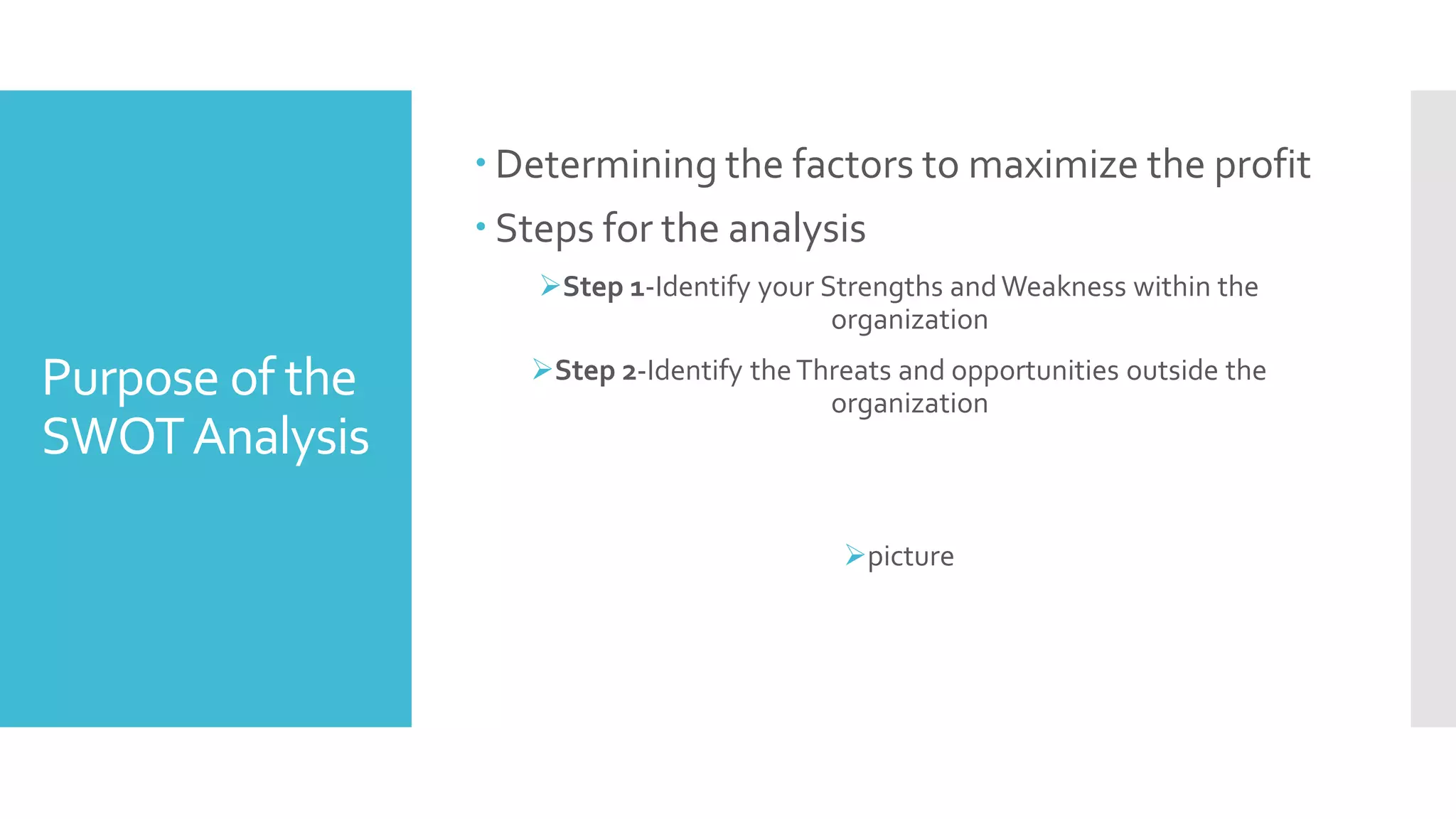
 Determining the factors to maximize the profit
 Steps for the analysis
Step 1-Identify your Strengths andWeakness within the
organization
Step 2-Identify theThreats and opportunities outside the
organization
picture
How to do
Analysis
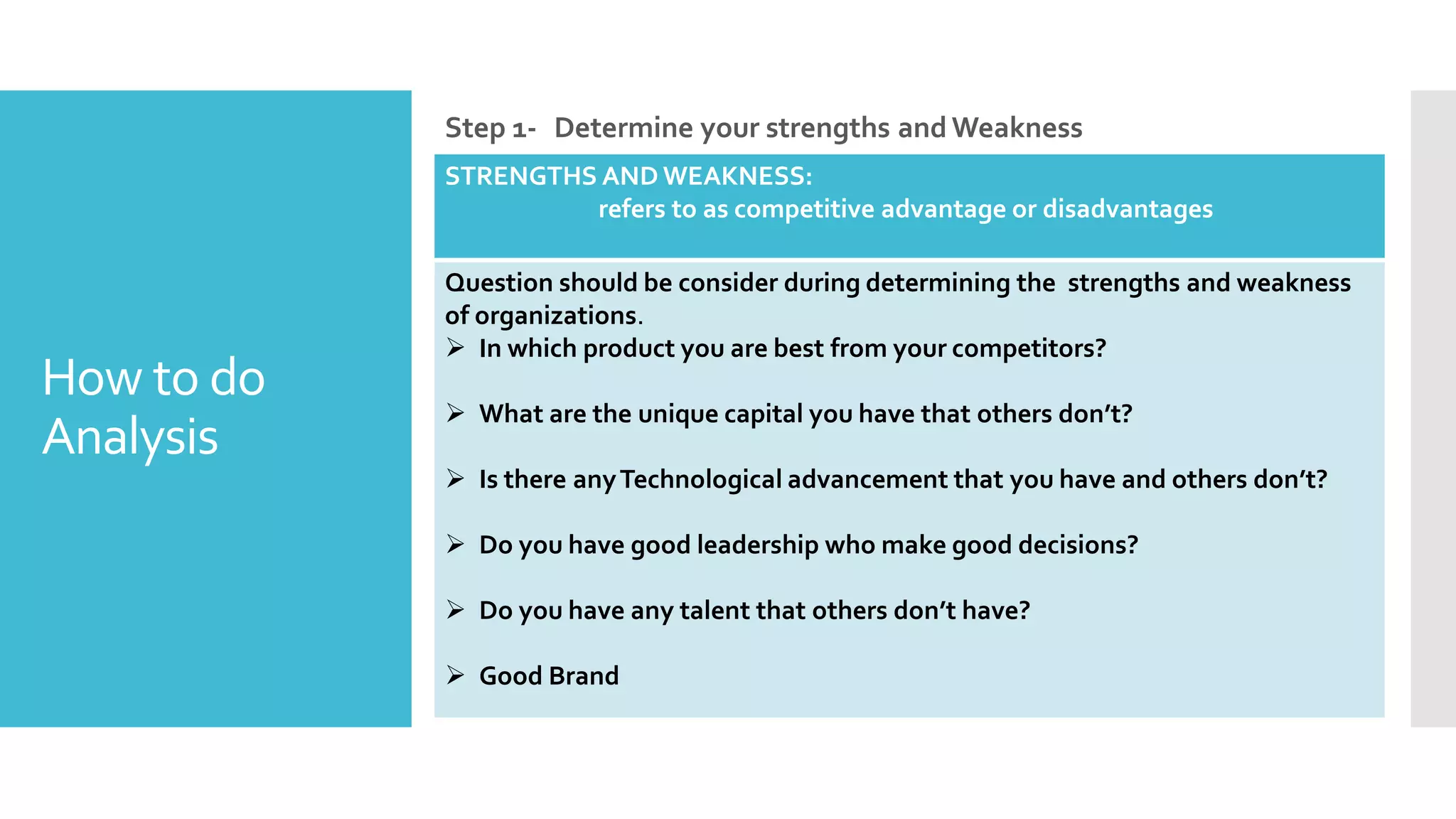
Step 1- Determine your strengths and Weakness
STRENGTHS AND WEAKNESS:
refers to as competitive advantage or disadvantages
Question should be consider during determining the strengths and weakness
of organizations.
 In which product you are best from your competitors?
 What are the unique capital you have that others don’t?
 Is there anyTechnological advancement that you have and others don’t?
 Do you have good leadership who make good decisions?
 Do you have any talent that others don’t have?
 Good Brand
How to do
analysis
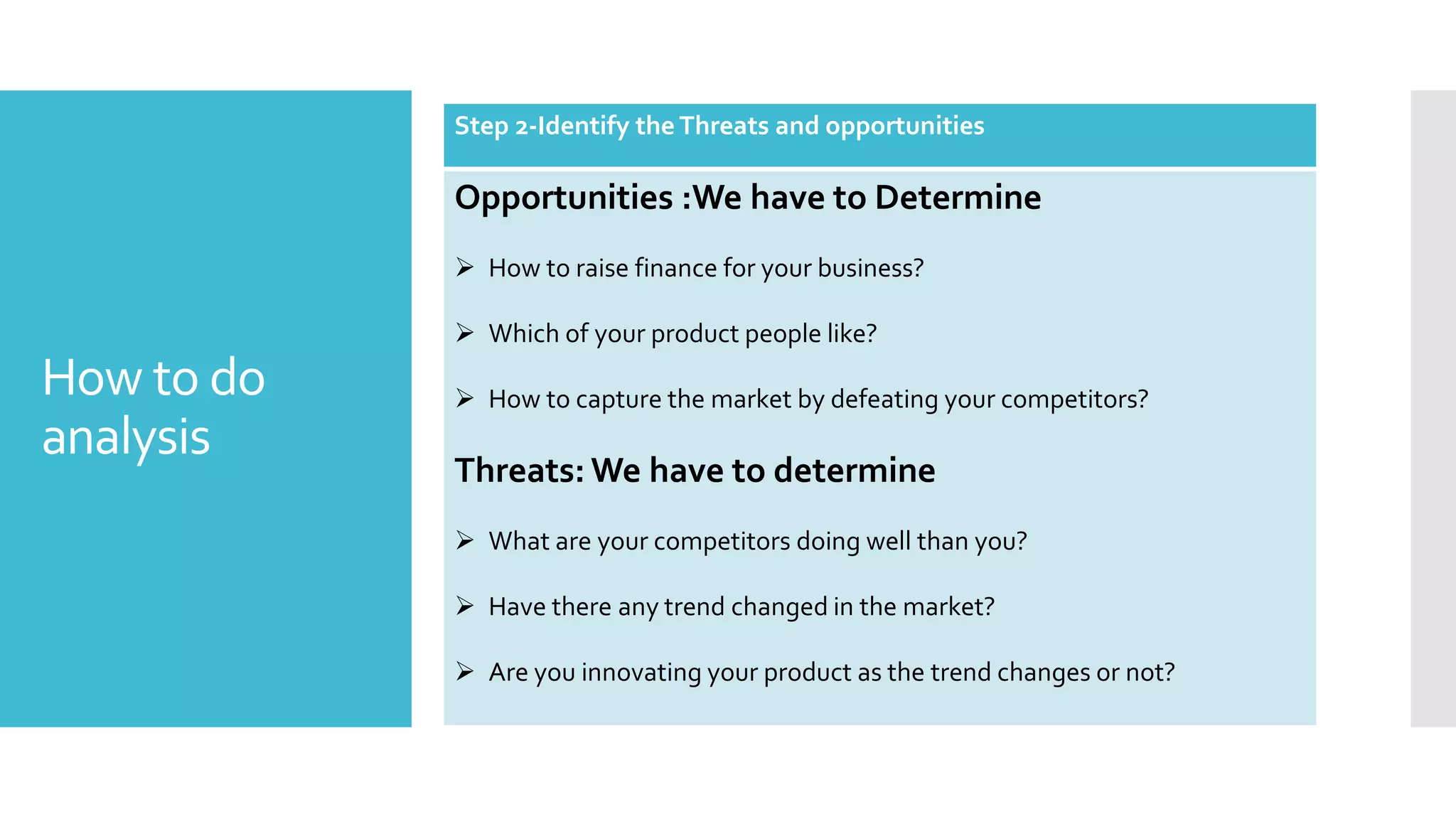
Step 2-Identify the Threats and opportunities
Opportunities :We have to Determine
 How to raise finance for your business?
 Which of your product people like?
 How to capture the market by defeating your competitors?
Threats: We have to determine
 What are your competitors doing well than you?
 Have there any trend changed in the market?
 Are you innovating your product as the trend changes or not?
Advantages
 It is a good tool which helps in organizing firms by knowing the
strengths and weakness of the firm.
 It aware us from our competitors.
 Helps in making good decisions by knowing opportunities and
threats.
 Equally applicable on big firms, startups and for individuals.
 Enhance analytical abilities of employees and employers.
Limitations
 Gives us analyzing techniques but not the solutions.
 Not give us idea which issue is more harmful for firm i.e. which
issue should have more priority

Utility
To decide a direction of an organization (i.e. What that
organization wants to do ?)
To analyze performance of employee to improve its performance.
For the assessment of its product or service.
To make fruitful strategies against its competitors.
To make future plan of its organization.
As a whole To find out best way to make strategies and future plan
of development of its organization and increase its performance to
make revenue in market.
Porter’s Five Forces
HISTORY
While SWOT analysis have advantages but it could not totally solve
the problems as they are not more concern about competitions.
 To solve the problem Michael Porter gave a theory named
porters five forces. He worked for Harvard Business School there
he with his team established strategies for competitive markets.
 He used principles of Economics to analyze the competitive
market and proposed “Porter’s five forces” which are useful in
maximizing the profit. He gave the concept of competitive
advantage and disadvantage
 .
Introduction
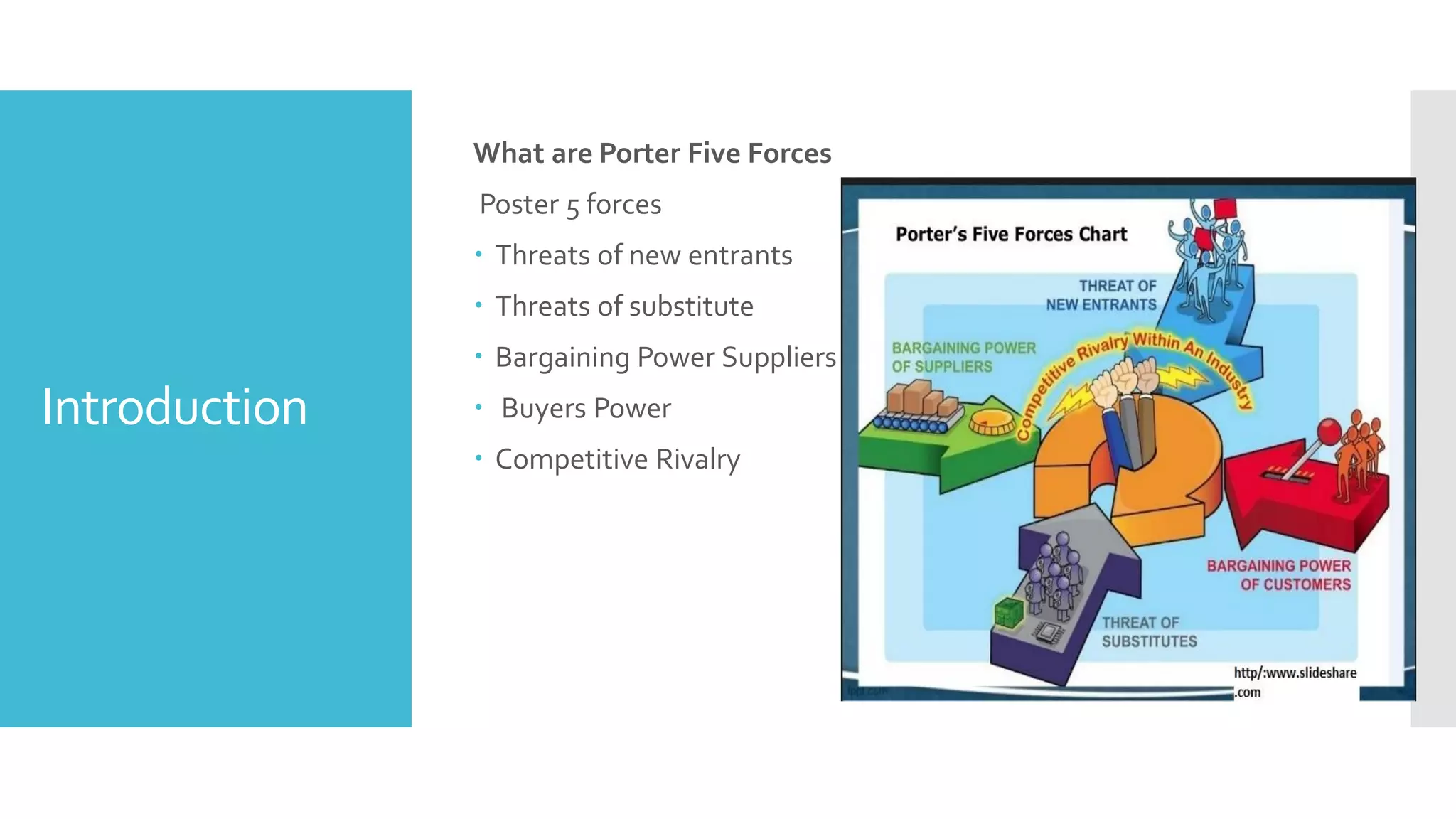
What are Porter Five Forces
Poster 5 forces
 Threats of new entrants
 Threats of substitute
 Bargaining Power Suppliers
 Buyers Power
 Competitive Rivalry
Purpose
 As SWOT analysis already enables us to find our strengths and
opportunities , But could not told us how to avail these
opportunities and how to turn our weakness into strengths.
Porters five forces enables us to do these things.
 Competitive Rivalry Competitive advantage analysis
enables us how to maximize our profit by specializing.
 Buyers Power It tells us how to engage your
customers towards your Brand by knowing the trends.
 Threats of substitute How to survive in the market
while good substitutes are present in the market.
Advantages
 As Every firm wants profits so by applying porters five forces
firms can maximize their profits.
 It is a good tool which helps us in surviving in the competitive
market.
 It gives us a solution how to make competition with your
competitors.
 Solved the problems which SWOT analysis faces, by giving us
tools to solve the problems.
 Enhance analytical abilities of employees and employers.
Limitations
 It is not too much simple as SWOT analysis was.
 It requires more analysis and expertise.
 It is time consuming and expensive.
 Sometimes it is very difficult to apply this theory in complex
competitive market where a lot of substitutes are present.
 It works for only Ideal market where ups and down are not occur in
the market.
Utility
 Analyze present situation of your industry and yours rivals.
 To make its position strong in market.
 We can avail more from its strong points and can also improve our
weak points.
 We can also find out different options about our industry by doing
option analysis using these five forces.
PESTAnalysis
History &
Creation of
PESTAnalysis
 In 1967 ,Aguilar, a Harvard professor, gave the idea of ‘ETPS’
 ETPS stands for Economical, Technological, Political and Social
 In 1980 it is recognized as “PEST”.
Purpose
 Since now we are analyzing micro economical factors but in PEST
analysis we observe the macro circumstances in which a firm can
work
 This analysis gives a brief information about Political, Social and
economical environment which are beneficial for us.
 Helps us in making a good decision in such political situations
where we have no control.
 How to sustain in advanced market using technology and
innovation.
Advantages
 Helps an organization to start a new product i.e. is this product is
compatible with culture.
 Helps in making new firms i.e. which firm is best and beneficial
according to environment.
 According to environment, It warns us about the threats which a
firm could face in future.
 As an investor, It helps you in which business investment is better
and why.
Limitations
 For this analysis to perform, We need expertise and analyst who
could perform analysis.
 Time consuming and expensive
 We have to know about the history of culture and people.
 Geography also matters in this analysis.
 Uncertainty is very high in this analysis as we can only predict the
future only according to our knowledge and by history. Something
could happen which is not happened in the history.
Utility
 Pest analysis can be used in any environment to get political,
social, technological and economical information about that
environment.
 SWOT analysis only be completed in a very good way when PEST
analysis is merged with it.
 It is beneficial for every type of business working in the specific
environment.
Value chainAnalysis
History
 Michael Porter gave concept of Value chain in 1980.
 In 1990s Gereffi introduced “Chains Concept” : It is a bridge
between households and market
 Morvan (1985s)
 Mesco-economy also said economy is interdependence.
Technology etc different factors that affect economy also depends
upon value
Introduction
 An analysis to increase value of product in the front of your
customer.
 It is based on three steps
 1st which product or service your industry is going to introduce in
market?
 2nd what will be proper price?
 3rd how to plan all these things
Purpose
This model is used
 To Provide great value to your costumers by applying value chain
theory.
 To Get maximum profit.
 Using providing techniques, analyze the better way of getting
profits.
 Using comparative advantage techniques maximizing your and
costumers benefits.
 To enhance public relationship of your brand
Advantages
 It provides help for every type of business.
 Comparative advantage and disadvantage analysis provides us the
key to success and maximization of profit.
 Using this strategy, firms decides about their future and beneficial
products.
 It is useful to utilize your capital in a better way.
Disadvantages
 Analysis is very difficult, as data collection is very tough in this
analysis.
 It is expensive as it requires more expertise and data collecting
skills.
 To apply this analysis data should be in a specific orientation and
organization.
Utility
 Utilized for marketing your product or service that you are going
to introduce in market.
 Utilized for maximize profit and increase revenue.
 Utilized for making your customer’s faith strength more.
 Utilized for making strategies about your competitor.
References /
Sources
 Cite Man:What are the benefits of value chain management?
 http://www.kstoolkit.org/Porter%27s+Five+Forces+Analysis
 http://www.tutor2u.net/business/reference/value-chain-analysis
 http://www.free-management-ebooks.com/faqst/pestle-09.htm
 https://www.mindtools.com/pages/article/newSTR_66.htm
 http://www.differentiateyourbusiness.co.uk/the-advantages-
disadvantages-of-value-chain-analysis
 http://managerial-accounting.blogspot.com/2012/10/limitations-of-
value-chain-analysis.html
 SWOT Analysis - Idea, Methodology and a Practical Approach; Nadine Pahl
and Anne Richter
 https://www.mindtools.com/pages/article/newTMC_09.htm

SWOT Analysis By Mohriz Shahid Syed

  • 1.
  • 2.
    SWOT ANALYSIS History  In1960’sAlbert Humphrey conducted a research to find the cause Why new organizations are failed in the market? What are factors why existing organizations could not maximize profit?  Result of research :  They found four major factors for failure. Good and Bad in Present and future  Developed an Analysis Technique named “SOFTAnalysis” S for Satisfactory in present O for Opportunity in the future F for Faults in the present T forThreats in the future
  • 3.
    SWOT ANALYSIS History  AfterThat in 1964 Concept of SWOT came  What is SWOT?  SWOT Analysis stands for Strengths,Weakness, Opportunities and Threats that a startup or business faces at a time. Helpful to achieve the objectives Harmful in achieving objectives Strengths in Present Weakness In Future Opportunities in Present Threats In Future
  • 4.
    Purpose of the SWOTAnalysis Determining the factors to maximize the profit  Steps for the analysis Step 1-Identify your Strengths andWeakness within the organization Step 2-Identify theThreats and opportunities outside the organization picture
  • 5.
    How to do Analysis Step1- Determine your strengths and Weakness STRENGTHS AND WEAKNESS: refers to as competitive advantage or disadvantages Question should be consider during determining the strengths and weakness of organizations.  In which product you are best from your competitors?  What are the unique capital you have that others don’t?  Is there anyTechnological advancement that you have and others don’t?  Do you have good leadership who make good decisions?  Do you have any talent that others don’t have?  Good Brand
  • 6.
    How to do analysis Step2-Identify the Threats and opportunities Opportunities :We have to Determine  How to raise finance for your business?  Which of your product people like?  How to capture the market by defeating your competitors? Threats: We have to determine  What are your competitors doing well than you?  Have there any trend changed in the market?  Are you innovating your product as the trend changes or not?
  • 7.
    Advantages  It isa good tool which helps in organizing firms by knowing the strengths and weakness of the firm.  It aware us from our competitors.  Helps in making good decisions by knowing opportunities and threats.  Equally applicable on big firms, startups and for individuals.  Enhance analytical abilities of employees and employers.
  • 8.
    Limitations  Gives usanalyzing techniques but not the solutions.  Not give us idea which issue is more harmful for firm i.e. which issue should have more priority 
  • 9.
    Utility To decide adirection of an organization (i.e. What that organization wants to do ?) To analyze performance of employee to improve its performance. For the assessment of its product or service. To make fruitful strategies against its competitors. To make future plan of its organization. As a whole To find out best way to make strategies and future plan of development of its organization and increase its performance to make revenue in market.
  • 10.
  • 11.
    HISTORY While SWOT analysishave advantages but it could not totally solve the problems as they are not more concern about competitions.  To solve the problem Michael Porter gave a theory named porters five forces. He worked for Harvard Business School there he with his team established strategies for competitive markets.  He used principles of Economics to analyze the competitive market and proposed “Porter’s five forces” which are useful in maximizing the profit. He gave the concept of competitive advantage and disadvantage  .
  • 12.
    Introduction What are PorterFive Forces Poster 5 forces  Threats of new entrants  Threats of substitute  Bargaining Power Suppliers  Buyers Power  Competitive Rivalry
  • 13.
    Purpose  As SWOTanalysis already enables us to find our strengths and opportunities , But could not told us how to avail these opportunities and how to turn our weakness into strengths. Porters five forces enables us to do these things.  Competitive Rivalry Competitive advantage analysis enables us how to maximize our profit by specializing.  Buyers Power It tells us how to engage your customers towards your Brand by knowing the trends.  Threats of substitute How to survive in the market while good substitutes are present in the market.
  • 14.
    Advantages  As Everyfirm wants profits so by applying porters five forces firms can maximize their profits.  It is a good tool which helps us in surviving in the competitive market.  It gives us a solution how to make competition with your competitors.  Solved the problems which SWOT analysis faces, by giving us tools to solve the problems.  Enhance analytical abilities of employees and employers.
  • 15.
    Limitations  It isnot too much simple as SWOT analysis was.  It requires more analysis and expertise.  It is time consuming and expensive.  Sometimes it is very difficult to apply this theory in complex competitive market where a lot of substitutes are present.  It works for only Ideal market where ups and down are not occur in the market.
  • 16.
    Utility  Analyze presentsituation of your industry and yours rivals.  To make its position strong in market.  We can avail more from its strong points and can also improve our weak points.  We can also find out different options about our industry by doing option analysis using these five forces.
  • 17.
  • 18.
    History & Creation of PESTAnalysis In 1967 ,Aguilar, a Harvard professor, gave the idea of ‘ETPS’  ETPS stands for Economical, Technological, Political and Social  In 1980 it is recognized as “PEST”.
  • 19.
    Purpose  Since nowwe are analyzing micro economical factors but in PEST analysis we observe the macro circumstances in which a firm can work  This analysis gives a brief information about Political, Social and economical environment which are beneficial for us.  Helps us in making a good decision in such political situations where we have no control.  How to sustain in advanced market using technology and innovation.
  • 20.
    Advantages  Helps anorganization to start a new product i.e. is this product is compatible with culture.  Helps in making new firms i.e. which firm is best and beneficial according to environment.  According to environment, It warns us about the threats which a firm could face in future.  As an investor, It helps you in which business investment is better and why.
  • 21.
    Limitations  For thisanalysis to perform, We need expertise and analyst who could perform analysis.  Time consuming and expensive  We have to know about the history of culture and people.  Geography also matters in this analysis.  Uncertainty is very high in this analysis as we can only predict the future only according to our knowledge and by history. Something could happen which is not happened in the history.
  • 22.
    Utility  Pest analysiscan be used in any environment to get political, social, technological and economical information about that environment.  SWOT analysis only be completed in a very good way when PEST analysis is merged with it.  It is beneficial for every type of business working in the specific environment.
  • 23.
  • 24.
    History  Michael Portergave concept of Value chain in 1980.  In 1990s Gereffi introduced “Chains Concept” : It is a bridge between households and market  Morvan (1985s)  Mesco-economy also said economy is interdependence. Technology etc different factors that affect economy also depends upon value
  • 25.
    Introduction  An analysisto increase value of product in the front of your customer.  It is based on three steps  1st which product or service your industry is going to introduce in market?  2nd what will be proper price?  3rd how to plan all these things
  • 26.
    Purpose This model isused  To Provide great value to your costumers by applying value chain theory.  To Get maximum profit.  Using providing techniques, analyze the better way of getting profits.  Using comparative advantage techniques maximizing your and costumers benefits.  To enhance public relationship of your brand
  • 27.
    Advantages  It provideshelp for every type of business.  Comparative advantage and disadvantage analysis provides us the key to success and maximization of profit.  Using this strategy, firms decides about their future and beneficial products.  It is useful to utilize your capital in a better way.
  • 28.
    Disadvantages  Analysis isvery difficult, as data collection is very tough in this analysis.  It is expensive as it requires more expertise and data collecting skills.  To apply this analysis data should be in a specific orientation and organization.
  • 29.
    Utility  Utilized formarketing your product or service that you are going to introduce in market.  Utilized for maximize profit and increase revenue.  Utilized for making your customer’s faith strength more.  Utilized for making strategies about your competitor.
  • 30.
    References / Sources  CiteMan:What are the benefits of value chain management?  http://www.kstoolkit.org/Porter%27s+Five+Forces+Analysis  http://www.tutor2u.net/business/reference/value-chain-analysis  http://www.free-management-ebooks.com/faqst/pestle-09.htm  https://www.mindtools.com/pages/article/newSTR_66.htm  http://www.differentiateyourbusiness.co.uk/the-advantages- disadvantages-of-value-chain-analysis  http://managerial-accounting.blogspot.com/2012/10/limitations-of- value-chain-analysis.html  SWOT Analysis - Idea, Methodology and a Practical Approach; Nadine Pahl and Anne Richter  https://www.mindtools.com/pages/article/newTMC_09.htm