Business Plan
Presented by:
Ilham Laabab
Majda Saaf
Meryem Oulghazi
Outline
I. Introduction
II. The benefits of a Business Plan
III. Major components of a Business Plan
IV. Steps of writing a Business Plan
V. Conclusion
I. Introduction
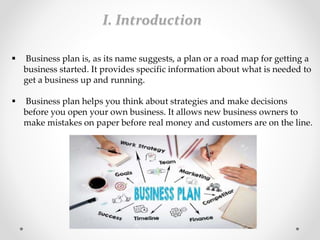
 Business plan is, as its name suggests, a plan or a road map for getting a
business started. It provides specific information about what is needed to
get a business up and running.
 Business plan helps you think about strategies and make decisions
before you open your own business. It allows new business owners to
make mistakes on paper before real money and customers are on the line.
II. The benefits of a Business Plan
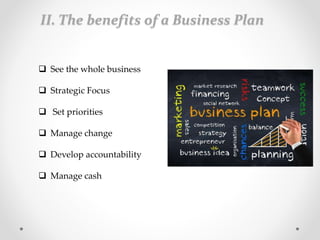
 See the whole business
 Strategic Focus
 Set priorities
 Manage change
 Develop accountability
 Manage cash
III. Major components of a Business Plan
Most business plans include six sections :
• Executive summary
• Products/Services
• Company overview
• Marketing research and strategies
• Operational plan
• Financial plan
IV. Steps of writing a Business Plan
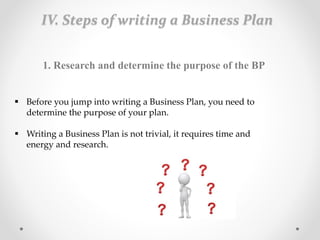
1. Research and determine the purpose of the BP
 Before you jump into writing a Business Plan, you need to
determine the purpose of your plan.
 Writing a Business Plan is not trivial, it requires time and
energy and research.
IV. Steps of writing a Business Plan
2. Study the potential market for the project
 Market research should be done
at the very beginning. This study
will have an influence on all of
your strategic decisions as well
as on your business model.
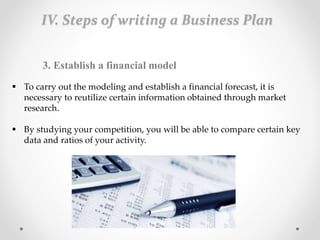
 To carry out the modeling and establish a financial forecast, it is
necessary to reutilize certain information obtained through market
research.
 By studying your competition, you will be able to compare certain key
data and ratios of your activity.
3. Establish a financial model
IV. Steps of writing a Business Plan
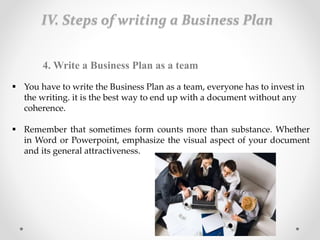
4. Write a Business Plan as a team
 You have to write the Business Plan as a team, everyone has to invest in
the writing. it is the best way to end up with a document without any
coherence.
 Remember that sometimes form counts more than substance. Whether
in Word or Powerpoint, emphasize the visual aspect of your document
and its general attractiveness.
IV. Steps of writing a Business Plan
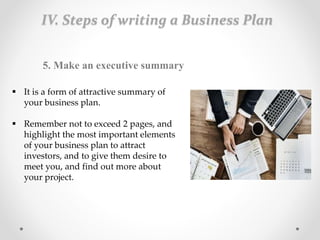
5. Make an executive summary
 It is a form of attractive summary of
your business plan.
 Remember not to exceed 2 pages, and
highlight the most important elements
of your business plan to attract
investors, and to give them desire to
meet you, and find out more about
your project.
IV. Steps of writing a Business Plan
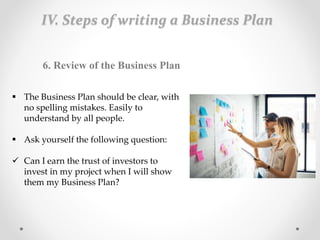
6. Review of the Business Plan
 The Business Plan should be clear, with
no spelling mistakes. Easily to
understand by all people.
 Ask yourself the following question:
 Can I earn the trust of investors to
invest in my project when I will show
them my Business Plan?
 A Business Plan is a living, breathing, and a document that
helps you work towards a predetermined objective.
 Business Plan is flexible for correcting your course during
those times when things won’t go as planned.
V. Conclusion
Business Plan presentation

Business Plan presentation

  • 1.
    Business Plan Presented by: IlhamLaabab Majda Saaf Meryem Oulghazi
  • 2.
    Outline I. Introduction II. Thebenefits of a Business Plan III. Major components of a Business Plan IV. Steps of writing a Business Plan V. Conclusion
  • 3.
    I. Introduction  Businessplan is, as its name suggests, a plan or a road map for getting a business started. It provides specific information about what is needed to get a business up and running.  Business plan helps you think about strategies and make decisions before you open your own business. It allows new business owners to make mistakes on paper before real money and customers are on the line.
  • 4.
    II. The benefitsof a Business Plan  See the whole business  Strategic Focus  Set priorities  Manage change  Develop accountability  Manage cash
  • 5.
    III. Major componentsof a Business Plan Most business plans include six sections : • Executive summary • Products/Services • Company overview • Marketing research and strategies • Operational plan • Financial plan
  • 6.
    IV. Steps ofwriting a Business Plan 1. Research and determine the purpose of the BP  Before you jump into writing a Business Plan, you need to determine the purpose of your plan.  Writing a Business Plan is not trivial, it requires time and energy and research.
  • 7.
    IV. Steps ofwriting a Business Plan 2. Study the potential market for the project  Market research should be done at the very beginning. This study will have an influence on all of your strategic decisions as well as on your business model.
  • 8.
     To carryout the modeling and establish a financial forecast, it is necessary to reutilize certain information obtained through market research.  By studying your competition, you will be able to compare certain key data and ratios of your activity. 3. Establish a financial model IV. Steps of writing a Business Plan
  • 9.
    IV. Steps ofwriting a Business Plan 4. Write a Business Plan as a team  You have to write the Business Plan as a team, everyone has to invest in the writing. it is the best way to end up with a document without any coherence.  Remember that sometimes form counts more than substance. Whether in Word or Powerpoint, emphasize the visual aspect of your document and its general attractiveness.
  • 10.
    IV. Steps ofwriting a Business Plan 5. Make an executive summary  It is a form of attractive summary of your business plan.  Remember not to exceed 2 pages, and highlight the most important elements of your business plan to attract investors, and to give them desire to meet you, and find out more about your project.
  • 11.
    IV. Steps ofwriting a Business Plan 6. Review of the Business Plan  The Business Plan should be clear, with no spelling mistakes. Easily to understand by all people.  Ask yourself the following question:  Can I earn the trust of investors to invest in my project when I will show them my Business Plan?
  • 12.
     A BusinessPlan is a living, breathing, and a document that helps you work towards a predetermined objective.  Business Plan is flexible for correcting your course during those times when things won’t go as planned. V. Conclusion