A Business Model is…
• Simply a description or an account or a
conceptual plan…
• …of how a business will make a profit
What Do Businesses Do?
1. Spend time, effort and or money to
create something
2. Find someone who is willing to pay
for it
3. 2. > 1.
Some Examples
• “Razor Blade Model”
– Sell razors ‘cheaply’ (below cost)
– Create a ‘locked in’ customer base
– Sell blades well above cost
• Same model used by ink jet printer firms
– Sell printer ‘cheaply’ (below cost)
– Create a ‘locked in’ customer base
– Sell inks well above cost
Other Examples
• Razors and Blades
• Ink-jet printers
• Keurig coffee maker
• Video game consoles
• iTunes
Key elements of a business model
• What’s the product or service?
• Who will pay for it, why, and how much (the value
proposition)?
• How much it costs to make or deliver
– How much is left (profit)
• Who are partners, suppliers, competitors, complementors
• Structure and processes
– Marketing
– Distribution
– Operating / manufacturing
– Supply chain
• Finance (sources of funds, returns to investors)
• Other Stakeholders
The Internet
• Lots of new business models have been
made possible by the Internet
– Amazon – a refinement of a old model
– Google – a completely new business model
• Top billing
• Click through
– Quibids.com
• Charging loosing bidders (penny auctions)
– edX (MOOCs)
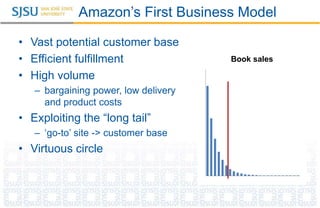
Amazon’s First Business Model
• Vast potential customer base
• Efficient fulfillment
• High volume
– bargaining power, low delivery
and product costs
• Exploiting the “long tail”
– ‘go-to’ site -> customer base
• Virtuous circle
Book sales
Amazon’s Evolving Business Model
• Diversification into related products
• Broadening into a generalized marketplace
– Making a market
– Providing a platform for small sellers
– Fire Phone
– Amazon Prime
• Spillover – Amazon Web Services
Google’s Business Model
• Initially just another search engine, (albeit
a very good one).
• Gradually beat out earlier rivals (Yahoo,
Lycos, Excite, Infoseek, AltaVistsa, and
AskJeeves)
• How to make money from search?
• Subscription, user fee?
• Search Top billing
• Result Click Through
Quibid’s Business Model
• ‘Endless auction’ (hard to do in physical
space)
• Winners pay…
• But so do the (very many ) losers
• So Quibids get paid multiple times
edX’ Business Model
• Leverage a well known brand
• Take existing material
• Possibly add fancy post production (cost
$500k)
• Put it on the web
• Sell this to other universities
– for $250k
– Plus 30% of all student fees above that
A General Template
Miller / Okumoto, Inc.
Retail Client
(Level - Pilot)
dunnhumby
(Vendor)
Business Model – Example
Miller / Okumoto, Inc.
Client Interface Team
1. Who are the members?
2. What skills should they possess?
3. What level of experience?
Solutions Team
1. Is this a dedicated group?
2. What skills should they possess?
Outside Partners
1. 3rd Party data sources?
2. 3rd Party software products?
Client / Vendor Value
Proposition
1. What is Client economic benefit?
2. What is Client strategic benefit?
3. What is Vendor benefit?
Vendor Interface Team
1. Are all levels represented?
2. Contact points, times, & events?
3. Expectations understood?
4. Level of satisfaction understood?
Vendor Supporters
1. Internal support points covered?
2. Inside “sales team”
3. Unofficial communication channel
Cost Elements
1. Client Team (labor + Overhead costs)
2. Solutions Team (labor + Overhead costs)
3. Outside partner(s) cost
4. Product cost
5. Product development cost
Revenue Streams
1. Data base access fee?
2. Incremental Inquiry fee?
3. Aid in acquiring Mfg fees
Contribution Margin: 1. Present in a P&L format 2. Contribution rate Objective: e.g. (break-even / slight profit / slight loss) ?
Key Processes – Activities
1. Account status reporting
2. Detailed SOW
3. Development of Mfg relationship
4. Relationship at every Client level?
5. Vertical development process
6. Other primary processes?
A Useful Template
Summary…
• What the product or service is
• Who will pay for it, why, and how much (the value
proposition)
• How much it costs to make or deliver
• How much is left (profit)
• Who are your: partners, suppliers, competitors,
complementors
• Structure and processes
– Marketing
– Distribution
– Operating / manufacturing
– Supply chain
• Finance (returns to investors)
• Other Stakeholders
Business models.pptx

Business models.pptx

  • 2.
    A Business Modelis… • Simply a description or an account or a conceptual plan… • …of how a business will make a profit
  • 3.
    What Do BusinessesDo? 1. Spend time, effort and or money to create something 2. Find someone who is willing to pay for it 3. 2. > 1.
  • 4.
    Some Examples • “RazorBlade Model” – Sell razors ‘cheaply’ (below cost) – Create a ‘locked in’ customer base – Sell blades well above cost • Same model used by ink jet printer firms – Sell printer ‘cheaply’ (below cost) – Create a ‘locked in’ customer base – Sell inks well above cost
  • 5.
    Other Examples • Razorsand Blades • Ink-jet printers • Keurig coffee maker • Video game consoles • iTunes
  • 6.
    Key elements ofa business model • What’s the product or service? • Who will pay for it, why, and how much (the value proposition)? • How much it costs to make or deliver – How much is left (profit) • Who are partners, suppliers, competitors, complementors • Structure and processes – Marketing – Distribution – Operating / manufacturing – Supply chain • Finance (sources of funds, returns to investors) • Other Stakeholders
  • 7.
    The Internet • Lotsof new business models have been made possible by the Internet – Amazon – a refinement of a old model – Google – a completely new business model • Top billing • Click through – Quibids.com • Charging loosing bidders (penny auctions) – edX (MOOCs)
  • 8.
    Amazon’s First BusinessModel • Vast potential customer base • Efficient fulfillment • High volume – bargaining power, low delivery and product costs • Exploiting the “long tail” – ‘go-to’ site -> customer base • Virtuous circle Book sales
  • 9.
    Amazon’s Evolving BusinessModel • Diversification into related products • Broadening into a generalized marketplace – Making a market – Providing a platform for small sellers – Fire Phone – Amazon Prime • Spillover – Amazon Web Services
  • 10.
    Google’s Business Model •Initially just another search engine, (albeit a very good one). • Gradually beat out earlier rivals (Yahoo, Lycos, Excite, Infoseek, AltaVistsa, and AskJeeves) • How to make money from search? • Subscription, user fee? • Search Top billing • Result Click Through
  • 11.
    Quibid’s Business Model •‘Endless auction’ (hard to do in physical space) • Winners pay… • But so do the (very many ) losers • So Quibids get paid multiple times
  • 12.
    edX’ Business Model •Leverage a well known brand • Take existing material • Possibly add fancy post production (cost $500k) • Put it on the web • Sell this to other universities – for $250k – Plus 30% of all student fees above that
  • 13.
  • 14.
    Retail Client (Level -Pilot) dunnhumby (Vendor) Business Model – Example Miller / Okumoto, Inc. Client Interface Team 1. Who are the members? 2. What skills should they possess? 3. What level of experience? Solutions Team 1. Is this a dedicated group? 2. What skills should they possess? Outside Partners 1. 3rd Party data sources? 2. 3rd Party software products? Client / Vendor Value Proposition 1. What is Client economic benefit? 2. What is Client strategic benefit? 3. What is Vendor benefit? Vendor Interface Team 1. Are all levels represented? 2. Contact points, times, & events? 3. Expectations understood? 4. Level of satisfaction understood? Vendor Supporters 1. Internal support points covered? 2. Inside “sales team” 3. Unofficial communication channel Cost Elements 1. Client Team (labor + Overhead costs) 2. Solutions Team (labor + Overhead costs) 3. Outside partner(s) cost 4. Product cost 5. Product development cost Revenue Streams 1. Data base access fee? 2. Incremental Inquiry fee? 3. Aid in acquiring Mfg fees Contribution Margin: 1. Present in a P&L format 2. Contribution rate Objective: e.g. (break-even / slight profit / slight loss) ? Key Processes – Activities 1. Account status reporting 2. Detailed SOW 3. Development of Mfg relationship 4. Relationship at every Client level? 5. Vertical development process 6. Other primary processes?
  • 15.
  • 16.
    Summary… • What theproduct or service is • Who will pay for it, why, and how much (the value proposition) • How much it costs to make or deliver • How much is left (profit) • Who are your: partners, suppliers, competitors, complementors • Structure and processes – Marketing – Distribution – Operating / manufacturing – Supply chain • Finance (returns to investors) • Other Stakeholders

Editor's Notes

  • #3 Joking aside, the concept of a business model is really very simple even though some of the particular models themselves can be fairly complex. A business model is simply a description of how a business will make money. That’s it.
  • #4 At the most fundamental level, every business does two things. First, it spends time and effort and money or all three to acquire or create something that others want and are prepared to pay for. Second, it finds those people, delivers the product or service, and takes money in exchange.
  • #5 Here’s another business model that you will almost certainly come across at some point if you haven’t already. It’s often called the razor blade model (sometime the razor blade strategy) and was devised by Gillette sometime in the 1970s. The basic idea of the razor blade business model is that you have a product that essentially comes in two parts, in this case the handle and the blades. The idea is that you sell one part fairly cheaply, often below your manufacturing costs, in order to guarantee repeat business for the part of the system on which you actually make a profit in this case the blades. An important feature of the razor blade model is that once consumers have bought the first part of the system, the handle, they have no other option but to buy the second part of the system from you as well. The strategy doesn’t work if you can get blades from someone else, because once consumers have a choice, you as a producer have competition; and with competition you will have to reduce prices and you may not make enough money on the blades to make the strategy work. The same basic model is also used in other industries; for example inkjet printers. Printer manufacturers like Hewlett-Packard or Canon will sell you an inkjet printer for very little money, but a printer which only takes their brand of inks. And within a few months you will probably find that you have spent more on ink then you did on the printer in the first place.
  • #6 In addition to the two we’ve already talked about, here are some other examples of companies and products that use the razor blade business model. Keurig will sell you a coffee maker that takes a proprietary plastic container with a measured amount of ground coffee at 50c a shot, making it fairly expensive coffee Video game consoles may seem expensive, but their cost pales in comparison to the amount of money serious gamers often spend on games themselves. The console may set you back $200 but by the time you have bought 20 games at $40 each the console is only 20% of your total investment as a gamer. The iTunes music player cost Apple a fair amount of time and money to develop and they give it away for free. But the player drives business to Apple’s iTunes store thus ensuring that users buy their music from Apple instead of from other online or brick and mortar retailers.
  • #7 So, the key elements in any business model should include: A description of the product or service An explanation of who would be prepared to pay for it, why, and hopefully how much they will be prepared to pay An estimate of how much the product or service will cost to make and deliver And then by implication how much profit will be left.
  • #8 The Internet has created a number of opportunities for completely new business models that we haven’t seen before. The iTunes example I mentioned a moment ago is one. Amazon is an example of another. Although in many ways this could be seen simply as a refinement of a fairly straightforward existing business model, it has some very nice features. Google is an example of a business model that simply didn’t exist before the Internet. Quibids.com rather like Amazon, takes an existing mode and adds a nice new twist. And edX is arguably adapting a model from the world of professional sports. So lets look at each individually…
  • #9 Although in many ways Amazon’s business model could be seen simply as a refinement of a fairly straightforward existing model, it has some very nice features. Retailers, particularly those with low prices (and low margins), need rapid turnover of their stock because carrying inventory that doesn’t move quickly is costly. If you think about amount of profit on a per-book basis - the contribution margin – the lower this is, the more times you have to sell a product in a week to cover your fixed costs of holding the inventory. That’s why low margin retailers generally only stock really popular items (to the left of the red line in the illustration). Because the Internet opens up a huge potential customer base, Amazon can stock some fairly esoteric books – those to the right of the red line, in the ‘long tail’. Amazons expects that somewhere among their potential customer base (i.e., anyone with an internet connection and an interest in books) there is almost certainly somebody who wants those more esoteric items, and so Amazon won’t have to hang onto those items for too long. The breadth of Amazon’s catalog draws more customers to the site and increases the likelihood that even those looking for rare books come to Amazon first. Chris Anderson in an article in Wired magazine in 2004 described this as the ‘long tail’ business model. Amazon’s business model has also changed over the years. Although it started as a bookseller, it soon diversified into other somewhat similar products like CDs and DVDs. Why was this? Well, a key part of Amazon’s business model depends on its very efficient - in other words low cost per item shipped - warehousing and distribution system. And that system can be applied to other products besides books; hence the move into CDs and DVDs. A second related diversification has been the extension of that fulfillment system to relatively small sellers. Amazon now becomes not just a bookseller but a marketplace supported by a sophisticated supply chain logistics system.
  • #10 Although in many ways Amazon’s business model could be seen simply as a refinement of a fairly straightforward existing model, it has some very nice features. Retailers, particularly those with low prices (and low margins), need rapid turnover of their stock because carrying inventory that doesn’t move quickly is costly. If you think about amount of profit on a per-book basis - the contribution margin – the lower this is, the more times you have to sell a product in a week to cover your fixed costs of holding the inventory. That’s why low margin retailers generally only stock really popular items (to the left of the red line in the illustration). Because the Internet opens up a huge potential customer base, Amazon can stock some fairly esoteric books – those to the right of the red line, in the ‘long tail’. Amazons expects that somewhere among their potential customer base (i.e., anyone with an internet connection and an interest in books) there is almost certainly somebody who wants those more esoteric items, and so Amazon won’t have to hang onto those items for too long. The breadth of Amazon’s catalog draws more customers to the site and increases the likelihood that even those looking for rare books come to Amazon first. Chris Anderson in an article in Wired magazine in 2004 described this as the ‘long tail’ business model. Amazon’s business model has also changed over the years. Although it started as a bookseller, it soon diversified into other somewhat similar products like CDs and DVDs. Why was this? Well, a key part of Amazon’s business model depends on its very efficient - in other words low cost per item shipped - warehousing and distribution system. And that system can be applied to other products besides books; hence the move into CDs and DVDs. A second related diversification has been the extension of that fulfillment system to relatively small sellers. Amazon now becomes not just a bookseller but a marketplace supported by a sophisticated supply chain logistics system.
  • #11 Google is an example of a new business model. Google started life as the brainchild of a couple of computer scientists at Stanford who wanted to solve the problem of finding things on the Internet. As part of their Ph.D. thesis they developed and wrote an innovative new search algorithm. Before Google, the place most people went to look for things on the Internet was Yahoo. Yahoo was initially just a database of URLs presented to users in a hierarchical organizational scheme. The ability to search database was added later, and the search engine was born. The problem with Yahoo was that the information it held was organized and cataloged manually by teams of people who looked at new sites and classified the URLs. Not only was this approach costly and inefficient, it couldn’t keep up with the growth of the Internet and increasingly didn’t give you back particularly useful information. Google’s search algorithm, in contrast, was completely automated, comprehensive and generated much more useful search results than its competitors, of which by 2000 there were several besides Yahoo including, Lycos, Excite, Infoseek, AltaVistsa, and AskJeeves (now simply Ask). But if Google was to be a business, the unanswered question in the early 2000s was: “How would it make money from search”? One business model might have been to have users create accounts and pay a subscription. Another would be to have people pay for each search, but that would probably have severely dampened its use. Google’s answer was to offer advertisers the chance to pay to have links to their sites appear at the top of the search list or to have relevant links appear along side the search results and have advertisers pay every time users click through the link.
  • #12 Another fairly innovative business model is Quibids.com. Their hook is that you can win an auction for an expensive product for very little money, at least in theory. From the company’s point of view, however, there are two really neat features to their business model. First, there is no fixed end to the auction so the more people are interested in the item, the longer the auction continues, and the longer the auction continues, the higher the bid price gets. That’s not entirely unlike a real auction in which the auctioneer will only end the bidding when he or she has a sense that no one else in the room is likely to bid up the price any more. The second feature, however, is quite different from a real live auction: in a live auction only the winning bidder pays. In a Quibids auction not only does the winner pay for the product they won, so do the losing bidders, who pay the amount that they have bid even though they’ve lost and even though they are not getting anything for their money. This means that for a product that may sell for 1/10 its retail value, Quibids will be paid many times over by the winning and by the loosing bidders.
  • #13 And finally here’s another business model that you might have heard something about recently; it’s called edX . The basic idea behind edX is that brand-name universities like MIT and Harvard charge other universities like ours a $1/4M to cover the cost of the repackaging their existing educational materials - like these videos - and an additional fee of between 30 and 50% of your tuition fees whenever we use that material. Because information is what economists term a ‘non-rival good’, once the material has been developed, the additional (or marginal) cost of its use, except for the cost of running the servers and web site maintenance, is zero. A bit like Quibids, that’s a fairly sweet deal for edE.
  • #17 So to recap very quickly, a business model is simply a description of how business is going to make money. Generally it should describe what the product is, Why people want to pay for it and how much they will pay for it, How much it will cost to make deliver, And therefore how much will be left as profit.