Business Management Simulation Course Work. Institute of Management Sciences
(PAKAIMS) February 2016. Author: Farooq Omar, Copy Rights Reserved by the author
Business Management Simulations - replacement Course
Semester: Spring 2016 Instructor: Farooq Omar
Course description and intent
Dispense the opening to acquire indefensible hands-on real-time experience in
running a business as a member of middle to high ranked functional management
team. Students define craft and implement strategies and apply strategic concepts,
develop tools and techniques within a practical ‘simulated business like decision
based platform. The simulation demonstrates and establish how a firm's entire
value chain function and operate and interact, and how key decisions influence
business performance within a competitive market space and beyond. Students
compete simultaneously with fellow classmates and student management teams
organized within the class.
This course is designed as ‘self-evolving’ modules which flow as integrative
growth involving step by step disciplines around real time scenarios. The students
as ‘teams’ compete with each other in development of managerial expertise and
skills needed to be an effective managers, planners, and decision makers based on
Business Analytics and Modeling concepts, which are the key applied requisites of
any corporate and industrial arena
Business Management Simulation Course Work. Institute of Management Sciences
(PAKAIMS) February 2016. Author: Farooq Omar, Copy Rights Reserved by the author
The following framework for business simulation will be used to inculcate real-
time assessments, critical and creative thinking into developing business processes
& value chain to run and create growth oriented business entity.
Decisions by Quarter – Business Development & Management Simulation
Quarter 1: Organize the firm and setup shop.
 Determine desired image of company
o Designate a company name
 Focus on process of working as a team to achieve goals
o Assess team skills, and work styles, and then assign corporate
responsibilities
o Determine how to manage the organization and establish group norms
 Review market survey results—evaluate segments, markets, and potential
competition
o Analyze market opportunities
 Establish corporate goals and strategic direction
o Select target segments
o Write mission statement
o Specify and rank order corporate goals
o Establish strategic direction
 Sell 2 million in stock to executive team
 Create customer value—match components to benefits (Quality Function
Deployment)
o Design a brand for each target segment
 Select test market
o Open first sales office
o Open a web center (Optional)
 Setup manufacturing operations
 Invest in plant capacity
Business Management Simulation Course Work. Institute of Management Sciences
(PAKAIMS) February 2016. Author: Farooq Omar, Copy Rights Reserved by the author
Quarter 2: Go to test market.
o Sell 1 million in stock to executive team
o Human resources
 Establish sales force compensation package
 Establish factory worker compensation package
o Sales office management
 Hire sales people—assign to segments
 Open new sales offices (Optional)
 Hire and assign web center staff (If applicable)
 Select web traffic and productivity tactics (If applicable)
o Brand design
 Revise brand designs for test market (Optional)
o Advertising
 Ad copy design
 Media placement and ad frequency
o Pricing
 Designate brands available for sale
 Set brand prices—price promotions
 Set sales priority
o Manufacturing
 Estimate demand per sales person
 Schedule daily production
 Run factory simulation
 Invest in plant capacity (Optional)
o Purchase market research
o Pro forma accounting
o Project cash flow
Quarter 3: Skillful adjustment and market expansion.
 Evaluate financial performance
Business Management Simulation Course Work. Institute of Management Sciences
(PAKAIMS) February 2016. Author: Farooq Omar, Copy Rights Reserved by the author
 Profitability analysis
 Evaluate market performance
 Customer opinion—brand designs, prices and advertising
 Market demand—by company, brand and per sales person
 Sell 1 million in stock to executive team
 Revise marketing tactics as needed, and continue test marketing
 Brand designs
 Brand prices, price promotions and sales priority
 Sales force numbers and assignments
 Web marketing tactics
 Compensation packages
 Advertising copy
 Media placement and frequency
 Sales office management
 Open new sales office (Optional)
 Establish production plan for quarter
 Review production results from previous quarter
 Forecast demand by brand
 Set daily production schedule for each brand
 Run factory simulation
 Invest in plant capacity (Optional)
 Purchase market research
 Pro forma accounting
 Project cash flow
 Quarter 4: Invest in the future.
 Evaluate financial performance
 Use activity based costing (ABC) to evaluate profitability
of brands and sales offices
o Evaluate market performance
 Customer opinion—brand designs, prices and advertising
 Market demand—by company, brand and per sales person
 Competitor tactics—segments targeted and selection of
marketing tactics
Business Management Simulation Course Work. Institute of Management Sciences
(PAKAIMS) February 2016. Author: Farooq Omar, Copy Rights Reserved by the author
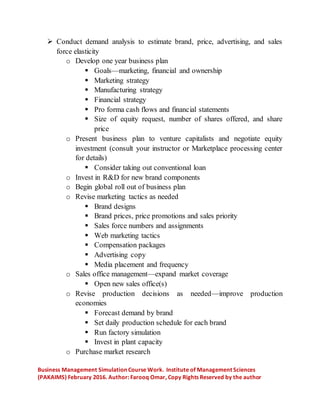
 Conduct demand analysis to estimate brand, price, advertising, and sales
force elasticity
o Develop one year business plan
 Goals—marketing, financial and ownership
 Marketing strategy
 Manufacturing strategy
 Financial strategy
 Pro forma cash flows and financial statements
 Size of equity request, number of shares offered, and share
price
o Present business plan to venture capitalists and negotiate equity
investment (consult your instructor or Marketplace processing center
for details)
 Consider taking out conventional loan
o Invest in R&D for new brand components
o Begin global roll out of business plan
o Revise marketing tactics as needed
 Brand designs
 Brand prices, price promotions and sales priority
 Sales force numbers and assignments
 Web marketing tactics
 Compensation packages
 Advertising copy
 Media placement and frequency
o Sales office management—expand market coverage
 Open new sales office(s)
o Revise production decisions as needed—improve production
economies
 Forecast demand by brand
 Set daily production schedule for each brand
 Run factory simulation
 Invest in plant capacity
o Purchase market research
Business Management Simulation Course Work. Institute of Management Sciences
(PAKAIMS) February 2016. Author: Farooq Omar, Copy Rights Reserved by the author
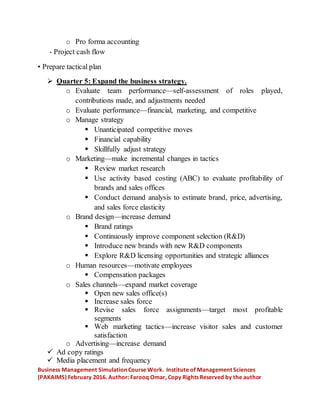
o Pro forma accounting
- Project cash flow
• Prepare tactical plan
 Quarter 5: Expand the business strategy.
o Evaluate team performance—self-assessment of roles played,
contributions made, and adjustments needed
o Evaluate performance—financial, marketing, and competitive
o Manage strategy
 Unanticipated competitive moves
 Financial capability
 Skillfully adjust strategy
o Marketing—make incremental changes in tactics
 Review market research
 Use activity based costing (ABC) to evaluate profitability of
brands and sales offices
 Conduct demand analysis to estimate brand, price, advertising,
and sales force elasticity
o Brand design—increase demand
 Brand ratings
 Continuously improve component selection (R&D)
 Introduce new brands with new R&D components
 Explore R&D licensing opportunities and strategic alliances
o Human resources—motivate employees
 Compensation packages
o Sales channels—expand market coverage
 Open new sales office(s)
 Increase sales force
 Revise sales force assignments—target most profitable
segments
 Web marketing tactics—increase visitor sales and customer
satisfaction
o Advertising—increase demand
 Ad copy ratings
 Media placement and frequency
Business Management Simulation Course Work. Institute of Management Sciences
(PAKAIMS) February 2016. Author: Farooq Omar, Copy Rights Reserved by the author
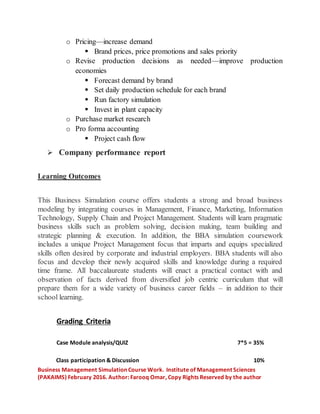
o Pricing—increase demand
 Brand prices, price promotions and sales priority
o Revise production decisions as needed—improve production
economies
 Forecast demand by brand
 Set daily production schedule for each brand
 Run factory simulation
 Invest in plant capacity
o Purchase market research
o Pro forma accounting
 Project cash flow
 Company performance report
Learning Outcomes
This Business Simulation course offers students a strong and broad business
modeling by integrating courses in Management, Finance, Marketing, Information
Technology, Supply Chain and Project Management. Students will learn pragmatic
business skills such as problem solving, decision making, team building and
strategic planning & execution. In addition, the BBA simulation coursework
includes a unique Project Management focus that imparts and equips specialized
skills often desired by corporate and industrial employers. BBA students will also
focus and develop their newly acquired skills and knowledge during a required
time frame. All baccalaureate students will enact a practical contact with and
observation of facts derived from diversified job centric curriculum that will
prepare them for a wide variety of business career fields – in addition to their
school learning.
Grading Criteria
Case Module analysis/QUIZ 7*5 = 35%
Class participation & Discussion 10%
Business Management Simulation Course Work. Institute of Management Sciences
(PAKAIMS) February 2016. Author: Farooq Omar, Copy Rights Reserved by the author
Assignments (Module Presentations)
Mid Term 20%
Modular Presentation (Individual) 05%
Final Examination 30%
______
Total 100
Note: All material and knowledge resource will be provided by the
faculty. Due to the nature of the course, try to avoid class ‘bunks’ and
late comers will suffer. No delayed work will be entertained unless it is
approved by the (IMS) Dean and the PAKAIMS Registrar.
Prepared by Farooq Omar

Business management Simulation Course

  • 1.
    Business Management SimulationCourse Work. Institute of Management Sciences (PAKAIMS) February 2016. Author: Farooq Omar, Copy Rights Reserved by the author Business Management Simulations - replacement Course Semester: Spring 2016 Instructor: Farooq Omar Course description and intent Dispense the opening to acquire indefensible hands-on real-time experience in running a business as a member of middle to high ranked functional management team. Students define craft and implement strategies and apply strategic concepts, develop tools and techniques within a practical ‘simulated business like decision based platform. The simulation demonstrates and establish how a firm's entire value chain function and operate and interact, and how key decisions influence business performance within a competitive market space and beyond. Students compete simultaneously with fellow classmates and student management teams organized within the class. This course is designed as ‘self-evolving’ modules which flow as integrative growth involving step by step disciplines around real time scenarios. The students as ‘teams’ compete with each other in development of managerial expertise and skills needed to be an effective managers, planners, and decision makers based on Business Analytics and Modeling concepts, which are the key applied requisites of any corporate and industrial arena
  • 2.
    Business Management SimulationCourse Work. Institute of Management Sciences (PAKAIMS) February 2016. Author: Farooq Omar, Copy Rights Reserved by the author The following framework for business simulation will be used to inculcate real- time assessments, critical and creative thinking into developing business processes & value chain to run and create growth oriented business entity. Decisions by Quarter – Business Development & Management Simulation Quarter 1: Organize the firm and setup shop.  Determine desired image of company o Designate a company name  Focus on process of working as a team to achieve goals o Assess team skills, and work styles, and then assign corporate responsibilities o Determine how to manage the organization and establish group norms  Review market survey results—evaluate segments, markets, and potential competition o Analyze market opportunities  Establish corporate goals and strategic direction o Select target segments o Write mission statement o Specify and rank order corporate goals o Establish strategic direction  Sell 2 million in stock to executive team  Create customer value—match components to benefits (Quality Function Deployment) o Design a brand for each target segment  Select test market o Open first sales office o Open a web center (Optional)  Setup manufacturing operations  Invest in plant capacity
  • 3.
    Business Management SimulationCourse Work. Institute of Management Sciences (PAKAIMS) February 2016. Author: Farooq Omar, Copy Rights Reserved by the author Quarter 2: Go to test market. o Sell 1 million in stock to executive team o Human resources  Establish sales force compensation package  Establish factory worker compensation package o Sales office management  Hire sales people—assign to segments  Open new sales offices (Optional)  Hire and assign web center staff (If applicable)  Select web traffic and productivity tactics (If applicable) o Brand design  Revise brand designs for test market (Optional) o Advertising  Ad copy design  Media placement and ad frequency o Pricing  Designate brands available for sale  Set brand prices—price promotions  Set sales priority o Manufacturing  Estimate demand per sales person  Schedule daily production  Run factory simulation  Invest in plant capacity (Optional) o Purchase market research o Pro forma accounting o Project cash flow Quarter 3: Skillful adjustment and market expansion.  Evaluate financial performance
  • 4.
    Business Management SimulationCourse Work. Institute of Management Sciences (PAKAIMS) February 2016. Author: Farooq Omar, Copy Rights Reserved by the author  Profitability analysis  Evaluate market performance  Customer opinion—brand designs, prices and advertising  Market demand—by company, brand and per sales person  Sell 1 million in stock to executive team  Revise marketing tactics as needed, and continue test marketing  Brand designs  Brand prices, price promotions and sales priority  Sales force numbers and assignments  Web marketing tactics  Compensation packages  Advertising copy  Media placement and frequency  Sales office management  Open new sales office (Optional)  Establish production plan for quarter  Review production results from previous quarter  Forecast demand by brand  Set daily production schedule for each brand  Run factory simulation  Invest in plant capacity (Optional)  Purchase market research  Pro forma accounting  Project cash flow  Quarter 4: Invest in the future.  Evaluate financial performance  Use activity based costing (ABC) to evaluate profitability of brands and sales offices o Evaluate market performance  Customer opinion—brand designs, prices and advertising  Market demand—by company, brand and per sales person  Competitor tactics—segments targeted and selection of marketing tactics
  • 5.
    Business Management SimulationCourse Work. Institute of Management Sciences (PAKAIMS) February 2016. Author: Farooq Omar, Copy Rights Reserved by the author  Conduct demand analysis to estimate brand, price, advertising, and sales force elasticity o Develop one year business plan  Goals—marketing, financial and ownership  Marketing strategy  Manufacturing strategy  Financial strategy  Pro forma cash flows and financial statements  Size of equity request, number of shares offered, and share price o Present business plan to venture capitalists and negotiate equity investment (consult your instructor or Marketplace processing center for details)  Consider taking out conventional loan o Invest in R&D for new brand components o Begin global roll out of business plan o Revise marketing tactics as needed  Brand designs  Brand prices, price promotions and sales priority  Sales force numbers and assignments  Web marketing tactics  Compensation packages  Advertising copy  Media placement and frequency o Sales office management—expand market coverage  Open new sales office(s) o Revise production decisions as needed—improve production economies  Forecast demand by brand  Set daily production schedule for each brand  Run factory simulation  Invest in plant capacity o Purchase market research
  • 6.
    Business Management SimulationCourse Work. Institute of Management Sciences (PAKAIMS) February 2016. Author: Farooq Omar, Copy Rights Reserved by the author o Pro forma accounting - Project cash flow • Prepare tactical plan  Quarter 5: Expand the business strategy. o Evaluate team performance—self-assessment of roles played, contributions made, and adjustments needed o Evaluate performance—financial, marketing, and competitive o Manage strategy  Unanticipated competitive moves  Financial capability  Skillfully adjust strategy o Marketing—make incremental changes in tactics  Review market research  Use activity based costing (ABC) to evaluate profitability of brands and sales offices  Conduct demand analysis to estimate brand, price, advertising, and sales force elasticity o Brand design—increase demand  Brand ratings  Continuously improve component selection (R&D)  Introduce new brands with new R&D components  Explore R&D licensing opportunities and strategic alliances o Human resources—motivate employees  Compensation packages o Sales channels—expand market coverage  Open new sales office(s)  Increase sales force  Revise sales force assignments—target most profitable segments  Web marketing tactics—increase visitor sales and customer satisfaction o Advertising—increase demand  Ad copy ratings  Media placement and frequency
  • 7.
    Business Management SimulationCourse Work. Institute of Management Sciences (PAKAIMS) February 2016. Author: Farooq Omar, Copy Rights Reserved by the author o Pricing—increase demand  Brand prices, price promotions and sales priority o Revise production decisions as needed—improve production economies  Forecast demand by brand  Set daily production schedule for each brand  Run factory simulation  Invest in plant capacity o Purchase market research o Pro forma accounting  Project cash flow  Company performance report Learning Outcomes This Business Simulation course offers students a strong and broad business modeling by integrating courses in Management, Finance, Marketing, Information Technology, Supply Chain and Project Management. Students will learn pragmatic business skills such as problem solving, decision making, team building and strategic planning & execution. In addition, the BBA simulation coursework includes a unique Project Management focus that imparts and equips specialized skills often desired by corporate and industrial employers. BBA students will also focus and develop their newly acquired skills and knowledge during a required time frame. All baccalaureate students will enact a practical contact with and observation of facts derived from diversified job centric curriculum that will prepare them for a wide variety of business career fields – in addition to their school learning. Grading Criteria Case Module analysis/QUIZ 7*5 = 35% Class participation & Discussion 10%
  • 8.
    Business Management SimulationCourse Work. Institute of Management Sciences (PAKAIMS) February 2016. Author: Farooq Omar, Copy Rights Reserved by the author Assignments (Module Presentations) Mid Term 20% Modular Presentation (Individual) 05% Final Examination 30% ______ Total 100 Note: All material and knowledge resource will be provided by the faculty. Due to the nature of the course, try to avoid class ‘bunks’ and late comers will suffer. No delayed work will be entertained unless it is approved by the (IMS) Dean and the PAKAIMS Registrar. Prepared by Farooq Omar