The GREAT
	way to grow
	Small businesses share
		 their advice
Live for the moment,
plan for the future
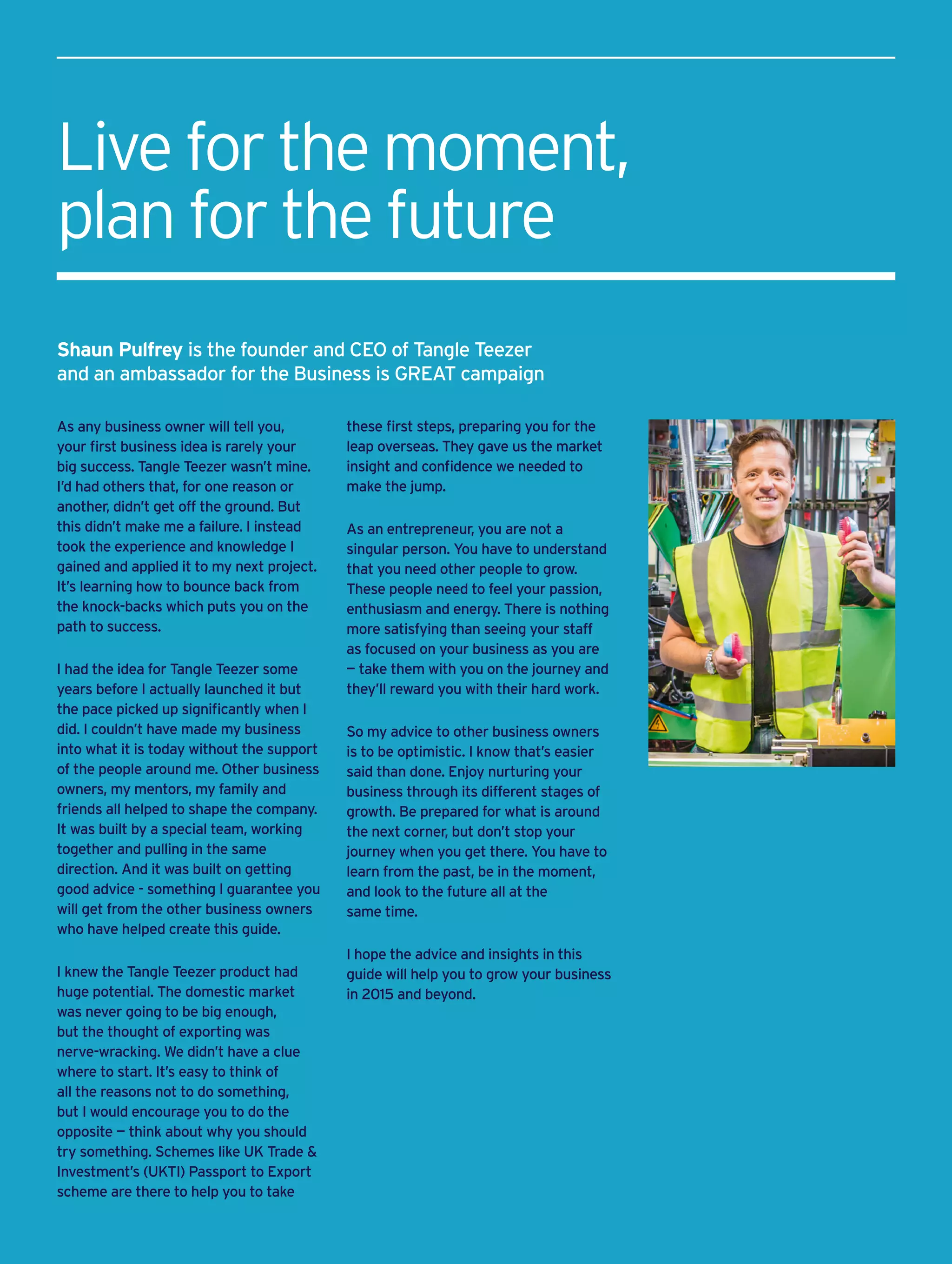
Shaun Pulfrey is the founder and CEO of Tangle Teezer
and an ambassador for the Business is GREAT campaign
As any business owner will tell you,
your first business idea is rarely your
big success. Tangle Teezer wasn’t mine.
I’d had others that, for one reason or
another, didn’t get off the ground. But
this didn’t make me a failure. I instead
took the experience and knowledge I
gained and applied it to my next project.
It’s learning how to bounce back from
the knock-backs which puts you on the
path to success.
I had the idea for Tangle Teezer some
years before I actually launched it but
the pace picked up significantly when I
did. I couldn’t have made my business
into what it is today without the support
of the people around me. Other business
owners, my mentors, my family and
friends all helped to shape the company.
It was built by a special team, working
together and pulling in the same
direction. And it was built on getting
good advice - something I guarantee you
will get from the other business owners
who have helped create this guide.
I knew the Tangle Teezer product had
huge potential. The domestic market
was never going to be big enough,
but the thought of exporting was
nerve-wracking. We didn’t have a clue
where to start. It’s easy to think of
all the reasons not to do something,
but I would encourage you to do the
opposite — think about why you should
try something. Schemes like UK Trade &
Investment’s (UKTI) Passport to Export
scheme are there to help you to take
these first steps, preparing you for the
leap overseas. They gave us the market
insight and confidence we needed to
make the jump.
As an entrepreneur, you are not a
singular person. You have to understand
that you need other people to grow.
These people need to feel your passion,
enthusiasm and energy. There is nothing
more satisfying than seeing your staff
as focused on your business as you are
— take them with you on the journey and
they’ll reward you with their hard work.
So my advice to other business owners
is to be optimistic. I know that’s easier
said than done. Enjoy nurturing your
business through its different stages of
growth. Be prepared for what is around
the next corner, but don’t stop your
journey when you get there. You have to
learn from the past, be in the moment,
and look to the future all at the
same time.
I hope the advice and insights in this
guide will help you to grow your business
in 2015 and beyond.
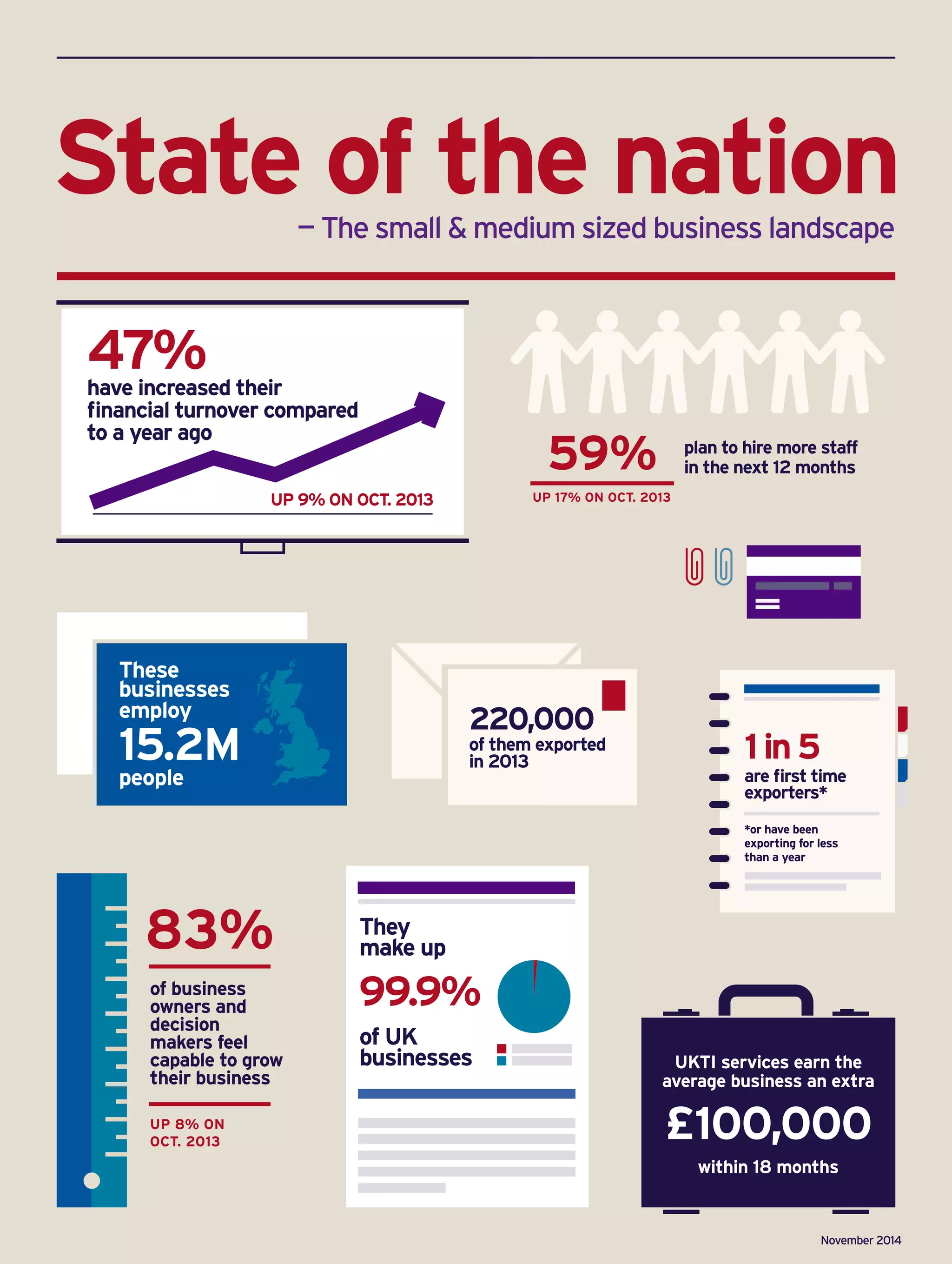
plan to hire more staff
in the next 12 months
­— The small & medium sized business landscape
of them exported
in 2013
are first time
exporters*
They
make up
99.9%
83%
of UK
businesses
of business
owners and
decision
makers feel
capable to grow
their business
These
businesses
employ
15.2M
people
*or have been
exporting for less
than a year
UKTI services earn the
average business an extra
£100,000
within 18 months
1 in 5
220,000
47%have increased their
financial turnover compared
to a year ago
UP 9% ON OCT. 2013 UP 17% ON OCT. 2013
UP 8% ON
OCT. 2013
59%
State of the nation
November 2014
Where to
begin
“A hotbed of useful information can be found at The British
Library’s Business & IP Centre and it’s free! Research and
knowledge is worth its weight in gold when starting up and
growing your business. It can lead to new potential sources of
revenue. Continually research; you will learn more about your
customer and identify potential new markets for expansion,”
says Amelia Rope, founder of Amelia Rope Chocolates, who
works closely with UKTI to take her luxury product overseas.
“Plan your growth carefully and remain in control. We always
look forward three years and know what we need to do, what
machines we’re going to buy and what training our teams
need,” says Chris Batty, from Lestercast, which uses the
Manufacturing Advisory Service (MAS), part of the Business
Growth Service, on strategy and process improvement for
their precision investment castings business.
“Try not get too caught up with all the small things you have
to do to get started. Everything can be figured out. Break it all
down into simple steps and just get going,” says Cara Sayer,
founder of SnoozeShade, an infant sleep shade company from
Surrey, which used GrowthAccelerator business development
coaching, part of the Business Growth Service.
Building your business can be overwhelming and it can be difficult
to know where to start. Every small business has its preferred route,
but here are the thoughts of some successful entrepreneurs:
It’s not enough to
know your own
product inside
out; you need to
understand the market
it will sit in, including
your customers,
competitors, retailers,
experts and the media.
“
“
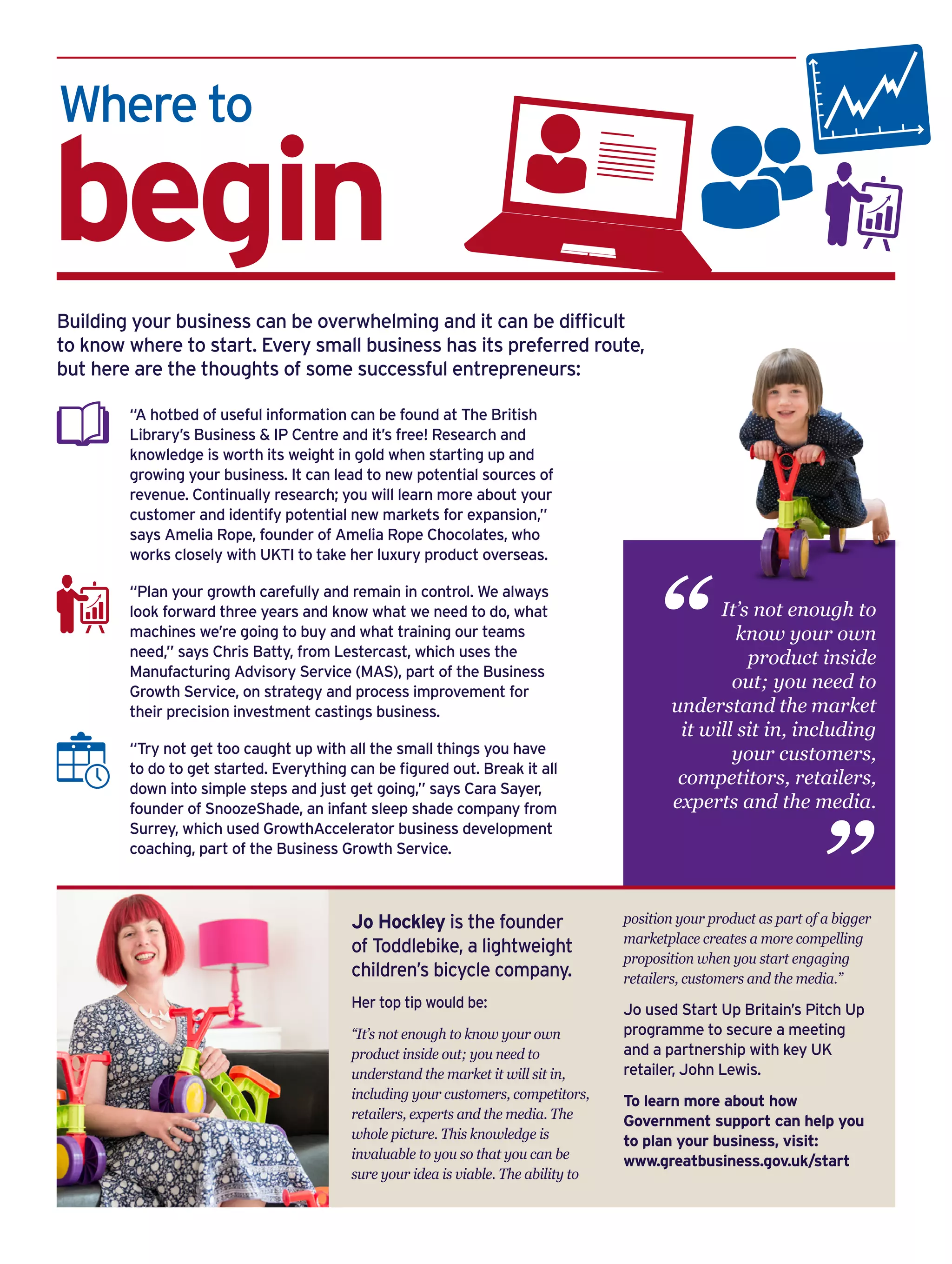
Jo Hockley is the founder
of Toddlebike, a lightweight
children’s bicycle company.
Her top tip would be:
“It’s not enough to know your own
product inside out; you need to
understand the market it will sit in,
including your customers, competitors,
retailers, experts and the media. The
whole picture. This knowledge is
invaluable to you so that you can be
sure your idea is viable. The ability to
position your product as part of a bigger
marketplace creates a more compelling
proposition when you start engaging
retailers, customers and the media.”
Jo used Start Up Britain’s Pitch Up
programme to secure a meeting
and a partnership with key UK
retailer, John Lewis.
To learn more about how
Government support can help you
to plan your business, visit:
www.greatbusiness.gov.uk/start
The
Biggerpicture
“Always think five years ahead. Don’t restrict yourself to the
next 12 months or you will stunt your own growth,” explains
Carla Garey, founder of Derbyshire-based Saffron Catering,
who used Growth Vouchers support to serve a wider Midlands
market, now extending from Manchester to Milton Keynes.
“Invest in market research. It was the best thing we did and
something I would always recommend to any business looking
to expand overseas. You want as much feedback as possible,
the good, the bad and the ugly! It gives you invaluable insight
into your potential market, helps you focus your efforts
ultimately saving you money in the long run,” says Una
Driscoll, founder of Belt up Kidz, a child-safety buckle, which
uses UKTI support to reach markets from China to Central
Europe.
“Focus on what your target consumer wants, allow them to
help shape your products by listening to feedback, and if your
product does not get high rating reviews, make a change.
By knowing your USP, forming a clear plan and regularly
reviewing it, you’ll stay one step ahead,” recommends Rob
Law, founder of Trunki, the children’s luggage company, which
has benefitted from research and development (R&D) tax
credits and UKTI’s Passport to Export scheme.
As your business grows, it’s important to take
a step back, assess how far you’ve come and
decide where to go next. Below a few businesses
explain why.
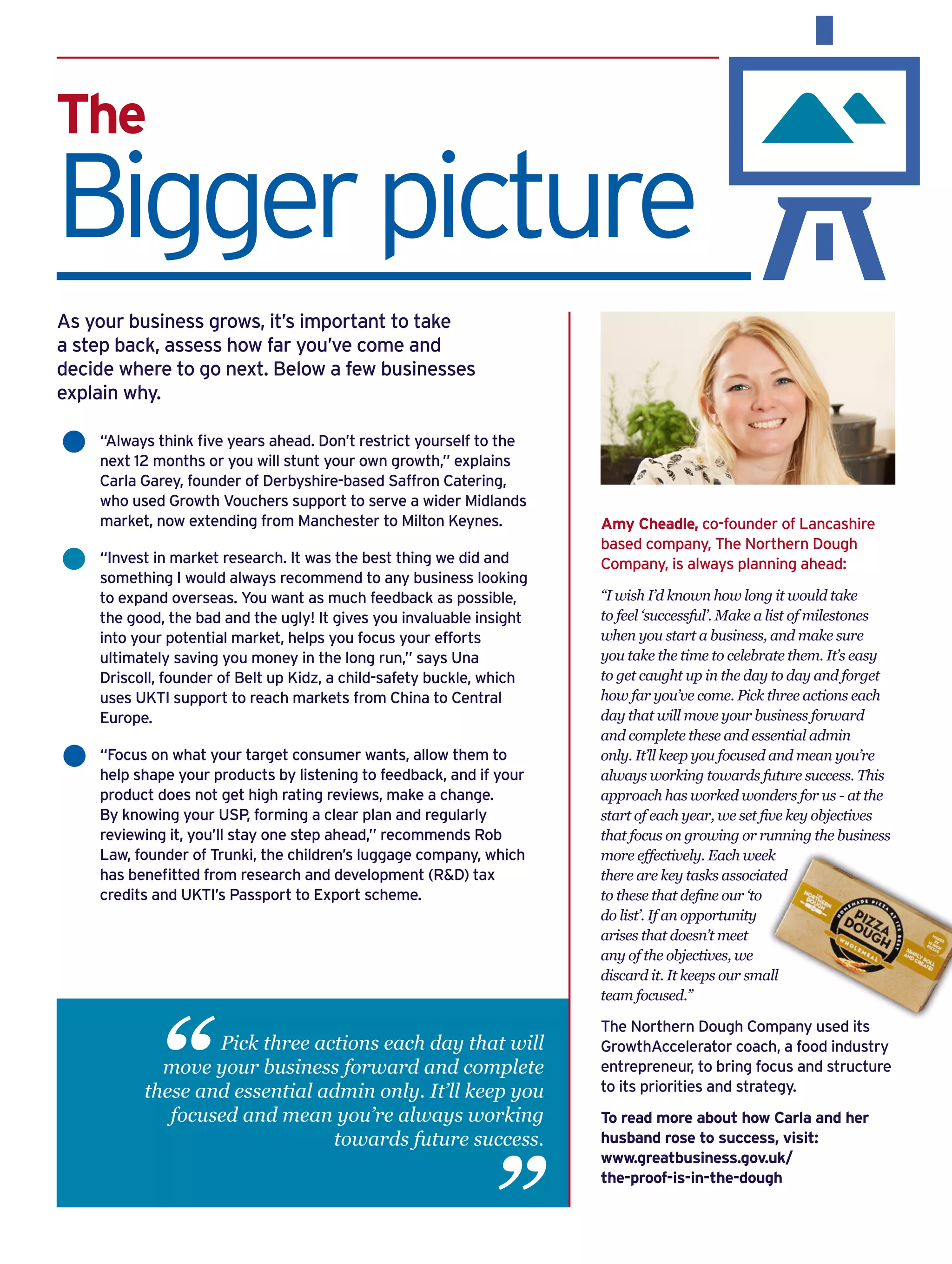
Amy Cheadle, co-founder of Lancashire
based company, The Northern Dough
Company, is always planning ahead:
“I wish I’d known how long it would take
to feel ‘successful’. Make a list of milestones
when you start a business, and make sure
you take the time to celebrate them. It’s easy
to get caught up in the day to day and forget
how far you’ve come. Pick three actions each
day that will move your business forward
and complete these and essential admin
only. It’ll keep you focused and mean you’re
always working towards future success. This
approach has worked wonders for us - at the
start of each year, we set five key objectives
that focus on growing or running the business
more effectively. Each week
there are key tasks associated
to these that define our ‘to
do list’. If an opportunity
arises that doesn’t meet
any of the objectives, we
discard it. It keeps our small
team focused.”
The Northern Dough Company used its
GrowthAccelerator coach, a food industry
entrepreneur, to bring focus and structure
to its priorities and strategy.
To read more about how Carla and her
husband rose to success, visit:
www.greatbusiness.gov.uk/
the-proof-is-in-the-dough
Pick three actions each day that will
move your business forward and complete
these and essential admin only. It’ll keep you
focused and mean you’re always working
towards future success.
“ “
Financial
backing
Mike Pickles,
founder and CEO of
Really Useful Products.
Mike received £4 million of
investment from the Regional Growth
Fund says:
“Help your bank to understand your
business and explain how investment
will lead to growth. I have meetings
at regular intervals when the business
is changing. For my company, this is
monthly.. I keep them informed of our
evolving strategy and ask them for
a financial steer. I wouldn’t make an
important financial decision without
passing it through them for
an opinion.”
To read more about how best
to access and manage small
business finance, visit
www.greatbusiness.gov.uk/finance
Stephen Rapoport, founder of
Pact Coffee, accessed R&D tax
credits and the Enterprise Investment
Scheme (EIS) to help secure
investors’ support:
“When looking for investors, make sure
they understand your vision deeply
enough to really, truly challenge you on
it. If they don’t, you’re just raising money
from them and not getting any other
insight beyond that. EIS is one of the most
valuable things that the Government
has done to support early-stage, high-
innovation companies. It’s a tax break
that encourages successful people to
support other aspirant, successful people
and something I suggest every business
looks into.”
“It’s so easy to get caught up in developing various aspects of the
business and forget the most fundamental part. Business is about
taking a great product to market at a price which is right for the
product and the customer”, says Nancy Johnston, CEO of Fairtrade
wool clothing designer, Tengri. It received support from the Business
Growth Service to help her develop her business model and give her
guidance on how manufacturing works.
“It is great to have bold aims, but working them out financially will
determine how realistic they are. With firm financial foundations,
the company and its people can really believe what is possible and
be more committed to achieving these goals. Keep track of the
actual achievement — evaluation of your work is as valuable as
the job itself,” explains Martin Adams, a specialist in growth and
development from Routes to Growth.
Accessing and managing finance is something small business owners deal
with every day. Here’s how some approach this:
“Invest, don’t spend. You need to think about the
long term and nurturing a business that can grow,”
says Karen Lynch, CEO of Belu Water.
£
Adam Sopher, co-founder
of family-run popcorn brand
Joe & Seph’s.
Adam accessed UKTI’s Passport to
Export and has attended a Japanese
trade mission. He explains how peer
to peer support helped him:
“Reach and teach – take advice from
others and pass on your knowledge
to your peers. In the early days I
found listening to the stories of other
businesses very helpful. It does not
mean that your journey will be exactly
the same, but it equips you with a better
understanding of how to proceed and
what to expect.”
To read more stories of successful
growth from small business owners
and learn how Government can help
you to grow, visit:
www.greatbusiness.gov.uk
“Attend UKTI events. They can really support your growth,” says Emily
Brooke, CEO of bicycle light manufacturer Blaze. “I have been to the
GREAT Festival of Creativity in Istanbul with Founders Forum, the
GREAT Business Exhibition in Liverpool, at which I presented Blaze to
the Prime Minister, and on a trade mission to South Africa. Getting out
there to events can really help put your business on the map”
”You don’t know what you don’t know, so engage with others who
can help and who you can learn from. Equally, your advice might
help another GREAT small business grow,” urges Rachel Eade, an
automotive specialist adviser for MAS, part of the Business Growth
Service.
“Surround yourself with people who have expertise in areas you need
help with - people offer you advice because they want you to succeed,”
explains Sarah Haywood, a UKTI Catalyst member who owns her own
eponymous wedding planning and event company. Sarah lectures
across Europe, the Middle East, South Africa, the USA, and Mexico on
the art of her business.
Guidance 			 from others
Support from those around you is invaluable. Using other people
as sounding boards can show you what will work for your business
and help you avoid what won’t.
“Surround yourself with wise owls,” says Alissa Koopal, founder of
baby bangle producer, Izzy Melody Limited. “I’ve always done this
in my career so I can fall back on them for advice and support.”
Take advice
from others and pass
on your knowledge to
your peers. In the early
days I found listening
to the stories of other
businesses very helpful.
“
“
It all comes down to people.
Finding a good team and then
getting the best out of them
— that’s what will make your
business fly.
Stephen Dann, a Growth Coach
from Southampton, advises
businesses on a daily basis and
comments: “Business owners
are often frustrated that their
teams don’t show the same level
of dedication, creativity, energy
and motivation as they do. Don’t
expect your teams to be like you.
If they were, they’d be doing your
job. Embrace different talents
and skills because it will help the
business in the long run.”
“Involve all staff in your growth
plans so your direction and
progress are highly visible. Your
staff will then feel fully invested
in the bigger picture and back
you up with the skills you need
to get there,” says Stuart Burns,
the founder of Dura Composites,
which has received MAS support
regarding financial advice and
help to enter into the offshore
wind and rail markets.
Dr Paul Beven, is the co-
founder of Healix Group.
Healix Group is Europe’s largest
provider of medical evacuation
services to the travel industry.
Starting in 1992 with a team of
three, today, Healix employs more
than 200 staff and is rapidly
expanding overseas with offices
in New Zealand, Australia, Spain,
Greece, Singapore, Kenya and the
USA. Beven says,
“Wherever you can, employ
people who are better than you so
they can shine as the light of the
organisation, and you can
lead them.”
Jane Field, who runs a
successful mail order
business, Jonny’s sister,
knows the value of
apprentices:
“Our apprentices are open,
fresh and they question things.
They make a real impact. I have
removed products which I was
convinced would sell, based on their
reactions. They carry zero baggage,
have a real ‘can do’ approach to
everything, and bring a freshness
that money can’t buy.”
To read more about how to develop
your management skills, visit:
www.greatbusiness.gov.uk/
building-your-management-skills
To learn more about how apprentices
could help your business to grow,
visit: www.greatbusiness.gov.uk/
taking-on-an-apprentice
Your
people
TOP 5
	 BUSINESS TIPS
1. Employ the best
The one invaluable lesson I have learned since
taking on the online food industry is to be the
best you must employ the best. It might sound
obvious, but setting the bar high and placing
people above everything else is harder than
you might imagine.
At Gousto we strictly employ only amazing
talent; offering an environment that nurtures
personal growth and career development,
and giving our team members bucket loads of
responsibility so that everyone is empowered
in some way to drive the business forward.
2. Stay passionate
Another motto I live by is to continually
draw back to the purpose I first founded the
company on; enabling people to eat delicious,
quality food with zero food waste. Doing
something you really care about and truly
value is paramount to building an infallible
company, as that passion will trickle through
to everything you do. The customers will sense
it in the quality of the service and product
you deliver, they will feel it in the way we
communicate and the efforts we go to for
them. If this purpose and passion is integral to
your mission, it will naturally infiltrate every
aspect of your operations.
3. Take a gamble
Do not limit yourself by fearing failure. Dare to
try new things and don’t constrain yourself by
what others might think of you if you fail. Think
big and bold, paying no heed to nagging fears,
concerns or insecurities. Take the long road
and be prepared to take a gamble. It’s a cliché,
but he who dares really does win! When James
and I started Gousto, we took a huge risk. We
left jobs we had been doing for years to do
something we’d never done before, all because
of our passion for food!
4. Trust your team
Try not to micromanage, instead trust the
team you have hired and give them space
to shine. Hire amazing managers, give them
targets and budgets, and cheerlead them on
to victory!
5. Live sustainably
Live sustainably - if you live in the UK, you’re
better off than the other 99% of people in this
world, so do what you can to make the world
a little better. It needn’t be anything huge, but
ultimately this will also make you a happier,
more fulfilled person. This is personal for me
as it is something I care deeply about, but I
genuinely believe it is important for
any business.
At Gousto, we make sure we conserve
electricity and recycle as much as possible.
If you do good things, good will come back to
you, so I really do think this is something worth
investing in.
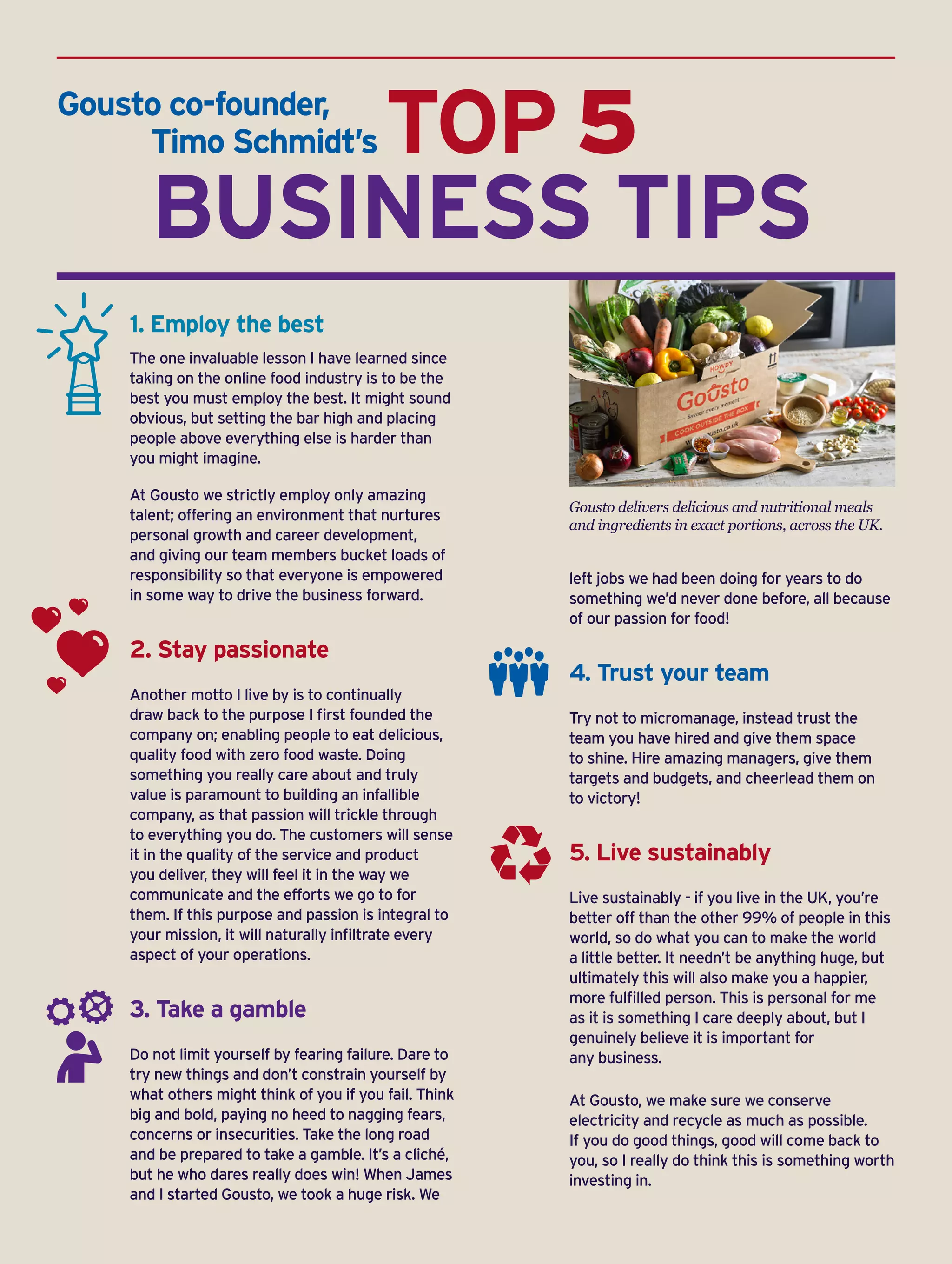
Gousto delivers delicious and nutritional meals
and ingredients in exact portions, across the UK.
Gousto co-founder,
	 Timo Schmidt’s
Innovation
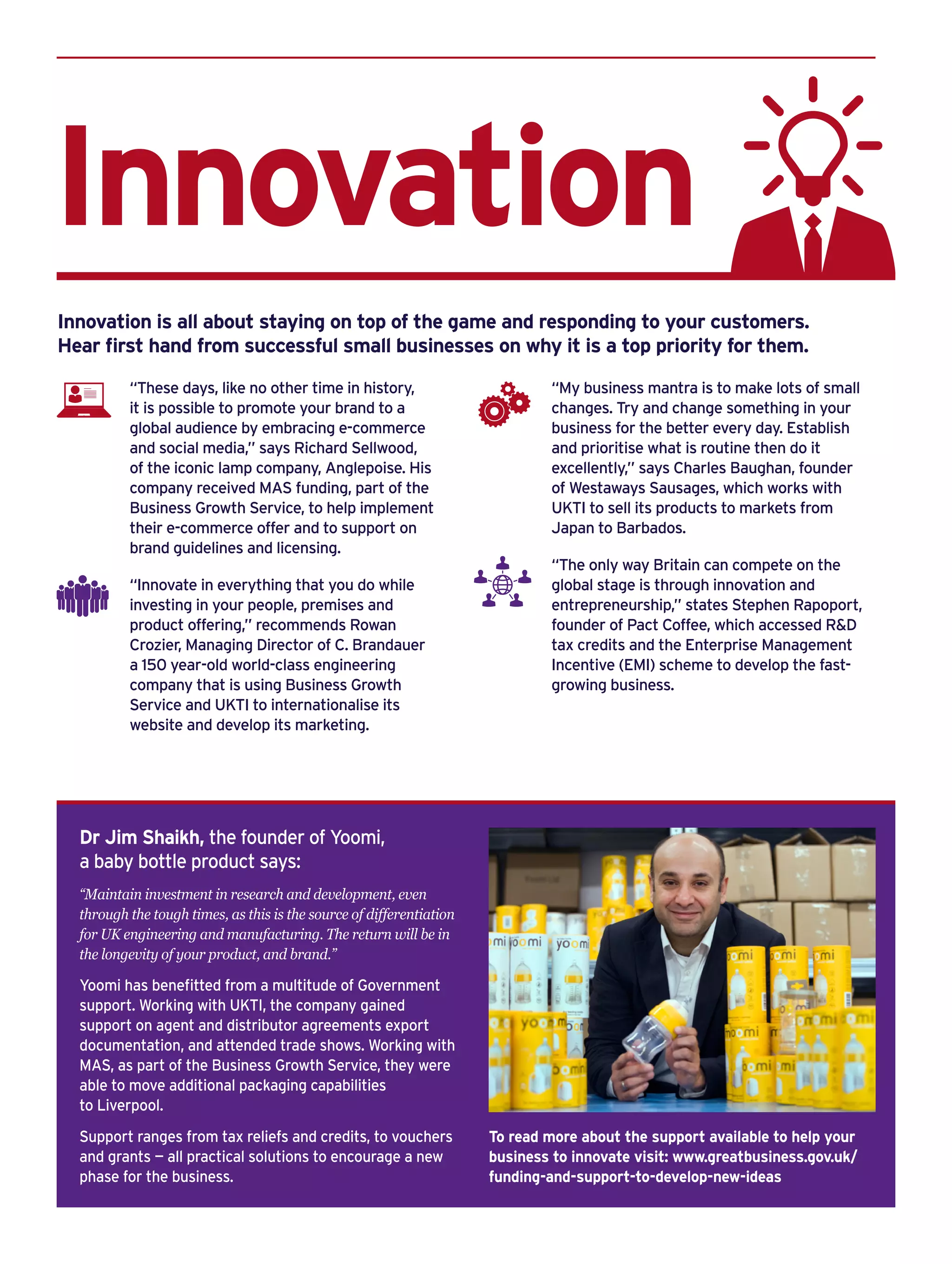
Dr Jim Shaikh, the founder of Yoomi,
a baby bottle product says:
“Maintain investment in research and development, even
through the tough times, as this is the source of differentiation
for UK engineering and manufacturing. The return will be in
the longevity of your product, and brand.”
Yoomi has benefitted from a multitude of Government
support. Working with UKTI, the company gained
support on agent and distributor agreements export
documentation, and attended trade shows. Working with
MAS, as part of the Business Growth Service, they were
able to move additional packaging capabilities
to Liverpool.
Support ranges from tax reliefs and credits, to vouchers
and grants — all practical solutions to encourage a new
phase for the business.
To read more about the support available to help your
business to innovate visit: www.greatbusiness.gov.uk/
funding-and-support-to-develop-new-ideas
Innovation is all about staying on top of the game and responding to your customers.
Hear first hand from successful small businesses on why it is a top priority for them.
“These days, like no other time in history,
it is possible to promote your brand to a
global audience by embracing e-commerce
and social media,” says Richard Sellwood,
of the iconic lamp company, Anglepoise. His
company received MAS funding, part of the
Business Growth Service, to help implement
their e-commerce offer and to support on
brand guidelines and licensing.
“Innovate in everything that you do while
investing in your people, premises and
product offering,” recommends Rowan
Crozier, Managing Director of C. Brandauer
a 150 year-old world-class engineering
company that is using Business Growth
Service and UKTI to internationalise its
website and develop its marketing.
“My business mantra is to make lots of small
changes. Try and change something in your
business for the better every day. Establish
and prioritise what is routine then do it
excellently,” says Charles Baughan, founder
of Westaways Sausages, which works with
UKTI to sell its products to markets from
Japan to Barbados.
“The only way Britain can compete on the
global stage is through innovation and
entrepreneurship,” states Stephen Rapoport,
founder of Pact Coffee, which accessed R&D
tax credits and the Enterprise Management
Incentive (EMI) scheme to develop the fast-
growing business.
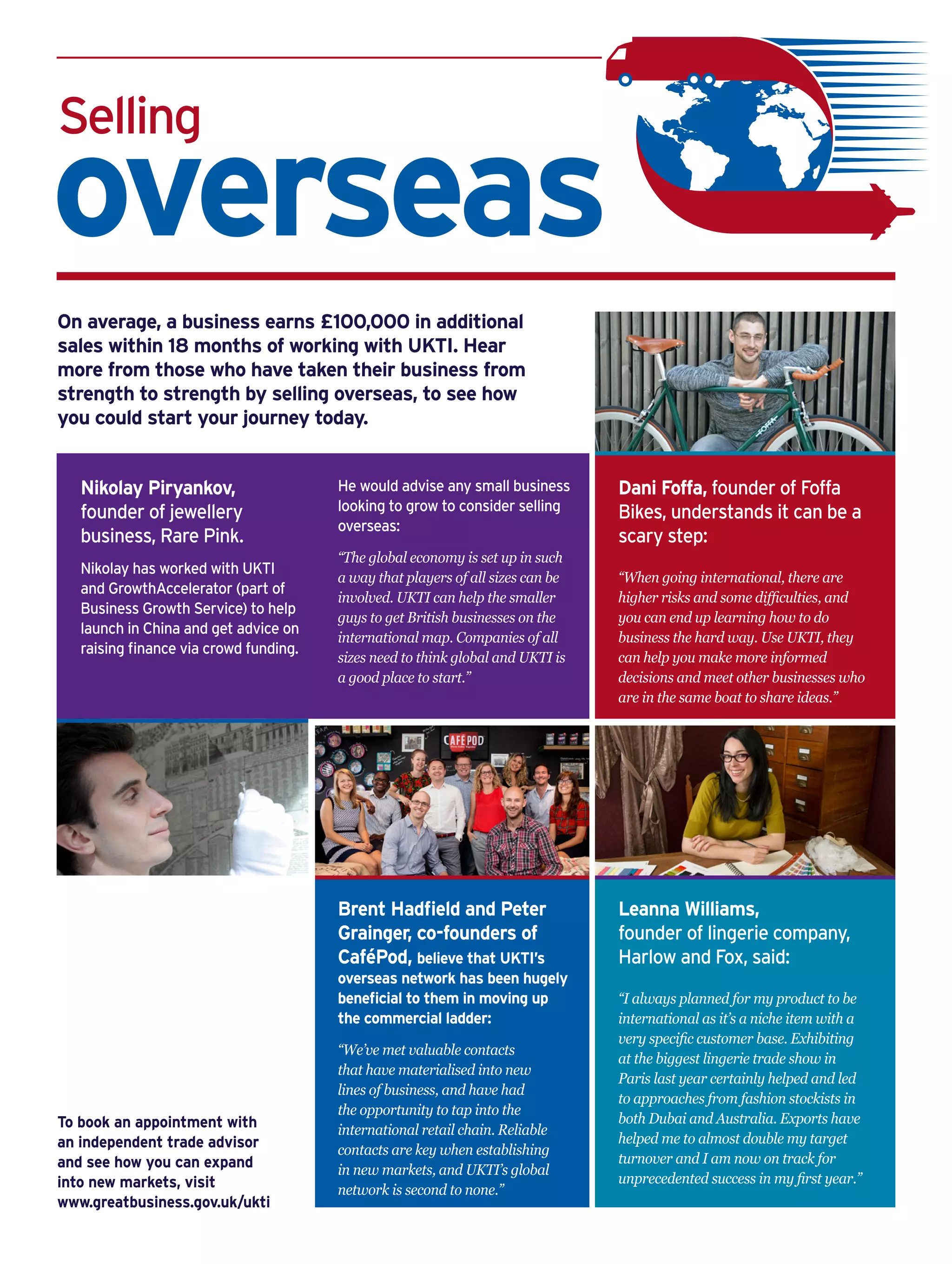
Selling
overseas
On average, a business earns £100,000 in additional
sales within 18 months of working with UKTI. Hear
more from those who have taken their business from
strength to strength by selling overseas, to see how
you could start your journey today.
Brent Hadfield and Peter
Grainger, co-founders of
CaféPod, believe that UKTI’s
overseas network has been hugely
beneficial to them in moving up
the commercial ladder:
“We’ve met valuable contacts
that have materialised into new
lines of business, and have had
the opportunity to tap into the
international retail chain. Reliable
contacts are key when establishing
in new markets, and UKTI’s global
network is second to none.”
Leanna Williams,
founder of lingerie company,
Harlow and Fox, said:
“I always planned for my product to be
international as it’s a niche item with a
very specific customer base. Exhibiting
at the biggest lingerie trade show in
Paris last year certainly helped and led
to approaches from fashion stockists in
both Dubai and Australia. Exports have
helped me to almost double my target
turnover and I am now on track for
unprecedented success in my first year.”
Dani Foffa, founder of Foffa
Bikes, understands it can be a
scary step:
“When going international, there are
higher risks and some difficulties, and
you can end up learning how to do
business the hard way. Use UKTI, they
can help you make more informed
decisions and meet other businesses who
are in the same boat to share ideas.”
To book an appointment with
an independent trade advisor
and see how you can expand
into new markets, visit
www.greatbusiness.gov.uk/ukti
Nikolay Piryankov,
founder of jewellery
business, Rare Pink.
Nikolay has worked with UKTI
and GrowthAccelerator (part of
Business Growth Service) to help
launch in China and get advice on
raising finance via crowd funding.
He would advise any small business
looking to grow to consider selling
overseas:
“The global economy is set up in such
a way that players of all sizes can be
involved. UKTI can help the smaller
guys to get British businesses on the
international map. Companies of all
sizes need to think global and UKTI is
a good place to start.”
Sticking to your
	 values
If you are expanding rapidly, you can sometimes
forget why you started the business in the first
place. Here’s how some founders try to stay on track:
“Remember the passion you had at the beginning, why
you’re doing this business, and then try to deliver that
every day,” says Marcus Whittington, Director of Bath
Boutique Stays, a luxury holiday accommodation rental
company. He received Growth Vouchers to help identify
new markets and customers.
“Believe in your ability to do what you are passionate
about: trust your instincts,” says Catherine Spink,
founder of Neon Creations, who used the Innovation
Voucher Scheme to fund market research in Manchester,
to establish a route to market for their new products.
“Persistence and determination are the two key qualities
needed to get your business off the ground,” says Sandy
Ruddock, founder of Scarlett & Mustard. They have
received many types of Government support including
grants from MAS, UKTI’s Passport to Export programme
and just taken on an apprentice. As a result, their
company grew by 300% in 2013, and in 2014, turnover
nearly doubled.
“Remember why you wanted to start your business. What
does it mean to you, what are your values and goals and
then plan how you intend to reach them,” advises Tina
Goldsmith, founder of Snuggle Sacs, an award-winning
small business, with products distributed across 12
countries and an exclusive Harry Potter licensing deal.
“Stick to being the best in the world at one thing. Don’t
get distracted from one very clear goal. Ours is to
become the global brand for children’s travel products.
We won’t make toys, or adult luggage or anything that
doesn’t fit this one single vision,” says Rob Law, founder
of Trunki.
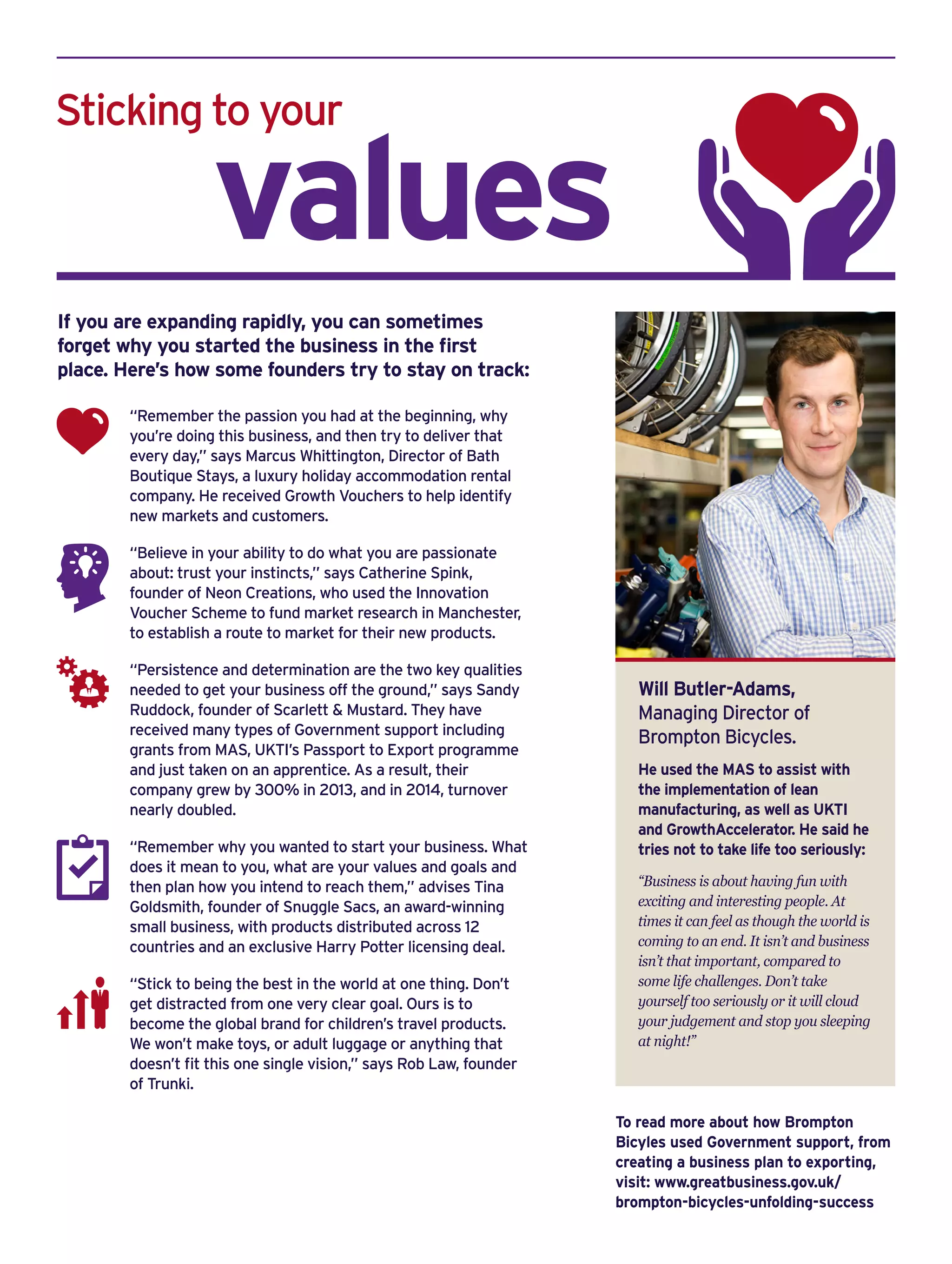
Will Butler-Adams,
Managing Director of
Brompton Bicycles.
He used the MAS to assist with
the implementation of lean
manufacturing, as well as UKTI
and GrowthAccelerator. He said he
tries not to take life too seriously:
“Business is about having fun with
exciting and interesting people. At
times it can feel as though the world is
coming to an end. It isn’t and business
isn’t that important, compared to
some life challenges. Don’t take
yourself too seriously or it will cloud
your judgement and stop you sleeping
at night!”
To read more about how Brompton
Bicyles used Government support, from
creating a business plan to exporting,
visit: www.greatbusiness.gov.uk/
brompton-bicycles-unfolding-success
Advice:
commodity
what a
Sometimes, great advice is all
about timing. What sounds like
a cliché for 364 days can be a
brilliant insight on the 365th.
We have all been told to “do
what you are passionate about.”
But it was only when Stephen
Rapoport, the serial entrepreneur
and founder-CEO of Pact Coffee,
was pondering his fourth business
venture that the power of that
advice hit home.
“My wife told me to ‘stop thinking
like an investor, just do the thing
that you love.’ And I have.” explains
Rapoport. “This business is driven
by a passion and love of coffee, of
flavour, of delighting customers.
As a result, I have a business
many times the size of the others
combined.”
Sometimes, you need to have your
business in the right place before
you can really benefit from great
advice.
In the early days of Brompton
Bicycle, recalls CEO Will Butler-
Adams, “we were charging around
like headless chickens, trying to
sort this and that out but we were
going round and round in circles.
We needed to get our head out of
the mire and think about where we
wanted to go.”
It was only after the team pulled
itself out of this busy-ness
that Brompton understood the
enormous amount of material and
advice that was available to support
its growth. “There is nothing we
are doing that other people haven’t
done before,” says Butler-Adams.
“There are so many companies who
have been where we are going.”
We think of great advice as coming
from experienced folk, from
mentors, professional advisers and
peers who have been there and
done it. But that’s only one aspect.
For many entrepreneurs, the best
advice they receive comes from
only one source - their customers.
For Jane Field, owner of successful
mail order business Jonny’s Sister,
great advice can also come from
her apprentices. “They are open,
fresh and they question things,” she
says. And they make a real impact:
“I have removed products which
I was convinced would sell, based
on their reactions. They carry
zero baggage, have a real ‘can do’
approach to everything, and bring a
freshness that money can’t buy.”
Whenever and from whomever it
comes, get as much good advice as
you can. Your task — and your own
genius — will then be to turn it into
great decisions.
Stuart Rock, Business is GREAT
Editor in Chief.
It is always in demand — and its supply is inexhaustible.
For many
entrepreneurs, the
best advice they
receive comes from
only one source -
their customers.
“
“
Sometimes,
you need to have
your business in the
right place before
you can really
benefit from great
advice.
“
“
Whenever
and from
whomever it
comes, get as
much good advice
as you can.
“
“
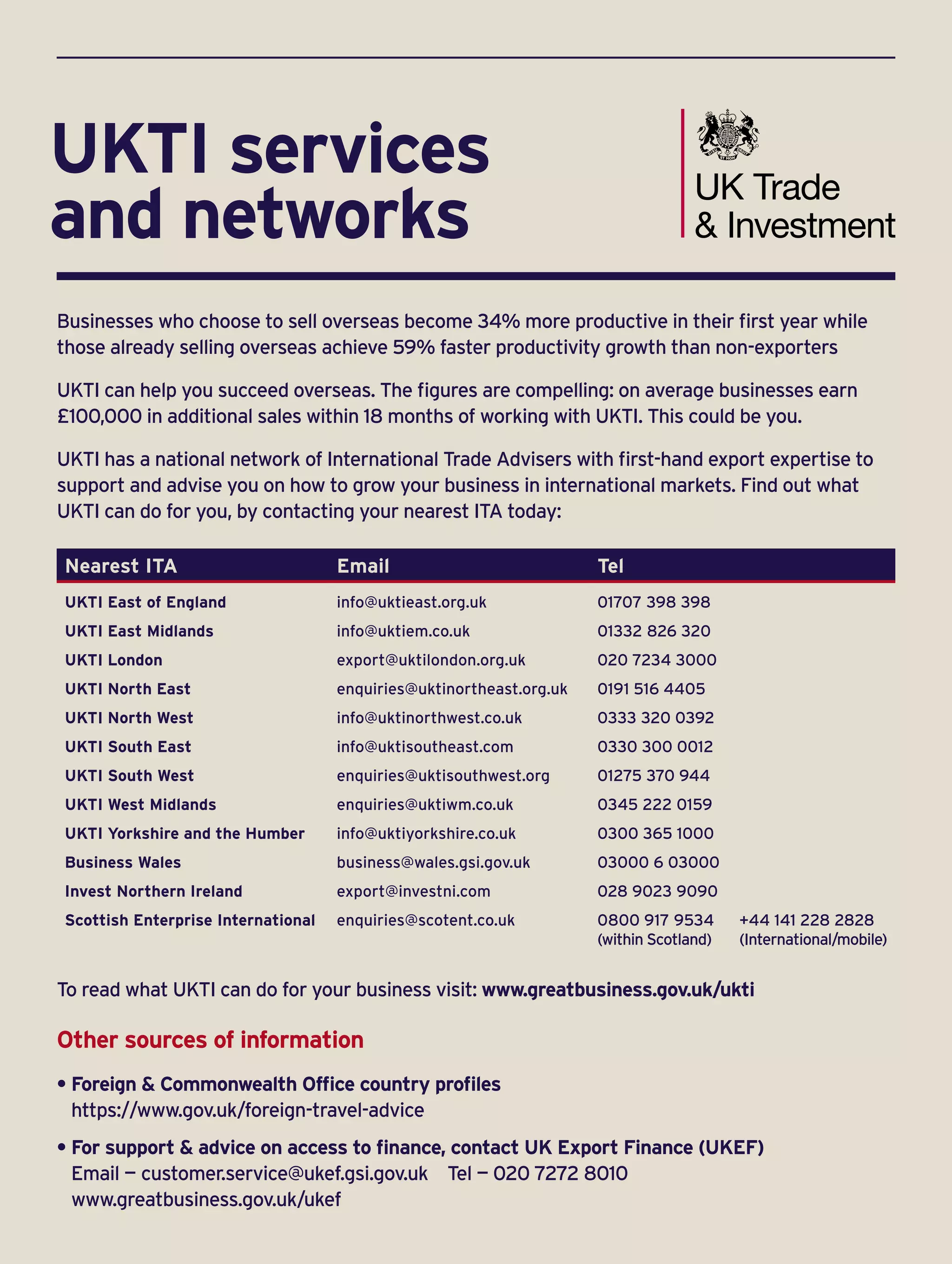
Businesses who choose to sell overseas become 34% more productive in their first year while
those already selling overseas achieve 59% faster productivity growth than non-exporters
UKTI can help you succeed overseas. The figures are compelling: on average businesses earn
£100,000 in additional sales within 18 months of working with UKTI. This could be you.
UKTI has a national network of International Trade Advisers with first-hand export expertise to
support and advise you on how to grow your business in international markets. Find out what
UKTI can do for you, by contacting your nearest ITA today:
Nearest ITA Email Tel
UKTI East of England info@uktieast.org.uk 01707 398 398
UKTI East Midlands info@uktiem.co.uk 01332 826 320
UKTI London export@uktilondon.org.uk 020 7234 3000
UKTI North East enquiries@uktinortheast.org.uk 0191 516 4405
UKTI North West info@uktinorthwest.co.uk 0333 320 0392
UKTI South East info@uktisoutheast.com 0330 300 0012
UKTI South West enquiries@uktisouthwest.org 01275 370 944
UKTI West Midlands enquiries@uktiwm.co.uk 0345 222 0159
UKTI Yorkshire and the Humber info@uktiyorkshire.co.uk 0300 365 1000
Business Wales business@wales.gsi.gov.uk 03000 6 03000
Invest Northern Ireland export@investni.com 028 9023 9090
Scottish Enterprise International enquiries@scotent.co.uk 0800 917 9534 	 +44 141 228 2828
(within Scotland)	 (International/mobile)
To read what UKTI can do for your business visit: www.greatbusiness.gov.uk/ukti
Other sources of information
• Foreign  Commonwealth Office country profiles
https://www.gov.uk/foreign-travel-advice
• For support  advice on access to finance, contact UK Export Finance (UKEF)
Email — customer.service@ukef.gsi.gov.uk Tel — 020 7272 8010
www.greatbusiness.gov.uk/ukef
UKTI services
and networks
Useful sources
of advice
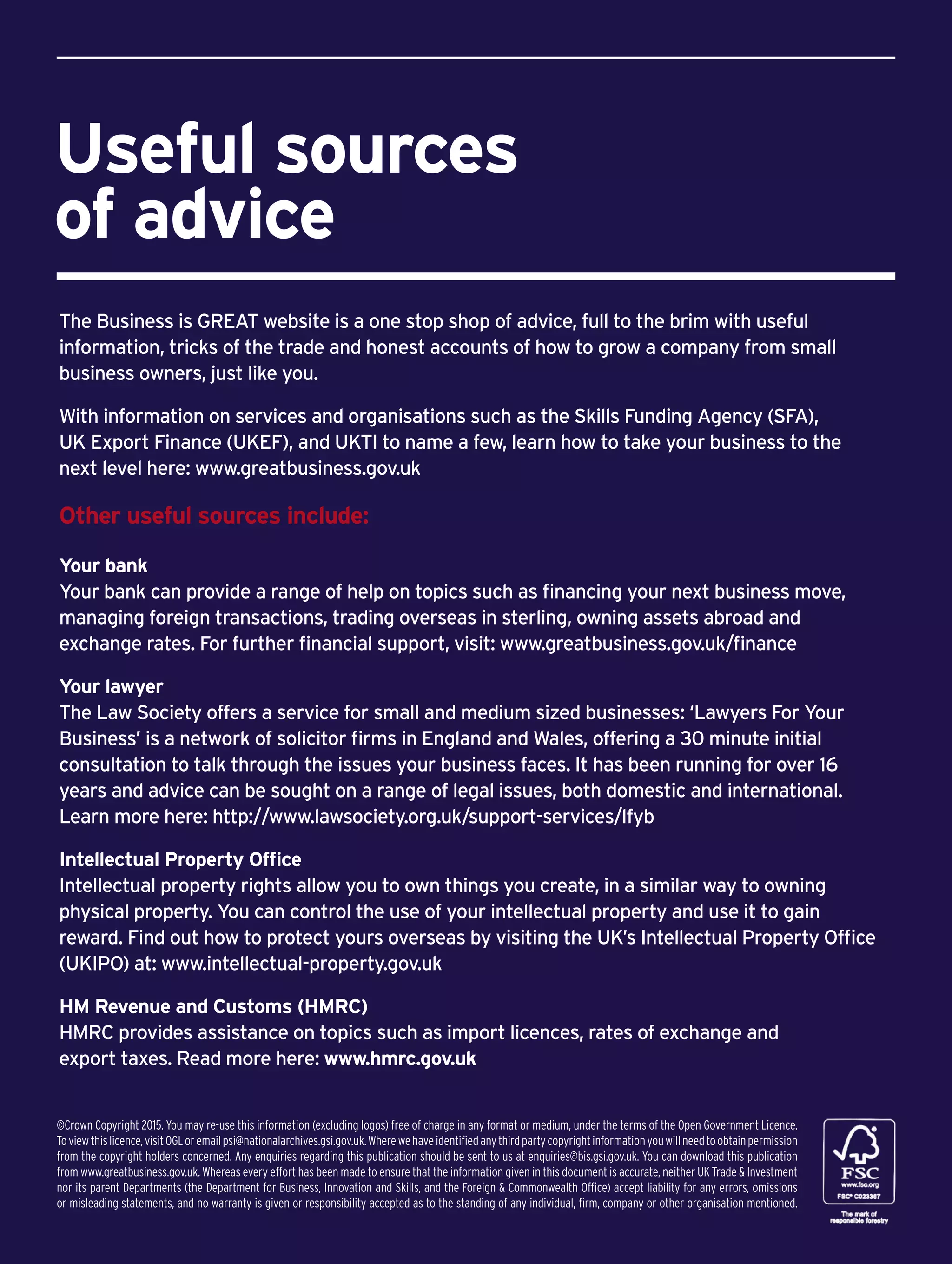
The Business is GREAT website is a one stop shop of advice, full to the brim with useful
information, tricks of the trade and honest accounts of how to grow a company from small
business owners, just like you.
With information on services and organisations such as the Skills Funding Agency (SFA),
UK Export Finance (UKEF), and UKTI to name a few, learn how to take your business to the
next level here: www.greatbusiness.gov.uk
Other useful sources include:
Your bank
Your bank can provide a range of help on topics such as financing your next business move,
managing foreign transactions, trading overseas in sterling, owning assets abroad and
exchange rates. For further financial support, visit: www.greatbusiness.gov.uk/finance
Your lawyer
The Law Society offers a service for small and medium sized businesses: ‘Lawyers For Your
Business’ is a network of solicitor firms in England and Wales, offering a 30 minute initial
consultation to talk through the issues your business faces. It has been running for over 16
years and advice can be sought on a range of legal issues, both domestic and international.
Learn more here: http://www.lawsociety.org.uk/support-services/lfyb
Intellectual Property Office
Intellectual property rights allow you to own things you create, in a similar way to owning
physical property. You can control the use of your intellectual property and use it to gain
reward. Find out how to protect yours overseas by visiting the UK’s Intellectual Property Office
(UKIPO) at: www.intellectual-property.gov.uk
HM Revenue and Customs (HMRC)
HMRC provides assistance on topics such as import licences, rates of exchange and
export taxes. Read more here: www.hmrc.gov.uk
©Crown Copyright 2015. You may re-use this information (excluding logos) free of charge in any format or medium, under the terms of the Open Government Licence.
Toviewthislicence,visitOGLoremailpsi@nationalarchives.gsi.gov.uk.Wherewehaveidentifiedanythirdpartycopyrightinformationyouwillneedtoobtainpermission
from the copyright holders concerned. Any enquiries regarding this publication should be sent to us at enquiries@bis.gsi.gov.uk. You can download this publication
from www.greatbusiness.gov.uk. Whereas every effort has been made to ensure that the information given in this document is accurate, neither UK Trade  Investment
nor its parent Departments (the Department for Business, Innovation and Skills, and the Foreign  Commonwealth Office) accept liability for any errors, omissions
or misleading statements, and no warranty is given or responsibility accepted as to the standing of any individual, firm, company or other organisation mentioned.
“Our expert Government
adviser helped us get
a handle on exporting”
Smruti Sriram, CEO of Supreme Creations
Businesses looking to export can work with an
expert International Trade Adviser. To discover
how Supreme Creations benefited from
Government support and how you can too,
visit greatbusiness.gov.uk/exporting

The-GREAT-way-to-grow1

  • 1.
    The GREAT way togrow Small businesses share their advice
  • 2.
    Live for themoment, plan for the future Shaun Pulfrey is the founder and CEO of Tangle Teezer and an ambassador for the Business is GREAT campaign As any business owner will tell you, your first business idea is rarely your big success. Tangle Teezer wasn’t mine. I’d had others that, for one reason or another, didn’t get off the ground. But this didn’t make me a failure. I instead took the experience and knowledge I gained and applied it to my next project. It’s learning how to bounce back from the knock-backs which puts you on the path to success. I had the idea for Tangle Teezer some years before I actually launched it but the pace picked up significantly when I did. I couldn’t have made my business into what it is today without the support of the people around me. Other business owners, my mentors, my family and friends all helped to shape the company. It was built by a special team, working together and pulling in the same direction. And it was built on getting good advice - something I guarantee you will get from the other business owners who have helped create this guide. I knew the Tangle Teezer product had huge potential. The domestic market was never going to be big enough, but the thought of exporting was nerve-wracking. We didn’t have a clue where to start. It’s easy to think of all the reasons not to do something, but I would encourage you to do the opposite — think about why you should try something. Schemes like UK Trade & Investment’s (UKTI) Passport to Export scheme are there to help you to take these first steps, preparing you for the leap overseas. They gave us the market insight and confidence we needed to make the jump. As an entrepreneur, you are not a singular person. You have to understand that you need other people to grow. These people need to feel your passion, enthusiasm and energy. There is nothing more satisfying than seeing your staff as focused on your business as you are — take them with you on the journey and they’ll reward you with their hard work. So my advice to other business owners is to be optimistic. I know that’s easier said than done. Enjoy nurturing your business through its different stages of growth. Be prepared for what is around the next corner, but don’t stop your journey when you get there. You have to learn from the past, be in the moment, and look to the future all at the same time. I hope the advice and insights in this guide will help you to grow your business in 2015 and beyond.
  • 3.
    plan to hiremore staff in the next 12 months ­— The small & medium sized business landscape of them exported in 2013 are first time exporters* They make up 99.9% 83% of UK businesses of business owners and decision makers feel capable to grow their business These businesses employ 15.2M people *or have been exporting for less than a year UKTI services earn the average business an extra £100,000 within 18 months 1 in 5 220,000 47%have increased their financial turnover compared to a year ago UP 9% ON OCT. 2013 UP 17% ON OCT. 2013 UP 8% ON OCT. 2013 59% State of the nation November 2014
  • 4.
    Where to begin “A hotbedof useful information can be found at The British Library’s Business & IP Centre and it’s free! Research and knowledge is worth its weight in gold when starting up and growing your business. It can lead to new potential sources of revenue. Continually research; you will learn more about your customer and identify potential new markets for expansion,” says Amelia Rope, founder of Amelia Rope Chocolates, who works closely with UKTI to take her luxury product overseas. “Plan your growth carefully and remain in control. We always look forward three years and know what we need to do, what machines we’re going to buy and what training our teams need,” says Chris Batty, from Lestercast, which uses the Manufacturing Advisory Service (MAS), part of the Business Growth Service, on strategy and process improvement for their precision investment castings business. “Try not get too caught up with all the small things you have to do to get started. Everything can be figured out. Break it all down into simple steps and just get going,” says Cara Sayer, founder of SnoozeShade, an infant sleep shade company from Surrey, which used GrowthAccelerator business development coaching, part of the Business Growth Service. Building your business can be overwhelming and it can be difficult to know where to start. Every small business has its preferred route, but here are the thoughts of some successful entrepreneurs: It’s not enough to know your own product inside out; you need to understand the market it will sit in, including your customers, competitors, retailers, experts and the media. “ “ Jo Hockley is the founder of Toddlebike, a lightweight children’s bicycle company. Her top tip would be: “It’s not enough to know your own product inside out; you need to understand the market it will sit in, including your customers, competitors, retailers, experts and the media. The whole picture. This knowledge is invaluable to you so that you can be sure your idea is viable. The ability to position your product as part of a bigger marketplace creates a more compelling proposition when you start engaging retailers, customers and the media.” Jo used Start Up Britain’s Pitch Up programme to secure a meeting and a partnership with key UK retailer, John Lewis. To learn more about how Government support can help you to plan your business, visit: www.greatbusiness.gov.uk/start
  • 5.
    The Biggerpicture “Always think fiveyears ahead. Don’t restrict yourself to the next 12 months or you will stunt your own growth,” explains Carla Garey, founder of Derbyshire-based Saffron Catering, who used Growth Vouchers support to serve a wider Midlands market, now extending from Manchester to Milton Keynes. “Invest in market research. It was the best thing we did and something I would always recommend to any business looking to expand overseas. You want as much feedback as possible, the good, the bad and the ugly! It gives you invaluable insight into your potential market, helps you focus your efforts ultimately saving you money in the long run,” says Una Driscoll, founder of Belt up Kidz, a child-safety buckle, which uses UKTI support to reach markets from China to Central Europe. “Focus on what your target consumer wants, allow them to help shape your products by listening to feedback, and if your product does not get high rating reviews, make a change. By knowing your USP, forming a clear plan and regularly reviewing it, you’ll stay one step ahead,” recommends Rob Law, founder of Trunki, the children’s luggage company, which has benefitted from research and development (R&D) tax credits and UKTI’s Passport to Export scheme. As your business grows, it’s important to take a step back, assess how far you’ve come and decide where to go next. Below a few businesses explain why. Amy Cheadle, co-founder of Lancashire based company, The Northern Dough Company, is always planning ahead: “I wish I’d known how long it would take to feel ‘successful’. Make a list of milestones when you start a business, and make sure you take the time to celebrate them. It’s easy to get caught up in the day to day and forget how far you’ve come. Pick three actions each day that will move your business forward and complete these and essential admin only. It’ll keep you focused and mean you’re always working towards future success. This approach has worked wonders for us - at the start of each year, we set five key objectives that focus on growing or running the business more effectively. Each week there are key tasks associated to these that define our ‘to do list’. If an opportunity arises that doesn’t meet any of the objectives, we discard it. It keeps our small team focused.” The Northern Dough Company used its GrowthAccelerator coach, a food industry entrepreneur, to bring focus and structure to its priorities and strategy. To read more about how Carla and her husband rose to success, visit: www.greatbusiness.gov.uk/ the-proof-is-in-the-dough Pick three actions each day that will move your business forward and complete these and essential admin only. It’ll keep you focused and mean you’re always working towards future success. “ “
  • 6.
    Financial backing Mike Pickles, founder andCEO of Really Useful Products. Mike received £4 million of investment from the Regional Growth Fund says: “Help your bank to understand your business and explain how investment will lead to growth. I have meetings at regular intervals when the business is changing. For my company, this is monthly.. I keep them informed of our evolving strategy and ask them for a financial steer. I wouldn’t make an important financial decision without passing it through them for an opinion.” To read more about how best to access and manage small business finance, visit www.greatbusiness.gov.uk/finance Stephen Rapoport, founder of Pact Coffee, accessed R&D tax credits and the Enterprise Investment Scheme (EIS) to help secure investors’ support: “When looking for investors, make sure they understand your vision deeply enough to really, truly challenge you on it. If they don’t, you’re just raising money from them and not getting any other insight beyond that. EIS is one of the most valuable things that the Government has done to support early-stage, high- innovation companies. It’s a tax break that encourages successful people to support other aspirant, successful people and something I suggest every business looks into.” “It’s so easy to get caught up in developing various aspects of the business and forget the most fundamental part. Business is about taking a great product to market at a price which is right for the product and the customer”, says Nancy Johnston, CEO of Fairtrade wool clothing designer, Tengri. It received support from the Business Growth Service to help her develop her business model and give her guidance on how manufacturing works. “It is great to have bold aims, but working them out financially will determine how realistic they are. With firm financial foundations, the company and its people can really believe what is possible and be more committed to achieving these goals. Keep track of the actual achievement — evaluation of your work is as valuable as the job itself,” explains Martin Adams, a specialist in growth and development from Routes to Growth. Accessing and managing finance is something small business owners deal with every day. Here’s how some approach this: “Invest, don’t spend. You need to think about the long term and nurturing a business that can grow,” says Karen Lynch, CEO of Belu Water. £
  • 7.
    Adam Sopher, co-founder offamily-run popcorn brand Joe & Seph’s. Adam accessed UKTI’s Passport to Export and has attended a Japanese trade mission. He explains how peer to peer support helped him: “Reach and teach – take advice from others and pass on your knowledge to your peers. In the early days I found listening to the stories of other businesses very helpful. It does not mean that your journey will be exactly the same, but it equips you with a better understanding of how to proceed and what to expect.” To read more stories of successful growth from small business owners and learn how Government can help you to grow, visit: www.greatbusiness.gov.uk “Attend UKTI events. They can really support your growth,” says Emily Brooke, CEO of bicycle light manufacturer Blaze. “I have been to the GREAT Festival of Creativity in Istanbul with Founders Forum, the GREAT Business Exhibition in Liverpool, at which I presented Blaze to the Prime Minister, and on a trade mission to South Africa. Getting out there to events can really help put your business on the map” ”You don’t know what you don’t know, so engage with others who can help and who you can learn from. Equally, your advice might help another GREAT small business grow,” urges Rachel Eade, an automotive specialist adviser for MAS, part of the Business Growth Service. “Surround yourself with people who have expertise in areas you need help with - people offer you advice because they want you to succeed,” explains Sarah Haywood, a UKTI Catalyst member who owns her own eponymous wedding planning and event company. Sarah lectures across Europe, the Middle East, South Africa, the USA, and Mexico on the art of her business. Guidance from others Support from those around you is invaluable. Using other people as sounding boards can show you what will work for your business and help you avoid what won’t. “Surround yourself with wise owls,” says Alissa Koopal, founder of baby bangle producer, Izzy Melody Limited. “I’ve always done this in my career so I can fall back on them for advice and support.” Take advice from others and pass on your knowledge to your peers. In the early days I found listening to the stories of other businesses very helpful. “ “
  • 8.
    It all comesdown to people. Finding a good team and then getting the best out of them — that’s what will make your business fly. Stephen Dann, a Growth Coach from Southampton, advises businesses on a daily basis and comments: “Business owners are often frustrated that their teams don’t show the same level of dedication, creativity, energy and motivation as they do. Don’t expect your teams to be like you. If they were, they’d be doing your job. Embrace different talents and skills because it will help the business in the long run.” “Involve all staff in your growth plans so your direction and progress are highly visible. Your staff will then feel fully invested in the bigger picture and back you up with the skills you need to get there,” says Stuart Burns, the founder of Dura Composites, which has received MAS support regarding financial advice and help to enter into the offshore wind and rail markets. Dr Paul Beven, is the co- founder of Healix Group. Healix Group is Europe’s largest provider of medical evacuation services to the travel industry. Starting in 1992 with a team of three, today, Healix employs more than 200 staff and is rapidly expanding overseas with offices in New Zealand, Australia, Spain, Greece, Singapore, Kenya and the USA. Beven says, “Wherever you can, employ people who are better than you so they can shine as the light of the organisation, and you can lead them.” Jane Field, who runs a successful mail order business, Jonny’s sister, knows the value of apprentices: “Our apprentices are open, fresh and they question things. They make a real impact. I have removed products which I was convinced would sell, based on their reactions. They carry zero baggage, have a real ‘can do’ approach to everything, and bring a freshness that money can’t buy.” To read more about how to develop your management skills, visit: www.greatbusiness.gov.uk/ building-your-management-skills To learn more about how apprentices could help your business to grow, visit: www.greatbusiness.gov.uk/ taking-on-an-apprentice Your people
  • 9.
    TOP 5 BUSINESSTIPS 1. Employ the best The one invaluable lesson I have learned since taking on the online food industry is to be the best you must employ the best. It might sound obvious, but setting the bar high and placing people above everything else is harder than you might imagine. At Gousto we strictly employ only amazing talent; offering an environment that nurtures personal growth and career development, and giving our team members bucket loads of responsibility so that everyone is empowered in some way to drive the business forward. 2. Stay passionate Another motto I live by is to continually draw back to the purpose I first founded the company on; enabling people to eat delicious, quality food with zero food waste. Doing something you really care about and truly value is paramount to building an infallible company, as that passion will trickle through to everything you do. The customers will sense it in the quality of the service and product you deliver, they will feel it in the way we communicate and the efforts we go to for them. If this purpose and passion is integral to your mission, it will naturally infiltrate every aspect of your operations. 3. Take a gamble Do not limit yourself by fearing failure. Dare to try new things and don’t constrain yourself by what others might think of you if you fail. Think big and bold, paying no heed to nagging fears, concerns or insecurities. Take the long road and be prepared to take a gamble. It’s a cliché, but he who dares really does win! When James and I started Gousto, we took a huge risk. We left jobs we had been doing for years to do something we’d never done before, all because of our passion for food! 4. Trust your team Try not to micromanage, instead trust the team you have hired and give them space to shine. Hire amazing managers, give them targets and budgets, and cheerlead them on to victory! 5. Live sustainably Live sustainably - if you live in the UK, you’re better off than the other 99% of people in this world, so do what you can to make the world a little better. It needn’t be anything huge, but ultimately this will also make you a happier, more fulfilled person. This is personal for me as it is something I care deeply about, but I genuinely believe it is important for any business. At Gousto, we make sure we conserve electricity and recycle as much as possible. If you do good things, good will come back to you, so I really do think this is something worth investing in. Gousto delivers delicious and nutritional meals and ingredients in exact portions, across the UK. Gousto co-founder, Timo Schmidt’s
  • 10.
    Innovation Dr Jim Shaikh,the founder of Yoomi, a baby bottle product says: “Maintain investment in research and development, even through the tough times, as this is the source of differentiation for UK engineering and manufacturing. The return will be in the longevity of your product, and brand.” Yoomi has benefitted from a multitude of Government support. Working with UKTI, the company gained support on agent and distributor agreements export documentation, and attended trade shows. Working with MAS, as part of the Business Growth Service, they were able to move additional packaging capabilities to Liverpool. Support ranges from tax reliefs and credits, to vouchers and grants — all practical solutions to encourage a new phase for the business. To read more about the support available to help your business to innovate visit: www.greatbusiness.gov.uk/ funding-and-support-to-develop-new-ideas Innovation is all about staying on top of the game and responding to your customers. Hear first hand from successful small businesses on why it is a top priority for them. “These days, like no other time in history, it is possible to promote your brand to a global audience by embracing e-commerce and social media,” says Richard Sellwood, of the iconic lamp company, Anglepoise. His company received MAS funding, part of the Business Growth Service, to help implement their e-commerce offer and to support on brand guidelines and licensing. “Innovate in everything that you do while investing in your people, premises and product offering,” recommends Rowan Crozier, Managing Director of C. Brandauer a 150 year-old world-class engineering company that is using Business Growth Service and UKTI to internationalise its website and develop its marketing. “My business mantra is to make lots of small changes. Try and change something in your business for the better every day. Establish and prioritise what is routine then do it excellently,” says Charles Baughan, founder of Westaways Sausages, which works with UKTI to sell its products to markets from Japan to Barbados. “The only way Britain can compete on the global stage is through innovation and entrepreneurship,” states Stephen Rapoport, founder of Pact Coffee, which accessed R&D tax credits and the Enterprise Management Incentive (EMI) scheme to develop the fast- growing business.
  • 11.
    Selling overseas On average, abusiness earns £100,000 in additional sales within 18 months of working with UKTI. Hear more from those who have taken their business from strength to strength by selling overseas, to see how you could start your journey today. Brent Hadfield and Peter Grainger, co-founders of CaféPod, believe that UKTI’s overseas network has been hugely beneficial to them in moving up the commercial ladder: “We’ve met valuable contacts that have materialised into new lines of business, and have had the opportunity to tap into the international retail chain. Reliable contacts are key when establishing in new markets, and UKTI’s global network is second to none.” Leanna Williams, founder of lingerie company, Harlow and Fox, said: “I always planned for my product to be international as it’s a niche item with a very specific customer base. Exhibiting at the biggest lingerie trade show in Paris last year certainly helped and led to approaches from fashion stockists in both Dubai and Australia. Exports have helped me to almost double my target turnover and I am now on track for unprecedented success in my first year.” Dani Foffa, founder of Foffa Bikes, understands it can be a scary step: “When going international, there are higher risks and some difficulties, and you can end up learning how to do business the hard way. Use UKTI, they can help you make more informed decisions and meet other businesses who are in the same boat to share ideas.” To book an appointment with an independent trade advisor and see how you can expand into new markets, visit www.greatbusiness.gov.uk/ukti Nikolay Piryankov, founder of jewellery business, Rare Pink. Nikolay has worked with UKTI and GrowthAccelerator (part of Business Growth Service) to help launch in China and get advice on raising finance via crowd funding. He would advise any small business looking to grow to consider selling overseas: “The global economy is set up in such a way that players of all sizes can be involved. UKTI can help the smaller guys to get British businesses on the international map. Companies of all sizes need to think global and UKTI is a good place to start.”
  • 12.
    Sticking to your values If you are expanding rapidly, you can sometimes forget why you started the business in the first place. Here’s how some founders try to stay on track: “Remember the passion you had at the beginning, why you’re doing this business, and then try to deliver that every day,” says Marcus Whittington, Director of Bath Boutique Stays, a luxury holiday accommodation rental company. He received Growth Vouchers to help identify new markets and customers. “Believe in your ability to do what you are passionate about: trust your instincts,” says Catherine Spink, founder of Neon Creations, who used the Innovation Voucher Scheme to fund market research in Manchester, to establish a route to market for their new products. “Persistence and determination are the two key qualities needed to get your business off the ground,” says Sandy Ruddock, founder of Scarlett & Mustard. They have received many types of Government support including grants from MAS, UKTI’s Passport to Export programme and just taken on an apprentice. As a result, their company grew by 300% in 2013, and in 2014, turnover nearly doubled. “Remember why you wanted to start your business. What does it mean to you, what are your values and goals and then plan how you intend to reach them,” advises Tina Goldsmith, founder of Snuggle Sacs, an award-winning small business, with products distributed across 12 countries and an exclusive Harry Potter licensing deal. “Stick to being the best in the world at one thing. Don’t get distracted from one very clear goal. Ours is to become the global brand for children’s travel products. We won’t make toys, or adult luggage or anything that doesn’t fit this one single vision,” says Rob Law, founder of Trunki. Will Butler-Adams, Managing Director of Brompton Bicycles. He used the MAS to assist with the implementation of lean manufacturing, as well as UKTI and GrowthAccelerator. He said he tries not to take life too seriously: “Business is about having fun with exciting and interesting people. At times it can feel as though the world is coming to an end. It isn’t and business isn’t that important, compared to some life challenges. Don’t take yourself too seriously or it will cloud your judgement and stop you sleeping at night!” To read more about how Brompton Bicyles used Government support, from creating a business plan to exporting, visit: www.greatbusiness.gov.uk/ brompton-bicycles-unfolding-success
  • 13.
    Advice: commodity what a Sometimes, greatadvice is all about timing. What sounds like a cliché for 364 days can be a brilliant insight on the 365th. We have all been told to “do what you are passionate about.” But it was only when Stephen Rapoport, the serial entrepreneur and founder-CEO of Pact Coffee, was pondering his fourth business venture that the power of that advice hit home. “My wife told me to ‘stop thinking like an investor, just do the thing that you love.’ And I have.” explains Rapoport. “This business is driven by a passion and love of coffee, of flavour, of delighting customers. As a result, I have a business many times the size of the others combined.” Sometimes, you need to have your business in the right place before you can really benefit from great advice. In the early days of Brompton Bicycle, recalls CEO Will Butler- Adams, “we were charging around like headless chickens, trying to sort this and that out but we were going round and round in circles. We needed to get our head out of the mire and think about where we wanted to go.” It was only after the team pulled itself out of this busy-ness that Brompton understood the enormous amount of material and advice that was available to support its growth. “There is nothing we are doing that other people haven’t done before,” says Butler-Adams. “There are so many companies who have been where we are going.” We think of great advice as coming from experienced folk, from mentors, professional advisers and peers who have been there and done it. But that’s only one aspect. For many entrepreneurs, the best advice they receive comes from only one source - their customers. For Jane Field, owner of successful mail order business Jonny’s Sister, great advice can also come from her apprentices. “They are open, fresh and they question things,” she says. And they make a real impact: “I have removed products which I was convinced would sell, based on their reactions. They carry zero baggage, have a real ‘can do’ approach to everything, and bring a freshness that money can’t buy.” Whenever and from whomever it comes, get as much good advice as you can. Your task — and your own genius — will then be to turn it into great decisions. Stuart Rock, Business is GREAT Editor in Chief. It is always in demand — and its supply is inexhaustible. For many entrepreneurs, the best advice they receive comes from only one source - their customers. “ “ Sometimes, you need to have your business in the right place before you can really benefit from great advice. “ “ Whenever and from whomever it comes, get as much good advice as you can. “ “
  • 14.
    Businesses who chooseto sell overseas become 34% more productive in their first year while those already selling overseas achieve 59% faster productivity growth than non-exporters UKTI can help you succeed overseas. The figures are compelling: on average businesses earn £100,000 in additional sales within 18 months of working with UKTI. This could be you. UKTI has a national network of International Trade Advisers with first-hand export expertise to support and advise you on how to grow your business in international markets. Find out what UKTI can do for you, by contacting your nearest ITA today: Nearest ITA Email Tel UKTI East of England info@uktieast.org.uk 01707 398 398 UKTI East Midlands info@uktiem.co.uk 01332 826 320 UKTI London export@uktilondon.org.uk 020 7234 3000 UKTI North East enquiries@uktinortheast.org.uk 0191 516 4405 UKTI North West info@uktinorthwest.co.uk 0333 320 0392 UKTI South East info@uktisoutheast.com 0330 300 0012 UKTI South West enquiries@uktisouthwest.org 01275 370 944 UKTI West Midlands enquiries@uktiwm.co.uk 0345 222 0159 UKTI Yorkshire and the Humber info@uktiyorkshire.co.uk 0300 365 1000 Business Wales business@wales.gsi.gov.uk 03000 6 03000 Invest Northern Ireland export@investni.com 028 9023 9090 Scottish Enterprise International enquiries@scotent.co.uk 0800 917 9534 +44 141 228 2828 (within Scotland) (International/mobile) To read what UKTI can do for your business visit: www.greatbusiness.gov.uk/ukti Other sources of information • Foreign Commonwealth Office country profiles https://www.gov.uk/foreign-travel-advice • For support advice on access to finance, contact UK Export Finance (UKEF) Email — customer.service@ukef.gsi.gov.uk Tel — 020 7272 8010 www.greatbusiness.gov.uk/ukef UKTI services and networks
  • 15.
    Useful sources of advice TheBusiness is GREAT website is a one stop shop of advice, full to the brim with useful information, tricks of the trade and honest accounts of how to grow a company from small business owners, just like you. With information on services and organisations such as the Skills Funding Agency (SFA), UK Export Finance (UKEF), and UKTI to name a few, learn how to take your business to the next level here: www.greatbusiness.gov.uk Other useful sources include: Your bank Your bank can provide a range of help on topics such as financing your next business move, managing foreign transactions, trading overseas in sterling, owning assets abroad and exchange rates. For further financial support, visit: www.greatbusiness.gov.uk/finance Your lawyer The Law Society offers a service for small and medium sized businesses: ‘Lawyers For Your Business’ is a network of solicitor firms in England and Wales, offering a 30 minute initial consultation to talk through the issues your business faces. It has been running for over 16 years and advice can be sought on a range of legal issues, both domestic and international. Learn more here: http://www.lawsociety.org.uk/support-services/lfyb Intellectual Property Office Intellectual property rights allow you to own things you create, in a similar way to owning physical property. You can control the use of your intellectual property and use it to gain reward. Find out how to protect yours overseas by visiting the UK’s Intellectual Property Office (UKIPO) at: www.intellectual-property.gov.uk HM Revenue and Customs (HMRC) HMRC provides assistance on topics such as import licences, rates of exchange and export taxes. Read more here: www.hmrc.gov.uk ©Crown Copyright 2015. You may re-use this information (excluding logos) free of charge in any format or medium, under the terms of the Open Government Licence. Toviewthislicence,visitOGLoremailpsi@nationalarchives.gsi.gov.uk.Wherewehaveidentifiedanythirdpartycopyrightinformationyouwillneedtoobtainpermission from the copyright holders concerned. Any enquiries regarding this publication should be sent to us at enquiries@bis.gsi.gov.uk. You can download this publication from www.greatbusiness.gov.uk. Whereas every effort has been made to ensure that the information given in this document is accurate, neither UK Trade Investment nor its parent Departments (the Department for Business, Innovation and Skills, and the Foreign Commonwealth Office) accept liability for any errors, omissions or misleading statements, and no warranty is given or responsibility accepted as to the standing of any individual, firm, company or other organisation mentioned.
  • 16.
    “Our expert Government adviserhelped us get a handle on exporting” Smruti Sriram, CEO of Supreme Creations Businesses looking to export can work with an expert International Trade Adviser. To discover how Supreme Creations benefited from Government support and how you can too, visit greatbusiness.gov.uk/exporting