Index
Page #
Address Note by the Managing Director 2-3
01 From the Prism of Sustainability
1. Vision & Mission 4
2. Scale of the organisation 4
3. Management Structure 4-5
4. Stakeholder Engagement 6-8
5. Providing Mobility Solutions 8
02 Economics
1. Financial Performance 9
2. Risk Management 9-10
3. Indirect Economic Impact 10
03 Product Responsibility
1. GHG Reduction 11-14
2. Product Safety 15
3. New Product Introduction 16
04 Environment Protection
1. Energy conservation 17-20
2. Waste Management 20
3. Recycle and Reuse 21
4. Promoting Bio-diversity 22-25
5. Environmental Expenditure 25
05 Employees
1. Ensuring Ethical Practices 26
2. Providing Equal Employment Opportunities 27
3. Health & Safety at work 27-28
4. Union Relations 29-30
5. Creating a Learning Environment 30-31
06 Social Commitment
1. Integrated Rural Development 32
4. Public-Private-Social Partnerships 32
3. Building bridges to manage impacted communities 32
4. Fighting HIV/AIDS 32-33
SI Linkage to GRI Indicators 34-37
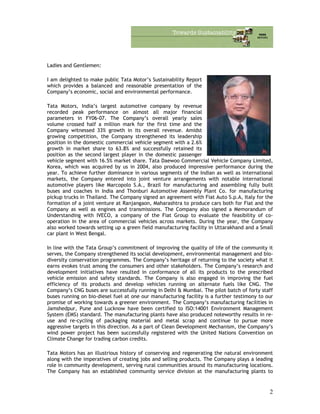
Ladies and Gentlemen:
I am delighted to make public Tata Motor’s Sustainability Report
which provides a balanced and reasonable presentation of the
Company’s economic, social and environmental performance.
Tata Motors, India’s largest automotive company by revenue
recorded peak performance on almost all major financial
parameters in FY06-07. The Company’s overall yearly sales
volume crossed half a million mark for the first time and the
Company witnessed 33% growth in its overall revenue. Amidst
growing competition, the Company strengthened its leadership
position in the domestic commercial vehicle segment with a 2.6%
growth in market share to 63.8% and successfully retained its
position as the second largest player in the domestic passenger
vehicle segment with 16.5% market share. Tata Daewoo Commercial Vehicle Company Limited,
Korea, which was acquired by us in 2004, also produced impressive performance during the
year. To achieve further dominance in various segments of the Indian as well as international
markets, the Company entered into joint venture arrangements with notable international
automotive players like Marcopolo S.A., Brazil for manufacturing and assembling fully built
buses and coaches in India and Thonburi Automotive Assembly Plant Co. for manufacturing
pickup trucks in Thailand. The Company signed an agreement with Fiat Auto S.p.A, Italy for the
formation of a joint venture at Ranjangaon, Maharashtra to produce cars both for Fiat and the
Company as well as engines and transmissions. The Company also signed a Memorandum of
Understanding with IVECO, a company of the Fiat Group to evaluate the feasibility of co-
operation in the area of commercial vehicles across markets. During the year, the Company
also worked towards setting up a green field manufacturing facility in Uttarakhand and a Small
car plant in West Bengal.
In line with the Tata Group’s commitment of improving the quality of life of the community it
serves, the Company strengthened its social development, environmental management and bio-
diversity conservation programmes. The Company’s heritage of returning to the society what it
earns evokes trust among the consumers and other stakeholders. The Company’s research and
development initiatives have resulted in conformance of all its products to the prescribed
vehicle emission and safety standards. The Company is also engaged in improving the fuel
efficiency of its products and develop vehicles running on alternate fuels like CNG. The
Company’s CNG buses are successfully running in Delhi & Mumbai. The pilot batch of forty staff
buses running on bio-diesel fuel at one our manufacturing facility is a further testimony to our
promise of working towards a greener environment. The Company’s manufacturing facilities in
Jamshedpur, Pune and Lucknow have been certified to ISO:14001 Environment Management
System (EMS) standard. The manufacturing plants have also produced noteworthy results in re-
use and re-cycling of packaging material and metal scrap and continue to pursue more
aggressive targets in this direction. As a part of Clean Development Mechanism, the Company’s
wind power project has been successfully registered with the United Nations Convention on
Climate Change for trading carbon credits.
Tata Motors has an illustrious history of conserving and regenerating the natural environment
along with the imperatives of creating jobs and selling products. The Company plays a leading
role in community development, serving rural communities around its manufacturing locations.
The Company has an established community service division at the manufacturing plants to
2
work with various societies for improving living conditions in adjoining villages. The Company
encourages self-sufficiency with the aim of improving the confidence, morale and lives of its
employees and their dependents. The Company has been actively engaged in programmes
which encourage economic independence through self initiated cottage industries, community
and social forestry, water and road projects, improving rural health and propagate family
planning benefits. The Company has identified truck drivers as a key community and has
undertaken pioneering work in dissemination of knowledge about AIDS prevention and fuel
conservation.
Tata Motor’s contribution in national development, environmental conservation and societal
value creation has been acknowledged at various forums. The Company has received many
awards including the coveted CII-EXIM award for Business Excellence, CII awards in Corporate
Sustainability Reporting, Energy Efficiency and Energy Management, Green Governance Award
by the Bombay Natural History Society and the Golden Peacock Global Award for Corporate
Social Responsibility by Institute of Directors, the international body of company directors.
In coming years, as India moves on the path of economic development at a faster pace, the
demand of vehicles for private as well as public transportation is expected to increase.
Improvement in road connectivity across the country through various on going road
development projects is also expected to trigger the demand of goods transportation vehicles.
Tata Motors is confident that the wealth generated as a result of development would not only
power the business but would also be ploughed back in the conservation and enrichment of
environment and for greater prosperity of the community.
Ravi Kant
3
01 FROM THE PRISM OF SUSTAINABILITY
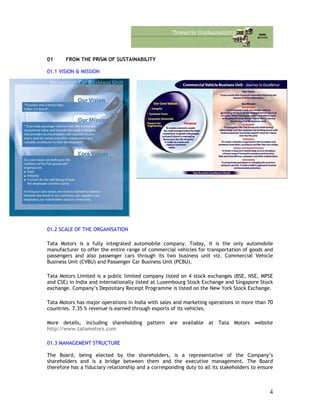
01.1 VISION & MISSION
01.2 SCALE OF THE ORGANISATION
Tata Motors is a fully integrated automobile company. Today, it is the only automobile
manufacturer to offer the entire range of commercial vehicles for transportation of goods and
passengers and also passenger cars through its two business unit viz. Commercial Vehicle
Business Unit (CVBU) and Passenger Car Business Unit (PCBU).
Tata Motors Limited is a public limited company listed on 4 stock exchanges (BSE, NSE, MPSE
and CSE) in India and internationally listed at Luxembourg Stock Exchange and Singapore Stock
exchange. Company’s Depositary Receipt Programme is listed on the New York Stock Exchange.
Tata Motors has major operations in India with sales and marketing operations in more than 70
countries. 7.35 % revenue is earned through exports of its vehicles.
More details, including shareholding pattern are available at Tata Motors website
http://www.tatamotors.com
01.3 MANAGEMENT STRUCTURE
The Board, being elected by the shareholders, is a representative of the Company’s
shareholders and is a bridge between them and the executive management. The Board
therefore has a fiduciary relationship and a corresponding duty to all its stakeholders to ensure
4
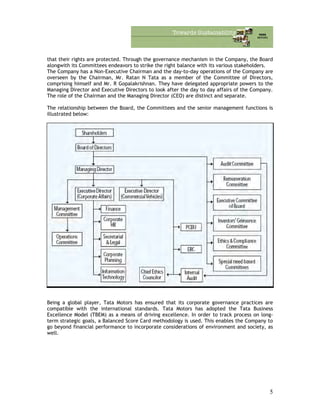
that their rights are protected. Through the governance mechanism in the Company, the Board
alongwith its Committees endeavors to strike the right balance with its various stakeholders.
The Company has a Non-Executive Chairman and the day-to-day operations of the Company are
overseen by the Chairman, Mr. Ratan N Tata as a member of the Committee of Directors,
comprising himself and Mr. R Gopalakrishnan. They have delegated appropriate powers to the
Managing Director and Executive Directors to look after the day to day affairs of the Company.
The role of the Chairman and the Managing Director (CEO) are distinct and separate.
The relationship between the Board, the Committees and the senior management functions is
illustrated below:
Being a global player, Tata Motors has ensured that its corporate governance practices are
compatible with the international standards. Tata Motors has adopted the Tata Business
Excellence Model (TBEM) as a means of driving excellence. In order to track process on long-
term strategic goals, a Balanced Score Card methodology is used. This enables the Company to
go beyond financial performance to incorporate considerations of environment and society, as
well.
5
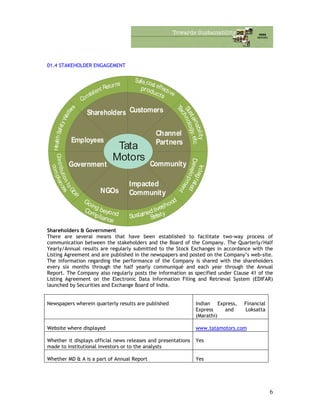
01.4 STAKEHOLDER ENGAGEMENT
Tata
Motors
Shareholders Customers
Channel
Partners
Community
Impacted
CommunityNGOs
Government
Employees
Consistent Returns
Safe,cost effective
products
Technology,etc
SustainabilityIntegratedDevelopment
Sustained livetihood
Sefety
Going beyond
Compliance
ContributiontoGDP,
compliances
HealthSafetyWelfare
Shareholders & Government
There are several means that have been established to facilitate two-way process of
communication between the stakeholders and the Board of the Company. The Quarterly/Half
Yearly/Annual results are regularly submitted to the Stock Exchanges in accordance with the
Listing Agreement and are published in the newspapers and posted on the Company’s web-site.
The information regarding the performance of the Company is shared with the shareholders
every six months through the half yearly communiqué and each year through the Annual
Report. The Company also regularly posts the information as specified under Clause 41 of the
Listing Agreement on the Electronic Data Information Filing and Retrieval System (EDIFAR)
launched by Securities and Exchange Board of India.
Newspapers wherein quarterly results are published Indian Express, Financial
Express and Loksatta
(Marathi)
Website where displayed www.tatamotors.com
Whether it displays official news releases and presentations
made to institutional investors or to the analysts
Yes
Whether MD & A is a part of Annual Report Yes
6
The Board of the Company has adopted the ‘Code of Corporate Disclosure Practices’ according
to which the public spokespersons are identified who are responsible in ensuring timely and
adequate disclosure of price sensitive information. This Code ensures simultaneous release of
information through various mediums of disclosure/dissemination in a transparent and fair
manner. This information is also available on the Company’s website,
www.tatamotors.com.
The 20F Annual Report prepared as per the US regulations and the NYSE Listed Manual provides
information which is not normally in the public domain vis-à-vis other listed companies, is also
available on the website of the Securities and Exchange Commission and the Company. The 20-
F Annual Report contains information on five-year financial data under US GAAP; risks
associated with the Company’s business; investments in the Company and relating to ADRs; a
business overview which includes sections on the Indian economy and the automotive market
and competition; business strategy and operations; a complete product profile; production
facilities and distribution network; R&D initiatives; intellectual property; legal proceedings;
organisation structure; subsidiaries and affiliates; operating and financial review and
prospects; capital expenditure incurred and sources of financing; details of the auditors; Board
composition and management; governance structure; shareholding pattern; dividend policy;
share and ADR price; rights of shareholders; exchange control policy of the Government and
taxation as relevant to investors; CEO and CFO certification to the investors and audited
consolidated financial statements for the last three years.
To ensure that the Company has disclosed relevant, accurate and complete information to its
investors so as to ensure that the Company’s financial condition and results of operations in all
material respects have been disclosed on a timely basis under the applicable laws, the
Company recently constituted a Disclosure Committee comprising of the senior management as
also heads of the larger subsidiary companies.
Customers
The Company is also in the midst of implementing a very comprehensive Customer Relationship
management program which is reviewed by the Management Committee and the Board sub-
Committees from time to time. This program ensures that the Customers are treated in the fair
manner by the channel members of the Company and their needs are also captured and
responded to through this programme.
Channel partners/Suppliers
A Supplier Relationship Management program and Dealer Management System are in place and
the Management Committee reviews the program from time to time. The key indicators of
review are the Supplier coverage and the efficiency of the transactions with the Company. The
Company also organizes Supplier’s day/Vendor meets/Channel partner meets where suppliers
can touch base with the Board members and share their thoughts and inputs.
Employees
The Management Committee on a very regular basis reviews the employees’ issues. The
remuneration guidelines, the employee satisfaction, the employee growth plan and the
organization culture are discussed in these meetings. Major employee welfare schemes are put
up to the Board for approval. The Board is also kept informed of senior level changes in
management, status on signing of Union wage agreements, remuneration of senior executives,
etc.
7
Impacted Community/Community
The company has a strong CSR practice in place, which is institutionalized and driven with the
commitment of our senior management and is grounded in the legacy of the Tata Group.
Regular day-to-day interactions take place with the community members and all activities are
designed, implemented and evaluated with the active involvement of the community members.
Participatory Rural Appraisal, Social Impact Assessment through external agencies and group
meetings are some of the methods in which the company engages with the impacted
communities at the new plant locations.
(In addition to the information above, see stakeholder engagement chart – Annexure I)
01.5 PROVIDING MOBILITY SOLUTIONS
Through a wide range of products, right from small passenger car vehicles to heavy trucks and
buses, the company caters to the free and safe movement of goods and people. The company
also caters to the government institutions like the municipal corporations and transport
corporations and manufactures vehicles used for defence purposes as well. In the reporting
period, the company introduced the Star Bus, which ensures that public transport becomes
disabled-friendly. In 2006, the company has also initiated the “small car project” which aims to
provide safe transport at affordable prices. The targeted price of US $2500 would make a four
wheel vehicle available to the masses, thereby making transportation personal and safer.
From 2006, Commercial Vehicle Business Unit (CVBU) has taken an initiative to conduct
industry-wide syndicated satisfaction surveys through TNS, so that commonly accepted
satisfaction scores are used by all players in the industry. TNS specializes in automobile
customer satisfaction determination and also conducts similar syndicated satisfaction surveys
for passenger cars as well as two-wheelers. In 2005-06 TNS commenced syndicated satisfaction
surveys for Trucks (M&HCVs as well as LCVs). In 2006-07 syndicated survey for trucks was
continued while a similar syndicated survey on buses (MCVs as well as LCVs) was commenced.
In TNS approach TRI*M index is derived as a weighted average of scores on overall satisfaction,
advocacy, loyalty, and competitive advantage. TRI”M index is also known as Customer
Retention index and can vary between -65 and +135. The higher the index, the greater is the
likelihood of retaining customers. TRI*M Indices revealed that CVBU has the highest scores in
M&HCV & LCV trucks and second highest scores in MCV and LCV Buses (comparison with other
players like Leyland, Eicher, M&M and Swaraj).
“The success of any product lies with its sustenance and although we have
achieved some results in the areas of product safety and innovation,
employee relationship management, labour practices, responsible
marketing practices and community development, we believe that this
journey has just started. Putting an emphasis on channel partners,
suppliers and other stakeholders to move towards more sustainable
practices is a challenge that is yet to be fully tackled. ”
- A K Mankad
Head – Car Plant
8
02 ECONOMICS
02.1 FINANCIAL PERFORMANCE
For an account on financial performance of the company and its subsidiaries in 2006-07, see
the Annual Report at our website, www.tatamotors.com .
02.2 RISK MANAGEMENT
The Company has a comprehensive system of control, focused on mitigation of risks to ensure
achievement of objectives. The risks are assessed on an ongoing basis and controls are designed
to respond to risk throughout the Company. For the purpose of review, risks are categorized
into Type A and Type B and are also rated from 1–4 based on impact and frequency. The Audit
Committee seriously looks into the Type A risks as also reviews the mitigation action taken
against these risks on a quarterly basis. Pertinent information on risk assessment and control
activities is communicated effectively to employees. The line management regularly monitors
controls. Thus the risk management/internal control practices contribute to the development
of robust business operations and promotes/enhances value creation. The Board regularly
reviews processes and procedures to ensure the effectiveness of the internal systems of
control. Management reports to the Board provide a balanced assessment of significant risks, a
balanced assessment of the effectiveness of the system of internal controls in managing those
risks and identify significant failings/weaknesses, its impact on the Company and actions taken
to rectify them.
The Risk Management key roles and components are:
The Company is promoting risk awareness through a structured risk management process. The
ownership of these programs vests with operating managers, with Internal Audit playing a
facilitators role. Risk Management is carried out through:
Business Management Plans Risk Taking Appetite
Strategic Risk Management
Framework
Strategic Business Unit
Risk Management Plans Risk Management Requirements
Controls Self-Assessment Risk Management Policies
(Initiated by Internal Audit) Risk Management Strategies
Chief Executive/
Executive Directors
Board &
Audit Committee
Incident Reports/Compliance Certificates Clear response effective buy-in
(To various levels, delegations & accountabilities
including the Board for significant incidents)
Staff
Line Management
a) Enterprise Risk Management (ERM)
b) Business Risk Management (BRM) and
c) Self Assessment questionnaire.
9
Internal Audit acts as a facilitator for all these, whereas the primary responsibility remains
with the process owners.
The ERM Process has been initiated in the Company as a tool to strengthen the Strategic
Planning process. It aims at sustaining desired operational performance and providing a
platform for rational allocation of capital across SBUs. The process maps the Strategic,
Operational, Financial & Governance Risks related to the Business strategy as also on account
of weaknesses in the internal processes.
The agreed risks are logged in the Company’s Risk register and the respective Responsibility
Centers are required to determine the risk treatment (Accept/Reduce/Transfer/Eliminate) and
work out the mitigation plans accordingly. The outcomes of the Risk Mapping Process were
presented to the Management Committee and the Audit Committee for review and direction.
The outcomes of ERM process were also reported to the Board on March 31, 2007.The Major
risks along with the mitigation actions are planned to be reviewed by the Management
Committee and presented to the Audit Committee and the Board on a regular basis.
A benchmarking of ERM practices of other local and global companies has been done to
ascertain opportunities for improvement. The ERM process is designed to be compliant with
SOX and Clause 49 of the Listing Agreement with the Indian Stock Exchanges.
02.3 INDIRECT ECONOMIC IMPACT
Worldwide, Transport sector has emerged as the biggest employer *
1 Commercial Vehicle - employment for 13.3 people
1 Car - employment for 5.3 people
1 Three Wheeler - employment for 3.9 people
1 Two Wheeler - employment for 0.5 people
* Source: Automotive Mission Plan 2006-16, Includes: Direct and Indirect Employment
With a growth of 28% in 2006-07, Tata Motors recorded its highest ever sales of 580,280
(334,238 commercial; 246,042 passenger) vehicles. The Company’s exports witnessed a growth
of 6.5% to 53,474 numbers. The approximate indirect economic impact generated by the
company in 2006-07 is summarised below
668,476
246,042
22,349
18,000
10,2615000
* Includes initiatives to enhance employability (vocational and technical training,
apprenticeship programmes), promotion of co-operatives and formation of Self-Help Groups
Employment
generated through
channel partners
Employment
through social
initiatives*
Employees in
Subsidiaries
Direct
Employees
Indirect employment
from commercial
vehicles***
Indirect
employment from
passenger cars**
** On assumption that one passenger car sold creates employment for at least one person –
driver/cleaner
*** On assumption that one commercial vehicle sold creates employment for at least two
people – Driver and cleaner/helper
10
03 PRODUCT RESPONSIBILITY
03.1 GHG REDUCTION
A challenge for any automobile company is to ensure that their products will not have any
adverse impact on the environment during its use phase. Several measures have been taken to
mitigate the environmental impacts of our goods and services, which are summarized below:
Reducing CO2 emissions and increasing fuel efficiency:
CO2 emissions are considered to be a primary contributing factor to global warming, making
their management the most important challenge for TML. Of the total volume of CO2 emissions
associated with the life cycle of an automobile, from excavation of raw materials to recycling
of end-of-life vehicles, the largest portion occurs when the vehicle is on the road. Controlling
these emissions is one of the most significant technology challenges TML is tackling today.
While we are working in developing fuel cells and other technologies of the future, we are also
working to reduce CO2 emissions today’s vehicles through highly efficient engines and
technology
a) Diesel engine emits 20 to 40 % less CO2 than gasoline engines. TML produces products
which mostly uses diesel as fuel
b) Although no regulatory standard for CO2 and fuel efficiency for different products are
specified in India, care is taken to reduce the CO2 emission and increase the fuel
efficiency from the product with introduction of advanced technology.
c) Use of common rail fuel injection for diesel engines has brought down the CO2
emission. The Common Rail system in particular gives engine developers the freedom
they need to reduce exhaust emissions even further, and especially to lower engine
noise. In the Common Rail accumulator injection system, the generation of the
injection pressure is separate from the injection itself. A high-pressure pump generates
in an accumulator – the rail – a pressure of up to 1,600 bar (determined by the
injection pressure setting in the engine control unit), independently of the engine
speed and the quantity of fuel injected. The fuel is fed through rigid pipes to the
injectors, which inject the correct amount of fuel in a fine spray into the combustion
chambers. The Electronic Diesel Control (EDC) controls extremely precisely all the
injection parameters – such as the pressure in the Rail and the timing and duration of
injection – as well as performing other engine functions.
d) Use of XETA technology has increased fuel efficiency and reduced CO2 emission in
gasoline passenger car. The new Indica Xeta with 1.4 litres extra fuel-efficient torque
advantage petrol engine delivers frugal fuel consumption at 14 kmpl. The 32-bit
microprocessor in the engine includes a knock sensor, which helps reduce damage from
adulterated fuel, and maintains efficiency.
e) Use of Integrator Starter Generator (ISG): TML is developing passenger cars with ISG,
and is planned for introduction in market in about two years. ISG combines the
alternator and starter motor in a vehicle into one machine. The machine is controlled
such that when the vehicle is stopped, the engine is automatically switched off, to
conserve fuel. The engine is started again when the vehicle needs to be moved again.
The automatic shutting off of engine can save 5 - 10 % of fuel in a typical city driving
cycle.
f) Use of energy efficient air conditioning system –
Scroll compressor: Automotive air conditioning compressor loads the engine in order to
provide thermal comfort inside cabin. Higher load on engine leads to higher emission
level/fuel consumption. Scroll compressors for automotive air conditioning systems
consume upto 20% less power and upto 4% less fuel than commonly used Swash Plate
11
compressors. Last year approximately 6000 Indica vehicles were fitted with scroll
compressors. More number of vehicles with scroll compressors is planned in current
year.
Heat exchanger & Condenser: TML has fitted air-conditioning systems that feature
smaller heat exchangers and high-efficiency condensers. These moves have helped to
restrict usage of the air-conditioner refrigerant HFC-134a, which is a more potent
greenhouse gas than CO2. Integrated receiver drier bottle condenser is being
aggressively pursued by TML as an initiative to reduce refrigerant charge quantity.
HVAC system with IRD condenser requires about 20% less of refrigerant (reduction of
approximately 80 gms per vehicle).
Reducing refrigerant leakage: All HVAC system components of TML vehicles are 100%
checked for refrigerant leakage. TML has ensured that the vehicle level leakage rates
are well below the specified limit of upcoming norms of 40 gms per year.
Refrigerant recovery mechanism: TML ensures that no R134A refrigerant is released to
atmosphere during any service, repair and maintenance. The refrigerant charge is first
recovered from vehicle before the system is being serviced.
Use of CO2 refrigerant for automobile air conditioning: Carbon dioxide (CO2) has GWP =
1 and is being aggressively pursued as an alternative environmentally friendly
refrigerant. Tata Motors is working closely with HVAC system suppliers and academic
institutions to develop automotive air conditioning system using CO2 as refrigerant.
Going Green:
At Tata Motors, the commitment to developing environment friendly and sustainable products
is in an accelerated phase. On March 29, 2005, the company announced its pilot bio-diesel
programme jointly undertaken with Indian Oil Corporation. This involves using bio-diesel for
Tata Motors' fleet of buses.
Environment friendly technologies:
Hybrid Electric Car: Hybrid Electric car is being developed in TML. The concept vehicle has
been demonstrated while prototypes are under development. Hybrid Car consists of a
mechanical and electrical powertrain. Hybrid vehicles achieve significant improvement in fuel
economy by limiting the IC engine’s operating region so as to maximise the efficiency. A
traction requirement outside the optimum operating region of the engine is handled by the
electric motor.
Hybrid bus: The prototype of hybrid mini bus is under development. This diesel electric bus for
intra-city transport consists of series hybrid configuration with downsized engine.
Electric Bus: The concept prototype of trolley bus is under development. Electric Bus has an
all-electric power train using motors and inverters for driving the motors. The power source
for the electric supply can be on-board, like a small diesel Genset or a fuel cell, or off-board,
as in the case of a trolley bus. The vehicle will also have a bank of batteries onboard to
provide high, intermittent power for acceleration and also to recover the braking energy using
regeneration.
12
Fuel cell Bus: Fuel cell Bus is a derivative of an Electric Bus, in that the electric power source
is a fuel cell. A fuel cell is a primary battery, which oxidises hydrogen to water through a
catalyst, generating electrical energy during the process. The oxidation occurs at much lower
temperature than combustion temperatures of hydrogen, resulting in no emissions other than
water.
Bio- diesel Engine: Developing use of bio-diesel blend at various blending percentages in order
to ensure that bio-diesel can be used on our vehicles with minimum engine modifications. We
have completed trials in the phase-1 of the program with 10% blend and are now planning for
higher blend percentages to increase the use of bio-diesel. This would result in reduced
emission and conservation of fossil fuels.
Use of Ethanol gasoline blend in Tata Vehicles: Tata Motors is actively pursuing other alternate
fuels such as using a blend of ethanol and gasoline in our vehicles. Trials with 7 & 10% blends of
ethanol and tuning of the engines are in progress. TML has also joined the Indian delegation to
Brazil to study the ethanol fuel vehicles in Brazil.
Use of Hydrogen in CNG for our commercial vehicles: In order to develop engines with lower
emissions, TML is progressing on a project to use hydrogen in CNG as fuel for our commercial
vehicles. This would also help in creating an understanding of the Hydrogen infrastructure for
future applications. This is a joint program with IOC, co-ordinated by SIAM.
Hydrogen Powered IC Engine: An exploratory project along with IIT Chennai has
been initiated for the use of Hydrogen fuel in engine. This project will help us
develop a clear understanding of the combustion process. 697 CNG BS II engine
has been taken as a base engine with a target of a possible demo bus.
TML is in
compliance
with the EU
directive
on ELV’s
for export
vehicles to
European
Union
CNG Buses: Tata Motors has already developed a wide range of CNG vehicles such
as buses, Indica with CNG application and LCV-407 CNG vehicles for bus and truck
applications. Today, over 6800 Tata Motors’ CNG buses are plying on Delhi roads.
LNG trucks: Tata Daewoo Commercial Vehicle Company (TDCV), the second largest commercial
vehicle manufacturer of South Korea and a 100 per cent subsidiary of Tata Motors, has
developed South Korea’s first liquefied natural gas (LNG) powered heavy tractor-trailer, an
environment-friendly commercial vehicle. TDCV pioneered the design, development and
manufacture of the new LNG tractor under an arrangement sponsored by the Korea Gas
Corporation (KOGAS). The development work on the vehicle had begun in September 2004, and
is expected to evoke encouraging response from customers with its fuel efficiency and economy
of operation.
Bus rapid transit system: This system developed by TML based on use of low floor CNG buses
with high capacity is an sustainable solution for mass transportation problems in metros like
Delhi, Mumbai , Bangalore etc.It proposes use of special lanes on the routes reserved for
such buses to facilitate faster movement of buses and is based on Intelligent Transportation
System model (ITS) .It is enabled by Information , Communication , Smart Card & GPS
technologies to provide better service to commuters.
TML has successfully implemented Lead free wheel balance weights, lead free printing inks,
lead free bulbs, alternate designs/coatings for hard Cr platings, cadmium platings, Lead free
coatings for fuel tanks, Lead free carbon brushes for electrical motors etc.
Asbestos free brake pads & clutches have been introduced in many of our products. In addition,
water based paints are being used instead of solvent based paints to avoid VOC emission. Work
13
is going on for reducing/elimination of hexavalent chromium for corrosion preventive coatings
and development / implementation of lead free bearing shells and bushes.
Reducing Emission levels:
Refrigerant CFC-12 is an “Ozone Depleting Substance (ODS)”, categorized under Group I of the
ODS (Regulation & Control) Rules, 2000, which is to be phased out by the year 2010. The
Company is actively working to achieve this well ahead of this target, by first targeting
reduction in consumption of CFC-12 for the existing refrigeration equipment. The Company has
an EMP in place to convert refrigeration units using refrigerant CFC-12 to its environmentally
friendly alternatives i.e. replaced with units operating on R-22 / R-134a. Due to the above
proactive actions, we have been successful in containing the consumption of CFC-12 refrigerant
for maintenance of existing equipment.
Tata Motors continuously strives to reduce vehicles’ emission levels and has undertaken the
following initiatives:
• Pollution level reduction for Commercial Vehicles (Diesel engines) from present level
(BS- II norms): CO - 4.0, HC -1.1, NOx -7, PM-0.1 gm/Kwh to target level (BS-III
norms): CO - 2.1, HC -0.66, NOx -5 gm/Kwh
• Pollutant level reduction for utility vehicle (diesel engine) from present level (Euro -3
norms): CO - 0.95, NOx - 0.75, HC + NOx - 0.86 gm / km to target level (Euro - 4
norms): CO - 0.75, NOx - 0.39, HC + NOx - 0.46, PM - 0.06 gm / km
• Pollutant level reduction for passenger cars (diesel engine) from present level (Euro -3
norms): CO - 0.64, NOx - 0.50, HC + NOx - 0.56, PM - 0.05 gm/km to target level (Euro -
4 norms): CO - 0.50, NOx - 0.25, HC + NOx - 0.30, PM - 0.025 gm/km
• Pollution level reduction for passenger cars (petrol engine) from present level (Euro -3
norms): CO - 2.3, NOx - 0.15, HC - 0.20 gm / km to target level (Euro - 4 norms ): CO -
1.0, NOx - 0.08, HC - 0.10, PM - 0.06 gm / km
All these targets to be met broadly through:
Common Rail direct injection system
Higher fuel injection pressure
Full electronic control of FIE system for fuel delivery & timing control.
Progressive ECU mapped exhaust Gas Re-circulation.
Closed coupled and under body catalytic converter for exhaust gas after treatment.
Improving the volumetric efficiency by incorporating 4 valve/cylinder instead of
existing 2 valve/cylinder
Variable geometry turbocharger for boost control.
Ozone Friendly Refrigerants:
Air conditioning systems in the entire product range use HFC - 134a - an ozone friendly
refrigerant since 1996 itself. Use of CO2 based refrigerant, is targeted by the year 2009.
Use of Non-Hazardous Material:
Asbestos free brake linings are developed for the entire product range in all export products.
However due to commercial consideration and market requirements many of our products
continue to be supplied with asbestos brake liners in domestic market and in Third World
countries.
Reducing noise levels:
Following measures were taken to reduce exterior noise of the vehicle as it is accelerated on
road at high engine-speeds:
14
1. Acoustic shields: They were specifically developed around engine and gear-box so that
roaring sound will be absorbed.
2. Silencer redesign: Silencers were deigned to have greater insertion losses before
pulsating exhaust gases would leave the tail pipe. A care was taken to see that
backpressure of the engine would not increase assuring adequate power of the vehicle.
3. Viscous or Electric Fan: Both of them reduced Fan noise of the engine at high speeds.
03.2 PRODUCT SAFETY
Tata Motors has been putting in a lot of effort to improve the safety (active & passive) of its
products and to go beyond the safety regulations – example our model, ACE has been designed
to meet more stringent crash safety norms that are not applicable to that class of products.
ERC (Our Research and Development Centre) is adequately equipped with state of the art
facilities to address specifically the issues of customer health and safety. It has facilities like
Crash Test facility for safety and the Hemi Anechoic chamber for NVH and engine emission
testing. These facilities enable development of products meeting safety and environmental
regulations.
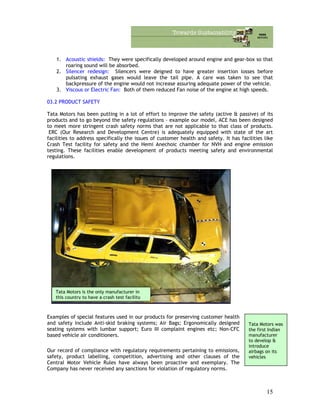
Tata Motors is the only manufacturer in
this country to have a crash test facility
Examples of special features used in our products for preserving customer health
and safety include Anti-skid braking systems; Air Bags; Ergonomically designed
seating systems with lumbar support; Euro III complaint engines etc; Non-CFC
based vehicle air conditioners.
Tata Motors was
the first Indian
manufacturer
to develop &
introduce
airbags on its
vehicles
Our record of compliance with regulatory requirements pertaining to emissions,
safety, product labelling, competition, advertising and other clauses of the
Central Motor Vehicle Rules have always been proactive and exemplary. The
Company has never received any sanctions for violation of regulatory norms.
15
Tata Motors obtains test certificates for vehicle worthiness and other safety related issues like
emission, brakes, noise etc. before the product is marketed through government authorised
agencies.
Tata Motors also obtain Homologation certificates for export markets from authorized test
agencies. Labelling Identification of parts that need to be labelled as per Annex II of EEC
directives 2000/53/EC amended by 2002/525/EC. This directive bans the use of hazardous
heavy metals – Lead, Hex-Chromium and Mercury.
03.3 NEW PRODUCT INTRODUCTION
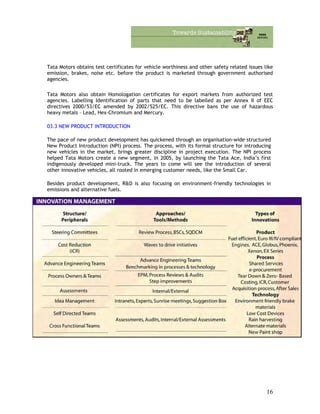
The pace of new product development has quickened through an organisation-wide structured
New Product Introduction (NPI) process. The process, with its formal structure for introducing
new vehicles in the market, brings greater discipline in project execution. The NPI process
helped Tata Motors create a new segment, in 2005, by launching the Tata Ace, India’s first
indigenously developed mini-truck. The years to come will see the introduction of several
other innovative vehicles, all rooted in emerging customer needs, like the Small Car.
Besides product development, R&D is also focusing on environment-friendly technologies in
emissions and alternative fuels.
16
04 ENVIRONMENT PROTECTION
Tata Motors plans for the environment in its processes,
products and services. “Facilities and Environment
Management” is identified as a Business Process and is formally
documented in our Enterprise Process Manual. Facilities and
Environment Management” process is mapped in detail and the
measures for “effectiveness and efficiency” of the process are
specified. This has helped the Company to evolve a uniform
approach across all manufacturing locations in the country.
“Our Founders - Sir Dorab Tata, Mr. J R D
Tata and Mr. Sumant Moolgaokar have
shown ‘environmental consciousness’ far
ahead of their times while planning new
Factories.
Since commencement of manufacturing
activities, Tata Motors has actively pursued
water and energy conservation, waste
minimization and pollution prevention at
source. Now, these activities have become
integral to the functioning of the Plant s
and are a planned and budgeted exercise.
As a result of such initiatives taken up in
the past, Pune has been able to successfully
conclude the sale of Certified Emission
Reductions (CERs) in September 2007.
Now that we are in rapid expansion mode,
we are continuously integrating our
learning’s into the planning of new facilities
to balance their environmental impact on
the local ecosystems.”
- M B Kulkarni
General Manager (Environment)
Contribution towards Sustainable Environment
Tata Motors has participated in the Sustainable development
(S-DEV) exhibition in Geneva through TERI showcasing the
company’s contribution for sustainable development. Tata
Motors is working with the steering committee of National
Hydrogen Energy board to find the ways where India may
harness hydrogen potential energy of future
The company is represented on several National Committees
working for improvement of environment throughout the
country.
1) Technical committee for “Air quality monitoring,
emission inventory and source apportionment studies
for Indian cities” constituted by Central pollution
control board, Delhi
2) Group on “Technical evaluation of ARAI reports on
development of emission factors” constituted by
Central pollution control board, Delhi
3) Technical committee for “Heavy-duty Diesel retrofit
demonstration project” constituted by National
environmental engineering research institute, Mumbai
4) Multi stakeholder committee to “Develop Better
environmental sustainability targets for lead battery
manufacturers” constituted by development
alternatives, Delhi in collaboration occupational
knowledge international, UK and national referral
center for lead poisoning, India
5) Steering committee for “Mobile Air conditioning
Assessment project” constituted by TERI, Delhi
04.1 ENERGY CONSERVATION
Tata Motors Ltd, (TML), being one of the pioneers in automobile sector in the country on its
path to World Class Manufacturing has incorporated environmentally sound practices as one of
its prime objective – in its processes, products and services. All manufacturing facilities at
Pune, Jamshedpur and Lucknow have achieved certification to the ISO-14001 Standard.
The Company has always been conscious of the need for conservation of energy. Energy
Conservation measures have been implemented at all the plants and offices of the Company.
These measures are aimed at effective management and utilization of energy resources and
have resulted in cost savings for the Company, aggregating approximately Rs 307.5 millions.
17
Company has started Energy Accounting & Energy conservation programmes: Tata Motors Ltd.
considers energy conservation critical to the operation of its Plant. Apart from reducing
operational costs, the energy saved amounts to environment protection by way of avoiding
pollution due to power generation processes. Energy conservation is driven throughout the
organization, by way of setting Division wise targets and monitoring performance on everyday
basis for optimising energy consumption.
1. Introducing FRP blades for man-coolers
2. Installing variable speed drive for flow control and energy saving
3. Introduction of fuel additives in Furnace Oil to improve the
combustion efficiency of the fuel
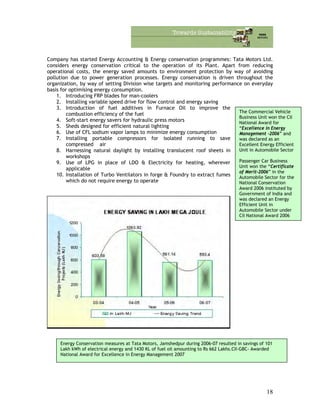
Energy Conservation measures at Tata Motors, Jamshedpur during 2006-07 resulted in savings of 101
Lakh kWh of electrical energy and 1430 KL of fuel oil amounting to Rs 662 Lakhs.CII-GBC- Awarded
National Award for Excellence in Energy Management 2007
4. Soft-start energy savers for hydraulic press motors
5. Sheds designed for efficient natural lighting
6. Use of CFL sodium vapor lamps to minimize energy consumption
7. Installing portable compressors for isolated running to save
compressed air
The Commercial Vehicle
Business Unit won the CII
National Award for
“Excellence in Energy
Management -2006” and
was declared as an
Excellent Energy Efficient
Unit in Automobile Sector
Passenger Car Business
Unit won the “Certificate
of Merit-2006” in the
Automobile Sector for the
National Conservation
Award 2006 instituted by
Government of India and
was declared an Energy
Efficient Unit in
Automobile Sector under
CII National Award 2006
8. Harnessing natural daylight by installing translucent roof sheets in
workshops
9. Use of LPG in place of LDO & Electricity for heating, wherever
applicable
10. Installation of Turbo Ventilators in forge & Foundry to extract fumes
which do not require energy to operate
18
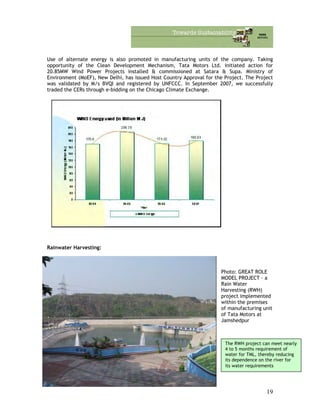
Use of alternate energy is also promoted in manufacturing units of the company. Taking
opportunity of the Clean Development Mechanism, Tata Motors Ltd. initiated action for
20.85MW Wind Power Projects installed & commissioned at Satara & Supa. Ministry of
Environment (MoEF), New Delhi, has issued Host Country Approval for the Project. The Project
was validated by M/s BVQI and registered by UNFCCC. In September 2007, we successfully
traded the CERs through e-bidding on the Chicago Climate Exchange.
Rainwater Harvesting:
Photo: GREAT ROLE
MODEL PROJECT – a
Rain Water
Harvesting (RWH)
project implemented
within the premises
of manufacturing unit
of Tata Motors at
Jamshedpur
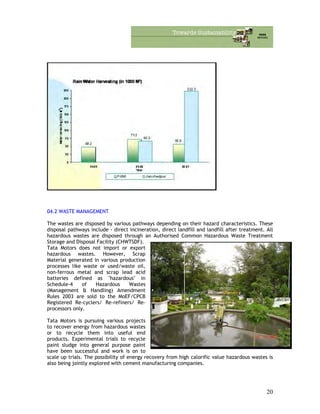
The RWH project can meet nearly
4 to 5 months requirement of
water for TML, thereby reducing
its dependence on the river for
its water requirements
19
04.2 WASTE MANAGEMENT
The wastes are disposed by various pathways depending on their hazard characteristics. These
disposal pathways include - direct incineration, direct landfill and landfill after treatment. All
hazardous wastes are disposed through an Authorised Common Hazardous Waste Treatment
Storage and Disposal Facility (CHWTSDF).
Tata Motors does not import or export
hazardous wastes. However, Scrap
Material generated in various production
processes like waste or used/waste oil,
non-ferrous metal and scrap lead acid
batteries defined as "hazardous" in
Schedule-4 of Hazardous Wastes
(Management & Handling) Amendment
Rules 2003 are sold to the MoEF/CPCB
Registered Re-cyclers/ Re-refiners/ Re-
processors only.
Tata Motors is pursuing various projects
to recover energy from hazardous wastes
or to recycle them into useful end
products. Experimental trials to recycle
paint sludge into general purpose paint
have been successful and work is on to
scale up trials. The possibility of energy recovery from high calorific value hazardous wastes is
also being jointly explored with cement manufacturing companies.
20
04.3 RECYCLE AND REUSE
Recycle of Packaging Materials:
The Company’s products do not require any external packaging. Wood used in packing crates of
spare parts is re-cycled from wooden scrap packaging of received material. Heavy bought out
components, which were received in wooden crates, are now changed over to returnable
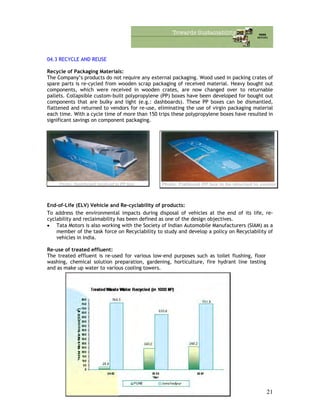
pallets. Collapsible custom-built polypropylene (PP) boxes have been developed for bought out
components that are bulky and light (e.g.: dashboards). These PP boxes can be dismantled,
flattened and returned to vendors for re-use, eliminating the use of virgin packaging material
each time. With a cycle time of more than 150 trips these polypropylene boxes have resulted in
significant savings on component packaging.
End-of-Life (ELV) Vehicle and Re-cyclability of products:
To address the environmental impacts during disposal of vehicles at the end of its life, re-
cyclability and reclaimability has been defined as one of the design objectives.
• Tata Motors is also working with the Society of Indian Automobile Manufacturers (SIAM) as a
member of the task force on Recyclability to study and develop a policy on Recyclability of
vehicles in India.
Re-use of treated effluent:
The treated effluent is re-used for various low-end purposes such as toilet flushing, floor
washing, chemical solution preparation, gardening, horticulture, fire hydrant line testing
and as make up water to various cooling towers.
21
04.4 PROMOTING BIO-DIVERSITY
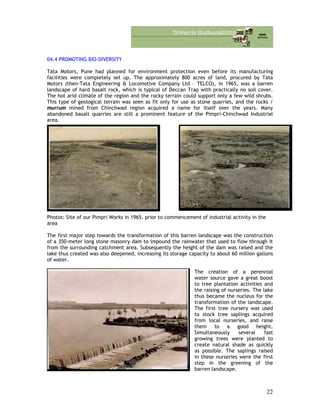
Tata Motors, Pune had planned for environment protection even before its manufacturing
facilities were completely set up. The approximately 800 acres of land, procured by Tata
Motors (then-Tata Engineering & Locomotive Company Ltd – TELCO), in 1965, was a barren
landscape of hard basalt rock, which is typical of Deccan Trap with practically no soil cover.
The hot arid climate of the region and the rocky terrain could support only a few wild shrubs.
This type of geological terrain was seen as fit only for use as stone quarries, and the rocks /
murrum mined from Chinchwad region acquired a name for itself over the years. Many
abandoned basalt quarries are still a prominent feature of the Pimpri-Chinchwad Industrial
area.
Photos: Site of our Pimpri Works in 1965, prior to commencement of industrial activity in the
area
The first major step towards the transformation of this barren landscape was the construction
of a 350-meter long stone masonry dam to impound the rainwater that used to flow through it
from the surrounding catchment area. Subsequently the height of the dam was raised and the
lake thus created was also deepened, increasing its storage capacity to about 60 million gallons
of water.
The creation of a perennial
water source gave a great boost
to tree plantation activities and
the raising of nurseries. The lake
thus became the nucleus for the
transformation of the landscape.
The first tree nursery was used
to stock tree saplings acquired
from local nurseries, and raise
them to a good height.
Simultaneously several fast
growing trees were planted to
create natural shade as quickly
as possible. The saplings raised
in these nurseries were the first
step in the greening of the
barren landscape.
22
Over time, the creation of the water bodies and the tree cover (approximately 1,50,000 trees)
has altered the very look of the entire landscape.
The objective was to make the lake
/ ponds and surrounding area
attractive to aquatic and other birds,
which was achieved by a planned
microhabitat development
programme.
These microhabitats include:
1. Water bodies
2. Marshy area / Reed beds
(Typha sp.)
3. Open scrub land / grassland
4. Garden / orchard area
Water Bodies: All the water bodies, i.e. 2 lakes and 4 ponds were originally created by
excavation. These ponds and lakes are spread out over an area of approximately 40 acres. The
ponds are smaller in area and also shallower, as compared with the lakes. Storm water and
treated effluent flow into the lakes through the 4 ponds. These ponds are frequented by
different varieties of small waders, cormorants and kingfishers. The depth and gradient of the
ponds have been maintained by planned dredging activities to remove the accumulated silt.
The ponds also allow for the sedimentation of the silt carried by the storm water runoff, which
in turn ensures that the water entering into the larger lakes – Sumant Sagar and Lake Sharma
are relatively cleaner and carry less dissolved solids. This 30-acre stretch of open water in
Sumant Sagar and Lake Sharma is the preferred foraging area for ducks, geese and other
paddling birds, which feed on fishes, algae, assorted phytoplankton and zooplankton, insect
larvae etc. Apart from the resident bird population, the lakes are visited by a number of
migratory birds, which winter in the Southern Hemisphere from October to March.
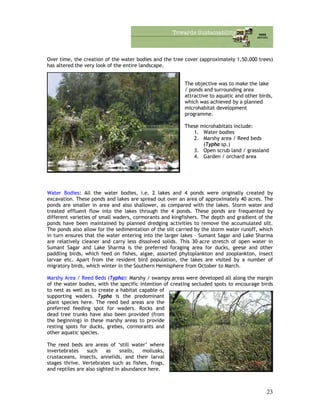
Marshy Area / Reed Beds (Typha): Marshy / swampy areas were developed all along the margin
of the water bodies, with the specific intention of creating secluded spots to encourage birds
to nest as well as to create a habitat capable of
supporting waders. Typha is the predominant
plant species here. The reed bed areas are the
preferred feeding spot for waders. Rocks and
dead tree trunks have also been provided (from
the beginning) in these marshy areas to provide
resting spots for ducks, grebes, cormorants and
other aquatic species.
The reed beds are areas of ‘still water’ where
invertebrates such as snails, mollusks,
crustaceans, insects, annelids, and their larval
stages thrive. Vertebrates such as fishes, frogs,
and reptiles are also sighted in abundance here.
23
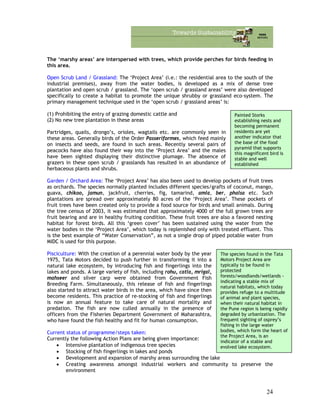
The ‘marshy areas’ are interspersed with trees, which provide perches for birds feeding in
this area.
Open Scrub Land / Grassland: The ‘Project Area’ (i.e.: the residential area to the south of the
industrial premises), away from the water bodies, is developed as a mix of dense tree
plantation and open scrub / grassland. The ‘open scrub / grassland areas’ were also developed
specifically to create a habitat to promote the unique shrubby or grassland eco-system. The
primary management technique used in the ‘open scrub / grassland areas’ is:
(1) Prohibiting the entry of grazing domestic cattle and Painted Storks
establishing nests and
becoming permanent
residents are yet
another indicator that
the base of the food
pyramid that supports
this magnificent bird is
stable and well
established
(2) No new tree plantation in these areas
Partridges, quails, drongo’s, orioles, wagtails etc. are commonly seen in
these areas. Generally birds of the Order Passeriformes, which feed mainly
on insects and seeds, are found in such areas. Recently several pairs of
peacocks have also found their way into the ‘Project Area’ and the males
have been sighted displaying their distinctive plumage. The absence of
grazers in these open scrub / grasslands has resulted in an abundance of
herbaceous plants and shrubs.
Garden / Orchard Area: The ‘Project Area’ has also been used to develop pockets of fruit trees
as orchards. The species normally planted includes different species/grafts of coconut, mango,
guava, chikoo, jamun, jackfruit, cherries, fig, tamarind, amla, ber, phalsa etc. Such
plantations are spread over approximately 80 acres of the ‘Project Area’. These pockets of
fruit trees have been created only to provide a food source for birds and small animals. During
the tree census of 2003, it was estimated that approximately 4000 of the full grown trees are
fruit bearing and are in healthy fruiting condition. These fruit trees are also a favored nesting
habitat for forest birds. All this ‘green cover’ has been sustained using the water from the
water bodies in the ‘Project Area’, which today is replenished only with treated effluent. This
is the best example of “Water Conservation”, as not a single drop of piped potable water from
MIDC is used for this purpose.
Pisciculture: With the creation of a perennial water body by the year
1975, Tata Motors decided to push further in transforming it into a
natural lake ecosystem, by introducing fish and fingerlings into the
lakes and ponds. A large variety of fish, including rohu, catla, mrigal,
mahseer and silver carp were obtained from Government Fish
Breeding Farm. Simultaneously, this release of fish and fingerlings
also started to attract water birds in the area, which have since then
become residents. This practice of re-stocking of fish and fingerlings
is now an annual feature to take care of natural mortality and
predation. The fish are now culled annually in the presence of
officers from the Fisheries Department Government of Maharashtra,
who have found the fish healthy and fit for human consumption.
The species found in the Tata
Motors Project Area are
typically to be found in
protected
forests/woodlands/wetlands -
indicating a stable mix of
natural habitats, which today
provides refuge to a multitude
of animal and plant species,
when their natural habitat in
the Pune region is being rapidly
degraded by urbanization. The
frequent sighting of osprey’s
fishing in the large water
bodies, which form the heart of
the Project Area, is an
indicator of a stable and
evolved lake ecosystem.
Current status of programme/steps taken:
Currently the following Action Plans are being given importance:
• Intensive plantation of indigenous tree species
• Stocking of fish fingerlings in lakes and ponds
• Development and expansion of marshy areas surrounding the lake
• Creating awareness amongst industrial workers and community to preserve the
environment
24
Environmental Advantages Achieved:
• Creation of an artificial lung in an area where none existed – acts as a CO2 sink and O2
generator, which modifies local microclimate positively – resulting in milder summers.
• Creation of a stopover for migratory birds and providing a safe haven from poachers
and hunters
• The creation of a new habitat for wintering migratory birds is all the more important,
as noted ornithologists have declared that many of the existing water bodies, wetlands
in Haveli Taluka are being rapidly degraded by rampant construction activity, artificial
draining, poaching and pollution
• Allows an ecologist to track ‘Indicator Species’ and gauge the health of ecosystems at
macro level for the entire geographical region
• Conservation of indigenous tree species, which have medicinal value and economic
importance
• Conservation of soil and rainwater and its utilization
• Control of air pollutants and improvement in overall air quality of Pimpri-Chinchwad
Industrial Area
The Pune Plant of the Company was awarded the ‘Bombay Natural History Society (BNHS) – Green
Governance Award – 2006’ in the “Conservation and Restoration of Habitat” category.
The Ministry of Environment & Forest (MoEF), Govt. of India has appointed Gram Vikas Kendra,
Jamshedpur (GVKJ) an NGO supported by Tata Motors, Jamshedpur, as the Regional Resource
Agency (RRA) for National Environmental Awareness Campaigns (NEAC) 2008 for Jharkhand
State for 15th consecutive year. National Theme for the year 2007 was Solid Waste
Management and for the year 2008 is Biodiversity Conservation.
04.5 ENVIRONMENTAL EXPENDITURE
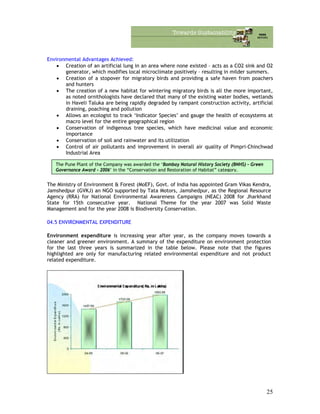
Environment expenditure is increasing year after year, as the company moves towards a
cleaner and greener environment. A summary of the expenditure on environment protection
for the last three years is summarized in the table below. Please note that the figures
highlighted are only for manufacturing related environmental expenditure and not product
related expenditure.
25
05 EMPLOYEES
05.1 UPHOLDING ETHICAL PRACTICES
Tata Motors’ employees uphold the Tata Group’s legacy and reputation of a “business built on
foundations of trust and ethics”, by adhering to the Tata Code of Conduct (TCoC). TCoC has
been developed to ensure high standard of corporate and personal behaviour on which the Tata
Group's reputation and respectability has been built over the past 120 years.
The Code is a set of 25 principles, adherence to which ensures ethical conduct both by the
employees as well as the Company at large. The chief clauses in the TCoc are as under:
• Competition
• Equal-opportunities employer
• Gifts and donations
• Political non-alignment
• Quality of products and services
• Corporate citizenship
• Ethical conduct
• Securities transactions and confidential information
• Integrity of data furnished
As an employee at Tata Motors, it is obligatory to not only adhere to the code but also to be
concerned if there is an actual or possible violation of any clause and to bring it to the
attention of the Ethics Counsellor. TCoC is prominently displayed at various locations in the
manufacturing plants and offices and is also available in English and two vernacular languages
at the company’s internal website. Moreover, all current and new employees undergo training
on TCoC.
There is robust Ethics Counsellor Process to monitor implementation of Tata Code of Conduct.
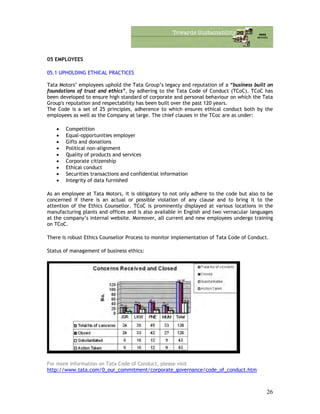
Status of management of business ethics:
For more information on Tata Code of Conduct, please visit
http://www.tata.com/0_our_commitment/corporate_governance/code_of_conduct.htm
26
05.2 PROVIDING EQUAL EMPLOYMENT OPPORTUNITIES
“As an equal opportunity employer, we do
not discriminate between gender, caste,
creed or religion. 692 of our permanent
employees are females. Even in the training
schemes, we have inducted a large number
of female trainees and they have been given
on-the job training in welding, electronic
mechanics etc hand in hand with their male
counterparts”.
- Mr. S. Borwankar
Plant Head, Jamshedpur
At Tata Motors, there is a written policy on non-
discrimination and equal opportunity for employment, which
is the basis for all recruitment. The policy is as under:
“As part of its Recruitment Practices, TATA MOTORS is
committed to provide Equal Opportunity to all eligible
applicants for employment without any discrimination
against their gender, race, religion, caste, colour, ancestry,
marital status, nationality and disability.
Opportunity for employment will be solely based on
eligibility and merit of the applicant. Career growth
opportunities will be based entirely on individual merit.”
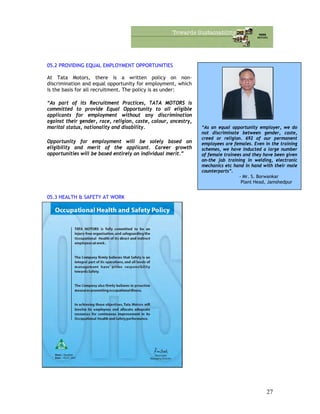
05.3 HEALTH & SAFETY AT WORK
27
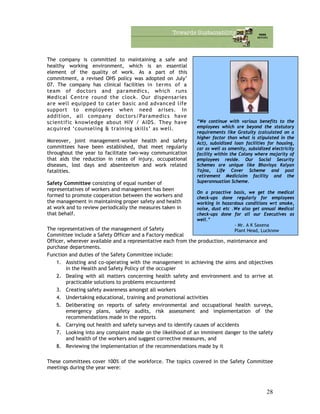
The company is committed to maintaining a safe and
healthy working environment, which is an essential
element of the quality of work. As a part of this
commitment, a revised OHS policy was adopted on July’
07. The company has clinical facilities in terms of a
team of doctors and paramedics, which runs
Medical Centre round the clock. Our dispensaries
are well equipped to cater basic and advanced life
support to employees when need arises. In
addition, all company doctors/Paramedics have
scientific knowledge about HIV / AIDS. They have
acquired ‘counseling & training skills’ as well.
“We continue with various benefits to the
employees which are beyond the statutory
requirements like Gratuity (calculated on a
higher factor than what is stipulated in the
Act), subsidized loan facilities for housing,
car as well as amenity, subsidized electricity
facility within the Colony where majority of
employees reside. Our Social Security
Schemes are unique like Bhavisya Kalyan
Yojna, Life Cover Scheme and post
retirement Mediclaim facility and the
Superannuation Scheme.
On a proactive basis, we get the medical
check-ups done regularly for employees
working in hazardous conditions wrt smoke,
noise, dust etc .We also get annual Medical
check-ups done for all our Executives as
well.”
- Mr. A K Saxena
Plant Head, Lucknow
Moreover, joint management-worker health and safety
committees have been established, that meet regularly
throughout the year to facilitate two-way communication
that aids the reduction in rates of injury, occupational
diseases, lost days and absenteeism and work related
fatalities.
Safety Committee consisting of equal number of
representatives of workers and management has been
formed to promote cooperation between the workers and
the management in maintaining proper safety and health
at work and to review periodically the measures taken in
that behalf.
The representatives of the management of Safety
Committee include a Safety Officer and a Factory medical
Officer, wherever available and a representative each from the production, maintenance and
purchase departments.
Function and duties of the Safety Committee include:
1. Assisting and co-operating with the management in achieving the aims and objectives
in the Health and Safety Policy of the occupier
2. Dealing with all matters concerning health safety and environment and to arrive at
practicable solutions to problems encountered
3. Creating safety awareness amongst all workers
4. Undertaking educational, training and promotional activities
5. Deliberating on reports of safety environmental and occupational health surveys,
emergency plans, safety audits, risk assessment and implementation of the
recommendations made in the reports
6. Carrying out health and safety surveys and to identify causes of accidents
7. Looking into any complaint made on the likelihood of an imminent danger to the safety
and health of the workers and suggest corrective measures, and
8. Reviewing the implementation of the recommendations made by it
These committees cover 100% of the workforce. The topics covered in the Safety Committee
meetings during the year were:
28
Safety Award: Distributed to all eligible workmen annually. Criteria - no work related injury in
previous 2 year
Medical assistance scheme: The rate of medical assistance payable to workmen who is unable
to report for duty due to prolonged illness is enhanced.
In 2006-07, no occupational diseases were recorded, man days were lost due to injuries were
1164. The rate of absenteeism was 0.17.
05.4 UNION RELATIONS
In keeping with the spirit of the Constitution of India wherein Right of Association is a
Fundamental Right, Tata Motors respects the right for association of its employees and has
constructive relationship with trade unions at all locations. Employees are encouraged to join
the Trade Unions, as it believes that most individual and collective grievances can be resolved
through bipartite forums. This has led to good industrial relations. With its collaborative
approach to company union, Tata Motors has not faced legal action regarding anti-union
practices.
Approximately 15000 of our permanent employees, who come under the unionised category,
are covered by collective bargaining agreements. These agreements include health and safety
provisions along with compensation structures in the form of a Memorandum of Understanding
(MoU) between the management and the representing Union as per the provisions of the
applicable labour legislations. These MoUs are signed every three years after negotiations
between representing committees of the union and the Management.
While the union membership may vary from each location, all eligible employees, irrespective
of his membership, enjoy the benefits as agreed in the MoU. The table below indicates the
percentage of permanent bargainable employees who are members of the recognised union at
respective locations.
While the existing grievance handling process takes care of issues of temporary employees, the
recognised Unions also take up their issues.
Percentage of eligible employees covered by Unions at each location
Location/Business Unit Union % Covered
Jamshedpur Tata Motors Workers’ Union 88.67%
Pune CVBU Tata Motors Employees Union 98%
Pune PCBU Tata Motors Employees Union 100%
Lucknow Tata Motors Workers’ Union 100%
Mumbai
Tata Motors Employees’
Association
100%
29
Procedures involving information, consultation and negotiation with employees
Interaction Level Frequency
Business Unit Level
Managing Director, Executive Director,
Annual
Plant Head Level
Plant head-Senior VP
Monthly
Divisional Level
General Manager/ Direct Reports
Monthly
Factory/Department Level
Divisional Head/ Factory Head/ Human Resource
Officer
Monthly
Weekly
Centre of Excellence owners / Human Resource
Officer
Need Based, one-to-one interactions
05.5 CREATING A LEARNING ENVIRONMENT
All employees are evaluated based on
performance and merit. The Company has
customized the PMS for the requirements of
different categories of employees-managerial,
supervisors and bargainable employees. In the
PMS system, Individual performance plans are
cascaded from the Balance Score Card down to
the smallest work unit, bringing business and
customer focus to all levels and teams. Monthly
and mid-course half yearly reviews are held to
ensure resources; targets and training are in
alignment with business needs. Employees have
an opportunity to develop their own view of
their performance and discuss it with their
supervisor. Formal evaluation ratings are
assigned at the end of the year. PMS instills a
high performance culture in the organisation.
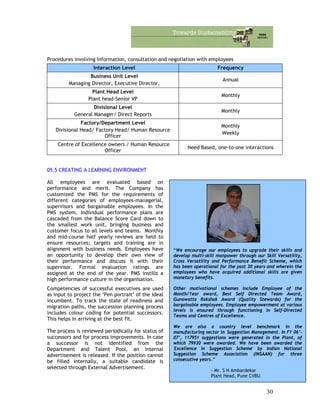
“We encourage our employees to upgrade their skills and
develop multi-skill manpower through our Skill Versatility,
Cross Versatility and Performance Benefit Scheme, which
has been operational for the past 30 years and wherein the
employees who have acquired additional skills are given
monetary benefits.
Other motivational schemes include Employee of the
Month/Year award, Best Self Directed Team Award,
Gunawatta Rakshak Award (Quality Stewards) for the
bargainable employees. Employee empowerment at various
levels is ensured through functioning in Self-Directed
Teams and Centres of Excellence.
We are also a country level benchmark in the
manufacturing sector in Suggestion Management. In FY 06’-
07’, 117951 suggestions were generated in the Plant, of
which 79930 were awarded. We have been awarded the
'Excellence in Suggestion Scheme' by Indian National
Suggestion Scheme Association (INSAAN) for three
consecutive years.”
- Mr. S N Ambardekar
Plant Head, Pune CVBU
Competencies of successful executives are used
as input to project the ‘Pen portrait’ of the ideal
incumbent. To track the state of readiness and
migration paths, the succession planning process
includes colour coding for potential successors.
This helps in arriving at the best fit.
The process is reviewed periodically for status of
successors and for process improvements. In case
a successor is not identified from the
Department and Talent Pool, an internal
advertisement is released. If the position cannot
be filled internally, a suitable candidate is
selected through External Advertisement.
30
All employees have the opportunity to advance their careers. The Company administers career
progression through the PMS system for managerial employees. All employees have the
opportunity of moving to higher levels. This is based on their personal preparation and desire
to move, windows of opportunity and a fair selection process.
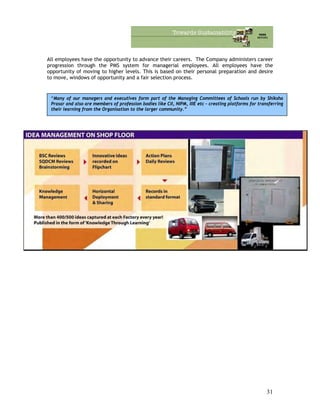
“Many of our managers and executives form part of the Managing Committees of Schools run by Shiksha
Prasar and also are members of profession bodies like CII, NIPM, IIIE etc – creating platforms for transferring
their learning from the Organisation to the larger community.”
31
06 SOCIAL COMMITMENT
06.1 INTEGRATED RURAL DEVELOPMENT
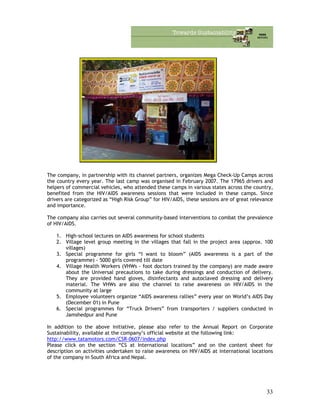
“There is an increasing awareness both
amongst the senior management and the
line functions that there is a need to tie
business decisions to the social needs. It is
then that CSR activities begin even before
the plant is operational. The plant at
Pantnagar being a new venture for Tata
Motors has already seen the dawn of various
activities in the areas of health and
education. This helps the company to build
rapport with the communities in which it
operates and ensures an inclusive growth in
the region.”
- Mr. P K Chobe
Plant Head, Pantnagar
Please refer to the Annual Report on Corporate
Sustainability, available at the company’s official
website at the following link:
http://www.tatamotors.com/CSR-0607/index.php
Please click on the section “CS at Plant locations” on the
content sheet for description on activities and impact of
Integrated Rural Development. Please also refer to the
section “Soul Curry” for an account of the beneficiaries
of the various community development activities
undertaken by the company.
06.2 PUBLIC-PRIVATE SOCIAL PARTNERSHIPS
Please refer to the Annual Report on Corporate
Sustainability, available at the company’s official
website at the following link:
http://www.tatamotors.com/CSR-0607/index.php
Please click on the section “CS at New Plant locations”
and “CS at Non Plant Locations” on the content sheet for
description on public-private partnerships.
06.3 BUILDING BRIDGES TO MANAGE IMPACTED
COMMUNITIES
Please refer to the Annual Report on Corporate
Sustainability, available at the company’s official
website at the following link:
http://www.tatamotors.com/CSR-0607/index.php
Please click on the section “CS at New Plant locations” and on the content sheet for
description on activities undertaken to enhance the employability of local populations to
manage the physiological and psychological needs of the impacted communities.
06.4 FIGHTING HIV/AIDS
For our employees, company doctors raise awareness on HIV/AIDS through lectures
to employees on the shop floor, distribution of informative booklet on AIDS, in-
house articles and screening of awareness films. Also, the company does not make
any discrimination, right from employment to retirement of employees:
• During pre-employment medical check-up, no HIV testing is done
• Employees having HIV /AIDS are allowed to work in our Factory until they are able
to continue normal duty
• Company’s Medical Benefit Scheme extends its’ benefits (reimbursement of
medical expenses) to employees who are suffering from HIV / AIDS. These benefits
are at par with any other medical benefits (It is not under exclusion as most of
Insurance Companies are having).
• Total confidentiality is maintained about HIV +ve status of any employee
32
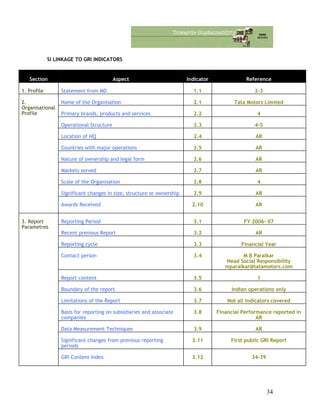
The company, in partnership with its channel partners, organizes Mega Check-Up Camps across
the country every year. The last camp was organised in February 2007. The 17965 drivers and
helpers of commercial vehicles, who attended these camps in various states across the country,
benefited from the HIV/AIDS awareness sessions that were included in these camps. Since
drivers are categorized as “High Risk Group” for HIV/AIDS, these sessions are of great relevance
and importance.
The company also carries out several community-based interventions to combat the prevalence
of HIV/AIDS.
1. High-school lectures on AIDS awareness for school students
2. Village level group meeting in the villages that fall in the project area (approx. 100
villages)
3. Special programme for girls “I want to bloom” (AIDS awareness is a part of the
programme) - 5000 girls covered till date
4. Village Health Workers (VHWs - foot doctors trained by the company) are made aware
about the Universal precautions to take during dressings and conduction of delivery.
They are provided hand gloves, disinfectants and autoclaved dressing and delivery
material. The VHWs are also the channel to raise awareness on HIV/AIDS in the
community at large
5. Employee volunteers organize “AIDS awareness rallies” every year on World’s AIDS Day
(December 01) in Pune
6. Special programmes for “Truck Drivers” from transporters / suppliers conducted in
Jamshedpur and Pune
In addition to the above initiative, please also refer to the Annual Report on Corporate
Sustainability, available at the company’s official website at the following link:
http://www.tatamotors.com/CSR-0607/index.php
Please click on the section “CS at International locations” and on the content sheet for
description on activities undertaken to raise awareness on HIV/AIDS at international locations
of the company in South Africa and Nepal.
33
SI LINKAGE TO GRI INDICATORS
Section Aspect Indicator Reference
1. Profile Statement from MD 1.1 2-3
Name of the Organisation 2.1 Tata Motors Limited
Primary brands, products and services 2.2 4
Operational Structure 2.3 4-5
Location of HQ 2.4 AR
Countries with major operations 2.5 AR
Nature of ownership and legal form 2.6 AR
Markets served 2.7 AR
Scale of the Organisation 2.8 4
Significant changes in size, structure or ownership 2.9 AR
2.
Organisational
Profile
Awards Received 2.10 AR
Reporting Period 3.1 FY 2006- 07
Recent previous Report 3.2 AR
Reporting cycle 3.3 Financial Year
Contact person 3.4 M B Paralkar
Head Social Responsibility
mparalkar@tatamotors.com
Report content 3.5 1
Boundary of the report 3.6 Indian operations only
Limitations of the Report 3.7 Not all indicators covered
Basis for reporting on subsidiaries and associate
companies
3.8 Financial Performance reported in
AR
Data Measurement Techniques 3.9 AR
Significant changes from previous reporting
periods
3.11 First public GRI Report
3. Report
Parametres
GRI Content Index 3.12 34-39
34
Governance structure and Board composition 4.1 AR
Non-executive status of the chair 4.2 AR
Independent and/or non-executive members 4.3 AR
Mechanism for shareholders & employees to
provide recommendations to the highest body
4.4 AR
Linkage between compensation and performance
of the Board
4.5 AR
Process to avoid conflicts of interest 4.6 AR
Process to determine expertise of Board members 4.7 AR
Statements and application of mission, values and
code of conduct
4.8 4
Overseeing of risks and opportunities by
governance bodies
4.9 AR
Evaluating the performance of highest governing
body
4.10 AR
Approach to risk management in operational
planning
4.11 9-10
Charters, initiatives and principles that the
organization subscribes to
4.12 MDGs, Global Compact, Human
Rights, Bharat Nirman, CDM
Membership in associations and
national/international organizations
4.13 SIAM, CII, BCCI, ASSOCHAM, TERI
GRI, Global Compact
Stakeholder engagement 4.14 6-8
Identification and selection of stakeholders 4.15 6-8
Approach to stakeholder engagement 4.16 6-8
4.
Governance,
Commitments
and
Engagement
Topics and concerns raised through stakeholder
engagement
4.17
AR
Economic performance EC1 AR
Organisation’s defined benefit plan obligations EC3 AR
Economic
Performance
Indicators
Impact of infrastructure investments for public
benefit
EC8 32
35
Indirect economic impacts EC9 10
Recycled input materials EN2 21
Energy saved EN5 18
Initiatives to provide energy-efficient products
and services
EN6 11-14
Initiatives to reduce energy consumptions EN7 17-21
Total recycling and reuse of water EN10 19-20
Location and size of land owned, leased or
managed in biodiversity rich habitats
EN11 22-25
Impacts of activities, products and services on
biodiversity
EN12 22-25
Initiatives to reduce Greenhouse Gas emissions EN18 11-14
Emissions of ozone-depleting substances EN19 11-14
Total waste by type and disposal method EN22 20
Weight of waste deemed hazardous EN24 20
Initiatives to mitigate environmental impacts of
products and services
EN26 11-14
Packaging materials that are reclaimed EN27 21
Environmental
Performance
Indicators
Environmental protection expenditure and
investments
EN30 25
Total workforce LA1 AR
Percentage of employees covered by collective
bargaining
LA4 29-30
Workforce represented in joint management-
worker health and safety committees
LA6 28-29
Preventive health care, counseling and training on
diseases
LA8 28-29
Health and safety topics covered in agreements
with trade unions
LA9 27-28
Social
Performance
Indicators
Education and training measures LA10 30-31
36
Programmes for skill management and managing
career endings
LA11 31
Employee performance and career development LA12 30-31
Ratio of basic salary of male and female
employees
LA14 Salaries at par with position,
location and qualification
Human rights screening for suppliers and
contractors
HR2 COP
Employee training on policies and procedures
regarding aspects of human rights
HR3 COP
Total number of incidents of discrimination HR4 COP
Managing risk to freedom of association HR5 29-30
Efforts to eliminate child labour HR6 COP
Efforts to eliminate forced and compulsory labour HR7 COP
Percentage of security personnel trained on
aspects of human rights relevant to operations
HR8 COP
Incidents of violations concerning rights of
indigenous people
HR9 In India, all residents are
indigenous
Programmes and practices to assess and manage
impacts on communities
SO1 32
Business units analysed for risks related to
corruption
SO2 COP
Employee training on anti-corruption SO3 COP
Anti corruption measures SO4 COP
Contributions to political parties SO6 TML adopts a politically neutral
stance
Life cycle stages in which Health and Safety
impacts of products are assessed
PR1 15-16
Customer Satisfaction PR5 AR
AR stands for Annual Report and is available on company website www.tatamotors.com. COP stands for
Communication of Progress and can be viewed at http://www.tatamotors.com/our_world/communication.php.
37

Tata project

  • 2.
    Index Page # Address Noteby the Managing Director 2-3 01 From the Prism of Sustainability 1. Vision & Mission 4 2. Scale of the organisation 4 3. Management Structure 4-5 4. Stakeholder Engagement 6-8 5. Providing Mobility Solutions 8 02 Economics 1. Financial Performance 9 2. Risk Management 9-10 3. Indirect Economic Impact 10 03 Product Responsibility 1. GHG Reduction 11-14 2. Product Safety 15 3. New Product Introduction 16 04 Environment Protection 1. Energy conservation 17-20 2. Waste Management 20 3. Recycle and Reuse 21 4. Promoting Bio-diversity 22-25 5. Environmental Expenditure 25 05 Employees 1. Ensuring Ethical Practices 26 2. Providing Equal Employment Opportunities 27 3. Health & Safety at work 27-28 4. Union Relations 29-30 5. Creating a Learning Environment 30-31 06 Social Commitment 1. Integrated Rural Development 32 4. Public-Private-Social Partnerships 32 3. Building bridges to manage impacted communities 32 4. Fighting HIV/AIDS 32-33 SI Linkage to GRI Indicators 34-37
  • 3.
    Ladies and Gentlemen: Iam delighted to make public Tata Motor’s Sustainability Report which provides a balanced and reasonable presentation of the Company’s economic, social and environmental performance. Tata Motors, India’s largest automotive company by revenue recorded peak performance on almost all major financial parameters in FY06-07. The Company’s overall yearly sales volume crossed half a million mark for the first time and the Company witnessed 33% growth in its overall revenue. Amidst growing competition, the Company strengthened its leadership position in the domestic commercial vehicle segment with a 2.6% growth in market share to 63.8% and successfully retained its position as the second largest player in the domestic passenger vehicle segment with 16.5% market share. Tata Daewoo Commercial Vehicle Company Limited, Korea, which was acquired by us in 2004, also produced impressive performance during the year. To achieve further dominance in various segments of the Indian as well as international markets, the Company entered into joint venture arrangements with notable international automotive players like Marcopolo S.A., Brazil for manufacturing and assembling fully built buses and coaches in India and Thonburi Automotive Assembly Plant Co. for manufacturing pickup trucks in Thailand. The Company signed an agreement with Fiat Auto S.p.A, Italy for the formation of a joint venture at Ranjangaon, Maharashtra to produce cars both for Fiat and the Company as well as engines and transmissions. The Company also signed a Memorandum of Understanding with IVECO, a company of the Fiat Group to evaluate the feasibility of co- operation in the area of commercial vehicles across markets. During the year, the Company also worked towards setting up a green field manufacturing facility in Uttarakhand and a Small car plant in West Bengal. In line with the Tata Group’s commitment of improving the quality of life of the community it serves, the Company strengthened its social development, environmental management and bio- diversity conservation programmes. The Company’s heritage of returning to the society what it earns evokes trust among the consumers and other stakeholders. The Company’s research and development initiatives have resulted in conformance of all its products to the prescribed vehicle emission and safety standards. The Company is also engaged in improving the fuel efficiency of its products and develop vehicles running on alternate fuels like CNG. The Company’s CNG buses are successfully running in Delhi & Mumbai. The pilot batch of forty staff buses running on bio-diesel fuel at one our manufacturing facility is a further testimony to our promise of working towards a greener environment. The Company’s manufacturing facilities in Jamshedpur, Pune and Lucknow have been certified to ISO:14001 Environment Management System (EMS) standard. The manufacturing plants have also produced noteworthy results in re- use and re-cycling of packaging material and metal scrap and continue to pursue more aggressive targets in this direction. As a part of Clean Development Mechanism, the Company’s wind power project has been successfully registered with the United Nations Convention on Climate Change for trading carbon credits. Tata Motors has an illustrious history of conserving and regenerating the natural environment along with the imperatives of creating jobs and selling products. The Company plays a leading role in community development, serving rural communities around its manufacturing locations. The Company has an established community service division at the manufacturing plants to 2
  • 4.
    work with varioussocieties for improving living conditions in adjoining villages. The Company encourages self-sufficiency with the aim of improving the confidence, morale and lives of its employees and their dependents. The Company has been actively engaged in programmes which encourage economic independence through self initiated cottage industries, community and social forestry, water and road projects, improving rural health and propagate family planning benefits. The Company has identified truck drivers as a key community and has undertaken pioneering work in dissemination of knowledge about AIDS prevention and fuel conservation. Tata Motor’s contribution in national development, environmental conservation and societal value creation has been acknowledged at various forums. The Company has received many awards including the coveted CII-EXIM award for Business Excellence, CII awards in Corporate Sustainability Reporting, Energy Efficiency and Energy Management, Green Governance Award by the Bombay Natural History Society and the Golden Peacock Global Award for Corporate Social Responsibility by Institute of Directors, the international body of company directors. In coming years, as India moves on the path of economic development at a faster pace, the demand of vehicles for private as well as public transportation is expected to increase. Improvement in road connectivity across the country through various on going road development projects is also expected to trigger the demand of goods transportation vehicles. Tata Motors is confident that the wealth generated as a result of development would not only power the business but would also be ploughed back in the conservation and enrichment of environment and for greater prosperity of the community. Ravi Kant 3
  • 5.
    01 FROM THEPRISM OF SUSTAINABILITY 01.1 VISION & MISSION 01.2 SCALE OF THE ORGANISATION Tata Motors is a fully integrated automobile company. Today, it is the only automobile manufacturer to offer the entire range of commercial vehicles for transportation of goods and passengers and also passenger cars through its two business unit viz. Commercial Vehicle Business Unit (CVBU) and Passenger Car Business Unit (PCBU). Tata Motors Limited is a public limited company listed on 4 stock exchanges (BSE, NSE, MPSE and CSE) in India and internationally listed at Luxembourg Stock Exchange and Singapore Stock exchange. Company’s Depositary Receipt Programme is listed on the New York Stock Exchange. Tata Motors has major operations in India with sales and marketing operations in more than 70 countries. 7.35 % revenue is earned through exports of its vehicles. More details, including shareholding pattern are available at Tata Motors website http://www.tatamotors.com 01.3 MANAGEMENT STRUCTURE The Board, being elected by the shareholders, is a representative of the Company’s shareholders and is a bridge between them and the executive management. The Board therefore has a fiduciary relationship and a corresponding duty to all its stakeholders to ensure 4
  • 6.
    that their rightsare protected. Through the governance mechanism in the Company, the Board alongwith its Committees endeavors to strike the right balance with its various stakeholders. The Company has a Non-Executive Chairman and the day-to-day operations of the Company are overseen by the Chairman, Mr. Ratan N Tata as a member of the Committee of Directors, comprising himself and Mr. R Gopalakrishnan. They have delegated appropriate powers to the Managing Director and Executive Directors to look after the day to day affairs of the Company. The role of the Chairman and the Managing Director (CEO) are distinct and separate. The relationship between the Board, the Committees and the senior management functions is illustrated below: Being a global player, Tata Motors has ensured that its corporate governance practices are compatible with the international standards. Tata Motors has adopted the Tata Business Excellence Model (TBEM) as a means of driving excellence. In order to track process on long- term strategic goals, a Balanced Score Card methodology is used. This enables the Company to go beyond financial performance to incorporate considerations of environment and society, as well. 5
  • 7.
    01.4 STAKEHOLDER ENGAGEMENT Tata Motors ShareholdersCustomers Channel Partners Community Impacted CommunityNGOs Government Employees Consistent Returns Safe,cost effective products Technology,etc SustainabilityIntegratedDevelopment Sustained livetihood Sefety Going beyond Compliance ContributiontoGDP, compliances HealthSafetyWelfare Shareholders & Government There are several means that have been established to facilitate two-way process of communication between the stakeholders and the Board of the Company. The Quarterly/Half Yearly/Annual results are regularly submitted to the Stock Exchanges in accordance with the Listing Agreement and are published in the newspapers and posted on the Company’s web-site. The information regarding the performance of the Company is shared with the shareholders every six months through the half yearly communiqué and each year through the Annual Report. The Company also regularly posts the information as specified under Clause 41 of the Listing Agreement on the Electronic Data Information Filing and Retrieval System (EDIFAR) launched by Securities and Exchange Board of India. Newspapers wherein quarterly results are published Indian Express, Financial Express and Loksatta (Marathi) Website where displayed www.tatamotors.com Whether it displays official news releases and presentations made to institutional investors or to the analysts Yes Whether MD & A is a part of Annual Report Yes 6
  • 8.
    The Board ofthe Company has adopted the ‘Code of Corporate Disclosure Practices’ according to which the public spokespersons are identified who are responsible in ensuring timely and adequate disclosure of price sensitive information. This Code ensures simultaneous release of information through various mediums of disclosure/dissemination in a transparent and fair manner. This information is also available on the Company’s website, www.tatamotors.com. The 20F Annual Report prepared as per the US regulations and the NYSE Listed Manual provides information which is not normally in the public domain vis-à-vis other listed companies, is also available on the website of the Securities and Exchange Commission and the Company. The 20- F Annual Report contains information on five-year financial data under US GAAP; risks associated with the Company’s business; investments in the Company and relating to ADRs; a business overview which includes sections on the Indian economy and the automotive market and competition; business strategy and operations; a complete product profile; production facilities and distribution network; R&D initiatives; intellectual property; legal proceedings; organisation structure; subsidiaries and affiliates; operating and financial review and prospects; capital expenditure incurred and sources of financing; details of the auditors; Board composition and management; governance structure; shareholding pattern; dividend policy; share and ADR price; rights of shareholders; exchange control policy of the Government and taxation as relevant to investors; CEO and CFO certification to the investors and audited consolidated financial statements for the last three years. To ensure that the Company has disclosed relevant, accurate and complete information to its investors so as to ensure that the Company’s financial condition and results of operations in all material respects have been disclosed on a timely basis under the applicable laws, the Company recently constituted a Disclosure Committee comprising of the senior management as also heads of the larger subsidiary companies. Customers The Company is also in the midst of implementing a very comprehensive Customer Relationship management program which is reviewed by the Management Committee and the Board sub- Committees from time to time. This program ensures that the Customers are treated in the fair manner by the channel members of the Company and their needs are also captured and responded to through this programme. Channel partners/Suppliers A Supplier Relationship Management program and Dealer Management System are in place and the Management Committee reviews the program from time to time. The key indicators of review are the Supplier coverage and the efficiency of the transactions with the Company. The Company also organizes Supplier’s day/Vendor meets/Channel partner meets where suppliers can touch base with the Board members and share their thoughts and inputs. Employees The Management Committee on a very regular basis reviews the employees’ issues. The remuneration guidelines, the employee satisfaction, the employee growth plan and the organization culture are discussed in these meetings. Major employee welfare schemes are put up to the Board for approval. The Board is also kept informed of senior level changes in management, status on signing of Union wage agreements, remuneration of senior executives, etc. 7
  • 9.
    Impacted Community/Community The companyhas a strong CSR practice in place, which is institutionalized and driven with the commitment of our senior management and is grounded in the legacy of the Tata Group. Regular day-to-day interactions take place with the community members and all activities are designed, implemented and evaluated with the active involvement of the community members. Participatory Rural Appraisal, Social Impact Assessment through external agencies and group meetings are some of the methods in which the company engages with the impacted communities at the new plant locations. (In addition to the information above, see stakeholder engagement chart – Annexure I) 01.5 PROVIDING MOBILITY SOLUTIONS Through a wide range of products, right from small passenger car vehicles to heavy trucks and buses, the company caters to the free and safe movement of goods and people. The company also caters to the government institutions like the municipal corporations and transport corporations and manufactures vehicles used for defence purposes as well. In the reporting period, the company introduced the Star Bus, which ensures that public transport becomes disabled-friendly. In 2006, the company has also initiated the “small car project” which aims to provide safe transport at affordable prices. The targeted price of US $2500 would make a four wheel vehicle available to the masses, thereby making transportation personal and safer. From 2006, Commercial Vehicle Business Unit (CVBU) has taken an initiative to conduct industry-wide syndicated satisfaction surveys through TNS, so that commonly accepted satisfaction scores are used by all players in the industry. TNS specializes in automobile customer satisfaction determination and also conducts similar syndicated satisfaction surveys for passenger cars as well as two-wheelers. In 2005-06 TNS commenced syndicated satisfaction surveys for Trucks (M&HCVs as well as LCVs). In 2006-07 syndicated survey for trucks was continued while a similar syndicated survey on buses (MCVs as well as LCVs) was commenced. In TNS approach TRI*M index is derived as a weighted average of scores on overall satisfaction, advocacy, loyalty, and competitive advantage. TRI”M index is also known as Customer Retention index and can vary between -65 and +135. The higher the index, the greater is the likelihood of retaining customers. TRI*M Indices revealed that CVBU has the highest scores in M&HCV & LCV trucks and second highest scores in MCV and LCV Buses (comparison with other players like Leyland, Eicher, M&M and Swaraj). “The success of any product lies with its sustenance and although we have achieved some results in the areas of product safety and innovation, employee relationship management, labour practices, responsible marketing practices and community development, we believe that this journey has just started. Putting an emphasis on channel partners, suppliers and other stakeholders to move towards more sustainable practices is a challenge that is yet to be fully tackled. ” - A K Mankad Head – Car Plant 8
  • 10.
    02 ECONOMICS 02.1 FINANCIALPERFORMANCE For an account on financial performance of the company and its subsidiaries in 2006-07, see the Annual Report at our website, www.tatamotors.com . 02.2 RISK MANAGEMENT The Company has a comprehensive system of control, focused on mitigation of risks to ensure achievement of objectives. The risks are assessed on an ongoing basis and controls are designed to respond to risk throughout the Company. For the purpose of review, risks are categorized into Type A and Type B and are also rated from 1–4 based on impact and frequency. The Audit Committee seriously looks into the Type A risks as also reviews the mitigation action taken against these risks on a quarterly basis. Pertinent information on risk assessment and control activities is communicated effectively to employees. The line management regularly monitors controls. Thus the risk management/internal control practices contribute to the development of robust business operations and promotes/enhances value creation. The Board regularly reviews processes and procedures to ensure the effectiveness of the internal systems of control. Management reports to the Board provide a balanced assessment of significant risks, a balanced assessment of the effectiveness of the system of internal controls in managing those risks and identify significant failings/weaknesses, its impact on the Company and actions taken to rectify them. The Risk Management key roles and components are: The Company is promoting risk awareness through a structured risk management process. The ownership of these programs vests with operating managers, with Internal Audit playing a facilitators role. Risk Management is carried out through: Business Management Plans Risk Taking Appetite Strategic Risk Management Framework Strategic Business Unit Risk Management Plans Risk Management Requirements Controls Self-Assessment Risk Management Policies (Initiated by Internal Audit) Risk Management Strategies Chief Executive/ Executive Directors Board & Audit Committee Incident Reports/Compliance Certificates Clear response effective buy-in (To various levels, delegations & accountabilities including the Board for significant incidents) Staff Line Management a) Enterprise Risk Management (ERM) b) Business Risk Management (BRM) and c) Self Assessment questionnaire. 9
  • 11.
    Internal Audit actsas a facilitator for all these, whereas the primary responsibility remains with the process owners. The ERM Process has been initiated in the Company as a tool to strengthen the Strategic Planning process. It aims at sustaining desired operational performance and providing a platform for rational allocation of capital across SBUs. The process maps the Strategic, Operational, Financial & Governance Risks related to the Business strategy as also on account of weaknesses in the internal processes. The agreed risks are logged in the Company’s Risk register and the respective Responsibility Centers are required to determine the risk treatment (Accept/Reduce/Transfer/Eliminate) and work out the mitigation plans accordingly. The outcomes of the Risk Mapping Process were presented to the Management Committee and the Audit Committee for review and direction. The outcomes of ERM process were also reported to the Board on March 31, 2007.The Major risks along with the mitigation actions are planned to be reviewed by the Management Committee and presented to the Audit Committee and the Board on a regular basis. A benchmarking of ERM practices of other local and global companies has been done to ascertain opportunities for improvement. The ERM process is designed to be compliant with SOX and Clause 49 of the Listing Agreement with the Indian Stock Exchanges. 02.3 INDIRECT ECONOMIC IMPACT Worldwide, Transport sector has emerged as the biggest employer * 1 Commercial Vehicle - employment for 13.3 people 1 Car - employment for 5.3 people 1 Three Wheeler - employment for 3.9 people 1 Two Wheeler - employment for 0.5 people * Source: Automotive Mission Plan 2006-16, Includes: Direct and Indirect Employment With a growth of 28% in 2006-07, Tata Motors recorded its highest ever sales of 580,280 (334,238 commercial; 246,042 passenger) vehicles. The Company’s exports witnessed a growth of 6.5% to 53,474 numbers. The approximate indirect economic impact generated by the company in 2006-07 is summarised below 668,476 246,042 22,349 18,000 10,2615000 * Includes initiatives to enhance employability (vocational and technical training, apprenticeship programmes), promotion of co-operatives and formation of Self-Help Groups Employment generated through channel partners Employment through social initiatives* Employees in Subsidiaries Direct Employees Indirect employment from commercial vehicles*** Indirect employment from passenger cars** ** On assumption that one passenger car sold creates employment for at least one person – driver/cleaner *** On assumption that one commercial vehicle sold creates employment for at least two people – Driver and cleaner/helper 10
  • 12.
    03 PRODUCT RESPONSIBILITY 03.1GHG REDUCTION A challenge for any automobile company is to ensure that their products will not have any adverse impact on the environment during its use phase. Several measures have been taken to mitigate the environmental impacts of our goods and services, which are summarized below: Reducing CO2 emissions and increasing fuel efficiency: CO2 emissions are considered to be a primary contributing factor to global warming, making their management the most important challenge for TML. Of the total volume of CO2 emissions associated with the life cycle of an automobile, from excavation of raw materials to recycling of end-of-life vehicles, the largest portion occurs when the vehicle is on the road. Controlling these emissions is one of the most significant technology challenges TML is tackling today. While we are working in developing fuel cells and other technologies of the future, we are also working to reduce CO2 emissions today’s vehicles through highly efficient engines and technology a) Diesel engine emits 20 to 40 % less CO2 than gasoline engines. TML produces products which mostly uses diesel as fuel b) Although no regulatory standard for CO2 and fuel efficiency for different products are specified in India, care is taken to reduce the CO2 emission and increase the fuel efficiency from the product with introduction of advanced technology. c) Use of common rail fuel injection for diesel engines has brought down the CO2 emission. The Common Rail system in particular gives engine developers the freedom they need to reduce exhaust emissions even further, and especially to lower engine noise. In the Common Rail accumulator injection system, the generation of the injection pressure is separate from the injection itself. A high-pressure pump generates in an accumulator – the rail – a pressure of up to 1,600 bar (determined by the injection pressure setting in the engine control unit), independently of the engine speed and the quantity of fuel injected. The fuel is fed through rigid pipes to the injectors, which inject the correct amount of fuel in a fine spray into the combustion chambers. The Electronic Diesel Control (EDC) controls extremely precisely all the injection parameters – such as the pressure in the Rail and the timing and duration of injection – as well as performing other engine functions. d) Use of XETA technology has increased fuel efficiency and reduced CO2 emission in gasoline passenger car. The new Indica Xeta with 1.4 litres extra fuel-efficient torque advantage petrol engine delivers frugal fuel consumption at 14 kmpl. The 32-bit microprocessor in the engine includes a knock sensor, which helps reduce damage from adulterated fuel, and maintains efficiency. e) Use of Integrator Starter Generator (ISG): TML is developing passenger cars with ISG, and is planned for introduction in market in about two years. ISG combines the alternator and starter motor in a vehicle into one machine. The machine is controlled such that when the vehicle is stopped, the engine is automatically switched off, to conserve fuel. The engine is started again when the vehicle needs to be moved again. The automatic shutting off of engine can save 5 - 10 % of fuel in a typical city driving cycle. f) Use of energy efficient air conditioning system – Scroll compressor: Automotive air conditioning compressor loads the engine in order to provide thermal comfort inside cabin. Higher load on engine leads to higher emission level/fuel consumption. Scroll compressors for automotive air conditioning systems consume upto 20% less power and upto 4% less fuel than commonly used Swash Plate 11
  • 13.
    compressors. Last yearapproximately 6000 Indica vehicles were fitted with scroll compressors. More number of vehicles with scroll compressors is planned in current year. Heat exchanger & Condenser: TML has fitted air-conditioning systems that feature smaller heat exchangers and high-efficiency condensers. These moves have helped to restrict usage of the air-conditioner refrigerant HFC-134a, which is a more potent greenhouse gas than CO2. Integrated receiver drier bottle condenser is being aggressively pursued by TML as an initiative to reduce refrigerant charge quantity. HVAC system with IRD condenser requires about 20% less of refrigerant (reduction of approximately 80 gms per vehicle). Reducing refrigerant leakage: All HVAC system components of TML vehicles are 100% checked for refrigerant leakage. TML has ensured that the vehicle level leakage rates are well below the specified limit of upcoming norms of 40 gms per year. Refrigerant recovery mechanism: TML ensures that no R134A refrigerant is released to atmosphere during any service, repair and maintenance. The refrigerant charge is first recovered from vehicle before the system is being serviced. Use of CO2 refrigerant for automobile air conditioning: Carbon dioxide (CO2) has GWP = 1 and is being aggressively pursued as an alternative environmentally friendly refrigerant. Tata Motors is working closely with HVAC system suppliers and academic institutions to develop automotive air conditioning system using CO2 as refrigerant. Going Green: At Tata Motors, the commitment to developing environment friendly and sustainable products is in an accelerated phase. On March 29, 2005, the company announced its pilot bio-diesel programme jointly undertaken with Indian Oil Corporation. This involves using bio-diesel for Tata Motors' fleet of buses. Environment friendly technologies: Hybrid Electric Car: Hybrid Electric car is being developed in TML. The concept vehicle has been demonstrated while prototypes are under development. Hybrid Car consists of a mechanical and electrical powertrain. Hybrid vehicles achieve significant improvement in fuel economy by limiting the IC engine’s operating region so as to maximise the efficiency. A traction requirement outside the optimum operating region of the engine is handled by the electric motor. Hybrid bus: The prototype of hybrid mini bus is under development. This diesel electric bus for intra-city transport consists of series hybrid configuration with downsized engine. Electric Bus: The concept prototype of trolley bus is under development. Electric Bus has an all-electric power train using motors and inverters for driving the motors. The power source for the electric supply can be on-board, like a small diesel Genset or a fuel cell, or off-board, as in the case of a trolley bus. The vehicle will also have a bank of batteries onboard to provide high, intermittent power for acceleration and also to recover the braking energy using regeneration. 12
  • 14.
    Fuel cell Bus:Fuel cell Bus is a derivative of an Electric Bus, in that the electric power source is a fuel cell. A fuel cell is a primary battery, which oxidises hydrogen to water through a catalyst, generating electrical energy during the process. The oxidation occurs at much lower temperature than combustion temperatures of hydrogen, resulting in no emissions other than water. Bio- diesel Engine: Developing use of bio-diesel blend at various blending percentages in order to ensure that bio-diesel can be used on our vehicles with minimum engine modifications. We have completed trials in the phase-1 of the program with 10% blend and are now planning for higher blend percentages to increase the use of bio-diesel. This would result in reduced emission and conservation of fossil fuels. Use of Ethanol gasoline blend in Tata Vehicles: Tata Motors is actively pursuing other alternate fuels such as using a blend of ethanol and gasoline in our vehicles. Trials with 7 & 10% blends of ethanol and tuning of the engines are in progress. TML has also joined the Indian delegation to Brazil to study the ethanol fuel vehicles in Brazil. Use of Hydrogen in CNG for our commercial vehicles: In order to develop engines with lower emissions, TML is progressing on a project to use hydrogen in CNG as fuel for our commercial vehicles. This would also help in creating an understanding of the Hydrogen infrastructure for future applications. This is a joint program with IOC, co-ordinated by SIAM. Hydrogen Powered IC Engine: An exploratory project along with IIT Chennai has been initiated for the use of Hydrogen fuel in engine. This project will help us develop a clear understanding of the combustion process. 697 CNG BS II engine has been taken as a base engine with a target of a possible demo bus. TML is in compliance with the EU directive on ELV’s for export vehicles to European Union CNG Buses: Tata Motors has already developed a wide range of CNG vehicles such as buses, Indica with CNG application and LCV-407 CNG vehicles for bus and truck applications. Today, over 6800 Tata Motors’ CNG buses are plying on Delhi roads. LNG trucks: Tata Daewoo Commercial Vehicle Company (TDCV), the second largest commercial vehicle manufacturer of South Korea and a 100 per cent subsidiary of Tata Motors, has developed South Korea’s first liquefied natural gas (LNG) powered heavy tractor-trailer, an environment-friendly commercial vehicle. TDCV pioneered the design, development and manufacture of the new LNG tractor under an arrangement sponsored by the Korea Gas Corporation (KOGAS). The development work on the vehicle had begun in September 2004, and is expected to evoke encouraging response from customers with its fuel efficiency and economy of operation. Bus rapid transit system: This system developed by TML based on use of low floor CNG buses with high capacity is an sustainable solution for mass transportation problems in metros like Delhi, Mumbai , Bangalore etc.It proposes use of special lanes on the routes reserved for such buses to facilitate faster movement of buses and is based on Intelligent Transportation System model (ITS) .It is enabled by Information , Communication , Smart Card & GPS technologies to provide better service to commuters. TML has successfully implemented Lead free wheel balance weights, lead free printing inks, lead free bulbs, alternate designs/coatings for hard Cr platings, cadmium platings, Lead free coatings for fuel tanks, Lead free carbon brushes for electrical motors etc. Asbestos free brake pads & clutches have been introduced in many of our products. In addition, water based paints are being used instead of solvent based paints to avoid VOC emission. Work 13
  • 15.
    is going onfor reducing/elimination of hexavalent chromium for corrosion preventive coatings and development / implementation of lead free bearing shells and bushes. Reducing Emission levels: Refrigerant CFC-12 is an “Ozone Depleting Substance (ODS)”, categorized under Group I of the ODS (Regulation & Control) Rules, 2000, which is to be phased out by the year 2010. The Company is actively working to achieve this well ahead of this target, by first targeting reduction in consumption of CFC-12 for the existing refrigeration equipment. The Company has an EMP in place to convert refrigeration units using refrigerant CFC-12 to its environmentally friendly alternatives i.e. replaced with units operating on R-22 / R-134a. Due to the above proactive actions, we have been successful in containing the consumption of CFC-12 refrigerant for maintenance of existing equipment. Tata Motors continuously strives to reduce vehicles’ emission levels and has undertaken the following initiatives: • Pollution level reduction for Commercial Vehicles (Diesel engines) from present level (BS- II norms): CO - 4.0, HC -1.1, NOx -7, PM-0.1 gm/Kwh to target level (BS-III norms): CO - 2.1, HC -0.66, NOx -5 gm/Kwh • Pollutant level reduction for utility vehicle (diesel engine) from present level (Euro -3 norms): CO - 0.95, NOx - 0.75, HC + NOx - 0.86 gm / km to target level (Euro - 4 norms): CO - 0.75, NOx - 0.39, HC + NOx - 0.46, PM - 0.06 gm / km • Pollutant level reduction for passenger cars (diesel engine) from present level (Euro -3 norms): CO - 0.64, NOx - 0.50, HC + NOx - 0.56, PM - 0.05 gm/km to target level (Euro - 4 norms): CO - 0.50, NOx - 0.25, HC + NOx - 0.30, PM - 0.025 gm/km • Pollution level reduction for passenger cars (petrol engine) from present level (Euro -3 norms): CO - 2.3, NOx - 0.15, HC - 0.20 gm / km to target level (Euro - 4 norms ): CO - 1.0, NOx - 0.08, HC - 0.10, PM - 0.06 gm / km All these targets to be met broadly through: Common Rail direct injection system Higher fuel injection pressure Full electronic control of FIE system for fuel delivery & timing control. Progressive ECU mapped exhaust Gas Re-circulation. Closed coupled and under body catalytic converter for exhaust gas after treatment. Improving the volumetric efficiency by incorporating 4 valve/cylinder instead of existing 2 valve/cylinder Variable geometry turbocharger for boost control. Ozone Friendly Refrigerants: Air conditioning systems in the entire product range use HFC - 134a - an ozone friendly refrigerant since 1996 itself. Use of CO2 based refrigerant, is targeted by the year 2009. Use of Non-Hazardous Material: Asbestos free brake linings are developed for the entire product range in all export products. However due to commercial consideration and market requirements many of our products continue to be supplied with asbestos brake liners in domestic market and in Third World countries. Reducing noise levels: Following measures were taken to reduce exterior noise of the vehicle as it is accelerated on road at high engine-speeds: 14
  • 16.
    1. Acoustic shields:They were specifically developed around engine and gear-box so that roaring sound will be absorbed. 2. Silencer redesign: Silencers were deigned to have greater insertion losses before pulsating exhaust gases would leave the tail pipe. A care was taken to see that backpressure of the engine would not increase assuring adequate power of the vehicle. 3. Viscous or Electric Fan: Both of them reduced Fan noise of the engine at high speeds. 03.2 PRODUCT SAFETY Tata Motors has been putting in a lot of effort to improve the safety (active & passive) of its products and to go beyond the safety regulations – example our model, ACE has been designed to meet more stringent crash safety norms that are not applicable to that class of products. ERC (Our Research and Development Centre) is adequately equipped with state of the art facilities to address specifically the issues of customer health and safety. It has facilities like Crash Test facility for safety and the Hemi Anechoic chamber for NVH and engine emission testing. These facilities enable development of products meeting safety and environmental regulations. Tata Motors is the only manufacturer in this country to have a crash test facility Examples of special features used in our products for preserving customer health and safety include Anti-skid braking systems; Air Bags; Ergonomically designed seating systems with lumbar support; Euro III complaint engines etc; Non-CFC based vehicle air conditioners. Tata Motors was the first Indian manufacturer to develop & introduce airbags on its vehicles Our record of compliance with regulatory requirements pertaining to emissions, safety, product labelling, competition, advertising and other clauses of the Central Motor Vehicle Rules have always been proactive and exemplary. The Company has never received any sanctions for violation of regulatory norms. 15
  • 17.
    Tata Motors obtainstest certificates for vehicle worthiness and other safety related issues like emission, brakes, noise etc. before the product is marketed through government authorised agencies. Tata Motors also obtain Homologation certificates for export markets from authorized test agencies. Labelling Identification of parts that need to be labelled as per Annex II of EEC directives 2000/53/EC amended by 2002/525/EC. This directive bans the use of hazardous heavy metals – Lead, Hex-Chromium and Mercury. 03.3 NEW PRODUCT INTRODUCTION The pace of new product development has quickened through an organisation-wide structured New Product Introduction (NPI) process. The process, with its formal structure for introducing new vehicles in the market, brings greater discipline in project execution. The NPI process helped Tata Motors create a new segment, in 2005, by launching the Tata Ace, India’s first indigenously developed mini-truck. The years to come will see the introduction of several other innovative vehicles, all rooted in emerging customer needs, like the Small Car. Besides product development, R&D is also focusing on environment-friendly technologies in emissions and alternative fuels. 16
  • 18.
    04 ENVIRONMENT PROTECTION TataMotors plans for the environment in its processes, products and services. “Facilities and Environment Management” is identified as a Business Process and is formally documented in our Enterprise Process Manual. Facilities and Environment Management” process is mapped in detail and the measures for “effectiveness and efficiency” of the process are specified. This has helped the Company to evolve a uniform approach across all manufacturing locations in the country. “Our Founders - Sir Dorab Tata, Mr. J R D Tata and Mr. Sumant Moolgaokar have shown ‘environmental consciousness’ far ahead of their times while planning new Factories. Since commencement of manufacturing activities, Tata Motors has actively pursued water and energy conservation, waste minimization and pollution prevention at source. Now, these activities have become integral to the functioning of the Plant s and are a planned and budgeted exercise. As a result of such initiatives taken up in the past, Pune has been able to successfully conclude the sale of Certified Emission Reductions (CERs) in September 2007. Now that we are in rapid expansion mode, we are continuously integrating our learning’s into the planning of new facilities to balance their environmental impact on the local ecosystems.” - M B Kulkarni General Manager (Environment) Contribution towards Sustainable Environment Tata Motors has participated in the Sustainable development (S-DEV) exhibition in Geneva through TERI showcasing the company’s contribution for sustainable development. Tata Motors is working with the steering committee of National Hydrogen Energy board to find the ways where India may harness hydrogen potential energy of future The company is represented on several National Committees working for improvement of environment throughout the country. 1) Technical committee for “Air quality monitoring, emission inventory and source apportionment studies for Indian cities” constituted by Central pollution control board, Delhi 2) Group on “Technical evaluation of ARAI reports on development of emission factors” constituted by Central pollution control board, Delhi 3) Technical committee for “Heavy-duty Diesel retrofit demonstration project” constituted by National environmental engineering research institute, Mumbai 4) Multi stakeholder committee to “Develop Better environmental sustainability targets for lead battery manufacturers” constituted by development alternatives, Delhi in collaboration occupational knowledge international, UK and national referral center for lead poisoning, India 5) Steering committee for “Mobile Air conditioning Assessment project” constituted by TERI, Delhi 04.1 ENERGY CONSERVATION Tata Motors Ltd, (TML), being one of the pioneers in automobile sector in the country on its path to World Class Manufacturing has incorporated environmentally sound practices as one of its prime objective – in its processes, products and services. All manufacturing facilities at Pune, Jamshedpur and Lucknow have achieved certification to the ISO-14001 Standard. The Company has always been conscious of the need for conservation of energy. Energy Conservation measures have been implemented at all the plants and offices of the Company. These measures are aimed at effective management and utilization of energy resources and have resulted in cost savings for the Company, aggregating approximately Rs 307.5 millions. 17
  • 19.
    Company has startedEnergy Accounting & Energy conservation programmes: Tata Motors Ltd. considers energy conservation critical to the operation of its Plant. Apart from reducing operational costs, the energy saved amounts to environment protection by way of avoiding pollution due to power generation processes. Energy conservation is driven throughout the organization, by way of setting Division wise targets and monitoring performance on everyday basis for optimising energy consumption. 1. Introducing FRP blades for man-coolers 2. Installing variable speed drive for flow control and energy saving 3. Introduction of fuel additives in Furnace Oil to improve the combustion efficiency of the fuel Energy Conservation measures at Tata Motors, Jamshedpur during 2006-07 resulted in savings of 101 Lakh kWh of electrical energy and 1430 KL of fuel oil amounting to Rs 662 Lakhs.CII-GBC- Awarded National Award for Excellence in Energy Management 2007 4. Soft-start energy savers for hydraulic press motors 5. Sheds designed for efficient natural lighting 6. Use of CFL sodium vapor lamps to minimize energy consumption 7. Installing portable compressors for isolated running to save compressed air The Commercial Vehicle Business Unit won the CII National Award for “Excellence in Energy Management -2006” and was declared as an Excellent Energy Efficient Unit in Automobile Sector Passenger Car Business Unit won the “Certificate of Merit-2006” in the Automobile Sector for the National Conservation Award 2006 instituted by Government of India and was declared an Energy Efficient Unit in Automobile Sector under CII National Award 2006 8. Harnessing natural daylight by installing translucent roof sheets in workshops 9. Use of LPG in place of LDO & Electricity for heating, wherever applicable 10. Installation of Turbo Ventilators in forge & Foundry to extract fumes which do not require energy to operate 18
  • 20.
    Use of alternateenergy is also promoted in manufacturing units of the company. Taking opportunity of the Clean Development Mechanism, Tata Motors Ltd. initiated action for 20.85MW Wind Power Projects installed & commissioned at Satara & Supa. Ministry of Environment (MoEF), New Delhi, has issued Host Country Approval for the Project. The Project was validated by M/s BVQI and registered by UNFCCC. In September 2007, we successfully traded the CERs through e-bidding on the Chicago Climate Exchange. Rainwater Harvesting: Photo: GREAT ROLE MODEL PROJECT – a Rain Water Harvesting (RWH) project implemented within the premises of manufacturing unit of Tata Motors at Jamshedpur The RWH project can meet nearly 4 to 5 months requirement of water for TML, thereby reducing its dependence on the river for its water requirements 19
  • 21.
    04.2 WASTE MANAGEMENT Thewastes are disposed by various pathways depending on their hazard characteristics. These disposal pathways include - direct incineration, direct landfill and landfill after treatment. All hazardous wastes are disposed through an Authorised Common Hazardous Waste Treatment Storage and Disposal Facility (CHWTSDF). Tata Motors does not import or export hazardous wastes. However, Scrap Material generated in various production processes like waste or used/waste oil, non-ferrous metal and scrap lead acid batteries defined as "hazardous" in Schedule-4 of Hazardous Wastes (Management & Handling) Amendment Rules 2003 are sold to the MoEF/CPCB Registered Re-cyclers/ Re-refiners/ Re- processors only. Tata Motors is pursuing various projects to recover energy from hazardous wastes or to recycle them into useful end products. Experimental trials to recycle paint sludge into general purpose paint have been successful and work is on to scale up trials. The possibility of energy recovery from high calorific value hazardous wastes is also being jointly explored with cement manufacturing companies. 20
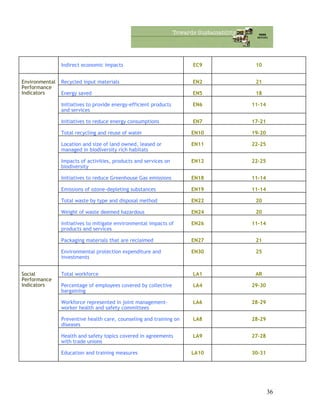
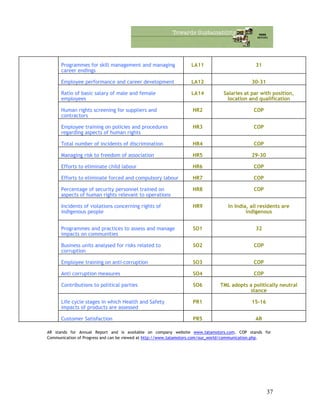
  • 22.
    04.3 RECYCLE ANDREUSE Recycle of Packaging Materials: The Company’s products do not require any external packaging. Wood used in packing crates of spare parts is re-cycled from wooden scrap packaging of received material. Heavy bought out components, which were received in wooden crates, are now changed over to returnable pallets. Collapsible custom-built polypropylene (PP) boxes have been developed for bought out components that are bulky and light (e.g.: dashboards). These PP boxes can be dismantled, flattened and returned to vendors for re-use, eliminating the use of virgin packaging material each time. With a cycle time of more than 150 trips these polypropylene boxes have resulted in significant savings on component packaging. End-of-Life (ELV) Vehicle and Re-cyclability of products: To address the environmental impacts during disposal of vehicles at the end of its life, re- cyclability and reclaimability has been defined as one of the design objectives. • Tata Motors is also working with the Society of Indian Automobile Manufacturers (SIAM) as a member of the task force on Recyclability to study and develop a policy on Recyclability of vehicles in India. Re-use of treated effluent: The treated effluent is re-used for various low-end purposes such as toilet flushing, floor washing, chemical solution preparation, gardening, horticulture, fire hydrant line testing and as make up water to various cooling towers. 21
  • 23.
    04.4 PROMOTING BIO-DIVERSITY TataMotors, Pune had planned for environment protection even before its manufacturing facilities were completely set up. The approximately 800 acres of land, procured by Tata Motors (then-Tata Engineering & Locomotive Company Ltd – TELCO), in 1965, was a barren landscape of hard basalt rock, which is typical of Deccan Trap with practically no soil cover. The hot arid climate of the region and the rocky terrain could support only a few wild shrubs. This type of geological terrain was seen as fit only for use as stone quarries, and the rocks / murrum mined from Chinchwad region acquired a name for itself over the years. Many abandoned basalt quarries are still a prominent feature of the Pimpri-Chinchwad Industrial area. Photos: Site of our Pimpri Works in 1965, prior to commencement of industrial activity in the area The first major step towards the transformation of this barren landscape was the construction of a 350-meter long stone masonry dam to impound the rainwater that used to flow through it from the surrounding catchment area. Subsequently the height of the dam was raised and the lake thus created was also deepened, increasing its storage capacity to about 60 million gallons of water. The creation of a perennial water source gave a great boost to tree plantation activities and the raising of nurseries. The lake thus became the nucleus for the transformation of the landscape. The first tree nursery was used to stock tree saplings acquired from local nurseries, and raise them to a good height. Simultaneously several fast growing trees were planted to create natural shade as quickly as possible. The saplings raised in these nurseries were the first step in the greening of the barren landscape. 22
  • 24.
    Over time, thecreation of the water bodies and the tree cover (approximately 1,50,000 trees) has altered the very look of the entire landscape. The objective was to make the lake / ponds and surrounding area attractive to aquatic and other birds, which was achieved by a planned microhabitat development programme. These microhabitats include: 1. Water bodies 2. Marshy area / Reed beds (Typha sp.) 3. Open scrub land / grassland 4. Garden / orchard area Water Bodies: All the water bodies, i.e. 2 lakes and 4 ponds were originally created by excavation. These ponds and lakes are spread out over an area of approximately 40 acres. The ponds are smaller in area and also shallower, as compared with the lakes. Storm water and treated effluent flow into the lakes through the 4 ponds. These ponds are frequented by different varieties of small waders, cormorants and kingfishers. The depth and gradient of the ponds have been maintained by planned dredging activities to remove the accumulated silt. The ponds also allow for the sedimentation of the silt carried by the storm water runoff, which in turn ensures that the water entering into the larger lakes – Sumant Sagar and Lake Sharma are relatively cleaner and carry less dissolved solids. This 30-acre stretch of open water in Sumant Sagar and Lake Sharma is the preferred foraging area for ducks, geese and other paddling birds, which feed on fishes, algae, assorted phytoplankton and zooplankton, insect larvae etc. Apart from the resident bird population, the lakes are visited by a number of migratory birds, which winter in the Southern Hemisphere from October to March. Marshy Area / Reed Beds (Typha): Marshy / swampy areas were developed all along the margin of the water bodies, with the specific intention of creating secluded spots to encourage birds to nest as well as to create a habitat capable of supporting waders. Typha is the predominant plant species here. The reed bed areas are the preferred feeding spot for waders. Rocks and dead tree trunks have also been provided (from the beginning) in these marshy areas to provide resting spots for ducks, grebes, cormorants and other aquatic species. The reed beds are areas of ‘still water’ where invertebrates such as snails, mollusks, crustaceans, insects, annelids, and their larval stages thrive. Vertebrates such as fishes, frogs, and reptiles are also sighted in abundance here. 23
  • 25.
    The ‘marshy areas’are interspersed with trees, which provide perches for birds feeding in this area. Open Scrub Land / Grassland: The ‘Project Area’ (i.e.: the residential area to the south of the industrial premises), away from the water bodies, is developed as a mix of dense tree plantation and open scrub / grassland. The ‘open scrub / grassland areas’ were also developed specifically to create a habitat to promote the unique shrubby or grassland eco-system. The primary management technique used in the ‘open scrub / grassland areas’ is: (1) Prohibiting the entry of grazing domestic cattle and Painted Storks establishing nests and becoming permanent residents are yet another indicator that the base of the food pyramid that supports this magnificent bird is stable and well established (2) No new tree plantation in these areas Partridges, quails, drongo’s, orioles, wagtails etc. are commonly seen in these areas. Generally birds of the Order Passeriformes, which feed mainly on insects and seeds, are found in such areas. Recently several pairs of peacocks have also found their way into the ‘Project Area’ and the males have been sighted displaying their distinctive plumage. The absence of grazers in these open scrub / grasslands has resulted in an abundance of herbaceous plants and shrubs. Garden / Orchard Area: The ‘Project Area’ has also been used to develop pockets of fruit trees as orchards. The species normally planted includes different species/grafts of coconut, mango, guava, chikoo, jamun, jackfruit, cherries, fig, tamarind, amla, ber, phalsa etc. Such plantations are spread over approximately 80 acres of the ‘Project Area’. These pockets of fruit trees have been created only to provide a food source for birds and small animals. During the tree census of 2003, it was estimated that approximately 4000 of the full grown trees are fruit bearing and are in healthy fruiting condition. These fruit trees are also a favored nesting habitat for forest birds. All this ‘green cover’ has been sustained using the water from the water bodies in the ‘Project Area’, which today is replenished only with treated effluent. This is the best example of “Water Conservation”, as not a single drop of piped potable water from MIDC is used for this purpose. Pisciculture: With the creation of a perennial water body by the year 1975, Tata Motors decided to push further in transforming it into a natural lake ecosystem, by introducing fish and fingerlings into the lakes and ponds. A large variety of fish, including rohu, catla, mrigal, mahseer and silver carp were obtained from Government Fish Breeding Farm. Simultaneously, this release of fish and fingerlings also started to attract water birds in the area, which have since then become residents. This practice of re-stocking of fish and fingerlings is now an annual feature to take care of natural mortality and predation. The fish are now culled annually in the presence of officers from the Fisheries Department Government of Maharashtra, who have found the fish healthy and fit for human consumption. The species found in the Tata Motors Project Area are typically to be found in protected forests/woodlands/wetlands - indicating a stable mix of natural habitats, which today provides refuge to a multitude of animal and plant species, when their natural habitat in the Pune region is being rapidly degraded by urbanization. The frequent sighting of osprey’s fishing in the large water bodies, which form the heart of the Project Area, is an indicator of a stable and evolved lake ecosystem. Current status of programme/steps taken: Currently the following Action Plans are being given importance: • Intensive plantation of indigenous tree species • Stocking of fish fingerlings in lakes and ponds • Development and expansion of marshy areas surrounding the lake • Creating awareness amongst industrial workers and community to preserve the environment 24
  • 26.
    Environmental Advantages Achieved: •Creation of an artificial lung in an area where none existed – acts as a CO2 sink and O2 generator, which modifies local microclimate positively – resulting in milder summers. • Creation of a stopover for migratory birds and providing a safe haven from poachers and hunters • The creation of a new habitat for wintering migratory birds is all the more important, as noted ornithologists have declared that many of the existing water bodies, wetlands in Haveli Taluka are being rapidly degraded by rampant construction activity, artificial draining, poaching and pollution • Allows an ecologist to track ‘Indicator Species’ and gauge the health of ecosystems at macro level for the entire geographical region • Conservation of indigenous tree species, which have medicinal value and economic importance • Conservation of soil and rainwater and its utilization • Control of air pollutants and improvement in overall air quality of Pimpri-Chinchwad Industrial Area The Pune Plant of the Company was awarded the ‘Bombay Natural History Society (BNHS) – Green Governance Award – 2006’ in the “Conservation and Restoration of Habitat” category. The Ministry of Environment & Forest (MoEF), Govt. of India has appointed Gram Vikas Kendra, Jamshedpur (GVKJ) an NGO supported by Tata Motors, Jamshedpur, as the Regional Resource Agency (RRA) for National Environmental Awareness Campaigns (NEAC) 2008 for Jharkhand State for 15th consecutive year. National Theme for the year 2007 was Solid Waste Management and for the year 2008 is Biodiversity Conservation. 04.5 ENVIRONMENTAL EXPENDITURE Environment expenditure is increasing year after year, as the company moves towards a cleaner and greener environment. A summary of the expenditure on environment protection for the last three years is summarized in the table below. Please note that the figures highlighted are only for manufacturing related environmental expenditure and not product related expenditure. 25
  • 27.
    05 EMPLOYEES 05.1 UPHOLDINGETHICAL PRACTICES Tata Motors’ employees uphold the Tata Group’s legacy and reputation of a “business built on foundations of trust and ethics”, by adhering to the Tata Code of Conduct (TCoC). TCoC has been developed to ensure high standard of corporate and personal behaviour on which the Tata Group's reputation and respectability has been built over the past 120 years. The Code is a set of 25 principles, adherence to which ensures ethical conduct both by the employees as well as the Company at large. The chief clauses in the TCoc are as under: • Competition • Equal-opportunities employer • Gifts and donations • Political non-alignment • Quality of products and services • Corporate citizenship • Ethical conduct • Securities transactions and confidential information • Integrity of data furnished As an employee at Tata Motors, it is obligatory to not only adhere to the code but also to be concerned if there is an actual or possible violation of any clause and to bring it to the attention of the Ethics Counsellor. TCoC is prominently displayed at various locations in the manufacturing plants and offices and is also available in English and two vernacular languages at the company’s internal website. Moreover, all current and new employees undergo training on TCoC. There is robust Ethics Counsellor Process to monitor implementation of Tata Code of Conduct. Status of management of business ethics: For more information on Tata Code of Conduct, please visit http://www.tata.com/0_our_commitment/corporate_governance/code_of_conduct.htm 26
  • 28.
    05.2 PROVIDING EQUALEMPLOYMENT OPPORTUNITIES “As an equal opportunity employer, we do not discriminate between gender, caste, creed or religion. 692 of our permanent employees are females. Even in the training schemes, we have inducted a large number of female trainees and they have been given on-the job training in welding, electronic mechanics etc hand in hand with their male counterparts”. - Mr. S. Borwankar Plant Head, Jamshedpur At Tata Motors, there is a written policy on non- discrimination and equal opportunity for employment, which is the basis for all recruitment. The policy is as under: “As part of its Recruitment Practices, TATA MOTORS is committed to provide Equal Opportunity to all eligible applicants for employment without any discrimination against their gender, race, religion, caste, colour, ancestry, marital status, nationality and disability. Opportunity for employment will be solely based on eligibility and merit of the applicant. Career growth opportunities will be based entirely on individual merit.” 05.3 HEALTH & SAFETY AT WORK 27
  • 29.
    The company iscommitted to maintaining a safe and healthy working environment, which is an essential element of the quality of work. As a part of this commitment, a revised OHS policy was adopted on July’ 07. The company has clinical facilities in terms of a team of doctors and paramedics, which runs Medical Centre round the clock. Our dispensaries are well equipped to cater basic and advanced life support to employees when need arises. In addition, all company doctors/Paramedics have scientific knowledge about HIV / AIDS. They have acquired ‘counseling & training skills’ as well. “We continue with various benefits to the employees which are beyond the statutory requirements like Gratuity (calculated on a higher factor than what is stipulated in the Act), subsidized loan facilities for housing, car as well as amenity, subsidized electricity facility within the Colony where majority of employees reside. Our Social Security Schemes are unique like Bhavisya Kalyan Yojna, Life Cover Scheme and post retirement Mediclaim facility and the Superannuation Scheme. On a proactive basis, we get the medical check-ups done regularly for employees working in hazardous conditions wrt smoke, noise, dust etc .We also get annual Medical check-ups done for all our Executives as well.” - Mr. A K Saxena Plant Head, Lucknow Moreover, joint management-worker health and safety committees have been established, that meet regularly throughout the year to facilitate two-way communication that aids the reduction in rates of injury, occupational diseases, lost days and absenteeism and work related fatalities. Safety Committee consisting of equal number of representatives of workers and management has been formed to promote cooperation between the workers and the management in maintaining proper safety and health at work and to review periodically the measures taken in that behalf. The representatives of the management of Safety Committee include a Safety Officer and a Factory medical Officer, wherever available and a representative each from the production, maintenance and purchase departments. Function and duties of the Safety Committee include: 1. Assisting and co-operating with the management in achieving the aims and objectives in the Health and Safety Policy of the occupier 2. Dealing with all matters concerning health safety and environment and to arrive at practicable solutions to problems encountered 3. Creating safety awareness amongst all workers 4. Undertaking educational, training and promotional activities 5. Deliberating on reports of safety environmental and occupational health surveys, emergency plans, safety audits, risk assessment and implementation of the recommendations made in the reports 6. Carrying out health and safety surveys and to identify causes of accidents 7. Looking into any complaint made on the likelihood of an imminent danger to the safety and health of the workers and suggest corrective measures, and 8. Reviewing the implementation of the recommendations made by it These committees cover 100% of the workforce. The topics covered in the Safety Committee meetings during the year were: 28
  • 30.
    Safety Award: Distributedto all eligible workmen annually. Criteria - no work related injury in previous 2 year Medical assistance scheme: The rate of medical assistance payable to workmen who is unable to report for duty due to prolonged illness is enhanced. In 2006-07, no occupational diseases were recorded, man days were lost due to injuries were 1164. The rate of absenteeism was 0.17. 05.4 UNION RELATIONS In keeping with the spirit of the Constitution of India wherein Right of Association is a Fundamental Right, Tata Motors respects the right for association of its employees and has constructive relationship with trade unions at all locations. Employees are encouraged to join the Trade Unions, as it believes that most individual and collective grievances can be resolved through bipartite forums. This has led to good industrial relations. With its collaborative approach to company union, Tata Motors has not faced legal action regarding anti-union practices. Approximately 15000 of our permanent employees, who come under the unionised category, are covered by collective bargaining agreements. These agreements include health and safety provisions along with compensation structures in the form of a Memorandum of Understanding (MoU) between the management and the representing Union as per the provisions of the applicable labour legislations. These MoUs are signed every three years after negotiations between representing committees of the union and the Management. While the union membership may vary from each location, all eligible employees, irrespective of his membership, enjoy the benefits as agreed in the MoU. The table below indicates the percentage of permanent bargainable employees who are members of the recognised union at respective locations. While the existing grievance handling process takes care of issues of temporary employees, the recognised Unions also take up their issues. Percentage of eligible employees covered by Unions at each location Location/Business Unit Union % Covered Jamshedpur Tata Motors Workers’ Union 88.67% Pune CVBU Tata Motors Employees Union 98% Pune PCBU Tata Motors Employees Union 100% Lucknow Tata Motors Workers’ Union 100% Mumbai Tata Motors Employees’ Association 100% 29
  • 31.
    Procedures involving information,consultation and negotiation with employees Interaction Level Frequency Business Unit Level Managing Director, Executive Director, Annual Plant Head Level Plant head-Senior VP Monthly Divisional Level General Manager/ Direct Reports Monthly Factory/Department Level Divisional Head/ Factory Head/ Human Resource Officer Monthly Weekly Centre of Excellence owners / Human Resource Officer Need Based, one-to-one interactions 05.5 CREATING A LEARNING ENVIRONMENT All employees are evaluated based on performance and merit. The Company has customized the PMS for the requirements of different categories of employees-managerial, supervisors and bargainable employees. In the PMS system, Individual performance plans are cascaded from the Balance Score Card down to the smallest work unit, bringing business and customer focus to all levels and teams. Monthly and mid-course half yearly reviews are held to ensure resources; targets and training are in alignment with business needs. Employees have an opportunity to develop their own view of their performance and discuss it with their supervisor. Formal evaluation ratings are assigned at the end of the year. PMS instills a high performance culture in the organisation. “We encourage our employees to upgrade their skills and develop multi-skill manpower through our Skill Versatility, Cross Versatility and Performance Benefit Scheme, which has been operational for the past 30 years and wherein the employees who have acquired additional skills are given monetary benefits. Other motivational schemes include Employee of the Month/Year award, Best Self Directed Team Award, Gunawatta Rakshak Award (Quality Stewards) for the bargainable employees. Employee empowerment at various levels is ensured through functioning in Self-Directed Teams and Centres of Excellence. We are also a country level benchmark in the manufacturing sector in Suggestion Management. In FY 06’- 07’, 117951 suggestions were generated in the Plant, of which 79930 were awarded. We have been awarded the 'Excellence in Suggestion Scheme' by Indian National Suggestion Scheme Association (INSAAN) for three consecutive years.” - Mr. S N Ambardekar Plant Head, Pune CVBU Competencies of successful executives are used as input to project the ‘Pen portrait’ of the ideal incumbent. To track the state of readiness and migration paths, the succession planning process includes colour coding for potential successors. This helps in arriving at the best fit. The process is reviewed periodically for status of successors and for process improvements. In case a successor is not identified from the Department and Talent Pool, an internal advertisement is released. If the position cannot be filled internally, a suitable candidate is selected through External Advertisement. 30
  • 32.
    All employees havethe opportunity to advance their careers. The Company administers career progression through the PMS system for managerial employees. All employees have the opportunity of moving to higher levels. This is based on their personal preparation and desire to move, windows of opportunity and a fair selection process. “Many of our managers and executives form part of the Managing Committees of Schools run by Shiksha Prasar and also are members of profession bodies like CII, NIPM, IIIE etc – creating platforms for transferring their learning from the Organisation to the larger community.” 31
  • 33.
    06 SOCIAL COMMITMENT 06.1INTEGRATED RURAL DEVELOPMENT “There is an increasing awareness both amongst the senior management and the line functions that there is a need to tie business decisions to the social needs. It is then that CSR activities begin even before the plant is operational. The plant at Pantnagar being a new venture for Tata Motors has already seen the dawn of various activities in the areas of health and education. This helps the company to build rapport with the communities in which it operates and ensures an inclusive growth in the region.” - Mr. P K Chobe Plant Head, Pantnagar Please refer to the Annual Report on Corporate Sustainability, available at the company’s official website at the following link: http://www.tatamotors.com/CSR-0607/index.php Please click on the section “CS at Plant locations” on the content sheet for description on activities and impact of Integrated Rural Development. Please also refer to the section “Soul Curry” for an account of the beneficiaries of the various community development activities undertaken by the company. 06.2 PUBLIC-PRIVATE SOCIAL PARTNERSHIPS Please refer to the Annual Report on Corporate Sustainability, available at the company’s official website at the following link: http://www.tatamotors.com/CSR-0607/index.php Please click on the section “CS at New Plant locations” and “CS at Non Plant Locations” on the content sheet for description on public-private partnerships. 06.3 BUILDING BRIDGES TO MANAGE IMPACTED COMMUNITIES Please refer to the Annual Report on Corporate Sustainability, available at the company’s official website at the following link: http://www.tatamotors.com/CSR-0607/index.php Please click on the section “CS at New Plant locations” and on the content sheet for description on activities undertaken to enhance the employability of local populations to manage the physiological and psychological needs of the impacted communities. 06.4 FIGHTING HIV/AIDS For our employees, company doctors raise awareness on HIV/AIDS through lectures to employees on the shop floor, distribution of informative booklet on AIDS, in- house articles and screening of awareness films. Also, the company does not make any discrimination, right from employment to retirement of employees: • During pre-employment medical check-up, no HIV testing is done • Employees having HIV /AIDS are allowed to work in our Factory until they are able to continue normal duty • Company’s Medical Benefit Scheme extends its’ benefits (reimbursement of medical expenses) to employees who are suffering from HIV / AIDS. These benefits are at par with any other medical benefits (It is not under exclusion as most of Insurance Companies are having). • Total confidentiality is maintained about HIV +ve status of any employee 32
  • 34.
    The company, inpartnership with its channel partners, organizes Mega Check-Up Camps across the country every year. The last camp was organised in February 2007. The 17965 drivers and helpers of commercial vehicles, who attended these camps in various states across the country, benefited from the HIV/AIDS awareness sessions that were included in these camps. Since drivers are categorized as “High Risk Group” for HIV/AIDS, these sessions are of great relevance and importance. The company also carries out several community-based interventions to combat the prevalence of HIV/AIDS. 1. High-school lectures on AIDS awareness for school students 2. Village level group meeting in the villages that fall in the project area (approx. 100 villages) 3. Special programme for girls “I want to bloom” (AIDS awareness is a part of the programme) - 5000 girls covered till date 4. Village Health Workers (VHWs - foot doctors trained by the company) are made aware about the Universal precautions to take during dressings and conduction of delivery. They are provided hand gloves, disinfectants and autoclaved dressing and delivery material. The VHWs are also the channel to raise awareness on HIV/AIDS in the community at large 5. Employee volunteers organize “AIDS awareness rallies” every year on World’s AIDS Day (December 01) in Pune 6. Special programmes for “Truck Drivers” from transporters / suppliers conducted in Jamshedpur and Pune In addition to the above initiative, please also refer to the Annual Report on Corporate Sustainability, available at the company’s official website at the following link: http://www.tatamotors.com/CSR-0607/index.php Please click on the section “CS at International locations” and on the content sheet for description on activities undertaken to raise awareness on HIV/AIDS at international locations of the company in South Africa and Nepal. 33
  • 35.
    SI LINKAGE TOGRI INDICATORS Section Aspect Indicator Reference 1. Profile Statement from MD 1.1 2-3 Name of the Organisation 2.1 Tata Motors Limited Primary brands, products and services 2.2 4 Operational Structure 2.3 4-5 Location of HQ 2.4 AR Countries with major operations 2.5 AR Nature of ownership and legal form 2.6 AR Markets served 2.7 AR Scale of the Organisation 2.8 4 Significant changes in size, structure or ownership 2.9 AR 2. Organisational Profile Awards Received 2.10 AR Reporting Period 3.1 FY 2006- 07 Recent previous Report 3.2 AR Reporting cycle 3.3 Financial Year Contact person 3.4 M B Paralkar Head Social Responsibility mparalkar@tatamotors.com Report content 3.5 1 Boundary of the report 3.6 Indian operations only Limitations of the Report 3.7 Not all indicators covered Basis for reporting on subsidiaries and associate companies 3.8 Financial Performance reported in AR Data Measurement Techniques 3.9 AR Significant changes from previous reporting periods 3.11 First public GRI Report 3. Report Parametres GRI Content Index 3.12 34-39 34
  • 36.
    Governance structure andBoard composition 4.1 AR Non-executive status of the chair 4.2 AR Independent and/or non-executive members 4.3 AR Mechanism for shareholders & employees to provide recommendations to the highest body 4.4 AR Linkage between compensation and performance of the Board 4.5 AR Process to avoid conflicts of interest 4.6 AR Process to determine expertise of Board members 4.7 AR Statements and application of mission, values and code of conduct 4.8 4 Overseeing of risks and opportunities by governance bodies 4.9 AR Evaluating the performance of highest governing body 4.10 AR Approach to risk management in operational planning 4.11 9-10 Charters, initiatives and principles that the organization subscribes to 4.12 MDGs, Global Compact, Human Rights, Bharat Nirman, CDM Membership in associations and national/international organizations 4.13 SIAM, CII, BCCI, ASSOCHAM, TERI GRI, Global Compact Stakeholder engagement 4.14 6-8 Identification and selection of stakeholders 4.15 6-8 Approach to stakeholder engagement 4.16 6-8 4. Governance, Commitments and Engagement Topics and concerns raised through stakeholder engagement 4.17 AR Economic performance EC1 AR Organisation’s defined benefit plan obligations EC3 AR Economic Performance Indicators Impact of infrastructure investments for public benefit EC8 32 35
  • 37.
    Indirect economic impactsEC9 10 Recycled input materials EN2 21 Energy saved EN5 18 Initiatives to provide energy-efficient products and services EN6 11-14 Initiatives to reduce energy consumptions EN7 17-21 Total recycling and reuse of water EN10 19-20 Location and size of land owned, leased or managed in biodiversity rich habitats EN11 22-25 Impacts of activities, products and services on biodiversity EN12 22-25 Initiatives to reduce Greenhouse Gas emissions EN18 11-14 Emissions of ozone-depleting substances EN19 11-14 Total waste by type and disposal method EN22 20 Weight of waste deemed hazardous EN24 20 Initiatives to mitigate environmental impacts of products and services EN26 11-14 Packaging materials that are reclaimed EN27 21 Environmental Performance Indicators Environmental protection expenditure and investments EN30 25 Total workforce LA1 AR Percentage of employees covered by collective bargaining LA4 29-30 Workforce represented in joint management- worker health and safety committees LA6 28-29 Preventive health care, counseling and training on diseases LA8 28-29 Health and safety topics covered in agreements with trade unions LA9 27-28 Social Performance Indicators Education and training measures LA10 30-31 36
  • 38.
    Programmes for skillmanagement and managing career endings LA11 31 Employee performance and career development LA12 30-31 Ratio of basic salary of male and female employees LA14 Salaries at par with position, location and qualification Human rights screening for suppliers and contractors HR2 COP Employee training on policies and procedures regarding aspects of human rights HR3 COP Total number of incidents of discrimination HR4 COP Managing risk to freedom of association HR5 29-30 Efforts to eliminate child labour HR6 COP Efforts to eliminate forced and compulsory labour HR7 COP Percentage of security personnel trained on aspects of human rights relevant to operations HR8 COP Incidents of violations concerning rights of indigenous people HR9 In India, all residents are indigenous Programmes and practices to assess and manage impacts on communities SO1 32 Business units analysed for risks related to corruption SO2 COP Employee training on anti-corruption SO3 COP Anti corruption measures SO4 COP Contributions to political parties SO6 TML adopts a politically neutral stance Life cycle stages in which Health and Safety impacts of products are assessed PR1 15-16 Customer Satisfaction PR5 AR AR stands for Annual Report and is available on company website www.tatamotors.com. COP stands for Communication of Progress and can be viewed at http://www.tatamotors.com/our_world/communication.php. 37