
DELAWARE’S
BUSINESS ENTITY LAWS
2016
PRESENTED BY
LORI ANN FOX, ESQ.
Seminar Overview
• Why is Delaware the leading formation state?
• Delaware General Corporation Law
• Delaware Limited Liability Company Act
• Paying Annual Franchise Taxes
1
WHY IS DELAWARE THE
LEADING FORMATION STATE?
2
3
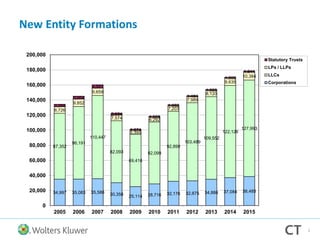
34,997 35,083 35,586 30,358 25,114 28,716 32,176 32,875 34,886 37,084 38,485
87,352
96,191
110,447
82,093
69,416
82,099
92,899
103,489
109,552
122,126
127,993
8,726
9,852
9,659
7,574
5,395
6,292
7,203
7,989
8,120
9,635
10,384
3,266
3,954
4,501
2,654
1,374
1,326
1,382
1,464
1,353
1,302
1,641
0
20,000
40,000
60,000
80,000
100,000
120,000
140,000
160,000
180,000
200,000
2005 2006 2007 2008 2009 2010 2011 2012 2013 2014 2015
Statutory Trusts
LPs / LLPs
LLCs
Corporations
New Entity Formations
4
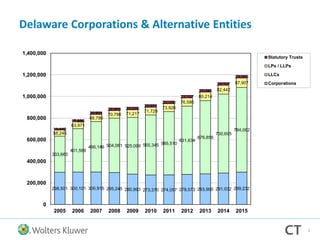
298,501 300,101 300,915 295,245 280,993 273,370 274,057 278,573 283,900 291,032 299,232
333,665
401,569
466,146 504,061 525,099 555,345 585,510
631,634
676,856
730,695
784,062
58,245
63,971
68,780
70,786 71,217
71,729
73,926
76,580
80,214
82,442
87,907
14,442
17,885
20,821
22,909 23,205
23,911
23,700
23,157
23,340
23,157
23,353
0
200,000
400,000
600,000
800,000
1,000,000
1,200,000
1,400,000
2005 2006 2007 2008 2009 2010 2011 2012 2013 2014 2015
Statutory Trusts
LPs / LLPs
LLCs
Corporations
Delaware Corporations & Alternative Entities
Why Delaware?
• The Business Entity Statutes
• The Court System
• The Body of Case Law
• The Division of Corporations
It is not always inexpensive
5
Delaware’s Business Entity Statutes
• Modern
• Flexible
• Liberal
• Non-restrictive
• Efficient
• Predictable
6
Guiding Principles of DE Entity Law
• Allow management to act quickly
• Freedom of contract
• Bias against regulation
• Laws must be adaptable to new developments
7
Law Adaptable to Business Climate
• Impetus
– Change in business environment
– Unpopular court decision
• Annual amendments drafted by Corporate Law Council
• Input from lawyers, professors, management, investors, etc. nationwide
• Requests from SOS
• Enacted by legislature
8
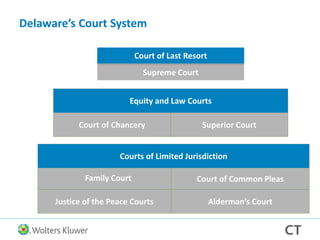
Delaware’s Court System
Supreme Court
Court of Last Resort
Court of Chancery Superior Court
Equity and Law Courts
Justice of the Peace Courts Alderman’s Court
Court of Common PleasFamily Court
Courts of Limited Jurisdiction
9
Three Ways to Chancery Court
• Equitable Remedy
• Equitable Claim
• Statute confers jurisdiction
10
Mass. Mutual Life Insurance Co.
v. Certain Underwriters at Lloyds of London
• C.A. No. 4791 (Chancery Court, 9/24/2010)
• Pl lost money entrusted to Bernie Madoff
• Filed suit in Ch Ct seeking equitable apportionment of defense costs
between bond underwriters and D&O insurers
• All litigants wanted case heard by Ch Ct
• Ch Ct raised subject matter jurisdiction issue on its own
• Held that Ch Ct lacked jurisdiction
11
Mass. Mutual Life Insurance Co.
v. Certain Underwriters at Lloyds of London
• Ct stated that at heart, claim is that defs did not fulfill obligations under
insurance policies
• Claim is fundamentally a breach of contract action for money damages
• Such a claim is province of Superior Court
• Rejected argument that D&O coverage issue resembles indemnification
issue Ct can hear under Sec. 145 of GCL
– Sec. 145 authorizes DE corp to buy D&O insurance
– Does not give Ch Ct jurisdiction over enforcement of policies
12
Benefits to Business Entities
• Expertise
• Speed
• Thoroughness
• Flexibility
• Consistency
13
Delaware’s Case Law
• Largest body of corporate case law in US
• Most sections of GCL have been interpreted
• Extensive precedents
– fiduciary duties
– director liability
– takeover defenses
– merger fairness
• Now has extensive LLC case law too
14
Delaware Division of Corporations
• Division of Secretary of State’s Office
• Processes all business entity filings
• Maintains official records
• Assesses and collects franchise taxes
15
Delaware Division of Corporations
• Modern, technologically advanced filing systems
• Filings can be completed within half hour
• Generates 25-30% of state’s revenue
• Meets and works with user community
• Unique role of service companies
16
Expedited Services and Cut Off Times
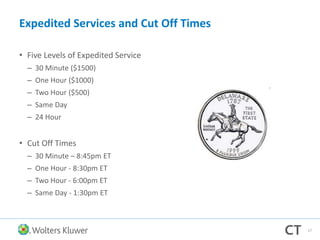
• Five Levels of Expedited Service
– 30 Minute ($1500)
– One Hour ($1000)
– Two Hour ($500)
– Same Day
– 24 Hour
• Cut Off Times
– 30 Minute – 8:45pm ET
– One Hour - 8:30pm ET
– Two Hour - 6:00pm ET
– Same Day - 1:30pm ET
17
Filing Documents With Division
• State forms are not mandatory
• One copy of document
• Correction filings allowed
– If document was inaccurate when filed
– If document was defectively executed
– Effective date - same as document being corrected
• Effective date - upon filing or later date or time set forth in document
– Up to 90 days after filing for corporations
– Up to 180 days after filing for LLC, LP, LLP, ST
– Prior effective date not acceptable except for extraordinary condition
18
Retroactive Dating Ban
• Liebermann v. Frangiosa
– Incumbent Board vs. New Board
– New Board valid since no preferred stock authorized
• even though New Board members were part of Incumbent Board at time of approval
of preferred stock
• incumbent Board had not properly approved certificate of designation for stock
– Chancery Court held that administrative practice to allow requested time and
date was in conflict with the statute 103(c)(3) since statute contemplates
actual time at which document is filed
– Potential for abuse as shown by this case
19
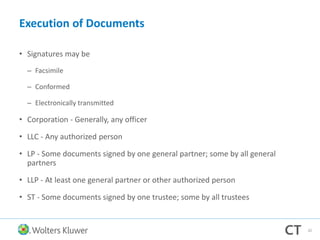
Execution of Documents
• Signatures may be
– Facsimile
– Conformed
– Electronically transmitted
• Corporation - Generally, any officer
• LLC - Any authorized person
• LP - Some documents signed by one general partner; some by all general
partners
• LLP - At least one general partner or other authorized person
• ST - Some documents signed by one trustee; some by all trustees
20
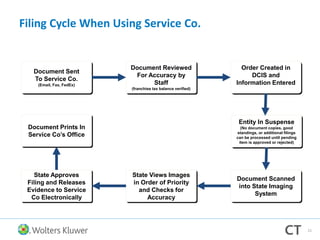
Document Prints In
Service Co’s Office
Document Sent
To Service Co.
(Email, Fax, FedEx)
Document Scanned
into State Imaging
System
State Views Images
in Order of Priority
and Checks for
Accuracy
State Approves
Filing and Releases
Evidence to Service
Co Electronically
Document Reviewed
For Accuracy by
Staff
(franchise tax balance verified)
Order Created in
DCIS and
Information Entered
Entity In Suspense
(No document copies, good
standings, or additional filings
can be processed until pending
item is approved or rejected)
21
Filing Cycle When Using Service Co.
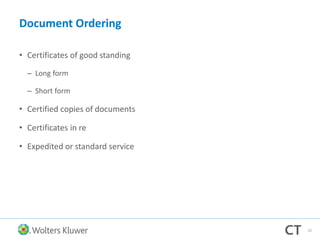
Document Ordering
• Certificates of good standing
– Long form
– Short form
• Certified copies of documents
• Certificates in re
• Expedited or standard service
22
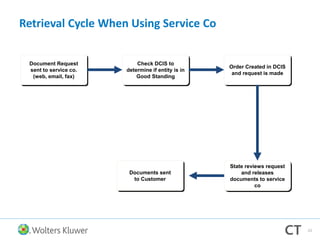
Document Request
sent to service co.
(web, email, fax)
State reviews request
and releases
documents to service
co
Order Created in DCIS
and request is made
Check DCIS to
determine if entity is in
Good Standing
Documents sent
to Customer
23
Retrieval Cycle When Using Service Co
Service Companies
• Access to state computer system
• Immediate filing capabilities
• Immediate document retrieval
• Public/private partnership
24
Top 10 Filing Errors
• Name and title of signer not indicated
• Registered agent’s name and address
• DCLA Section # missing
• Co. name does not agree with State’s computer
• Stock information incorrect
• SOP information missing or incorrect in mergers
• Failure to verify tax due prior to filing
• Failure to check names for availability
• Copy quality of document
• Attempts to assume Charter of Non-Survivor
25
DELAWARE’S
GENERAL CORPORATION LAW
Brief History of GCL
• GCL of 1899 based on NJ GCL
• 1913 - NJ passed antitrust acts & DE became top incorporation state
• July 3, 1967 - new statute effective
• Publicly traded DE corporations – subject to federal securities laws
– Traditionally federal law did not govern internal affairs
– SOX, Dodd-Frank – regulate corps in areas formerly left to states
• Makeup and duties of board committees
• Prohibition on loans to executives
• Say on pay
27
General Corporation Law
• Formation
• Stockholders
• Directors & Officers
• Amendment, Merger, Conversion, Dissolution
28
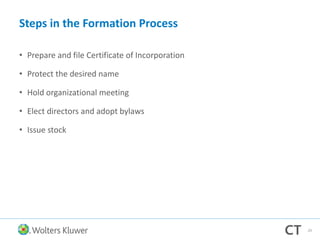
Steps in the Formation Process
• Prepare and file Certificate of Incorporation
• Protect the desired name
• Hold organizational meeting
• Elect directors and adopt bylaws
• Issue stock
29
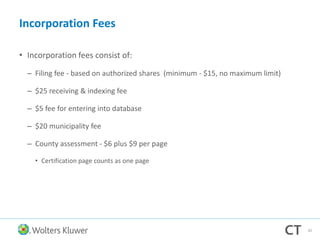
Incorporation Fees
• Incorporation fees consist of:
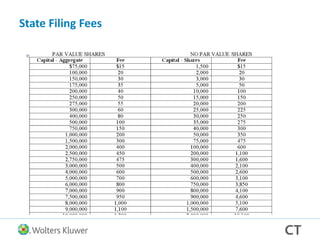
– Filing fee - based on authorized shares (minimum - $15, no maximum limit)
– $25 receiving & indexing fee
– $5 fee for entering into database
– $20 municipality fee
– County assessment - $6 plus $9 per page
• Certification page counts as one page
30
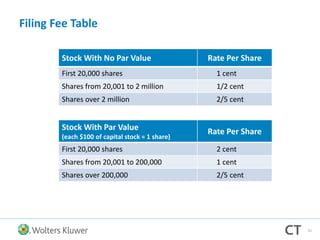
Filing Fee Table
Stock With No Par Value Rate Per Share
First 20,000 shares 1 cent
Shares from 20,001 to 2 million 1/2 cent
Shares over 2 million 2/5 cent
Stock With Par Value
(each $100 of capital stock = 1 share)
Rate Per Share
First 20,000 shares 2 cent
Shares from 20,001 to 200,000 1 cent
Shares over 200,000 2/5 cent
31
State Filing Fees
Practice Pointer
• Annual franchise tax - based on # of authorized shares
• Corporation with high # of authorized shares & low PV may owe only the
minimum filing fee but high annual tax
• Care should be taken in deciding on the capital structure of a new
Delaware corporation to avoid surprise on first annual report
33
ATP Tour, Inc. v. Deutscher tennis bund
• No. 534, 2013, Del S Ct, decided 5/8/2014
• Issue – is a bylaw adopted by board shifting atty fees to unsuccessful
plaintiffs in intra-corporate litigation valid?
• Del S Ct says it is valid
– No provision of GCL, other DE law, common law prohibits it
– Enforceable even if board’s intention is to deter legal challenges to corporate
action as that is not an improper purpose
• Decision led to introduction of bill to prohibit fee shifting bylaws for stock
corporations
– SB 75 passed in 2015
– Secs. 102(f), 109(b) & 114: prohibit fee shifting for internal corp claims
34
STOCKHOLDERS:
MEETINGS, VOTING AND OTHER RIGHTS
Stockholder Meetings
• Annual meeting required
• Special meetings may be called by board or any authorized person
• Meetings may be held by “means of remote communication”
36
Action By Consent
• Action may be taken without a meeting, notice or vote
• Voting requirements same as meeting
• May be denied in Certificate of Incorporation
• Election of directors requires unanimous consent
37
Voting
• One vote per share
• Classes or series may have greater, lesser or no voting rights
• Cumulative voting may be authorized
• Most voting in publicly traded corporations done by proxy
38
Dividends
• Payable if and when declared by board
• May be paid out of surplus or net profits
• Stockholder approval not needed
39
Inspection of Books and Records
• Stockholders may inspect
• Written demand and proper purpose required
• Burden of proof for proper purpose
– Stockholder list - on corporation
– Other records - on stockholder
40
King v. Verifone Holdings, Inc.
• No. 330, 2010 (DE. Supreme Ct. 1/28/2011)
• Pl filed deriv suit after co announced it was restating earnings and
income. Three other suits were then filed.
• Counsel wanted to be 1st to file to be named lead pl
• Fed ct dismissed for failure to meet pleading burden. Granted leave
to amend and suggested pl seek an inspection in DE
• Ch Ct dismissed inspection complaint on grounds that pl’s purpose –
to seek information to show that making a demand in previously
filed derivative suit was futile – was not proper
41
King v. Verifone Holdings, Inc.
• Del S Ct reversed Ch Ct
• Held that Ch Ct’s bright line rule, barring stockholders from pursuing
inspection solely because they filed a derivative action first, did not
comport with DE law or sound policy
• Held that it is a proper purpose under DE law to inspect books to aid
Pl in pleading demand futility where derivative action was dismissed
with leave to amend and w/o prejudice
• S Ct stated it was sensitive to Ch Ct’s concerns about wasting
resources repeatedly litigating issue of demand futility
• But bright line rule was overly broad. Narrower remedies are
available to address concerns
42
Derivative Suits
• Contemporaneous ownership required
• Procedural rules - found in Chancery Court Rule 23.1 and case law
• Demand may be excused if futile
• Plaintiff must be adequate representative
43
Louisiana Municipal Police v. Pyott
• No. 380, 2012 (Del. Supr. 4/4/2013)
• Addresses issue of “fast filers” – stockholders rushing to court to file
derivative suit to control litigation before investigating if demand is
futile
• Allergan pled guilty to promoting “off-label” uses of Botox
• Derivative suits filed first in Cal fed ct, then in Del. Ch.Ct.
• Fed ct dismissed for failure to plead demand futility
• Del. Ch. Ct denies defendants’ motion to dismiss on collateral
estoppel grounds
– Under DE law Cal pls lack privity until DE ct dismisses
– Cal pl were inadequate reps bec they filed suit shortly after settlement
without reviewing bks and records under Sec. 220
44
Louisiana Municipal Police v. Pyott
• DE Supreme Court reversed
• Cal law applied to determine preclusive effect of the Cal federal ct’s
dismissal
– Required by Full Faith and Credit Clause
– Federal ct’s judgment satisfied requirements of collateral estoppel under CA
law
• Cal plaintiffs were adequate representatives
– Rejected Ch Ct’s irrebutable presumption against pls who file derivative suits
shortly after a corporate trauma without first demanding inspection of books
and records
– No record support for such a presumption
– Remedies for fast-filer problems should be directed at the lawyers, not the
stockholder plaintiffs
45
When Demand is Excused
• Demand can only be excused when facts allege board’s decision not
entitled to the protections of the business judgment rule
• Purpose of demand requirement is to give corporations ability to rectify
an alleged wrong prior to litigation
46
DIRECTORS & OFFICERS
Board of Directors
• Manages business and affairs
• May have one or more members
• Term - one year unless staggered
• May be removed by majority vote of stockholders
• May be removed by Chancery Court
48
Election of Directors
• Elected by plurality of votes cast by stockholders
– Director with most votes is elected w/o regard to votes withheld, not cast or
voted against
• “Plurality plus” bylaw may be adopted
– Requires director receiving less than majority of votes to resign
– Bylaw may give board discretion to reject the resignation
49
Directors’ Fiduciary Duties
• Defined by case law, not GCL
• Owe duty of loyalty
– May not be on both sides of transaction
– May not compete with corporation
– Corporate opportunity doctrine
– Good faith is not an independent duty but part of the duty of loyalty
(Stone v. Ritter, 911 A.2d 362 (Del. 2006))
• Owe duty of care
– Must make informed decisions
• Actions protected by business judgment rule
50
Americas Mining Corp. v. Theriault
• 51 A.3d 1213 (Del Supr. 2012)
• DE SCt affirms awards of $2 billion in damages and $300 million in
attorneys’ fees
• Southern Peru (SP) buys Minero for $3 billion from its controlling
stockholder Groupo Mexico
• Stockholders claim price too high; sue for breach of duty
• Ch Ct finds SP special committee breached duty of loyalty
– Was controlled by Groupo
– Only wanted to find way to approve Groupo deal
– Was not free to negotiate or look for other strategies
– Changed financial analysis to make Groupo bid look better
51
Americas Mining Corp. v. Theriault
• Del SCt holds that burden of proving entire fairness of deal stayed
with defs because special committee was not well functioning
• Holds $2 billion award was reasonable estimate of difference
between price paid and what price would have been had process
been fair
• Approves Ch’s use of “percentage of common fund” to determine
attorneys’ fee award
• Holds that 15% of fund awarded in this case was reasonable
52
Freedman v. Adams
• 58 A.3d 414 (Del Supr. 2013)
• Derivative suit alleging board of directors committed waste by failing
to adopt a plan that would have made its executive bonus payments
tax deductible
• Chancery Court - complaint did not adequately allege that a demand
on the board of directors would have been futile
• Delaware Supreme Court affirmed
– To state a claim for waste a stockholder must allege with particularity that
the board authorized an action no reasonable person would consider fair
– Board’s decision to sacrifice some tax savings to retain flexibility in
compensation decisions was a classic exercise of business judgment and
not unconscionable or irrational
53
Statutory Protections
• Sec. 102(b)(7) - Eliminate liability for breach of duty of care
• Sec. 141(e) - Directors protected if they rely in good faith on expert
opinions
• Sec. 144 - “Safety harbor” for conflict transactions
• Sec. 122 - Corporation may renounce interest in business opportunities
54
Officers
• Titles and duties stated in bylaws or board resolution
• Any number of offices may be held by same person
• Chosen as prescribed in bylaws or as determined by board
• Owe same fiduciary duties as directors
– Gantler v. Stephens, 965 A.2d 695 (Del. 2009)
• Section 103
– Corporate charter cannot limit or eliminate personal liability for breach of
fiduciary duties
– Difference from directors
55
Indemnification & Advancement
• Sec. 145(a) - Permissive indemnification
– Pays expenses, attorney’s fees, judgments, amounts paid in settlement
– Person must have acted in good faith & in corporation’s best interests
• Sec. 145(b) - Indemnification not permitted in derivative suit if defendant
found liable
• Sec. 145(c) - Mandatory indemnification
– Director or officer must be successful on merits in defense of claim
• Sec. 145 (e)
– Attorney fees and other expenses incurred by officer or director in defending him
or herself may be paid by corporation in advance of final disposition
– Conditioned upon receipt of undertaking by officer/director to repay if
determined he or she is not entitled to indemnification
56
Items of Interest
• Sec. 145 is nonexclusive
• Corporations may have bylaws and agreements providing indemnification
and advancement, rather than relying on statutory scheme
• Many Delaware corporations include a provision in their bylaws making
indemnification and advancement mandatory under circumstances
where they would only be permissive under Sec. 145
57
AMENDMENT, MERGER,
CONVERSION & DISSOLUTION
Amendments
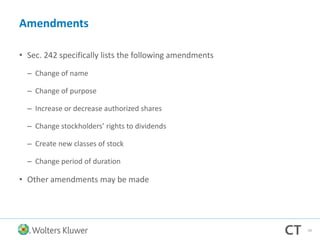
• Sec. 242 specifically lists the following amendments
– Change of name
– Change of purpose
– Increase or decrease authorized shares
– Change stockholders’ rights to dividends
– Create new classes of stock
– Change period of duration
• Other amendments may be made
59
Amendment Procedure
• Board adopts resolution
• Stockholders vote
• File a certificate of amendment
• Amendments before payment of capital
60
Restated Certificate of Incorporation
• Advisable where corporation has filed several amendments
• Single instrument containing all provisions of Certificate of Incorporation
in effect
• Amendment may be made at same time as restatement
• If no new amendments are made, stockholder vote not needed
• Can dramatically reduce certification costs
61
Corporations May Merge With:
• Domestic & foreign
corporations
Secs. 251, 252
• Parent or subsidiary
Sec. 253, 267 (2010
amendment)
• Joint stock or other
associations
Sec. 254
• Domestic & foreign nonstock
corporations
Sec. 256-258
• Domestic & foreign GP,
LP, LLP, LLLP
Sec. 263
• Domestic & foreign LLC
Sec. 264
Consolidations and Share Exchanges
• DE corporations may also enter into consolidations
• DE GCL does not authorize share exchanges
63
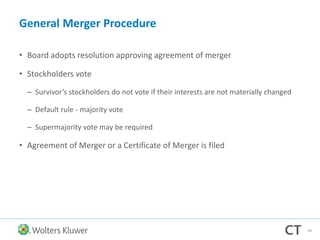
General Merger Procedure
• Board adopts resolution approving agreement of merger
• Stockholders vote
– Survivor’s stockholders do not vote if their interests are not materially changed
– Default rule - majority vote
– Supermajority vote may be required
• Agreement of Merger or a Certificate of Merger is filed
64
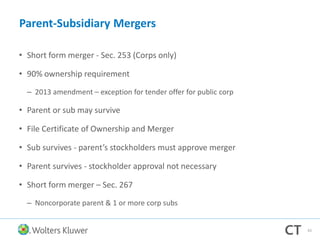
Parent-Subsidiary Mergers
• Short form merger - Sec. 253 (Corps only)
• 90% ownership requirement
– 2013 amendment – exception for tender offer for public corp
• Parent or sub may survive
• File Certificate of Ownership and Merger
• Sub survives - parent’s stockholders must approve merger
• Parent survives - stockholder approval not necessary
• Short form merger – Sec. 267
– Noncorporate parent & 1 or more corp subs
65
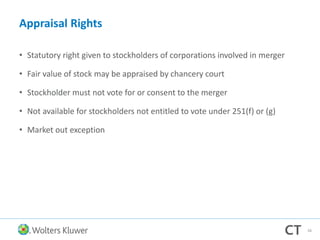
Appraisal Rights
• Statutory right given to stockholders of corporations involved in merger
• Fair value of stock may be appraised by chancery court
• Stockholder must not vote for or consent to the merger
• Not available for stockholders not entitled to vote under 251(f) or (g)
• Market out exception
66
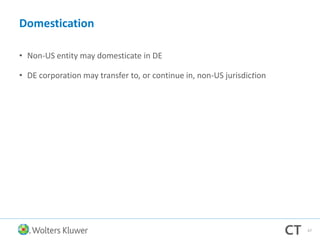
Domestication
• Non-US entity may domesticate in DE
• DE corporation may transfer to, or continue in, non-US jurisdiction
67
Conversion
• DE corporation may convert to any other DE or foreign entity
• All outstanding stock of converting corporation must vote in favor
• File Certificate of Conversion
• If converting to DE entity also file formation document of new entity
68
Conversion
• Any other DE or foreign entity may convert to a DE corporation
• Approval of other entity as provided for in governing document
• File Certificate of Conversion and Certificate of Incorporation
– 2011 amendment required simultaneous filing or same future effective dates
69
Dissolution
• Approved by board and majority of stockholders
• May be approved by unanimous written consent
• Incorporators or initial directors may dissolve before business begins
• After approval, file Certificate of Dissolution
• No corporation may be dissolved before all franchise taxes are paid
• SOS requires all annual franchise tax reports to be filed before
corporation may be dissolved
• Revocation of dissolution allowed within three years
70
Public Benefit Corporations
• PBC defined as a for-profit corporation organized under the GCL that is intended to
produce a public benefit and operate in a responsible and sustainable manner
• PBC shall be managed in a manner that balances the stockholders’ pecuniary
interests, the best interests of those materially affected by the corporation’s conduct,
and the public benefit
• PBC’s certificate of incorporation must identify the public benefit to be promoted
• An existing Delaware corporation may become a PBC by amending its certificate of
incorporation or by a merger approved by 2/3 of the outstanding shares of each class
of stock
• PBC must provide periodic notices to stockholders regarding the efforts taken to
achieve the public benefits it was formed to promote
• No appraisal rights available if publicly held
71
Ratification of Defective Acts
• HB 127, effective April 1, 2014
• New Sec. 204
– Establishes procedure for corp to ratify an overissue of stock, election of directors or act or
tansaction that due to a lack of compliance with GCL, cert of inc., bylaws, or other agreement
is void or voidable
– Board of directors adopts resolution
– Stockholders approve (if act being ratified required approval)
– File certificate of validation with SOS (if act being ratified would have required a filing)
• New Sec. 205
– Ch Ct can ratify if Sec. 204 not available
– Ch Ct can rule on the validity of a Sec. 204 ratification
• 2015 Amendments
72
DELAWARE’S
LIMITED LIABILITY COMPANY ACT
DLLC Act - An Overview
• Effective October 1, 1992
• Modeled after LP Act, not GCL
• Mostly default provisions
• Policy of Act - “give the maximum effect to the principle of freedom of
contract and the enforceability of LLC agreements”
74
FORMATION
Formation
• File Certificate of Formation
• Required contents
– Name of LLC
• Requires entity indicator
• Must be distinguishable
• Check availability; reserve name
– Address of registered office, name of registered agent
• $70 filing fee + $20 municipality fee
76
Purposes and Powers
• May carry on any lawful business, purpose or activity
• May be for profit or not for profit
• May not be in business of banking
• Possesses all powers granted by law and LLC agreement
77
LLC Agreement
• Called Operating Agreement in most states
• LLC Act states that
– LLC agreement shall be entered into or otherwise existing before, after or upon
filing of the certificate of formation
– LLC agreement may be written, oral, or implied
– 2010 amendment – LLC agreement not subject to statute of frauds
• Covers matters found in corporation’s Certificate of Incorporation, bylaws,
and shareholder agreements
• Used to opt out of default provisions
• Used to fill in gaps where there are no default provisions
78
LLC Agreement
• Typical matters dealt with include:
– Term of existence and purposes
– Power and authority of members, managers, officers
– Admission of members
– Indemnification
– Allocation of profits and losses
– Dissolution and winding up
– Assignment and transfer of interests
– Meeting formalities
79
Practice Pointer
• Far fewer default provisions in the DLLCA than in GCL
• LLC Agreement must be carefully drafted to provide for those issues not
provided for in the Act
• Issues include place and time of meetings, quorum, notice and voting
requirements
80
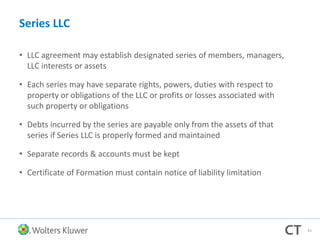
Series LLC
• LLC agreement may establish designated series of members, managers,
LLC interests or assets
• Each series may have separate rights, powers, duties with respect to
property or obligations of the LLC or profits or losses associated with
such property or obligations
• Debts incurred by the series are payable only from the assets of that
series if Series LLC is properly formed and maintained
• Separate records & accounts must be kept
• Certificate of Formation must contain notice of liability limitation
81
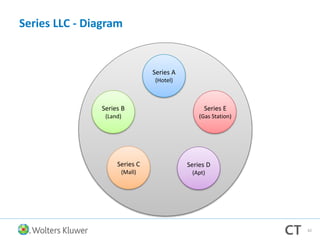
Series LLC - Diagram
82
Series A
(Hotel)
Series D
(Apt)
Series C
(Mall)
Series B
(Land)
Series E
(Gas Station)
MEMBERS & MANAGERS
Members
• LLC may have one or more members
• Members have limited liability
• New members admitted upon unanimous consent unless LLC agreement
provides otherwise
• May have classes of members with different rights, powers, etc.
• Member may not resign unless LLC agreement provides otherwise
• Contribution may be cash, property services, future obligations
84
Member Voting Rights
• Voting may be on per capita, number, financial interest, or any other
basis
• Member or class of members may be denied voting rights
• May have members or classes with greater or lesser voting rights than
others
• Voting by separate groups may be provided
85
Member Meetings
• Few default provisions
• LLC agreement may address
– Place & date
– Notice & waiver
– Record date
– Quorum
– Proxy voting
• Action may be taken without a meeting upon consent
86
Right to Profits, Losses, Distributions
• Members share in profits, losses and distributions
• Allocated as provided in the LLC agreement
• Default rule - allocation on the basis of the agreed value of the
contributions of the members
87
Other Statutory Rights
• Right to inspect LLC records
– Business and financial information
– Tax returns
– List of members
– Right may be restricted in LLC agreement
– May apply to Ch Ct if LLC does not provide records following demand
• Right to bring derivative suit
– Members or managers must refuse to bring
– Or effort to have them bring suit not likely to succeed
88
Assignment of LLC Interest
• LLC interest is assignable
• Assignee
– May share in profits, losses, distributions, allocations
– Has no right to participate in management
– May become member upon consent or as provided in LLC agreement
89
Management
• Default rule - management vested in members
• Decision of members owning more than 50% profits controls
• Management may be vested in managers (LLC agreement)
• Members/managers may delegate authority to officers, agents,
employees
90
Managers
• Chosen in manner provided in LLC agreement
• Hold offices accorded them in LLC agreement
• Have responsibilities accorded them in LLC agreement
• Meeting details may be set forth in LLC agreement
91
Items of Interest
• Managers may act without a meeting upon consent of the number of
managers necessary to take action at a meeting
• Managers may vote by proxy
• Directors of corporations cannot act without a meeting on less than
unanimous consent, or vote by proxy
92
Fiduciary Duties
• No statutory standard of conduct for members or managers
• Act states any fiduciary duties owed may be limited or eliminated in LLC agreement
– Ch Ct - any such provision must be clear and unambiguous
– Covenant of good faith and fair dealing may not be eliminated
• 2013 amendment – “In any case not provided for in this chapter, the rules of law and
equity, including the rules of law and equity relating to fiduciary duties and the law
merchant, shall govern
– Resolved split between DE Supr and Ch Cts over whether, in absence of such
provision, managers and members owe fiduciary duties of loyalty and care
• No statutory indemnification; may be provided for in LLC agreement
• Protected for good faith reliance on expert opinions and LLC records
93
Gatz Properties, LLC v. Auriga Capital Corp.
• 59 A.3d 1206 (Del Supr. 2012)
• Case creating split over default fiduciary duties
• Minority members sued manager alleging breach of fiduciary duties after he
bought them out for price well below market value
• Ch Ct holds that managers owe default fiduciary duties of care and loyalty
• S Ct states that Ch Ct’s ruling that managers owe default fiduciary duties was
dicta and had no precedential value
– Where there is a contractual provision imposing fiduciary duties there is no need
to decide if there are default duties
– No party asked the Ch Ct to decide the issue
– Reasonable minds can differ so it is up to General Assembly to clarify
94
AMENDMENT, MERGER,
CONVERSION & DISSOLUTION
Amending Certificate of Formation
• Required upon change in information set forth in Certificate of Formation
• Certificate of Formation may be amended for any other purpose
• File Certificate of Amendment
• Certificate of Amendment sets forth LLC’s name and amendment
96
Merger
• DE LLC may merge with one or more DE or foreign corporations or
unincorporated business entities
• Members must vote in favor
• Survivor files Certificate or agreement of merger
• Short form merger authorized between LLC parent and corporate sub
Consolidations authorized
• Appraisal rights not granted by statute
– May be provided for in LLC agreement or
– Agreement of merger
• LLC agreement may provide that LLC shall not have the power to merge or
consolidate
97
Conversion
• Other domestic or foreign entity may convert to DE LLC
• Approval as provided in other entity’s governing documents and
applicable law
• File Certificate of Conversion & Certificate of Formation
98
Conversion
• DE LLC may convert to other DE or foreign entity
• Default rule - approval by members owning more than 50% of interest in
profits
• If converting to DE entity file:
– Certificate of Conversion
– Formation document
• If converting to foreign entity file Certificate of Conversion to Non-
Delaware Entity
• LLC agreement may provide that LLC shall not have the power to convert
99
Domestication
• Non-US entity may domesticate as DE LLC
• DE LLC may transfer to or domesticate in a non-US jurisdiction
• Approval as provided in LLC agreement
– Default – approval by members owning more than 50% of interest in profits
• LLC agreement may provide that LLC shall not have the power to
domesticate
100
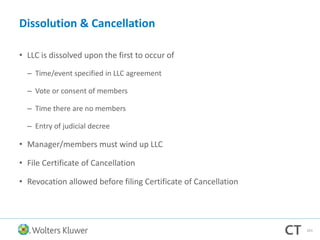
Dissolution & Cancellation
• LLC is dissolved upon the first to occur of
– Time/event specified in LLC agreement
– Vote or consent of members
– Time there are no members
– Entry of judicial decree
• Manager/members must wind up LLC
• File Certificate of Cancellation
• Revocation allowed before filing Certificate of Cancellation
101
PAYING ANNUAL FRANCHISE TAXES
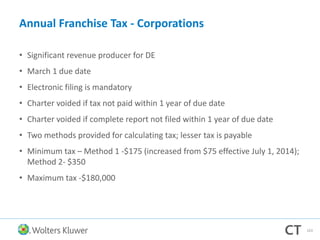
Annual Franchise Tax - Corporations
• Significant revenue producer for DE
• March 1 due date
• Electronic filing is mandatory
• Charter voided if tax not paid within 1 year of due date
• Charter voided if complete report not filed within 1 year of due date
• Two methods provided for calculating tax; lesser tax is payable
• Minimum tax – Method 1 -$175 (increased from $75 effective July 1, 2014);
Method 2- $350
• Maximum tax -$180,000
103
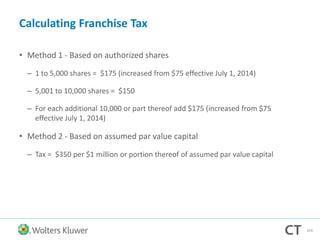
Calculating Franchise Tax
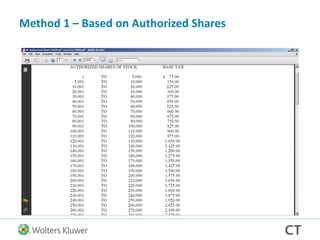
• Method 1 - Based on authorized shares
– 1 to 5,000 shares = $175 (increased from $75 effective July 1, 2014)
– 5,001 to 10,000 shares = $150
– For each additional 10,000 or part thereof add $175 (increased from $75
effective July 1, 2014)
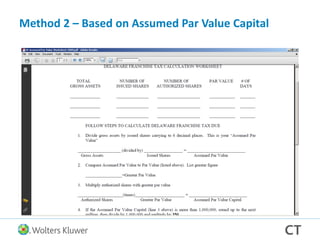
• Method 2 - Based on assumed par value capital
– Tax = $350 per $1 million or portion thereof of assumed par value capital
104
Method 1 – Based on Authorized Shares
Method 2 – Based on Assumed Par Value Capital
Annual Taxes for Other Entities
• LLC & LP - Owe annual tax of $300 (increased from $250 effective July 1,
2014)
• LLP - Annual report fee of $200 per partner
• June 1 due date
• LLC, LP or LLP failing to pay by due date loses good standing status
– State will not file documents for entity
– Entity may not maintain lawsuit in state courts
107
Recap
• Why Delaware?
• GCL
• LLCA
• Annual Taxes
108
THANK YOU FOR ATTENDING
DELAWARE’S BUSINESS ENTITY LAWS – 2016

Delaware's Business Entity Laws

  • 1.
  • 2.
    Seminar Overview • Whyis Delaware the leading formation state? • Delaware General Corporation Law • Delaware Limited Liability Company Act • Paying Annual Franchise Taxes 1
  • 3.
    WHY IS DELAWARETHE LEADING FORMATION STATE? 2
  • 4.
    3 34,997 35,083 35,58630,358 25,114 28,716 32,176 32,875 34,886 37,084 38,485 87,352 96,191 110,447 82,093 69,416 82,099 92,899 103,489 109,552 122,126 127,993 8,726 9,852 9,659 7,574 5,395 6,292 7,203 7,989 8,120 9,635 10,384 3,266 3,954 4,501 2,654 1,374 1,326 1,382 1,464 1,353 1,302 1,641 0 20,000 40,000 60,000 80,000 100,000 120,000 140,000 160,000 180,000 200,000 2005 2006 2007 2008 2009 2010 2011 2012 2013 2014 2015 Statutory Trusts LPs / LLPs LLCs Corporations New Entity Formations
  • 5.
    4 298,501 300,101 300,915295,245 280,993 273,370 274,057 278,573 283,900 291,032 299,232 333,665 401,569 466,146 504,061 525,099 555,345 585,510 631,634 676,856 730,695 784,062 58,245 63,971 68,780 70,786 71,217 71,729 73,926 76,580 80,214 82,442 87,907 14,442 17,885 20,821 22,909 23,205 23,911 23,700 23,157 23,340 23,157 23,353 0 200,000 400,000 600,000 800,000 1,000,000 1,200,000 1,400,000 2005 2006 2007 2008 2009 2010 2011 2012 2013 2014 2015 Statutory Trusts LPs / LLPs LLCs Corporations Delaware Corporations & Alternative Entities
  • 6.
    Why Delaware? • TheBusiness Entity Statutes • The Court System • The Body of Case Law • The Division of Corporations It is not always inexpensive 5
  • 7.
    Delaware’s Business EntityStatutes • Modern • Flexible • Liberal • Non-restrictive • Efficient • Predictable 6
  • 8.
    Guiding Principles ofDE Entity Law • Allow management to act quickly • Freedom of contract • Bias against regulation • Laws must be adaptable to new developments 7
  • 9.
    Law Adaptable toBusiness Climate • Impetus – Change in business environment – Unpopular court decision • Annual amendments drafted by Corporate Law Council • Input from lawyers, professors, management, investors, etc. nationwide • Requests from SOS • Enacted by legislature 8
  • 10.
    Delaware’s Court System SupremeCourt Court of Last Resort Court of Chancery Superior Court Equity and Law Courts Justice of the Peace Courts Alderman’s Court Court of Common PleasFamily Court Courts of Limited Jurisdiction 9
  • 11.
    Three Ways toChancery Court • Equitable Remedy • Equitable Claim • Statute confers jurisdiction 10
  • 12.
    Mass. Mutual LifeInsurance Co. v. Certain Underwriters at Lloyds of London • C.A. No. 4791 (Chancery Court, 9/24/2010) • Pl lost money entrusted to Bernie Madoff • Filed suit in Ch Ct seeking equitable apportionment of defense costs between bond underwriters and D&O insurers • All litigants wanted case heard by Ch Ct • Ch Ct raised subject matter jurisdiction issue on its own • Held that Ch Ct lacked jurisdiction 11
  • 13.
    Mass. Mutual LifeInsurance Co. v. Certain Underwriters at Lloyds of London • Ct stated that at heart, claim is that defs did not fulfill obligations under insurance policies • Claim is fundamentally a breach of contract action for money damages • Such a claim is province of Superior Court • Rejected argument that D&O coverage issue resembles indemnification issue Ct can hear under Sec. 145 of GCL – Sec. 145 authorizes DE corp to buy D&O insurance – Does not give Ch Ct jurisdiction over enforcement of policies 12
  • 14.
    Benefits to BusinessEntities • Expertise • Speed • Thoroughness • Flexibility • Consistency 13
  • 15.
    Delaware’s Case Law •Largest body of corporate case law in US • Most sections of GCL have been interpreted • Extensive precedents – fiduciary duties – director liability – takeover defenses – merger fairness • Now has extensive LLC case law too 14
  • 16.
    Delaware Division ofCorporations • Division of Secretary of State’s Office • Processes all business entity filings • Maintains official records • Assesses and collects franchise taxes 15
  • 17.
    Delaware Division ofCorporations • Modern, technologically advanced filing systems • Filings can be completed within half hour • Generates 25-30% of state’s revenue • Meets and works with user community • Unique role of service companies 16
  • 18.
    Expedited Services andCut Off Times • Five Levels of Expedited Service – 30 Minute ($1500) – One Hour ($1000) – Two Hour ($500) – Same Day – 24 Hour • Cut Off Times – 30 Minute – 8:45pm ET – One Hour - 8:30pm ET – Two Hour - 6:00pm ET – Same Day - 1:30pm ET 17
  • 19.
    Filing Documents WithDivision • State forms are not mandatory • One copy of document • Correction filings allowed – If document was inaccurate when filed – If document was defectively executed – Effective date - same as document being corrected • Effective date - upon filing or later date or time set forth in document – Up to 90 days after filing for corporations – Up to 180 days after filing for LLC, LP, LLP, ST – Prior effective date not acceptable except for extraordinary condition 18
  • 20.
    Retroactive Dating Ban •Liebermann v. Frangiosa – Incumbent Board vs. New Board – New Board valid since no preferred stock authorized • even though New Board members were part of Incumbent Board at time of approval of preferred stock • incumbent Board had not properly approved certificate of designation for stock – Chancery Court held that administrative practice to allow requested time and date was in conflict with the statute 103(c)(3) since statute contemplates actual time at which document is filed – Potential for abuse as shown by this case 19
  • 21.
    Execution of Documents •Signatures may be – Facsimile – Conformed – Electronically transmitted • Corporation - Generally, any officer • LLC - Any authorized person • LP - Some documents signed by one general partner; some by all general partners • LLP - At least one general partner or other authorized person • ST - Some documents signed by one trustee; some by all trustees 20
  • 22.
    Document Prints In ServiceCo’s Office Document Sent To Service Co. (Email, Fax, FedEx) Document Scanned into State Imaging System State Views Images in Order of Priority and Checks for Accuracy State Approves Filing and Releases Evidence to Service Co Electronically Document Reviewed For Accuracy by Staff (franchise tax balance verified) Order Created in DCIS and Information Entered Entity In Suspense (No document copies, good standings, or additional filings can be processed until pending item is approved or rejected) 21 Filing Cycle When Using Service Co.
  • 23.
    Document Ordering • Certificatesof good standing – Long form – Short form • Certified copies of documents • Certificates in re • Expedited or standard service 22
  • 24.
    Document Request sent toservice co. (web, email, fax) State reviews request and releases documents to service co Order Created in DCIS and request is made Check DCIS to determine if entity is in Good Standing Documents sent to Customer 23 Retrieval Cycle When Using Service Co
  • 25.
    Service Companies • Accessto state computer system • Immediate filing capabilities • Immediate document retrieval • Public/private partnership 24
  • 26.
    Top 10 FilingErrors • Name and title of signer not indicated • Registered agent’s name and address • DCLA Section # missing • Co. name does not agree with State’s computer • Stock information incorrect • SOP information missing or incorrect in mergers • Failure to verify tax due prior to filing • Failure to check names for availability • Copy quality of document • Attempts to assume Charter of Non-Survivor 25
  • 27.
  • 28.
    Brief History ofGCL • GCL of 1899 based on NJ GCL • 1913 - NJ passed antitrust acts & DE became top incorporation state • July 3, 1967 - new statute effective • Publicly traded DE corporations – subject to federal securities laws – Traditionally federal law did not govern internal affairs – SOX, Dodd-Frank – regulate corps in areas formerly left to states • Makeup and duties of board committees • Prohibition on loans to executives • Say on pay 27
  • 29.
    General Corporation Law •Formation • Stockholders • Directors & Officers • Amendment, Merger, Conversion, Dissolution 28
  • 30.
    Steps in theFormation Process • Prepare and file Certificate of Incorporation • Protect the desired name • Hold organizational meeting • Elect directors and adopt bylaws • Issue stock 29
  • 31.
    Incorporation Fees • Incorporationfees consist of: – Filing fee - based on authorized shares (minimum - $15, no maximum limit) – $25 receiving & indexing fee – $5 fee for entering into database – $20 municipality fee – County assessment - $6 plus $9 per page • Certification page counts as one page 30
  • 32.
    Filing Fee Table StockWith No Par Value Rate Per Share First 20,000 shares 1 cent Shares from 20,001 to 2 million 1/2 cent Shares over 2 million 2/5 cent Stock With Par Value (each $100 of capital stock = 1 share) Rate Per Share First 20,000 shares 2 cent Shares from 20,001 to 200,000 1 cent Shares over 200,000 2/5 cent 31
  • 33.
  • 34.
    Practice Pointer • Annualfranchise tax - based on # of authorized shares • Corporation with high # of authorized shares & low PV may owe only the minimum filing fee but high annual tax • Care should be taken in deciding on the capital structure of a new Delaware corporation to avoid surprise on first annual report 33
  • 35.
    ATP Tour, Inc.v. Deutscher tennis bund • No. 534, 2013, Del S Ct, decided 5/8/2014 • Issue – is a bylaw adopted by board shifting atty fees to unsuccessful plaintiffs in intra-corporate litigation valid? • Del S Ct says it is valid – No provision of GCL, other DE law, common law prohibits it – Enforceable even if board’s intention is to deter legal challenges to corporate action as that is not an improper purpose • Decision led to introduction of bill to prohibit fee shifting bylaws for stock corporations – SB 75 passed in 2015 – Secs. 102(f), 109(b) & 114: prohibit fee shifting for internal corp claims 34
  • 36.
  • 37.
    Stockholder Meetings • Annualmeeting required • Special meetings may be called by board or any authorized person • Meetings may be held by “means of remote communication” 36
  • 38.
    Action By Consent •Action may be taken without a meeting, notice or vote • Voting requirements same as meeting • May be denied in Certificate of Incorporation • Election of directors requires unanimous consent 37
  • 39.
    Voting • One voteper share • Classes or series may have greater, lesser or no voting rights • Cumulative voting may be authorized • Most voting in publicly traded corporations done by proxy 38
  • 40.
    Dividends • Payable ifand when declared by board • May be paid out of surplus or net profits • Stockholder approval not needed 39
  • 41.
    Inspection of Booksand Records • Stockholders may inspect • Written demand and proper purpose required • Burden of proof for proper purpose – Stockholder list - on corporation – Other records - on stockholder 40
  • 42.
    King v. VerifoneHoldings, Inc. • No. 330, 2010 (DE. Supreme Ct. 1/28/2011) • Pl filed deriv suit after co announced it was restating earnings and income. Three other suits were then filed. • Counsel wanted to be 1st to file to be named lead pl • Fed ct dismissed for failure to meet pleading burden. Granted leave to amend and suggested pl seek an inspection in DE • Ch Ct dismissed inspection complaint on grounds that pl’s purpose – to seek information to show that making a demand in previously filed derivative suit was futile – was not proper 41
  • 43.
    King v. VerifoneHoldings, Inc. • Del S Ct reversed Ch Ct • Held that Ch Ct’s bright line rule, barring stockholders from pursuing inspection solely because they filed a derivative action first, did not comport with DE law or sound policy • Held that it is a proper purpose under DE law to inspect books to aid Pl in pleading demand futility where derivative action was dismissed with leave to amend and w/o prejudice • S Ct stated it was sensitive to Ch Ct’s concerns about wasting resources repeatedly litigating issue of demand futility • But bright line rule was overly broad. Narrower remedies are available to address concerns 42
  • 44.
    Derivative Suits • Contemporaneousownership required • Procedural rules - found in Chancery Court Rule 23.1 and case law • Demand may be excused if futile • Plaintiff must be adequate representative 43
  • 45.
    Louisiana Municipal Policev. Pyott • No. 380, 2012 (Del. Supr. 4/4/2013) • Addresses issue of “fast filers” – stockholders rushing to court to file derivative suit to control litigation before investigating if demand is futile • Allergan pled guilty to promoting “off-label” uses of Botox • Derivative suits filed first in Cal fed ct, then in Del. Ch.Ct. • Fed ct dismissed for failure to plead demand futility • Del. Ch. Ct denies defendants’ motion to dismiss on collateral estoppel grounds – Under DE law Cal pls lack privity until DE ct dismisses – Cal pl were inadequate reps bec they filed suit shortly after settlement without reviewing bks and records under Sec. 220 44
  • 46.
    Louisiana Municipal Policev. Pyott • DE Supreme Court reversed • Cal law applied to determine preclusive effect of the Cal federal ct’s dismissal – Required by Full Faith and Credit Clause – Federal ct’s judgment satisfied requirements of collateral estoppel under CA law • Cal plaintiffs were adequate representatives – Rejected Ch Ct’s irrebutable presumption against pls who file derivative suits shortly after a corporate trauma without first demanding inspection of books and records – No record support for such a presumption – Remedies for fast-filer problems should be directed at the lawyers, not the stockholder plaintiffs 45
  • 47.
    When Demand isExcused • Demand can only be excused when facts allege board’s decision not entitled to the protections of the business judgment rule • Purpose of demand requirement is to give corporations ability to rectify an alleged wrong prior to litigation 46
  • 48.
  • 49.
    Board of Directors •Manages business and affairs • May have one or more members • Term - one year unless staggered • May be removed by majority vote of stockholders • May be removed by Chancery Court 48
  • 50.
    Election of Directors •Elected by plurality of votes cast by stockholders – Director with most votes is elected w/o regard to votes withheld, not cast or voted against • “Plurality plus” bylaw may be adopted – Requires director receiving less than majority of votes to resign – Bylaw may give board discretion to reject the resignation 49
  • 51.
    Directors’ Fiduciary Duties •Defined by case law, not GCL • Owe duty of loyalty – May not be on both sides of transaction – May not compete with corporation – Corporate opportunity doctrine – Good faith is not an independent duty but part of the duty of loyalty (Stone v. Ritter, 911 A.2d 362 (Del. 2006)) • Owe duty of care – Must make informed decisions • Actions protected by business judgment rule 50
  • 52.
    Americas Mining Corp.v. Theriault • 51 A.3d 1213 (Del Supr. 2012) • DE SCt affirms awards of $2 billion in damages and $300 million in attorneys’ fees • Southern Peru (SP) buys Minero for $3 billion from its controlling stockholder Groupo Mexico • Stockholders claim price too high; sue for breach of duty • Ch Ct finds SP special committee breached duty of loyalty – Was controlled by Groupo – Only wanted to find way to approve Groupo deal – Was not free to negotiate or look for other strategies – Changed financial analysis to make Groupo bid look better 51
  • 53.
    Americas Mining Corp.v. Theriault • Del SCt holds that burden of proving entire fairness of deal stayed with defs because special committee was not well functioning • Holds $2 billion award was reasonable estimate of difference between price paid and what price would have been had process been fair • Approves Ch’s use of “percentage of common fund” to determine attorneys’ fee award • Holds that 15% of fund awarded in this case was reasonable 52
  • 54.
    Freedman v. Adams •58 A.3d 414 (Del Supr. 2013) • Derivative suit alleging board of directors committed waste by failing to adopt a plan that would have made its executive bonus payments tax deductible • Chancery Court - complaint did not adequately allege that a demand on the board of directors would have been futile • Delaware Supreme Court affirmed – To state a claim for waste a stockholder must allege with particularity that the board authorized an action no reasonable person would consider fair – Board’s decision to sacrifice some tax savings to retain flexibility in compensation decisions was a classic exercise of business judgment and not unconscionable or irrational 53
  • 55.
    Statutory Protections • Sec.102(b)(7) - Eliminate liability for breach of duty of care • Sec. 141(e) - Directors protected if they rely in good faith on expert opinions • Sec. 144 - “Safety harbor” for conflict transactions • Sec. 122 - Corporation may renounce interest in business opportunities 54
  • 56.
    Officers • Titles andduties stated in bylaws or board resolution • Any number of offices may be held by same person • Chosen as prescribed in bylaws or as determined by board • Owe same fiduciary duties as directors – Gantler v. Stephens, 965 A.2d 695 (Del. 2009) • Section 103 – Corporate charter cannot limit or eliminate personal liability for breach of fiduciary duties – Difference from directors 55
  • 57.
    Indemnification & Advancement •Sec. 145(a) - Permissive indemnification – Pays expenses, attorney’s fees, judgments, amounts paid in settlement – Person must have acted in good faith & in corporation’s best interests • Sec. 145(b) - Indemnification not permitted in derivative suit if defendant found liable • Sec. 145(c) - Mandatory indemnification – Director or officer must be successful on merits in defense of claim • Sec. 145 (e) – Attorney fees and other expenses incurred by officer or director in defending him or herself may be paid by corporation in advance of final disposition – Conditioned upon receipt of undertaking by officer/director to repay if determined he or she is not entitled to indemnification 56
  • 58.
    Items of Interest •Sec. 145 is nonexclusive • Corporations may have bylaws and agreements providing indemnification and advancement, rather than relying on statutory scheme • Many Delaware corporations include a provision in their bylaws making indemnification and advancement mandatory under circumstances where they would only be permissive under Sec. 145 57
  • 59.
  • 60.
    Amendments • Sec. 242specifically lists the following amendments – Change of name – Change of purpose – Increase or decrease authorized shares – Change stockholders’ rights to dividends – Create new classes of stock – Change period of duration • Other amendments may be made 59
  • 61.
    Amendment Procedure • Boardadopts resolution • Stockholders vote • File a certificate of amendment • Amendments before payment of capital 60
  • 62.
    Restated Certificate ofIncorporation • Advisable where corporation has filed several amendments • Single instrument containing all provisions of Certificate of Incorporation in effect • Amendment may be made at same time as restatement • If no new amendments are made, stockholder vote not needed • Can dramatically reduce certification costs 61
  • 63.
    Corporations May MergeWith: • Domestic & foreign corporations Secs. 251, 252 • Parent or subsidiary Sec. 253, 267 (2010 amendment) • Joint stock or other associations Sec. 254 • Domestic & foreign nonstock corporations Sec. 256-258 • Domestic & foreign GP, LP, LLP, LLLP Sec. 263 • Domestic & foreign LLC Sec. 264
  • 64.
    Consolidations and ShareExchanges • DE corporations may also enter into consolidations • DE GCL does not authorize share exchanges 63
  • 65.
    General Merger Procedure •Board adopts resolution approving agreement of merger • Stockholders vote – Survivor’s stockholders do not vote if their interests are not materially changed – Default rule - majority vote – Supermajority vote may be required • Agreement of Merger or a Certificate of Merger is filed 64
  • 66.
    Parent-Subsidiary Mergers • Shortform merger - Sec. 253 (Corps only) • 90% ownership requirement – 2013 amendment – exception for tender offer for public corp • Parent or sub may survive • File Certificate of Ownership and Merger • Sub survives - parent’s stockholders must approve merger • Parent survives - stockholder approval not necessary • Short form merger – Sec. 267 – Noncorporate parent & 1 or more corp subs 65
  • 67.
    Appraisal Rights • Statutoryright given to stockholders of corporations involved in merger • Fair value of stock may be appraised by chancery court • Stockholder must not vote for or consent to the merger • Not available for stockholders not entitled to vote under 251(f) or (g) • Market out exception 66
  • 68.
    Domestication • Non-US entitymay domesticate in DE • DE corporation may transfer to, or continue in, non-US jurisdiction 67
  • 69.
    Conversion • DE corporationmay convert to any other DE or foreign entity • All outstanding stock of converting corporation must vote in favor • File Certificate of Conversion • If converting to DE entity also file formation document of new entity 68
  • 70.
    Conversion • Any otherDE or foreign entity may convert to a DE corporation • Approval of other entity as provided for in governing document • File Certificate of Conversion and Certificate of Incorporation – 2011 amendment required simultaneous filing or same future effective dates 69
  • 71.
    Dissolution • Approved byboard and majority of stockholders • May be approved by unanimous written consent • Incorporators or initial directors may dissolve before business begins • After approval, file Certificate of Dissolution • No corporation may be dissolved before all franchise taxes are paid • SOS requires all annual franchise tax reports to be filed before corporation may be dissolved • Revocation of dissolution allowed within three years 70
  • 72.
    Public Benefit Corporations •PBC defined as a for-profit corporation organized under the GCL that is intended to produce a public benefit and operate in a responsible and sustainable manner • PBC shall be managed in a manner that balances the stockholders’ pecuniary interests, the best interests of those materially affected by the corporation’s conduct, and the public benefit • PBC’s certificate of incorporation must identify the public benefit to be promoted • An existing Delaware corporation may become a PBC by amending its certificate of incorporation or by a merger approved by 2/3 of the outstanding shares of each class of stock • PBC must provide periodic notices to stockholders regarding the efforts taken to achieve the public benefits it was formed to promote • No appraisal rights available if publicly held 71
  • 73.
    Ratification of DefectiveActs • HB 127, effective April 1, 2014 • New Sec. 204 – Establishes procedure for corp to ratify an overissue of stock, election of directors or act or tansaction that due to a lack of compliance with GCL, cert of inc., bylaws, or other agreement is void or voidable – Board of directors adopts resolution – Stockholders approve (if act being ratified required approval) – File certificate of validation with SOS (if act being ratified would have required a filing) • New Sec. 205 – Ch Ct can ratify if Sec. 204 not available – Ch Ct can rule on the validity of a Sec. 204 ratification • 2015 Amendments 72
  • 74.
  • 75.
    DLLC Act -An Overview • Effective October 1, 1992 • Modeled after LP Act, not GCL • Mostly default provisions • Policy of Act - “give the maximum effect to the principle of freedom of contract and the enforceability of LLC agreements” 74
  • 76.
  • 77.
    Formation • File Certificateof Formation • Required contents – Name of LLC • Requires entity indicator • Must be distinguishable • Check availability; reserve name – Address of registered office, name of registered agent • $70 filing fee + $20 municipality fee 76
  • 78.
    Purposes and Powers •May carry on any lawful business, purpose or activity • May be for profit or not for profit • May not be in business of banking • Possesses all powers granted by law and LLC agreement 77
  • 79.
    LLC Agreement • CalledOperating Agreement in most states • LLC Act states that – LLC agreement shall be entered into or otherwise existing before, after or upon filing of the certificate of formation – LLC agreement may be written, oral, or implied – 2010 amendment – LLC agreement not subject to statute of frauds • Covers matters found in corporation’s Certificate of Incorporation, bylaws, and shareholder agreements • Used to opt out of default provisions • Used to fill in gaps where there are no default provisions 78
  • 80.
    LLC Agreement • Typicalmatters dealt with include: – Term of existence and purposes – Power and authority of members, managers, officers – Admission of members – Indemnification – Allocation of profits and losses – Dissolution and winding up – Assignment and transfer of interests – Meeting formalities 79
  • 81.
    Practice Pointer • Farfewer default provisions in the DLLCA than in GCL • LLC Agreement must be carefully drafted to provide for those issues not provided for in the Act • Issues include place and time of meetings, quorum, notice and voting requirements 80
  • 82.
    Series LLC • LLCagreement may establish designated series of members, managers, LLC interests or assets • Each series may have separate rights, powers, duties with respect to property or obligations of the LLC or profits or losses associated with such property or obligations • Debts incurred by the series are payable only from the assets of that series if Series LLC is properly formed and maintained • Separate records & accounts must be kept • Certificate of Formation must contain notice of liability limitation 81
  • 83.
    Series LLC -Diagram 82 Series A (Hotel) Series D (Apt) Series C (Mall) Series B (Land) Series E (Gas Station)
  • 84.
  • 85.
    Members • LLC mayhave one or more members • Members have limited liability • New members admitted upon unanimous consent unless LLC agreement provides otherwise • May have classes of members with different rights, powers, etc. • Member may not resign unless LLC agreement provides otherwise • Contribution may be cash, property services, future obligations 84
  • 86.
    Member Voting Rights •Voting may be on per capita, number, financial interest, or any other basis • Member or class of members may be denied voting rights • May have members or classes with greater or lesser voting rights than others • Voting by separate groups may be provided 85
  • 87.
    Member Meetings • Fewdefault provisions • LLC agreement may address – Place & date – Notice & waiver – Record date – Quorum – Proxy voting • Action may be taken without a meeting upon consent 86
  • 88.
    Right to Profits,Losses, Distributions • Members share in profits, losses and distributions • Allocated as provided in the LLC agreement • Default rule - allocation on the basis of the agreed value of the contributions of the members 87
  • 89.
    Other Statutory Rights •Right to inspect LLC records – Business and financial information – Tax returns – List of members – Right may be restricted in LLC agreement – May apply to Ch Ct if LLC does not provide records following demand • Right to bring derivative suit – Members or managers must refuse to bring – Or effort to have them bring suit not likely to succeed 88
  • 90.
    Assignment of LLCInterest • LLC interest is assignable • Assignee – May share in profits, losses, distributions, allocations – Has no right to participate in management – May become member upon consent or as provided in LLC agreement 89
  • 91.
    Management • Default rule- management vested in members • Decision of members owning more than 50% profits controls • Management may be vested in managers (LLC agreement) • Members/managers may delegate authority to officers, agents, employees 90
  • 92.
    Managers • Chosen inmanner provided in LLC agreement • Hold offices accorded them in LLC agreement • Have responsibilities accorded them in LLC agreement • Meeting details may be set forth in LLC agreement 91
  • 93.
    Items of Interest •Managers may act without a meeting upon consent of the number of managers necessary to take action at a meeting • Managers may vote by proxy • Directors of corporations cannot act without a meeting on less than unanimous consent, or vote by proxy 92
  • 94.
    Fiduciary Duties • Nostatutory standard of conduct for members or managers • Act states any fiduciary duties owed may be limited or eliminated in LLC agreement – Ch Ct - any such provision must be clear and unambiguous – Covenant of good faith and fair dealing may not be eliminated • 2013 amendment – “In any case not provided for in this chapter, the rules of law and equity, including the rules of law and equity relating to fiduciary duties and the law merchant, shall govern – Resolved split between DE Supr and Ch Cts over whether, in absence of such provision, managers and members owe fiduciary duties of loyalty and care • No statutory indemnification; may be provided for in LLC agreement • Protected for good faith reliance on expert opinions and LLC records 93
  • 95.
    Gatz Properties, LLCv. Auriga Capital Corp. • 59 A.3d 1206 (Del Supr. 2012) • Case creating split over default fiduciary duties • Minority members sued manager alleging breach of fiduciary duties after he bought them out for price well below market value • Ch Ct holds that managers owe default fiduciary duties of care and loyalty • S Ct states that Ch Ct’s ruling that managers owe default fiduciary duties was dicta and had no precedential value – Where there is a contractual provision imposing fiduciary duties there is no need to decide if there are default duties – No party asked the Ch Ct to decide the issue – Reasonable minds can differ so it is up to General Assembly to clarify 94
  • 96.
  • 97.
    Amending Certificate ofFormation • Required upon change in information set forth in Certificate of Formation • Certificate of Formation may be amended for any other purpose • File Certificate of Amendment • Certificate of Amendment sets forth LLC’s name and amendment 96
  • 98.
    Merger • DE LLCmay merge with one or more DE or foreign corporations or unincorporated business entities • Members must vote in favor • Survivor files Certificate or agreement of merger • Short form merger authorized between LLC parent and corporate sub Consolidations authorized • Appraisal rights not granted by statute – May be provided for in LLC agreement or – Agreement of merger • LLC agreement may provide that LLC shall not have the power to merge or consolidate 97
  • 99.
    Conversion • Other domesticor foreign entity may convert to DE LLC • Approval as provided in other entity’s governing documents and applicable law • File Certificate of Conversion & Certificate of Formation 98
  • 100.
    Conversion • DE LLCmay convert to other DE or foreign entity • Default rule - approval by members owning more than 50% of interest in profits • If converting to DE entity file: – Certificate of Conversion – Formation document • If converting to foreign entity file Certificate of Conversion to Non- Delaware Entity • LLC agreement may provide that LLC shall not have the power to convert 99
  • 101.
    Domestication • Non-US entitymay domesticate as DE LLC • DE LLC may transfer to or domesticate in a non-US jurisdiction • Approval as provided in LLC agreement – Default – approval by members owning more than 50% of interest in profits • LLC agreement may provide that LLC shall not have the power to domesticate 100
  • 102.
    Dissolution & Cancellation •LLC is dissolved upon the first to occur of – Time/event specified in LLC agreement – Vote or consent of members – Time there are no members – Entry of judicial decree • Manager/members must wind up LLC • File Certificate of Cancellation • Revocation allowed before filing Certificate of Cancellation 101
  • 103.
  • 104.
    Annual Franchise Tax- Corporations • Significant revenue producer for DE • March 1 due date • Electronic filing is mandatory • Charter voided if tax not paid within 1 year of due date • Charter voided if complete report not filed within 1 year of due date • Two methods provided for calculating tax; lesser tax is payable • Minimum tax – Method 1 -$175 (increased from $75 effective July 1, 2014); Method 2- $350 • Maximum tax -$180,000 103
  • 105.
    Calculating Franchise Tax •Method 1 - Based on authorized shares – 1 to 5,000 shares = $175 (increased from $75 effective July 1, 2014) – 5,001 to 10,000 shares = $150 – For each additional 10,000 or part thereof add $175 (increased from $75 effective July 1, 2014) • Method 2 - Based on assumed par value capital – Tax = $350 per $1 million or portion thereof of assumed par value capital 104
  • 106.
    Method 1 –Based on Authorized Shares
  • 107.
    Method 2 –Based on Assumed Par Value Capital
  • 108.
    Annual Taxes forOther Entities • LLC & LP - Owe annual tax of $300 (increased from $250 effective July 1, 2014) • LLP - Annual report fee of $200 per partner • June 1 due date • LLC, LP or LLP failing to pay by due date loses good standing status – State will not file documents for entity – Entity may not maintain lawsuit in state courts 107
  • 109.
    Recap • Why Delaware? •GCL • LLCA • Annual Taxes 108
  • 110.
    THANK YOU FORATTENDING DELAWARE’S BUSINESS ENTITY LAWS – 2016