











BUSINESS COMMUNICATION
MODULE 1
(FOR MBA) UNDER CALICUT UNIVERSITY)
B Y A R J U N K R , A S S T P R O F E S S O R , S N E S
I M S A R , C A L I C U T
• COMMUNICATION- DEFINITION
AND MEANING
 Communication is an exchange of facts, ideas,
opinions or emotions by two or more persons.
 Communication is defined as “the process of
passing information and understanding from one
person to another, it is essentially a bridge of
meaning between people. By using the bridge of
meaning a person can safely cross the river of
misunderstanding.”
B Y A R J U N K R , A S S T P R O F E S S O R , S N E S
I M S A R , C A L I C U T
2. A COMMUNICATION PROCESS MODEL
Feedback
Thought Encoding
Sender
Transmission
of
Message
Reception Decoding Understanding
Noise
Receiver
B Y A R J U N K R , A S S T P R O F E S S O R , S N E S
I M S A R , C A L I C U T
SENDER
 Communication begins with a thought/idea that a sender has.
Encoding
 refers to putting the thought/idea in a form, which can be understood
by receiver.
Channel to transmit the message:
 Channel
 Links the sender and the receiver.
 Forms may be oral, written, a letter, a computer, a telegram, a fax,
Television or radio.
 Two or more channels may be used at the same time.
ELEMENTS OF COMMUNICATION PROCESS MODEL
B Y A R J U N K R , A S S T P R O F E S S O R , S N E S
I M S A R , C A L I C U T
RECEIVER OF THE
MESSAGE:
 Reception
being ready for the message.
 Decoding
refers to conversion of the message into thoughts.
 Understanding
refers to interpreting the message i.e. attaching meaning.
Accurate communication can occur only when sender and receiver
attach same or similar meaning to the message.
Noise:
 Is anything, which hinders communication. It may in the sender, the
transmission or the receiver.
ELEMENTS OF COMMUNICATION PROCESS MODEL (Contd.)
B Y A R J U N K R , A S S T P R O F E S S O R , S N E S
I M S A R , C A L I C U T
ELEMENTS OF COMMUNICATION PROCESS MODEL (Contd.)
 Examples of noise:
Encoding
 Faulty due to use of ambiguous symbols.
 Transmission
Faulty telephone connection.
 Reception
Inaccurate attention.
 Decoding
Faulty due to wrong meaning attached.
Understanding
Can be obstructed by prejudices.
Gestures and posture.
B Y A R J U N K R , A S S T P R O F E S S O R , S N E S
I M S A R , C A L I C U T
ELEMENTS OF COMMUNICATION PROCESS MODEL (Contd.)
 Feedback
To check effectiveness of communication, a person must have
feedback.
One can never be sure that the message has been encoded,
transmitted and decoded properly unless it is confirmed by
feedback.
 Situational and Organizational Factors in Communication
 Situational Factors
External Factors- educational, sociological, legal-political,
economic.
Geographical distance.
 Organizational Factors
Organization structure, managerial and non-managerial processes
and technology.
B Y A R J U N K R , A S S T P R O F E S S O R , S N E S
I M S A R , C A L I C U T
3. CHARACTERISTICS
(i) A two-way traffic
It is a two-way traffic – upward and downward. Messages, directives,
opinions are communicated downward.
Likewise grievances, complaints, opinions, feelings, are communicated
upward along the line.
(ii) Continuous Process
It is continuous process. It is repeated to achieve the desired
results. It is not a one time shot.
(iii) A short-lived process:
It is complete as soon as the message is received and understood by the
receiver in the right perspective.
(iv) Needs proper understanding:
There may be numerous media of communication but the main purpose of
conveying the message is a proper understanding of the message by the
other party. For this purpose, it should be clearly and concisely worded.B Y A R J U N K R , A S S T P R O F E S S O R , S N E S
I M S A R , C A L I C U T
3. CHARACTERISTICS
(CONTD.)
(v) Leads achievement of the organizational objective:
Effective communication does this by creating the sense of object
orientation in the organization.
(vi) Dispels misunderstanding:
It provides clear understanding between persons and thus builds a
bridge of camaraderie among people.
B Y A R J U N K R , A S S T P R O F E S S O R , S N E S
I M S A R , C A L I C U T
4. Purpose or Objectives of Communication
 The main objectives are:
l Conveying the right message:
The main objective of communication is to convey the right message
to the right person, i.e., to the person for whom it is meant. The
message conveyed should be well understood and accepted by the
receiver in the right perspective.
(ii) Coordination of effort:
It is an effective tool for coordinating the activities of different
persons engaged in running a business. Coordination without
communication is a remote possibility. The individuals or groups
come to know what others are doing and what is expected from
them only through communication.
B Y A R J U N K R , A S S T P R O F E S S O R , S N E S
I M S A R , C A L I C U T
4. Purpose or Objectives of Communication (Contd.)
(iv) Good Industrial relations:
Communication develops good industrial relations as it conveys the
feelings, ideas, opinions and viewpoints of one party to the other
party. The two parties-the management and the subordinates come
closer through communication. They understand each other and
dispel any misunderstanding. Thus, it promotes cooperation and
good industrial relations.
(v) Development of managerial skills:
Communication helps managers to understand human behavior at
work. Communication of facts, ideas, opinions, information, feelings
etc. add value to the knowledge of managers about various
happenings, in the organization and behavior of people. Thus,
communication is a process of learning.
B Y A R J U N K R , A S S T P R O F E S S O R , S N E S
I M S A R , C A L I C U T
4. PURPOSE OR OBJECTIVES OF COMMUNICATION
(CONTD.)
(vi) Effectiveness of policies:
The organization formulates policies and programmes to guide the
workforce. These should be conveyed properly to those who are
really responsible for the execution of work to achieve the
organizational objectives. Only effective communication can
translate the policies into action. Effectiveness of the policies can be
judged from the success which surely depends upon an effective
communication system.
B Y A R J U N K R , A S S T P R O F E S S O R , S N E S
I M S A R , C A L I C U T
5. PRINCIPLES OF
COMMUNICATION
 The following principles can be followed to make the communication system more
effective:
(i) Principle of clarity:
The idea or the message to be transmitted should be clearly worded so that it may
be interpreted by the receiver in the same sense in which it is communicated.
(ii) Principle of integrity:
Communication should be aimed at motivating people to take action as agreed upon.
(iii) Principle of informality:
Formal communication system is cornerstone of a formal organization, it leads
transmittal of messages. But, sometimes, formal communications prove ineffective
in evoking the needed response from the subordinates. In such cases, the
superiors should adopt the strategy of making use of informal channels of
communication: they may contact, if necessary, the subordinates personally or
through someone else to persuade them to translate their orders into action. Informal
communication at times proves far more effective than formal communication.
B Y A R J U N K R , A S S T P R O F E S S O R , S N E S
I M S A R , C A L I C U T
5. PRINCIPLES OF COMMUNICATION
(CONTD.)
(iv) Principle of attention:
In order to make the message effective, the recipient's attention should be
drawn to the message communicated. Each one is different in behavior,
sentiments, and emotions, which determine the degree of attention. For
this purpose, the superior must note that he himself should not expect from his
subordinates what he himself does not practice. So, a manger cannot enforce
punctuality if he himself is not punctual.
(v) Principle of consistency:
This principle implies that communication should always be consistent with
the policies, plans, programmes and objectives of the organization, and
not in conflict with them.
(vi) Principle of adequacy:
The information should be adequate and complete in all respects. Inadequate
and incomplete information may delay action and destroy understanding
and create confusion.
Inadequate information also affects the efficiency of the sender and the receiver
of the communication.
B Y A R J U N K R , A S S T P R O F E S S O R , S N E S
I M S A R , C A L I C U T
Principles of Communication (Contd.)
(vii)Principle of timeliness:
All messages should be transmitted at the proper time. Any delay in
communicating message serves no purpose except to make them
merely historical document as it loses its importance after some
time.
(viii)Principle of feedback:
One of the most important principles of communications is the principle
of feedback. The communicator must have feedback information from
the recipient to know whether the recipient has understood the
message in the same sense in which the sender has meant it, or
whether the subordinates agree or disagree with the contents of the
message. It also helps in understanding attitude of the people.
B Y A R J U N K R , A S S T P R O F E S S O R , S N E S
I M S A R , C A L I C U T
PRINCIPLES OF COMMUNICATION
(CONTD.)
(ix) Principle of communications network:
Communications network means the routes through which the
communication travels to its destination, i.e., the person for whom it is
meant. A number of such networks may exist in an organization at a
given point of time; but the management should consider the
effectiveness of the communications network in the given situation, and
its effects on the behavior of the recipient before it finally chooses the
network.
 Clarity of expression:
Use simple words
Use single words for long phrases Avoid double entry
Use verbs for nouns
Use concrete expressions
B Y A R J U N K R , A S S T P R O F E S S O R , S N E S
I M S A R , C A L I C U T
• Clarity of expression:
Use simple words
Use single words for long phrases Avoid
double entry
Use verbs for nouns
Use concrete expressions
• Prefer active construction
Avoid excessive use of the infinitive Avoid
jargons
Avoid ambiguity
Use short sentences
B Y A R J U N K R , A S S T P R O F E S S O R , S N E S
I M S A R , C A L I C U T
 Completeness
While answering ensure you have answered
all the points
Check for “five W” questions
 Conciseness
Include only relevant facts Avoid
repetition
Avoid trite and wordy expressions Organize
your message well
B Y A R J U N K R , A S S T P R O F E S S O R , S N E S
I M S A R , C A L I C U T
 Consideration
Adopt the you – attitude Avoid
gender bias
Emphasize positive, pleasant facts Impart
integrity to your message
B Y A R J U N K R , A S S T P R O F E S S O R , S N E S
I M S A R , C A L I C U T
6. SCOPE OF COMMUNICATION
 The scope of communication includes:
(i) Information Sharing:
To transmit information from a source to target individuals or groups.
Information can be:
- policies and rules
- changes and development in the organization
- Special rewards and awards
- Settlements with the union
- major changes in the organization
(ii) Feedback:
Give feedback to employees on their achievements
- To the departments on their performance
- Higher management on the fulfillment of goals
(iii) Control:
Information is transmitted to ensure that plans are being carried out according to
the original design. Communication helps to ensuring such control.
B Y A R J U N K R , A S S T P R O F E S S O R , S N E S
I M S A R , C A L I C U T
6. Scope of Communication (Contd.)
 The scope of communication includes:
(iv) Influence:
Information is power. One purpose of communication is to influence
people.
(v) Problem-solving:
In many cases communication helps to solving problems.
Many meetings are held between the management and the
unions on some issues to find solution.
Alternative solutions may be held to solve a problem and evolve a
consensus.
(iii) Decision-making:
For arriving at a decision several kinds of communication are
needed.
B Y A R J U N K R , A S S T P R O F E S S O R , S N E S
I M S A R , C A L I C U T
6. SCOPE OF COMMUNICATION (CONTD.)
 The scope of communication includes:
(vii) Facilitating change:
Change can be brought about effectively by
communication.
(viii) Group Building:
Communication helps in building relationships. If
communication breaks down the group may breakdown.
(ix) Gate Keeping:
Communication helps to build linkages of the
organization with the outside world.
B Y A R J U N K R , A S S T P R O F E S S O R , S N E S
I M S A R , C A L I C U T
7. LIMITATIONS OF COMMUNICATION
l
l
l
l
l
The distortion of communication is its main limitation.
The distortion of communication may have the
following consequences:
The message received is not very close to the
message sent.
The non-verbal messages are not congruent with the
verbal message.
The message may not result in the desired response.
The communication can at times create confusion.
Communication at times is costly and can be
delayed.
B Y A R J U N K R , A S S T P R O F E S S O R , S N E S
I M S A R , C A L I C U T
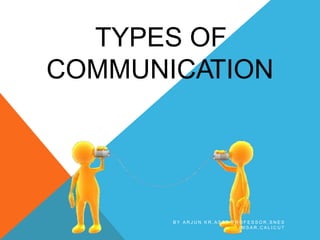
TYPES OF
COMMUNICATION
B Y A R J U N K R , A S S T P R O F E S S O R , S N E S
I M S A R , C A L I C U T
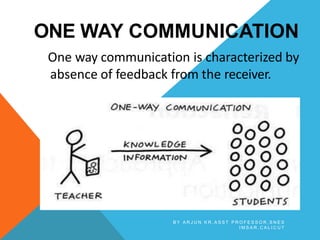
ONE WAY COMMUNICATION
One way communication is characterized by
absence of feedback from the receiver.
B Y A R J U N K R , A S S T P R O F E S S O R , S N E S
I M S A R , C A L I C U T
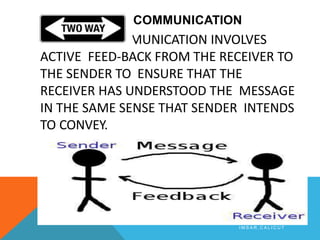
COMMUNICATION
TWO WAY COMMUNICATION INVOLVES
ACTIVE FEED-BACK FROM THE RECEIVER TO
THE SENDER TO ENSURE THAT THE
RECEIVER HAS UNDERSTOOD THE MESSAGE
IN THE SAME SENSE THAT SENDER INTENDS
TO CONVEY.
B Y A R J U N K R , A S S T P R O F E S S O R , S N E S
I M S A R , C A L I C U T
VERBALCOMMUNICATION
Verbal communication involves the use of
symbols that generally have universal meanings
for all who are talking part in the process.
Types of verbal communication
 ORAL COMMUNICATION
 WRITTEN COMMUNICATION
B Y A R J U N K R , A S S T P R O F E S S O R , S N E S
I M S A R , C A L I C U T
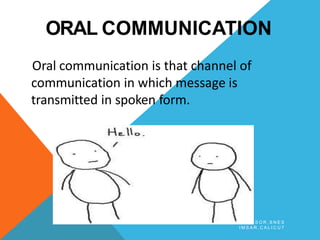
ORAL COMMUNICATION
Oral communication is that channel of
communication in which message is
transmitted in spoken form.
B Y A R J U N K R , A S S T P R O F E S S O R , S N E S
I M S A R , C A L I C U T
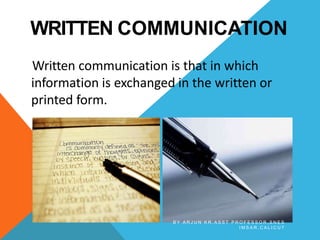
WRITTEN COMMUNICATION
Written communication is that in which
information is exchanged in the written or
printed form.
B Y A R J U N K R , A S S T P R O F E S S O R , S N E S
I M S A R , C A L I C U T
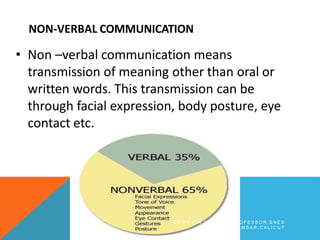
NON-VERBAL COMMUNICATION
• Non –verbal communication means
transmission of meaning other than oral or
written words. This transmission can be
through facial expression, body posture, eye
contact etc.
B Y A R J U N K R , A S S T P R O F E S S O R , S N E S
I M S A R , C A L I C U T
TYPES OF NON-VERBAL
COMMUNICATION
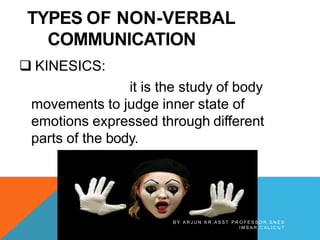
 KINESICS:
it is the study of body
movements to judge inner state of
emotions expressed through different
parts of the body.
B Y A R J U N K R , A S S T P R O F E S S O R , S N E S
I M S A R , C A L I C U T
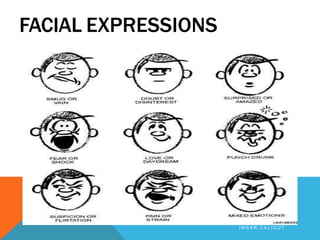
FACIAL EXPRESSIONS
B Y A R J U N K R , A S S T P R O F E S S O R , S N E S
I M S A R , C A L I C U T
GESTURES
B Y A R J U N K R , A S S T P R O F E S S O R , S N E S
I M S A R , C A L I C U T
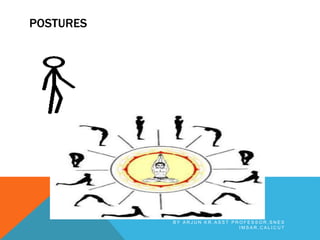
POSTURES
B Y A R J U N K R , A S S T P R O F E S S O R , S N E S
I M S A R , C A L I C U T
PROXEMICS
B Y A R J U N K R , A S S T P R O F E S S O R , S N E S
I M S A R , C A L I C U T
PARALANGUAGE
It involves the study of voice quality, volume,
speed rate and the manner of speaking
beyond the words. E.g. shaky voice reveals
nervousness, clear voice reveals confidence,
broken voice reveals lack of preparation etc.
B Y A R J U N K R , A S S T P R O F E S S O R , S N E S
I M S A R , C A L I C U T
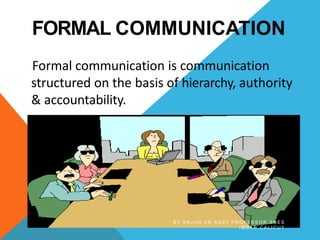
FORMAL COMMUNICATION
Formal communication is communication
structured on the basis of hierarchy, authority
& accountability.
B Y A R J U N K R , A S S T P R O F E S S O R , S N E S
I M S A R , C A L I C U T
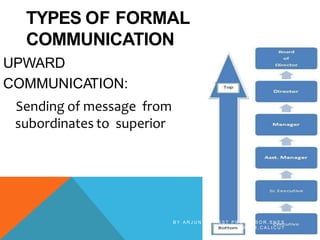
TYPES OF FORMAL
COMMUNICATION
UPWARD
COMMUNICATION:
Sending of message from
subordinates to superior
B Y A R J U N K R , A S S T P R O F E S S O R , S N E S
I M S A R , C A L I C U T
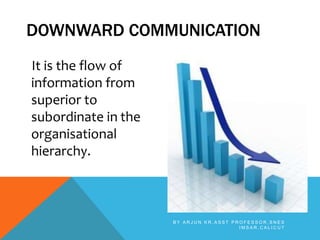
DOWNWARD COMMUNICATION
It is the flow of
information from
superior to
subordinate in the
organisational
hierarchy.
B Y A R J U N K R , A S S T P R O F E S S O R , S N E S
I M S A R , C A L I C U T
HORIZONTAL COMMUNICATION
It refers to the horizontal flow of message
among colleagues.
B Y A R J U N K R , A S S T P R O F E S S O R , S N E S
I M S A R , C A L I C U T
INFORMAL COMMUNICATION
INFORMAL COMMUNICATION IS RELATIVELY
LESS STRUCTURED & SPONTANEOUS
COMMUNICATION ARISING OUT OF DAY TO
DAY ROUTINE & MEETINGS AMONG
PEOPLE.
B Y A R J U N K R , A S S T P R O F E S S O R , S N E S
I M S A R , C A L I C U T
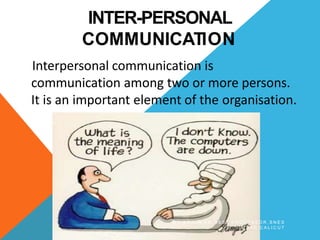
INTER-PERSONAL
COMMUNICATION
Interpersonal communication is
communication among two or more persons.
It is an important element of the organisation.
B Y A R J U N K R , A S S T P R O F E S S O R , S N E S
I M S A R , C A L I C U T
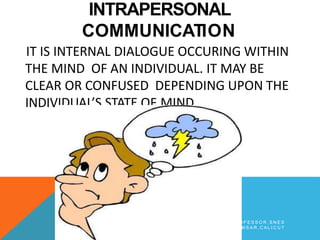
INTRAPERSONAL
COMMUNICATION
IT IS INTERNAL DIALOGUE OCCURING WITHIN
THE MIND OF AN INDIVIDUAL. IT MAY BE
CLEAR OR CONFUSED DEPENDING UPON THE
INDIVIDUAL’S STATE OF MIND.
B Y A R J U N K R , A S S T P R O F E S S O R , S N E S
I M S A R , C A L I C U T
VISUAL COMMUNICATION
B Y A R J U N K R , A S S T P R O F E S S O R , S N E S
I M S A R , C A L I C U T
1. INTRODUCTION TO VISUAL
COMMUNICATION
 The expression of ideas and information using visible forms
or aids is referred to as visual communication.
 In fact, it is a pictorial form of communication.
 Body language including gestures are part of such communication
in business.
 Presentations may also include photographs, charts,
graphs, and diagrams to enforce or demonstrate ideas or
data.
 Visual communication also includes traffic signals,hoardings and
paintings too
3
B Y A R J U N K R , A S S T P R O F E S S O R , S N E S
I M S A R , C A L I C U T
2. IMPORTANCE OF VISUAL COMMUNICATION IN
BUSINESS
1. People remember what they see so much more than
what they hear.
2. Visual things have direct route to long-term
memory of the audience.
3. Research supports that visual communication can be
more powerful than verbal communication.
4. The more visual content in a presentation, the more
memorable will the information be.
5. People not only communicate visually more than ever,
they also communicate better when theycommunicate
visually.
B Y A R J U N K R , A S S T P R O F E S S O R , S N E S
I M S A R , C A L I C U T
3. SELECTING THE RIGHT TYPE OF
VISUALS
 Visuals should support, clarify, and amplify, not
repeat what is said.
 In order to make sure that the intent of the visual aid is
clear, we should try to use only important or
memorable words or phrases.
 It is important to consider if the visual can be seen and
understood by all the members of the audience who
are farthest from the screen when choosing to use it.
 In order to do this, we must test out the visual aids
in different environments.
B Y A R J U N K R , A S S T P R O F E S S O R , S N E S
I M S A R , C A L I C U T
4. SELECTING THE RIGHT TYPE OF
VISUALS…
 Visual communication relies on vision, and is
primarily presented or expressed with different
images.
 A visual message accompanying text has a greater
power to inform, educate, or persuade a person
or audience.
B Y A R J U N K R , A S S T P R O F E S S O R , S N E S
I M S A R , C A L I C U T
VISUAL COMMUNICATION RELIES ON VISION, AND IS
PRIMARILY PRESENTED OR EXPRESSED WITH
DIFFERENT IMAGES.
These may include the following:
1.Typography
2.Drawing
3.Graphic Design
4.Illustration
5.Color
8
6.E1l2e/21c/16tronic ResourcDe B Y A R J U N K R , A S S T P R O F E S S O R , S N E S
I M S A R , C A L I C U T
1. TYPOGRAPHY
B Y A R J U N K R , A S S T P R O F E S S O R , S N E S
I M S A R , C A L I C U T
2. DRAWING
B Y A R J U N K R , A S S T P R O F E S S O R , S N E S
I M S A R , C A L I C U T
3. GRAPHIC
DESIGN
B Y A R J U N K R , A S S T P R O F E S S O R , S N E S
I M S A R , C A L I C U T
4. ILLUSTRATION
B Y A R J U N K R , A S S T P R O F E S S O R , S N E S
I M S A R , C A L I C U T
5. COLOR
B Y A R J U N K R , A S S T P R O F E S S O R , S N E S
I M S A R , C A L I C U T
6. ELECTRONIC RESOURCES
B Y A R J U N K R , A S S T P R O F E S S O R , S N E S
I M S A R , C A L I C U T
What is telecommunication?
•The transmission of information
that allows for communication
between people who are separated
by distance.
B Y A R J U N K R , A S S T P R O F E S S O R , S N E S
I M S A R , C A L I C U T
EXAMPLES OF TELECOMMUNICATION :
•Telephone system
•Satellite communication system
•Mobile cellular system
•Radar and sonar systems
•Microwave radio systems
•TV and radio broadcasting systems
•Space discovery using telecommunications
•Oil exploration using radio frequency
analysis warfare communications
•Information and intelligent gathering
B Y A R J U N K R , A S S T P R O F E S S O R , S N E S
I M S A R , C A L I C U T
Three units of telecommunication:
A transmitter that takes information and
converts it to a signal.
A transmission medium, also called the
“physical channel” that carries the signal.
A receiver that takes thesignal from the
channel and converts it back into usable
information.
B Y A R J U N K R , A S S T P R O F E S S O R , S N E S
I M S A R , C A L I C U T
BASIC ELEMENTS OF TELECOMMUNICATION
Sender
• who uses a transmitter which converts
the message into a signal. Transmitter
• transmits the information through a
medium to the receiver which transmits the
signals into information that can be used
and understood by people.
B Y A R J U N K R , A S S T P R O F E S S O R , S N E S
I M S A R , C A L I C U T
TRANSMISSION MEDIUM
This carries the signal
Sender
•receives the signal and converts it back into
usable information
Channel
•responsible to transfer the information from
the source to the destination without distortion
or loss of information. Channels tend to be
affected by external signals or noise. To achieve
this a variety of "protocols" or rules are used.
B Y A R J U N K R , A S S T P R O F E S S O R , S N E S
I M S A R , C A L I C U T
TELECOMMUNICATION NETWORK
•represent all the players that make
telecommunication possible, from the
transmitters and receivers to the
communication mediums that make it
possible for the messages to be transmitted.
Telecommunication medium
•refers to the channel that carries the signal
between a transmitter and a receiver. Examples
of telecommunication media in our modern
times are optical fibre as well as cables.
B Y A R J U N K R , A S S T P R O F E S S O R , S N E S
I M S A R , C A L I C U T
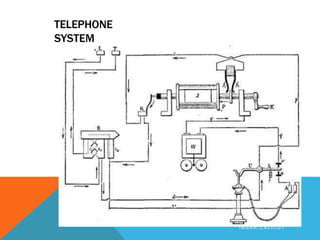
TELEPHONE
SYSTEM
B Y A R J U N K R , A S S T P R O F E S S O R , S N E S
I M S A R , C A L I C U T
SATELLITE COMMUNICATION
SYSTEMS
B Y A R J U N K R , A S S T P R O F E S S O R , S N E S
I M S A R , C A L I C U T
MOBILE CELLULAR
SYSTEM
B Y A R J U N K R , A S S T P R O F E S S O R , S N E S
I M S A R , C A L I C U T
RADAR AND SONAR
SYSTEMS
B Y A R J U N K R , A S S T P R O F E S S O R , S N E S
I M S A R , C A L I C U T
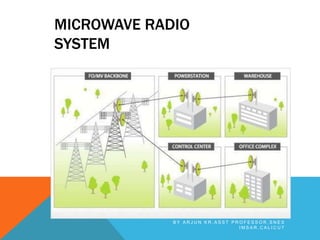
MICROWAVE RADIO
SYSTEM
B Y A R J U N K R , A S S T P R O F E S S O R , S N E S
I M S A R , C A L I C U T
8
TYPES OF BUSINESS
COMMUNICATION
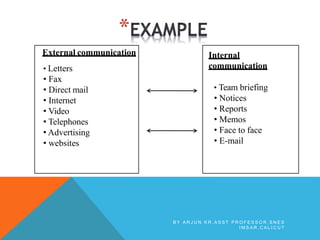
1. Internal communication: This is the communication that
takes place within an organization. In addition to the usual
face to face, telephone, fax or mail; modern organizations
may use technology to communicate internally. Technology
may be used for e-mails or a linked internal communication.
2. External communication: Communication between the
organization and those outside the organization. The
communicate with other businesses can be through
telephone, fax ,internet etc.
B Y A R J U N K R , A S S T P R O F E S S O R , S N E S
I M S A R , C A L I C U T
*
External communication
• Letters
• Fax
• Direct mail
• Internet
• Video
• Telephones
• Advertising
• websites
Internal
communication
• Team briefing
• Notices
• Reports
• Memos
• Face to face
• E-mail
B Y A R J U N K R , A S S T P R O F E S S O R , S N E S
I M S A R , C A L I C U T
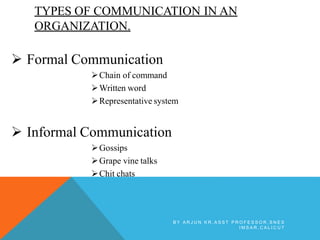
TYPES OF COMMUNICATION IN AN
ORGANIZATION.
 Formal Communication
Chain of command
Written word
Representative system
 Informal Communication
Gossips
Grape vine talks
Chit chats
B Y A R J U N K R , A S S T P R O F E S S O R , S N E S
I M S A R , C A L I C U T
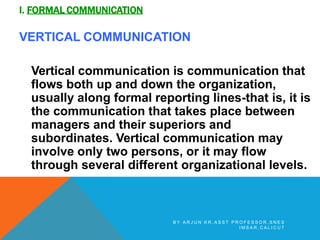
I. FORMAL COMMUNICATION
VERTICAL COMMUNICATION
Vertical communication is communication that
flows both up and down the organization,
usually along formal reporting lines-that is, it is
the communication that takes place between
managers and their superiors and
subordinates. Vertical communication may
involve only two persons, or it may flow
through several different organizational levels.
B Y A R J U N K R , A S S T P R O F E S S O R , S N E S
I M S A R , C A L I C U T
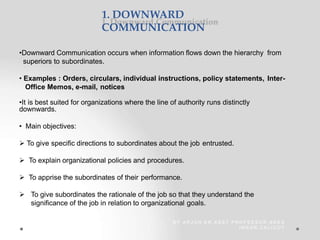
1. DOWNWARD
COMMUNICATION
•Downward Communication occurs when information flows down the hierarchy from
superiors to subordinates.
• Examples : Orders, circulars, individual instructions, policy statements, Inter-
Office Memos, e-mail, notices
•It is best suited for organizations where the line of authority runs distinctly
downwards.
• Main objectives:
 To give specific directions to subordinates about the job entrusted.
 To explain organizational policies and procedures.
 To apprise the subordinates of their performance.
 To give subordinates the rationale of the job so that they understand the
significance of the job in relation to organizational goals.
B Y A R J U N K R , A S S T P R O F E S S O R , S N E S
I M S A R , C A L I C U T
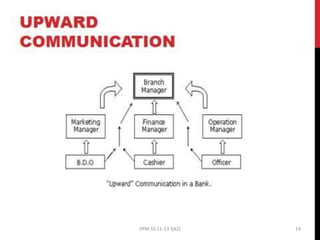
2. UPWARD
COMMUNICATION
Upward communication consists of messages from subordinates to superiors. This flow is usually
from subordinates to their direct superior, then to that person’s direct superior, and so on up the
hierarchy. Occasionally, a message might by-pass a particular superior.
Examples : The typical content of upward communication is requests, information that the lower-
level manager thinks is important to the higher-level manager, responses to requests from the
higher-level manager, suggestions, complaints, and financial information.
Importance :
1.Providing feedback: Whether directions issued are understood by lower staff.
2.Outlet for pent-up emotions : Grievances and problems addressed, solutions are developed
and employees feel better after having talked about them.
3.Constructive suggestions: These can be secured for improvement of the organization.
B Y A R J U N K R , A S S T P R O F E S S O R , S N E S
I M S A R , C A L I C U T
IIPM SS 11-13 i(A2) 14
B Y A R J U N K R , A S S T P R O F E S S O R , S N E S
I M S A R , C A L I C U T
B. HORIZONTAL COMMUNICATION
 Whereas vertical communication involves a superior and a subordinate, horizontal
communication involves colleagues and peers at the same level of the
organization.
 For example : an operations manager might communicate to a marketing manager
that inventory levels are running low and that projected delivery dates should be
extended by two weeks. Horizontal communication probably occurs more among
managers than among non managers.
 Horizontal communication serves a number of purposes.
 It facilitates coordination among interdependent units. For example, a manager
at Motorola was recently researching the strategies of Japanese semiconductor
firms in Europe. He found a great deal of information that was relevant to his
assignment.
He also uncovered some additional information that was potentially important to
another department, so he passed it along to a colleague in that department, who
used it to improve his own operations.
 Horizontal communication can also be used for joint problem solving, as
when tow plant managers at Westinghouse got together to work out a new method
to improve productivity.
 Finally, horizontal communication plays a major role in work teams with
members drawn from several departments.
B Y A R J U N K R , A S S T P R O F E S S O R , S N E S
I M S A R , C A L I C U T
DIAGONAL
COMMUNICATION
*This occurs when communication occurs between workers in a
different section of the organization where one worker is on a
higher level.
*For example diagonal communication will occur when a department
manager converses with an employee in another department.
*It allows cross communication between departments
B Y A R J U N K R , A S S T P R O F E S S O R , S N E S
I M S A R , C A L I C U T
DIAGONAL COMMUNICATION IS
USUALLY VERBAL.
It is a most direct
and fastest
method
of communication.
B Y A R J U N K R , A S S T P R O F E S S O R , S N E S
I M S A R , C A L I C U T
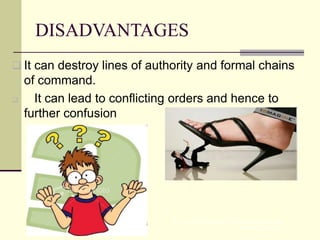
DISADVANTAGES
 It can destroy lines of authority and formal chains
of command.
 It can lead to conflicting orders and hence to
further confusion
B Y A R J U N K R , A S S T P R O F E S S O R , S N E S
I M S A R , C A L I C U T
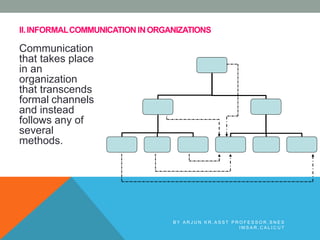
II.INFORMALCOMMUNICATIONINORGANIZATIONS
Communication
that takes place
in an
organization
that transcends
formal channels
and instead
follows any of
several
methods.
B Y A R J U N K R , A S S T P R O F E S S O R , S N E S
I M S A R , C A L I C U T
“GRAPEVINE“
1. a secret means of spreading or
receiving information
2. the informal transmission of
(unofficial) information, gossip or
rumor from person-to-person -> "to
hear about s.th. through the
grapevine"
3. a rumor: unfounded report; hearsay
B Y A R J U N K R , A S S T P R O F E S S O R , S N E S
I M S A R , C A L I C U T
GRAPEVINE
CHARACTERISTICS
 oral  mostly undocumented
 open to change
 fast (hours instead of days)
 crossing organizational boundaries
B Y A R J U N K R , A S S T P R O F E S S O R , S N E S
I M S A R , C A L I C U T
GRAPEVINE
CHARACTERISTICS
 inaccuracy:
 levelling
deletion of crucial details
 sharpening
exaggeration of the most dramatic details
while the grapevine generally carries the
truth it seldom carries the whole truth
B Y A R J U N K R , A S S T P R O F E S S O R , S N E S
I M S A R , C A L I C U T
GRAPEVINE
FIGURES
 70% of all organizational communication
occurs at the grapevine level
 estimated accuracy rates: 75-90%
 the incorrect part might change the
meaning of the whole message though
 an estimated 80% of grapevine
information is oriented toward the
individual while 20% concerns the
company
B Y A R J U N K R , A S S T P R O F E S S O R , S N E S
I M S A R , C A L I C U T
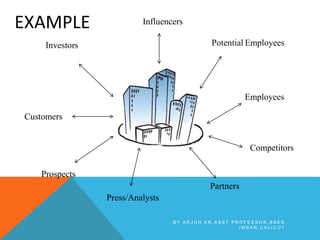
EXTERNAL
COMMUNICATION
Communication that takes place between a manager
and external groups
Such as - suppliers, vendors, banks, financial institutes
etc. For instance - To raise capital the Managing director
would interact with the Bank Manager.
B Y A R J U N K R , A S S T P R O F E S S O R , S N E S
I M S A R , C A L I C U T
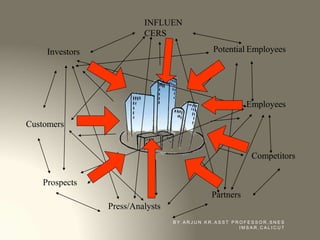
Investors
Customers
Prospects
Partners
Press/Analysts
Employees
Potential Employees
Influencers
Competitors
EXAMPLE
B Y A R J U N K R , A S S T P R O F E S S O R , S N E S
I M S A R , C A L I C U T
THE COMMUNICATION LOOKS FAIRLY
SIMPLE
27
B Y A R J U N K R , A S S T P R O F E S S O R , S N E S
I M S A R , C A L I C U T
Investors
Customers
Prospects
Partners
Press/Analysts
Employees
Potential Employees
INFLUEN
CERS
Competitors
B Y A R J U N K R , A S S T P R O F E S S O R , S N E S
I M S A R , C A L I C U T
BARRIERS OF
COMMUNICATION
B Y A R J U N K R , A S S T P R O F E S S O R , S N E S
I M S A R , C A L I C U T
“WHATEVER WORDS WE UTTER SHOULD
BE CHOSEN WITH CARE FOR PEOPLE
WILL HEAR THEM AND BE INFLUENCED
BY THEM FOR GOOD OR ILL.” BUDDHA
B Y A R J U N K R , A S S T P R O F E S S O R , S N E S
I M S A R , C A L I C U T
WHAT IS COMMUNICATION AND BARRIER ?
• Communication is the activity of conveying
meaningful information. It requires a sender, a
message, and an intended recipient.
• Barrier An obstacle in a place that prevents us
from completing certain tasks.
• Communication barriers can be defined as
the aspects or conditions that interfere with
effective exchange of ideas or thoughts.
B Y A R J U N K R , A S S T P R O F E S S O R , S N E S
I M S A R , C A L I C U T
TYPES OF
BARRIER
• Physical Barrier
• Cultural Barrier
• Language Barrier
• Emotional Barrier
• Gender Barrier
• Organizational Barrier
• Perceptual Barrier
B Y A R J U N K R , A S S T P R O F E S S O R , S N E S
I M S A R , C A L I C U T
PHYSICAL BARRIER
• Physical barriers relate to disturbance in the immediate situation, which
can interfere in the course of an effective communication.
• Some of them are easy to Alter whereas, some may prove to be tough
obstacles in the process of effective communication.
B Y A R J U N K R , A S S T P R O F E S S O R , S N E S
I M S A R , C A L I C U T
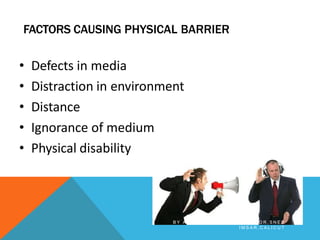
FACTORS CAUSING PHYSICAL BARRIER
• Defects in media
• Distraction in environment
• Distance
• Ignorance of medium
• Physical disability
B Y A R J U N K R , A S S T P R O F E S S O R , S N E S
I M S A R , C A L I C U T
HOW TO
OVERCOME?
• Tobe updated with latest technologies.
• Choosing a suitable environment.
• Removing obstacle.
• Making signs easier to read, example, you
could supplement written signs with pictures
and visual signs.
• Self Motivation.
B Y A R J U N K R , A S S T P R O F E S S O R , S N E S
I M S A R , C A L I C U T
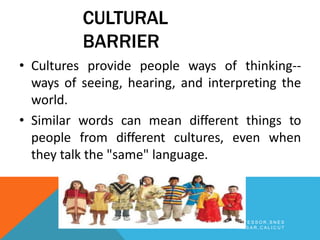
CULTURAL
BARRIER
• Cultures provide people ways of thinking--
ways of seeing, hearing, and interpreting the
world.
• Similar words can mean different things to
people from different cultures, even when
they talk the "same" language.
B Y A R J U N K R , A S S T P R O F E S S O R , S N E S
I M S A R , C A L I C U T
FACTORS CAUSING CULTURAL BARRIER
• Diversified cultural background.
• Language and Accent.
• Behavior and Nature.
• Religion.
B Y A R J U N K R , A S S T P R O F E S S O R , S N E S
I M S A R , C A L I C U T
HOW TO OVERCOME
?
• Cross culture environment.
• Have a thorough knowledge of your
counterpart’s culture background.
• Conduct effective communication workshop.
• Work in groups and run frequent meeting
B Y A R J U N K R , A S S T P R O F E S S O R , S N E S
I M S A R , C A L I C U T
LANGUAGE
BARRIERS
• Inability to converse in a language that is
known by both the sender and receiver is the
greatest barrier to effective communication.
• When a person uses inappropriate words
while conversing or writing, it could lead to
misunderstanding between the sender and a
receiver.
B Y A R J U N K R , A S S T P R O F E S S O R , S N E S
I M S A R , C A L I C U T
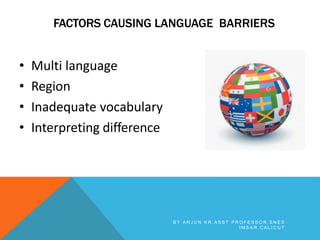
FACTORS CAUSING LANGUAGE BARRIERS
• Multi language
• Region
• Inadequate vocabulary
• Interpreting difference
B Y A R J U N K R , A S S T P R O F E S S O R , S N E S
I M S A R , C A L I C U T
HOW TO OVERCOME
?
• Speak slowly and clearly.
• Ask for clarification.
• Frequently check for understanding.
• Be specific.
• Choose your medium of communication
effectively.
• Be patient.
B Y A R J U N K R , A S S T P R O F E S S O R , S N E S
I M S A R , C A L I C U T
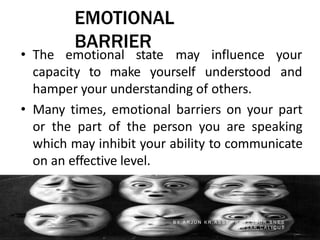
EMOTIONAL
BARRIER
• The emotional state may
capacity to make yourself
influence your
understood and
hamper your understanding of others.
• Many times, emotional barriers on your part
or the part of the person you are speaking
which may inhibit your ability to communicate
on an effective level.
B Y A R J U N K R , A S S T P R O F E S S O R , S N E S
I M S A R , C A L I C U T
FACTORS CAUSING EMOTIONAL BARRIER
• Fear/ insecurity
• Mistrust
• Stress
B Y A R J U N K R , A S S T P R O F E S S O R , S N E S
I M S A R , C A L I C U T
HOW TO
OVERCOME
• Motivation and commitment to change.
• Peer or mentor support .
• Practice expressing recognition .
B Y A R J U N K R , A S S T P R O F E S S O R , S N E S
I M S A R , C A L I C U T
GENDER
BARRIERS
• Relationships, respect, workplace authority and education are common
ways men and women are pitted against each other.
• Overcoming barriers in gender communication isn’t simple but can be
made clear with a little patience and understanding.
• This barrier arises because men and women have different ways of
thinking and communication.
B Y A R J U N K R , A S S T P R O F E S S O R , S N E S
I M S A R , C A L I C U T
FACTORS CAUSING GENDER BARRIERS
• Fear and shy
• Environment
• Misunderstanding
B Y A R J U N K R , A S S T P R O F E S S O R , S N E S
I M S A R , C A L I C U T
HOW TO
OVERCOME
• The process of bridging the gap in gender
communication requires the great deal of
patience and understanding that only time
and attention will teach.
B Y A R J U N K R , A S S T P R O F E S S O R , S N E S
I M S A R , C A L I C U T
ORGANIZATIONAL
BARRIERS
capability of the employees as far as
• Organizational structure greatly affects the
the
communication is concerned .
• All the internal factors which stymie or block
the process of communication are known as
organisational barriers. Some such factors
have already been discussed like restrictive
environments, deceptive tactics,
communication network.
B Y A R J U N K R , A S S T P R O F E S S O R , S N E S
I M S A R , C A L I C U T
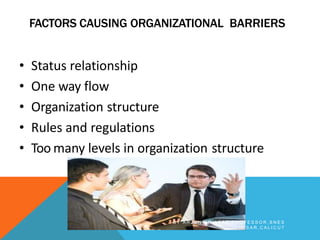
FACTORS CAUSING ORGANIZATIONAL BARRIERS
• Status relationship
• One way flow
• Organization structure
• Rules and regulations
• Too many levels in organization structure
B Y A R J U N K R , A S S T P R O F E S S O R , S N E S
I M S A R , C A L I C U T
HOW TO
OVERCOME?
• Poor structure to the communication.
• A weak delivery.
• The use of the wrong medium to deliver the
communication.
• A mixed message.
• The message is delivered to the wrong
audience.
• A distracting environment.
B Y A R J U N K R , A S S T P R O F E S S O R , S N E S
I M S A R , C A L I C U T
PERCEPTUAL
BARRIERS
• The most common problem is that the people
have difference opinion .
• The varied perceptions of every individual give
rise to a need for effective communication.
• We all have our own preferences, values,
attitudes, origins and life experiences that act
as ‘filters’ on our experiences of people,
events and information.
B Y A R J U N K R , A S S T P R O F E S S O R , S N E S
I M S A R , C A L I C U T
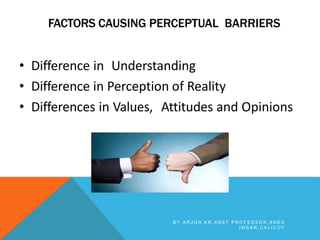
FACTORS CAUSING PERCEPTUAL BARRIERS
• Difference in Understanding
• Difference in Perception of Reality
• Differences in Values, Attitudes and Opinions
B Y A R J U N K R , A S S T P R O F E S S O R , S N E S
I M S A R , C A L I C U T
HOW TO
OVERCOME?
• Start by listening to others.
• Clarify if there is confusion.
• Stay calm and be positive.
B Y A R J U N K R , A S S T P R O F E S S O R , S N E S
I M S A R , C A L I C U T
B Y A R J U N K R , A S S T P R O F E S S O R , S N E S
I M S A R , C A L I C U T
B Y A R J U N K R , A S S T P R O F E S S O R , S N E S
I M S A R , C A L I C U T

Business communication , Module 1 (MBA)

  • 1.
    BUSINESS COMMUNICATION MODULE 1 (FORMBA) UNDER CALICUT UNIVERSITY) B Y A R J U N K R , A S S T P R O F E S S O R , S N E S I M S A R , C A L I C U T
  • 2.
    • COMMUNICATION- DEFINITION ANDMEANING  Communication is an exchange of facts, ideas, opinions or emotions by two or more persons.  Communication is defined as “the process of passing information and understanding from one person to another, it is essentially a bridge of meaning between people. By using the bridge of meaning a person can safely cross the river of misunderstanding.” B Y A R J U N K R , A S S T P R O F E S S O R , S N E S I M S A R , C A L I C U T
  • 3.
    2. A COMMUNICATIONPROCESS MODEL Feedback Thought Encoding Sender Transmission of Message Reception Decoding Understanding Noise Receiver B Y A R J U N K R , A S S T P R O F E S S O R , S N E S I M S A R , C A L I C U T
  • 4.
    SENDER  Communication beginswith a thought/idea that a sender has. Encoding  refers to putting the thought/idea in a form, which can be understood by receiver. Channel to transmit the message:  Channel  Links the sender and the receiver.  Forms may be oral, written, a letter, a computer, a telegram, a fax, Television or radio.  Two or more channels may be used at the same time. ELEMENTS OF COMMUNICATION PROCESS MODEL B Y A R J U N K R , A S S T P R O F E S S O R , S N E S I M S A R , C A L I C U T
  • 5.
    RECEIVER OF THE MESSAGE: Reception being ready for the message.  Decoding refers to conversion of the message into thoughts.  Understanding refers to interpreting the message i.e. attaching meaning. Accurate communication can occur only when sender and receiver attach same or similar meaning to the message. Noise:  Is anything, which hinders communication. It may in the sender, the transmission or the receiver. ELEMENTS OF COMMUNICATION PROCESS MODEL (Contd.) B Y A R J U N K R , A S S T P R O F E S S O R , S N E S I M S A R , C A L I C U T
  • 6.
    ELEMENTS OF COMMUNICATIONPROCESS MODEL (Contd.)  Examples of noise: Encoding  Faulty due to use of ambiguous symbols.  Transmission Faulty telephone connection.  Reception Inaccurate attention.  Decoding Faulty due to wrong meaning attached. Understanding Can be obstructed by prejudices. Gestures and posture. B Y A R J U N K R , A S S T P R O F E S S O R , S N E S I M S A R , C A L I C U T
  • 7.
    ELEMENTS OF COMMUNICATIONPROCESS MODEL (Contd.)  Feedback To check effectiveness of communication, a person must have feedback. One can never be sure that the message has been encoded, transmitted and decoded properly unless it is confirmed by feedback.  Situational and Organizational Factors in Communication  Situational Factors External Factors- educational, sociological, legal-political, economic. Geographical distance.  Organizational Factors Organization structure, managerial and non-managerial processes and technology. B Y A R J U N K R , A S S T P R O F E S S O R , S N E S I M S A R , C A L I C U T
  • 8.
    3. CHARACTERISTICS (i) Atwo-way traffic It is a two-way traffic – upward and downward. Messages, directives, opinions are communicated downward. Likewise grievances, complaints, opinions, feelings, are communicated upward along the line. (ii) Continuous Process It is continuous process. It is repeated to achieve the desired results. It is not a one time shot. (iii) A short-lived process: It is complete as soon as the message is received and understood by the receiver in the right perspective. (iv) Needs proper understanding: There may be numerous media of communication but the main purpose of conveying the message is a proper understanding of the message by the other party. For this purpose, it should be clearly and concisely worded.B Y A R J U N K R , A S S T P R O F E S S O R , S N E S I M S A R , C A L I C U T
  • 9.
    3. CHARACTERISTICS (CONTD.) (v) Leadsachievement of the organizational objective: Effective communication does this by creating the sense of object orientation in the organization. (vi) Dispels misunderstanding: It provides clear understanding between persons and thus builds a bridge of camaraderie among people. B Y A R J U N K R , A S S T P R O F E S S O R , S N E S I M S A R , C A L I C U T
  • 10.
    4. Purpose orObjectives of Communication  The main objectives are: l Conveying the right message: The main objective of communication is to convey the right message to the right person, i.e., to the person for whom it is meant. The message conveyed should be well understood and accepted by the receiver in the right perspective. (ii) Coordination of effort: It is an effective tool for coordinating the activities of different persons engaged in running a business. Coordination without communication is a remote possibility. The individuals or groups come to know what others are doing and what is expected from them only through communication. B Y A R J U N K R , A S S T P R O F E S S O R , S N E S I M S A R , C A L I C U T
  • 11.
    4. Purpose orObjectives of Communication (Contd.) (iv) Good Industrial relations: Communication develops good industrial relations as it conveys the feelings, ideas, opinions and viewpoints of one party to the other party. The two parties-the management and the subordinates come closer through communication. They understand each other and dispel any misunderstanding. Thus, it promotes cooperation and good industrial relations. (v) Development of managerial skills: Communication helps managers to understand human behavior at work. Communication of facts, ideas, opinions, information, feelings etc. add value to the knowledge of managers about various happenings, in the organization and behavior of people. Thus, communication is a process of learning. B Y A R J U N K R , A S S T P R O F E S S O R , S N E S I M S A R , C A L I C U T
  • 12.
    4. PURPOSE OROBJECTIVES OF COMMUNICATION (CONTD.) (vi) Effectiveness of policies: The organization formulates policies and programmes to guide the workforce. These should be conveyed properly to those who are really responsible for the execution of work to achieve the organizational objectives. Only effective communication can translate the policies into action. Effectiveness of the policies can be judged from the success which surely depends upon an effective communication system. B Y A R J U N K R , A S S T P R O F E S S O R , S N E S I M S A R , C A L I C U T
  • 13.
    5. PRINCIPLES OF COMMUNICATION The following principles can be followed to make the communication system more effective: (i) Principle of clarity: The idea or the message to be transmitted should be clearly worded so that it may be interpreted by the receiver in the same sense in which it is communicated. (ii) Principle of integrity: Communication should be aimed at motivating people to take action as agreed upon. (iii) Principle of informality: Formal communication system is cornerstone of a formal organization, it leads transmittal of messages. But, sometimes, formal communications prove ineffective in evoking the needed response from the subordinates. In such cases, the superiors should adopt the strategy of making use of informal channels of communication: they may contact, if necessary, the subordinates personally or through someone else to persuade them to translate their orders into action. Informal communication at times proves far more effective than formal communication. B Y A R J U N K R , A S S T P R O F E S S O R , S N E S I M S A R , C A L I C U T
  • 14.
    5. PRINCIPLES OFCOMMUNICATION (CONTD.) (iv) Principle of attention: In order to make the message effective, the recipient's attention should be drawn to the message communicated. Each one is different in behavior, sentiments, and emotions, which determine the degree of attention. For this purpose, the superior must note that he himself should not expect from his subordinates what he himself does not practice. So, a manger cannot enforce punctuality if he himself is not punctual. (v) Principle of consistency: This principle implies that communication should always be consistent with the policies, plans, programmes and objectives of the organization, and not in conflict with them. (vi) Principle of adequacy: The information should be adequate and complete in all respects. Inadequate and incomplete information may delay action and destroy understanding and create confusion. Inadequate information also affects the efficiency of the sender and the receiver of the communication. B Y A R J U N K R , A S S T P R O F E S S O R , S N E S I M S A R , C A L I C U T
  • 15.
    Principles of Communication(Contd.) (vii)Principle of timeliness: All messages should be transmitted at the proper time. Any delay in communicating message serves no purpose except to make them merely historical document as it loses its importance after some time. (viii)Principle of feedback: One of the most important principles of communications is the principle of feedback. The communicator must have feedback information from the recipient to know whether the recipient has understood the message in the same sense in which the sender has meant it, or whether the subordinates agree or disagree with the contents of the message. It also helps in understanding attitude of the people. B Y A R J U N K R , A S S T P R O F E S S O R , S N E S I M S A R , C A L I C U T
  • 16.
    PRINCIPLES OF COMMUNICATION (CONTD.) (ix)Principle of communications network: Communications network means the routes through which the communication travels to its destination, i.e., the person for whom it is meant. A number of such networks may exist in an organization at a given point of time; but the management should consider the effectiveness of the communications network in the given situation, and its effects on the behavior of the recipient before it finally chooses the network.  Clarity of expression: Use simple words Use single words for long phrases Avoid double entry Use verbs for nouns Use concrete expressions B Y A R J U N K R , A S S T P R O F E S S O R , S N E S I M S A R , C A L I C U T
  • 17.
    • Clarity ofexpression: Use simple words Use single words for long phrases Avoid double entry Use verbs for nouns Use concrete expressions • Prefer active construction Avoid excessive use of the infinitive Avoid jargons Avoid ambiguity Use short sentences B Y A R J U N K R , A S S T P R O F E S S O R , S N E S I M S A R , C A L I C U T
  • 18.
     Completeness While answeringensure you have answered all the points Check for “five W” questions  Conciseness Include only relevant facts Avoid repetition Avoid trite and wordy expressions Organize your message well B Y A R J U N K R , A S S T P R O F E S S O R , S N E S I M S A R , C A L I C U T
  • 19.
     Consideration Adopt theyou – attitude Avoid gender bias Emphasize positive, pleasant facts Impart integrity to your message B Y A R J U N K R , A S S T P R O F E S S O R , S N E S I M S A R , C A L I C U T
  • 20.
    6. SCOPE OFCOMMUNICATION  The scope of communication includes: (i) Information Sharing: To transmit information from a source to target individuals or groups. Information can be: - policies and rules - changes and development in the organization - Special rewards and awards - Settlements with the union - major changes in the organization (ii) Feedback: Give feedback to employees on their achievements - To the departments on their performance - Higher management on the fulfillment of goals (iii) Control: Information is transmitted to ensure that plans are being carried out according to the original design. Communication helps to ensuring such control. B Y A R J U N K R , A S S T P R O F E S S O R , S N E S I M S A R , C A L I C U T
  • 21.
    6. Scope ofCommunication (Contd.)  The scope of communication includes: (iv) Influence: Information is power. One purpose of communication is to influence people. (v) Problem-solving: In many cases communication helps to solving problems. Many meetings are held between the management and the unions on some issues to find solution. Alternative solutions may be held to solve a problem and evolve a consensus. (iii) Decision-making: For arriving at a decision several kinds of communication are needed. B Y A R J U N K R , A S S T P R O F E S S O R , S N E S I M S A R , C A L I C U T
  • 22.
    6. SCOPE OFCOMMUNICATION (CONTD.)  The scope of communication includes: (vii) Facilitating change: Change can be brought about effectively by communication. (viii) Group Building: Communication helps in building relationships. If communication breaks down the group may breakdown. (ix) Gate Keeping: Communication helps to build linkages of the organization with the outside world. B Y A R J U N K R , A S S T P R O F E S S O R , S N E S I M S A R , C A L I C U T
  • 23.
    7. LIMITATIONS OFCOMMUNICATION l l l l l The distortion of communication is its main limitation. The distortion of communication may have the following consequences: The message received is not very close to the message sent. The non-verbal messages are not congruent with the verbal message. The message may not result in the desired response. The communication can at times create confusion. Communication at times is costly and can be delayed. B Y A R J U N K R , A S S T P R O F E S S O R , S N E S I M S A R , C A L I C U T
  • 24.
    TYPES OF COMMUNICATION B YA R J U N K R , A S S T P R O F E S S O R , S N E S I M S A R , C A L I C U T
  • 25.
    ONE WAY COMMUNICATION Oneway communication is characterized by absence of feedback from the receiver. B Y A R J U N K R , A S S T P R O F E S S O R , S N E S I M S A R , C A L I C U T
  • 26.
    COMMUNICATION TWO WAY COMMUNICATIONINVOLVES ACTIVE FEED-BACK FROM THE RECEIVER TO THE SENDER TO ENSURE THAT THE RECEIVER HAS UNDERSTOOD THE MESSAGE IN THE SAME SENSE THAT SENDER INTENDS TO CONVEY. B Y A R J U N K R , A S S T P R O F E S S O R , S N E S I M S A R , C A L I C U T
  • 27.
    VERBALCOMMUNICATION Verbal communication involvesthe use of symbols that generally have universal meanings for all who are talking part in the process. Types of verbal communication  ORAL COMMUNICATION  WRITTEN COMMUNICATION B Y A R J U N K R , A S S T P R O F E S S O R , S N E S I M S A R , C A L I C U T
  • 28.
    ORAL COMMUNICATION Oral communicationis that channel of communication in which message is transmitted in spoken form. B Y A R J U N K R , A S S T P R O F E S S O R , S N E S I M S A R , C A L I C U T
  • 29.
    WRITTEN COMMUNICATION Written communicationis that in which information is exchanged in the written or printed form. B Y A R J U N K R , A S S T P R O F E S S O R , S N E S I M S A R , C A L I C U T
  • 30.
    NON-VERBAL COMMUNICATION • Non–verbal communication means transmission of meaning other than oral or written words. This transmission can be through facial expression, body posture, eye contact etc. B Y A R J U N K R , A S S T P R O F E S S O R , S N E S I M S A R , C A L I C U T
  • 31.
    TYPES OF NON-VERBAL COMMUNICATION KINESICS: it is the study of body movements to judge inner state of emotions expressed through different parts of the body. B Y A R J U N K R , A S S T P R O F E S S O R , S N E S I M S A R , C A L I C U T
  • 32.
    FACIAL EXPRESSIONS B YA R J U N K R , A S S T P R O F E S S O R , S N E S I M S A R , C A L I C U T
  • 33.
    GESTURES B Y AR J U N K R , A S S T P R O F E S S O R , S N E S I M S A R , C A L I C U T
  • 34.
    POSTURES B Y AR J U N K R , A S S T P R O F E S S O R , S N E S I M S A R , C A L I C U T
  • 35.
    PROXEMICS B Y AR J U N K R , A S S T P R O F E S S O R , S N E S I M S A R , C A L I C U T
  • 36.
    PARALANGUAGE It involves thestudy of voice quality, volume, speed rate and the manner of speaking beyond the words. E.g. shaky voice reveals nervousness, clear voice reveals confidence, broken voice reveals lack of preparation etc. B Y A R J U N K R , A S S T P R O F E S S O R , S N E S I M S A R , C A L I C U T
  • 37.
    FORMAL COMMUNICATION Formal communicationis communication structured on the basis of hierarchy, authority & accountability. B Y A R J U N K R , A S S T P R O F E S S O R , S N E S I M S A R , C A L I C U T
  • 38.
    TYPES OF FORMAL COMMUNICATION UPWARD COMMUNICATION: Sendingof message from subordinates to superior B Y A R J U N K R , A S S T P R O F E S S O R , S N E S I M S A R , C A L I C U T
  • 39.
    DOWNWARD COMMUNICATION It isthe flow of information from superior to subordinate in the organisational hierarchy. B Y A R J U N K R , A S S T P R O F E S S O R , S N E S I M S A R , C A L I C U T
  • 40.
    HORIZONTAL COMMUNICATION It refersto the horizontal flow of message among colleagues. B Y A R J U N K R , A S S T P R O F E S S O R , S N E S I M S A R , C A L I C U T
  • 41.
    INFORMAL COMMUNICATION INFORMAL COMMUNICATIONIS RELATIVELY LESS STRUCTURED & SPONTANEOUS COMMUNICATION ARISING OUT OF DAY TO DAY ROUTINE & MEETINGS AMONG PEOPLE. B Y A R J U N K R , A S S T P R O F E S S O R , S N E S I M S A R , C A L I C U T
  • 42.
    INTER-PERSONAL COMMUNICATION Interpersonal communication is communicationamong two or more persons. It is an important element of the organisation. B Y A R J U N K R , A S S T P R O F E S S O R , S N E S I M S A R , C A L I C U T
  • 43.
    INTRAPERSONAL COMMUNICATION IT IS INTERNALDIALOGUE OCCURING WITHIN THE MIND OF AN INDIVIDUAL. IT MAY BE CLEAR OR CONFUSED DEPENDING UPON THE INDIVIDUAL’S STATE OF MIND. B Y A R J U N K R , A S S T P R O F E S S O R , S N E S I M S A R , C A L I C U T
  • 44.
    VISUAL COMMUNICATION B YA R J U N K R , A S S T P R O F E S S O R , S N E S I M S A R , C A L I C U T
  • 45.
    1. INTRODUCTION TOVISUAL COMMUNICATION  The expression of ideas and information using visible forms or aids is referred to as visual communication.  In fact, it is a pictorial form of communication.  Body language including gestures are part of such communication in business.  Presentations may also include photographs, charts, graphs, and diagrams to enforce or demonstrate ideas or data.  Visual communication also includes traffic signals,hoardings and paintings too 3 B Y A R J U N K R , A S S T P R O F E S S O R , S N E S I M S A R , C A L I C U T
  • 46.
    2. IMPORTANCE OFVISUAL COMMUNICATION IN BUSINESS 1. People remember what they see so much more than what they hear. 2. Visual things have direct route to long-term memory of the audience. 3. Research supports that visual communication can be more powerful than verbal communication. 4. The more visual content in a presentation, the more memorable will the information be. 5. People not only communicate visually more than ever, they also communicate better when theycommunicate visually. B Y A R J U N K R , A S S T P R O F E S S O R , S N E S I M S A R , C A L I C U T
  • 47.
    3. SELECTING THERIGHT TYPE OF VISUALS  Visuals should support, clarify, and amplify, not repeat what is said.  In order to make sure that the intent of the visual aid is clear, we should try to use only important or memorable words or phrases.  It is important to consider if the visual can be seen and understood by all the members of the audience who are farthest from the screen when choosing to use it.  In order to do this, we must test out the visual aids in different environments. B Y A R J U N K R , A S S T P R O F E S S O R , S N E S I M S A R , C A L I C U T
  • 48.
    4. SELECTING THERIGHT TYPE OF VISUALS…  Visual communication relies on vision, and is primarily presented or expressed with different images.  A visual message accompanying text has a greater power to inform, educate, or persuade a person or audience. B Y A R J U N K R , A S S T P R O F E S S O R , S N E S I M S A R , C A L I C U T
  • 49.
    VISUAL COMMUNICATION RELIESON VISION, AND IS PRIMARILY PRESENTED OR EXPRESSED WITH DIFFERENT IMAGES. These may include the following: 1.Typography 2.Drawing 3.Graphic Design 4.Illustration 5.Color 8 6.E1l2e/21c/16tronic ResourcDe B Y A R J U N K R , A S S T P R O F E S S O R , S N E S I M S A R , C A L I C U T
  • 50.
    1. TYPOGRAPHY B YA R J U N K R , A S S T P R O F E S S O R , S N E S I M S A R , C A L I C U T
  • 51.
    2. DRAWING B YA R J U N K R , A S S T P R O F E S S O R , S N E S I M S A R , C A L I C U T
  • 52.
    3. GRAPHIC DESIGN B YA R J U N K R , A S S T P R O F E S S O R , S N E S I M S A R , C A L I C U T
  • 53.
    4. ILLUSTRATION B YA R J U N K R , A S S T P R O F E S S O R , S N E S I M S A R , C A L I C U T
  • 54.
    5. COLOR B YA R J U N K R , A S S T P R O F E S S O R , S N E S I M S A R , C A L I C U T
  • 55.
    6. ELECTRONIC RESOURCES BY A R J U N K R , A S S T P R O F E S S O R , S N E S I M S A R , C A L I C U T
  • 56.
    What is telecommunication? •Thetransmission of information that allows for communication between people who are separated by distance. B Y A R J U N K R , A S S T P R O F E S S O R , S N E S I M S A R , C A L I C U T
  • 57.
    EXAMPLES OF TELECOMMUNICATION: •Telephone system •Satellite communication system •Mobile cellular system •Radar and sonar systems •Microwave radio systems •TV and radio broadcasting systems •Space discovery using telecommunications •Oil exploration using radio frequency analysis warfare communications •Information and intelligent gathering B Y A R J U N K R , A S S T P R O F E S S O R , S N E S I M S A R , C A L I C U T
  • 58.
    Three units oftelecommunication: A transmitter that takes information and converts it to a signal. A transmission medium, also called the “physical channel” that carries the signal. A receiver that takes thesignal from the channel and converts it back into usable information. B Y A R J U N K R , A S S T P R O F E S S O R , S N E S I M S A R , C A L I C U T
  • 59.
    BASIC ELEMENTS OFTELECOMMUNICATION Sender • who uses a transmitter which converts the message into a signal. Transmitter • transmits the information through a medium to the receiver which transmits the signals into information that can be used and understood by people. B Y A R J U N K R , A S S T P R O F E S S O R , S N E S I M S A R , C A L I C U T
  • 60.
    TRANSMISSION MEDIUM This carriesthe signal Sender •receives the signal and converts it back into usable information Channel •responsible to transfer the information from the source to the destination without distortion or loss of information. Channels tend to be affected by external signals or noise. To achieve this a variety of "protocols" or rules are used. B Y A R J U N K R , A S S T P R O F E S S O R , S N E S I M S A R , C A L I C U T
  • 61.
    TELECOMMUNICATION NETWORK •represent allthe players that make telecommunication possible, from the transmitters and receivers to the communication mediums that make it possible for the messages to be transmitted. Telecommunication medium •refers to the channel that carries the signal between a transmitter and a receiver. Examples of telecommunication media in our modern times are optical fibre as well as cables. B Y A R J U N K R , A S S T P R O F E S S O R , S N E S I M S A R , C A L I C U T
  • 62.
    TELEPHONE SYSTEM B Y AR J U N K R , A S S T P R O F E S S O R , S N E S I M S A R , C A L I C U T
  • 63.
    SATELLITE COMMUNICATION SYSTEMS B YA R J U N K R , A S S T P R O F E S S O R , S N E S I M S A R , C A L I C U T
  • 64.
    MOBILE CELLULAR SYSTEM B YA R J U N K R , A S S T P R O F E S S O R , S N E S I M S A R , C A L I C U T
  • 65.
    RADAR AND SONAR SYSTEMS BY A R J U N K R , A S S T P R O F E S S O R , S N E S I M S A R , C A L I C U T
  • 66.
    MICROWAVE RADIO SYSTEM B YA R J U N K R , A S S T P R O F E S S O R , S N E S I M S A R , C A L I C U T
  • 67.
    8 TYPES OF BUSINESS COMMUNICATION 1.Internal communication: This is the communication that takes place within an organization. In addition to the usual face to face, telephone, fax or mail; modern organizations may use technology to communicate internally. Technology may be used for e-mails or a linked internal communication. 2. External communication: Communication between the organization and those outside the organization. The communicate with other businesses can be through telephone, fax ,internet etc. B Y A R J U N K R , A S S T P R O F E S S O R , S N E S I M S A R , C A L I C U T
  • 68.
    * External communication • Letters •Fax • Direct mail • Internet • Video • Telephones • Advertising • websites Internal communication • Team briefing • Notices • Reports • Memos • Face to face • E-mail B Y A R J U N K R , A S S T P R O F E S S O R , S N E S I M S A R , C A L I C U T
  • 69.
    TYPES OF COMMUNICATIONIN AN ORGANIZATION.  Formal Communication Chain of command Written word Representative system  Informal Communication Gossips Grape vine talks Chit chats B Y A R J U N K R , A S S T P R O F E S S O R , S N E S I M S A R , C A L I C U T
  • 70.
    I. FORMAL COMMUNICATION VERTICALCOMMUNICATION Vertical communication is communication that flows both up and down the organization, usually along formal reporting lines-that is, it is the communication that takes place between managers and their superiors and subordinates. Vertical communication may involve only two persons, or it may flow through several different organizational levels. B Y A R J U N K R , A S S T P R O F E S S O R , S N E S I M S A R , C A L I C U T
  • 71.
    1. DOWNWARD COMMUNICATION •Downward Communicationoccurs when information flows down the hierarchy from superiors to subordinates. • Examples : Orders, circulars, individual instructions, policy statements, Inter- Office Memos, e-mail, notices •It is best suited for organizations where the line of authority runs distinctly downwards. • Main objectives:  To give specific directions to subordinates about the job entrusted.  To explain organizational policies and procedures.  To apprise the subordinates of their performance.  To give subordinates the rationale of the job so that they understand the significance of the job in relation to organizational goals. B Y A R J U N K R , A S S T P R O F E S S O R , S N E S I M S A R , C A L I C U T
  • 72.
    2. UPWARD COMMUNICATION Upward communicationconsists of messages from subordinates to superiors. This flow is usually from subordinates to their direct superior, then to that person’s direct superior, and so on up the hierarchy. Occasionally, a message might by-pass a particular superior. Examples : The typical content of upward communication is requests, information that the lower- level manager thinks is important to the higher-level manager, responses to requests from the higher-level manager, suggestions, complaints, and financial information. Importance : 1.Providing feedback: Whether directions issued are understood by lower staff. 2.Outlet for pent-up emotions : Grievances and problems addressed, solutions are developed and employees feel better after having talked about them. 3.Constructive suggestions: These can be secured for improvement of the organization. B Y A R J U N K R , A S S T P R O F E S S O R , S N E S I M S A R , C A L I C U T
  • 73.
    IIPM SS 11-13i(A2) 14 B Y A R J U N K R , A S S T P R O F E S S O R , S N E S I M S A R , C A L I C U T
  • 74.
    B. HORIZONTAL COMMUNICATION Whereas vertical communication involves a superior and a subordinate, horizontal communication involves colleagues and peers at the same level of the organization.  For example : an operations manager might communicate to a marketing manager that inventory levels are running low and that projected delivery dates should be extended by two weeks. Horizontal communication probably occurs more among managers than among non managers.  Horizontal communication serves a number of purposes.  It facilitates coordination among interdependent units. For example, a manager at Motorola was recently researching the strategies of Japanese semiconductor firms in Europe. He found a great deal of information that was relevant to his assignment. He also uncovered some additional information that was potentially important to another department, so he passed it along to a colleague in that department, who used it to improve his own operations.  Horizontal communication can also be used for joint problem solving, as when tow plant managers at Westinghouse got together to work out a new method to improve productivity.  Finally, horizontal communication plays a major role in work teams with members drawn from several departments. B Y A R J U N K R , A S S T P R O F E S S O R , S N E S I M S A R , C A L I C U T
  • 75.
    DIAGONAL COMMUNICATION *This occurs whencommunication occurs between workers in a different section of the organization where one worker is on a higher level. *For example diagonal communication will occur when a department manager converses with an employee in another department. *It allows cross communication between departments B Y A R J U N K R , A S S T P R O F E S S O R , S N E S I M S A R , C A L I C U T
  • 76.
    DIAGONAL COMMUNICATION IS USUALLYVERBAL. It is a most direct and fastest method of communication. B Y A R J U N K R , A S S T P R O F E S S O R , S N E S I M S A R , C A L I C U T
  • 77.
    DISADVANTAGES  It candestroy lines of authority and formal chains of command.  It can lead to conflicting orders and hence to further confusion B Y A R J U N K R , A S S T P R O F E S S O R , S N E S I M S A R , C A L I C U T
  • 78.
    II.INFORMALCOMMUNICATIONINORGANIZATIONS Communication that takes place inan organization that transcends formal channels and instead follows any of several methods. B Y A R J U N K R , A S S T P R O F E S S O R , S N E S I M S A R , C A L I C U T
  • 79.
    “GRAPEVINE“ 1. a secretmeans of spreading or receiving information 2. the informal transmission of (unofficial) information, gossip or rumor from person-to-person -> "to hear about s.th. through the grapevine" 3. a rumor: unfounded report; hearsay B Y A R J U N K R , A S S T P R O F E S S O R , S N E S I M S A R , C A L I C U T
  • 80.
    GRAPEVINE CHARACTERISTICS  oral mostly undocumented  open to change  fast (hours instead of days)  crossing organizational boundaries B Y A R J U N K R , A S S T P R O F E S S O R , S N E S I M S A R , C A L I C U T
  • 81.
    GRAPEVINE CHARACTERISTICS  inaccuracy:  levelling deletionof crucial details  sharpening exaggeration of the most dramatic details while the grapevine generally carries the truth it seldom carries the whole truth B Y A R J U N K R , A S S T P R O F E S S O R , S N E S I M S A R , C A L I C U T
  • 82.
    GRAPEVINE FIGURES  70% ofall organizational communication occurs at the grapevine level  estimated accuracy rates: 75-90%  the incorrect part might change the meaning of the whole message though  an estimated 80% of grapevine information is oriented toward the individual while 20% concerns the company B Y A R J U N K R , A S S T P R O F E S S O R , S N E S I M S A R , C A L I C U T
  • 83.
    EXTERNAL COMMUNICATION Communication that takesplace between a manager and external groups Such as - suppliers, vendors, banks, financial institutes etc. For instance - To raise capital the Managing director would interact with the Bank Manager. B Y A R J U N K R , A S S T P R O F E S S O R , S N E S I M S A R , C A L I C U T
  • 84.
  • 85.
    THE COMMUNICATION LOOKSFAIRLY SIMPLE 27 B Y A R J U N K R , A S S T P R O F E S S O R , S N E S I M S A R , C A L I C U T
  • 86.
    Investors Customers Prospects Partners Press/Analysts Employees Potential Employees INFLUEN CERS Competitors B YA R J U N K R , A S S T P R O F E S S O R , S N E S I M S A R , C A L I C U T
  • 87.
    BARRIERS OF COMMUNICATION B YA R J U N K R , A S S T P R O F E S S O R , S N E S I M S A R , C A L I C U T
  • 88.
    “WHATEVER WORDS WEUTTER SHOULD BE CHOSEN WITH CARE FOR PEOPLE WILL HEAR THEM AND BE INFLUENCED BY THEM FOR GOOD OR ILL.” BUDDHA B Y A R J U N K R , A S S T P R O F E S S O R , S N E S I M S A R , C A L I C U T
  • 89.
    WHAT IS COMMUNICATIONAND BARRIER ? • Communication is the activity of conveying meaningful information. It requires a sender, a message, and an intended recipient. • Barrier An obstacle in a place that prevents us from completing certain tasks. • Communication barriers can be defined as the aspects or conditions that interfere with effective exchange of ideas or thoughts. B Y A R J U N K R , A S S T P R O F E S S O R , S N E S I M S A R , C A L I C U T
  • 90.
    TYPES OF BARRIER • PhysicalBarrier • Cultural Barrier • Language Barrier • Emotional Barrier • Gender Barrier • Organizational Barrier • Perceptual Barrier B Y A R J U N K R , A S S T P R O F E S S O R , S N E S I M S A R , C A L I C U T
  • 91.
    PHYSICAL BARRIER • Physicalbarriers relate to disturbance in the immediate situation, which can interfere in the course of an effective communication. • Some of them are easy to Alter whereas, some may prove to be tough obstacles in the process of effective communication. B Y A R J U N K R , A S S T P R O F E S S O R , S N E S I M S A R , C A L I C U T
  • 92.
    FACTORS CAUSING PHYSICALBARRIER • Defects in media • Distraction in environment • Distance • Ignorance of medium • Physical disability B Y A R J U N K R , A S S T P R O F E S S O R , S N E S I M S A R , C A L I C U T
  • 93.
    HOW TO OVERCOME? • Tobeupdated with latest technologies. • Choosing a suitable environment. • Removing obstacle. • Making signs easier to read, example, you could supplement written signs with pictures and visual signs. • Self Motivation. B Y A R J U N K R , A S S T P R O F E S S O R , S N E S I M S A R , C A L I C U T
  • 94.
    CULTURAL BARRIER • Cultures providepeople ways of thinking-- ways of seeing, hearing, and interpreting the world. • Similar words can mean different things to people from different cultures, even when they talk the "same" language. B Y A R J U N K R , A S S T P R O F E S S O R , S N E S I M S A R , C A L I C U T
  • 95.
    FACTORS CAUSING CULTURALBARRIER • Diversified cultural background. • Language and Accent. • Behavior and Nature. • Religion. B Y A R J U N K R , A S S T P R O F E S S O R , S N E S I M S A R , C A L I C U T
  • 96.
    HOW TO OVERCOME ? •Cross culture environment. • Have a thorough knowledge of your counterpart’s culture background. • Conduct effective communication workshop. • Work in groups and run frequent meeting B Y A R J U N K R , A S S T P R O F E S S O R , S N E S I M S A R , C A L I C U T
  • 97.
    LANGUAGE BARRIERS • Inability toconverse in a language that is known by both the sender and receiver is the greatest barrier to effective communication. • When a person uses inappropriate words while conversing or writing, it could lead to misunderstanding between the sender and a receiver. B Y A R J U N K R , A S S T P R O F E S S O R , S N E S I M S A R , C A L I C U T
  • 98.
    FACTORS CAUSING LANGUAGEBARRIERS • Multi language • Region • Inadequate vocabulary • Interpreting difference B Y A R J U N K R , A S S T P R O F E S S O R , S N E S I M S A R , C A L I C U T
  • 99.
    HOW TO OVERCOME ? •Speak slowly and clearly. • Ask for clarification. • Frequently check for understanding. • Be specific. • Choose your medium of communication effectively. • Be patient. B Y A R J U N K R , A S S T P R O F E S S O R , S N E S I M S A R , C A L I C U T
  • 100.
    EMOTIONAL BARRIER • The emotionalstate may capacity to make yourself influence your understood and hamper your understanding of others. • Many times, emotional barriers on your part or the part of the person you are speaking which may inhibit your ability to communicate on an effective level. B Y A R J U N K R , A S S T P R O F E S S O R , S N E S I M S A R , C A L I C U T
  • 101.
    FACTORS CAUSING EMOTIONALBARRIER • Fear/ insecurity • Mistrust • Stress B Y A R J U N K R , A S S T P R O F E S S O R , S N E S I M S A R , C A L I C U T
  • 102.
    HOW TO OVERCOME • Motivationand commitment to change. • Peer or mentor support . • Practice expressing recognition . B Y A R J U N K R , A S S T P R O F E S S O R , S N E S I M S A R , C A L I C U T
  • 103.
    GENDER BARRIERS • Relationships, respect,workplace authority and education are common ways men and women are pitted against each other. • Overcoming barriers in gender communication isn’t simple but can be made clear with a little patience and understanding. • This barrier arises because men and women have different ways of thinking and communication. B Y A R J U N K R , A S S T P R O F E S S O R , S N E S I M S A R , C A L I C U T
  • 104.
    FACTORS CAUSING GENDERBARRIERS • Fear and shy • Environment • Misunderstanding B Y A R J U N K R , A S S T P R O F E S S O R , S N E S I M S A R , C A L I C U T
  • 105.
    HOW TO OVERCOME • Theprocess of bridging the gap in gender communication requires the great deal of patience and understanding that only time and attention will teach. B Y A R J U N K R , A S S T P R O F E S S O R , S N E S I M S A R , C A L I C U T
  • 106.
    ORGANIZATIONAL BARRIERS capability of theemployees as far as • Organizational structure greatly affects the the communication is concerned . • All the internal factors which stymie or block the process of communication are known as organisational barriers. Some such factors have already been discussed like restrictive environments, deceptive tactics, communication network. B Y A R J U N K R , A S S T P R O F E S S O R , S N E S I M S A R , C A L I C U T
  • 107.
    FACTORS CAUSING ORGANIZATIONALBARRIERS • Status relationship • One way flow • Organization structure • Rules and regulations • Too many levels in organization structure B Y A R J U N K R , A S S T P R O F E S S O R , S N E S I M S A R , C A L I C U T
  • 108.
    HOW TO OVERCOME? • Poorstructure to the communication. • A weak delivery. • The use of the wrong medium to deliver the communication. • A mixed message. • The message is delivered to the wrong audience. • A distracting environment. B Y A R J U N K R , A S S T P R O F E S S O R , S N E S I M S A R , C A L I C U T
  • 109.
    PERCEPTUAL BARRIERS • The mostcommon problem is that the people have difference opinion . • The varied perceptions of every individual give rise to a need for effective communication. • We all have our own preferences, values, attitudes, origins and life experiences that act as ‘filters’ on our experiences of people, events and information. B Y A R J U N K R , A S S T P R O F E S S O R , S N E S I M S A R , C A L I C U T
  • 110.
    FACTORS CAUSING PERCEPTUALBARRIERS • Difference in Understanding • Difference in Perception of Reality • Differences in Values, Attitudes and Opinions B Y A R J U N K R , A S S T P R O F E S S O R , S N E S I M S A R , C A L I C U T
  • 111.
    HOW TO OVERCOME? • Startby listening to others. • Clarify if there is confusion. • Stay calm and be positive. B Y A R J U N K R , A S S T P R O F E S S O R , S N E S I M S A R , C A L I C U T
  • 112.
    B Y AR J U N K R , A S S T P R O F E S S O R , S N E S I M S A R , C A L I C U T
  • 113.
    B Y AR J U N K R , A S S T P R O F E S S O R , S N E S I M S A R , C A L I C U T