AHM Pervej Kabir
HoD S/w Operations
ERA-Infotech Ltd.
May
2023
2. Core Program
• Business analysis essential
Business Analysis 2
1. Knowledge Area
• Strategic business analysis
• About business requirement document
• Process Modeling using BPMN
• Writing effective business case
• Eliciting and Writing effective requirements
• Requirement Management for Project
3. Elective Program
Business Analysis 3
• Agile for business analysis using DSDM
• Understanding root cause analysis
• Design Template (ERD,DD,DFD,OPD, SD,CD,PT)
• ToT And user training Process
• User Acceptance Test
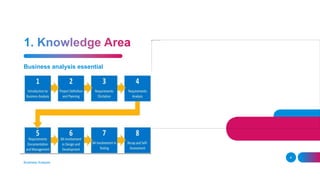
Business analysis essential
Business Analysis
4
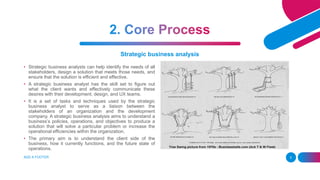
Strategic business analysis
• Strategic business analysts can help identify the needs of all
stakeholders, design a solution that meets those needs, and
ensure that the solution is efficient and effective.
• A strategic business analyst has the skill set to figure out
what the client wants and effectively communicate these
desires with their development, design, and UX teams.
• It is a set of tasks and techniques used by the strategic
business analyst to serve as a liaison between the
stakeholders of an organization and the development
company. A strategic business analysis aims to understand a
business’s policies, operations, and objectives to produce a
solution that will solve a particular problem or increase the
operational efficiencies within the organization.
• The primary aim is to understand the client side of the
business, how it currently functions, and the future state of
operations.
ADD A FOOTER 5
About business requirement document
• A business requirements document is a report detailing everything
a new project requires for success. This document outlines project
objectives, what's expected throughout the project lifecycle, and
what's required to accomplish the project.
• It is client site document, in many reason vendor need to prepare
this artifacts
Business Analysis 6
Process modeling using BPMN
• The Business Process Modeling and Notation (BPMN )is a
precise, graphical notation for documenting business processes. It
resolves the ambiguities of textual process specifications by
visually depicting the sequence of business activities and
information flows needed to complete a specific processes.
• The BPMN language is based on flowcharts and graphical
notations. The notations are separated into four categories for
diagramming-
• Flow objects
• Connecting objects
• Swim-lanes
• Artifacts
Business Analysis 7
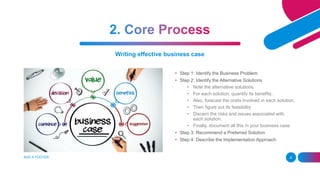
Writing effective business case
• Step 1: Identify the Business Problem
• Step 2: Identify the Alternative Solutions
• Note the alternative solutions.
• For each solution, quantify its benefits.
• Also, forecast the costs involved in each solution.
• Then figure out its feasibility
• Discern the risks and issues associated with
each solution.
• Finally, document all this in your business case
• Step 3: Recommend a Preferred Solution
• Step 4: Describe the Implementation Approach
ADD A FOOTER 8
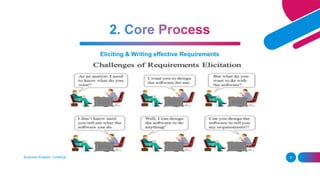
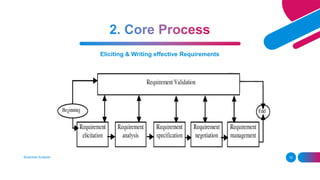
Eliciting & Writing effective Requirements
Business Analysis- Continue 9
Eliciting & Writing effective Requirements
Business Analysis 10
Requirements Development for Project
• Step 1: Requirements elicitation Activities
• Knowledge of the overall area where the systems is
applied.
• The details of the precise customer problem where the
system is going to be applied must be understood.
• Interaction of system with external requirements.
• Detailed investigation of user needs.
• Define the constraints for system development.
• Step 2: Requirements elicitation Methods
• Interviews
• Brainstorming Sessions
• Facilitated Application Specification Technique (FAST)
• Quality Function Deployment (QFD)
• Use Case Approach
Business Analysis 11
• Step 3: Requirements elicitation Methods
• Interviews
• Brainstorming Sessions
• Facilitated Application Specification Technique (FAST)
• Quality Function Deployment (QFD)
• Use Case Approach
• Step 4: Requirements Engineering
• Readable SRS Preparation
• Relational mapping with requirements
• Necessary Design architecture adding
• Replica or prototype creation
• Generic & specific blocking with priority
• Complexity estimation
• Version controlling
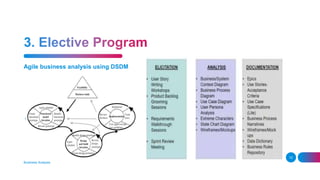
Agile business analysis using DSDM
Business Analysis
12
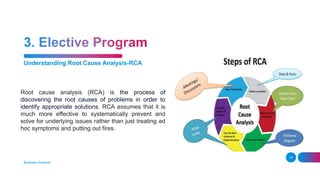
Understanding Root Cause Analysis-RCA
Business Analysis
13
Root cause analysis (RCA) is the process of
discovering the root causes of problems in order to
identify appropriate solutions. RCA assumes that it is
much more effective to systematically prevent and
solve for underlying issues rather than just treating ad
hoc symptoms and putting out fires.
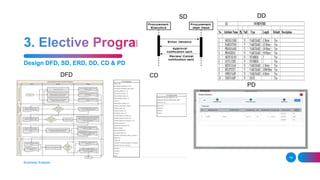
Design DFD, SD, ERD, DD, CD & PD
Business Analysis
14
DFD
SD
CD
DD
PD
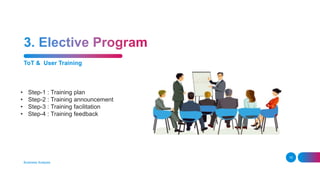
ToT & User Training
Business Analysis
15
• Step-1 : Training plan
• Step-2 : Training announcement
• Step-3 : Training facilitation
• Step-4 : Training feedback
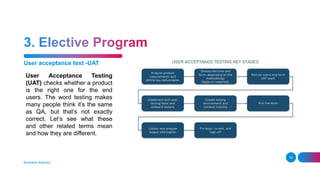
User acceptance test -UAT
Business Analysis
16
User Acceptance Testing
(UAT) checks whether a product
is the right one for the end
users. The word testing makes
many people think it’s the same
as QA, but that’s not exactly
correct. Let’s see what these
and other related terms mean
and how they are different.
Phone:
+8801757051005
Email:
pervej_kabir@yahoo.com

Business Analysis.pptx

  • 1.
    AHM Pervej Kabir HoDS/w Operations ERA-Infotech Ltd. May 2023
  • 2.
    2. Core Program •Business analysis essential Business Analysis 2 1. Knowledge Area • Strategic business analysis • About business requirement document • Process Modeling using BPMN • Writing effective business case • Eliciting and Writing effective requirements • Requirement Management for Project
  • 3.
    3. Elective Program BusinessAnalysis 3 • Agile for business analysis using DSDM • Understanding root cause analysis • Design Template (ERD,DD,DFD,OPD, SD,CD,PT) • ToT And user training Process • User Acceptance Test
  • 4.
  • 5.
    Strategic business analysis •Strategic business analysts can help identify the needs of all stakeholders, design a solution that meets those needs, and ensure that the solution is efficient and effective. • A strategic business analyst has the skill set to figure out what the client wants and effectively communicate these desires with their development, design, and UX teams. • It is a set of tasks and techniques used by the strategic business analyst to serve as a liaison between the stakeholders of an organization and the development company. A strategic business analysis aims to understand a business’s policies, operations, and objectives to produce a solution that will solve a particular problem or increase the operational efficiencies within the organization. • The primary aim is to understand the client side of the business, how it currently functions, and the future state of operations. ADD A FOOTER 5
  • 6.
    About business requirementdocument • A business requirements document is a report detailing everything a new project requires for success. This document outlines project objectives, what's expected throughout the project lifecycle, and what's required to accomplish the project. • It is client site document, in many reason vendor need to prepare this artifacts Business Analysis 6
  • 7.
    Process modeling usingBPMN • The Business Process Modeling and Notation (BPMN )is a precise, graphical notation for documenting business processes. It resolves the ambiguities of textual process specifications by visually depicting the sequence of business activities and information flows needed to complete a specific processes. • The BPMN language is based on flowcharts and graphical notations. The notations are separated into four categories for diagramming- • Flow objects • Connecting objects • Swim-lanes • Artifacts Business Analysis 7
  • 8.
    Writing effective businesscase • Step 1: Identify the Business Problem • Step 2: Identify the Alternative Solutions • Note the alternative solutions. • For each solution, quantify its benefits. • Also, forecast the costs involved in each solution. • Then figure out its feasibility • Discern the risks and issues associated with each solution. • Finally, document all this in your business case • Step 3: Recommend a Preferred Solution • Step 4: Describe the Implementation Approach ADD A FOOTER 8
  • 9.
    Eliciting & Writingeffective Requirements Business Analysis- Continue 9
  • 10.
    Eliciting & Writingeffective Requirements Business Analysis 10
  • 11.
    Requirements Development forProject • Step 1: Requirements elicitation Activities • Knowledge of the overall area where the systems is applied. • The details of the precise customer problem where the system is going to be applied must be understood. • Interaction of system with external requirements. • Detailed investigation of user needs. • Define the constraints for system development. • Step 2: Requirements elicitation Methods • Interviews • Brainstorming Sessions • Facilitated Application Specification Technique (FAST) • Quality Function Deployment (QFD) • Use Case Approach Business Analysis 11 • Step 3: Requirements elicitation Methods • Interviews • Brainstorming Sessions • Facilitated Application Specification Technique (FAST) • Quality Function Deployment (QFD) • Use Case Approach • Step 4: Requirements Engineering • Readable SRS Preparation • Relational mapping with requirements • Necessary Design architecture adding • Replica or prototype creation • Generic & specific blocking with priority • Complexity estimation • Version controlling
  • 12.
    Agile business analysisusing DSDM Business Analysis 12
  • 13.
    Understanding Root CauseAnalysis-RCA Business Analysis 13 Root cause analysis (RCA) is the process of discovering the root causes of problems in order to identify appropriate solutions. RCA assumes that it is much more effective to systematically prevent and solve for underlying issues rather than just treating ad hoc symptoms and putting out fires.
  • 14.
    Design DFD, SD,ERD, DD, CD & PD Business Analysis 14 DFD SD CD DD PD
  • 15.
    ToT & UserTraining Business Analysis 15 • Step-1 : Training plan • Step-2 : Training announcement • Step-3 : Training facilitation • Step-4 : Training feedback
  • 16.
    User acceptance test-UAT Business Analysis 16 User Acceptance Testing (UAT) checks whether a product is the right one for the end users. The word testing makes many people think it’s the same as QA, but that’s not exactly correct. Let’s see what these and other related terms mean and how they are different.
  • 17.