BURSTING PRESSURE OF MILD STEEL
CYLINDRICAL VESSELS
T. ASEER BRABIN , T. CHRISTOPHER, B. NAGESWARA RAO
INTERNATIONAL JOURNAL OF PRESSURE VESSELS AND PIPING
Paper Presentation
MNIT Jaipur
Presented by:
Mayank Mehta Nikita Mittal
CONTENTS
 ABSTRACT
 INTRODUCTION
 OBJECTIVE
 TYPE OF PRESSURE VESSEL USED
 DESIGN EQUATIONS USED
 RESULTS
 CONCLUSION
 REFRENCES
18-03-2015
2
DepartmentofChemicalEngineering
ABSTRACT
 An accurate prediction of the burst pressure of
cylindrical vessels is very important in the
engineering design for the oil and gas industry.
 Some of the existing predictive equations are
examined utilizing test data on different steel
vessels.
 Faupel’s bursting pressure formula is found to be
simple and reliable in predicting the burst strength
of thick and thin-walled steel cylindrical vessels.
18-03-2015
3
DepartmentofChemicalEngineering
INTRODUCTION
 The pressure vessels are used to store fluids under pressure. The
material of pressure vessel may be brittle such as cast iron, or ductile
such as mild steel.
 According to the dimensions, Pressure vessels can be classified as :
 The pressure at which the pressure vessel should burst if all of the
specified design tolerances are at their minimum values is called Burst
pressure.
 The Burst Pressure gives an indication of the margin of safety available
over the maximum expected operating pressure (MEOP).
• Wall thickness< 1/10th
of Shell Diameter
1. Thin
Shell
• Wall thickness > 1/10th
of shell diameter
2. Thick
shell
18-03-2015
4
DepartmentofChemicalEngineering
OBJECTIVE
 To examine the existing predictive equations utilizing test
data on different steel vessels.
18-03-2015
5
DepartmentofChemicalEngineering
TYPE OF PRESSURE VESSEL USED
 Applicability of Faupel’s bursting pressure formula by considering
test results of mild steel cylindrical vessels is examined.
 Being inexpensive and possessing high plasticity, toughness as well
as good weldablity, mild steels have become the main production
materials of pressure vessels such as tower reactors and
exchangers or chemical equipment.
18-03-2015
6
DepartmentofChemicalEngineering
BURST PRESSURE ESTIMATES OF
CYLINDRICAL PRESSURE VESSELS
a) For power-law hardening materials, three different theoretical
solutions for the burst pressure (Pb) of thin-walled pipes can
be expressed in the general form
...(1)
 ti = initial wall thickness
 Dm= (Do+Di)/2
 Czl = yield theory dependent constant
= 1 for the Tresca Theory
= 2/√3 for the von Mises Theory
= ½+1/√3 for the ASSY theory
18-03-2015
7
DepartmentofChemicalEngineering
 σult =ultimate tensile strength of the material
 n =strain-hardening exponent
 σys =0.2% proof stress or yield strength of the material
18-03-2015
8
DepartmentofChemicalEngineering
b) Solution obtained in case of burst pressure of thin-walled rocket
motor cases as :
...(2)
 Replacing Di by Dm in above, eqn 1 for the von Mises theory can be
obtained.
c) Other formulae frequently used to evaluate the failure pressure of
cylindrical vessels are
 Svensson
...(3)
18-03-2015
9
DepartmentofChemicalEngineering
 Faupel
...(4)
d) For relatively thin-walled vessels,
a modified Svensson’s formula is suggested by writing ln(Do/Di)≈
(2*ti)/Di in equation 3rd.
 Equation 4th has been obtained using the ratio,
σys/σult : (1-σys/σult) to interpolate between the Pmin and Pmax of
the vessels defined below :
18-03-2015
10
DepartmentofChemicalEngineering
 Modified Faupel’s bursting pressure formula is given as :
where χ= 0:65 for steel cylindrical vessels.
18-03-2015
11
DepartmentofChemicalEngineering
RESULTS
 Lawand Bowie presented failure data of thin-walled
end-capped steel pipes.
18-03-2015
12
DepartmentofChemicalEngineering
 Tresca yield theory estimates of burst pressure are
found to be close to the test results.
 The modified Faupel formula predicts failure
pressures close to those obtained from Svensson’s
formula.
 Huang et al. have compiled test data of different
steels and sizes of casing to examine the adequacy
of the burst pressure evaluation by performing FEA
using ABAQUS.
 Test data are found to be within the expected Pmin
and Pmax values from equations (fig1,2)
 Most of the test data are close to Pmin values.
18-03-2015
13
DepartmentofChemicalEngineering
FIG 1 & 2
18-03-2015
14
DepartmentofChemicalEngineering
 The failure pressure estimates based on Faupel’s
formula are slightly higher than the test results.
 The vessels after the burst test, shown in Figs. 3
and 4, indicate high plastic deformation.
 The test data of Q235 (Gr.D) mild steel cylindrical
vessels in Fig. 3 and Table 3 are found to be higher
than the Pmax estimates.
 hence Faupel’s bursting pressure formula gives a
failure pressure lower than the test results.
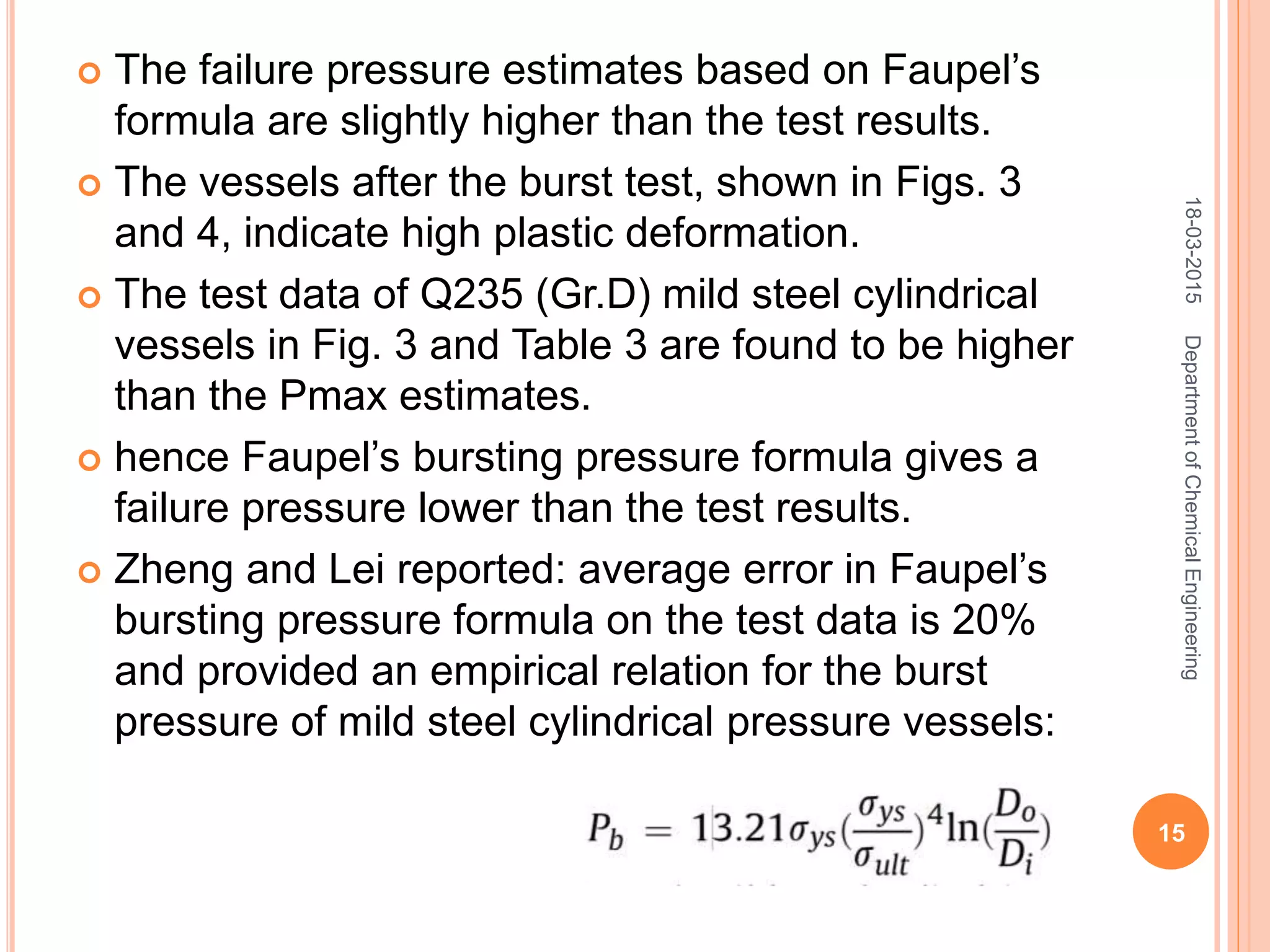
 Zheng and Lei reported: average error in Faupel’s
bursting pressure formula on the test data is 20%
and provided an empirical relation for the burst
pressure of mild steel cylindrical pressure vessels:
18-03-2015
15
DepartmentofChemicalEngineering
18-03-2015
16
DepartmentofChemicalEngineering
 The test data in Fig. 3 is related to 20R (1020) mild
steel cylindrical pressure vessels. The yield
strength (sys) and the ultimate tensile strength
(sult) of 20R (1020) mild steel are 285 and 484
Mpa, respectively.
 The test data in Fig. 4 are found to be within the
bounds of the expected Pmin and Pmax values
from equations and Hence Faupel’s bursting
pressure formula gives failure pressures close to
the test results (Table 3).
18-03-2015
17
DepartmentofChemicalEngineering
18-03-2015
18
DepartmentofChemicalEngineering
CONCLUSION
 Among all the predictive equations Faupel’s
bursting pressure formula predicted the failure
pressure of cylindrical vessels closest to the test
results.
 No single failure criterion can predict accurately all
failure pressures.
 The discrepancy in the predictions may be due to
variations in the strength properties of the vessel
materials.
 There is no guarantee that the empirical relation of
Zheng and Lei will be suitable for all mild steel
cylindrical vessels.
18-03-2015
19
DepartmentofChemicalEngineering
REFERENCES
[1] Christopher T, Rama Sarma BV, Govindan Potti PK, Nageswara Rao B,
Sankaranarayanasamy K. A comparative study on failure pressure estimations of
unflawed cylindrical vessels. International Journal of Pressure Vessels and Piping
2002;79:53e66.
[2] Zheng CX, Lei SH. Research on bursting pressure formula of mild steel pressure
vessel. Journal of Zhejiang University Science A 2006;7:277e81.
[3] Law M, Bowie G. Prediction of failure strain and burst pressure in high yield to-
tensile strength ratio linepipe. International Journal of Pressure Vessels and Piping
2007;84:487e92.
[4] Guven U. A comparison on failure pressures of cylindrical pressure vessels.
Mechanics Research Communications 2007;34:466e71.
[5] Zhu X, Leis BN. Theoretical and numerical predictions of burst pressure of
pipelines. Transactions of ASME, Journal of Pressure Vessel Technology 2007;
129:644e52.
[6] Kamaya M, Suzuki T, Meshii T. Failure pressure of straight pipe with wall thinning
under internal pressure. International Journal of Pressure Vessels and Piping
2008;85:628e34.
[7] Huang X, Chen Y, Lin K, Mihsein M, Kibble K, Hall R. Burst strength analysis of
casing with geometrical imperfections. Transactions of ASME, Journal of Pressure
Vessel Technology 2007;129:763e70.
18-03-2015
20
DepartmentofChemicalEngineering
[8] Xue L, Widera GEO, Sang Z. Burst analysis of cylindrical shells.
Trans.ASME Journal of Pressure Vessel Technology 2008;130:1e4.
[9] Aseer Brabin T, Christopher T, Nageswara Rao B. Investigation on failure
behavior of unflawed steel cylindrical pressure vessels using FEA.
Multidiscipline Modeling in Materials and Structures 2009;5:29e42.
[10] Subhananda Rao A, Venkata Rao G, Nageswara Rao B. Effect of long-
seam mismatch on the burst pressure of maraging steel rocket motor
cases. Engineering Failure Analysis 2005;12:325e36.
[11] Durban D, Kubi M. Large strain analysis for plastic othotropic tubes.
International Journal of Solids and Structures 1990;26:483e95.
[12] Marin J, Sharma MG. Design of thin-walled cylindrical vessel based
upon plastic range and considering anisotropy. Weld Research Council
Bulletin 1958;40.
[13] Svensson NL. Bursting pressure of cylindrical and spherical vessels.
Journal of Applied Mechanics, 25, Transactions of ASME 1958;80:89e96.
[14] Faupel JH. Yield and bursting characteristics of heavy-wall cylinders.
Journal of Applied Mechanics, 23, Transactions of ASME
1956;78:1031e64.
[15] Hill R. The Mathematical theory of plasticity. New York: Oxford
UniversityPress; 1950.
18-03-2015
21
DepartmentofChemicalEngineering
BURSTING PRESSURE OF MILD STEEL
CYLINDRICAL VESSELS
T. ASEER BRABIN , T. CHRISTOPHER, B. NAGESWARA RAO
PRESENTED BY: MAYANK MEHTA & NIKITA MITTAL
18-03-2015
MNIT JAIPUR
18-03-2015
22
DepartmentofChemicalEngineering

Bursting Pressure of Mild Steel Cylindrical Vessels

  • 1.
    BURSTING PRESSURE OFMILD STEEL CYLINDRICAL VESSELS T. ASEER BRABIN , T. CHRISTOPHER, B. NAGESWARA RAO INTERNATIONAL JOURNAL OF PRESSURE VESSELS AND PIPING Paper Presentation MNIT Jaipur Presented by: Mayank Mehta Nikita Mittal
  • 2.
    CONTENTS  ABSTRACT  INTRODUCTION OBJECTIVE  TYPE OF PRESSURE VESSEL USED  DESIGN EQUATIONS USED  RESULTS  CONCLUSION  REFRENCES 18-03-2015 2 DepartmentofChemicalEngineering
  • 3.
    ABSTRACT  An accurateprediction of the burst pressure of cylindrical vessels is very important in the engineering design for the oil and gas industry.  Some of the existing predictive equations are examined utilizing test data on different steel vessels.  Faupel’s bursting pressure formula is found to be simple and reliable in predicting the burst strength of thick and thin-walled steel cylindrical vessels. 18-03-2015 3 DepartmentofChemicalEngineering
  • 4.
    INTRODUCTION  The pressurevessels are used to store fluids under pressure. The material of pressure vessel may be brittle such as cast iron, or ductile such as mild steel.  According to the dimensions, Pressure vessels can be classified as :  The pressure at which the pressure vessel should burst if all of the specified design tolerances are at their minimum values is called Burst pressure.  The Burst Pressure gives an indication of the margin of safety available over the maximum expected operating pressure (MEOP). • Wall thickness< 1/10th of Shell Diameter 1. Thin Shell • Wall thickness > 1/10th of shell diameter 2. Thick shell 18-03-2015 4 DepartmentofChemicalEngineering
  • 5.
    OBJECTIVE  To examinethe existing predictive equations utilizing test data on different steel vessels. 18-03-2015 5 DepartmentofChemicalEngineering
  • 6.
    TYPE OF PRESSUREVESSEL USED  Applicability of Faupel’s bursting pressure formula by considering test results of mild steel cylindrical vessels is examined.  Being inexpensive and possessing high plasticity, toughness as well as good weldablity, mild steels have become the main production materials of pressure vessels such as tower reactors and exchangers or chemical equipment. 18-03-2015 6 DepartmentofChemicalEngineering
  • 7.
    BURST PRESSURE ESTIMATESOF CYLINDRICAL PRESSURE VESSELS a) For power-law hardening materials, three different theoretical solutions for the burst pressure (Pb) of thin-walled pipes can be expressed in the general form ...(1)  ti = initial wall thickness  Dm= (Do+Di)/2  Czl = yield theory dependent constant = 1 for the Tresca Theory = 2/√3 for the von Mises Theory = ½+1/√3 for the ASSY theory 18-03-2015 7 DepartmentofChemicalEngineering
  • 8.
     σult =ultimatetensile strength of the material  n =strain-hardening exponent  σys =0.2% proof stress or yield strength of the material 18-03-2015 8 DepartmentofChemicalEngineering
  • 9.
    b) Solution obtainedin case of burst pressure of thin-walled rocket motor cases as : ...(2)  Replacing Di by Dm in above, eqn 1 for the von Mises theory can be obtained. c) Other formulae frequently used to evaluate the failure pressure of cylindrical vessels are  Svensson ...(3) 18-03-2015 9 DepartmentofChemicalEngineering
  • 10.
     Faupel ...(4) d) Forrelatively thin-walled vessels, a modified Svensson’s formula is suggested by writing ln(Do/Di)≈ (2*ti)/Di in equation 3rd.  Equation 4th has been obtained using the ratio, σys/σult : (1-σys/σult) to interpolate between the Pmin and Pmax of the vessels defined below : 18-03-2015 10 DepartmentofChemicalEngineering
  • 11.
     Modified Faupel’sbursting pressure formula is given as : where χ= 0:65 for steel cylindrical vessels. 18-03-2015 11 DepartmentofChemicalEngineering
  • 12.
    RESULTS  Lawand Bowiepresented failure data of thin-walled end-capped steel pipes. 18-03-2015 12 DepartmentofChemicalEngineering
  • 13.
     Tresca yieldtheory estimates of burst pressure are found to be close to the test results.  The modified Faupel formula predicts failure pressures close to those obtained from Svensson’s formula.  Huang et al. have compiled test data of different steels and sizes of casing to examine the adequacy of the burst pressure evaluation by performing FEA using ABAQUS.  Test data are found to be within the expected Pmin and Pmax values from equations (fig1,2)  Most of the test data are close to Pmin values. 18-03-2015 13 DepartmentofChemicalEngineering
  • 14.
    FIG 1 &2 18-03-2015 14 DepartmentofChemicalEngineering
  • 15.
     The failurepressure estimates based on Faupel’s formula are slightly higher than the test results.  The vessels after the burst test, shown in Figs. 3 and 4, indicate high plastic deformation.  The test data of Q235 (Gr.D) mild steel cylindrical vessels in Fig. 3 and Table 3 are found to be higher than the Pmax estimates.  hence Faupel’s bursting pressure formula gives a failure pressure lower than the test results.  Zheng and Lei reported: average error in Faupel’s bursting pressure formula on the test data is 20% and provided an empirical relation for the burst pressure of mild steel cylindrical pressure vessels: 18-03-2015 15 DepartmentofChemicalEngineering
  • 16.
  • 17.
     The testdata in Fig. 3 is related to 20R (1020) mild steel cylindrical pressure vessels. The yield strength (sys) and the ultimate tensile strength (sult) of 20R (1020) mild steel are 285 and 484 Mpa, respectively.  The test data in Fig. 4 are found to be within the bounds of the expected Pmin and Pmax values from equations and Hence Faupel’s bursting pressure formula gives failure pressures close to the test results (Table 3). 18-03-2015 17 DepartmentofChemicalEngineering
  • 18.
  • 19.
    CONCLUSION  Among allthe predictive equations Faupel’s bursting pressure formula predicted the failure pressure of cylindrical vessels closest to the test results.  No single failure criterion can predict accurately all failure pressures.  The discrepancy in the predictions may be due to variations in the strength properties of the vessel materials.  There is no guarantee that the empirical relation of Zheng and Lei will be suitable for all mild steel cylindrical vessels. 18-03-2015 19 DepartmentofChemicalEngineering
  • 20.
    REFERENCES [1] Christopher T,Rama Sarma BV, Govindan Potti PK, Nageswara Rao B, Sankaranarayanasamy K. A comparative study on failure pressure estimations of unflawed cylindrical vessels. International Journal of Pressure Vessels and Piping 2002;79:53e66. [2] Zheng CX, Lei SH. Research on bursting pressure formula of mild steel pressure vessel. Journal of Zhejiang University Science A 2006;7:277e81. [3] Law M, Bowie G. Prediction of failure strain and burst pressure in high yield to- tensile strength ratio linepipe. International Journal of Pressure Vessels and Piping 2007;84:487e92. [4] Guven U. A comparison on failure pressures of cylindrical pressure vessels. Mechanics Research Communications 2007;34:466e71. [5] Zhu X, Leis BN. Theoretical and numerical predictions of burst pressure of pipelines. Transactions of ASME, Journal of Pressure Vessel Technology 2007; 129:644e52. [6] Kamaya M, Suzuki T, Meshii T. Failure pressure of straight pipe with wall thinning under internal pressure. International Journal of Pressure Vessels and Piping 2008;85:628e34. [7] Huang X, Chen Y, Lin K, Mihsein M, Kibble K, Hall R. Burst strength analysis of casing with geometrical imperfections. Transactions of ASME, Journal of Pressure Vessel Technology 2007;129:763e70. 18-03-2015 20 DepartmentofChemicalEngineering
  • 21.
    [8] Xue L,Widera GEO, Sang Z. Burst analysis of cylindrical shells. Trans.ASME Journal of Pressure Vessel Technology 2008;130:1e4. [9] Aseer Brabin T, Christopher T, Nageswara Rao B. Investigation on failure behavior of unflawed steel cylindrical pressure vessels using FEA. Multidiscipline Modeling in Materials and Structures 2009;5:29e42. [10] Subhananda Rao A, Venkata Rao G, Nageswara Rao B. Effect of long- seam mismatch on the burst pressure of maraging steel rocket motor cases. Engineering Failure Analysis 2005;12:325e36. [11] Durban D, Kubi M. Large strain analysis for plastic othotropic tubes. International Journal of Solids and Structures 1990;26:483e95. [12] Marin J, Sharma MG. Design of thin-walled cylindrical vessel based upon plastic range and considering anisotropy. Weld Research Council Bulletin 1958;40. [13] Svensson NL. Bursting pressure of cylindrical and spherical vessels. Journal of Applied Mechanics, 25, Transactions of ASME 1958;80:89e96. [14] Faupel JH. Yield and bursting characteristics of heavy-wall cylinders. Journal of Applied Mechanics, 23, Transactions of ASME 1956;78:1031e64. [15] Hill R. The Mathematical theory of plasticity. New York: Oxford UniversityPress; 1950. 18-03-2015 21 DepartmentofChemicalEngineering
  • 22.
    BURSTING PRESSURE OFMILD STEEL CYLINDRICAL VESSELS T. ASEER BRABIN , T. CHRISTOPHER, B. NAGESWARA RAO PRESENTED BY: MAYANK MEHTA & NIKITA MITTAL 18-03-2015 MNIT JAIPUR 18-03-2015 22 DepartmentofChemicalEngineering

Editor's Notes

  • #16 The yield strength (sys) and the ultimate tensile strength (sult) of Q235 (Gr.D) mild steel are 235 and 375 MPa respectively