“Bullying is whensomeone
repeatedly and on purpose
says or does mean or hurtful
things to another person who
has a hard time defending
himself or herself.”
Definition of Bullying:
3
4.
The Key Componentsof Bullying Behavior:
1. Involves an aggressive behavior
2. Typically involves a pattern of
behavior repeated over time
3. Imbalance of power or strength
4. Motivated by a characteristic
(or perceived characteristic)
4
5.
Common Myths About
Childrenwho Bully
“Children who bully are loners.”
“Children who bully have low self-esteem.”
“Only boys bully.”
5
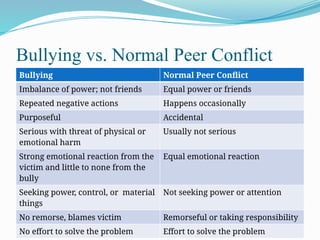
Bullying vs. NormalPeer Conflict
Bullying Normal Peer Conflict
Imbalance of power; not friends Equal power or friends
Repeated negative actions Happens occasionally
Purposeful Accidental
Serious with threat of physical or
emotional harm
Usually not serious
Strong emotional reaction from the
victim and little to none from the
bully
Equal emotional reaction
Seeking power, control, or material
things
Not seeking power or attention
No remorse, blames victim Remorseful or taking responsibility
No effort to solve the problem Effort to solve the problem
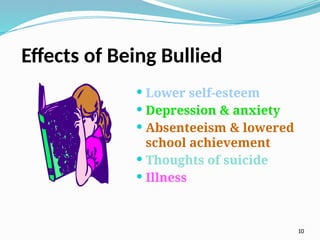
Effects of BeingBullied
Lower self-esteem
Depression & anxiety
Absenteeism & lowered
school achievement
Thoughts of suicide
Illness
10
11.
Effects of Bullyingon
School Climate
Creates a climate of fear and
disrespect
Interferes with student
learning
Students may feel insecurity
and not like school as well
Students may perceive lack
of control/caring
11
12.
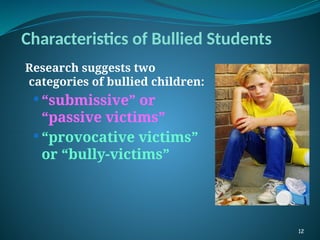
Characteristics of BulliedStudents
Research suggests two
categories of bullied children:
“submissive” or
“passive victims”
“provocative victims”
or “bully-victims”
12
13.
Children at HigherRisk of
Being Bullied:
Children with disabilities, special needs,
and health problems
Children who are obese
13
14.
Concerns About Children
WhoBully
Children who bully are more likely to:
Get into frequent fights
Be injured in a fight
Steal, vandalize property
Drink alcohol, smoke
Be truant, drop out of school
Report poorer academic achievement
Perceive a negative climate at school
Carry a weapon
14
15.
Children Who Bully
Bullying may be part of a conduct-
disordered behavior pattern
This pattern may continue
into young adulthood
study:
Bullies were 4 times as likely
to have 3 or more convictions by
age 24
15
16.
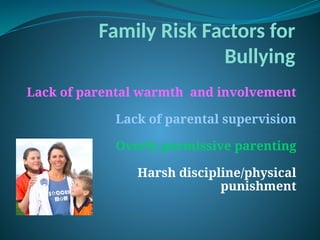
Family Risk Factorsfor
Bullying
Lack of parental warmth and involvement
Lack of parental supervision
Overly-permissive parenting
Harsh discipline/physical
punishment
17.
School Risk Factorsfor Problems of
Bullying
Lack of supervision during breaks
Students have indifferent or accepting
attitudes
Staff have indifferent or accepting attitudes
towards bullying
18.
Effects of Bullyingon Bystanders
Bystanders may feel:
Afraid
Powerless to change the situation
Guilty for not acting
Diminished empathy for
victims over time
18
19.
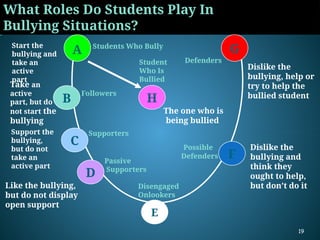
What Roles DoStudents Play In
Bullying Situations?
B
C
D
H
G
E
F
A
Start the
bullying and
take an
active
part
Take an
active
part, but do
not start the
bullying
Support the
bullying,
but do not
take an
active part
Like the bullying,
but do not display
open support
Dislike the
bullying and
think they
ought to help,
but don’t do it
Dislike the
bullying, help or
try to help the
bullied student
The one who is
being bullied
Student
Who Is
Bullied
Students Who Bully
Followers
Supporters
Passive
Supporters
Disengaged
Onlookers
Possible
Defenders
Defenders
19
20.
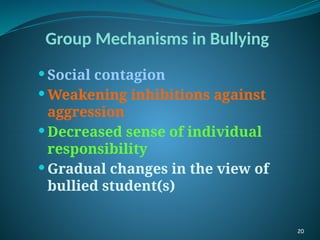
Group Mechanisms inBullying
Social contagion
Weakening inhibitions against
aggression
Decreased sense of individual
responsibility
Gradual changes in the view of
bullied student(s)
20
21.
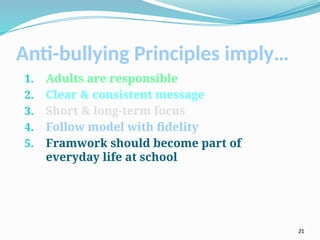
Anti-bullying Principles imply…
1.Adults are responsible
2. Clear & consistent message
3. Short & long-term focus
4. Follow model with fidelity
5. Framwork should become part of
everyday life at school
21
22.
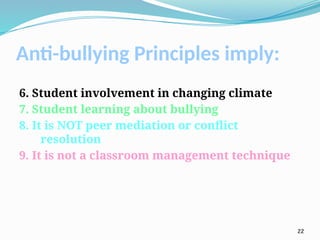
Anti-bullying Principles imply:
6.Student involvement in changing climate
7. Student learning about bullying
8. It is NOT peer mediation or conflict
resolution
9. It is not a classroom management technique
22
23.
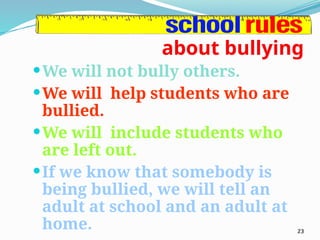
about bullying
We willnot bully others.
We will help students who are
bullied.
We will include students who
are left out.
If we know that somebody is
being bullied, we will tell an
adult at school and an adult at
home. 23
24.
Remember……
Stopping bullying takesa team
effort.
You play a critical position
on the team.
Change happens in
small increments but can have
positive long-term impact for
us all!
24
#4 Three Key Components of Bullying Behavior:
Involves an aggressive behavior
Typically involves a pattern of behavior repeated over time
Imbalance of power or strength
#5 Common Myths About Children who Bully
“Children who bully are loners.”
“Children who bully have low self-esteem.”
“Only boys bully.”
#8
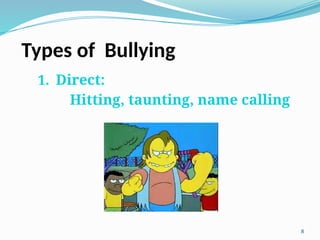
Types of Bullying
Direct:
Hitting, taunting, name calling
#9
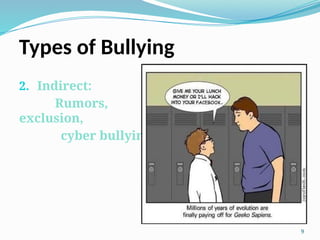
Types of Bullying
Indirect:
Rumors, exclusion,
cyber bullying
#10 Effects of Being Bullied
Lower self-esteem
Depression & anxiety
Absenteeism & lowered school achievement
Thoughts of suicide
Illness
#11 Effects of Bullying on
School Climate
Creates a climate of fear and disrespect
Interferes with student learning
Students may feel insecurity and not like school as well
Students may perceive lack of control/caring
#12
Characteristics of Bullied Students
Research suggests two categories of bullied children:
“submissive” or “passive victims”
“provocative victims” or “bully-victims”
#13 Children at Higher Risk of
Being Bullied:
Children with disabilities, special needs, and health problems
Children who are obese
Children who are lesbian, gay, bisexual, transgender, or who are questioning their identities (GLBTQ)
#14 Concerns About Children Who Bully
Children who bully are more likely to:
Get into frequent fights
Be injured in a fight
Steal, vandalize property
Drink alcohol, smoke
Be truant, drop out of school
Report poorer academic achievement
Perceive a negative climate at school
Carry a weapon
#15 Children Who Bully
Bullying may be part of a conduct-disordered behavior pattern
This pattern may continue
into young adulthood
Olweus study:
Bullies were 4 times as likely
to have 3 or more convictions by age 24
#16 Lack of parental warmth and involvement
Lack of parental supervision
Overly-permissive parenting
Harsh discipline/physical punishment
#17 School Risk Factors for Problems of Bullying
Lack of supervision during breaks
Students have indifferent or accepting attitudes
Staff have indifferent or accepting attitudes towards bullying
#18 Effects of Bullying on Bystanders
Bystanders may feel:
Afraid
Powerless to change the situation
Guilty for not acting
Diminished empathy for
victims over time
#20 Group Mechanisms in Bullying
Social contagion
Weakening inhibitions against aggression
Decreased sense of individual responsibility
Gradual changes in the view of bullied student(s)
#21 OBPP Principles imply…
Adults are responsible
Clear & consistent message
Short & long-term focus
Follow model with fidelity
OBPP should become part of everyday life at school
#22 OBPP Principles imply:
6. Student involvement in changing climate
7. Student learning about bullying
8. OBPP is NOT peer mediation or conflict resolution
9. OBPP is not a classroom management technique
#23 about bullying
We will not bully others.
We will help students who are bullied.
We will include students who are left out.
If we know that somebody is being bullied, we will tell an adult at school and an adult at home.
#24 Remember……
Stopping bullying takes a team effort.
You play a critical position on the team.
Change happens in
small increments but can have positive long-term impact for us all!