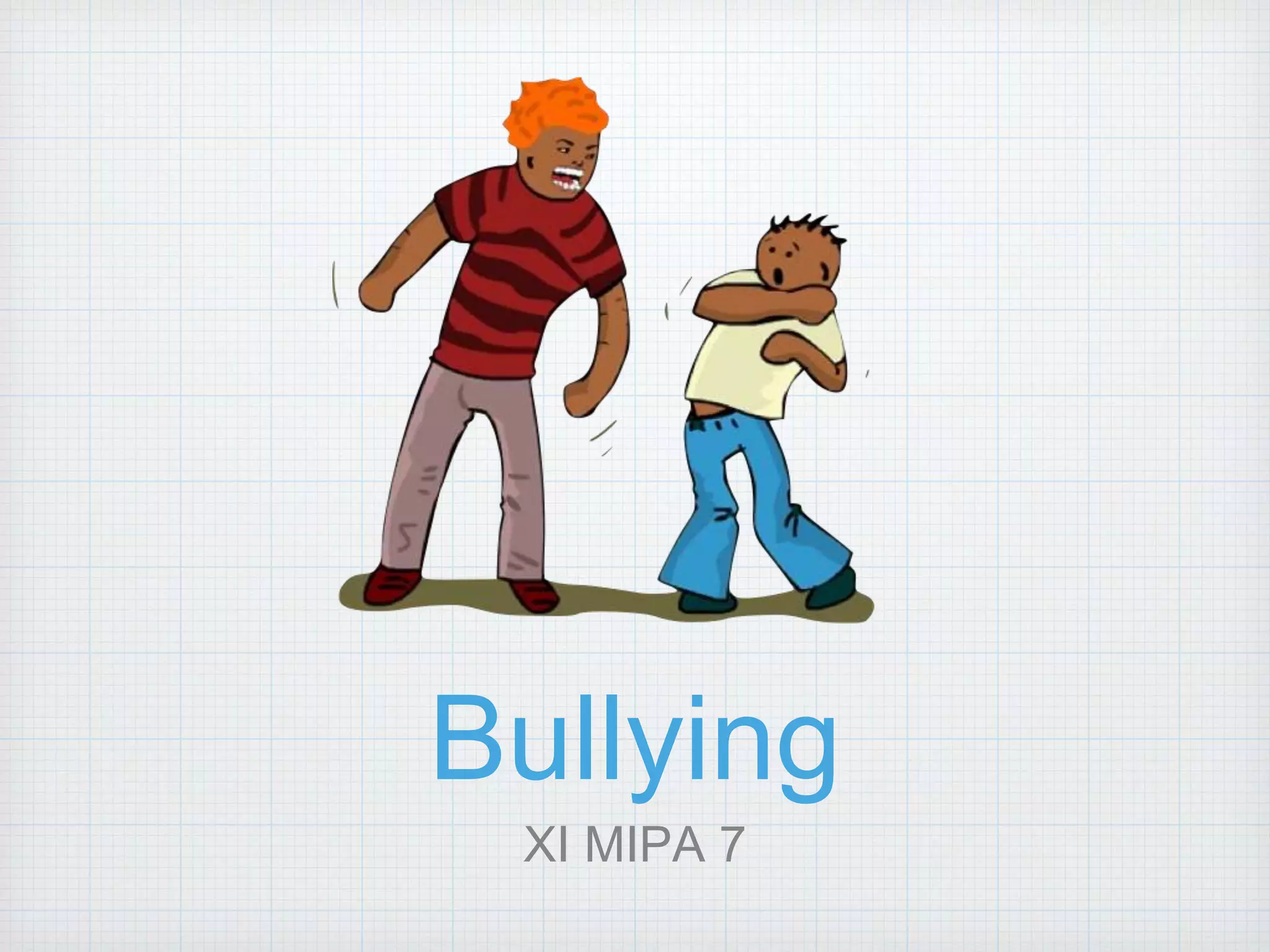
Bullying
XI MIPA 7
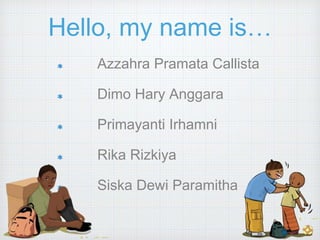
Hello, my name is…
Azzahra Pramata Callista
Dimo Hary Anggara
Primayanti Irhamni
Rika Rizkiya
Siska Dewi Paramitha
What is Bullying?
Bullying Definition
An unhappy teen boy walks away from bullying girls. Bullying is
unwanted, aggressive behavior among school aged children that involves
a real or perceived power imbalance. The behavior is repeated, or has
the potential to be repeated, over time. Both kids who are bullied and
who bully others may have serious, lasting problems.
In order to be considered bullying, the behavior must be aggressive and
include:
An Imbalance of Power: Kids who bully use their power—such as physical
strength, access to embarrassing information, or popularity—to control
or harm others. Power imbalances can change over time and in different
situations, even if they involve the same people.
Repetition: Bullying behaviors happen more than once or have the
potential to happen more than once.
Bullying includes actions such as making threats, spreading rumors,
attacking someone physically or verbally, and excluding someone from a
group on purpose.
Bullying and Teasing: No Laughing Matter
Unfortunately, teasing is often part of growing up — almost every child experiences it. But it isn't
always as innocuous as it seems. Words can cause pain. Teasing becomes bullying when it is
repetitive or when there is a conscious intent to hurt another child. It can be verbal bullying
(making threats, name-calling), psychological bullying (excluding children, spreading rumors), or
physical bullying (hitting, pushing, taking a child's possessions).
How Bullying Starts
Bullying behavior is prevalent throughout the world and it cuts across socio-economic,
racial/ethnic, and cultural lines. Researchers estimate that 20 to 30 percent of school-age
children are involved in bullying incidents, as either perpetrators or victims. Bullying can begin
as early as preschool and intensify during transitional stages, such as starting school in 1st
grade or going into middle school.
Victims of bullying are often shy and tend to be physically weaker than their peers. They may
also have low self-esteem and poor social skills, which makes it hard for them to stand up for
themselves. Bullies consider these children safe targets because they usually don't retaliate.
Effects of Bullying
If your child is the victim of bullying, he may suffer physically and emotionally, and his
schoolwork will likely show it. Grades drop because, instead of listening to the teacher, kids are
wondering what they did wrong and whether anyone will sit with them at lunch. If bullying
persists, they may be afraid to go to school. Problems with low self-esteem and depression can
last into adulthood and interfere with personal and professional lives.
Bullies are affected too, even into adulthood; they may have difficulty forming positive
relationships. They are more apt to use tobacco and alcohol, and to be abusive spouses. Some
studies have even found a correlation with later criminal activities.
Warning Signs
If you're concerned that your child is a victim of teasing or bullying, look for these signs of stress:
•Increased passivity or withdrawal
•Frequent crying
•Recurrent complaints of physical symptoms such as stomach-aches or headaches with no
apparent cause
•Unexplained bruises
•Sudden drop in grades or other learning problems
•Not wanting to go to school
•Significant changes in social life — suddenly no one is calling or extending invitations
•Sudden change in the way your child talks — calling herself a loser, or a former friend a jerkHow
to Help
First, give your child space to talk. If she recounts incidences of teasing or bullying, be
empathetic. If your child has trouble verbalizing her feelings, read a story about children being
teased or bullied. You can also use puppets, dolls, or stuffed animals to encourage a young child
to act out problems.
Once you've opened the door, help your child begin to problem-solve. Role-play situations
and teach your child ways to respond. You might also need to help your child find a way to move
on by encouraging her to reach out and make new friends. She might join teams and school clubs
to widen her circle.
At home and on the playground:
Adults need to intervene to help children resolve bullying issues, but calling another parent
directly can be tricky unless he or she is a close friend. It is easy to find yourself in a "he
said/she said" argument. Try to find an intermediary: even if the bullying occurs outside of
school, a teacher, counselor, coach, or after-school program director may be able to help
mediate a productive discussion.
If you do find yourself talking directly to the other parent, try to do it in person rather than over
the phone. Don't begin with an angry recounting of the other child's offenses. Set the stage for
a collaborative approach by suggesting going to the playground, or walking the children to
school together, to observe interactions and jointly express disapproval for any unacceptable
behavior.
At school:
Many schools (sometimes as part of a statewide effort) have programs especially designed to
raise awareness of bullying behavior and to help parents and teachers deal effectively with it.
Check with your local school district to see if it has such a program.
Schools and parents can work effectively behind the scenes to help a child meet and
make new friends via study groups or science-lab partnerships. If you are concerned
about your child:
•Share with the teacher what your child has told you; describe any teasing or bullying you
may have witnessed.
•Ask the teacher if she sees similar behavior at school, and enlist her help in finding
ways to solve the problem.
•If she hasn't seen any instances of teasing, ask that she keep an eye out for the
behavior you described.
•If the teacher says your child is being teased, find out whether there are any things he
may be doing in class to attract teasing. Ask how he responds to the teasing, and
discuss helping him develop a more effective response.
•After the initial conversation, be sure to make a follow-up appointment to discuss how
things are going.
•If the problem persists, or the teacher ignores your concerns, and your child starts to
withdraw or not want to go to school, consider the possibility of "therapeutic
intervention." Ask to meet with the school counselor or psychologist, or request a
referral to the appropriate school professional.
http://www.scholastic.com/parents/resources/article/social-emotional-skills/bullying-and-teasing-no-
laughing-matter
1. Do you think bullying is a
serious issue in your school?
Give reasons to support your
opinion.
Yes, because bullying affects the
children both psychologically and
physically.
2. Did this opinion article
raise/change your
awareness about bullying?
Please explain.
yes, because this article make us
know more about bullying
education.
3. Do you think it is necessary to
educate people on issue of bullying?
Why? Give reason to support your
opinion.
yes, because many people have
been bullyed. We hoping that who
have been bullied can stand up and
speak out to fight the bullying.
6. Are you aware of cyber bullying?
Do you think it is worse than physical
bullying? Why? Support your opinion
with examples.
yes, it is worse than physically
bullying because, cyber bullying can
break mentality and if the mentar has
broken it would affect the physik.
4. Do you think bullying should be
declared as punishable crime? Give
reason to support your answer.
I think yes because bullying not only
affect someone’s psychology we know
that a few day ago in Bekasi a junior
high school student died because
bullied by his senior in MOS.
5. Discuss the article on bullying in a
group. Does it change your
perspective on bullying or not? Give
reason to support your answer.
No, bully is bad habit and it many hurt
someone.
7. What can young people like you do
to prevent or stop bullying? List at
least 3 things and your friend can do
to prevent or stop bullying?
- Respect each other
- Dont be racist
- Think before doing something and
speak
why we chose this
article?
We think this article support our
opinion and we hope after you
read this article you will realize
that bully is bad.
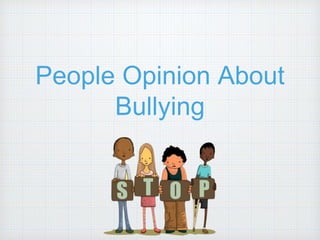
People Opinion About
Bullying
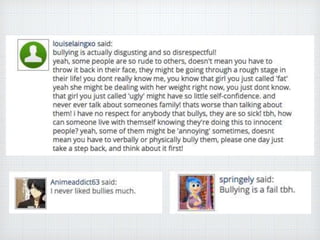
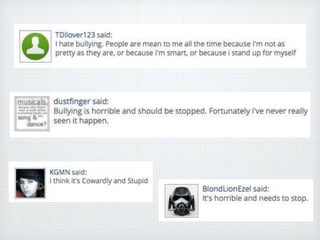
http://www.fanpop.com/clubs/random/an
swers/show/170506/what-opinion-about-
bullying
https://www.youtube.com/results?search
_query=people+opinion+about+bullying
&page=1
https://www.youtube.com/watch?v=Ocg
AF8GcBIw
https://www.youtube.com/watch?v=EisZ
TB4ZQxY
“THANK YOU”

bullying

  • 1.
  • 2.
    Hello, my nameis… Azzahra Pramata Callista Dimo Hary Anggara Primayanti Irhamni Rika Rizkiya Siska Dewi Paramitha
  • 3.
  • 4.
    Bullying Definition An unhappyteen boy walks away from bullying girls. Bullying is unwanted, aggressive behavior among school aged children that involves a real or perceived power imbalance. The behavior is repeated, or has the potential to be repeated, over time. Both kids who are bullied and who bully others may have serious, lasting problems. In order to be considered bullying, the behavior must be aggressive and include: An Imbalance of Power: Kids who bully use their power—such as physical strength, access to embarrassing information, or popularity—to control or harm others. Power imbalances can change over time and in different situations, even if they involve the same people. Repetition: Bullying behaviors happen more than once or have the potential to happen more than once. Bullying includes actions such as making threats, spreading rumors, attacking someone physically or verbally, and excluding someone from a group on purpose.
  • 5.
    Bullying and Teasing:No Laughing Matter Unfortunately, teasing is often part of growing up — almost every child experiences it. But it isn't always as innocuous as it seems. Words can cause pain. Teasing becomes bullying when it is repetitive or when there is a conscious intent to hurt another child. It can be verbal bullying (making threats, name-calling), psychological bullying (excluding children, spreading rumors), or physical bullying (hitting, pushing, taking a child's possessions). How Bullying Starts Bullying behavior is prevalent throughout the world and it cuts across socio-economic, racial/ethnic, and cultural lines. Researchers estimate that 20 to 30 percent of school-age children are involved in bullying incidents, as either perpetrators or victims. Bullying can begin as early as preschool and intensify during transitional stages, such as starting school in 1st grade or going into middle school. Victims of bullying are often shy and tend to be physically weaker than their peers. They may also have low self-esteem and poor social skills, which makes it hard for them to stand up for themselves. Bullies consider these children safe targets because they usually don't retaliate. Effects of Bullying If your child is the victim of bullying, he may suffer physically and emotionally, and his schoolwork will likely show it. Grades drop because, instead of listening to the teacher, kids are wondering what they did wrong and whether anyone will sit with them at lunch. If bullying persists, they may be afraid to go to school. Problems with low self-esteem and depression can last into adulthood and interfere with personal and professional lives.
  • 6.
    Bullies are affectedtoo, even into adulthood; they may have difficulty forming positive relationships. They are more apt to use tobacco and alcohol, and to be abusive spouses. Some studies have even found a correlation with later criminal activities. Warning Signs If you're concerned that your child is a victim of teasing or bullying, look for these signs of stress: •Increased passivity or withdrawal •Frequent crying •Recurrent complaints of physical symptoms such as stomach-aches or headaches with no apparent cause •Unexplained bruises •Sudden drop in grades or other learning problems •Not wanting to go to school •Significant changes in social life — suddenly no one is calling or extending invitations •Sudden change in the way your child talks — calling herself a loser, or a former friend a jerkHow to Help First, give your child space to talk. If she recounts incidences of teasing or bullying, be empathetic. If your child has trouble verbalizing her feelings, read a story about children being teased or bullied. You can also use puppets, dolls, or stuffed animals to encourage a young child to act out problems. Once you've opened the door, help your child begin to problem-solve. Role-play situations and teach your child ways to respond. You might also need to help your child find a way to move on by encouraging her to reach out and make new friends. She might join teams and school clubs to widen her circle.
  • 7.
    At home andon the playground: Adults need to intervene to help children resolve bullying issues, but calling another parent directly can be tricky unless he or she is a close friend. It is easy to find yourself in a "he said/she said" argument. Try to find an intermediary: even if the bullying occurs outside of school, a teacher, counselor, coach, or after-school program director may be able to help mediate a productive discussion. If you do find yourself talking directly to the other parent, try to do it in person rather than over the phone. Don't begin with an angry recounting of the other child's offenses. Set the stage for a collaborative approach by suggesting going to the playground, or walking the children to school together, to observe interactions and jointly express disapproval for any unacceptable behavior. At school: Many schools (sometimes as part of a statewide effort) have programs especially designed to raise awareness of bullying behavior and to help parents and teachers deal effectively with it. Check with your local school district to see if it has such a program.
  • 8.
    Schools and parentscan work effectively behind the scenes to help a child meet and make new friends via study groups or science-lab partnerships. If you are concerned about your child: •Share with the teacher what your child has told you; describe any teasing or bullying you may have witnessed. •Ask the teacher if she sees similar behavior at school, and enlist her help in finding ways to solve the problem. •If she hasn't seen any instances of teasing, ask that she keep an eye out for the behavior you described. •If the teacher says your child is being teased, find out whether there are any things he may be doing in class to attract teasing. Ask how he responds to the teasing, and discuss helping him develop a more effective response. •After the initial conversation, be sure to make a follow-up appointment to discuss how things are going. •If the problem persists, or the teacher ignores your concerns, and your child starts to withdraw or not want to go to school, consider the possibility of "therapeutic intervention." Ask to meet with the school counselor or psychologist, or request a referral to the appropriate school professional. http://www.scholastic.com/parents/resources/article/social-emotional-skills/bullying-and-teasing-no- laughing-matter
  • 9.
    1. Do youthink bullying is a serious issue in your school? Give reasons to support your opinion. Yes, because bullying affects the children both psychologically and physically.
  • 10.
    2. Did thisopinion article raise/change your awareness about bullying? Please explain. yes, because this article make us know more about bullying education.
  • 11.
    3. Do youthink it is necessary to educate people on issue of bullying? Why? Give reason to support your opinion. yes, because many people have been bullyed. We hoping that who have been bullied can stand up and speak out to fight the bullying.
  • 12.
    6. Are youaware of cyber bullying? Do you think it is worse than physical bullying? Why? Support your opinion with examples. yes, it is worse than physically bullying because, cyber bullying can break mentality and if the mentar has broken it would affect the physik.
  • 13.
    4. Do youthink bullying should be declared as punishable crime? Give reason to support your answer. I think yes because bullying not only affect someone’s psychology we know that a few day ago in Bekasi a junior high school student died because bullied by his senior in MOS.
  • 14.
    5. Discuss thearticle on bullying in a group. Does it change your perspective on bullying or not? Give reason to support your answer. No, bully is bad habit and it many hurt someone.
  • 15.
    7. What canyoung people like you do to prevent or stop bullying? List at least 3 things and your friend can do to prevent or stop bullying? - Respect each other - Dont be racist - Think before doing something and speak
  • 16.
    why we chosethis article? We think this article support our opinion and we hope after you read this article you will realize that bully is bad.
  • 17.
  • 24.
  • 25.