Module 1
SYLLABUS
■ MANAGEMENT
– Meaning and Definition
– Functions of Management
– Importance
– Nature and Characteristics of Management
– Scope and Functional areas of management
– Management as a Science, Art or Profession
– Management & Administration
– Roles of Manager
– Levels of Management
– Managerial Skills
SYLLABUS
■ PLANNING
– Nature
– Importance and Purpose of planning
– Types of plans
– Steps in planning
– Limitations of Planning
■ DECISION MAKING
– Meaning
– Types of Decisions
– Steps in Decision Making
MANAGEMENT
DEFINITIONS
■ “Management is an art of knowing what is to be done and seeing that it is
done in the best possible manner.” – F.W. Taylor
■ “Management is to forecast, to plan, to organise, to command, to co-ordinate
and control activities of others.” - Henri Fayol
■ “Management is the art of getting things done through the people” – Mary
Parker Follett
■ “Management is the co-ordination of all resources through the process of
planning, organising, directing and controlling in order to attain stated goals.”
– Henry Sisk
MEANING
■ Management in business and organizations is the function that coordinates
the efforts of people to accomplish goals and objectives using available
resources efficiently and effectively.
■ Management is a process consisting of planning, organizing, directing and
controlling, performed to determine and accomplish the objectives by the use
of people and resources.
■ Resourcing encompasses the deployment and manipulation of human
resources, financial resources, technological resources and natural resources.
■ Management’s primary function is to get people to work together for
attainment of an organization’s goals and objectives
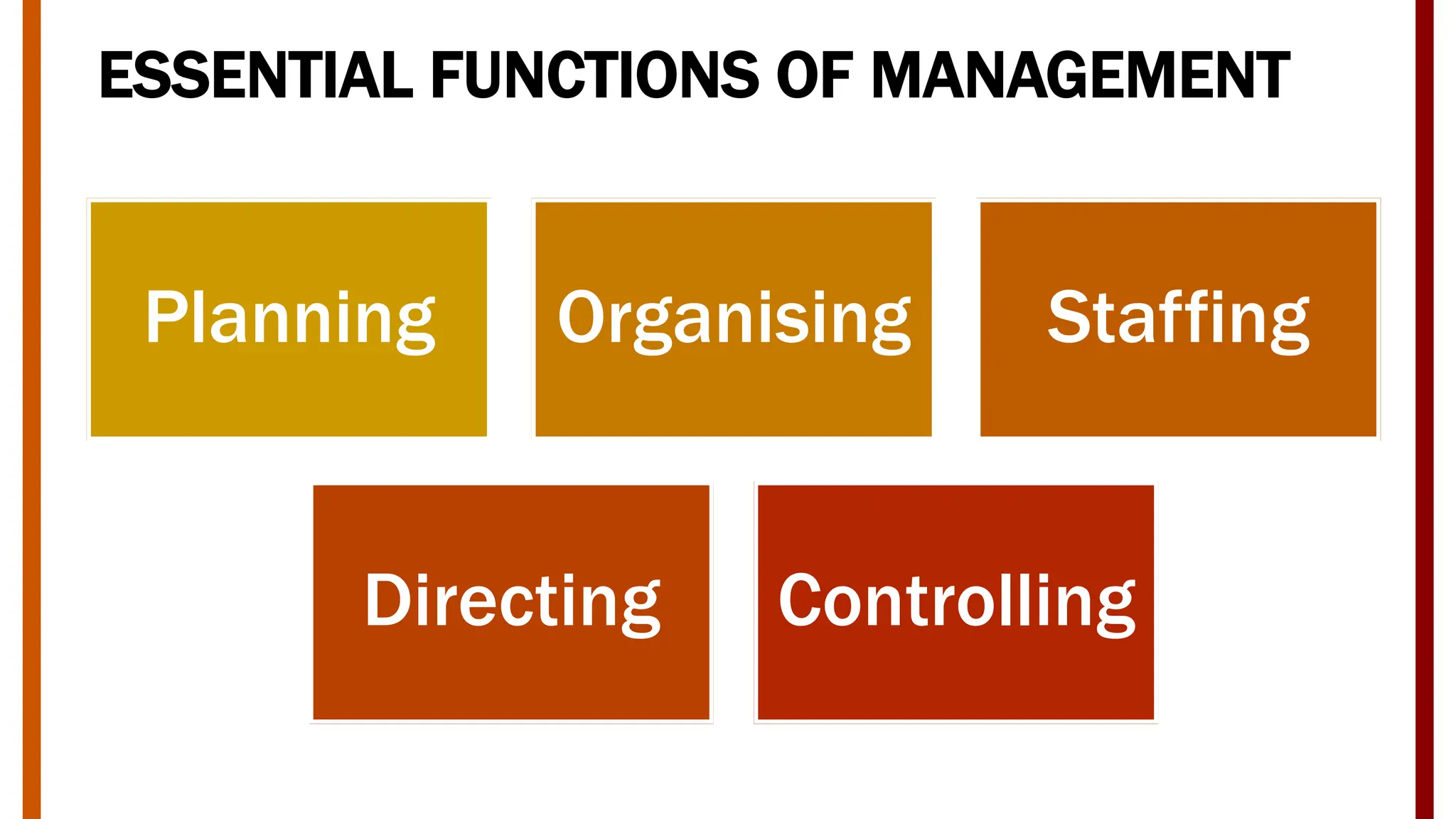
ESSENTIAL FUNCTIONS OF MANAGEMENT
Planning Organising Staffing
Directing Controlling
IMPORTANCE OF MANAGEMENT
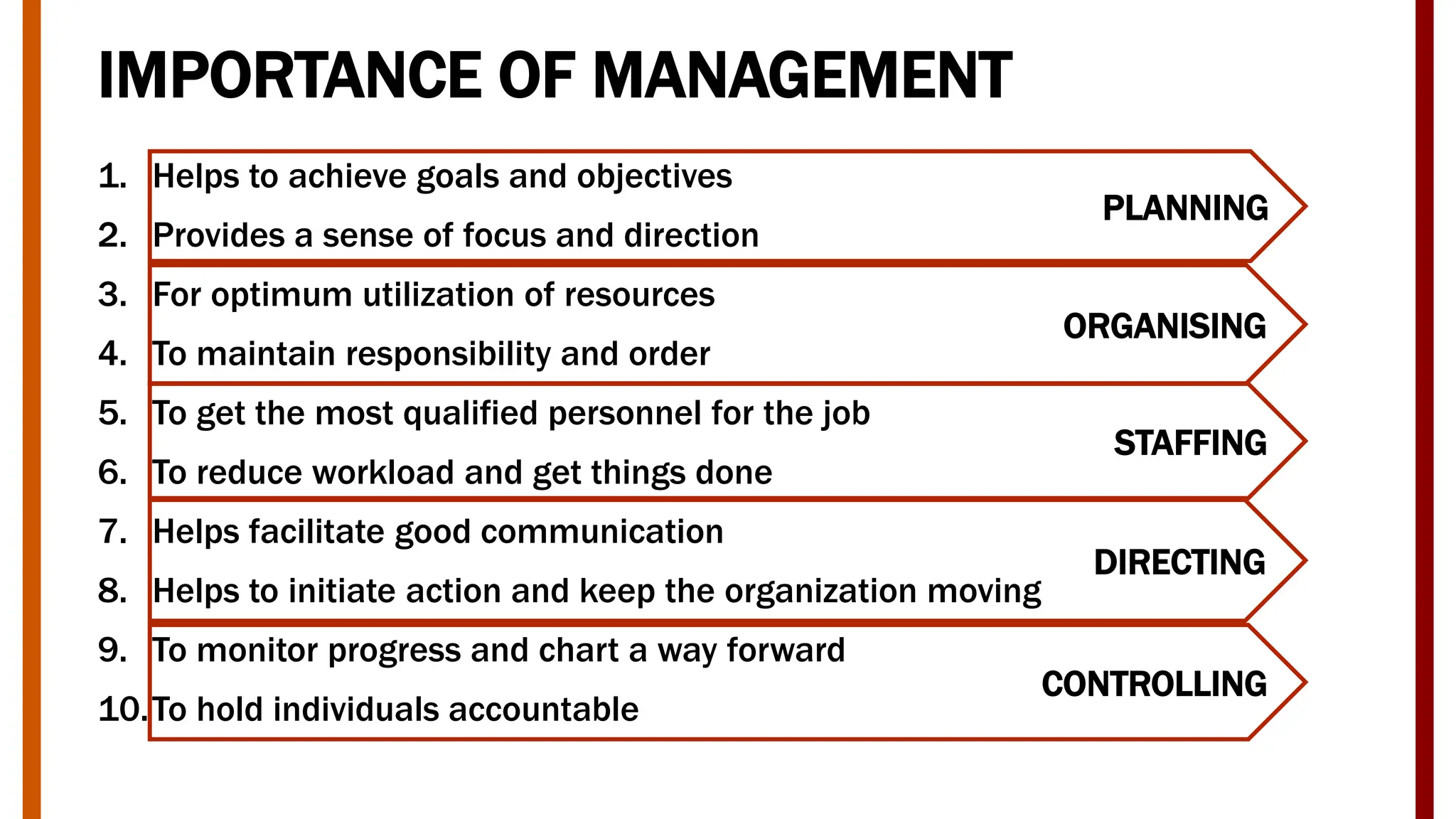
1. Helps to achieve goals and objectives
2. Provides a sense of focus and direction
3. For optimum utilization of resources
4. To maintain responsibility and order
5. To get the most qualified personnel for the job
6. To reduce workload and get things done
7. Helps facilitate good communication
8. Helps to initiate action and keep the organization moving
9. To monitor progress and chart a way forward
10.To hold individuals accountable
PLANNING
ORGANISING
STAFFING
DIRECTING
CONTROLLING
IMPORTANCE OF MANAGEMENT
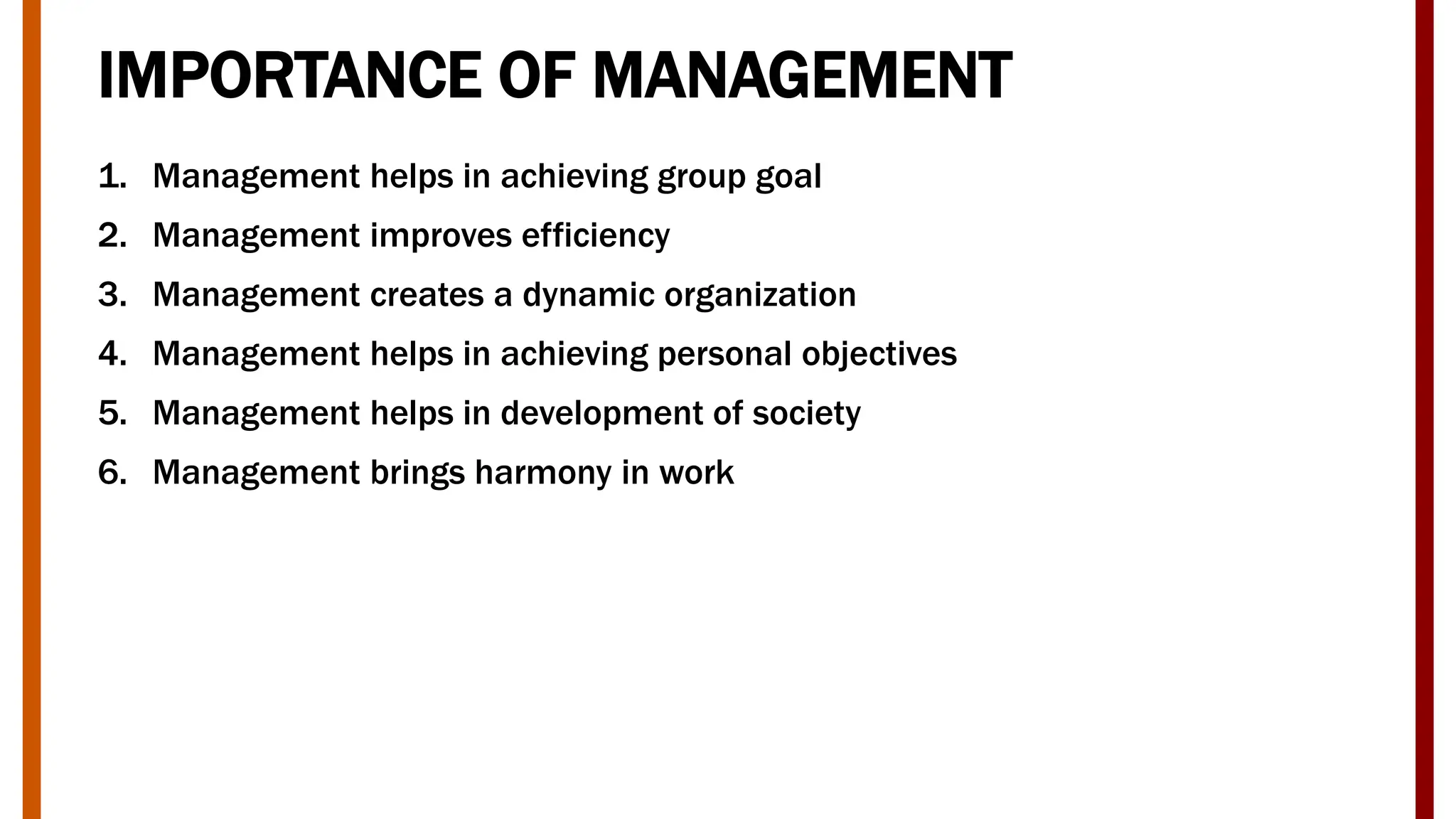
1. Management helps in achieving group goal
2. Management improves efficiency
3. Management creates a dynamic organization
4. Management helps in achieving personal objectives
5. Management helps in development of society
6. Management brings harmony in work
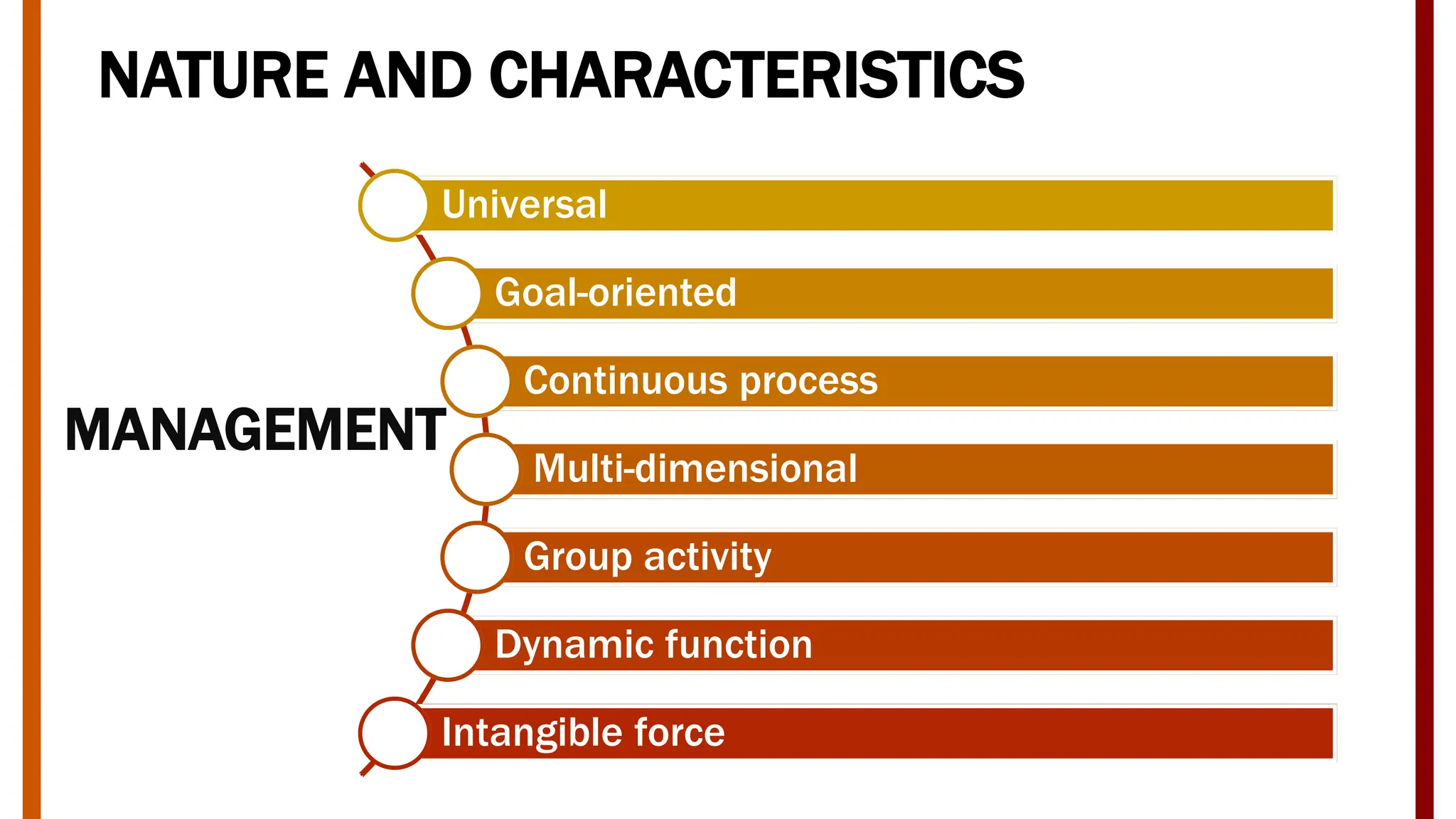
NATURE AND CHARACTERISTICS
Universal
Goal-oriented
Continuous process
Multi-dimensional
Group activity
Dynamic function
Intangible force
MANAGEMENT
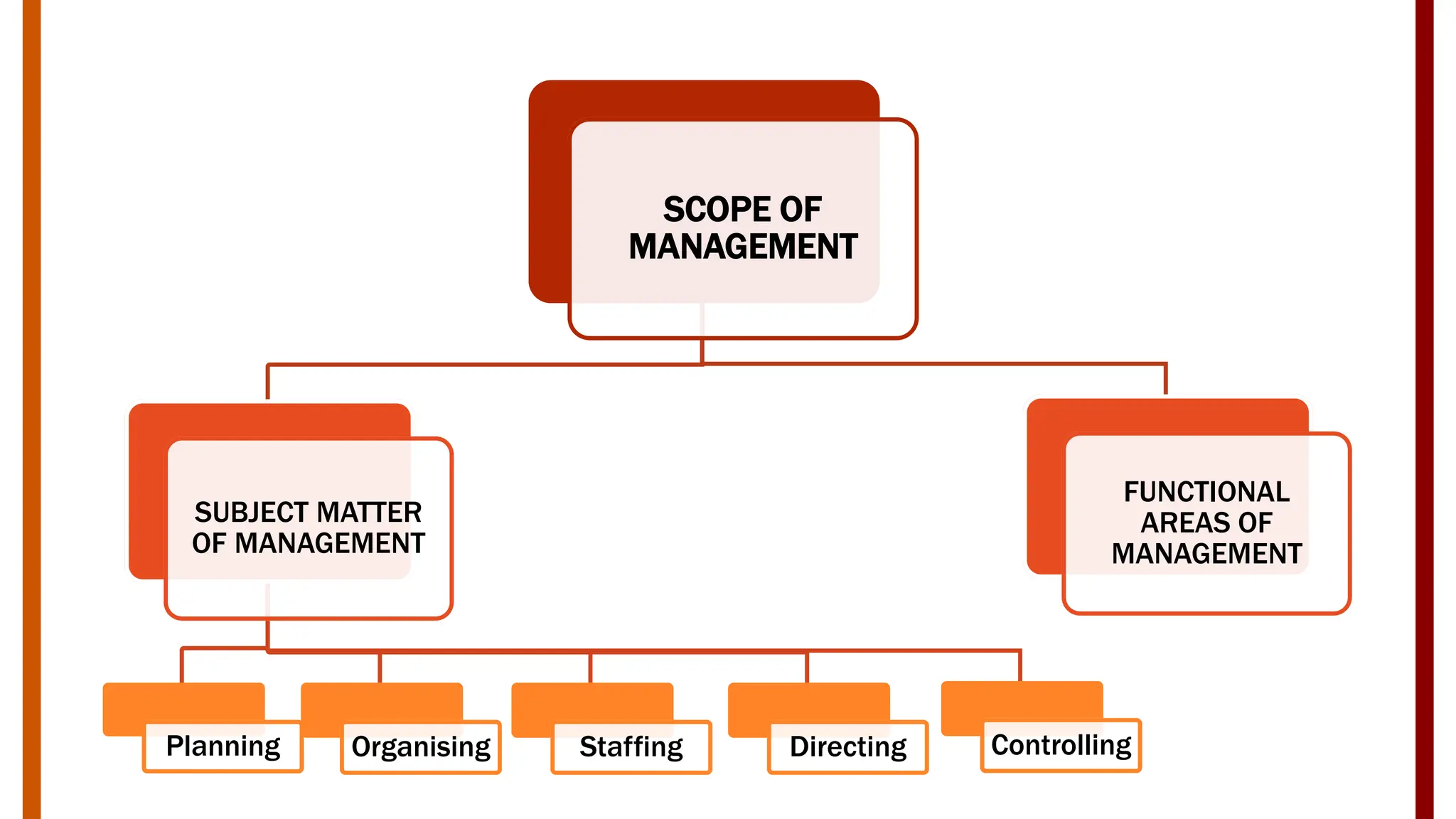
SCOPE OF
MANAGEMENT
SUBJECT MATTER
OF MANAGEMENT
Planning Organising Staffing Directing Controlling
FUNCTIONAL
AREAS OF
MANAGEMENT
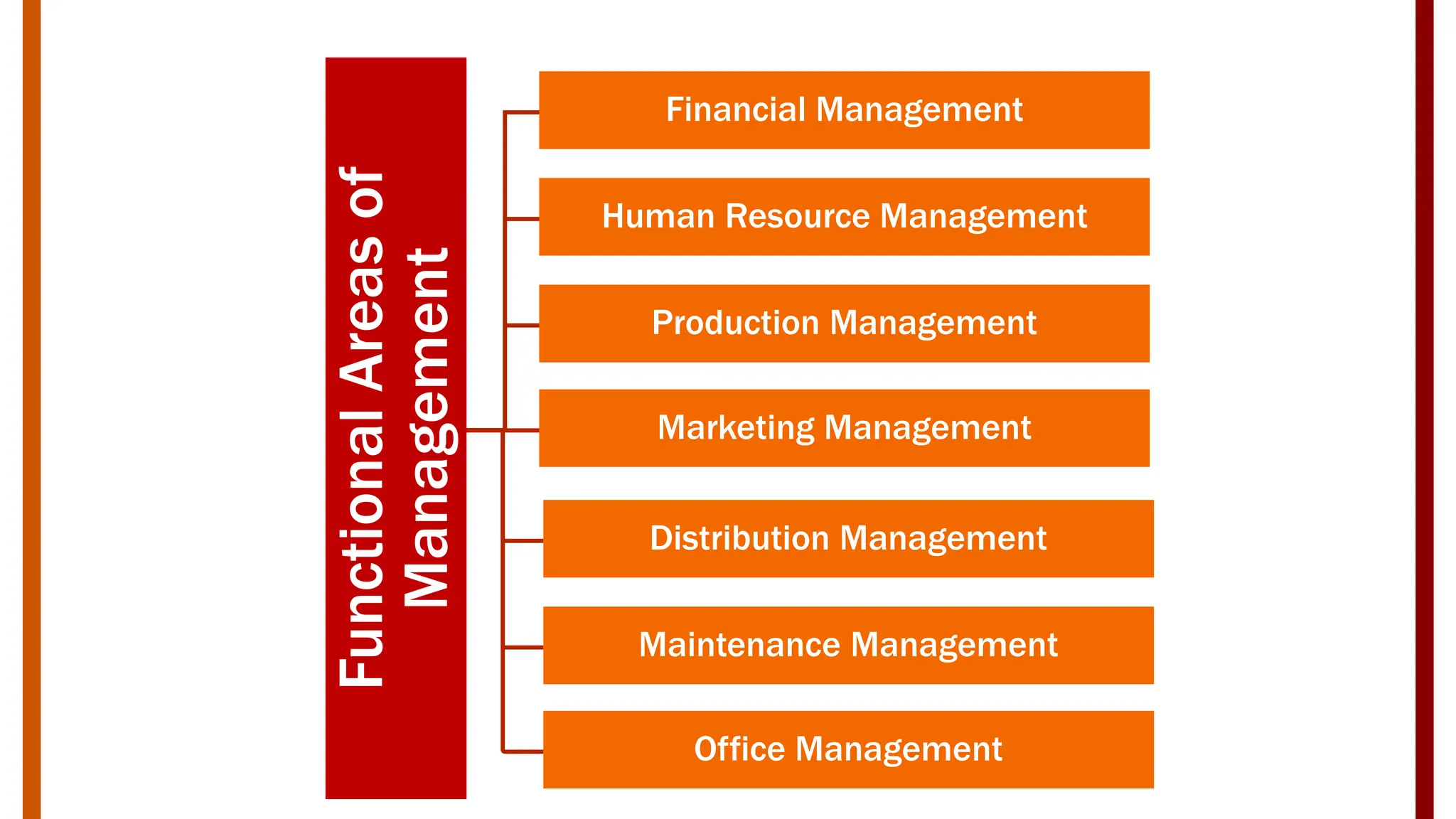
Functional
Areas
of
Management
Financial Management
Human Resource Management
Production Management
Marketing Management
Distribution Management
Maintenance Management
Office Management
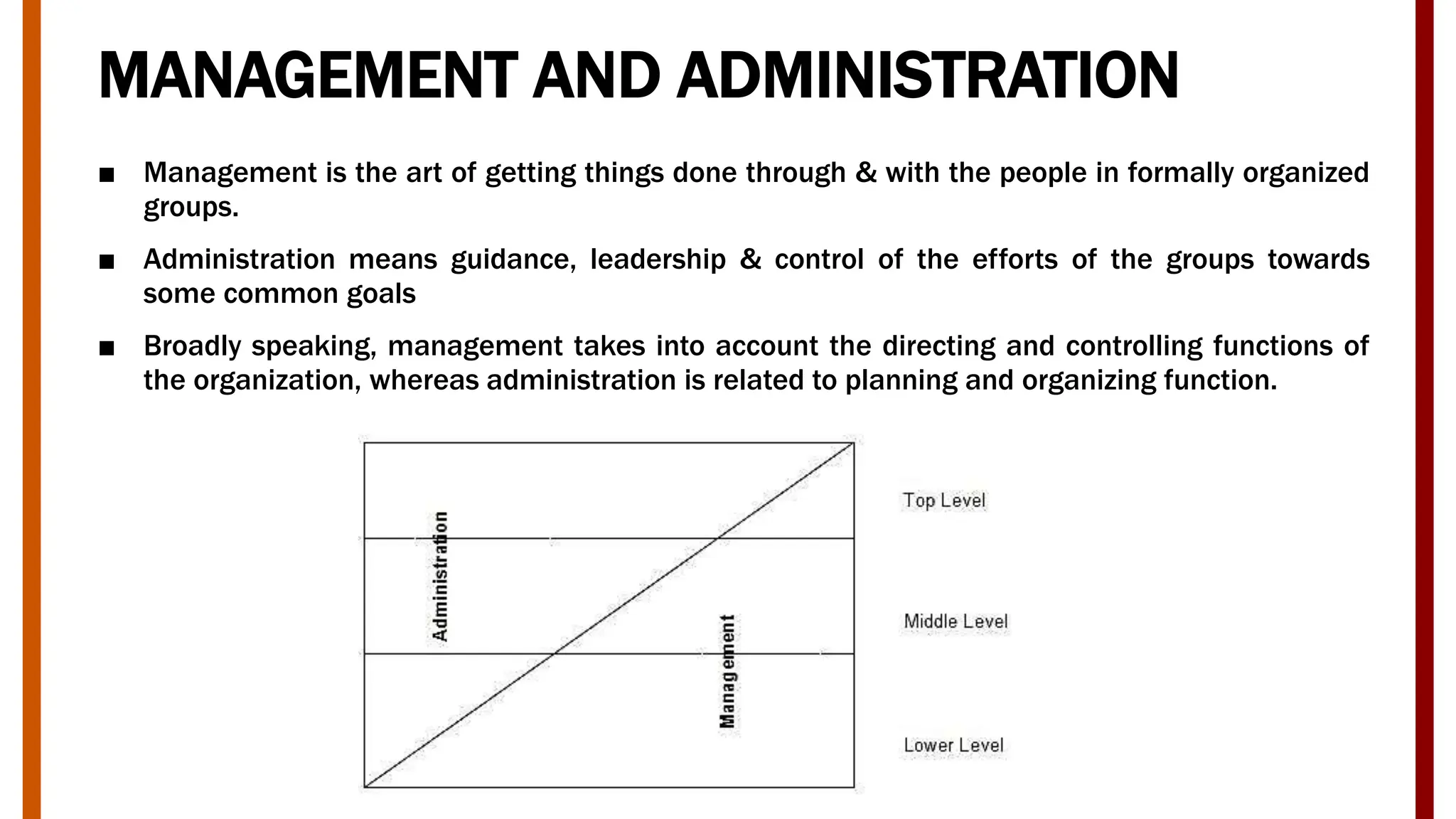
MANAGEMENT AND ADMINISTRATION
■ Management is the art of getting things done through & with the people in formally organized
groups.
■ Administration means guidance, leadership & control of the efforts of the groups towards
some common goals
■ Broadly speaking, management takes into account the directing and controlling functions of
the organization, whereas administration is related to planning and organizing function.
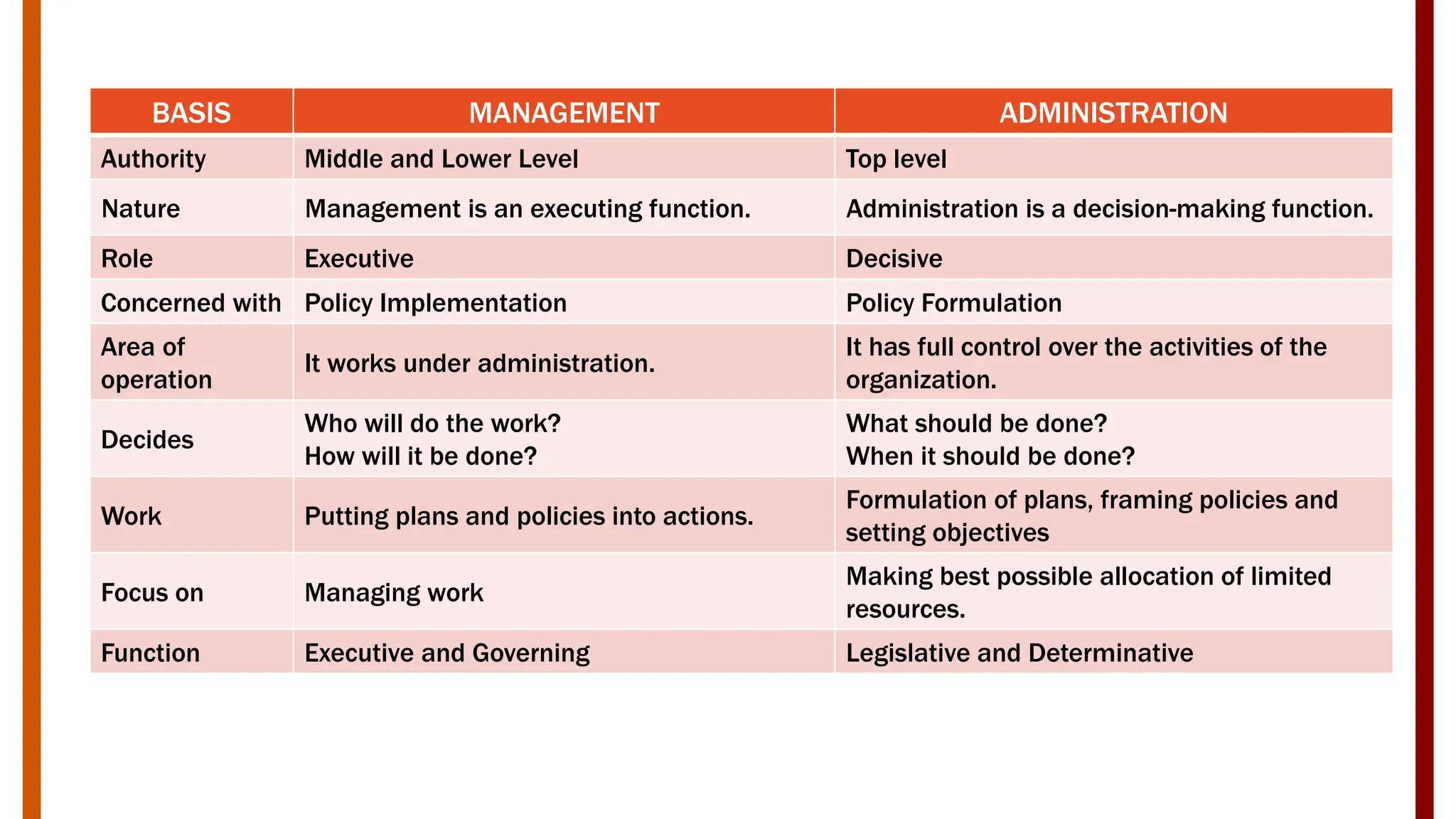
BASIS MANAGEMENT ADMINISTRATION
Authority Middle and Lower Level Top level
Nature Management is an executing function. Administration is a decision-making function.
Role Executive Decisive
Concerned with Policy Implementation Policy Formulation
Area of
operation
It works under administration.
It has full control over the activities of the
organization.
Decides
Who will do the work?
How will it be done?
What should be done?
When it should be done?
Work Putting plans and policies into actions.
Formulation of plans, framing policies and
setting objectives
Focus on Managing work
Making best possible allocation of limited
resources.
Function Executive and Governing Legislative and Determinative
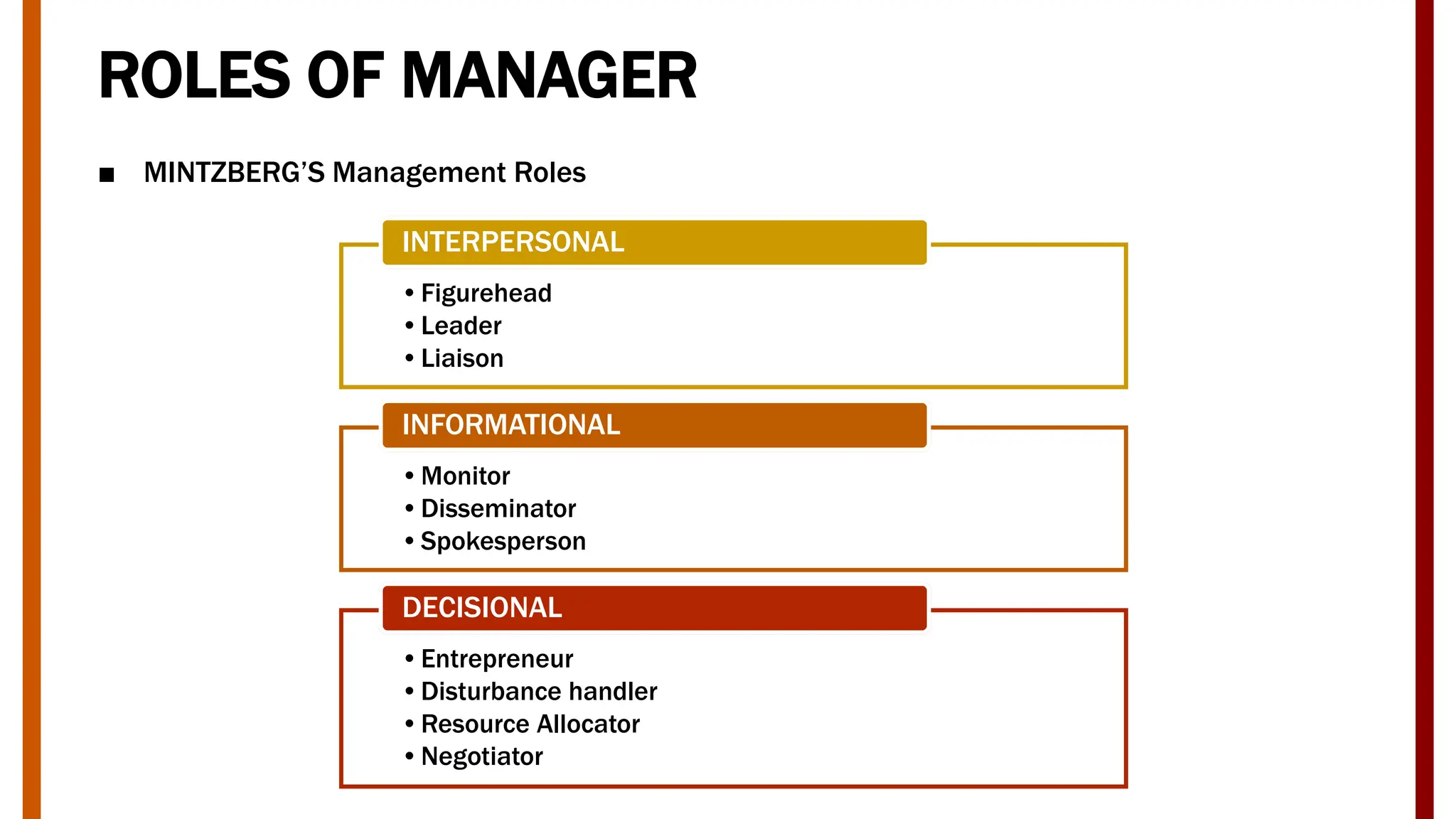
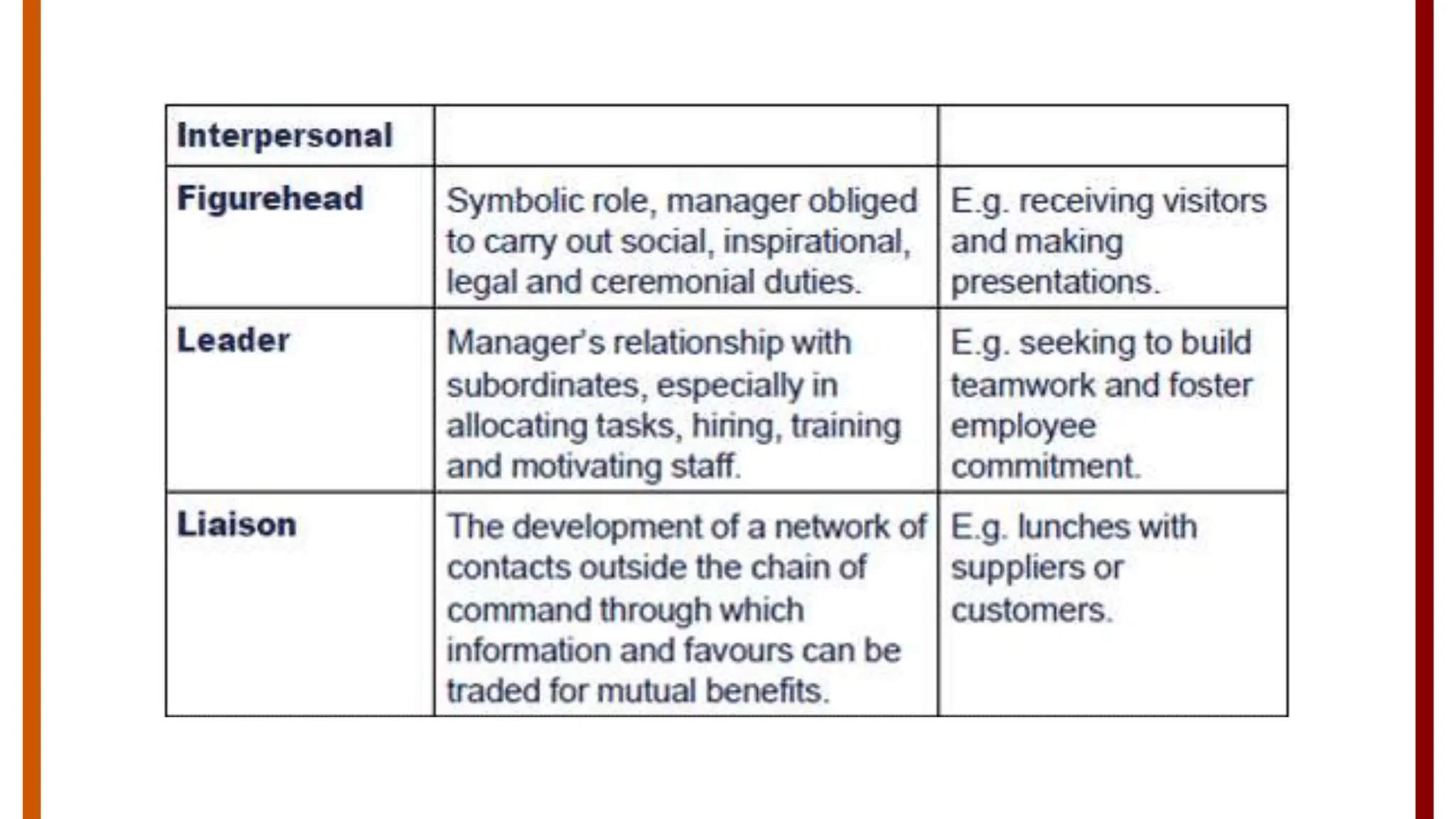
ROLES OF MANAGER
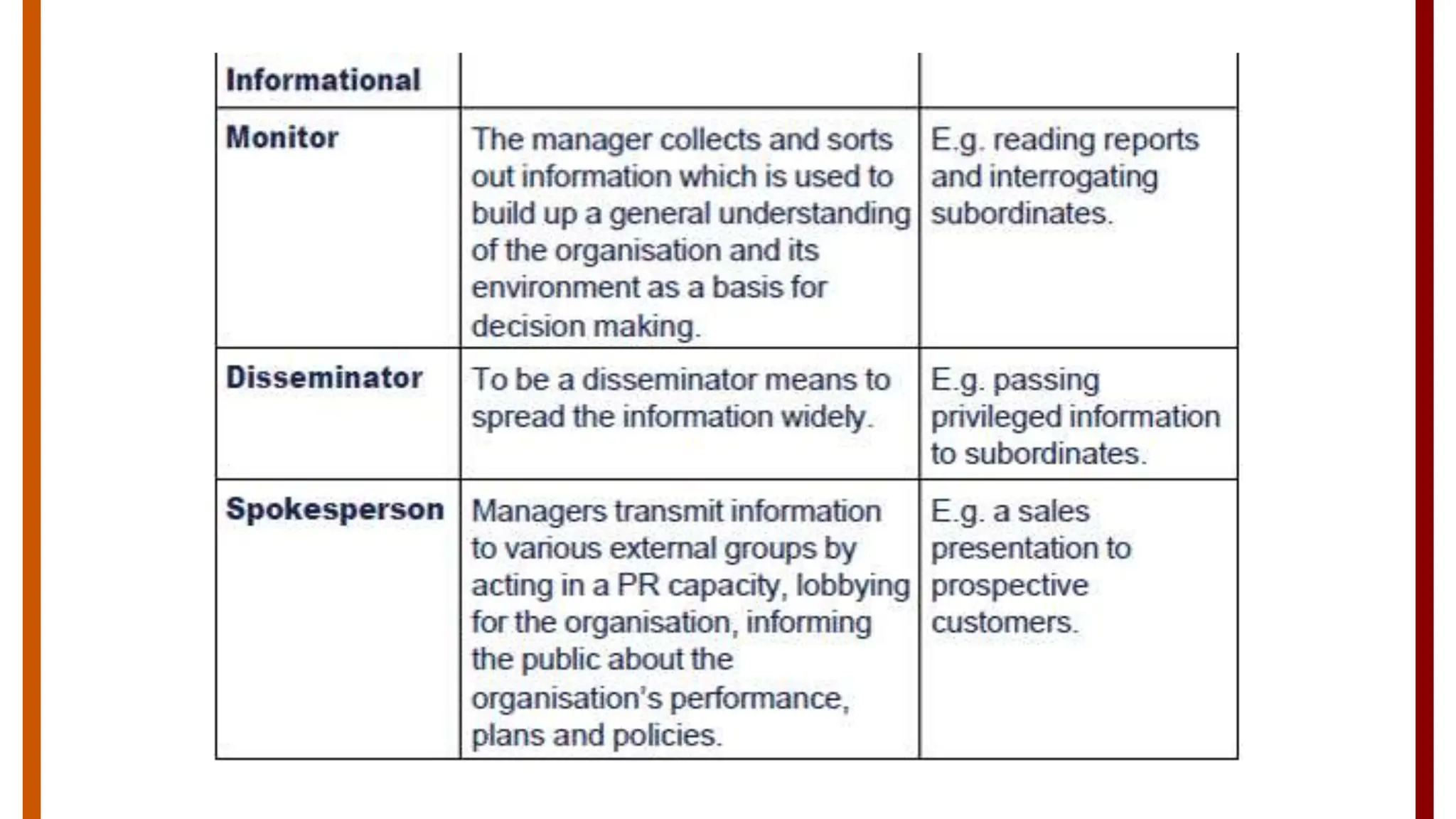
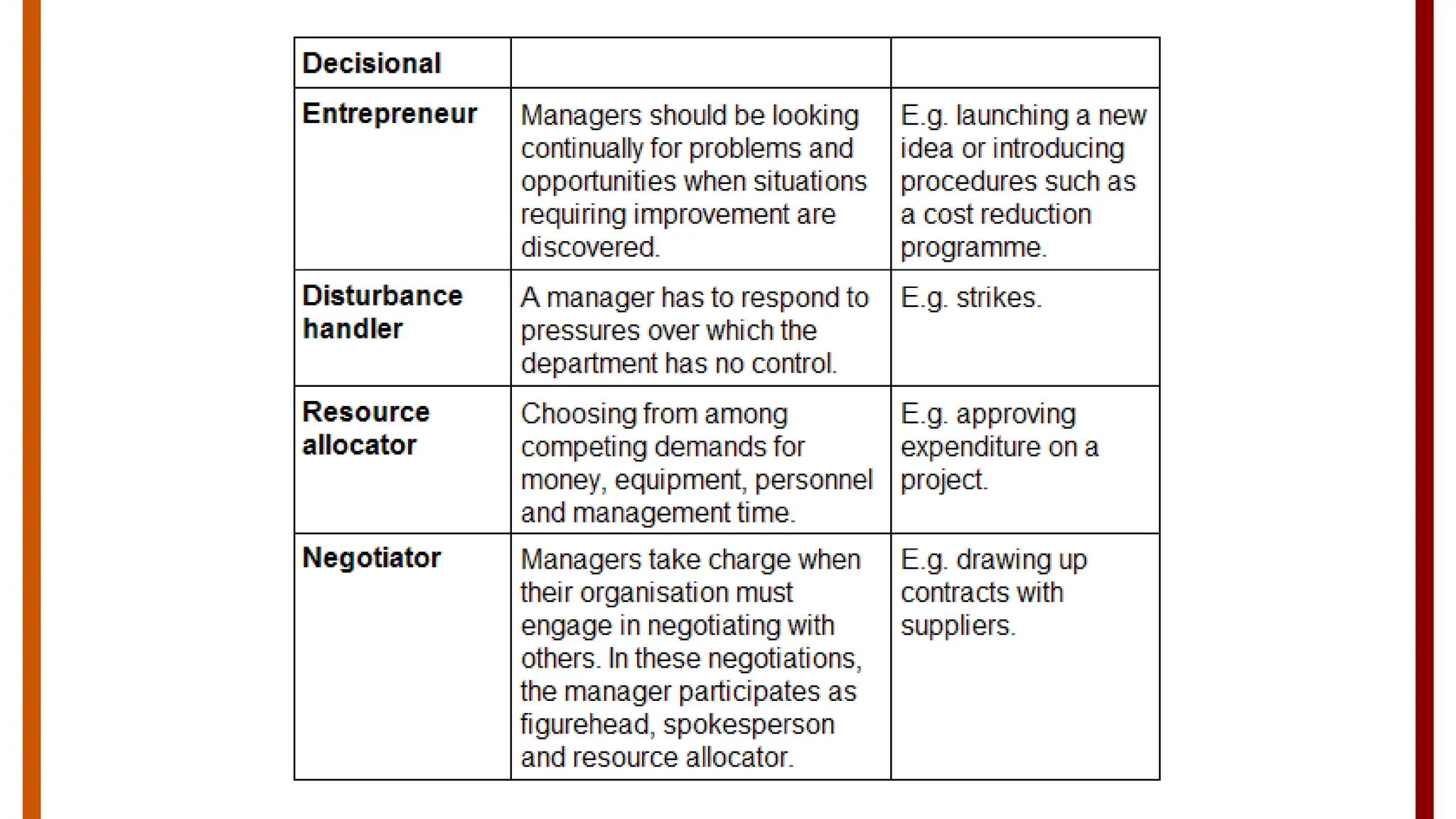
■ MINTZBERG’S Management Roles
•Figurehead
•Leader
•Liaison
INTERPERSONAL
•Monitor
•Disseminator
•Spokesperson
INFORMATIONAL
•Entrepreneur
•Disturbance handler
•Resource Allocator
•Negotiator
DECISIONAL
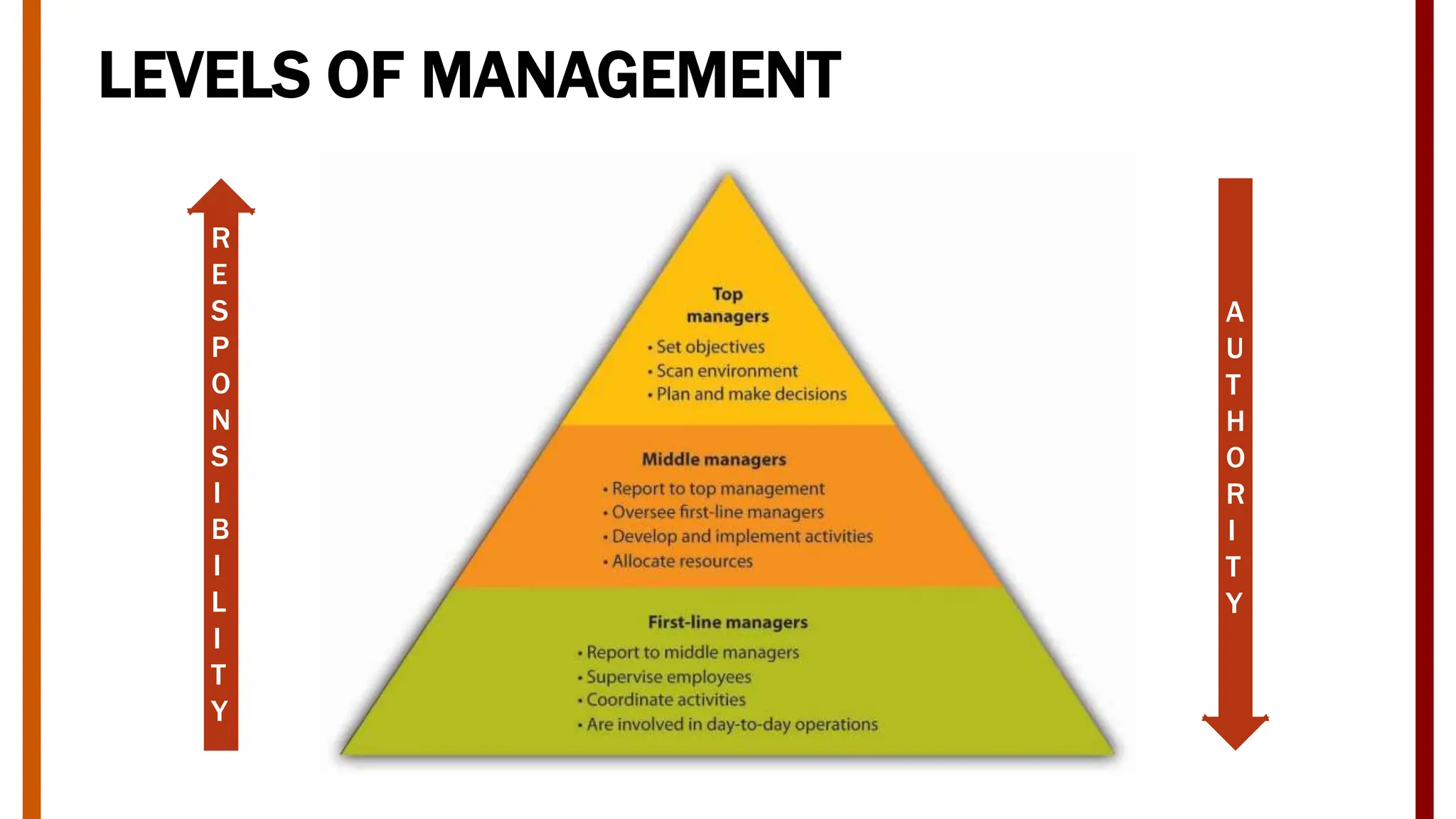
LEVELS OF MANAGEMENT
R
E
S
P
O
N
S
I
B
I
L
I
T
Y
A
U
T
H
O
R
I
T
Y
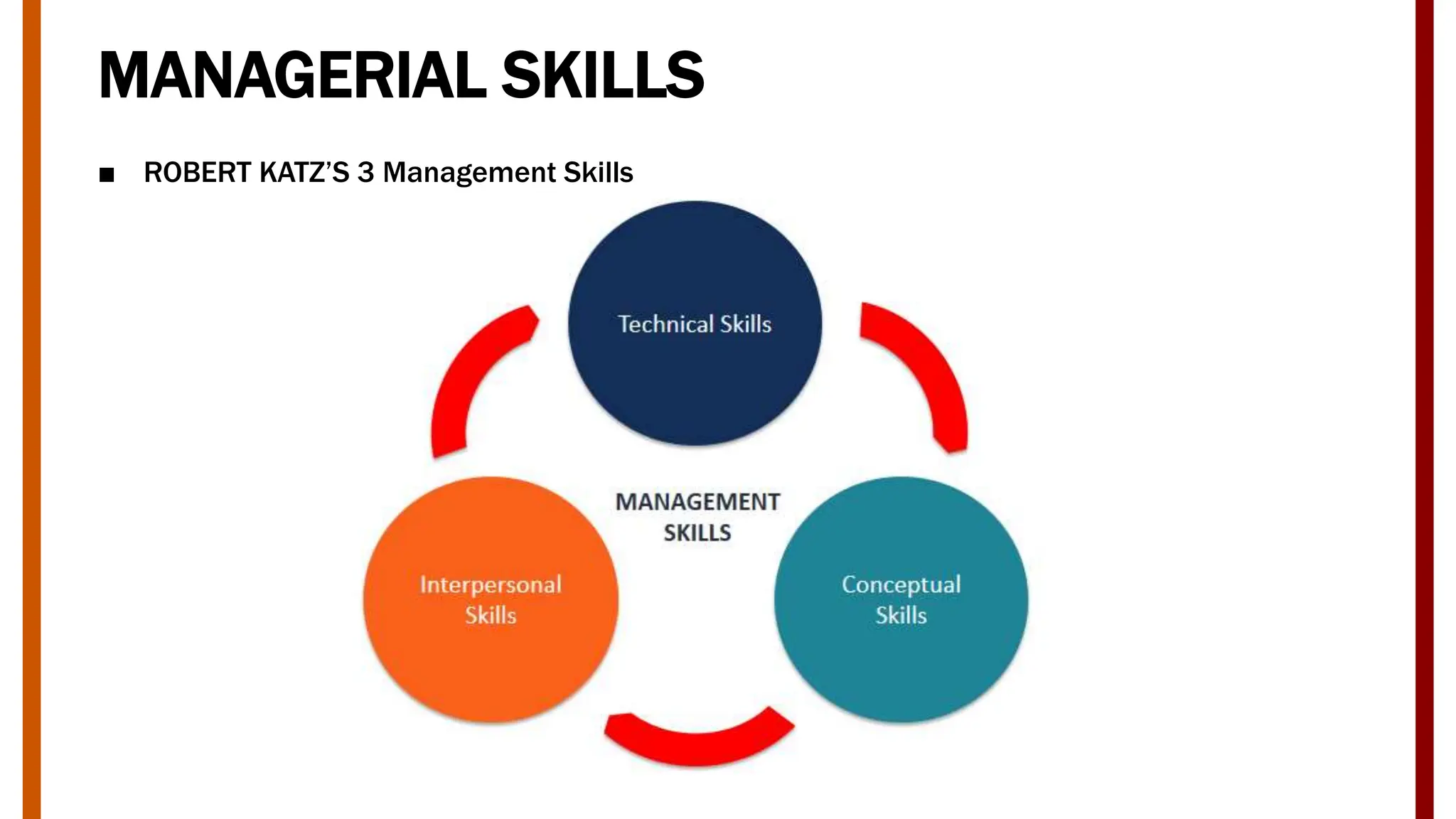
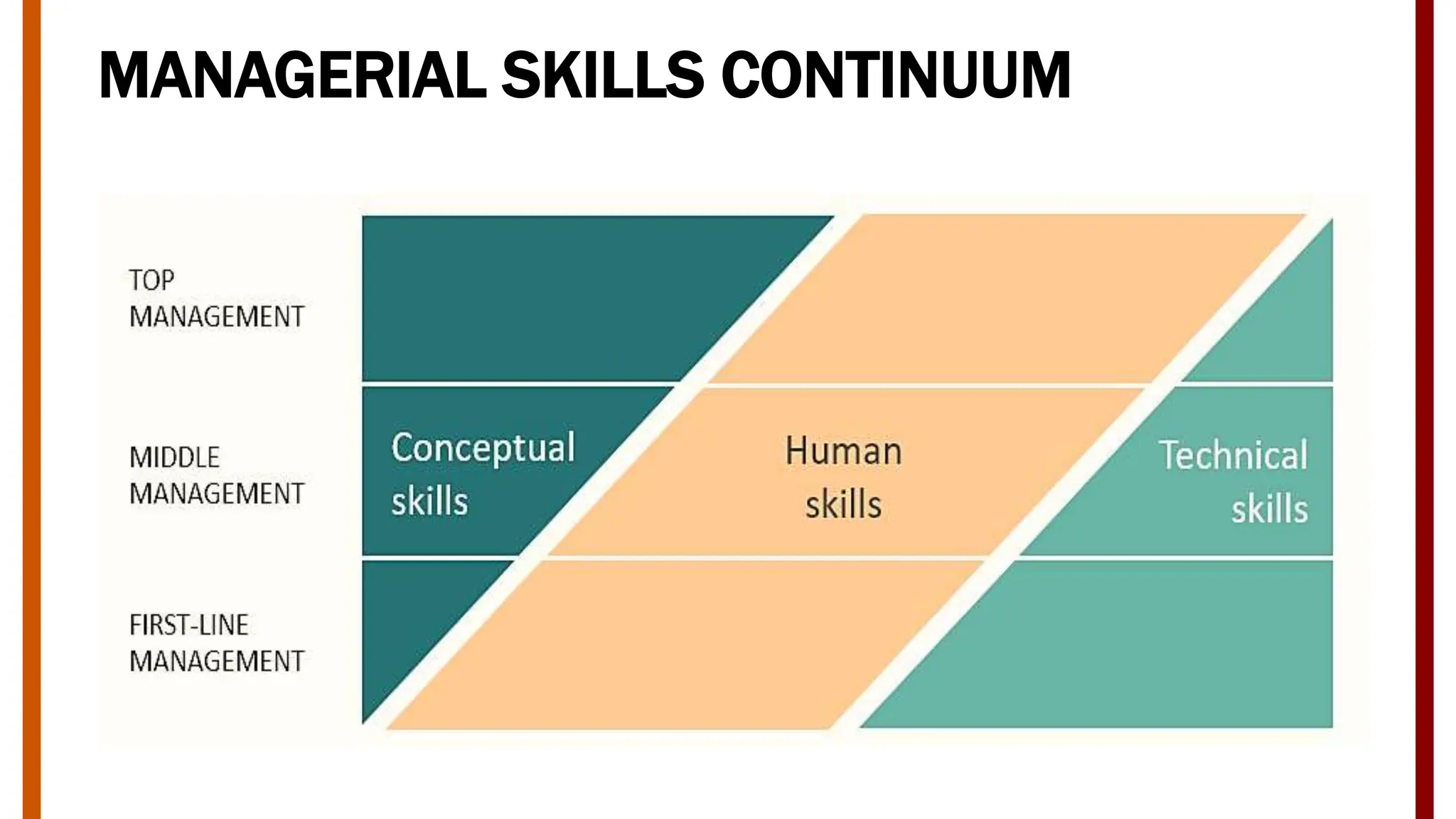
MANAGERIAL SKILLS
■ ROBERT KATZ’S 3 Management Skills
MANAGERIAL SKILLS CONTINUUM
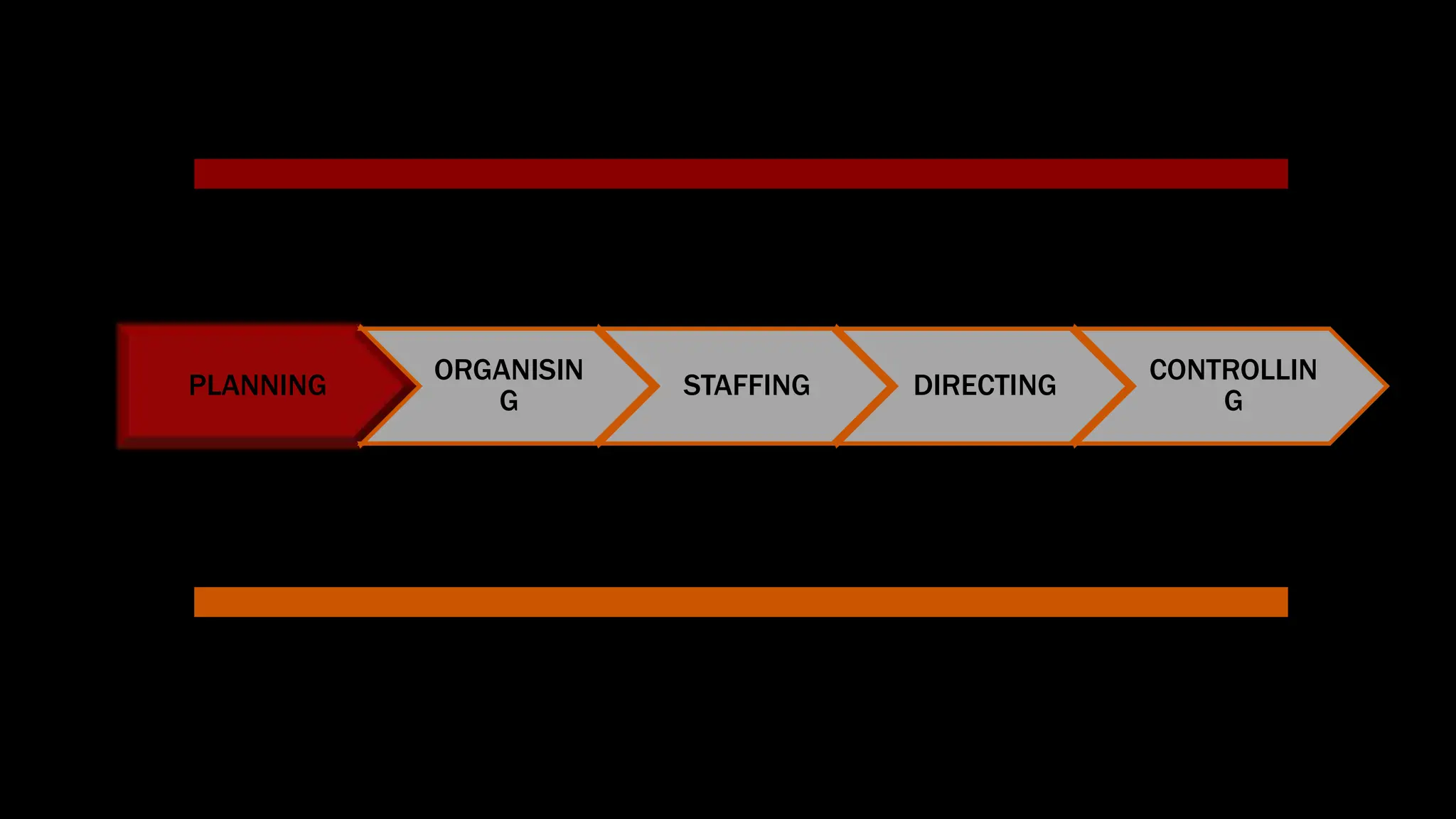
PLANNING
ORGANISIN
G
STAFFING DIRECTING
CONTROLLIN
G
MEANING AND DEFINITIONS
■ Planning is deciding in advance what to do, how to do it, when to do it and who
is to do it. It bridges the gap from where we are, to where we want to go. It is in
essence the exercise of foresight”. - Koontz and O’Donell
■ “Planning is deciding in advance what is to be done. It involves the selection of
objectives, policies, procedures and programmes from among alternatives.” –
M.S. Hardy
■ Planning is a pre-decided course of action which will be taken in future. It
deals with the determination of objectives to be achieved, and the activities
required to achieve the objectives.
■ Planning is the determination of a future course of action to achieve any
desired result. It is the process of thinking before doing. It depicts a framework
within which other management functions will operate. It is a continuous
process that takes place at all levels of management.
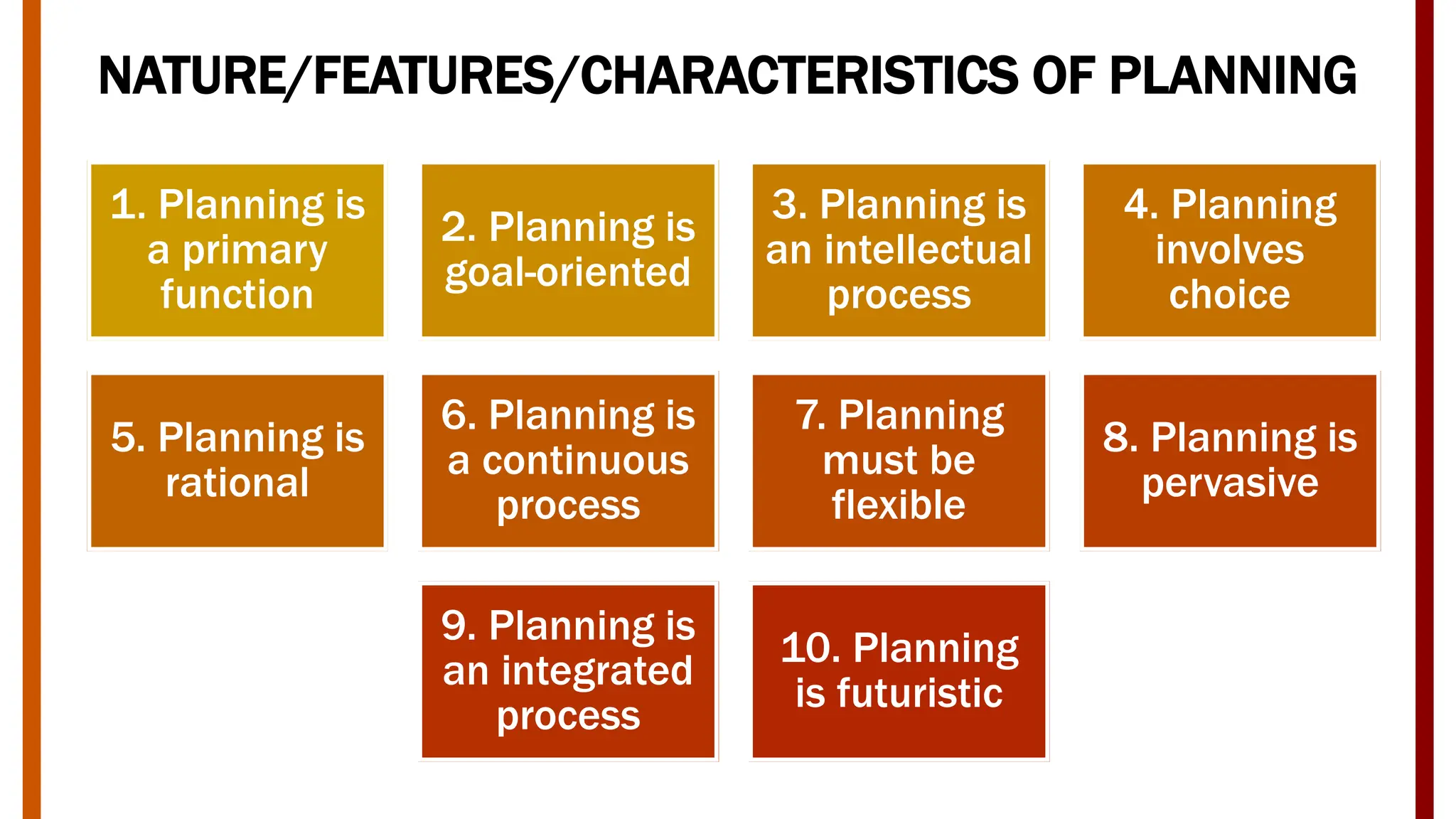
NATURE/FEATURES/CHARACTERISTICS OF PLANNING
1. Planning is
a primary
function
2. Planning is
goal-oriented
3. Planning is
an intellectual
process
4. Planning
involves
choice
5. Planning is
rational
6. Planning is
a continuous
process
7. Planning
must be
flexible
8. Planning is
pervasive
9. Planning is
an integrated
process
10. Planning
is futuristic
IMPORTANCE AND PURPOSE
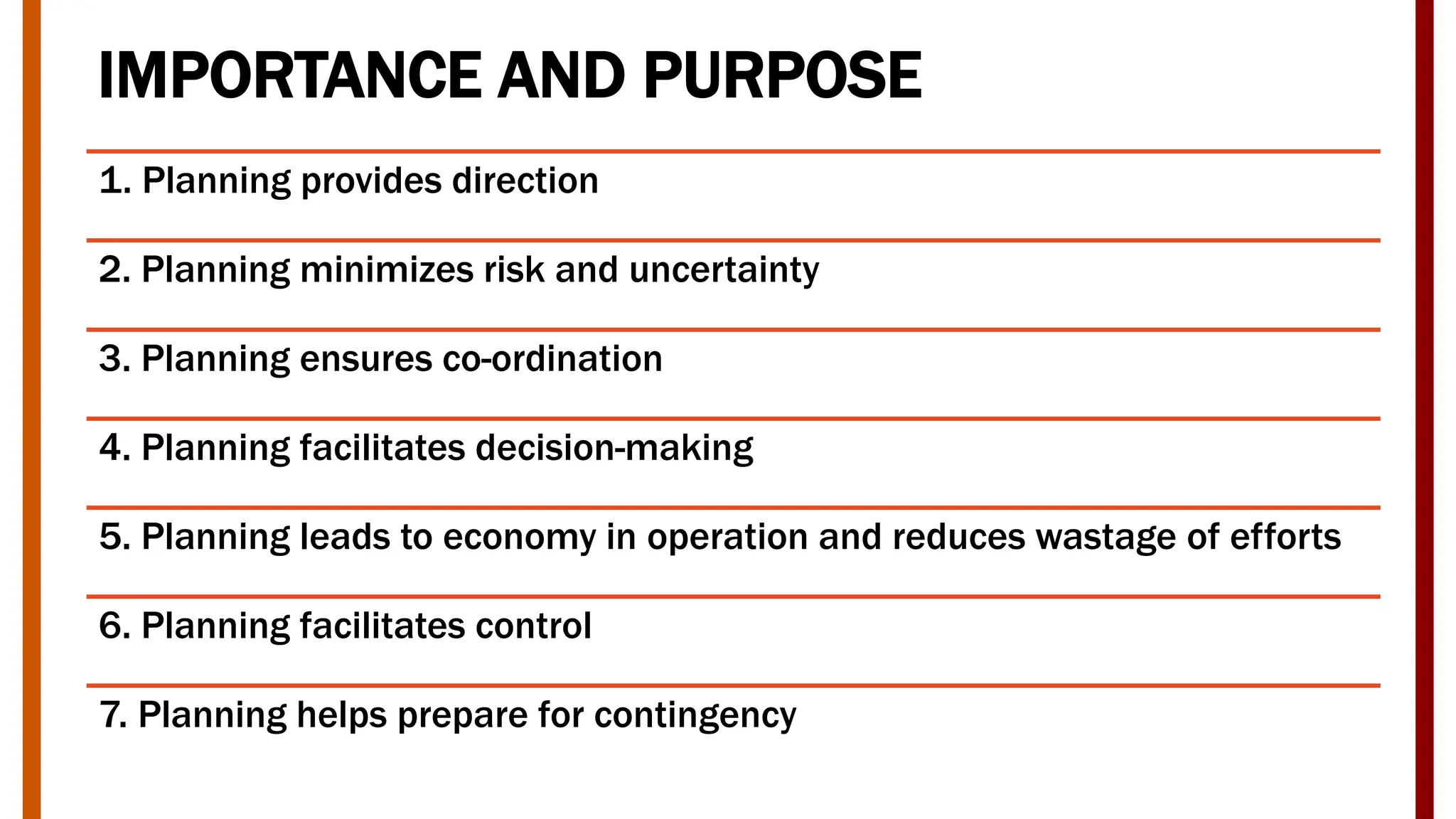
1. Planning provides direction
2. Planning minimizes risk and uncertainty
3. Planning ensures co-ordination
4. Planning facilitates decision-making
5. Planning leads to economy in operation and reduces wastage of efforts
6. Planning facilitates control
7. Planning helps prepare for contingency
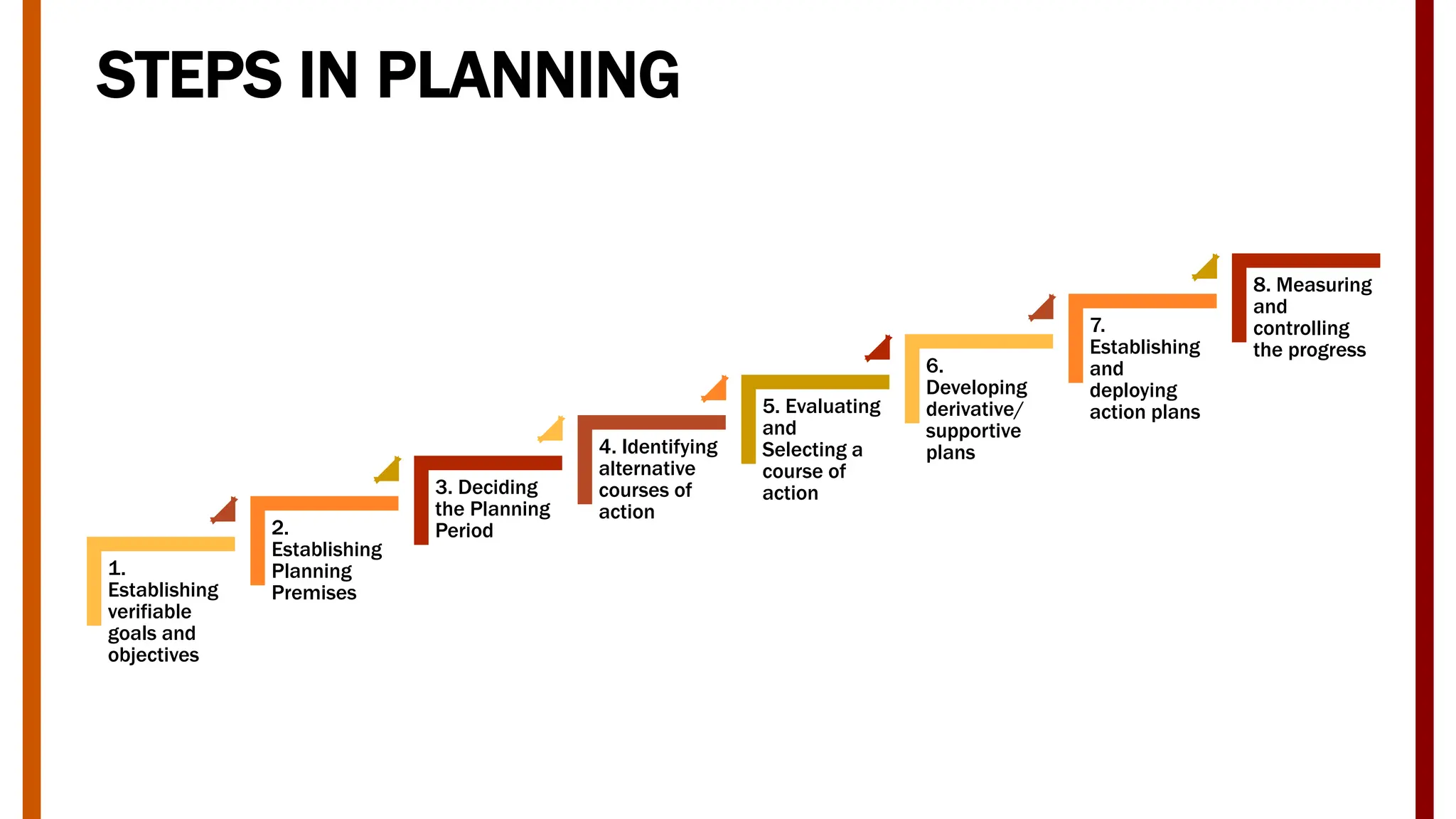
STEPS IN PLANNING
1.
Establishing
verifiable
goals and
objectives
2.
Establishing
Planning
Premises
3. Deciding
the Planning
Period
4. Identifying
alternative
courses of
action
5. Evaluating
and
Selecting a
course of
action
6.
Developing
derivative/
supportive
plans
7.
Establishing
and
deploying
action plans
8. Measuring
and
controlling
the progress
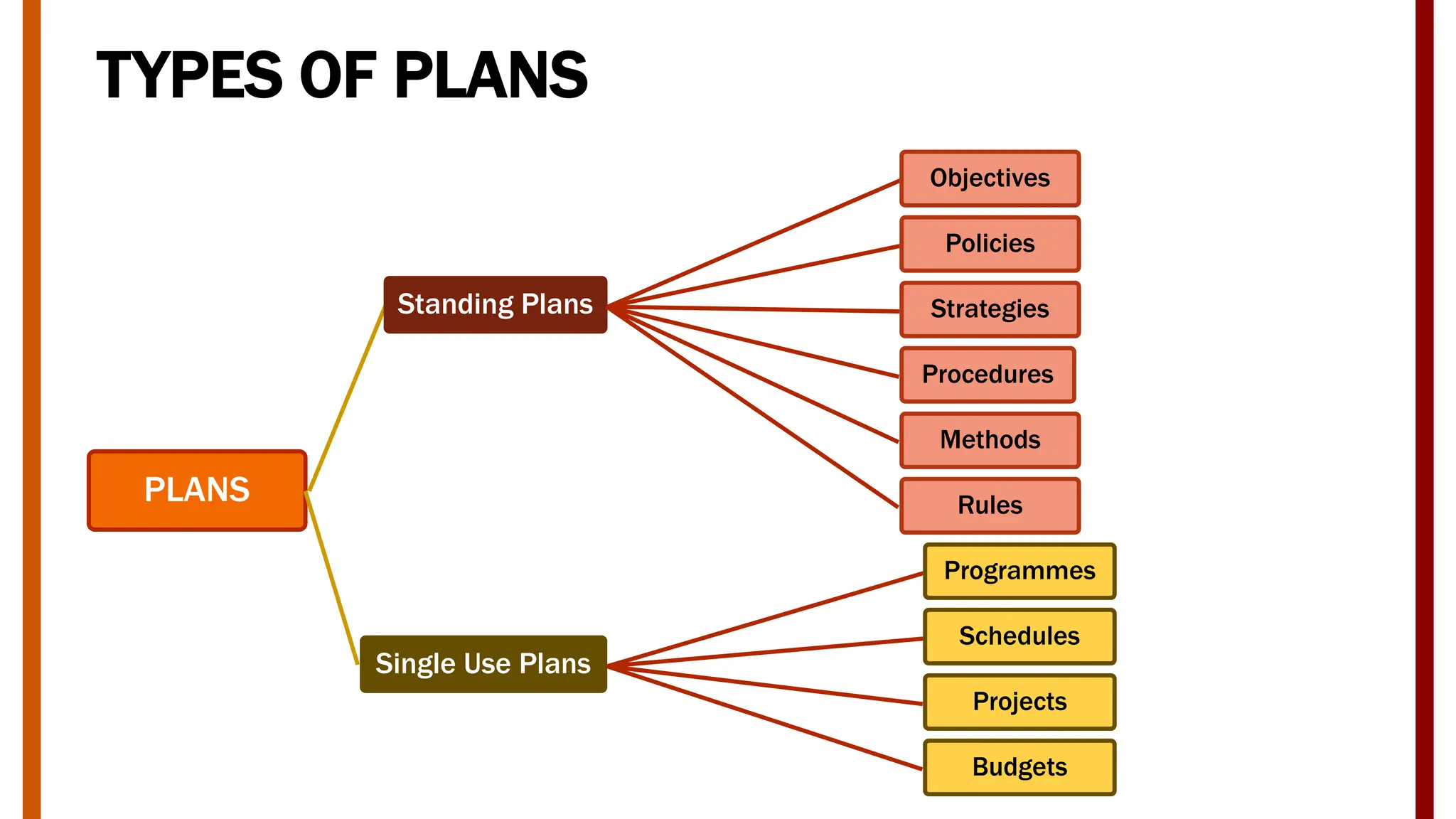
TYPES OF PLANS
PLANS
Standing Plans
Objectives
Policies
Strategies
Procedures
Methods
Rules
Single Use Plans
Programmes
Schedules
Projects
Budgets
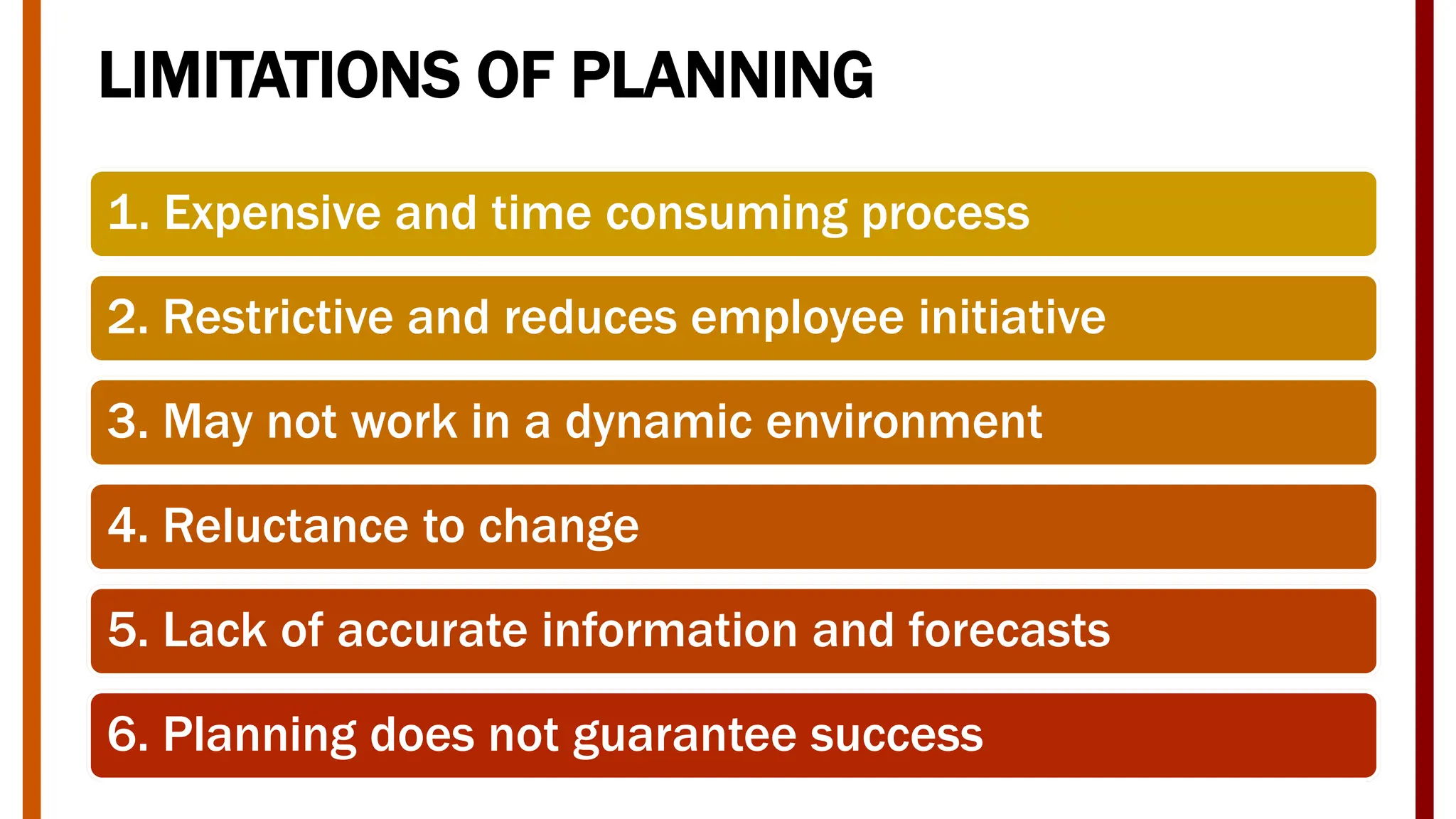
LIMITATIONS OF PLANNING
1. Expensive and time consuming process
2. Restrictive and reduces employee initiative
3. May not work in a dynamic environment
4. Reluctance to change
5. Lack of accurate information and forecasts
6. Planning does not guarantee success
DECISION MAKING
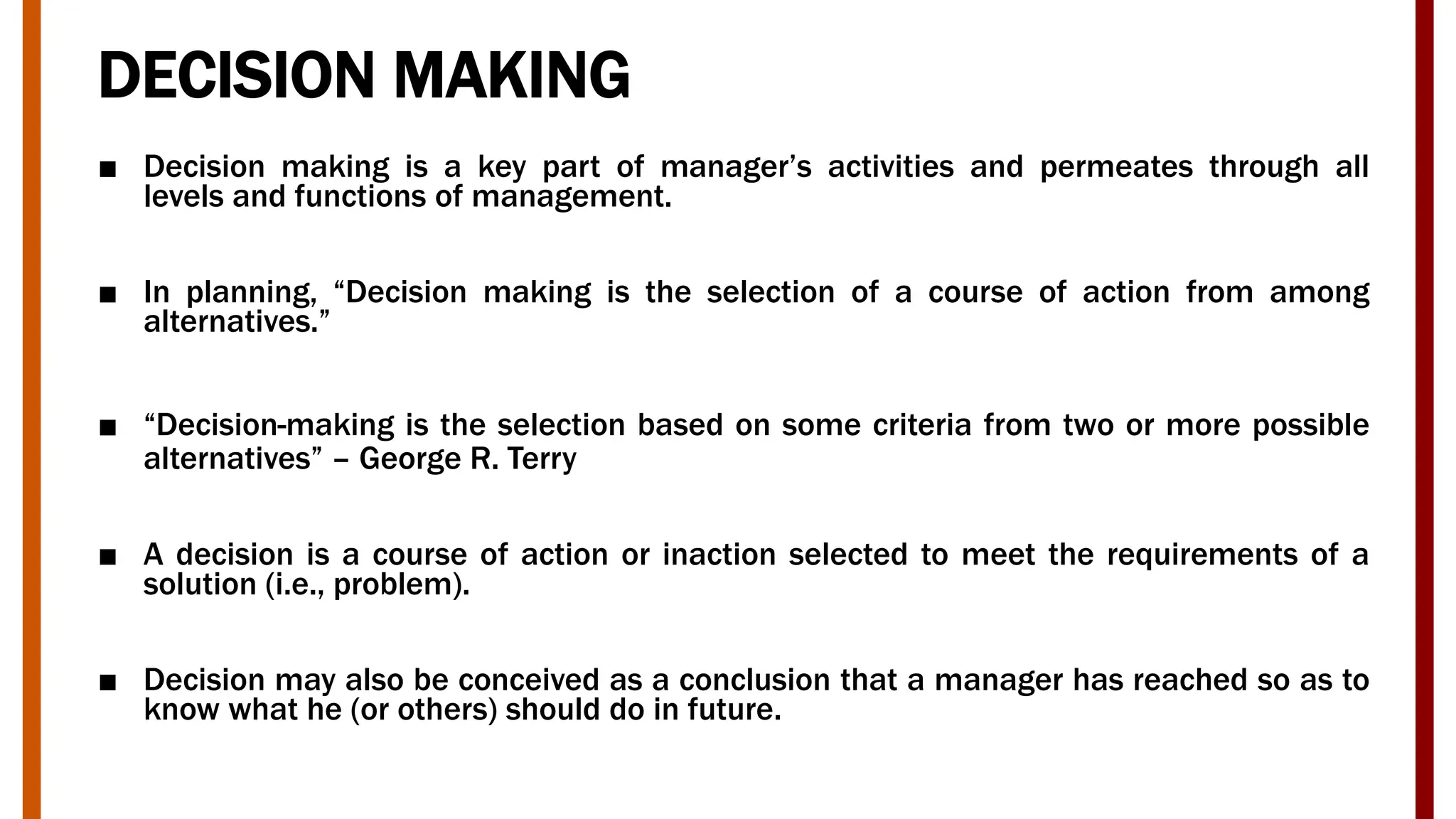
■ Decision making is a key part of manager’s activities and permeates through all
levels and functions of management.
■ In planning, “Decision making is the selection of a course of action from among
alternatives.”
■ “Decision-making is the selection based on some criteria from two or more possible
alternatives” – George R. Terry
■ A decision is a course of action or inaction selected to meet the requirements of a
solution (i.e., problem).
■ Decision may also be conceived as a conclusion that a manager has reached so as to
know what he (or others) should do in future.
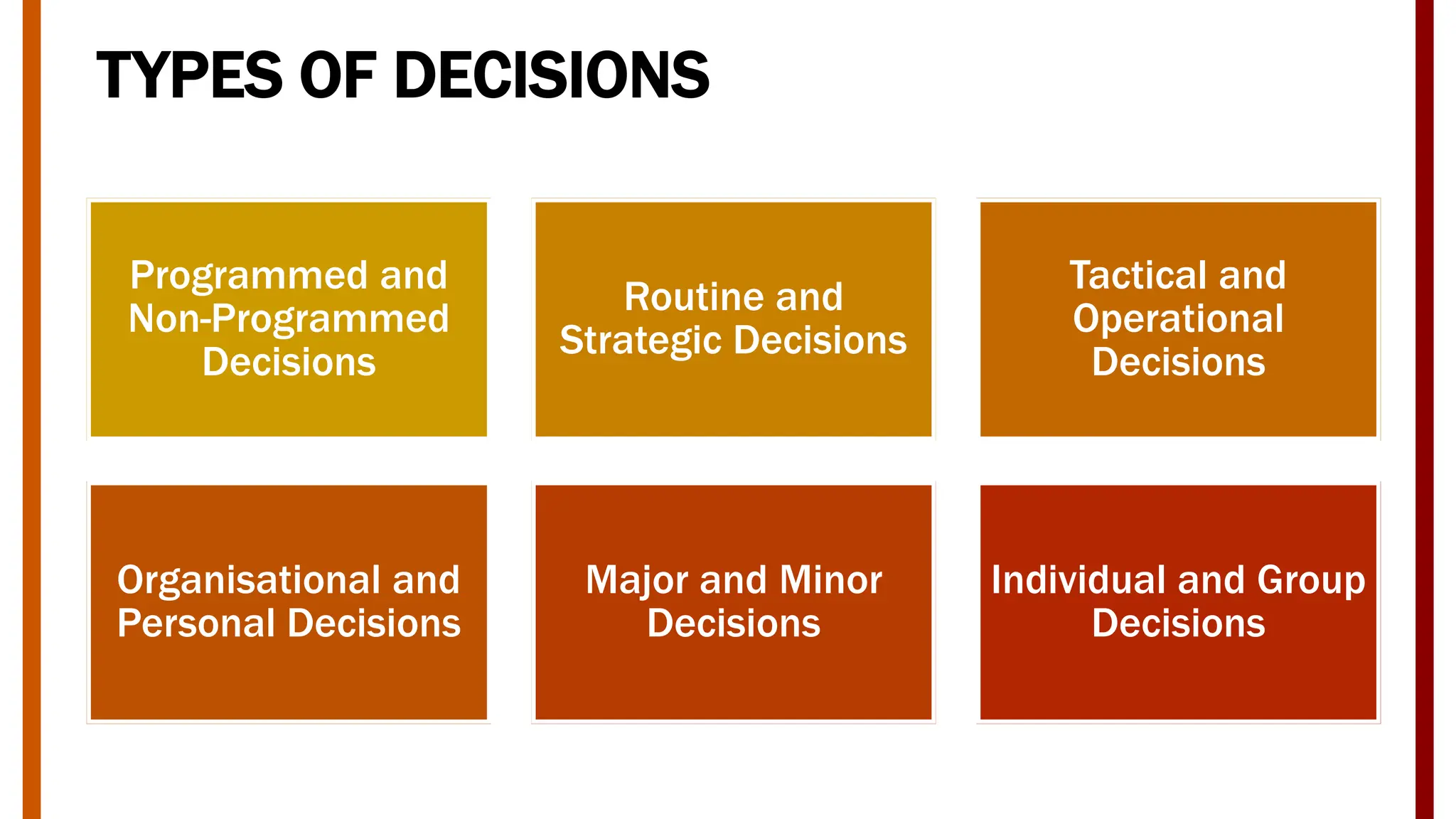
TYPES OF DECISIONS
Programmed and
Non-Programmed
Decisions
Routine and
Strategic Decisions
Tactical and
Operational
Decisions
Organisational and
Personal Decisions
Major and Minor
Decisions
Individual and Group
Decisions
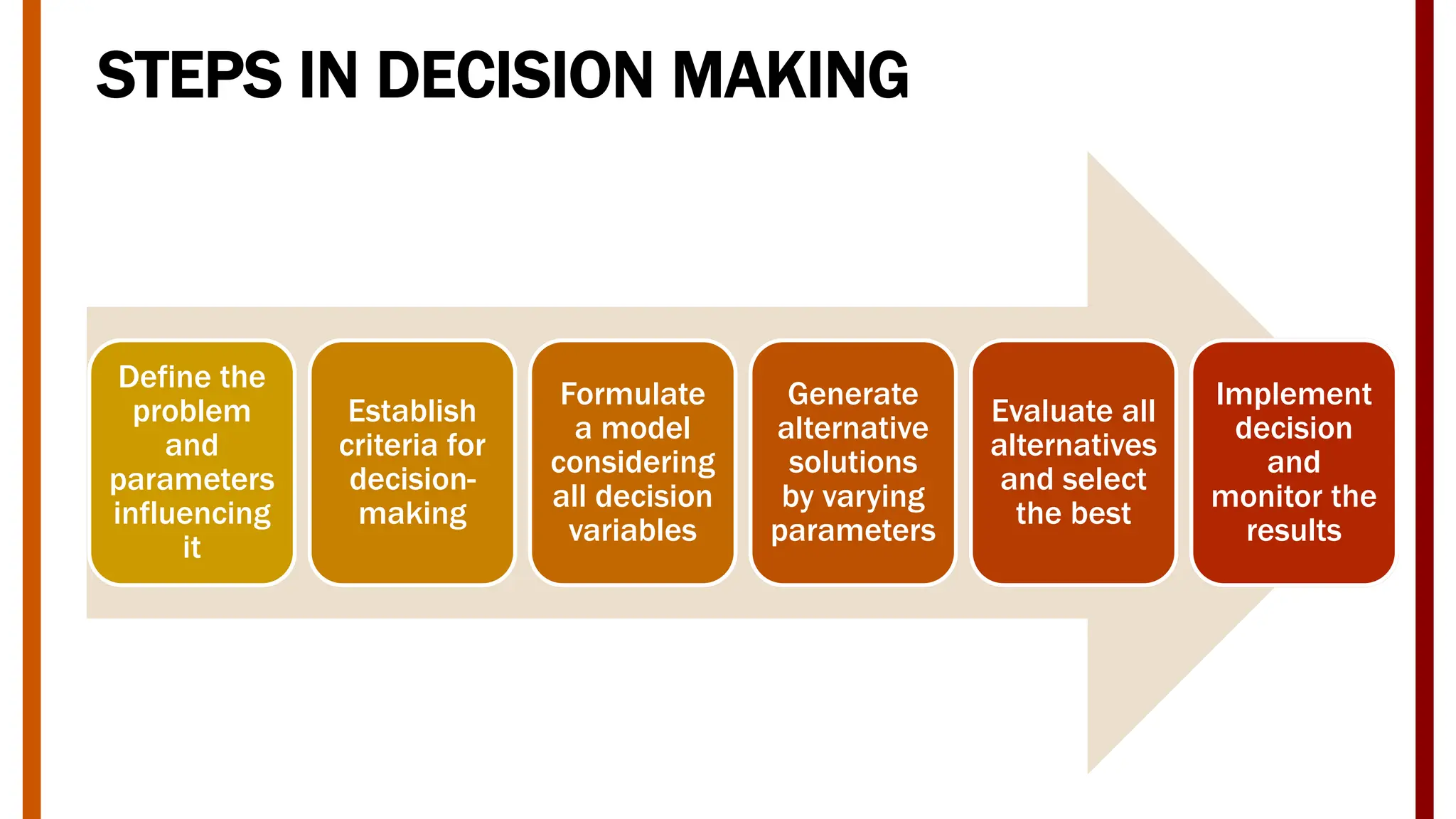
STEPS IN DECISION MAKING
Define the
problem
and
parameters
influencing
it
Establish
criteria for
decision-
making
Formulate
a model
considering
all decision
variables
Generate
alternative
solutions
by varying
parameters
Evaluate all
alternatives
and select
the best
Implement
decision
and
monitor the
results
THANK YOU

Management, Planning and Decision Making

  • 1.
  • 2.
    SYLLABUS ■ MANAGEMENT – Meaningand Definition – Functions of Management – Importance – Nature and Characteristics of Management – Scope and Functional areas of management – Management as a Science, Art or Profession – Management & Administration – Roles of Manager – Levels of Management – Managerial Skills
  • 3.
    SYLLABUS ■ PLANNING – Nature –Importance and Purpose of planning – Types of plans – Steps in planning – Limitations of Planning ■ DECISION MAKING – Meaning – Types of Decisions – Steps in Decision Making
  • 4.
  • 5.
    DEFINITIONS ■ “Management isan art of knowing what is to be done and seeing that it is done in the best possible manner.” – F.W. Taylor ■ “Management is to forecast, to plan, to organise, to command, to co-ordinate and control activities of others.” - Henri Fayol ■ “Management is the art of getting things done through the people” – Mary Parker Follett ■ “Management is the co-ordination of all resources through the process of planning, organising, directing and controlling in order to attain stated goals.” – Henry Sisk
  • 6.
    MEANING ■ Management inbusiness and organizations is the function that coordinates the efforts of people to accomplish goals and objectives using available resources efficiently and effectively. ■ Management is a process consisting of planning, organizing, directing and controlling, performed to determine and accomplish the objectives by the use of people and resources. ■ Resourcing encompasses the deployment and manipulation of human resources, financial resources, technological resources and natural resources. ■ Management’s primary function is to get people to work together for attainment of an organization’s goals and objectives
  • 7.
    ESSENTIAL FUNCTIONS OFMANAGEMENT Planning Organising Staffing Directing Controlling
  • 8.
    IMPORTANCE OF MANAGEMENT 1.Helps to achieve goals and objectives 2. Provides a sense of focus and direction 3. For optimum utilization of resources 4. To maintain responsibility and order 5. To get the most qualified personnel for the job 6. To reduce workload and get things done 7. Helps facilitate good communication 8. Helps to initiate action and keep the organization moving 9. To monitor progress and chart a way forward 10.To hold individuals accountable PLANNING ORGANISING STAFFING DIRECTING CONTROLLING
  • 9.
    IMPORTANCE OF MANAGEMENT 1.Management helps in achieving group goal 2. Management improves efficiency 3. Management creates a dynamic organization 4. Management helps in achieving personal objectives 5. Management helps in development of society 6. Management brings harmony in work
  • 10.
    NATURE AND CHARACTERISTICS Universal Goal-oriented Continuousprocess Multi-dimensional Group activity Dynamic function Intangible force MANAGEMENT
  • 11.
    SCOPE OF MANAGEMENT SUBJECT MATTER OFMANAGEMENT Planning Organising Staffing Directing Controlling FUNCTIONAL AREAS OF MANAGEMENT
  • 12.
    Functional Areas of Management Financial Management Human ResourceManagement Production Management Marketing Management Distribution Management Maintenance Management Office Management
  • 13.
    MANAGEMENT AND ADMINISTRATION ■Management is the art of getting things done through & with the people in formally organized groups. ■ Administration means guidance, leadership & control of the efforts of the groups towards some common goals ■ Broadly speaking, management takes into account the directing and controlling functions of the organization, whereas administration is related to planning and organizing function.
  • 14.
    BASIS MANAGEMENT ADMINISTRATION AuthorityMiddle and Lower Level Top level Nature Management is an executing function. Administration is a decision-making function. Role Executive Decisive Concerned with Policy Implementation Policy Formulation Area of operation It works under administration. It has full control over the activities of the organization. Decides Who will do the work? How will it be done? What should be done? When it should be done? Work Putting plans and policies into actions. Formulation of plans, framing policies and setting objectives Focus on Managing work Making best possible allocation of limited resources. Function Executive and Governing Legislative and Determinative
  • 15.
    ROLES OF MANAGER ■MINTZBERG’S Management Roles •Figurehead •Leader •Liaison INTERPERSONAL •Monitor •Disseminator •Spokesperson INFORMATIONAL •Entrepreneur •Disturbance handler •Resource Allocator •Negotiator DECISIONAL
  • 19.
  • 20.
    MANAGERIAL SKILLS ■ ROBERTKATZ’S 3 Management Skills
  • 21.
  • 22.
  • 23.
    MEANING AND DEFINITIONS ■Planning is deciding in advance what to do, how to do it, when to do it and who is to do it. It bridges the gap from where we are, to where we want to go. It is in essence the exercise of foresight”. - Koontz and O’Donell ■ “Planning is deciding in advance what is to be done. It involves the selection of objectives, policies, procedures and programmes from among alternatives.” – M.S. Hardy ■ Planning is a pre-decided course of action which will be taken in future. It deals with the determination of objectives to be achieved, and the activities required to achieve the objectives. ■ Planning is the determination of a future course of action to achieve any desired result. It is the process of thinking before doing. It depicts a framework within which other management functions will operate. It is a continuous process that takes place at all levels of management.
  • 24.
    NATURE/FEATURES/CHARACTERISTICS OF PLANNING 1.Planning is a primary function 2. Planning is goal-oriented 3. Planning is an intellectual process 4. Planning involves choice 5. Planning is rational 6. Planning is a continuous process 7. Planning must be flexible 8. Planning is pervasive 9. Planning is an integrated process 10. Planning is futuristic
  • 25.
    IMPORTANCE AND PURPOSE 1.Planning provides direction 2. Planning minimizes risk and uncertainty 3. Planning ensures co-ordination 4. Planning facilitates decision-making 5. Planning leads to economy in operation and reduces wastage of efforts 6. Planning facilitates control 7. Planning helps prepare for contingency
  • 26.
    STEPS IN PLANNING 1. Establishing verifiable goalsand objectives 2. Establishing Planning Premises 3. Deciding the Planning Period 4. Identifying alternative courses of action 5. Evaluating and Selecting a course of action 6. Developing derivative/ supportive plans 7. Establishing and deploying action plans 8. Measuring and controlling the progress
  • 27.
    TYPES OF PLANS PLANS StandingPlans Objectives Policies Strategies Procedures Methods Rules Single Use Plans Programmes Schedules Projects Budgets
  • 28.
    LIMITATIONS OF PLANNING 1.Expensive and time consuming process 2. Restrictive and reduces employee initiative 3. May not work in a dynamic environment 4. Reluctance to change 5. Lack of accurate information and forecasts 6. Planning does not guarantee success
  • 29.
    DECISION MAKING ■ Decisionmaking is a key part of manager’s activities and permeates through all levels and functions of management. ■ In planning, “Decision making is the selection of a course of action from among alternatives.” ■ “Decision-making is the selection based on some criteria from two or more possible alternatives” – George R. Terry ■ A decision is a course of action or inaction selected to meet the requirements of a solution (i.e., problem). ■ Decision may also be conceived as a conclusion that a manager has reached so as to know what he (or others) should do in future.
  • 30.
    TYPES OF DECISIONS Programmedand Non-Programmed Decisions Routine and Strategic Decisions Tactical and Operational Decisions Organisational and Personal Decisions Major and Minor Decisions Individual and Group Decisions
  • 31.
    STEPS IN DECISIONMAKING Define the problem and parameters influencing it Establish criteria for decision- making Formulate a model considering all decision variables Generate alternative solutions by varying parameters Evaluate all alternatives and select the best Implement decision and monitor the results
  • 32.

Editor's Notes

  • #5 The knowledge of management science is very much essential for an engineer Management science helps to brings together the technological problem-solving savvy of engineering In general everyone is involved in management processes everyday while planning day to day activities,
  • #8 Planning in management is the process of laying down how and when to do the appropriate so that goals can be achieved either in the short term or long term Organizing involves defining and grouping roles, establishing authorities and frameworks that are geared towards the attainment of goals. It breaks down how plans will be implemented and assigns the resources needed to do so To staff means to select, develop, maintain, and utilize personnel in such a way that the organization can achieve its goals effectively and economically. In management, directing is the same as supervising or leading. Directors, supervisors, and leaders are responsible for overseeing their subordinates. It is impossible to run an organization without leadership as you will find out below. n an organization, the controlling function of management focuses on checking whether progress is being made, while measuring the performance of various aspects.