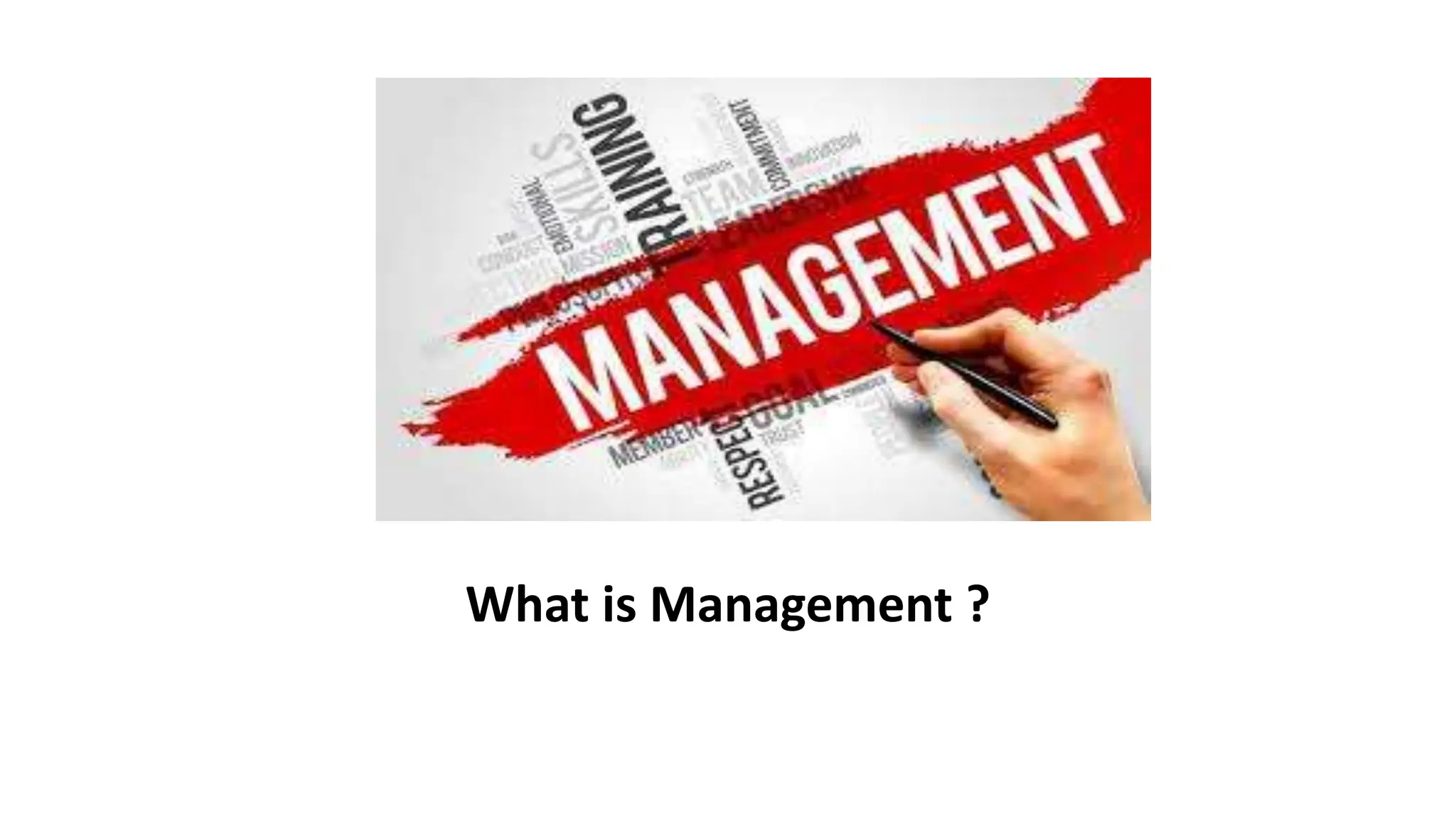
What is Management ?
How you manage your day?
• Wake Up ?
• Exercise?
• Diet?
• Study?
• Hobby?
• Communication?
• Sleep?
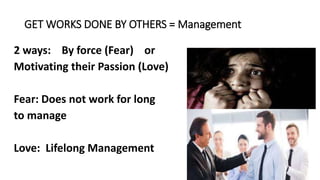
GET WORKS DONE BY OTHERS = Management
2 ways: By force (Fear) or
Motivating their Passion (Love)
Fear: Does not work for long
to manage
Love: Lifelong Management
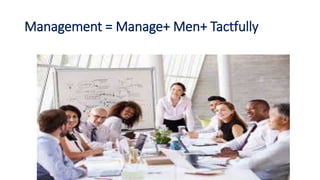
Management = Manage+ Men+ Tactfully
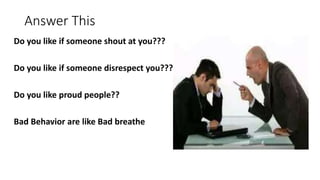
Answer This
Do you like if someone shout at you???
Do you like if someone disrespect you???
Do you like proud people??
Bad Behavior are like Bad breathe
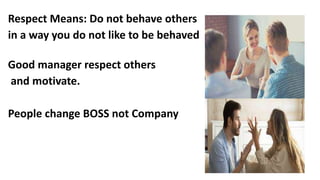
Respect Means: Do not behave others
in a way you do not like to be behaved
Good manager respect others
and motivate.
People change BOSS not Company
Management
• A'Management Is a distinct process consisting of
planning, organising, actuating and controlling;
utilising in each both science and art, and followed in
order to accomplish pre-determined objectives."
• George R Terry (1877 - 1955)
•"Management is the art of getting things done
through others and with formally organised
groups."
•Harold Koontz (1909-1984)
Father of Management
• Peter Ferdinand Drucker
• (November 19, 1909 – November 11, 2005)
• "Management may be defined as the process by means of
which the purpose and objectives of a particular human group
are determined, clarified and effectuated"
• Management is a multipurpose organ that manage a business
and manages Managers and manages Workers and work.
Father of Scientific Management
•"Management is the art of knowing what you
want to do and then seeing that they do it in the
best and the cheapest may.“
•Frederick Winslow Taylor (March 20, 1856 –
March 21, 1915)
Nature and Characteristics of
Management
• 1. Management as a Science
• Science as a discipline has the following characteristics:
• i. Systematic body of knowledge
ii. Principles based on experimentation
iii. Universal validity of the laws and principles
i. Management is a systematic body of knowledge with its own
theories and principles.
ii. The principles of management also evolved through repeated
experimentation. But since management deals with humans, the
outcome of the experiments is significantly unpredictable.
iii. The principles of management do not have a universal applicability
and need modification under different circumstances.
Thus, it can be said that management is not an exact science. It is a
social science as it deals with humans or in the words of Ernest Dale –
‘Management is a soft science’.
• 2. Management as an Art
• Art implies application of knowledge. It is highly personalized
activity to achieve desired goals. Since, art varies from person
to person it is prone to failure.
• Just like any other art:
• i. management is also application of knowledge in different
situations.
ii. management is a highly personalized activity and varies from
manager to manager. Thus, management is also prone to
failure.
iii. management is action-oriented to achieve organizational
objectives.
• Thus, management is a perfect art or rather a fine art.
• 3. Management as a Profession
• According to McFarland, various characteristics of a
professional activity are:
• i. based on special skills and knowledge
ii. formal methods of acquiring these skills.
iii. an apex body which issues guidelines for professionalization
of the occupation.
iv. a uniform code of conduct to regulate the members.
v. providing service for a fee.
vi. social responsibility.
• Management is a professional activity like doctors and lawyers.
Although every organization tries to design their ethical codes of
behaviour individually, there is absence of a uniform code of
conduct.
• Thus, management can be considered as a developing
profession.
• 4. Management is a goal-oriented process: Every organisation
has formed for some specific purpose. The goal of management
should be to achieve these purposes. These should be simple
and clearly stated.
• 5. Management is all pervasive: The activities involved in
managing an organisation are common to all whether it is
performed economic, social or political activity. A petrol pump
needs to be managed as much as a hospital or a school.
Management is not only required for
• 6. Management is multidimensional: Management is a complex
activity that has three main dimensions. These are:
• (a) Management of work:
(b) Management of people:
(c) Management of operations:
• 7. Management is a continuous process: The process of
management is a series of continuous, composite, but separate
functions (planning, organising, directing, staffing and
controlling).
• 8. Management is a group activity: An organisation is a group
of diverse individuals with different needs. Every member of the
group has a different purpose for joining the organisation but as
members of the organisation they work towards fulfilling the
common organisational goal. This requires team work and
coordination of individual effort in a common direction.
• 9. Management is a dynamic function: Management is a
dynamic function and has to adapt itself to the changing
environment.
• An organisation interacts with its external environment which
consists of various social, economic and political factors. In
order to be successful, an organisation must change itself and
its goals according to the needs of the environment.
• 10. Management is an intangible force: Management is an
intangible force that cannot be seen but its presence can be felt
in the way the organisation functions.
• Importance/ Significance of Management
• Importance of management to an organization can be gauged
through the activities it performs. These activities can be listed
as:
1.Optimum utilization of resources: Management helps to utilize the
resources in best possible manner thereby reducing the wastage
ensuring maximum possible profitability. This gives business a
competitive edge in the market and also helps in growth and
expansion of business.
2.Cordial industrial relations: It motivates employees to perform the
assigned job to their potential level. This increases productivity and
results in higher satisfaction level among the employees. The
employee turnover and absenteeism is also reduced. Thus,
management and workers have cordial relationship.
3. Adapting to changed environment: Management keeps a track of
the changes in business environment. This helps organization to adapt to
the changed situations of the market. Bringing about changes in the
organization, including introduction of new technology, becomes easier
with the efforts of the managers.
4. Develops team spirit: Management brings about unity of direction in
the organization as it guides all the efforts towards the achievement of a
common objective. This helps develop team-spirit in the organization.
5. Effective communication: Management brings about an effective
communication – both upwards and downwards. This helps in smooth
functioning of the organization.
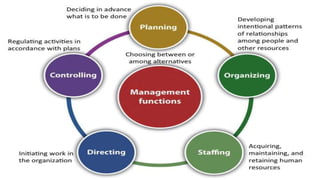
• Management Functions
• Following are the main functions of management:
1.Planning
2.Organising
3.Staffing
4.Directing, and
5.Controlling
Objectives of Management
• 1. Optimize resources
• Management teams work to use resources effectively to
provide the most output possible.
• This objective creates the ability to increase profits by
reducing the ratio of resource costs to profits.
• Management teams implement logistic strategies and
procedures to identify and reduce processes that create
waste and require extra resources.
• 2. Increase efficiency
• Increasing the efficiency of operations, production
and services allows for greater production, sales
and profits.
• Management systems track the processes,
duration and flow of the workplace to determine
methods that provide more efficient outcomes.
• Managers may work with other employees and
department leaders to create and implement new
processes and requirements.
• 3. Maximize profits
• Management teams aim to find the balance between
maximizing profits and promoting a beneficial workplace
for employees.
• Maximizing profits includes working with various
departments and leaders such as accountants,
supervisors and executives to determine areas that
require improvements and changes.
• Managers can achieve maximum profit objectives by
identifying unnecessary expenses and waste and
creating new procedures for more efficient operations.
• 4. Promote personal development
• An effective management team prioritizes the growth
and development of its employees.
• Providing opportunities such as seminars, mentorship
programs, training resources and internal promotions
allows employees to develop new skills and advance
their careers.
• The personal development and growth of employees
can also contribute to the growth, quality and efficiency
of work produced and can help management achieve
multiple objectives simultaneously.
• 5. Maintain quality
• Management teams handle the regulations,
procedures and parameters for the production
and distribution of products and services.
• A primary objective of management includes
maintaining the quality standards necessary for
the organization.
• The team collaborates with other departments,
supervisors and employees to create, implement
and maintain quality.
6. Reduce risk
• Many management positions focus on forecasting
and projecting results and changes.
• One main objective for managers includes using
planning and predictions to reduce opportunities
for risks and losses.
• Reducing risk factors such as safety issues,
wasted resources and extra expenses can help
increase profits and eliminate loss.
7. Identify talent
• An organization's management aims to identify,
acquire and maintain top candidates and
employees.
• Managers may work with recruiters to establish
hiring requirements, evaluate candidates and
create recruitment offers.
• Identifying and gaining talented and qualified
employees increases the knowledge, expertise
and production of the organization as a whole.
Scope of Management
• The definition of the scope of management comes from the business
ideas, theories, principles and responsibilities that a business uses
for managing its various functions. The scope of management can
cover:
• 1. 1. Financial management
• Financial management is a top priority for companies as the effective
and proper managing of finances enables them to stay in business
and remain competitive. It is necessary for companies to plan,
organise, direct and control their financial activities to increase profit
and reduce wastage of resources. By applying management
principles to their financial resources, companies can keep track of
how they procure revenues and how they utilise them.
• 2. Marketing management
• Marketing management usually covers the different marketing
activities undertaken by the company's marketing department.
These may include identifying consumer trends and creating
appropriate business solutions to respond to them.
• Implementing marketing plans, directing their implementation
and controlling the work activities are also usually part of
marketing management.
• The different functions of marketing management typically
include market research, financing, risk-taking, campaign
planning, customer outreach, loyalty programmes, lead
generation and customer relationship management.
• 3. Personnel management/ Human Resource Management
• Personnel management is about managing the personnel or
staff in an organisation and maintaining a positive and
productive business environment.
• It includes establishing effective communication with the
organisation's personnel, publishing company policies,
implementing health and safety practices, responding to
grievances and taking disciplinary action when necessary.
• Personnel management also involves determining the
compensation and benefits packages that the employees can
receive from the organisation.
• 4. Production management
• Production management is the application of management
principles to the different production activities in a company's
production department.
• It usually involves handling the entire manufacturing process
and planning, organising, overseeing and monitoring the
production of goods and services.
• In production management, the production manager is
responsible for procuring raw materials, hiring and assigning
labour for different work activities, maintaining equipment and
creating production budgets.
• They also supervise work performance, oversee research and
development, ensure quality control and monitor delivery and
storage of finished products.
• 5. Office management
• Office management concerns the planning, coordinating
and controlling the different work activities in an office
environment.
• The aim of office management is to ensure the smooth
and efficient functioning of all office departments to get
the necessary work done and achieve the organisation's
work targets and business goals.
• The primary functions of office management are
planning projects, hiring qualified employees, organising
and assigning work tasks, directing and guiding project
work and monitoring and controlling the work
processes.
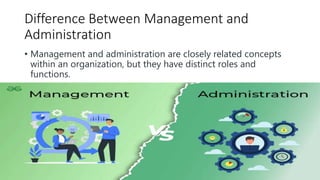
Difference Between Management and
Administration
• Management and administration are closely related concepts
within an organization, but they have distinct roles and
functions.
Meaning
• Management encompasses the process of strategically
planning, organizing resources, coordinating efforts, directing
activities, and maintaining control within an organization to
achieve its intended goals and objectives.
• Administration involves overseeing an organisation’s day-to-day
operations, ensuring they run smoothly by implementing
policies and decisions set by management.
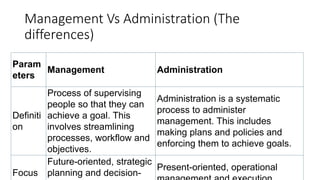
Management Vs Administration (The
differences)
Param
eters
Management Administration
Definiti
on
Process of supervising
people so that they can
achieve a goal. This
involves streamlining
processes, workflow and
objectives.
Administration is a systematic
process to administer
management. This includes
making plans and policies and
enforcing them to achieve goals.
Focus
Future-oriented, strategic
planning and decision-
Present-oriented, operational
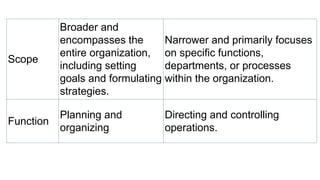
Scope
Broader and
encompasses the
entire organization,
including setting
goals and formulating
strategies.
Narrower and primarily focuses
on specific functions,
departments, or processes
within the organization.
Function
Planning and
organizing
Directing and controlling
operations.
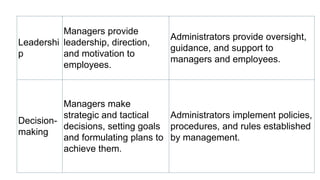
Leadershi
p
Managers provide
leadership, direction,
and motivation to
employees.
Administrators provide oversight,
guidance, and support to
managers and employees.
Decision-
making
Managers make
strategic and tactical
decisions, setting goals
and formulating plans to
achieve them.
Administrators implement policies,
procedures, and rules established
by management.
THANK YOU

PPT 1 Management Concept and Practises-1.pptx

  • 1.
  • 2.
    How you manageyour day? • Wake Up ? • Exercise? • Diet? • Study? • Hobby? • Communication? • Sleep?
  • 4.
    GET WORKS DONEBY OTHERS = Management 2 ways: By force (Fear) or Motivating their Passion (Love) Fear: Does not work for long to manage Love: Lifelong Management
  • 5.
    Management = Manage+Men+ Tactfully
  • 6.
    Answer This Do youlike if someone shout at you??? Do you like if someone disrespect you??? Do you like proud people?? Bad Behavior are like Bad breathe
  • 7.
    Respect Means: Donot behave others in a way you do not like to be behaved Good manager respect others and motivate. People change BOSS not Company
  • 8.
    Management • A'Management Isa distinct process consisting of planning, organising, actuating and controlling; utilising in each both science and art, and followed in order to accomplish pre-determined objectives." • George R Terry (1877 - 1955)
  • 9.
    •"Management is theart of getting things done through others and with formally organised groups." •Harold Koontz (1909-1984)
  • 10.
    Father of Management •Peter Ferdinand Drucker • (November 19, 1909 – November 11, 2005) • "Management may be defined as the process by means of which the purpose and objectives of a particular human group are determined, clarified and effectuated" • Management is a multipurpose organ that manage a business and manages Managers and manages Workers and work.
  • 11.
    Father of ScientificManagement •"Management is the art of knowing what you want to do and then seeing that they do it in the best and the cheapest may.“ •Frederick Winslow Taylor (March 20, 1856 – March 21, 1915)
  • 12.
    Nature and Characteristicsof Management • 1. Management as a Science • Science as a discipline has the following characteristics: • i. Systematic body of knowledge ii. Principles based on experimentation iii. Universal validity of the laws and principles
  • 13.
    i. Management isa systematic body of knowledge with its own theories and principles. ii. The principles of management also evolved through repeated experimentation. But since management deals with humans, the outcome of the experiments is significantly unpredictable. iii. The principles of management do not have a universal applicability and need modification under different circumstances. Thus, it can be said that management is not an exact science. It is a social science as it deals with humans or in the words of Ernest Dale – ‘Management is a soft science’.
  • 14.
    • 2. Managementas an Art • Art implies application of knowledge. It is highly personalized activity to achieve desired goals. Since, art varies from person to person it is prone to failure. • Just like any other art: • i. management is also application of knowledge in different situations. ii. management is a highly personalized activity and varies from manager to manager. Thus, management is also prone to failure. iii. management is action-oriented to achieve organizational objectives. • Thus, management is a perfect art or rather a fine art.
  • 15.
    • 3. Managementas a Profession • According to McFarland, various characteristics of a professional activity are: • i. based on special skills and knowledge ii. formal methods of acquiring these skills. iii. an apex body which issues guidelines for professionalization of the occupation. iv. a uniform code of conduct to regulate the members. v. providing service for a fee. vi. social responsibility. • Management is a professional activity like doctors and lawyers. Although every organization tries to design their ethical codes of behaviour individually, there is absence of a uniform code of conduct. • Thus, management can be considered as a developing profession.
  • 16.
    • 4. Managementis a goal-oriented process: Every organisation has formed for some specific purpose. The goal of management should be to achieve these purposes. These should be simple and clearly stated. • 5. Management is all pervasive: The activities involved in managing an organisation are common to all whether it is performed economic, social or political activity. A petrol pump needs to be managed as much as a hospital or a school. Management is not only required for • 6. Management is multidimensional: Management is a complex activity that has three main dimensions. These are: • (a) Management of work: (b) Management of people: (c) Management of operations:
  • 17.
    • 7. Managementis a continuous process: The process of management is a series of continuous, composite, but separate functions (planning, organising, directing, staffing and controlling). • 8. Management is a group activity: An organisation is a group of diverse individuals with different needs. Every member of the group has a different purpose for joining the organisation but as members of the organisation they work towards fulfilling the common organisational goal. This requires team work and coordination of individual effort in a common direction.
  • 18.
    • 9. Managementis a dynamic function: Management is a dynamic function and has to adapt itself to the changing environment. • An organisation interacts with its external environment which consists of various social, economic and political factors. In order to be successful, an organisation must change itself and its goals according to the needs of the environment. • 10. Management is an intangible force: Management is an intangible force that cannot be seen but its presence can be felt in the way the organisation functions.
  • 19.
    • Importance/ Significanceof Management • Importance of management to an organization can be gauged through the activities it performs. These activities can be listed as: 1.Optimum utilization of resources: Management helps to utilize the resources in best possible manner thereby reducing the wastage ensuring maximum possible profitability. This gives business a competitive edge in the market and also helps in growth and expansion of business. 2.Cordial industrial relations: It motivates employees to perform the assigned job to their potential level. This increases productivity and results in higher satisfaction level among the employees. The employee turnover and absenteeism is also reduced. Thus, management and workers have cordial relationship.
  • 20.
    3. Adapting tochanged environment: Management keeps a track of the changes in business environment. This helps organization to adapt to the changed situations of the market. Bringing about changes in the organization, including introduction of new technology, becomes easier with the efforts of the managers. 4. Develops team spirit: Management brings about unity of direction in the organization as it guides all the efforts towards the achievement of a common objective. This helps develop team-spirit in the organization. 5. Effective communication: Management brings about an effective communication – both upwards and downwards. This helps in smooth functioning of the organization.
  • 21.
    • Management Functions •Following are the main functions of management: 1.Planning 2.Organising 3.Staffing 4.Directing, and 5.Controlling
  • 22.
    Objectives of Management •1. Optimize resources • Management teams work to use resources effectively to provide the most output possible. • This objective creates the ability to increase profits by reducing the ratio of resource costs to profits. • Management teams implement logistic strategies and procedures to identify and reduce processes that create waste and require extra resources.
  • 23.
    • 2. Increaseefficiency • Increasing the efficiency of operations, production and services allows for greater production, sales and profits. • Management systems track the processes, duration and flow of the workplace to determine methods that provide more efficient outcomes. • Managers may work with other employees and department leaders to create and implement new processes and requirements.
  • 24.
    • 3. Maximizeprofits • Management teams aim to find the balance between maximizing profits and promoting a beneficial workplace for employees. • Maximizing profits includes working with various departments and leaders such as accountants, supervisors and executives to determine areas that require improvements and changes. • Managers can achieve maximum profit objectives by identifying unnecessary expenses and waste and creating new procedures for more efficient operations.
  • 25.
    • 4. Promotepersonal development • An effective management team prioritizes the growth and development of its employees. • Providing opportunities such as seminars, mentorship programs, training resources and internal promotions allows employees to develop new skills and advance their careers. • The personal development and growth of employees can also contribute to the growth, quality and efficiency of work produced and can help management achieve multiple objectives simultaneously.
  • 26.
    • 5. Maintainquality • Management teams handle the regulations, procedures and parameters for the production and distribution of products and services. • A primary objective of management includes maintaining the quality standards necessary for the organization. • The team collaborates with other departments, supervisors and employees to create, implement and maintain quality.
  • 27.
    6. Reduce risk •Many management positions focus on forecasting and projecting results and changes. • One main objective for managers includes using planning and predictions to reduce opportunities for risks and losses. • Reducing risk factors such as safety issues, wasted resources and extra expenses can help increase profits and eliminate loss.
  • 28.
    7. Identify talent •An organization's management aims to identify, acquire and maintain top candidates and employees. • Managers may work with recruiters to establish hiring requirements, evaluate candidates and create recruitment offers. • Identifying and gaining talented and qualified employees increases the knowledge, expertise and production of the organization as a whole.
  • 29.
    Scope of Management •The definition of the scope of management comes from the business ideas, theories, principles and responsibilities that a business uses for managing its various functions. The scope of management can cover: • 1. 1. Financial management • Financial management is a top priority for companies as the effective and proper managing of finances enables them to stay in business and remain competitive. It is necessary for companies to plan, organise, direct and control their financial activities to increase profit and reduce wastage of resources. By applying management principles to their financial resources, companies can keep track of how they procure revenues and how they utilise them.
  • 30.
    • 2. Marketingmanagement • Marketing management usually covers the different marketing activities undertaken by the company's marketing department. These may include identifying consumer trends and creating appropriate business solutions to respond to them. • Implementing marketing plans, directing their implementation and controlling the work activities are also usually part of marketing management. • The different functions of marketing management typically include market research, financing, risk-taking, campaign planning, customer outreach, loyalty programmes, lead generation and customer relationship management.
  • 31.
    • 3. Personnelmanagement/ Human Resource Management • Personnel management is about managing the personnel or staff in an organisation and maintaining a positive and productive business environment. • It includes establishing effective communication with the organisation's personnel, publishing company policies, implementing health and safety practices, responding to grievances and taking disciplinary action when necessary. • Personnel management also involves determining the compensation and benefits packages that the employees can receive from the organisation.
  • 32.
    • 4. Productionmanagement • Production management is the application of management principles to the different production activities in a company's production department. • It usually involves handling the entire manufacturing process and planning, organising, overseeing and monitoring the production of goods and services. • In production management, the production manager is responsible for procuring raw materials, hiring and assigning labour for different work activities, maintaining equipment and creating production budgets. • They also supervise work performance, oversee research and development, ensure quality control and monitor delivery and storage of finished products.
  • 33.
    • 5. Officemanagement • Office management concerns the planning, coordinating and controlling the different work activities in an office environment. • The aim of office management is to ensure the smooth and efficient functioning of all office departments to get the necessary work done and achieve the organisation's work targets and business goals. • The primary functions of office management are planning projects, hiring qualified employees, organising and assigning work tasks, directing and guiding project work and monitoring and controlling the work processes.
  • 34.
    Difference Between Managementand Administration • Management and administration are closely related concepts within an organization, but they have distinct roles and functions.
  • 35.
    Meaning • Management encompassesthe process of strategically planning, organizing resources, coordinating efforts, directing activities, and maintaining control within an organization to achieve its intended goals and objectives. • Administration involves overseeing an organisation’s day-to-day operations, ensuring they run smoothly by implementing policies and decisions set by management.
  • 36.
    Management Vs Administration(The differences) Param eters Management Administration Definiti on Process of supervising people so that they can achieve a goal. This involves streamlining processes, workflow and objectives. Administration is a systematic process to administer management. This includes making plans and policies and enforcing them to achieve goals. Focus Future-oriented, strategic planning and decision- Present-oriented, operational
  • 37.
    Scope Broader and encompasses the entireorganization, including setting goals and formulating strategies. Narrower and primarily focuses on specific functions, departments, or processes within the organization. Function Planning and organizing Directing and controlling operations.
  • 38.
    Leadershi p Managers provide leadership, direction, andmotivation to employees. Administrators provide oversight, guidance, and support to managers and employees. Decision- making Managers make strategic and tactical decisions, setting goals and formulating plans to achieve them. Administrators implement policies, procedures, and rules established by management.
  • 39.