Management
Definition: Management can be defined as the process of administering
and controlling the affairs of the organization, irrespective of its nature,
type, structure and size. It is an act of creating and maintaining such
a business environment wherein the members of the organization can work
together, and achieve business objectives efficiently and effectively.
Management acts as a guide to a group of people working in the
organization and coordinating their efforts, towards the attainment of the
common objective.
In other words, it is concerned with optimally using 5M’s, i.e. men,
machine, material, money and methods and, this is possible only when
there proper direction, coordination and integration of the processes and
activities, to achieve the desired results.
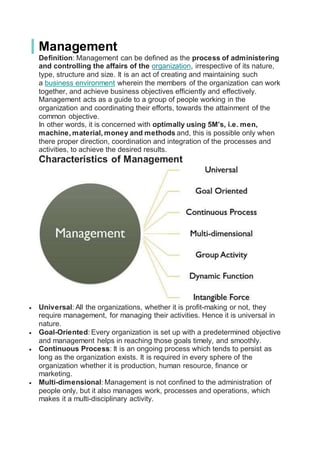
Characteristics of Management
 Universal: All the organizations, whether it is profit-making or not, they
require management, for managing their activities. Hence it is universal in
nature.
 Goal-Oriented: Every organization is set up with a predetermined objective
and management helps in reaching those goals timely, and smoothly.
 Continuous Process: It is an ongoing process which tends to persist as
long as the organization exists. It is required in every sphere of the
organization whether it is production, human resource, finance or
marketing.
 Multi-dimensional: Management is not confined to the administration of
people only, but it also manages work, processes and operations, which
makes it a multi-disciplinary activity.
 Group activity: An organization consists of various members who have
different needs, expectations and beliefs. Every person joins the
organization with a different motive, but after becoming a part of the
organization they work for achieving the same goal. It requires supervision,
teamwork and coordination, and in this way, management comes into the
picture.
 Dynamic function: An organization exists in a business environment that
has various factors like social, political, legal, technological and economic.
A slight change in any of these factors will affect the organization’s growth
and performance. So, to overcome these changes management formulates
strategies and implements them.
 Intangible force: Management can neither be seen nor touched but one
can feel its existence, in the way the organization functions.
Precisely, all the functions, activities and processes of the organization are
interconnected to one another. And it is the task of the management to
bring them together in such a way that they help in reaching the intended
result.
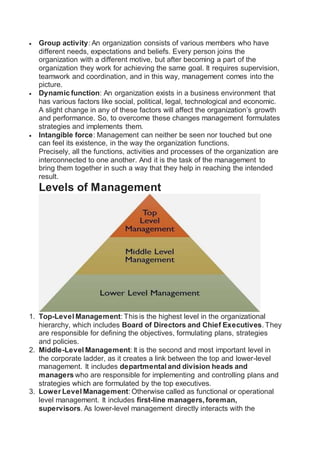
Levels of Management
1. Top-Level Management: This is the highest level in the organizational
hierarchy, which includes Board of Directors and Chief Executives. They
are responsible for defining the objectives, formulating plans, strategies
and policies.
2. Middle-Level Management: It is the second and most important level in
the corporate ladder, as it creates a link between the top and lower-level
management. It includes departmental and division heads and
managers who are responsible for implementing and controlling plans and
strategies which are formulated by the top executives.
3. Lower Level Management: Otherwise called as functional or operational
level management. It includes first-line managers, foreman,
supervisors. As lower-level management directly interacts with the
workers, it plays a crucial role in the organization because it helps in
reducing wastage and idle time of the workers, improving the quality and
quantity of output.
The three management levels form the management hierarchy, that
represents the position and rank of executives and managers in the chart.
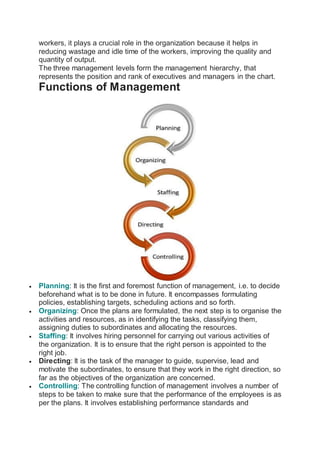
Functions of Management
 Planning: It is the first and foremost function of management, i.e. to decide
beforehand what is to be done in future. It encompasses formulating
policies, establishing targets, scheduling actions and so forth.
 Organizing: Once the plans are formulated, the next step is to organise the
activities and resources, as in identifying the tasks, classifying them,
assigning duties to subordinates and allocating the resources.
 Staffing: It involves hiring personnel for carrying out various activities of
the organization. It is to ensure that the right person is appointed to the
right job.
 Directing: It is the task of the manager to guide, supervise, lead and
motivate the subordinates, to ensure that they work in the right direction, so
far as the objectives of the organization are concerned.
 Controlling: The controlling function of management involves a number of
steps to be taken to make sure that the performance of the employees is as
per the plans. It involves establishing performance standards and
comparing them with the actual performance. In case of any variations,
necessary steps are to be taken for its correction.
Coordination is an important feature of management which means the
integration of the activities, processes and operations of the organization
and synchronisation of efforts, to ensure that every element of the
organization contributes to its success.
Planning
Definition: Planning is the fundamental management function, which
involves deciding beforehand, what is to be done, when is it to be done,
how it is to be done and who is going to do it. It is an intellectual
process which lays down an organization’s objectives and develops
various courses of action, by which the organization can achieve those
objectives. It chalks out exactly, how to attain a specific goal.
Planning is nothing but thinking before the action takes place. It helps us
to take a peep into the future and decide in advance the way to deal with
the situations, which we are going to encounter in future. It involves logical
thinking and rational decision making.
Characteristics of Planning
1. Managerial function: Planning is a first and foremost managerial function
provides the base for other functions of the management, i.e. organising,
staffing, directing and controlling, as they are performed within the
periphery of the plans made.
2. Goal oriented: It focuses on defining the goals of the organisation,
identifying alternative courses of action and deciding the appropriate action
plan, which is to be undertaken for reaching the goals.
3. Pervasive: It is pervasive in the sense that it is present in all the segments
and is required at all the levels of the organisation. Although the scope of
planning varies at different levels and departments.
4. Continuous Process: Plans are made for a specific term, say for a month,
quarter, year and so on. Once that period is over, new plans are drawn,
considering the organisation’s present and future requirements and
conditions. Therefore, it is an ongoing process, as the plans are framed,
executed and followed by another plan.
5. Intellectual Process: It is a mental exercise at it involves the application of
mind, to think, forecast, imagine intelligently and innovate etc.
6. Futuristic: In the process of planning we take a sneak peek of the future. It
encompasses looking into the future, to analyse and predict it so that the
organisation can face future challenges effectively.
7. Decision making: Decisions are made regarding the choice of alternative
courses of action that can be undertaken to reach the goal. The alternative
chosen should be best among all, with the least number of the negative
and highest number of positive outcomes.
Planning is concerned with setting objectives, targets, and formulating plan
to accomplish them. The activity helps managers analyse the present
condition to identify the ways of attaining the desired position in
future. It is both, the need of the organisation and the responsibility of
managers.
Importance of Planning
 It helps managers to improve future performance, by establishing
objectives and selecting a course of action, for the benefit of the
organisation.
 It minimises risk and uncertainty, by looking ahead into the future.
 It facilitates the coordination of activities. Thus, reduces overlapping
among activities and eliminates unproductive work.
 It states in advance, what should be done in future, so it provides direction
for action.
 It uncovers and identifies future opportunities and threats.
 It sets out standards for controlling. It compares actual performance
with the standard performance and efforts are made to correct the same.
Planning is present in all types of organisations, households, sectors,
economies, etc. We need to plan because the future is highly uncertain and
no one can predict the future with 100% accuracy, as the conditions can
change anytime. Hence, planning is the basic requirement of any
organization for the survival, growth and success.
Steps involved in Planning
By planning process, an organisation not only gets the insights of the
future, but it also helps the organisation to shape its future. Effective
planning involves simplicity of the plan, i.e. the plan should be clearly
stated and easy to understand because if the plan is too much
complicated it will create chaos among the members of the organisation.
Further, the plan should fulfil all the requirements of the organisation.
Organizing
Definition: Organizing is the second key management function,
after planning, which coordinates human efforts, arranges resources and
incorporates the two in such a way which helps in the achievement of
objectives. It involves deciding the ways and means with which the plans
can be implemented.
It entails defining jobs and working relationships, assigning different tasks
associated with the plans, arranging and allocating resources, design a
structure which distinguishes duties, responsibilities and authorities,
scheduling activities, in order to maintain smoothness and effectiveness in
operations.
Characteristics of Organizing
Organizing has the following characteristics:
 Division of Labour: Work is assigned to the employee who is specialised
in that work.
 Coordination: Different members of the organization are given different
tasks to perform when all the tasks are put together logically and
sequentially, it results in the objectives, so coordination is required.
 Objectives: Objectives need to be specifically defined.
 Authority-Responsibility Structure: For an effective authority
responsibility structure, the position of each manager and executive is
specified, as per the degree of the authority and responsibility assigned to
them, while performing the duties.
 Communication: The techniques, flow and importance of communication
must be known to all the members.
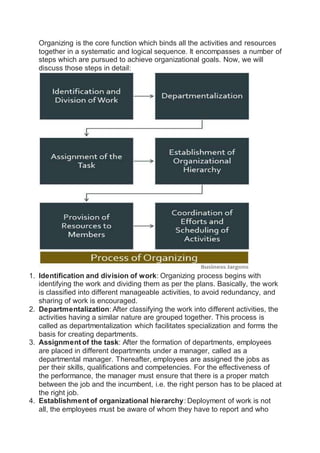
Process of Organizing
Organizing is the core function which binds all the activities and resources
together in a systematic and logical sequence. It encompasses a number of
steps which are pursued to achieve organizational goals. Now, we will
discuss those steps in detail:
1. Identification and division of work: Organizing process begins with
identifying the work and dividing them as per the plans. Basically, the work
is classified into different manageable activities, to avoid redundancy, and
sharing of work is encouraged.
2. Departmentalization: After classifying the work into different activities, the
activities having a similar nature are grouped together. This process is
called as departmentalization which facilitates specialization and forms the
basis for creating departments.
3. Assignment of the task: After the formation of departments, employees
are placed in different departments under a manager, called as a
departmental manager. Thereafter, employees are assigned the jobs as
per their skills, qualifications and competencies. For the effectiveness of
the performance, the manager must ensure that there is a proper match
between the job and the incumbent, i.e. the right person has to be placed at
the right job.
4. Establishment of organizational hierarchy: Deployment of work is not
all, the employees must be aware of whom they have to report and who
can give them orders. Hence, work relationships need to be established
clearly, which helps in the creation of a hierarchical structure of the
organization.
5. Provision of resources to the members: Arrangement and deployment of
resources such as money, materials, supplies, and machine, etc. which are
important to carry out day to day operations of the organization.
6. Coordination of efforts and scheduling of activities: The final step to
this process is the coordination of efforts and scheduling the activities in a
logical and systematic manner so that the common objectives can be
achieved effectively.
Importance of Organizing
Organizing is integral to management as it facilitates the smooth
functioning of the enterprise. The importance of organizing is as under:
 Advantage of Specialization: Organizing helps in the classification of jobs
systematically amongst the workforce, which helps in the reduction of
workload, as well as improved productivity. This is because the
organization will get the benefit of specialization wherein workers will
perform specific work on a regular basis, according to their competency.
 Describes work relationships: The definition of work relationships
describes the flow of communication and determine the superior-
subordinate relationship. This removes confusion and chaos, in getting
orders and instructions.
 Effective utilization of resources: Organizing function ensures the best
possible utilization of resources whether it is human, material, financial or
technical. This is because jobs are assigned to the employees which avoid
overlapping and duplication of work.
 Adaptation to change: Organizing process helps the organization to
survive and adapt the changes, by making substantial changes in the
strategies, hierarchy, relationships, etc.
 Development of personnel: Organising encourages creativity in
executives. Delegation of authority reduce their workload and they get time
to identify new methods to perform the work. It also enables them to
explore new areas for their growth and development.
In a nutshell, with organizing the manager brings order out of disorder,
removes confusion with respect to work and responsibility, and frames an
ideal environment where all the members of the organization can work in
tandem.
Staffing
Definition: Staffing is a managerial function which involves obtaining,
utilising and retaining, qualified and competent personnel to fill all positions
of an organisation, from top to operative echelon. In finer terms, staffing
is placing the right person at the right job.
It aims at employing, deploying and monitoring a competent and
contented staff, i.e. daily wage earners, contract employees, consultants,
regular employees, etc., to undertake various managerial and non-
managerial activities in an organisation.
Importance of Staffing
 It helps in the finding out efficient and effective workforce, to fill
different posts in the organisation.
 It improves organisation’s performance and productivity by appointing
the right person at the right job.
 It facilitates in identifying the staffing requirements of the organisation in
future.
 It ensures continuous survival and growth of the organisation, by way of
succession planning for executives.
 It develops personnel to take up top managerial positions of the
organisation.
 It ensures training and development of the people working in the
organisation.
 It assists the organisation in making the optimum use of human
resources.
Therefore, staffing increases employee morale and job satisfaction.
Further, it helps the top management in ascertaining the manpower
requirement resulting from a promotion, transfer, employee turnover,
retirement, etc. of the existing employees.
Process of Staffing
Staffing process stresses on equipping the organisation with an exact
number of people, and that too at the right time and place, which will
help the organisation to attain its objectives effectively. The staffing process
involves a series of steps, discussed as under:
1. Manpower Planning: Popularly known as human resource planning, it is
the process of forecasting the firm’s demand for and supply of competent
workforce, in the adequate number in future.
2. Recruitment: It entails seeking, stimulating and obtaining, as many
applications as possible from the eligible and competent candidates.
3. Selection: It is the decisive step of the staffing process, which involves
differentiating between applicants, so as to identify and choose the
candidate who best fulfils the qualifications and requirements of the vacant
position.
4. Placement: The allocation of rank and responsibility to selected candidate,
is known as Placement.
5. Orientation and Induction: After the placement, the next step is to provide
the new employee with the information they require for functioning
comfortably and efficiently in an organisation. Induction is the process of
introducing the new joinees to the job and the organisation as well.
6. Training and Development: In this step, the new joinees undergo training
to acquire specific skills. Development implies learning opportunities,
designed by the organisation, to ensure the growth of employees.
7. Performance Appraisal: A rational assessment and evaluation of
employee’s performance against clear-cut benchmarks.
8. Career Management: Career Management is a process in which the
individual understands and learns new skills and interests and use them for
the betterment of the organization and self.
9. Compensation: Compensation refers to the consideration which an
individual gains, in return for his/her contribution to the organisation.
Staffing process recognises the significance of each person employed
by the organisation, as the work of every individual, keeps the organisation
going. So, acquiring a good staff is a tough task, because the success of
the organisation depends on it and so, the process should be performed
attentively.
Further, the top executives of the organisation should be aware of the
national labour laws, which applies to the organisation. Moreover, the
organisation should be clear on how many employees, it is going to recruit,
for carrying out various activities of the organisation.
Controlling
Definition: Control is a primary goal-oriented function of management in an
organisation. It is a process of comparing the actual performance with
the set standards of the company to ensure that activities are performed
according to the plans and if not then taking corrective action.
Every manager needs to monitor and evaluate the activities of his
subordinates. It helps in taking corrective actions by the manager in the
given timeline to avoid contingency or company’s loss.
Controlling is performed at the lower, middle and upper levels of the
management.
Features of Controlling
 An effective control system has the following features:
 It helps in achieving organizational goals.
 Facilitates optimum utilization of resources.
 It evaluates the accuracy of the standard.
 It also sets discipline and order.
 Motivates the employees and boosts employee morale.
 Ensures future planning by revising standards.
 Improves overall performance of an organization.
 It also minimises errors.
Controlling and planning are interrelated for controlling gives an important
input into the next planning cycle. Controlling is a backwards-looking
function which brings the management cycle back to the planning function.
Planning is a forward-looking process as it deals with the forecasts about
the future conditions.
Process of Controlling
Control process involves the following steps as shown in the figure:
 Establishing standards: This means setting up of the target which needs
to be achieved to meet organisational goals eventually. Standards indicate
the criteria of performance.
Control standards are categorized as quantitative and qualitative
standards. Quantitative standards are expressed in terms of
money. Qualitative standards, on the other hand, includes intangible
items.
 Measurement of actual performance: The actual performance of the
employee is measured against the target. With the increasing levels of
management, the measurement of performance becomes difficult.
 Comparison of actual performance with the standard: This compares
the degree of difference between the actual performance and the standard.
 Taking corrective actions: It is initiated by the manager who corrects any
defects in actual performance.
Controlling process thus regulates companies’ activities so that actual
performance conforms to the standard plan. An effective control system
enables managers to avoid circumstances which cause the company’s
loss.
Types of control
There are three types of control viz.,
1. Feedback Control: This process involves collecting information about a
finished task, assessing that information and improvising the same type of
tasks in the future.
2. Concurrent control: It is also called real-time control. It checks any
problem and examines it to take action before any loss is incurred.
Example: control chart.
3. Predictive/ feedforward control: This type of control helps to foresee
problem ahead of occurrence. Therefore action can be taken before such a
circumstance arises.
In an ever-changing and complex environment, controlling forms an integral
part of the organization.
Advantages of controlling
 Saves time and energy
 Allows managers to concentrate on important tasks. This allows better
utilization of the managerial resource.
 Helps in timely corrective action to be taken by the manager.
 Managers can delegate tasks so routinely chores can be completed by
subordinates.
On the contrary, controlling suffers from the constraint that the organization
has no control over external factors. It can turn out to be a costly affair,
especially for small companies
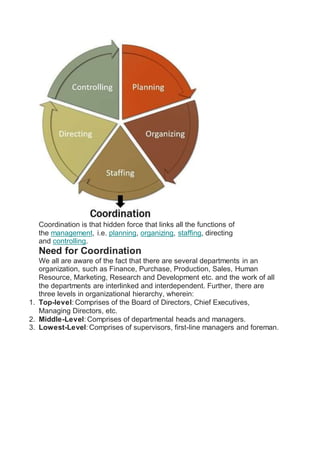
Coordination
Definition: Coordination can be described as that invisible cord, which runs
through all the activities of the organization and binds them together. It is
not a function of the management, rather it is the essence of
management, which is needed at all levels and at each step of the firm, to
achieve the objectives of the organization.
In basic terms, coordination means the integration and synchronization of
the activities, resources and efforts of the people working in the
organization, which leads to unity of action, in the pursuit of the
organization’s objectives.
Coordination is that hidden force that links all the functions of
the management, i.e. planning, organizing, staffing, directing
and controlling.
Need for Coordination
We all are aware of the fact that there are several departments in an
organization, such as Finance, Purchase, Production, Sales, Human
Resource, Marketing, Research and Development etc. and the work of all
the departments are interlinked and interdependent. Further, there are
three levels in organizational hierarchy, wherein:
1. Top-level: Comprises of the Board of Directors, Chief Executives,
Managing Directors, etc.
2. Middle-Level: Comprises of departmental heads and managers.
3. Lowest-Level: Comprises of supervisors, first-line managers and foreman.
Coordination is a process, which ensures that various departments, units
and levels of the organization work smoothly and continuously in tandem,
i.e. in the same direction, towards the accomplishment of organizational
goals, while effectively utilizing the resources.
It aims at involving all the elements of the company, in the plan, strategy or
task, to get input from everyone and attain best results.
Coordination tends to lineup the resources, people and efforts in such a
way that there is no chaos, hustle, disorder and conflict, regarding any
issue in an organization. Hence it is not wrong to say “With coordination
comes harmony in the performance of organizational tasks”.
Characteristics of Coordination
The salient features of coordination are given as under:
 Integrates efforts of employees: Coordination integrates the efforts of the
employees, to translate it into a determined activity. It aims at giving a
specific direction to the group, to make sure that the results obtained are
according to the plans.
 Unity of Action: There must be a unity of action in the accomplishment of
organization’s objectives. It is that implicit force which binds various
departments, divisions and units of the concern, and ensures that they
work with a single focus.
 Ongoing process: Coordination begins at the very first stage of planning,
thereafter organizational hierarchy is defined keeping the company’s plans
in mind. Then, the staff is hired according to the company’s plans and
hierarchy, and work is assigned to them accordingly.Thereafter, the
direction is given to the employees as per the company’s plans and
policies. Lastly, if there are any discrepancies from the plans, they are
corrected, at the controlling stage.So, we can say that coordination is
implied in all the functions of the management, which keeps on continuing.
 Pervasive Function: Coordination is a must for all the three levels of the
management as are interlinked and interdependent with respect to the
functions performed by these levels.
 Deliberate activity: Various activities and efforts of the organization are to
be coordinated in a thoughtful and careful manner.
If there is no coordination among the various activities, then the efforts of
the employees are wasted even if they cooperate. Further, in the absence
of cooperation, coordination may not work effectively and leads to
dissatisfaction. So, cooperation and coordination should go hand in hand.
Importance of Coordination
The importance of coordination is discussed below:
1. Growth of organization: As time passes, organization grows in size,
resulting in an increased volume of work. There will be numerous
employees to handle the work, which are hired for different departments. At
times, the departmental goals are considered more important by them, as
compared to the overall goal of the concern.So, coordination of activities, is
useful in unifying all the people together, to focus on just one ultimate goal.
2. Locational differences: Big corporations are located at different locations,
even in different countries, which does not allow people to meet and
communicate frequently. In the absence of it, coordination helps in keeping
all the units and offices, together, to work in sync.
3. Diversification of business: When a company decides to diversify
its business, by entering into new markets with a new product, the
company starts new divisions or ventures, to undertake the activities. Then
also coordination plays a critical role, in reconciling the goals of the
organization.
4. Specialisation: In specialization, tasks are assigned to the employees as
per their expertise or specialization in the specific field. Coordination helps
in bringing together all the talented and experienced employees together,
to maintain a harmonious relationship between various groups.
5. Synergy: It is a universal fact that the combined effort of two people is
always greater than those working separately. So, coordination combines
the efforts of the firm which helps in achieving synergy.
Coordination keeps a balance in all the activities by ensuring the
appropriate allocation of tasks to suitable persons, to realize the
organization’s objectives successfully
Management.docx

Management.docx

  • 1.
    Management Definition: Management canbe defined as the process of administering and controlling the affairs of the organization, irrespective of its nature, type, structure and size. It is an act of creating and maintaining such a business environment wherein the members of the organization can work together, and achieve business objectives efficiently and effectively. Management acts as a guide to a group of people working in the organization and coordinating their efforts, towards the attainment of the common objective. In other words, it is concerned with optimally using 5M’s, i.e. men, machine, material, money and methods and, this is possible only when there proper direction, coordination and integration of the processes and activities, to achieve the desired results. Characteristics of Management  Universal: All the organizations, whether it is profit-making or not, they require management, for managing their activities. Hence it is universal in nature.  Goal-Oriented: Every organization is set up with a predetermined objective and management helps in reaching those goals timely, and smoothly.  Continuous Process: It is an ongoing process which tends to persist as long as the organization exists. It is required in every sphere of the organization whether it is production, human resource, finance or marketing.  Multi-dimensional: Management is not confined to the administration of people only, but it also manages work, processes and operations, which makes it a multi-disciplinary activity.
  • 2.
     Group activity:An organization consists of various members who have different needs, expectations and beliefs. Every person joins the organization with a different motive, but after becoming a part of the organization they work for achieving the same goal. It requires supervision, teamwork and coordination, and in this way, management comes into the picture.  Dynamic function: An organization exists in a business environment that has various factors like social, political, legal, technological and economic. A slight change in any of these factors will affect the organization’s growth and performance. So, to overcome these changes management formulates strategies and implements them.  Intangible force: Management can neither be seen nor touched but one can feel its existence, in the way the organization functions. Precisely, all the functions, activities and processes of the organization are interconnected to one another. And it is the task of the management to bring them together in such a way that they help in reaching the intended result. Levels of Management 1. Top-Level Management: This is the highest level in the organizational hierarchy, which includes Board of Directors and Chief Executives. They are responsible for defining the objectives, formulating plans, strategies and policies. 2. Middle-Level Management: It is the second and most important level in the corporate ladder, as it creates a link between the top and lower-level management. It includes departmental and division heads and managers who are responsible for implementing and controlling plans and strategies which are formulated by the top executives. 3. Lower Level Management: Otherwise called as functional or operational level management. It includes first-line managers, foreman, supervisors. As lower-level management directly interacts with the
  • 3.
    workers, it playsa crucial role in the organization because it helps in reducing wastage and idle time of the workers, improving the quality and quantity of output. The three management levels form the management hierarchy, that represents the position and rank of executives and managers in the chart. Functions of Management  Planning: It is the first and foremost function of management, i.e. to decide beforehand what is to be done in future. It encompasses formulating policies, establishing targets, scheduling actions and so forth.  Organizing: Once the plans are formulated, the next step is to organise the activities and resources, as in identifying the tasks, classifying them, assigning duties to subordinates and allocating the resources.  Staffing: It involves hiring personnel for carrying out various activities of the organization. It is to ensure that the right person is appointed to the right job.  Directing: It is the task of the manager to guide, supervise, lead and motivate the subordinates, to ensure that they work in the right direction, so far as the objectives of the organization are concerned.  Controlling: The controlling function of management involves a number of steps to be taken to make sure that the performance of the employees is as per the plans. It involves establishing performance standards and
  • 4.
    comparing them withthe actual performance. In case of any variations, necessary steps are to be taken for its correction. Coordination is an important feature of management which means the integration of the activities, processes and operations of the organization and synchronisation of efforts, to ensure that every element of the organization contributes to its success. Planning Definition: Planning is the fundamental management function, which involves deciding beforehand, what is to be done, when is it to be done, how it is to be done and who is going to do it. It is an intellectual process which lays down an organization’s objectives and develops various courses of action, by which the organization can achieve those objectives. It chalks out exactly, how to attain a specific goal. Planning is nothing but thinking before the action takes place. It helps us to take a peep into the future and decide in advance the way to deal with the situations, which we are going to encounter in future. It involves logical thinking and rational decision making. Characteristics of Planning 1. Managerial function: Planning is a first and foremost managerial function provides the base for other functions of the management, i.e. organising, staffing, directing and controlling, as they are performed within the periphery of the plans made.
  • 5.
    2. Goal oriented:It focuses on defining the goals of the organisation, identifying alternative courses of action and deciding the appropriate action plan, which is to be undertaken for reaching the goals. 3. Pervasive: It is pervasive in the sense that it is present in all the segments and is required at all the levels of the organisation. Although the scope of planning varies at different levels and departments. 4. Continuous Process: Plans are made for a specific term, say for a month, quarter, year and so on. Once that period is over, new plans are drawn, considering the organisation’s present and future requirements and conditions. Therefore, it is an ongoing process, as the plans are framed, executed and followed by another plan. 5. Intellectual Process: It is a mental exercise at it involves the application of mind, to think, forecast, imagine intelligently and innovate etc. 6. Futuristic: In the process of planning we take a sneak peek of the future. It encompasses looking into the future, to analyse and predict it so that the organisation can face future challenges effectively. 7. Decision making: Decisions are made regarding the choice of alternative courses of action that can be undertaken to reach the goal. The alternative chosen should be best among all, with the least number of the negative and highest number of positive outcomes. Planning is concerned with setting objectives, targets, and formulating plan to accomplish them. The activity helps managers analyse the present condition to identify the ways of attaining the desired position in future. It is both, the need of the organisation and the responsibility of managers. Importance of Planning  It helps managers to improve future performance, by establishing objectives and selecting a course of action, for the benefit of the organisation.  It minimises risk and uncertainty, by looking ahead into the future.  It facilitates the coordination of activities. Thus, reduces overlapping among activities and eliminates unproductive work.  It states in advance, what should be done in future, so it provides direction for action.  It uncovers and identifies future opportunities and threats.  It sets out standards for controlling. It compares actual performance with the standard performance and efforts are made to correct the same. Planning is present in all types of organisations, households, sectors, economies, etc. We need to plan because the future is highly uncertain and no one can predict the future with 100% accuracy, as the conditions can change anytime. Hence, planning is the basic requirement of any organization for the survival, growth and success. Steps involved in Planning
  • 6.
    By planning process,an organisation not only gets the insights of the future, but it also helps the organisation to shape its future. Effective planning involves simplicity of the plan, i.e. the plan should be clearly stated and easy to understand because if the plan is too much complicated it will create chaos among the members of the organisation. Further, the plan should fulfil all the requirements of the organisation. Organizing Definition: Organizing is the second key management function, after planning, which coordinates human efforts, arranges resources and incorporates the two in such a way which helps in the achievement of objectives. It involves deciding the ways and means with which the plans can be implemented. It entails defining jobs and working relationships, assigning different tasks associated with the plans, arranging and allocating resources, design a structure which distinguishes duties, responsibilities and authorities, scheduling activities, in order to maintain smoothness and effectiveness in operations. Characteristics of Organizing
  • 7.
    Organizing has thefollowing characteristics:  Division of Labour: Work is assigned to the employee who is specialised in that work.  Coordination: Different members of the organization are given different tasks to perform when all the tasks are put together logically and sequentially, it results in the objectives, so coordination is required.  Objectives: Objectives need to be specifically defined.  Authority-Responsibility Structure: For an effective authority responsibility structure, the position of each manager and executive is specified, as per the degree of the authority and responsibility assigned to them, while performing the duties.  Communication: The techniques, flow and importance of communication must be known to all the members. Process of Organizing
  • 8.
    Organizing is thecore function which binds all the activities and resources together in a systematic and logical sequence. It encompasses a number of steps which are pursued to achieve organizational goals. Now, we will discuss those steps in detail: 1. Identification and division of work: Organizing process begins with identifying the work and dividing them as per the plans. Basically, the work is classified into different manageable activities, to avoid redundancy, and sharing of work is encouraged. 2. Departmentalization: After classifying the work into different activities, the activities having a similar nature are grouped together. This process is called as departmentalization which facilitates specialization and forms the basis for creating departments. 3. Assignment of the task: After the formation of departments, employees are placed in different departments under a manager, called as a departmental manager. Thereafter, employees are assigned the jobs as per their skills, qualifications and competencies. For the effectiveness of the performance, the manager must ensure that there is a proper match between the job and the incumbent, i.e. the right person has to be placed at the right job. 4. Establishment of organizational hierarchy: Deployment of work is not all, the employees must be aware of whom they have to report and who
  • 9.
    can give themorders. Hence, work relationships need to be established clearly, which helps in the creation of a hierarchical structure of the organization. 5. Provision of resources to the members: Arrangement and deployment of resources such as money, materials, supplies, and machine, etc. which are important to carry out day to day operations of the organization. 6. Coordination of efforts and scheduling of activities: The final step to this process is the coordination of efforts and scheduling the activities in a logical and systematic manner so that the common objectives can be achieved effectively. Importance of Organizing Organizing is integral to management as it facilitates the smooth functioning of the enterprise. The importance of organizing is as under:  Advantage of Specialization: Organizing helps in the classification of jobs systematically amongst the workforce, which helps in the reduction of workload, as well as improved productivity. This is because the organization will get the benefit of specialization wherein workers will perform specific work on a regular basis, according to their competency.  Describes work relationships: The definition of work relationships describes the flow of communication and determine the superior- subordinate relationship. This removes confusion and chaos, in getting orders and instructions.  Effective utilization of resources: Organizing function ensures the best possible utilization of resources whether it is human, material, financial or technical. This is because jobs are assigned to the employees which avoid overlapping and duplication of work.
  • 10.
     Adaptation tochange: Organizing process helps the organization to survive and adapt the changes, by making substantial changes in the strategies, hierarchy, relationships, etc.  Development of personnel: Organising encourages creativity in executives. Delegation of authority reduce their workload and they get time to identify new methods to perform the work. It also enables them to explore new areas for their growth and development. In a nutshell, with organizing the manager brings order out of disorder, removes confusion with respect to work and responsibility, and frames an ideal environment where all the members of the organization can work in tandem. Staffing Definition: Staffing is a managerial function which involves obtaining, utilising and retaining, qualified and competent personnel to fill all positions of an organisation, from top to operative echelon. In finer terms, staffing is placing the right person at the right job. It aims at employing, deploying and monitoring a competent and contented staff, i.e. daily wage earners, contract employees, consultants, regular employees, etc., to undertake various managerial and non- managerial activities in an organisation. Importance of Staffing  It helps in the finding out efficient and effective workforce, to fill different posts in the organisation.  It improves organisation’s performance and productivity by appointing the right person at the right job.  It facilitates in identifying the staffing requirements of the organisation in future.  It ensures continuous survival and growth of the organisation, by way of succession planning for executives.  It develops personnel to take up top managerial positions of the organisation.  It ensures training and development of the people working in the organisation.  It assists the organisation in making the optimum use of human resources. Therefore, staffing increases employee morale and job satisfaction. Further, it helps the top management in ascertaining the manpower requirement resulting from a promotion, transfer, employee turnover, retirement, etc. of the existing employees. Process of Staffing Staffing process stresses on equipping the organisation with an exact number of people, and that too at the right time and place, which will
  • 11.
    help the organisationto attain its objectives effectively. The staffing process involves a series of steps, discussed as under: 1. Manpower Planning: Popularly known as human resource planning, it is the process of forecasting the firm’s demand for and supply of competent workforce, in the adequate number in future. 2. Recruitment: It entails seeking, stimulating and obtaining, as many applications as possible from the eligible and competent candidates. 3. Selection: It is the decisive step of the staffing process, which involves differentiating between applicants, so as to identify and choose the candidate who best fulfils the qualifications and requirements of the vacant position. 4. Placement: The allocation of rank and responsibility to selected candidate, is known as Placement. 5. Orientation and Induction: After the placement, the next step is to provide the new employee with the information they require for functioning comfortably and efficiently in an organisation. Induction is the process of introducing the new joinees to the job and the organisation as well. 6. Training and Development: In this step, the new joinees undergo training to acquire specific skills. Development implies learning opportunities, designed by the organisation, to ensure the growth of employees. 7. Performance Appraisal: A rational assessment and evaluation of employee’s performance against clear-cut benchmarks. 8. Career Management: Career Management is a process in which the individual understands and learns new skills and interests and use them for the betterment of the organization and self. 9. Compensation: Compensation refers to the consideration which an individual gains, in return for his/her contribution to the organisation. Staffing process recognises the significance of each person employed by the organisation, as the work of every individual, keeps the organisation going. So, acquiring a good staff is a tough task, because the success of the organisation depends on it and so, the process should be performed attentively. Further, the top executives of the organisation should be aware of the national labour laws, which applies to the organisation. Moreover, the organisation should be clear on how many employees, it is going to recruit, for carrying out various activities of the organisation. Controlling Definition: Control is a primary goal-oriented function of management in an organisation. It is a process of comparing the actual performance with the set standards of the company to ensure that activities are performed according to the plans and if not then taking corrective action. Every manager needs to monitor and evaluate the activities of his subordinates. It helps in taking corrective actions by the manager in the given timeline to avoid contingency or company’s loss.
  • 12.
    Controlling is performedat the lower, middle and upper levels of the management. Features of Controlling  An effective control system has the following features:  It helps in achieving organizational goals.  Facilitates optimum utilization of resources.  It evaluates the accuracy of the standard.  It also sets discipline and order.  Motivates the employees and boosts employee morale.  Ensures future planning by revising standards.  Improves overall performance of an organization.  It also minimises errors. Controlling and planning are interrelated for controlling gives an important input into the next planning cycle. Controlling is a backwards-looking function which brings the management cycle back to the planning function. Planning is a forward-looking process as it deals with the forecasts about the future conditions. Process of Controlling Control process involves the following steps as shown in the figure:  Establishing standards: This means setting up of the target which needs to be achieved to meet organisational goals eventually. Standards indicate the criteria of performance. Control standards are categorized as quantitative and qualitative standards. Quantitative standards are expressed in terms of money. Qualitative standards, on the other hand, includes intangible items.  Measurement of actual performance: The actual performance of the employee is measured against the target. With the increasing levels of management, the measurement of performance becomes difficult.  Comparison of actual performance with the standard: This compares the degree of difference between the actual performance and the standard.  Taking corrective actions: It is initiated by the manager who corrects any defects in actual performance. Controlling process thus regulates companies’ activities so that actual performance conforms to the standard plan. An effective control system
  • 13.
    enables managers toavoid circumstances which cause the company’s loss. Types of control There are three types of control viz., 1. Feedback Control: This process involves collecting information about a finished task, assessing that information and improvising the same type of tasks in the future. 2. Concurrent control: It is also called real-time control. It checks any problem and examines it to take action before any loss is incurred. Example: control chart. 3. Predictive/ feedforward control: This type of control helps to foresee problem ahead of occurrence. Therefore action can be taken before such a circumstance arises. In an ever-changing and complex environment, controlling forms an integral part of the organization. Advantages of controlling  Saves time and energy  Allows managers to concentrate on important tasks. This allows better utilization of the managerial resource.  Helps in timely corrective action to be taken by the manager.  Managers can delegate tasks so routinely chores can be completed by subordinates. On the contrary, controlling suffers from the constraint that the organization has no control over external factors. It can turn out to be a costly affair, especially for small companies Coordination Definition: Coordination can be described as that invisible cord, which runs through all the activities of the organization and binds them together. It is not a function of the management, rather it is the essence of management, which is needed at all levels and at each step of the firm, to achieve the objectives of the organization. In basic terms, coordination means the integration and synchronization of the activities, resources and efforts of the people working in the organization, which leads to unity of action, in the pursuit of the organization’s objectives.
  • 14.
    Coordination is thathidden force that links all the functions of the management, i.e. planning, organizing, staffing, directing and controlling. Need for Coordination We all are aware of the fact that there are several departments in an organization, such as Finance, Purchase, Production, Sales, Human Resource, Marketing, Research and Development etc. and the work of all the departments are interlinked and interdependent. Further, there are three levels in organizational hierarchy, wherein: 1. Top-level: Comprises of the Board of Directors, Chief Executives, Managing Directors, etc. 2. Middle-Level: Comprises of departmental heads and managers. 3. Lowest-Level: Comprises of supervisors, first-line managers and foreman.
  • 15.
    Coordination is aprocess, which ensures that various departments, units and levels of the organization work smoothly and continuously in tandem, i.e. in the same direction, towards the accomplishment of organizational goals, while effectively utilizing the resources. It aims at involving all the elements of the company, in the plan, strategy or task, to get input from everyone and attain best results. Coordination tends to lineup the resources, people and efforts in such a way that there is no chaos, hustle, disorder and conflict, regarding any issue in an organization. Hence it is not wrong to say “With coordination comes harmony in the performance of organizational tasks”. Characteristics of Coordination
  • 16.
    The salient featuresof coordination are given as under:  Integrates efforts of employees: Coordination integrates the efforts of the employees, to translate it into a determined activity. It aims at giving a specific direction to the group, to make sure that the results obtained are according to the plans.  Unity of Action: There must be a unity of action in the accomplishment of organization’s objectives. It is that implicit force which binds various departments, divisions and units of the concern, and ensures that they work with a single focus.  Ongoing process: Coordination begins at the very first stage of planning, thereafter organizational hierarchy is defined keeping the company’s plans in mind. Then, the staff is hired according to the company’s plans and hierarchy, and work is assigned to them accordingly.Thereafter, the direction is given to the employees as per the company’s plans and policies. Lastly, if there are any discrepancies from the plans, they are corrected, at the controlling stage.So, we can say that coordination is implied in all the functions of the management, which keeps on continuing.  Pervasive Function: Coordination is a must for all the three levels of the management as are interlinked and interdependent with respect to the functions performed by these levels.  Deliberate activity: Various activities and efforts of the organization are to be coordinated in a thoughtful and careful manner. If there is no coordination among the various activities, then the efforts of the employees are wasted even if they cooperate. Further, in the absence of cooperation, coordination may not work effectively and leads to dissatisfaction. So, cooperation and coordination should go hand in hand. Importance of Coordination The importance of coordination is discussed below:
  • 17.
    1. Growth oforganization: As time passes, organization grows in size, resulting in an increased volume of work. There will be numerous employees to handle the work, which are hired for different departments. At times, the departmental goals are considered more important by them, as compared to the overall goal of the concern.So, coordination of activities, is useful in unifying all the people together, to focus on just one ultimate goal. 2. Locational differences: Big corporations are located at different locations, even in different countries, which does not allow people to meet and communicate frequently. In the absence of it, coordination helps in keeping all the units and offices, together, to work in sync. 3. Diversification of business: When a company decides to diversify its business, by entering into new markets with a new product, the company starts new divisions or ventures, to undertake the activities. Then also coordination plays a critical role, in reconciling the goals of the organization. 4. Specialisation: In specialization, tasks are assigned to the employees as per their expertise or specialization in the specific field. Coordination helps in bringing together all the talented and experienced employees together, to maintain a harmonious relationship between various groups. 5. Synergy: It is a universal fact that the combined effort of two people is always greater than those working separately. So, coordination combines the efforts of the firm which helps in achieving synergy. Coordination keeps a balance in all the activities by ensuring the appropriate allocation of tasks to suitable persons, to realize the organization’s objectives successfully