School of Architecture, Building and Design
Bachelor of Science (Hons) in Architecture
Building Structure (ARC 2523/BLD 61003)
Project 2 Beam and Column Analysis
Tutor: Puan Norita
Group member:
STUDENT NAME STUDENT ID
CHEN EE DONG 0321181
NG YUHENG 0315476
YONG THANG SHAUN 0320675
LIST OF CONTENT
INTRODUCTION TO THE PROJECT
KEY EQUATIONS AND PRELIMINARY STUDIES
STRUCTURAL PLANS
ARCHITECTURAL PLANS
CONCLUSION
REFERENCES
INDIVIDUAL COMPONENTS (INCLUDING SLAB ANALYSIS)
CHEN EE DONG
YONG THANG SHAUN
NG YUHENG
INTRODUCTION TO THE PROJECT
This project is split into two components – group and individual. In a group of three, we are
required to study a residential building of maximum three storeys, preferably two storeys to
analyse the structural components of the building. The structural plans and architectural plans
should be thoroughly analysed to aid us in our individual components later.
For the individual component, each student is to select and analyse six beams and four columns
each. The selection of these components are preferably varied, for example, beam selection
should be in a variety of complex and simple beams to deepen our understanding on the
structural component.
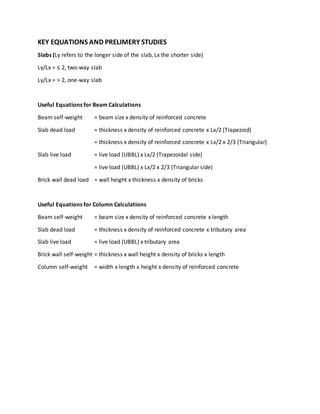
KEY EQUATIONS AND PRELIMERY STUDIES
Slabs (Ly refers to the longer side of the slab, Lx the shorter side)
Ly/Lx = ≤ 2, two-way slab
Ly/Lx = > 2, one-way slab
Useful Equations for Beam Calculations
Beam self-weight = beam size x density of reinforced concrete
Slab dead load = thickness x density of reinforced concrete x Lx/2 (Trapezoid)
= thickness x density of reinforced concrete x Lx/2 x 2/3 (Triangular)
Slab live load = live load (UBBL) x Lx/2 (Trapezoidal side)
= live load (UBBL) x Lx/2 x 2/3 (Triangular side)
Brick wall dead load = wall height x thickness x density of bricks
Useful Equations for Column Calculations
Beam self-weight = beam size x density of reinforced concrete x length
Slab dead load = thickness x density of reinforced concrete x tributary area
Slab live load = live load (UBBL) x tributary area
Brick wall self-weight = thickness x wall height x density of bricks x length
Column self-weight = width x length x height x density of reinforced concrete
ARCHITECTURAL DRAWINGS
GROUND FLOOR
FIRST FLOOR
STRUCTURAL DRAWINGS
GROUND FLOOR
FIRST FLOOR
ROOF LEVEL
CONCLUSION
From this project, we had the opportunity to conduct an in-depth analysis and study on the
structural systemof a residential house. We have also learned about the process of load
transfer and the integration between slabs, walls, columns and beams in ensuring stability of
the building. From extensively analysis we are able to translate the position of columns and
beams by constantly cross referencing to the architectural and structural drawings provided.
REFERENCES
1. Analysis of Beams | Shear Force & Bending Moment Diagram~ Learn Engineering.
(2016). Learnengineering.org. Retrieved 24 June 2016, from
http://www.learnengineering.org/2013/08/shear-force-bending-moment-diagram.html
2. BEAM FORMULAS WITH SHEAR AND MOM. (2016). Linsgroup.com. Retrieved 24 June
2016, from
http://www.linsgroup.com/MECHANICAL_DESIGN/Beam/beam_formula.htmL
3. Building Construction: Understanding Loads and Loading. (2016). Fireengineering.com.
Retrieved 24 June 2016, from
http://www.fireengineering.com/articles/2010/06/building-construction-
understanding-loads-and-loading.html
INDIVIDUAL COMPONENT
CHEN EE DONG 0321181
INDIVIDUAL COMPONENT
YONG THANG SHAUN 0320675

Building Structures: Group Report

  • 1.
    School of Architecture,Building and Design Bachelor of Science (Hons) in Architecture Building Structure (ARC 2523/BLD 61003) Project 2 Beam and Column Analysis Tutor: Puan Norita Group member: STUDENT NAME STUDENT ID CHEN EE DONG 0321181 NG YUHENG 0315476 YONG THANG SHAUN 0320675
  • 2.
    LIST OF CONTENT INTRODUCTIONTO THE PROJECT KEY EQUATIONS AND PRELIMINARY STUDIES STRUCTURAL PLANS ARCHITECTURAL PLANS CONCLUSION REFERENCES INDIVIDUAL COMPONENTS (INCLUDING SLAB ANALYSIS) CHEN EE DONG YONG THANG SHAUN NG YUHENG
  • 3.
    INTRODUCTION TO THEPROJECT This project is split into two components – group and individual. In a group of three, we are required to study a residential building of maximum three storeys, preferably two storeys to analyse the structural components of the building. The structural plans and architectural plans should be thoroughly analysed to aid us in our individual components later. For the individual component, each student is to select and analyse six beams and four columns each. The selection of these components are preferably varied, for example, beam selection should be in a variety of complex and simple beams to deepen our understanding on the structural component.
  • 4.
    KEY EQUATIONS ANDPRELIMERY STUDIES Slabs (Ly refers to the longer side of the slab, Lx the shorter side) Ly/Lx = ≤ 2, two-way slab Ly/Lx = > 2, one-way slab Useful Equations for Beam Calculations Beam self-weight = beam size x density of reinforced concrete Slab dead load = thickness x density of reinforced concrete x Lx/2 (Trapezoid) = thickness x density of reinforced concrete x Lx/2 x 2/3 (Triangular) Slab live load = live load (UBBL) x Lx/2 (Trapezoidal side) = live load (UBBL) x Lx/2 x 2/3 (Triangular side) Brick wall dead load = wall height x thickness x density of bricks Useful Equations for Column Calculations Beam self-weight = beam size x density of reinforced concrete x length Slab dead load = thickness x density of reinforced concrete x tributary area Slab live load = live load (UBBL) x tributary area Brick wall self-weight = thickness x wall height x density of bricks x length Column self-weight = width x length x height x density of reinforced concrete
  • 5.
  • 6.
  • 7.
    CONCLUSION From this project,we had the opportunity to conduct an in-depth analysis and study on the structural systemof a residential house. We have also learned about the process of load transfer and the integration between slabs, walls, columns and beams in ensuring stability of the building. From extensively analysis we are able to translate the position of columns and beams by constantly cross referencing to the architectural and structural drawings provided. REFERENCES 1. Analysis of Beams | Shear Force & Bending Moment Diagram~ Learn Engineering. (2016). Learnengineering.org. Retrieved 24 June 2016, from http://www.learnengineering.org/2013/08/shear-force-bending-moment-diagram.html 2. BEAM FORMULAS WITH SHEAR AND MOM. (2016). Linsgroup.com. Retrieved 24 June 2016, from http://www.linsgroup.com/MECHANICAL_DESIGN/Beam/beam_formula.htmL 3. Building Construction: Understanding Loads and Loading. (2016). Fireengineering.com. Retrieved 24 June 2016, from http://www.fireengineering.com/articles/2010/06/building-construction- understanding-loads-and-loading.html
  • 8.
  • 9.