










Building Relationships on the WebKalev PeeknaWeb Strategy Manager
History of Legal Websites
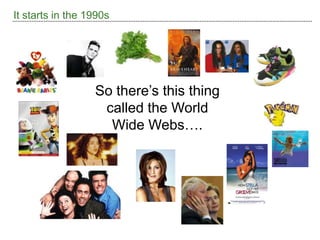
So there’s this thing called the World Wide Webs….It starts in the 1990s
Let’s put a small ‘i’ in front.  No, wait, a small ‘e’!Where does the floppy go?We should call ourselves CyberfirmCan we get it in cornflower blue?Total ChaosCan that guy get me a web?“Under Construction”Look! I can make the text flash!
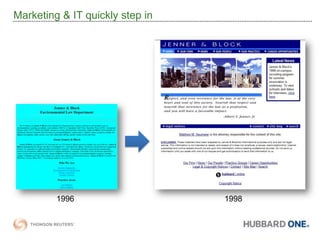
Marketing & IT quickly step in19961998
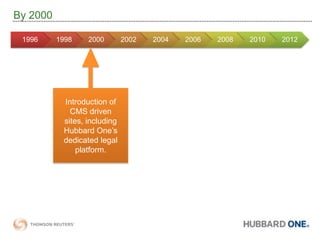
By 2000Introduction of CMS driven sites, including Hubbard One’s dedicated legal platform.
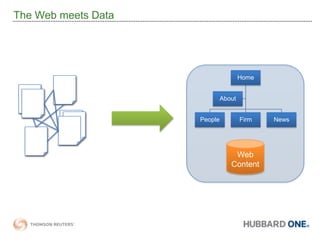
The Web meets DataWeb Content
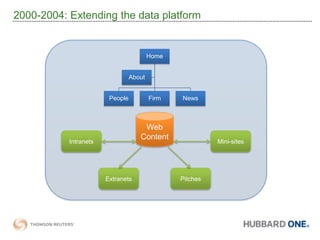
2000-2004: Extending the data platformWeb ContentMini-sitesIntranetsPitchesExtranets
Data provides valueData-driven web sites provided huge advantages that are simply assumed today:Immediate updates
Content editing by non-technical resources
Information re-use and re-deployment
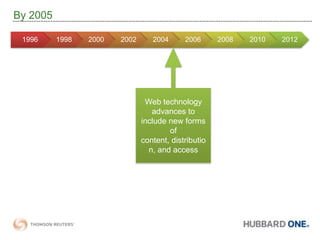
Integration into the law firm data ecosystemBy 2005Web technology advances to include new forms of content, distribution, and access
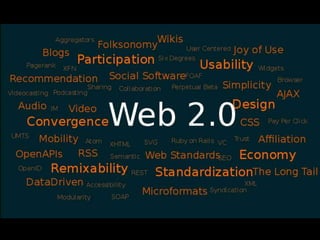
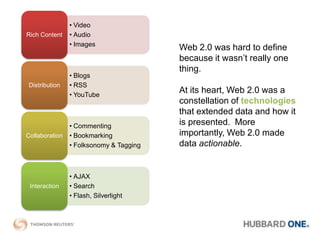
Web 2.0 was hard to define because it wasn’t really one thing.At its heart, Web 2.0 was a constellation of technologiesthat extended data and how itis presented.  More importantly, Web 2.0 made data actionable.
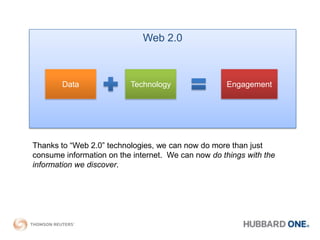
Web 2.0DataTechnologyEngagementThanks to “Web 2.0” technologies, we can now do more than just consume information on the internet.  We can now do things with the information we discover.
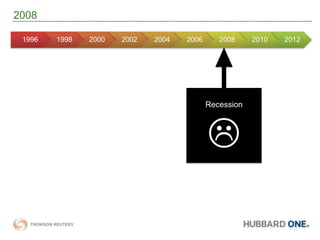
2008Recession
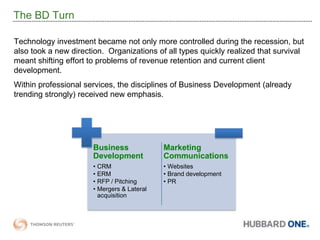
The BD TurnTechnology investment became not only more controlled during the recession, but also took a new direction.  Organizations of all types quickly realized that survival meant shifting effort to problems of revenue retention and current client development.   Within professional services, the disciplines of Business Development (already trending strongly) received new emphasis.
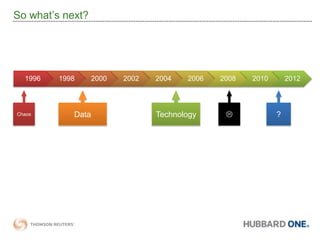
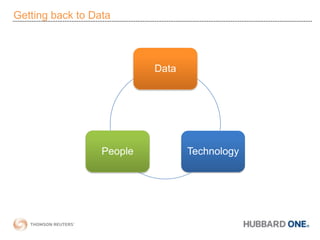
So what’s next? DataTechnology?Chaos
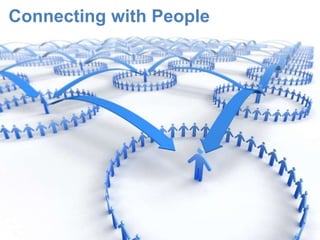
People.The Internet is made of People.
Connecting with People
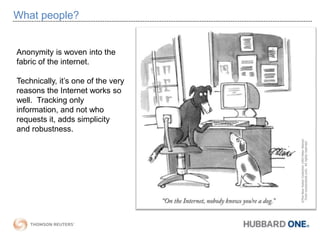
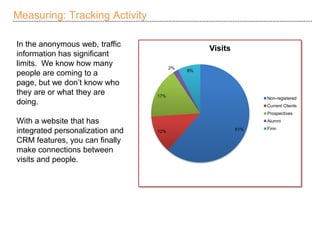
What people?Anonymity is woven into the fabric of the internet.  Technically, it’s one of the very reasons the Internet works so well.  Tracking only information, and not who requests it, adds simplicity and robustness.
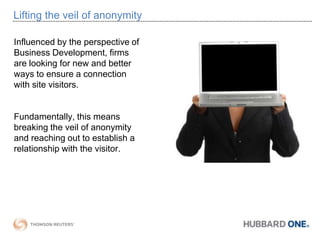
Lifting the veil of anonymityInfluenced by the perspective of Business Development, firms are looking for new and better ways to ensure a connection with site visitors.Fundamentally, this means breaking the veil of anonymity and reaching out to establish a relationship with the visitor.
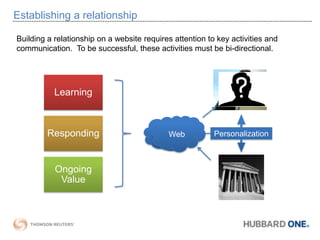
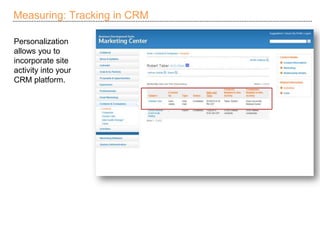
PersonalizationWebEstablishing a relationshipBuilding a relationship on a website requires attention to key activities and communication.  To be successful, these activities must be bi-directional.Web
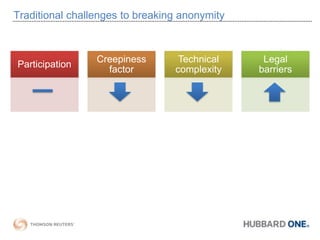
Traditional challenges to breaking anonymity
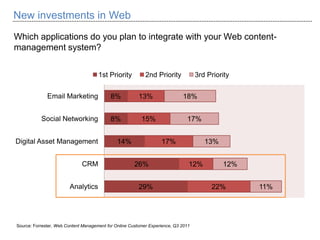
New investments in WebWhich applications do you plan to integrate with your Web content-management system?Source: Forrester, Web Content Management for Online Customer Experience, Q3 2011
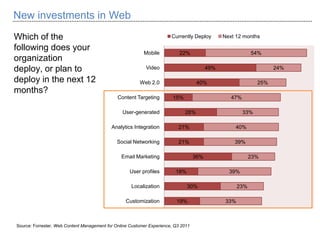
New investments in WebWhich of the following does your organization deploy, or plan to deploy in the next 12 months?Source: Forrester, Web Content Management for Online Customer Experience, Q3 2011
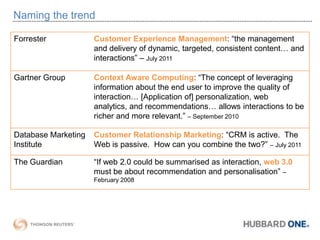
Naming the trend
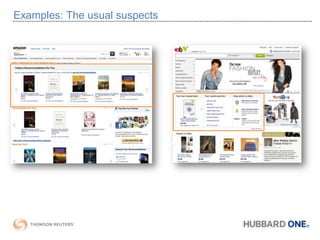
Examples: The usual suspects
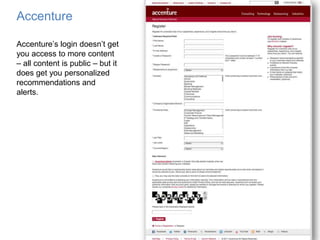
AccentureAccenture’s login doesn’t get you access to more content – all content is public – but it does get you personalized recommendations and alerts.
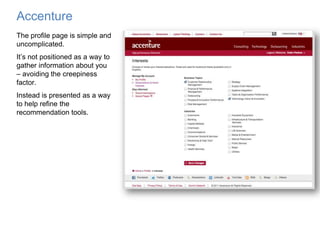
AccentureThe profile page is simple and uncomplicated.  It’s not positioned as a way to gather information about you – avoiding the creepiness factor.  Instead is presented as a way to help refine the recommendation tools.
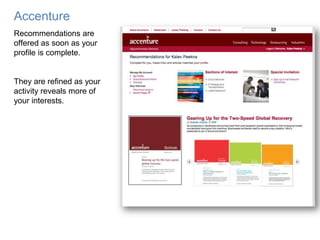
AccentureRecommendations are offered as soon as your profile is complete.They are refined as your activity reveals more of your interests.
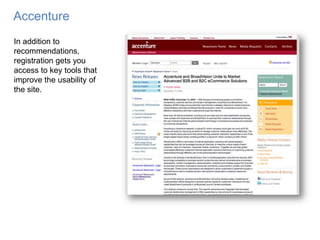
AccentureIn addition to recommendations, registration gets you access to key tools that improve the usability of the site.
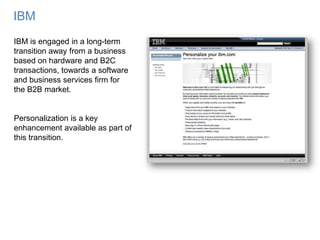
IBMIBM is engaged in a long-term transition away from a business based on hardware and B2C transactions, towards a software and business services firm for the B2B market.Personalization is a key enhancement available as part of this transition.
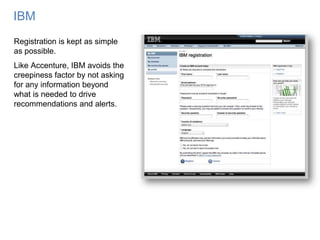
IBMRegistration is kept as simple as possible.  Like Accenture, IBM avoids the creepiness factor by not asking for any information beyond what is needed to drive recommendations and alerts.
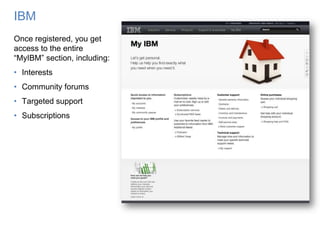
IBMOnce registered, you get access to the entire “MyIBM” section, including:InterestsCommunity forumsTargeted supportSubscriptions
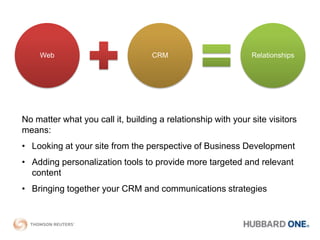
No matter what you call it, building a relationship with your site visitors means:Looking at your site from the perspective of Business Development
Adding personalization tools to provide more targeted and relevant content
Bringing together your CRM and communications strategiesWhy Personalization for Law Firms?
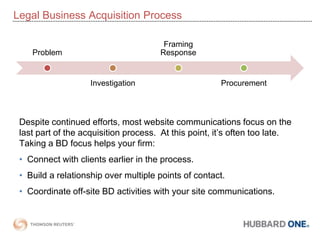
Legal Business Acquisition ProcessDespite continued efforts, most website communications focus on the last part of the acquisition process.  At this point, it’s often too late.  Taking a BD focus helps your firm:Connect with clients earlier in the process.Build a relationship over multiple points of contact.Coordinate off-site BD activities with your site communications.
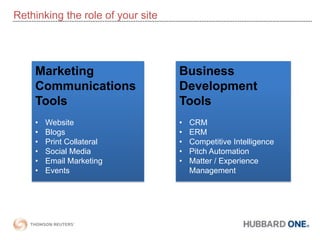
Rethinking the role of your siteMarketing Communications ToolsWebsite
Blogs
Print Collateral
Social Media
Email Marketing
EventsBusiness DevelopmentToolsCRM
ERM
Competitive Intelligence
Pitch Automation
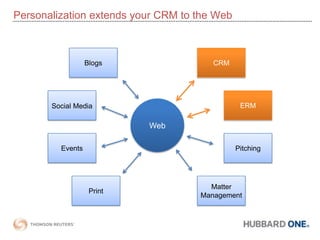
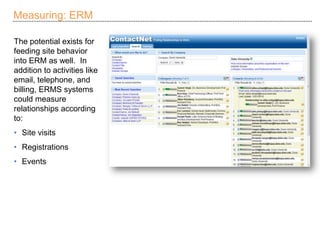
Matter / Experience ManagementPersonalization extends your CRM to the WebCRMBlogsERMSocialMediaWebPitchingEventsMatter ManagementPrint
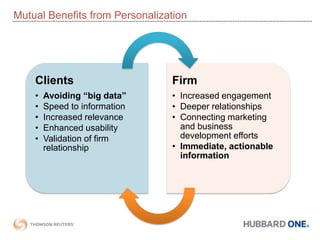
Mutual Benefits from Personalization
Scenarios
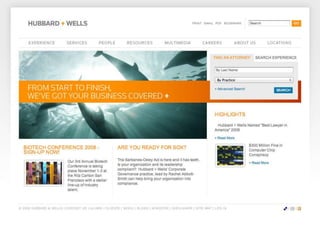
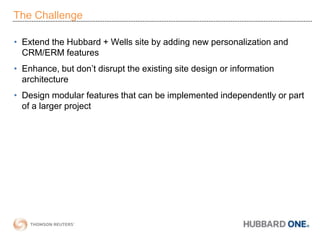
The ChallengeExtend the Hubbard + Wells site by adding new personalization and CRM/ERM featuresEnhance, but don’t disrupt the existing site design or information architectureDesign modular features that can be implemented independently or part of a larger project
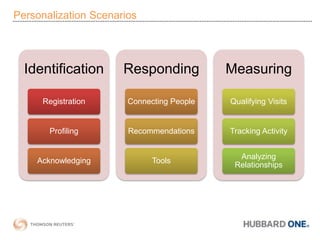
Personalization Scenarios
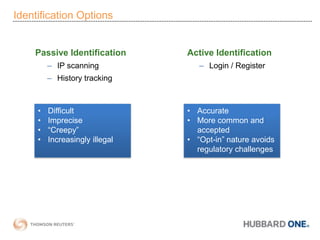
Passive IdentificationIP scanningHistory trackingActive IdentificationLogin / RegisterIdentification OptionsDifficult
Imprecise
“Creepy”
Increasingly illegal
Accurate
More common and accepted
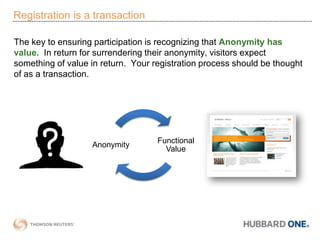
“Opt-in” nature avoids regulatory challengesRegistration is a transactionThe key to ensuring participation is recognizing that Anonymity has value.  In return for surrendering their anonymity, visitors expect something of value in return.  Your registration process should be thought of as a transaction.
Identification: Registration Offer
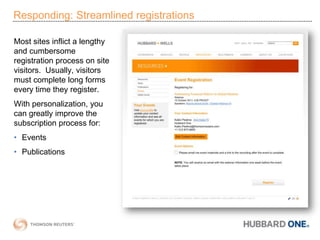
Identification Step 1: Signing UpKeep your signup as simple as possible.  Only collect information that is needed, especially on the first screen.
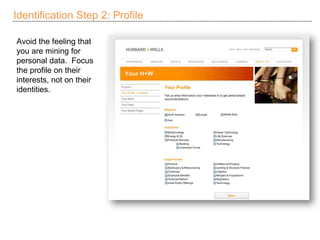
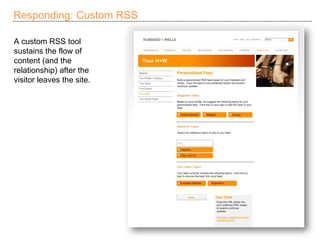
Identification Step 2: ProfileAvoid the feeling that you are mining for personal data.  Focus the profile on their interests, not on their identities.
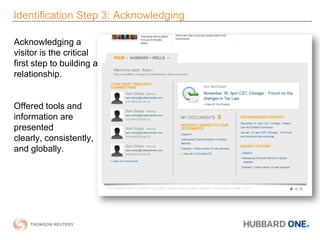
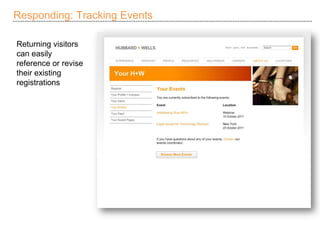
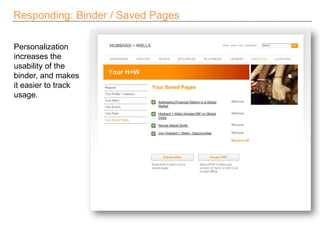
Identification Step 3: AcknowledgingAcknowledging a visitor is the critical first step to building a relationship.Offered tools and information are presented clearly, consistently, and globally.

Building Relationships through the Web

  • 1.
    Building Relationships onthe WebKalev PeeknaWeb Strategy Manager
  • 2.
  • 3.
    So there’s thisthing called the World Wide Webs….It starts in the 1990s
  • 4.
    Let’s put asmall ‘i’ in front. No, wait, a small ‘e’!Where does the floppy go?We should call ourselves CyberfirmCan we get it in cornflower blue?Total ChaosCan that guy get me a web?“Under Construction”Look! I can make the text flash!
  • 5.
    Marketing & ITquickly step in19961998
  • 6.
    By 2000Introduction ofCMS driven sites, including Hubbard One’s dedicated legal platform.
  • 7.
    The Web meetsDataWeb Content
  • 8.
    2000-2004: Extending thedata platformWeb ContentMini-sitesIntranetsPitchesExtranets
  • 9.
    Data provides valueData-drivenweb sites provided huge advantages that are simply assumed today:Immediate updates
  • 10.
    Content editing bynon-technical resources
  • 11.
  • 12.
    Integration into thelaw firm data ecosystemBy 2005Web technology advances to include new forms of content, distribution, and access
  • 14.
    Web 2.0 washard to define because it wasn’t really one thing.At its heart, Web 2.0 was a constellation of technologiesthat extended data and how itis presented. More importantly, Web 2.0 made data actionable.
  • 15.
    Web 2.0DataTechnologyEngagementThanks to“Web 2.0” technologies, we can now do more than just consume information on the internet. We can now do things with the information we discover.
  • 16.
  • 17.
    The BD TurnTechnologyinvestment became not only more controlled during the recession, but also took a new direction. Organizations of all types quickly realized that survival meant shifting effort to problems of revenue retention and current client development. Within professional services, the disciplines of Business Development (already trending strongly) received new emphasis.
  • 18.
    So what’s next?DataTechnology?Chaos
  • 19.
    People.The Internet ismade of People.
  • 20.
  • 21.
    What people?Anonymity iswoven into the fabric of the internet. Technically, it’s one of the very reasons the Internet works so well. Tracking only information, and not who requests it, adds simplicity and robustness.
  • 22.
    Lifting the veilof anonymityInfluenced by the perspective of Business Development, firms are looking for new and better ways to ensure a connection with site visitors.Fundamentally, this means breaking the veil of anonymity and reaching out to establish a relationship with the visitor.
  • 23.
    PersonalizationWebEstablishing a relationshipBuildinga relationship on a website requires attention to key activities and communication. To be successful, these activities must be bi-directional.Web
  • 24.
    Traditional challenges tobreaking anonymity
  • 25.
    New investments inWebWhich applications do you plan to integrate with your Web content-management system?Source: Forrester, Web Content Management for Online Customer Experience, Q3 2011
  • 26.
    New investments inWebWhich of the following does your organization deploy, or plan to deploy in the next 12 months?Source: Forrester, Web Content Management for Online Customer Experience, Q3 2011
  • 27.
  • 28.
  • 29.
    AccentureAccenture’s login doesn’tget you access to more content – all content is public – but it does get you personalized recommendations and alerts.
  • 30.
    AccentureThe profile pageis simple and uncomplicated. It’s not positioned as a way to gather information about you – avoiding the creepiness factor. Instead is presented as a way to help refine the recommendation tools.
  • 31.
    AccentureRecommendations are offeredas soon as your profile is complete.They are refined as your activity reveals more of your interests.
  • 32.
    AccentureIn addition torecommendations, registration gets you access to key tools that improve the usability of the site.
  • 33.
    IBMIBM is engagedin a long-term transition away from a business based on hardware and B2C transactions, towards a software and business services firm for the B2B market.Personalization is a key enhancement available as part of this transition.
  • 34.
    IBMRegistration is keptas simple as possible. Like Accenture, IBM avoids the creepiness factor by not asking for any information beyond what is needed to drive recommendations and alerts.
  • 35.
    IBMOnce registered, youget access to the entire “MyIBM” section, including:InterestsCommunity forumsTargeted supportSubscriptions
  • 36.
    No matter whatyou call it, building a relationship with your site visitors means:Looking at your site from the perspective of Business Development
  • 37.
    Adding personalization toolsto provide more targeted and relevant content
  • 38.
    Bringing together yourCRM and communications strategiesWhy Personalization for Law Firms?
  • 39.
    Legal Business AcquisitionProcessDespite continued efforts, most website communications focus on the last part of the acquisition process. At this point, it’s often too late. Taking a BD focus helps your firm:Connect with clients earlier in the process.Build a relationship over multiple points of contact.Coordinate off-site BD activities with your site communications.
  • 40.
    Rethinking the roleof your siteMarketing Communications ToolsWebsite
  • 41.
  • 42.
  • 43.
  • 44.
  • 45.
  • 46.
  • 47.
  • 48.
  • 49.
    Matter / ExperienceManagementPersonalization extends your CRM to the WebCRMBlogsERMSocialMediaWebPitchingEventsMatter ManagementPrint
  • 50.
    Mutual Benefits fromPersonalization
  • 51.
  • 53.
    The ChallengeExtend theHubbard + Wells site by adding new personalization and CRM/ERM featuresEnhance, but don’t disrupt the existing site design or information architectureDesign modular features that can be implemented independently or part of a larger project
  • 54.
  • 55.
    Passive IdentificationIP scanningHistorytrackingActive IdentificationLogin / RegisterIdentification OptionsDifficult
  • 56.
  • 57.
  • 58.
  • 59.
  • 60.
  • 61.
    “Opt-in” nature avoidsregulatory challengesRegistration is a transactionThe key to ensuring participation is recognizing that Anonymity has value. In return for surrendering their anonymity, visitors expect something of value in return. Your registration process should be thought of as a transaction.
  • 63.
  • 66.
    Identification Step 1:Signing UpKeep your signup as simple as possible. Only collect information that is needed, especially on the first screen.
  • 67.
    Identification Step 2:ProfileAvoid the feeling that you are mining for personal data. Focus the profile on their interests, not on their identities.
  • 68.
    Identification Step 3:AcknowledgingAcknowledging a visitor is the critical first step to building a relationship.Offered tools and information are presented clearly, consistently, and globally.

Editor's Notes

  • #5 Among law firms, it’s practically total chaos
  • #14 Web 2.0 created free-range data
  • #22 Introduce the notion of personalization – that is how these relationships get built.