Aspects of Building Construction
By: Prakash Singh
Code:B2055R14001010
Guided by
Mr. Vishutosh Bajpai
Overview
Why do we need buildings?
Process of building construction
Constraints on building construction
Elements create building load
Forces delivered to Earth for building to
be structurally sound
Basic Components of building
Identification of Construction materials
Why do we need buildings?
 Safety- from natural hazards,animals,protection
from things detrimental to human health
 Recreational Purpose- Cinema hall, Markets,
Malls, Gaming Centre.
 Services-Hospitals ,Schools , Colleges.
 Day to day activities of human being food, sleep
,waste disposal
 We need services that provide
energy,communications,water and disposal of
wastes.
 We need less light by day and more light by night,
than is offered by the natural world.
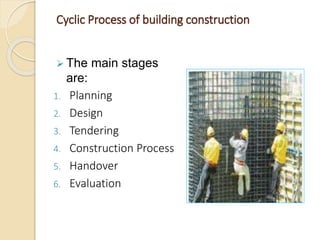
Cyclic Process of building construction
 The main stages
are:
1. Planning
2. Design
3. Tendering
4. Construction Process
5. Handover
6. Evaluation
Constraints on building construction
 Health codes
 Fire codes
 Plumbing codes
 Electrical codes
 Building contractors and Labour Union Regulations
Elements create building load
Various loads are taken into account while
designing the foundation of a structure.
Two broad categories:
 Dead loads
 Live loads
Specific terms for dead loads and live loads:
 Concentrated load
 Distributed load
 Design load
 Undesigned load
 Fire load
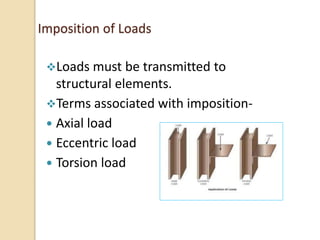
Imposition of Loads
Loads must be transmitted to
structural elements.
Terms associated with imposition-
 Axial load
 Eccentric load
 Torsion load
Forces delivered to Earth for building to be structurally sound
Structural Elements
Building is an assembly of structural
elements designed to transfer loads to
the earth.
Can be defined simply as:
Beams
Columns
Walls
Connections
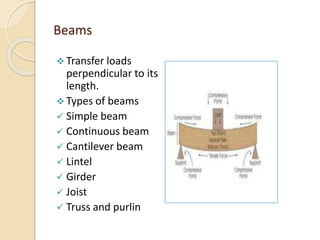
Beams
 Transfer loads
perpendicular to its
length.
 Types of beams
 Simple beam
 Continuous beam
 Cantilever beam
 Lintel
 Girder
 Joist
 Truss and purlin
Columns
Any structural component that transmits
a compressive force parallel through its
centre.
Typically support beams and other
columns
Generally vertical supports of building
Can be vertical, horizontal or diagonal
Walls
Really long, but slender column
Two categories-
-Load bearing walls
It carries weight of beams, other
walls,floors,roofs,other structural elements.
IT carries weight of the wall itself.
-Non-load bearing walls
Need only support its own weight. Example
are partition wall between two stores in a
strip mall.
Connections
Weak link as it relates to structural failure
during fires
 - Often small, low-mass material that
lacks capacity to absorb heat.
Three Categories-
 Pinned
 Rigid
 Gravity
Basic components of building
 1. SUPER-STRUCTURE
 2. SUBSTRUCTURE-
Plinth,D.P.C.,Walls and
columns,Floors,Beams,Slabs
Identification of Construction materials
Many factors determine which material is
used to form structural elements-
Cost
Application
Engineering capabilities
Adaptability
Each material react to fire in a different
way.
wood
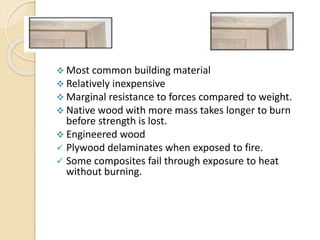
 Most common building material
 Relatively inexpensive
 Marginal resistance to forces compared to weight.
 Native wood with more mass takes longer to burn
before strength is lost.
 Engineered wood
 Plywood delaminates when exposed to fire.
 Some composites fail through exposure to heat
without burning.
Steel
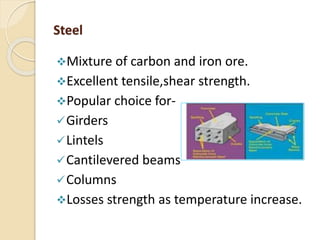
Mixture of carbon and iron ore.
Excellent tensile,shear strength.
Popular choice for-
Girders
Lintels
Cantilevered beams
Columns
Losses strength as temperature increase.
Concrete
Mixture of portland cement,sand,gravel
and water.
Excellent compressive strength.
All concrete contains some moisture.
Under heat,moisture expands and causes
concrete to crack .
Concrete can stay hot long after the fire is
out.
Masonry
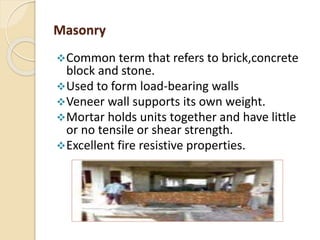
Common term that refers to brick,concrete
block and stone.
Used to form load-bearing walls
Veneer wall supports its own weight.
Mortar holds units together and have little
or no tensile or shear strength.
Excellent fire resistive properties.
Cement
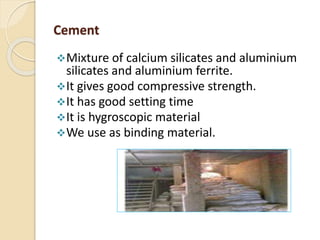
Mixture of calcium silicates and aluminium
silicates and aluminium ferrite.
It gives good compressive strength.
It has good setting time
It is hygroscopic material
We use as binding material.
THANK YOU

building construction ppt.pptx

  • 1.
    Aspects of BuildingConstruction By: Prakash Singh Code:B2055R14001010 Guided by Mr. Vishutosh Bajpai
  • 2.
    Overview Why do weneed buildings? Process of building construction Constraints on building construction Elements create building load Forces delivered to Earth for building to be structurally sound Basic Components of building Identification of Construction materials
  • 3.
    Why do weneed buildings?  Safety- from natural hazards,animals,protection from things detrimental to human health  Recreational Purpose- Cinema hall, Markets, Malls, Gaming Centre.  Services-Hospitals ,Schools , Colleges.  Day to day activities of human being food, sleep ,waste disposal  We need services that provide energy,communications,water and disposal of wastes.  We need less light by day and more light by night, than is offered by the natural world.
  • 4.
    Cyclic Process ofbuilding construction  The main stages are: 1. Planning 2. Design 3. Tendering 4. Construction Process 5. Handover 6. Evaluation
  • 5.
    Constraints on buildingconstruction  Health codes  Fire codes  Plumbing codes  Electrical codes  Building contractors and Labour Union Regulations
  • 6.
    Elements create buildingload Various loads are taken into account while designing the foundation of a structure. Two broad categories:  Dead loads  Live loads Specific terms for dead loads and live loads:  Concentrated load  Distributed load  Design load  Undesigned load  Fire load
  • 7.
    Imposition of Loads Loadsmust be transmitted to structural elements. Terms associated with imposition-  Axial load  Eccentric load  Torsion load
  • 8.
    Forces delivered toEarth for building to be structurally sound Structural Elements Building is an assembly of structural elements designed to transfer loads to the earth. Can be defined simply as: Beams Columns Walls Connections
  • 9.
    Beams  Transfer loads perpendicularto its length.  Types of beams  Simple beam  Continuous beam  Cantilever beam  Lintel  Girder  Joist  Truss and purlin
  • 10.
    Columns Any structural componentthat transmits a compressive force parallel through its centre. Typically support beams and other columns Generally vertical supports of building Can be vertical, horizontal or diagonal
  • 11.
    Walls Really long, butslender column Two categories- -Load bearing walls It carries weight of beams, other walls,floors,roofs,other structural elements. IT carries weight of the wall itself. -Non-load bearing walls Need only support its own weight. Example are partition wall between two stores in a strip mall.
  • 12.
    Connections Weak link asit relates to structural failure during fires  - Often small, low-mass material that lacks capacity to absorb heat. Three Categories-  Pinned  Rigid  Gravity
  • 13.
    Basic components ofbuilding  1. SUPER-STRUCTURE  2. SUBSTRUCTURE- Plinth,D.P.C.,Walls and columns,Floors,Beams,Slabs
  • 14.
    Identification of Constructionmaterials Many factors determine which material is used to form structural elements- Cost Application Engineering capabilities Adaptability Each material react to fire in a different way.
  • 15.
    wood  Most commonbuilding material  Relatively inexpensive  Marginal resistance to forces compared to weight.  Native wood with more mass takes longer to burn before strength is lost.  Engineered wood  Plywood delaminates when exposed to fire.  Some composites fail through exposure to heat without burning.
  • 16.
    Steel Mixture of carbonand iron ore. Excellent tensile,shear strength. Popular choice for- Girders Lintels Cantilevered beams Columns Losses strength as temperature increase.
  • 17.
    Concrete Mixture of portlandcement,sand,gravel and water. Excellent compressive strength. All concrete contains some moisture. Under heat,moisture expands and causes concrete to crack . Concrete can stay hot long after the fire is out.
  • 18.
    Masonry Common term thatrefers to brick,concrete block and stone. Used to form load-bearing walls Veneer wall supports its own weight. Mortar holds units together and have little or no tensile or shear strength. Excellent fire resistive properties.
  • 19.
    Cement Mixture of calciumsilicates and aluminium silicates and aluminium ferrite. It gives good compressive strength. It has good setting time It is hygroscopic material We use as binding material.
  • 20.