BCD PROJECT
FINAL TERM
ZARNOSH KTK 8/2/20 BUILDING CONSTRUCTION
BCD PROJECT ZARNOSH KTK
1
FINAL TERM PROJECT
SUBJECT: BUILDING CONSTRUCTION
COURSE INSTRUCTOR: ENGG.ARSALAAN
STUDENT NAME: ZARNOSH KHATTAK
SECTION: M
CLASSROLL# 161
REG# 19PWCIV5207
UNIVERSITY NAME: UET PESHAWAR
DEPARTMENT: CIVIL
SEMESTER: 2ND
BCD PROJECT ZARNOSH KTK
2
1. What is formwork or shuttering? What are the requirements of good formwork?
Ans:
FORMWORK: The temporary support beneath and all the sides of precast or cast in
situ concrete work is called formwork or shuttering
•
Both formwork and shuttering accomplish the same task but
Shuttering refers to the method of forming the mold using plywood
while formwork is more of a broader term that's used to denote the process
of creating a mold using a variety of materials
•
wood in planks or strips used as a temporary structure to contain setting
concrete, to support the sides of trenches or a temporary structure made from
planks or wood
•
The speed with which construction is done and appearance of the finished
surface are largely dependent on the use of properly constructed formwork
TYPES OF FORM WORK:
There are many types of formwork, some of them are following
01 Formwork for concrete floors and beams
02 Formwork for walls
03 Formwork for columns
04 Timber formwork
05 Steel formwork
BCD PROJECT ZARNOSH KTK
3
REQUIREMENTS OF FORMWORK:
Following are the main requirements for good quality formwork,
1. Easy removal: It should be easily removed.
2. Economy: It should not be so costly so that the owner can’t managed it.
3. Strength: It should be strong enough to support the dead and live loads during
construction.
4. Rigidity: The formwork should be rigid and hard.
5. Smooth surface: It should have plain surface so that it can provide good finished
surface.
6. Less leakage: It should be water tight as far as possible.
7. Light weight: the formwork should be of light weight.
8. Quality: It should be so design so that it could be used several times.
9. Support: The formwork should provide support.
BCD PROJECT ZARNOSH KTK
4
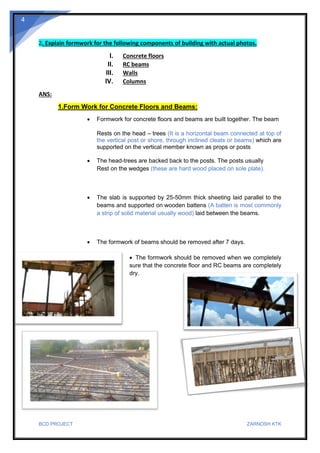
2. Explain formwork for the following components of building with actual photos.
I. Concrete floors
II. RC beams
III. Walls
IV. Columns
ANS:
1.Form Work for Concrete Floors and Beams:
• Formwork for concrete floors and beams are built together. The beam
Rests on the head – trees (It is a horizontal beam connected at top of
the vertical post or shore, through inclined cleats or beams) which are
supported on the vertical member known as props or posts
• The head-trees are backed back to the posts. The posts usually
Rest on the wedges (these are hard wood placed on sole plate).
• The slab is supported by 25-50mm thick sheeting laid parallel to the
beams and supported on wooden battens (A batten is most commonly
a strip of solid material usually wood) laid between the beams.
• The formwork of beams should be removed after 7 days.
• The formwork should be removed when we completely
sure that the concrete floor and RC beams are completely
dry.
BCD PROJECT ZARNOSH KTK
5
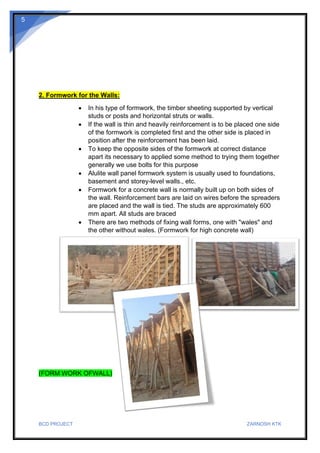
2. Formwork for the Walls:
• In his type of formwork, the timber sheeting supported by vertical
studs or posts and horizontal struts or walls.
• If the wall is thin and heavily reinforcement is to be placed one side
of the formwork is completed first and the other side is placed in
position after the reinforcement has been laid.
• To keep the opposite sides of the formwork at correct distance
apart its necessary to applied some method to trying them together
generally we use bolts for this purpose
• Alulite wall panel formwork system is usually used to foundations,
basement and storey-level walls., etc.
• Formwork for a concrete wall is normally built up on both sides of
the wall. Reinforcement bars are laid on wires before the spreaders
are placed and the wall is tied. The studs are approximately 600
mm apart. All studs are braced
• There are two methods of fixing wall forms, one with "wales" and
the other without wales. (Formwork for high concrete wall)
(FORM WORK OFWALL)
BCD PROJECT ZARNOSH KTK
6
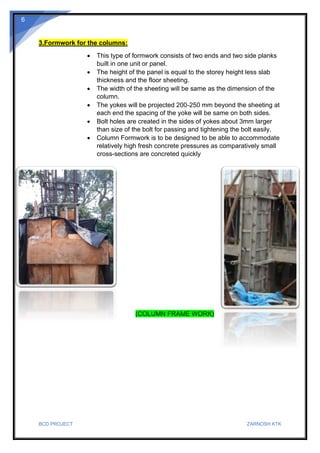
3.Formwork for the columns:
• This type of formwork consists of two ends and two side planks
built in one unit or panel.
• The height of the panel is equal to the storey height less slab
thickness and the floor sheeting.
• The width of the sheeting will be same as the dimension of the
column.
• The yokes will be projected 200-250 mm beyond the sheeting at
each end the spacing of the yoke will be same on both sides.
• Bolt holes are created in the sides of yokes about 3mm larger
than size of the bolt for passing and tightening the bolt easily.
• Column Formwork is to be designed to be able to accommodate
relatively high fresh concrete pressures as comparatively small
cross-sections are concreted quickly
(COLUMN FRAME WORK)
BCD PROJECT ZARNOSH KTK
7
3. Describe in your own words the importance of building bye-laws.
ANS:
Definition: The construction of any building, certain restrictions are laid down by
Municipal bodies, Urban development authorities and other government departments
as town planning trusts to clear open spaces to be left round the building.
(or)
The Building Byelaws are defined as the standards &specifications designed to grant
minimum safeguards to the workers during construction, to the health &comfort of
the users & to provide enough safety to the public in general.
• “The human has to no longer have to roam around for a proper shelter but live
in a better planned and construction of such houses, some basic rules and
regulation which may be termed as building bylaws.”
IMPORTANCE OF BUILDING BY LAWS: following are the main importance of building
by laws.
a) Building by laws are made to ensure orderly development of
localities in urban areas so that every house is assured of good ventilation and no
building affects the lighting and ventilation of neighbors.
2. There has to be laws or regulations binding on the prospective builders, if not,
the building constructed will be Un-scientific, Unhealthy and Inconvenient for the
people to occupy.
3. The buildings must get sufficient sunshine, air and ventilation.
4. Open spaces should be well planned.
5. The buildings should create better environment.
6. The buildings should be located in healthy surroundings and should
have an aesthetic appearance.
7. Allows disciplined and systematic growth of buildings and towns and
prevent haphazard development.
8. Protect safety of public against fire, noise, health hazards and
structural failures.
9. Provide proper utilization of space. Hence, maximum efficiency in
planning can be derived from these bye laws.
10. They give guidelines to the architect or an engineer in effective
planning and useful in preplanning the building activities.
BCD PROJECT ZARNOSH KTK
8
11. They provide health, safety and comfort to the people who live in
Buildings.
12. Due to these by-laws, each building will have proper approaches,
light, air and ventilation which are essential for health, safety and
comfort.
13. Application of Bye Laws like structural safety, fire safety,
earthquake safety, basement, electricity, water, and
communication lines in various building types.
14. Provide safety against diseases.
15. Develop town in systematic manner
16. To make it easier to pre-plan the building activities.
BCD PROJECT ZARNOSH KTK
9
4. Describe the requirements for the following types of facilities as per building bye-laws.
Also explain any technical terms involved in your answer.
(CLO-1)
I. Amenity buildings
II. Commercial-cum-residential buildings
III. Industrial buildings and industrial zones
IV. Public buildings in housing schemes
V. Residential buildings
VI. Apartment buildings
VII. Parking requirements
VIII. Petrol pumps and CNG stations
IX. Fire protection in different classes of building occupancies
X. Life safety requirements
ANS: (1) AMENITY BUILDINGS:
a) HOSPITALS:
• Minimum Plot Size shall be 4 Kanals
• Set Back (Front, Rear, Sides) = 20 ft. Each
• Foot Print, Plot to Floor Area Ration and Site Coverage
• Foot Print (Max) = 60 %
• Floor Area Ratio = 1:5
• Maximum height of building = 170 ft.
b) B.H. U& Clinics:
➢ For clinic the minimum space shall be according to the nature of practice
➢ For B.H.U the plot size shall be 1 Kanal
➢ Set back from all sides shall be 5’-0”
➢ Foot Print, Plot to Floor Area Ratio and Site Coverage
➢ Foot Print (Max) = 60 %
➢ Floor Area Ratio = 1:2.8
c) Colleges and Universities:
▪ Minimum Plot Size shall be 36 Kanals for colleges &Minimum Plot Size
shall be 56 Kanals for Universities
▪ Front should be 40’-0”
▪ All other sides shall be 20’each
▪ Foot Print (Max) shall be 40 %
▪ Floor Area Ratio shall be 1:1.6
BCD PROJECT ZARNOSH KTK
10
▪ Plinth Level subject to contour of Plot as defined is 1.5 ft. to 4.5 ft.
▪ Height of Lawn should not be less than 9 inches from Road Level.
▪ 50% of the open area should be reserved for parks and recreational
spaces inside hospitals and all other health care buildings
d) Schools:
o For Primary Schools the minimum lot size shall be 2 Kanals
o For Middle Schools the minimum lot size shall be 4 Kanals
o For High Schools the minimum plot size shall be 8 Kanals
o For Higher Secondary Schools the minimum plot size shall be 16
kanals
o The setback shall be 10’ each side
o Foot Print (Max) = 40 %
o Floor Area Ratio = 1:1.6
o Ground Floor: 9.5 Ft to 12 Ft
o 1st Floor & 2nd Floor (if applicable): 10.5 Ft (each) 9.5 Ft (each)
o Clear Height of Basement: 9 ft.
o Boundary Wall from Crown of the Road shall be 6 to 8 ft.
o For storey Floor height shall be: 9.5 Ft to 16 Ft
o Clear Height of Basement shall be 9 ft.
o l doors, Windows and Ventilators provided for rooms in the
proposed building shall not be less than the following. All doors
should open towards outwards of the buildings.
Minimum sizes: -
o For Ventilators – 3 sqft
o For Doors – 2’6” X 6’6”
o For Windows – 6’-0”.
o 50% of the open area should be reserved for parks, recreational
spaces and car parking inside hospitals and all other health care
buildings.
(2) Commercial-cum-residential buildings:
MARLAS 2.6 Marla’s
to 5
Marla’s
5.1Marla -
8.3 Marla
8.3 Marla
to 13.2
Marla
13.2 Marla
to 20 Marla
20 Marla to
33 Marla
33 Marla to
66 Marla
ARCADE no space no space no space 8 Ft 8 Ft 8 Ft
RARE 3 Ft 5 Ft 7.5 Ft 7.5 Ft 8 Ft 10 Ft
SIDE no Space no Space no Space 5 FT 5 FT 7.5 FT
BCD PROJECT ZARNOSH KTK
11
❖ Commercial Buildings 3 ft. if basement is constructed, otherwise 2 ft.
❖ Arcade from Crown of the Road: 1.33ft
❖ Parapet Wall: 4 ft.
❖ Ground Floor: 9.5 Ft
❖ 1st floor & 2nd floor 9.5 Ft (each) if applicable
❖ Height of Stair Tower 8’-0”
❖ Height of Basement 9’ without obstruction
❖ Width 8 ft.
❖ Maximum height of arcade floor from adjacent road level 10′-6″.
❖ Minimum height from floor level 10-6” ft.
❖ Ventilators – 2 sqft
❖ Doors – 2′-6″x6′-6″
❖ Windows – 9Sqft
❖ Minimum floor area of shop shall be 100 sq. ft. having minimum floor width of
8 ft.
❖ The roofs of every building abutting on the street or constructed over a street
shall be drained by means of gutters and down pipes
❖ One car space for every 1000 sq. ft of floor area.
❖ 40% of Parking space shall be reserved for cycles and motorcycles
(3) Industrial buildings and industrial zones:
Plot Size Max. Covered
Area (%)
1 Kanal 60
2 Kanals 60
3 to 4 Kanals 60
1 to 3 Acres 60
4 Acres and above 60
▪ Minimum height for each story shall be 12 ft.
▪ Top of the plinth of the building shall not be less than 12 inches from the road
level from the road level.
▪ Parapet where applicable may be up to 3 ft. height from the roof level
▪ Minimum clear height to be maintained at 11 ft.
▪ Provision of adequate natural light and ventilation Provision of Emergency
exits at multiple points Installation of firefighting apparatus
▪ Minimum stairs width to be maintained at 4 ft.
▪ Maximum riser to be maintained at 7.0 inches
BCD PROJECT ZARNOSH KTK
12
▪ Parking for multi-axel trailers, cargo containers and cranes. Road networks
within and around the industrial zone to be of international standards.
▪ For light and ventilation in every building there shall be opening in the walls or
roofs wherever applicable. The amount of these openings shall not be less
than 1/12th of the floor area of the building or 5 sq. ft.
▪ All bath rooms, lavatories, and water closets shall have ventilation, in or close
to the ceiling opening direct to the outer air. Area of bath room and water
closet should not be less 20 sq. ft. and 16 sq. ft respectively.
(4) Public buildings in housing schemes:
AREA Plot<10 MARLAS PLOT<1KANAL 1-2KANAL >2KANAL
Building line 7 feet 10 feet 20 feet 30 feet
Rear space 5feet 5feet 7feet null
Side space 0feet 5feet 10feet 15feet
Theater/ Concert Hall/ Marriage Hall/ Clubs/ Banquet Hall:
• Minimum Plot size = 4 Kanals
• Building line = 40 feet
• Remaining Three Sides = 10 feet
• Minimum parking for cars to be 60% of occupancy
Fire Fighting:
• Emergency Exits.
• Fire Alarm System
• Fire Extinguisher
• Fire Sprinkler
• Fire Route
ROAD:
➢ The minimum width for any road proposed shall not be less than 24 foot,
excluding central median and walkways/footpaths for pedestrians.
➢ The height of the road will be at least 18 inches below the plot level.
BCD PROJECT ZARNOSH KTK
13
(5) Residential buildings:
FOR 2 MARLAS PLOT:
➢ 100% covered with the provision of 10% void (s)/open duct(s) in the
house (Mandatory) (to enhance the ventilation and atmosphere) Front,
Rear, and Sides - No Space
➢ Max. 100% of the ground coverage for basement
➢ 100% minus Void Area (10%)
➢ 1:2 but not exceeding ground + 1 floors (G+FF). This is exclusive of the
provision of construction on Mumty
➢ Up to 100 sqft No ramp or stairs on the road or green belt.
FOR 1-2 KANAL:
• Front = 15ft, Back = 10ft, on both Side = 5ft, mandatory open space.
• Maximum 100% of the ground coverage area
• 70% of the plot area
• 1:1.25 but not exceeding ground + 1 floors (G+FF). This is exclusive of
the provision of construction on Mumty
FOR >2 KANAL:
❖ Front 20ft, Back = 15ft, On Both Sides = 10ft, Mandatory open space.
❖ Maximum 100% of the ground coverage area
❖ FOOT PRINT 60% of the plot area
❖ 1:1.25 but not exceeding ground + 1 floors (G+FF). This is exclusive of
the provision of construction on Mumty
(6) Apartment buildings:
FOR 4 STOREY BUILDING:
❖ 40ft in case of row of flats with front open from front line.
❖ 60 ft. in case of row of flats facing each other
❖ 20 ft. in between end of blocks of apartment/flats either facing each
other or placed as single row from front line.
❖ 20 ft. at rear as service road for garbage collection and as privacy
buffer for apartment/flats placed back to back
❖ Minimum of one stair case for 8 numbers of Apartments with a
minimum width of 4 feet
❖ In case of unavailability of sewerage provision of a septic tank and a
soakage pit shall be provided.
❖ Lighting conductor for a group of 8 apartments needs to be provided.
BCD PROJECT ZARNOSH KTK
14
FOR > 4 STOREY BUILDING:
➢ 40ft in case of row of flats with front open from front line.
➢ 60 ft in case of row of flats facing each other 60 ft.
➢ 20 ft in between end of blocks of apartment/ flats either facing each
other or placed as single row from front line
➢ 20 ft.at rear as service road for garbage collection, firefighting and as
privacy buffer for apartment / flats placed back to back.
➢ Minimum of one stair case for 8 numbers of Apartments with a
minimum width of 4 feet.
➢ Garbage disposal chute accessible to 8 number flats and receptors
shall be provided at Ground floor.
➢ Minimum of two numbers of firefighting extinguishers shall be provided
at each floor landing area.
(7) Parking requirements:
• Minimum clear height of parking structure without obstruction shall be
7.5 feet.
• Mechanical ventilation to be provided for parking in the basement or
closed areas.
• Adequate car parking to be provided.
• The parking space, including ramps, shall be exempted from FAR.
• 16% of the total car parking space will be utilized to provide space for
Motorcycle parking @ 6 Motorcycles and 8 bicycles for every one car.
• One car lift with standby generator shall be provided for every 50 cars.
If parking level is up to 40 ft in height.
• Minimum one car lift wherever so required with standby generator shall
be provided for every 40 cars, if parking level is at more than 40ft
(12m) in height from road level.
DIFFERENT VEHICEL PARKING STANDARDS:
➢ Car: 2.4 meters x 4.8 meters.
➢ Light Vans: 2.4 meters x 5.5 meters.
➢ Rigid Vehicles: 3.5 meters x 14.0 meters.
➢ Articulated Vehicles: 3.5 meters x 18.5 meters.
➢ Coaches (60 seats): 3.5 meters x 14.0 meters
BCD PROJECT ZARNOSH KTK
15
(8) Petrol pumps and CNG stations:
❖ Plot size for establishing petrol pump or petrol pump cum CNG station
shall be min.1000 Sq. Yards.
❖ Plot size for establishing CNG station shall be Minimum 750 Sq. Yards.
❖ Right-of-way of road on which petrol pump or CNG Station can be
established shall be min. 80 ft.
❖ Distance between two adjacent petrol pumps or CNG stations shall be
min.0.5 KM along the road.
❖ Frontage of petrol pump / CNG Stations shall be min 80 feet.
❖ Both Ladies and gents’ toilets are compulsory.
❖ Minimum area of offices, bathrooms and tuck shop etc. (single storey
only) shall be 5% of plot area.
❖ Distance between two dispensers shall be min. 24 feet.
❖ Distance between dispenser and road edge shall be min. 18 feet.
❖ Minimum area of offices, bathrooms and tuck shop etc. (single storey
only) shall be 5% of plot area.
❖ 2 ½ % of permissible FAR/proposed covered area shall be provided for
recreational facility/prayer area which will not be regularized,
(9) Fire protection in different classes of building occupancies:
All buildings, whether existing or hereafter erected shall be classified according to the
use or the character of occupancy in 9 groups,
Group A (Residential Buildings):
➢ These shall include any building in which sleeping
accommodation is provided of normal residential purposes with
or without cooking or dining or both facilities.
Sub-division A-1:
➢ These shall include any building or group of building under the
same management, in which separate sleeping accommodation
for a total of not more than 40 persons.
➢ A lodging or rooming house shall be classified as a dwelling in
sub-division A-2 If no room in any of its private dwelling units is
rented to more than three persons.
Sub-division:
BCD PROJECT ZARNOSH KTK
16
➢ These shall include any private dwelling which is occupied by members
of one or two families and has a total sleeping accommodation for not
more than 20 persons.
➢ If sleeping accommodation for more than 20 persons is provided in any
one residential building, it shall be classified as a building in sub-
division A-1, A-3 or A-4 as the case may be.
Sub-division A-3:
➢ These shall include any building in which group sleeping
accommodation is provided, with or without dining facilities for persons
who are not members of the same family.
➢ for example, school and college dormitories, students, and other
hostels and military barracks.
Sub-division A-4:
➢ These shall include any building or structure which living quarters are
provided for three
➢ or more families, living independently of each other and with
independent cooking facilities.
➢ for example, apartment houses and mansions.
Sub-division A-5:
➢ Theses shall include any building or group of building under single
management, like hotels
Sub-division A-6:
➢ Theses shall include the hotels duly approved by the concerned
authorities as Five Star and above Hotels.
Group B (Educational Buildings):
• These shall include any building used for school, colleges other training
institutions for day-care purposes involving assembly for instruction, education
or recreation for not less than 20 students.
• Building and structures under Group-B shall be further Sub-division as follows:
o Sub-division B-1 Schools up to senior secondary level
o Sub-division B-2 all other/training institutions
Group C (Institutional Buildings):
❖ These shall include any building or part thereof which is used for
purposes, such as medical or other treatment or care of persons
suffering from physical or mental illness, disease or infirmity; care of
infants, convalescents or aged persons and for penal or correctional
detention in which the liberty of the inmates is restricted.
BCD PROJECT ZARNOSH KTK
17
Buildings and structures under Group C shall be further Sub-division as follows;
o Sub-division C-1 Hospitals and sanatoria
o Sub-division C-2 Custodial Institutions
o Sub-division C-3 Penal and mental institutions
Group D (Assembly Buildings):
➢ These shall include any building or part of a building, where any
building or part of a building, where number of persons not less than 50
congregate or gather for amusement, recreation, social, religious,
patriotic, civil, travel and similar purposes.
➢ For example, theatres, motion picture houses, assembly halls,
auditoria, exhibition halls, museums, skating rinks,
➢ Building under group D shall be further sub-divided as following.
o Sub-division D-1
o Sub-division D-2
o Sub Division D-3
o Sub-division D-4
o Sub-division D-5
o Sub-division D-6
o Sub-division D-7
Group E (Business Buildings):
❖ These shall include any building or part of a building, which is used for
transaction of business for keeping of accounts and records and similar
purposes professional establishments, services facilities
❖ etc. City halls, town halls, courthouses and libraries etc.
business buildings shall be further sub-divided as follows:
o Sub- division E-1
o Sub- division E-2
o Sub- division E-3
o Sub- division E-4
o Sub- division E-5
Group F (Mercantile Buildings):
These shall include any building or part of building, which is used as
shops, stores, market, for display and sale of merchandise,
Mercantile buildings shall be further sub-divided as follows:
o Sub- division F-1
o Sub- division F-2
o Sub- division F-3
Group G (Industrial Buildings):
BCD PROJECT ZARNOSH KTK
18
▪ These shall include any building or part of a building or structure, in
which products or materials of all kinds and properties are fabricated,
assembled, manufactured or processed.
▪ for example, assembly plants, industrial laboratories, dry cleaning
plants, power plants, generating units, pumping stations.
Buildings under Groups G shall be further sub- divided as follows:
o Sub- division G-1
o Sub- division G-2
o Sub- division G-3
Group H (Storage Buildings):
• These shall include any building or part of a building used primarily for
the storage or sheltering of goods and products
• for example, warehouses, cold storage, freight depots, transit sheds,
storehouses, truck and marine terminals, garages.
Group I (Hazardous Buildings):
❖ These shall include any building or part of a building which is used for
the storage, handling, manufacture or processing of highly combustible
or explosive materials or products.
❖ Examples of building in this class are those buildings, which are
used for;
o Storage, under pressure of more than o.1N/mm sq. and in
quantities exceeding 70 m cube, of acetylene, hydrogen,
illuminating and natural gases, ammonia, chlorine,
phosgene, Sulphur dioxide, carbon dioxide methyl oxide and
all gases subject to explosion, fumes or toxic hazards,
cryogenic gases etc.
o Storage and handling of hazardous and highly inflammable
liquids, liquefiable gases like LPG, rocket propellants, etc.
o Storage and handling of hazardous and highly inflammable
or explosive material (other than liquid) and Manufacturing of
artificial flowers, synthetic leathers, ammunition, explosive
and fireworks.
(10) Life safety requirements:
Every building shall be so constructed equipped maintained and operated as
to avoid undue danger to the life and safety of the occupants from fire smoke fumes
or panic during the time period necessary for escape.
Lifts and escalators shall not be considered as exits
No building shall be so altered as to reduce the number width or
protection of exits to less than that required.
In every building or structure, exits shall comply with the minimum
requirements of this part except those not accessible for general public
use.
BCD PROJECT ZARNOSH KTK
19
Every exit, exit access or exit discharge shall be continuously
maintained free of all obstructions or impediments to full use in the
case of fire or other emergency.
An exit may be a doorway corridor passageway to an internal
staircase, or to a Verandah or terrace which have access to the street
or to the roof of a building
Exits shall be clearly visible and the route to reach the exits shall be
clearly marked and signs posted to guide the occupants of the floor
concerned.
The floor of areas covered for the means of exit shall be illuminated to
values not less than 1ft candle 10 lux at floor level.
Fire doors with 2 h fire resistance shall be providing at appropriate
places along the escape route and particularly at the entrance to lift
lobby and stair.
all exits provide continuous means of egress to the exterior of a
building or to an exterior open space leading to a street.
The general requirements of number of exits shall supplement the
requirement of different occupancies.
Exit doorways shall open outwards, that is, away from the room,
Mirrors shall not be placed in exit ways or exit doors to avoid confusion
regarding the direction of exit.
No gas piping or electrical panels shall be allowed in the stairway.
Ducting in stairway may be permitted if it is of 1 h fire resistance rating.
Where applicable, fire lifts shall be provided with a minimum capacity
for 8 passengers and fully automated with emergency switch on ground
level. In general, buildings 15 M in height or above shall be provided
with fire lifts.
Escape lighting luminaries should be sited
The fire detection system shall be in accordance with accepted
standards.
BCD PROJECT ZARNOSH KTK
20
SA

Building construction mini project

  • 1.
    BCD PROJECT FINAL TERM ZARNOSHKTK 8/2/20 BUILDING CONSTRUCTION
  • 2.
    BCD PROJECT ZARNOSHKTK 1 FINAL TERM PROJECT SUBJECT: BUILDING CONSTRUCTION COURSE INSTRUCTOR: ENGG.ARSALAAN STUDENT NAME: ZARNOSH KHATTAK SECTION: M CLASSROLL# 161 REG# 19PWCIV5207 UNIVERSITY NAME: UET PESHAWAR DEPARTMENT: CIVIL SEMESTER: 2ND
  • 3.
    BCD PROJECT ZARNOSHKTK 2 1. What is formwork or shuttering? What are the requirements of good formwork? Ans: FORMWORK: The temporary support beneath and all the sides of precast or cast in situ concrete work is called formwork or shuttering • Both formwork and shuttering accomplish the same task but Shuttering refers to the method of forming the mold using plywood while formwork is more of a broader term that's used to denote the process of creating a mold using a variety of materials • wood in planks or strips used as a temporary structure to contain setting concrete, to support the sides of trenches or a temporary structure made from planks or wood • The speed with which construction is done and appearance of the finished surface are largely dependent on the use of properly constructed formwork TYPES OF FORM WORK: There are many types of formwork, some of them are following 01 Formwork for concrete floors and beams 02 Formwork for walls 03 Formwork for columns 04 Timber formwork 05 Steel formwork
  • 4.
    BCD PROJECT ZARNOSHKTK 3 REQUIREMENTS OF FORMWORK: Following are the main requirements for good quality formwork, 1. Easy removal: It should be easily removed. 2. Economy: It should not be so costly so that the owner can’t managed it. 3. Strength: It should be strong enough to support the dead and live loads during construction. 4. Rigidity: The formwork should be rigid and hard. 5. Smooth surface: It should have plain surface so that it can provide good finished surface. 6. Less leakage: It should be water tight as far as possible. 7. Light weight: the formwork should be of light weight. 8. Quality: It should be so design so that it could be used several times. 9. Support: The formwork should provide support.
  • 5.
    BCD PROJECT ZARNOSHKTK 4 2. Explain formwork for the following components of building with actual photos. I. Concrete floors II. RC beams III. Walls IV. Columns ANS: 1.Form Work for Concrete Floors and Beams: • Formwork for concrete floors and beams are built together. The beam Rests on the head – trees (It is a horizontal beam connected at top of the vertical post or shore, through inclined cleats or beams) which are supported on the vertical member known as props or posts • The head-trees are backed back to the posts. The posts usually Rest on the wedges (these are hard wood placed on sole plate). • The slab is supported by 25-50mm thick sheeting laid parallel to the beams and supported on wooden battens (A batten is most commonly a strip of solid material usually wood) laid between the beams. • The formwork of beams should be removed after 7 days. • The formwork should be removed when we completely sure that the concrete floor and RC beams are completely dry.
  • 6.
    BCD PROJECT ZARNOSHKTK 5 2. Formwork for the Walls: • In his type of formwork, the timber sheeting supported by vertical studs or posts and horizontal struts or walls. • If the wall is thin and heavily reinforcement is to be placed one side of the formwork is completed first and the other side is placed in position after the reinforcement has been laid. • To keep the opposite sides of the formwork at correct distance apart its necessary to applied some method to trying them together generally we use bolts for this purpose • Alulite wall panel formwork system is usually used to foundations, basement and storey-level walls., etc. • Formwork for a concrete wall is normally built up on both sides of the wall. Reinforcement bars are laid on wires before the spreaders are placed and the wall is tied. The studs are approximately 600 mm apart. All studs are braced • There are two methods of fixing wall forms, one with "wales" and the other without wales. (Formwork for high concrete wall) (FORM WORK OFWALL)
  • 7.
    BCD PROJECT ZARNOSHKTK 6 3.Formwork for the columns: • This type of formwork consists of two ends and two side planks built in one unit or panel. • The height of the panel is equal to the storey height less slab thickness and the floor sheeting. • The width of the sheeting will be same as the dimension of the column. • The yokes will be projected 200-250 mm beyond the sheeting at each end the spacing of the yoke will be same on both sides. • Bolt holes are created in the sides of yokes about 3mm larger than size of the bolt for passing and tightening the bolt easily. • Column Formwork is to be designed to be able to accommodate relatively high fresh concrete pressures as comparatively small cross-sections are concreted quickly (COLUMN FRAME WORK)
  • 8.
    BCD PROJECT ZARNOSHKTK 7 3. Describe in your own words the importance of building bye-laws. ANS: Definition: The construction of any building, certain restrictions are laid down by Municipal bodies, Urban development authorities and other government departments as town planning trusts to clear open spaces to be left round the building. (or) The Building Byelaws are defined as the standards &specifications designed to grant minimum safeguards to the workers during construction, to the health &comfort of the users & to provide enough safety to the public in general. • “The human has to no longer have to roam around for a proper shelter but live in a better planned and construction of such houses, some basic rules and regulation which may be termed as building bylaws.” IMPORTANCE OF BUILDING BY LAWS: following are the main importance of building by laws. a) Building by laws are made to ensure orderly development of localities in urban areas so that every house is assured of good ventilation and no building affects the lighting and ventilation of neighbors. 2. There has to be laws or regulations binding on the prospective builders, if not, the building constructed will be Un-scientific, Unhealthy and Inconvenient for the people to occupy. 3. The buildings must get sufficient sunshine, air and ventilation. 4. Open spaces should be well planned. 5. The buildings should create better environment. 6. The buildings should be located in healthy surroundings and should have an aesthetic appearance. 7. Allows disciplined and systematic growth of buildings and towns and prevent haphazard development. 8. Protect safety of public against fire, noise, health hazards and structural failures. 9. Provide proper utilization of space. Hence, maximum efficiency in planning can be derived from these bye laws. 10. They give guidelines to the architect or an engineer in effective planning and useful in preplanning the building activities.
  • 9.
    BCD PROJECT ZARNOSHKTK 8 11. They provide health, safety and comfort to the people who live in Buildings. 12. Due to these by-laws, each building will have proper approaches, light, air and ventilation which are essential for health, safety and comfort. 13. Application of Bye Laws like structural safety, fire safety, earthquake safety, basement, electricity, water, and communication lines in various building types. 14. Provide safety against diseases. 15. Develop town in systematic manner 16. To make it easier to pre-plan the building activities.
  • 10.
    BCD PROJECT ZARNOSHKTK 9 4. Describe the requirements for the following types of facilities as per building bye-laws. Also explain any technical terms involved in your answer. (CLO-1) I. Amenity buildings II. Commercial-cum-residential buildings III. Industrial buildings and industrial zones IV. Public buildings in housing schemes V. Residential buildings VI. Apartment buildings VII. Parking requirements VIII. Petrol pumps and CNG stations IX. Fire protection in different classes of building occupancies X. Life safety requirements ANS: (1) AMENITY BUILDINGS: a) HOSPITALS: • Minimum Plot Size shall be 4 Kanals • Set Back (Front, Rear, Sides) = 20 ft. Each • Foot Print, Plot to Floor Area Ration and Site Coverage • Foot Print (Max) = 60 % • Floor Area Ratio = 1:5 • Maximum height of building = 170 ft. b) B.H. U& Clinics: ➢ For clinic the minimum space shall be according to the nature of practice ➢ For B.H.U the plot size shall be 1 Kanal ➢ Set back from all sides shall be 5’-0” ➢ Foot Print, Plot to Floor Area Ratio and Site Coverage ➢ Foot Print (Max) = 60 % ➢ Floor Area Ratio = 1:2.8 c) Colleges and Universities: ▪ Minimum Plot Size shall be 36 Kanals for colleges &Minimum Plot Size shall be 56 Kanals for Universities ▪ Front should be 40’-0” ▪ All other sides shall be 20’each ▪ Foot Print (Max) shall be 40 % ▪ Floor Area Ratio shall be 1:1.6
  • 11.
    BCD PROJECT ZARNOSHKTK 10 ▪ Plinth Level subject to contour of Plot as defined is 1.5 ft. to 4.5 ft. ▪ Height of Lawn should not be less than 9 inches from Road Level. ▪ 50% of the open area should be reserved for parks and recreational spaces inside hospitals and all other health care buildings d) Schools: o For Primary Schools the minimum lot size shall be 2 Kanals o For Middle Schools the minimum lot size shall be 4 Kanals o For High Schools the minimum plot size shall be 8 Kanals o For Higher Secondary Schools the minimum plot size shall be 16 kanals o The setback shall be 10’ each side o Foot Print (Max) = 40 % o Floor Area Ratio = 1:1.6 o Ground Floor: 9.5 Ft to 12 Ft o 1st Floor & 2nd Floor (if applicable): 10.5 Ft (each) 9.5 Ft (each) o Clear Height of Basement: 9 ft. o Boundary Wall from Crown of the Road shall be 6 to 8 ft. o For storey Floor height shall be: 9.5 Ft to 16 Ft o Clear Height of Basement shall be 9 ft. o l doors, Windows and Ventilators provided for rooms in the proposed building shall not be less than the following. All doors should open towards outwards of the buildings. Minimum sizes: - o For Ventilators – 3 sqft o For Doors – 2’6” X 6’6” o For Windows – 6’-0”. o 50% of the open area should be reserved for parks, recreational spaces and car parking inside hospitals and all other health care buildings. (2) Commercial-cum-residential buildings: MARLAS 2.6 Marla’s to 5 Marla’s 5.1Marla - 8.3 Marla 8.3 Marla to 13.2 Marla 13.2 Marla to 20 Marla 20 Marla to 33 Marla 33 Marla to 66 Marla ARCADE no space no space no space 8 Ft 8 Ft 8 Ft RARE 3 Ft 5 Ft 7.5 Ft 7.5 Ft 8 Ft 10 Ft SIDE no Space no Space no Space 5 FT 5 FT 7.5 FT
  • 12.
    BCD PROJECT ZARNOSHKTK 11 ❖ Commercial Buildings 3 ft. if basement is constructed, otherwise 2 ft. ❖ Arcade from Crown of the Road: 1.33ft ❖ Parapet Wall: 4 ft. ❖ Ground Floor: 9.5 Ft ❖ 1st floor & 2nd floor 9.5 Ft (each) if applicable ❖ Height of Stair Tower 8’-0” ❖ Height of Basement 9’ without obstruction ❖ Width 8 ft. ❖ Maximum height of arcade floor from adjacent road level 10′-6″. ❖ Minimum height from floor level 10-6” ft. ❖ Ventilators – 2 sqft ❖ Doors – 2′-6″x6′-6″ ❖ Windows – 9Sqft ❖ Minimum floor area of shop shall be 100 sq. ft. having minimum floor width of 8 ft. ❖ The roofs of every building abutting on the street or constructed over a street shall be drained by means of gutters and down pipes ❖ One car space for every 1000 sq. ft of floor area. ❖ 40% of Parking space shall be reserved for cycles and motorcycles (3) Industrial buildings and industrial zones: Plot Size Max. Covered Area (%) 1 Kanal 60 2 Kanals 60 3 to 4 Kanals 60 1 to 3 Acres 60 4 Acres and above 60 ▪ Minimum height for each story shall be 12 ft. ▪ Top of the plinth of the building shall not be less than 12 inches from the road level from the road level. ▪ Parapet where applicable may be up to 3 ft. height from the roof level ▪ Minimum clear height to be maintained at 11 ft. ▪ Provision of adequate natural light and ventilation Provision of Emergency exits at multiple points Installation of firefighting apparatus ▪ Minimum stairs width to be maintained at 4 ft. ▪ Maximum riser to be maintained at 7.0 inches
  • 13.
    BCD PROJECT ZARNOSHKTK 12 ▪ Parking for multi-axel trailers, cargo containers and cranes. Road networks within and around the industrial zone to be of international standards. ▪ For light and ventilation in every building there shall be opening in the walls or roofs wherever applicable. The amount of these openings shall not be less than 1/12th of the floor area of the building or 5 sq. ft. ▪ All bath rooms, lavatories, and water closets shall have ventilation, in or close to the ceiling opening direct to the outer air. Area of bath room and water closet should not be less 20 sq. ft. and 16 sq. ft respectively. (4) Public buildings in housing schemes: AREA Plot<10 MARLAS PLOT<1KANAL 1-2KANAL >2KANAL Building line 7 feet 10 feet 20 feet 30 feet Rear space 5feet 5feet 7feet null Side space 0feet 5feet 10feet 15feet Theater/ Concert Hall/ Marriage Hall/ Clubs/ Banquet Hall: • Minimum Plot size = 4 Kanals • Building line = 40 feet • Remaining Three Sides = 10 feet • Minimum parking for cars to be 60% of occupancy Fire Fighting: • Emergency Exits. • Fire Alarm System • Fire Extinguisher • Fire Sprinkler • Fire Route ROAD: ➢ The minimum width for any road proposed shall not be less than 24 foot, excluding central median and walkways/footpaths for pedestrians. ➢ The height of the road will be at least 18 inches below the plot level.
  • 14.
    BCD PROJECT ZARNOSHKTK 13 (5) Residential buildings: FOR 2 MARLAS PLOT: ➢ 100% covered with the provision of 10% void (s)/open duct(s) in the house (Mandatory) (to enhance the ventilation and atmosphere) Front, Rear, and Sides - No Space ➢ Max. 100% of the ground coverage for basement ➢ 100% minus Void Area (10%) ➢ 1:2 but not exceeding ground + 1 floors (G+FF). This is exclusive of the provision of construction on Mumty ➢ Up to 100 sqft No ramp or stairs on the road or green belt. FOR 1-2 KANAL: • Front = 15ft, Back = 10ft, on both Side = 5ft, mandatory open space. • Maximum 100% of the ground coverage area • 70% of the plot area • 1:1.25 but not exceeding ground + 1 floors (G+FF). This is exclusive of the provision of construction on Mumty FOR >2 KANAL: ❖ Front 20ft, Back = 15ft, On Both Sides = 10ft, Mandatory open space. ❖ Maximum 100% of the ground coverage area ❖ FOOT PRINT 60% of the plot area ❖ 1:1.25 but not exceeding ground + 1 floors (G+FF). This is exclusive of the provision of construction on Mumty (6) Apartment buildings: FOR 4 STOREY BUILDING: ❖ 40ft in case of row of flats with front open from front line. ❖ 60 ft. in case of row of flats facing each other ❖ 20 ft. in between end of blocks of apartment/flats either facing each other or placed as single row from front line. ❖ 20 ft. at rear as service road for garbage collection and as privacy buffer for apartment/flats placed back to back ❖ Minimum of one stair case for 8 numbers of Apartments with a minimum width of 4 feet ❖ In case of unavailability of sewerage provision of a septic tank and a soakage pit shall be provided. ❖ Lighting conductor for a group of 8 apartments needs to be provided.
  • 15.
    BCD PROJECT ZARNOSHKTK 14 FOR > 4 STOREY BUILDING: ➢ 40ft in case of row of flats with front open from front line. ➢ 60 ft in case of row of flats facing each other 60 ft. ➢ 20 ft in between end of blocks of apartment/ flats either facing each other or placed as single row from front line ➢ 20 ft.at rear as service road for garbage collection, firefighting and as privacy buffer for apartment / flats placed back to back. ➢ Minimum of one stair case for 8 numbers of Apartments with a minimum width of 4 feet. ➢ Garbage disposal chute accessible to 8 number flats and receptors shall be provided at Ground floor. ➢ Minimum of two numbers of firefighting extinguishers shall be provided at each floor landing area. (7) Parking requirements: • Minimum clear height of parking structure without obstruction shall be 7.5 feet. • Mechanical ventilation to be provided for parking in the basement or closed areas. • Adequate car parking to be provided. • The parking space, including ramps, shall be exempted from FAR. • 16% of the total car parking space will be utilized to provide space for Motorcycle parking @ 6 Motorcycles and 8 bicycles for every one car. • One car lift with standby generator shall be provided for every 50 cars. If parking level is up to 40 ft in height. • Minimum one car lift wherever so required with standby generator shall be provided for every 40 cars, if parking level is at more than 40ft (12m) in height from road level. DIFFERENT VEHICEL PARKING STANDARDS: ➢ Car: 2.4 meters x 4.8 meters. ➢ Light Vans: 2.4 meters x 5.5 meters. ➢ Rigid Vehicles: 3.5 meters x 14.0 meters. ➢ Articulated Vehicles: 3.5 meters x 18.5 meters. ➢ Coaches (60 seats): 3.5 meters x 14.0 meters
  • 16.
    BCD PROJECT ZARNOSHKTK 15 (8) Petrol pumps and CNG stations: ❖ Plot size for establishing petrol pump or petrol pump cum CNG station shall be min.1000 Sq. Yards. ❖ Plot size for establishing CNG station shall be Minimum 750 Sq. Yards. ❖ Right-of-way of road on which petrol pump or CNG Station can be established shall be min. 80 ft. ❖ Distance between two adjacent petrol pumps or CNG stations shall be min.0.5 KM along the road. ❖ Frontage of petrol pump / CNG Stations shall be min 80 feet. ❖ Both Ladies and gents’ toilets are compulsory. ❖ Minimum area of offices, bathrooms and tuck shop etc. (single storey only) shall be 5% of plot area. ❖ Distance between two dispensers shall be min. 24 feet. ❖ Distance between dispenser and road edge shall be min. 18 feet. ❖ Minimum area of offices, bathrooms and tuck shop etc. (single storey only) shall be 5% of plot area. ❖ 2 ½ % of permissible FAR/proposed covered area shall be provided for recreational facility/prayer area which will not be regularized, (9) Fire protection in different classes of building occupancies: All buildings, whether existing or hereafter erected shall be classified according to the use or the character of occupancy in 9 groups, Group A (Residential Buildings): ➢ These shall include any building in which sleeping accommodation is provided of normal residential purposes with or without cooking or dining or both facilities. Sub-division A-1: ➢ These shall include any building or group of building under the same management, in which separate sleeping accommodation for a total of not more than 40 persons. ➢ A lodging or rooming house shall be classified as a dwelling in sub-division A-2 If no room in any of its private dwelling units is rented to more than three persons. Sub-division:
  • 17.
    BCD PROJECT ZARNOSHKTK 16 ➢ These shall include any private dwelling which is occupied by members of one or two families and has a total sleeping accommodation for not more than 20 persons. ➢ If sleeping accommodation for more than 20 persons is provided in any one residential building, it shall be classified as a building in sub- division A-1, A-3 or A-4 as the case may be. Sub-division A-3: ➢ These shall include any building in which group sleeping accommodation is provided, with or without dining facilities for persons who are not members of the same family. ➢ for example, school and college dormitories, students, and other hostels and military barracks. Sub-division A-4: ➢ These shall include any building or structure which living quarters are provided for three ➢ or more families, living independently of each other and with independent cooking facilities. ➢ for example, apartment houses and mansions. Sub-division A-5: ➢ Theses shall include any building or group of building under single management, like hotels Sub-division A-6: ➢ Theses shall include the hotels duly approved by the concerned authorities as Five Star and above Hotels. Group B (Educational Buildings): • These shall include any building used for school, colleges other training institutions for day-care purposes involving assembly for instruction, education or recreation for not less than 20 students. • Building and structures under Group-B shall be further Sub-division as follows: o Sub-division B-1 Schools up to senior secondary level o Sub-division B-2 all other/training institutions Group C (Institutional Buildings): ❖ These shall include any building or part thereof which is used for purposes, such as medical or other treatment or care of persons suffering from physical or mental illness, disease or infirmity; care of infants, convalescents or aged persons and for penal or correctional detention in which the liberty of the inmates is restricted.
  • 18.
    BCD PROJECT ZARNOSHKTK 17 Buildings and structures under Group C shall be further Sub-division as follows; o Sub-division C-1 Hospitals and sanatoria o Sub-division C-2 Custodial Institutions o Sub-division C-3 Penal and mental institutions Group D (Assembly Buildings): ➢ These shall include any building or part of a building, where any building or part of a building, where number of persons not less than 50 congregate or gather for amusement, recreation, social, religious, patriotic, civil, travel and similar purposes. ➢ For example, theatres, motion picture houses, assembly halls, auditoria, exhibition halls, museums, skating rinks, ➢ Building under group D shall be further sub-divided as following. o Sub-division D-1 o Sub-division D-2 o Sub Division D-3 o Sub-division D-4 o Sub-division D-5 o Sub-division D-6 o Sub-division D-7 Group E (Business Buildings): ❖ These shall include any building or part of a building, which is used for transaction of business for keeping of accounts and records and similar purposes professional establishments, services facilities ❖ etc. City halls, town halls, courthouses and libraries etc. business buildings shall be further sub-divided as follows: o Sub- division E-1 o Sub- division E-2 o Sub- division E-3 o Sub- division E-4 o Sub- division E-5 Group F (Mercantile Buildings): These shall include any building or part of building, which is used as shops, stores, market, for display and sale of merchandise, Mercantile buildings shall be further sub-divided as follows: o Sub- division F-1 o Sub- division F-2 o Sub- division F-3 Group G (Industrial Buildings):
  • 19.
    BCD PROJECT ZARNOSHKTK 18 ▪ These shall include any building or part of a building or structure, in which products or materials of all kinds and properties are fabricated, assembled, manufactured or processed. ▪ for example, assembly plants, industrial laboratories, dry cleaning plants, power plants, generating units, pumping stations. Buildings under Groups G shall be further sub- divided as follows: o Sub- division G-1 o Sub- division G-2 o Sub- division G-3 Group H (Storage Buildings): • These shall include any building or part of a building used primarily for the storage or sheltering of goods and products • for example, warehouses, cold storage, freight depots, transit sheds, storehouses, truck and marine terminals, garages. Group I (Hazardous Buildings): ❖ These shall include any building or part of a building which is used for the storage, handling, manufacture or processing of highly combustible or explosive materials or products. ❖ Examples of building in this class are those buildings, which are used for; o Storage, under pressure of more than o.1N/mm sq. and in quantities exceeding 70 m cube, of acetylene, hydrogen, illuminating and natural gases, ammonia, chlorine, phosgene, Sulphur dioxide, carbon dioxide methyl oxide and all gases subject to explosion, fumes or toxic hazards, cryogenic gases etc. o Storage and handling of hazardous and highly inflammable liquids, liquefiable gases like LPG, rocket propellants, etc. o Storage and handling of hazardous and highly inflammable or explosive material (other than liquid) and Manufacturing of artificial flowers, synthetic leathers, ammunition, explosive and fireworks. (10) Life safety requirements: Every building shall be so constructed equipped maintained and operated as to avoid undue danger to the life and safety of the occupants from fire smoke fumes or panic during the time period necessary for escape. Lifts and escalators shall not be considered as exits No building shall be so altered as to reduce the number width or protection of exits to less than that required. In every building or structure, exits shall comply with the minimum requirements of this part except those not accessible for general public use.
  • 20.
    BCD PROJECT ZARNOSHKTK 19 Every exit, exit access or exit discharge shall be continuously maintained free of all obstructions or impediments to full use in the case of fire or other emergency. An exit may be a doorway corridor passageway to an internal staircase, or to a Verandah or terrace which have access to the street or to the roof of a building Exits shall be clearly visible and the route to reach the exits shall be clearly marked and signs posted to guide the occupants of the floor concerned. The floor of areas covered for the means of exit shall be illuminated to values not less than 1ft candle 10 lux at floor level. Fire doors with 2 h fire resistance shall be providing at appropriate places along the escape route and particularly at the entrance to lift lobby and stair. all exits provide continuous means of egress to the exterior of a building or to an exterior open space leading to a street. The general requirements of number of exits shall supplement the requirement of different occupancies. Exit doorways shall open outwards, that is, away from the room, Mirrors shall not be placed in exit ways or exit doors to avoid confusion regarding the direction of exit. No gas piping or electrical panels shall be allowed in the stairway. Ducting in stairway may be permitted if it is of 1 h fire resistance rating. Where applicable, fire lifts shall be provided with a minimum capacity for 8 passengers and fully automated with emergency switch on ground level. In general, buildings 15 M in height or above shall be provided with fire lifts. Escape lighting luminaries should be sited The fire detection system shall be in accordance with accepted standards.
  • 21.