This paper serves as an introduction to the most common ways to work
with professional service firms. It allows for the right partnership model to
be implemented relative to the client’s structure and resources.


What you will learn:
  1. Models, terminology and definitions for outsourcing
      services
  2. Advantages and disadvantages of the 4 services
      outsourcing models
  3. Making the most of service outsourcing within your
      organization structure and resources


August 2010


© 2010 MCI Group

ALL RIGHTS RESERVED

Contents based on the document “Outsourcing Models: Aligning Sourcing Strategy to Business Objectives” by Infosys Technologies Limited. Reproduced
with permission of the copyright owner. Further reproduction prohibited without permission.
SOURCING MODELS FOR PROFESSIONAL SERVICES

After making the decision to work with a professional services firm, there are a number of different options
available to organizations. In many ways, these are influenced by desired outcomes and the organization‟s
current levels of sourcing maturity.

                                  Arrangement wherein the vendor agrees to provide specific skilled
    Ad-Hoc Staff                   resources to supplement personnel from the client‟s side
                                  The vendor does not take on any accountability or risk, and works as
   Augmentation
                                   instructed by the client on activities outlined in the agreement


                                  Out-tasking is where the client keeps control, management, oversight and
     “Strategic”                   control in-house while asking vendors to perform certain functions
                                  Vendors are held responsible for the functions that was provided to them –
    Out-Tasking
                                   and do not take on end-to-end SLAs


                                  Here companies give away close operational control of               project
   Project-Based                   management while keeping control over its business outcomes
                                  SLAs and/or metrics are determined upfront – before projects are
    Outsourcing
                                   outsourced. Vendors are held accountable to these service levels.


                                  In a Managed Services model, one vendor will take on all aspects of the
      Managed                      outsourced work.
                                  Consequently the client gains the benefit of having an integrated
       Services
                                   outsourcing solution provided by one vendor.


COMPARISON OF SOURCING MODELS FOR PROFESSIONAL SERVICES

Selecting a model depends on the organization‟s existing sourcing maturity level and their willingness to
improve it. It is not necessary for every organization to operate or aspire to operate at the highest level of
sourcing maturity - they may have different business dynamics and different expectations from sourcing. Based
on its unique needs, a company should select the sourcing model appropriate to them.

Staff Augmentation

This arrangement is generally used when:
 Companies have just begun their sourcing journey i.e. they are at an early stage of sourcing maturity.
 These companies want to extend their own team but do not have the ramp up capability.
 The service provider–client relationship is relatively new.
 There is an aggressive timeline and the client needs a quick fix.

Strategic Out-Tasking

Out-tasking is used when:
 There is a strategic decision to not maintain some skills in house – since these can be easily outsourced.
 There is comfort that the „out-tasked‟ piece of work can be easily disaggregated to send over to the service
  provider and then seamlessly integrated back into the process later.
 An organization is at an early stage of sourcing maturity, and is not ready to relinquish project control.
Project-Based Outsourcing

This model offers the following benefits to the clients:
 End-to-end service provider accountability for projects (through appropriate SLAs).
 Increased avenues for service providers to apply their best practices.
 Sharing of risks and reward – a key ingredient for true partnership
 Project outsourcing enables significant productivity and cost benefits.

Managed Services Model

The Managed Services model is typically a large scope, multi-year SLA-based strategic relationship between
the service provider and the outsourcer. The service provider is completely responsible for delivery of services –
including design, building, operating and improving process, applications and infrastructure. Usually, the service
provider takes on business level SLAs for the outsourced work.

A well-articulated multi-year agreement can help realize the following benefits:
 Upfront identification of capabilities needed for client organizations to leverage world -class sourcing.
 A predictable, yet flexible way to build these capabilities – through identified end outcomes and SLAs on
   various parameters.
 Simplification, standardization, re-engineering and transformation of processes/activities that the service
   provider undertakes on account of the increased scope and responsibility.
 Service provider investments and sharing of business risks/rewards – signs of a true partnership.

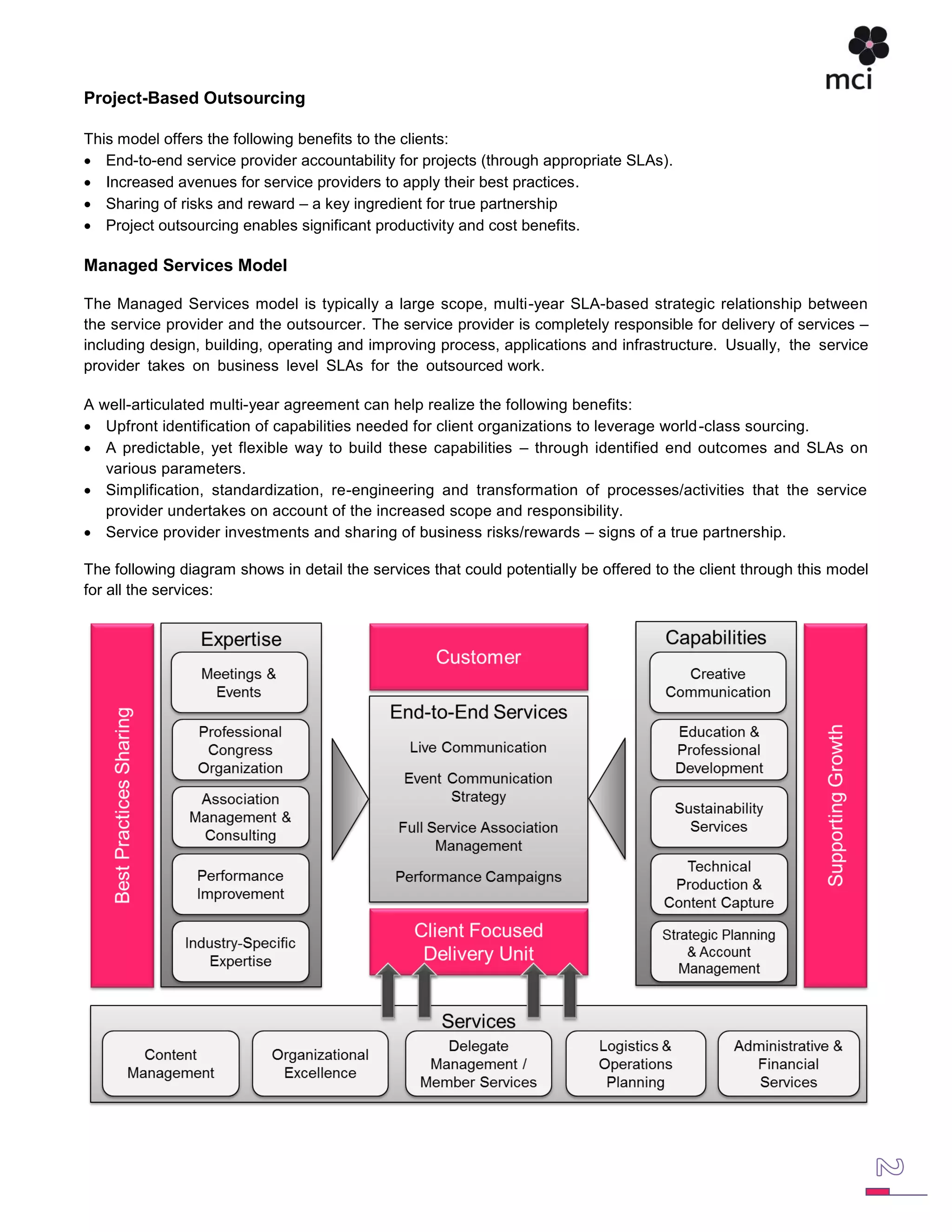
The following diagram shows in detail the services that could potentially be offered to the client through this model
for all the services:
SELECTING AN APPROPRIATE SOURCING MODEL

The selection of an appropriate sourcing model is also dependent on the portfolio of activities to be outsourced.
Each of the models outlined in this paper support specific advantages that can be utilized to handle specific
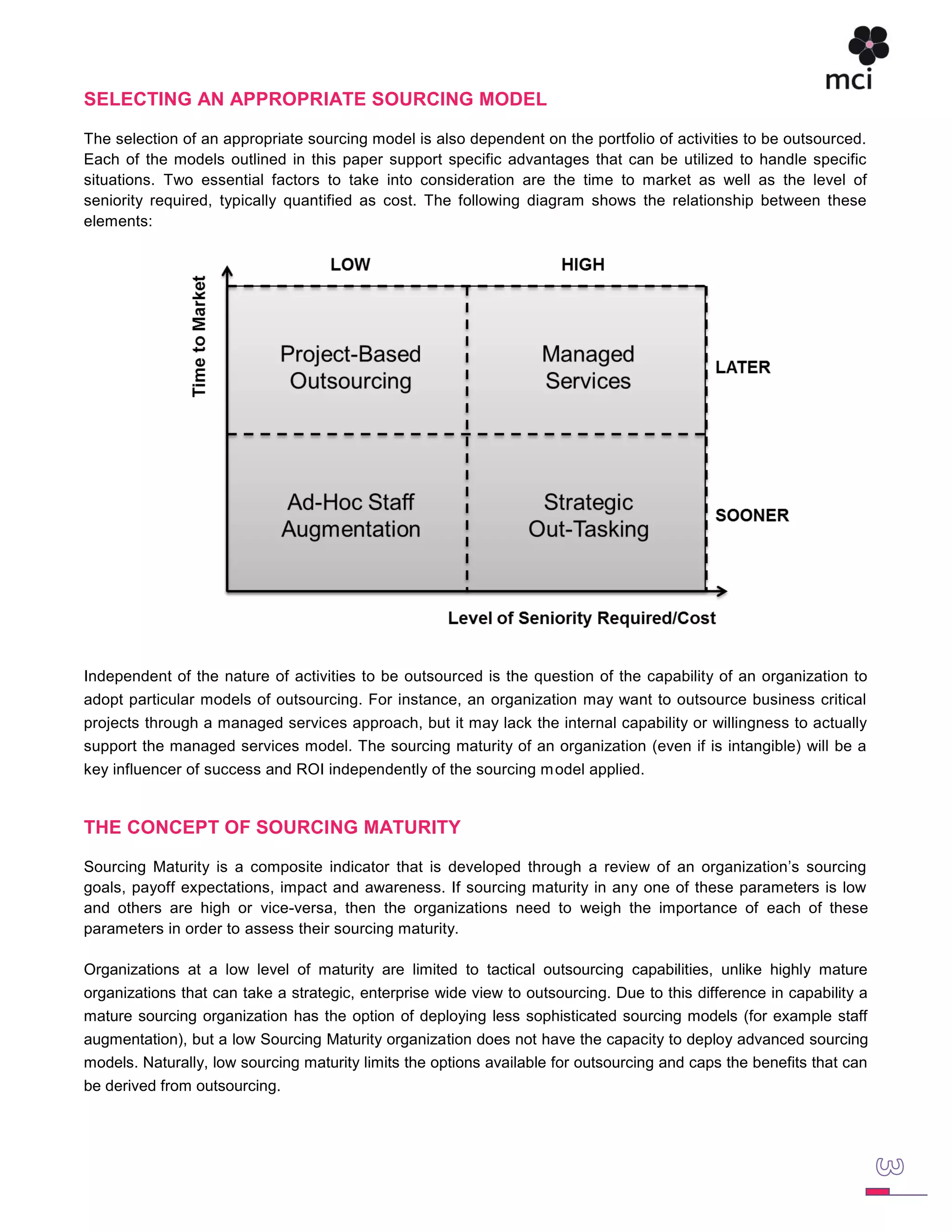
situations. Two essential factors to take into consideration are the time to market as well as the level of
seniority required, typically quantified as cost. The following diagram shows the relationship between these
elements:


Independent of the nature of activities to be outsourced is the question of the capability of an organization to
adopt particular models of outsourcing. For instance, an organization may want to outsource business critical
projects through a managed services approach, but it may lack the internal capability or willingness to actually
support the managed services model. The sourcing maturity of an organization (even if is intangible) will be a
key influencer of success and ROI independently of the sourcing m odel applied.


THE CONCEPT OF SOURCING MATURITY

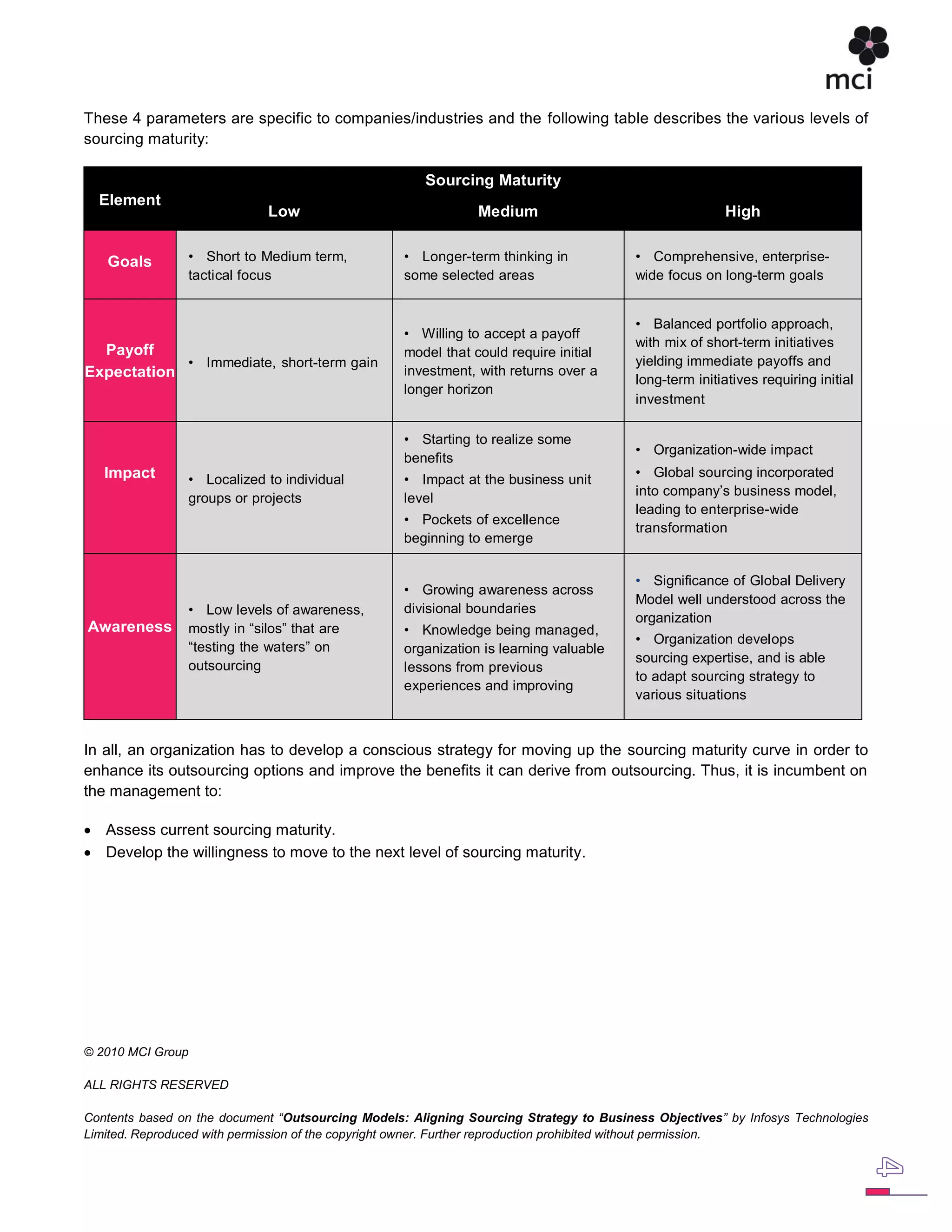
Sourcing Maturity is a composite indicator that is developed through a review of an organization‟s sourcing
goals, payoff expectations, impact and awareness. If sourcing maturity in any one of these parameters is low
and others are high or vice-versa, then the organizations need to weigh the importance of each of these
parameters in order to assess their sourcing maturity.

Organizations at a low level of maturity are limited to tactical outsourcing capabilities, unlike highly mature
organizations that can take a strategic, enterprise wide view to outsourcing. Due to this difference in capability a
mature sourcing organization has the option of deploying less sophisticated sourcing models (for example staff
augmentation), but a low Sourcing Maturity organization does not have the capacity to deploy advanced sourcing
models. Naturally, low sourcing maturity limits the options available for outsourcing and caps the benefits that can
be derived from outsourcing.
These 4 parameters are specific to companies/industries and the following table describes the various levels of
sourcing maturity:

                                                      Sourcing Maturity
  Element
                             Low                               Medium                                   High


   Goals        • Short to Medium term,            • Longer-term thinking in            • Comprehensive, enterprise-
                tactical focus                     some selected areas                  wide focus on long-term goals


                                                                                        • Balanced portfolio approach,
                                                   • Willing to accept a payoff
                                                                                        with mix of short-term initiatives
  Payoff                                           model that could require initial
            • Immediate, short-term gain                                                yielding immediate payoffs and
Expectation                                        investment, with returns over a
                                                                                        long-term initiatives requiring initial
                                                   longer horizon
                                                                                        investment

                                                   • Starting to realize some
                                                                                        • Organization-wide impact
                                                   benefits
   Impact                                                                               • Global sourcing incorporated
                • Localized to individual          • Impact at the business unit
                                                                                        into company‟s business model,
                groups or projects                 level
                                                                                        leading to enterprise-wide
                                                   • Pockets of excellence
                                                                                        transformation
                                                   beginning to emerge


                                                                                        • Significance of Global Delivery
                                                   • Growing awareness across
                                                                                        Model well understood across the
                • Low levels of awareness,         divisional boundaries
                                                                                        organization
Awareness       mostly in “silos” that are         • Knowledge being managed,
                                                                                        • Organization develops
                “testing the waters” on            organization is learning valuable
                                                                                        sourcing expertise, and is able
                outsourcing                        lessons from previous
                                                                                        to adapt sourcing strategy to
                                                   experiences and improving
                                                                                        various situations


In all, an organization has to develop a conscious strategy for moving up the sourcing maturity curve in order to
enhance its outsourcing options and improve the benefits it can derive from outsourcing. Thus, it is incumbent on
the management to:

 Assess current sourcing maturity.
 Develop the willingness to move to the next level of sourcing maturity.


© 2010 MCI Group

ALL RIGHTS RESERVED

Contents based on the document “Outsourcing Models: Aligning Sourcing Strategy to Business Objectives” by Infosys Technologies
Limited. Reproduced with permission of the copyright owner. Further reproduction prohibited without permission.

MCI Outsourcing Whitepaper

  • 1.
    This paper servesas an introduction to the most common ways to work with professional service firms. It allows for the right partnership model to be implemented relative to the client’s structure and resources. What you will learn: 1. Models, terminology and definitions for outsourcing services 2. Advantages and disadvantages of the 4 services outsourcing models 3. Making the most of service outsourcing within your organization structure and resources August 2010 © 2010 MCI Group ALL RIGHTS RESERVED Contents based on the document “Outsourcing Models: Aligning Sourcing Strategy to Business Objectives” by Infosys Technologies Limited. Reproduced with permission of the copyright owner. Further reproduction prohibited without permission.
  • 2.
    SOURCING MODELS FORPROFESSIONAL SERVICES After making the decision to work with a professional services firm, there are a number of different options available to organizations. In many ways, these are influenced by desired outcomes and the organization‟s current levels of sourcing maturity.  Arrangement wherein the vendor agrees to provide specific skilled Ad-Hoc Staff resources to supplement personnel from the client‟s side  The vendor does not take on any accountability or risk, and works as Augmentation instructed by the client on activities outlined in the agreement  Out-tasking is where the client keeps control, management, oversight and “Strategic” control in-house while asking vendors to perform certain functions  Vendors are held responsible for the functions that was provided to them – Out-Tasking and do not take on end-to-end SLAs  Here companies give away close operational control of project Project-Based management while keeping control over its business outcomes  SLAs and/or metrics are determined upfront – before projects are Outsourcing outsourced. Vendors are held accountable to these service levels.  In a Managed Services model, one vendor will take on all aspects of the Managed outsourced work.  Consequently the client gains the benefit of having an integrated Services outsourcing solution provided by one vendor. COMPARISON OF SOURCING MODELS FOR PROFESSIONAL SERVICES Selecting a model depends on the organization‟s existing sourcing maturity level and their willingness to improve it. It is not necessary for every organization to operate or aspire to operate at the highest level of sourcing maturity - they may have different business dynamics and different expectations from sourcing. Based on its unique needs, a company should select the sourcing model appropriate to them. Staff Augmentation This arrangement is generally used when:  Companies have just begun their sourcing journey i.e. they are at an early stage of sourcing maturity.  These companies want to extend their own team but do not have the ramp up capability.  The service provider–client relationship is relatively new.  There is an aggressive timeline and the client needs a quick fix. Strategic Out-Tasking Out-tasking is used when:  There is a strategic decision to not maintain some skills in house – since these can be easily outsourced.  There is comfort that the „out-tasked‟ piece of work can be easily disaggregated to send over to the service provider and then seamlessly integrated back into the process later.  An organization is at an early stage of sourcing maturity, and is not ready to relinquish project control.
  • 3.
    Project-Based Outsourcing This modeloffers the following benefits to the clients:  End-to-end service provider accountability for projects (through appropriate SLAs).  Increased avenues for service providers to apply their best practices.  Sharing of risks and reward – a key ingredient for true partnership  Project outsourcing enables significant productivity and cost benefits. Managed Services Model The Managed Services model is typically a large scope, multi-year SLA-based strategic relationship between the service provider and the outsourcer. The service provider is completely responsible for delivery of services – including design, building, operating and improving process, applications and infrastructure. Usually, the service provider takes on business level SLAs for the outsourced work. A well-articulated multi-year agreement can help realize the following benefits:  Upfront identification of capabilities needed for client organizations to leverage world -class sourcing.  A predictable, yet flexible way to build these capabilities – through identified end outcomes and SLAs on various parameters.  Simplification, standardization, re-engineering and transformation of processes/activities that the service provider undertakes on account of the increased scope and responsibility.  Service provider investments and sharing of business risks/rewards – signs of a true partnership. The following diagram shows in detail the services that could potentially be offered to the client through this model for all the services:
  • 4.
    SELECTING AN APPROPRIATESOURCING MODEL The selection of an appropriate sourcing model is also dependent on the portfolio of activities to be outsourced. Each of the models outlined in this paper support specific advantages that can be utilized to handle specific situations. Two essential factors to take into consideration are the time to market as well as the level of seniority required, typically quantified as cost. The following diagram shows the relationship between these elements: Independent of the nature of activities to be outsourced is the question of the capability of an organization to adopt particular models of outsourcing. For instance, an organization may want to outsource business critical projects through a managed services approach, but it may lack the internal capability or willingness to actually support the managed services model. The sourcing maturity of an organization (even if is intangible) will be a key influencer of success and ROI independently of the sourcing m odel applied. THE CONCEPT OF SOURCING MATURITY Sourcing Maturity is a composite indicator that is developed through a review of an organization‟s sourcing goals, payoff expectations, impact and awareness. If sourcing maturity in any one of these parameters is low and others are high or vice-versa, then the organizations need to weigh the importance of each of these parameters in order to assess their sourcing maturity. Organizations at a low level of maturity are limited to tactical outsourcing capabilities, unlike highly mature organizations that can take a strategic, enterprise wide view to outsourcing. Due to this difference in capability a mature sourcing organization has the option of deploying less sophisticated sourcing models (for example staff augmentation), but a low Sourcing Maturity organization does not have the capacity to deploy advanced sourcing models. Naturally, low sourcing maturity limits the options available for outsourcing and caps the benefits that can be derived from outsourcing.
  • 5.
    These 4 parametersare specific to companies/industries and the following table describes the various levels of sourcing maturity: Sourcing Maturity Element Low Medium High Goals • Short to Medium term, • Longer-term thinking in • Comprehensive, enterprise- tactical focus some selected areas wide focus on long-term goals • Balanced portfolio approach, • Willing to accept a payoff with mix of short-term initiatives Payoff model that could require initial • Immediate, short-term gain yielding immediate payoffs and Expectation investment, with returns over a long-term initiatives requiring initial longer horizon investment • Starting to realize some • Organization-wide impact benefits Impact • Global sourcing incorporated • Localized to individual • Impact at the business unit into company‟s business model, groups or projects level leading to enterprise-wide • Pockets of excellence transformation beginning to emerge • Significance of Global Delivery • Growing awareness across Model well understood across the • Low levels of awareness, divisional boundaries organization Awareness mostly in “silos” that are • Knowledge being managed, • Organization develops “testing the waters” on organization is learning valuable sourcing expertise, and is able outsourcing lessons from previous to adapt sourcing strategy to experiences and improving various situations In all, an organization has to develop a conscious strategy for moving up the sourcing maturity curve in order to enhance its outsourcing options and improve the benefits it can derive from outsourcing. Thus, it is incumbent on the management to:  Assess current sourcing maturity.  Develop the willingness to move to the next level of sourcing maturity. © 2010 MCI Group ALL RIGHTS RESERVED Contents based on the document “Outsourcing Models: Aligning Sourcing Strategy to Business Objectives” by Infosys Technologies Limited. Reproduced with permission of the copyright owner. Further reproduction prohibited without permission.