This is the guidance from the WQE Online page and the syllabus section for Learning Aim b
B1 Functional specification
Designing a functional specification to meet requirements:
• nature of the problem
• functions the model must perform
• user interface
• constraints
• success criteria.
B2 Spreadsheet model design
A design which shows how the spreadsheet model will look and work.
• Producing worksheet structure diagrams that show: o layout and
presentation
o processing
o data entry and validation
o navigation
o output.
• Producing a test plan to show: o test data
o purpose of the test
o expected result.
B3 Reviewing and refining data model designs
Working with clients and others to improve the quality, effectiveness and
appropriateness of designs.
• Gathering feedback from client(s) and potential users on the
extent to which the design meets requirements.
• Communicating with clients, e.g. email, verbal
communication.
• Scheduling and documenting meetings.
• Agreeing and adjusting timescales.
• Refining ideas and solutions.
• Updating design specification documentation, based on
review and feedback.
.
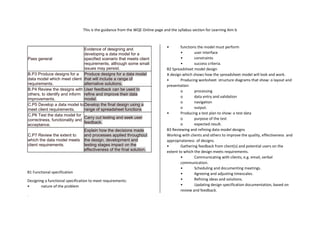
Pass general
Evidence of designing and
developing a data model for a
specified scenario that meets client
requirements, although some small
issues may persist.
B.P3 Produce designs for a
data model which meet client
requirements.
Produce designs for a data model
that will include a range of
alternative solutions.
B.P4 Review the designs with
others, to identify and inform
improvements.
User feedback can be used to
refine and improve their data
model.
C.P5 Develop a data model to
meet client requirements.
Develop the final design using a
range of spreadsheet functions
C.P6 Test the data model for
correctness, functionality and
acceptance.
Carry out testing and seek user
feedback.
C.P7 Review the extent to
which the data model meets
client requirements.
Explain how the decisions made
and processes applied throughout
the design, development and
testing stages impact on the
effectiveness of the final solution.
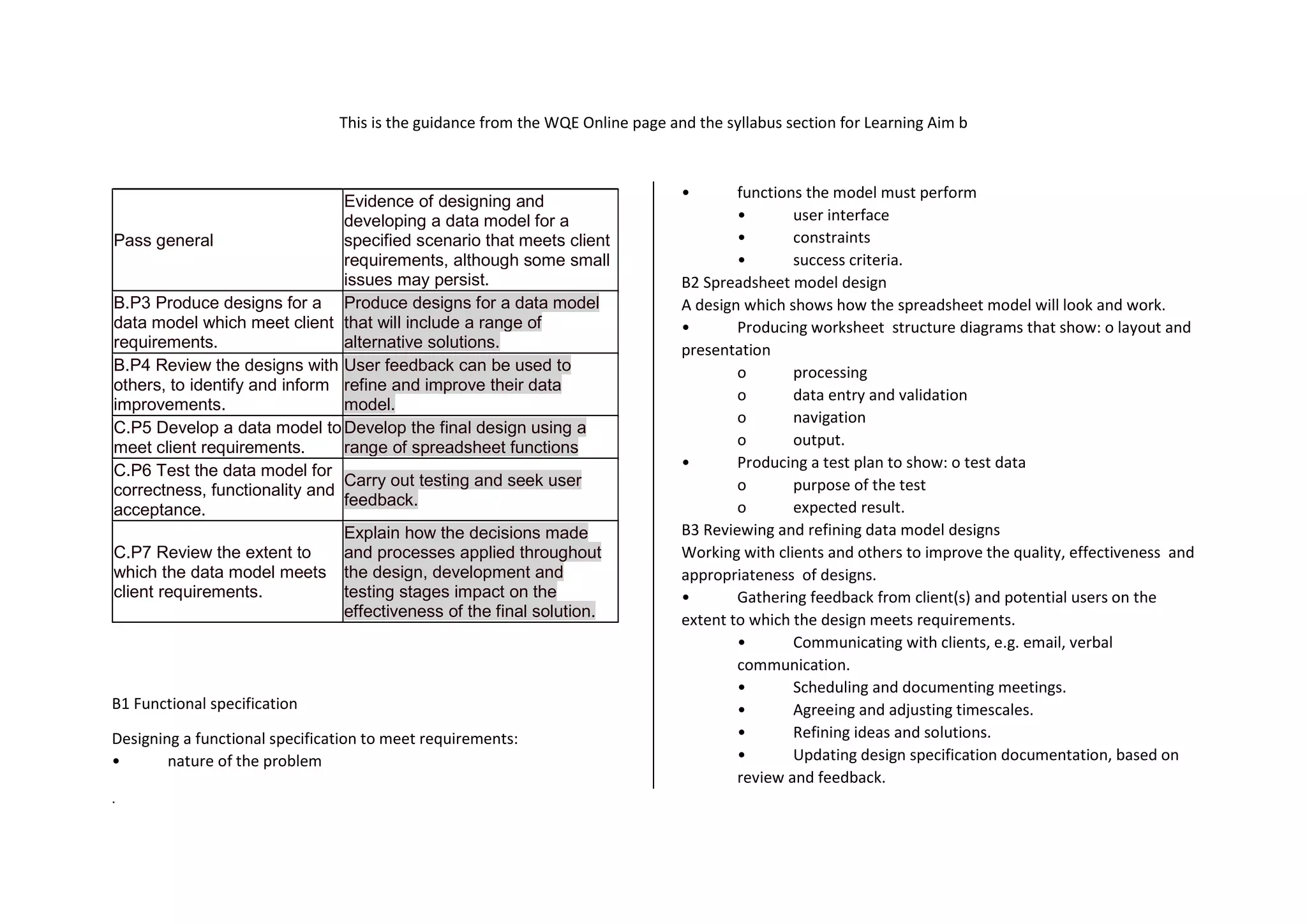
Start with the grid in the left column.
Pass general is an overall check on the work, and needs to be demonstrated, so copy that down as your
starting point:
Introduction (Pass General)
Evidence of designing a data model for
a specified scenario
that meets client requirements,
B1 Designing a functional specification to meet
requirements:
• nature of the problem
The functions that must be included
are
 user interface
• constraints
• success criteria
although some small issues may persist.
B2 Spreadsheet model design
A design which shows how the spreadsheet
model will look and work.
• Producing worksheet structure diagrams
that show:
O layout and presentation
o processing
o data entry and validation
o navigation
o output.
• Producing a test plan to show: o test data
o purpose of the test
o expected result.
B3 Working with clients and others to improve
the Quality, effectiveness and appropriateness
of designs.
• Gathering feedback from client(s) and
potential users on the extent to which the design
meets requirements.
• Communicating with clients, e.g.
email, verbal communication.
• Scheduling and documenting
meetings.
• Agreeing and adjusting
timescales.
• Refining ideas and solutions.
• Updating design specification
documentation, based on review and
feedbackp7
I am working for ….
I have been asked to develop a spreadsheet
model to do …
The client requirements are …
That it must have a user interface the client
accepts,
There are a number of constraints that need
to be taken into account in developing the
model (list them)
The client will judge the model a success if it
meets the following agreed criteria
What my model will look like i.e. what goes
on each page BUT NOT in detail – you
haven’t worked this out yet.
Each bullet point opposite needs to be
covered
You know from the scenario and task what
the spreadsheet model has to cope with, so
develop a list of tests showing they are all
covered (AT this point you /cannot complete
the tests they are the intended tests and
expected results
Your plan should indicate dates when you
need to meet with the client to get feedback.
How do you ask for the feedback (formal is
best) can they annotate your work with
feedback – good primary evidence.
Do you realise you need to change your plan
(that is OK as long as it is documented)
Has the client objected to anything in the
design that you need to change? Again
document it.
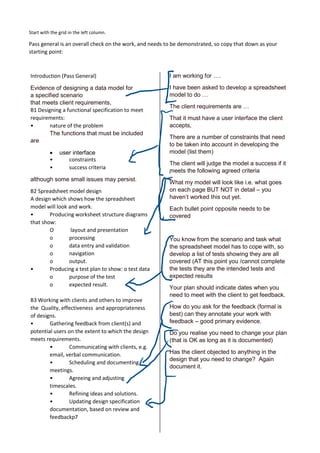
In the example abovep6 and there are some overlaps with Merit and Distinction criteria, I have not
highlighted them specifically.
This deals with P3 and P4, the design of the model. It has nothing to do with the actual design and building
of the model that is P5, P6, and P7
With this you should be able to extend my example to include those criteria.
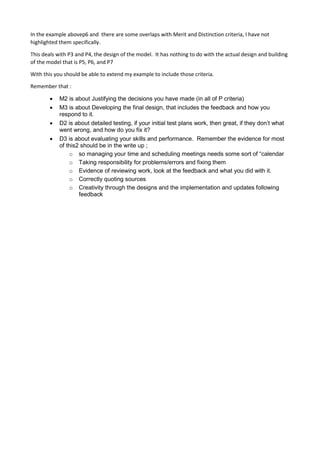
Remember that :
 M2 is about Justifying the decisions you have made (in all of P criteria)
 M3 is about Developing the final design, that includes the feedback and how you
respond to it.
 D2 is about detailed testing, if your initial test plans work, then great, if they don’t what
went wrong, and how do you fix it?
 D3 is about evaluating your skills and performance. Remember the evidence for most
of this2 should be in the write up ;
o so managing your time and scheduling meetings needs some sort of “calendar
o Taking responsibility for problems/errors and fixing them
o Evidence of reviewing work, look at the feedback and what you did with it.
o Correctly quoting sources
o Creativity through the designs and the implementation and updates following
feedback

Guidance 2 for assessment 2

  • 1.
    This is theguidance from the WQE Online page and the syllabus section for Learning Aim b B1 Functional specification Designing a functional specification to meet requirements: • nature of the problem • functions the model must perform • user interface • constraints • success criteria. B2 Spreadsheet model design A design which shows how the spreadsheet model will look and work. • Producing worksheet structure diagrams that show: o layout and presentation o processing o data entry and validation o navigation o output. • Producing a test plan to show: o test data o purpose of the test o expected result. B3 Reviewing and refining data model designs Working with clients and others to improve the quality, effectiveness and appropriateness of designs. • Gathering feedback from client(s) and potential users on the extent to which the design meets requirements. • Communicating with clients, e.g. email, verbal communication. • Scheduling and documenting meetings. • Agreeing and adjusting timescales. • Refining ideas and solutions. • Updating design specification documentation, based on review and feedback. . Pass general Evidence of designing and developing a data model for a specified scenario that meets client requirements, although some small issues may persist. B.P3 Produce designs for a data model which meet client requirements. Produce designs for a data model that will include a range of alternative solutions. B.P4 Review the designs with others, to identify and inform improvements. User feedback can be used to refine and improve their data model. C.P5 Develop a data model to meet client requirements. Develop the final design using a range of spreadsheet functions C.P6 Test the data model for correctness, functionality and acceptance. Carry out testing and seek user feedback. C.P7 Review the extent to which the data model meets client requirements. Explain how the decisions made and processes applied throughout the design, development and testing stages impact on the effectiveness of the final solution.
  • 2.
    Start with thegrid in the left column. Pass general is an overall check on the work, and needs to be demonstrated, so copy that down as your starting point: Introduction (Pass General) Evidence of designing a data model for a specified scenario that meets client requirements, B1 Designing a functional specification to meet requirements: • nature of the problem The functions that must be included are  user interface • constraints • success criteria although some small issues may persist. B2 Spreadsheet model design A design which shows how the spreadsheet model will look and work. • Producing worksheet structure diagrams that show: O layout and presentation o processing o data entry and validation o navigation o output. • Producing a test plan to show: o test data o purpose of the test o expected result. B3 Working with clients and others to improve the Quality, effectiveness and appropriateness of designs. • Gathering feedback from client(s) and potential users on the extent to which the design meets requirements. • Communicating with clients, e.g. email, verbal communication. • Scheduling and documenting meetings. • Agreeing and adjusting timescales. • Refining ideas and solutions. • Updating design specification documentation, based on review and feedbackp7 I am working for …. I have been asked to develop a spreadsheet model to do … The client requirements are … That it must have a user interface the client accepts, There are a number of constraints that need to be taken into account in developing the model (list them) The client will judge the model a success if it meets the following agreed criteria What my model will look like i.e. what goes on each page BUT NOT in detail – you haven’t worked this out yet. Each bullet point opposite needs to be covered You know from the scenario and task what the spreadsheet model has to cope with, so develop a list of tests showing they are all covered (AT this point you /cannot complete the tests they are the intended tests and expected results Your plan should indicate dates when you need to meet with the client to get feedback. How do you ask for the feedback (formal is best) can they annotate your work with feedback – good primary evidence. Do you realise you need to change your plan (that is OK as long as it is documented) Has the client objected to anything in the design that you need to change? Again document it.
  • 3.
    In the exampleabovep6 and there are some overlaps with Merit and Distinction criteria, I have not highlighted them specifically. This deals with P3 and P4, the design of the model. It has nothing to do with the actual design and building of the model that is P5, P6, and P7 With this you should be able to extend my example to include those criteria. Remember that :  M2 is about Justifying the decisions you have made (in all of P criteria)  M3 is about Developing the final design, that includes the feedback and how you respond to it.  D2 is about detailed testing, if your initial test plans work, then great, if they don’t what went wrong, and how do you fix it?  D3 is about evaluating your skills and performance. Remember the evidence for most of this2 should be in the write up ; o so managing your time and scheduling meetings needs some sort of “calendar o Taking responsibility for problems/errors and fixing them o Evidence of reviewing work, look at the feedback and what you did with it. o Correctly quoting sources o Creativity through the designs and the implementation and updates following feedback