Building a Enterprise
Eventing Platform
Bryan Zelle and Neil Buesing
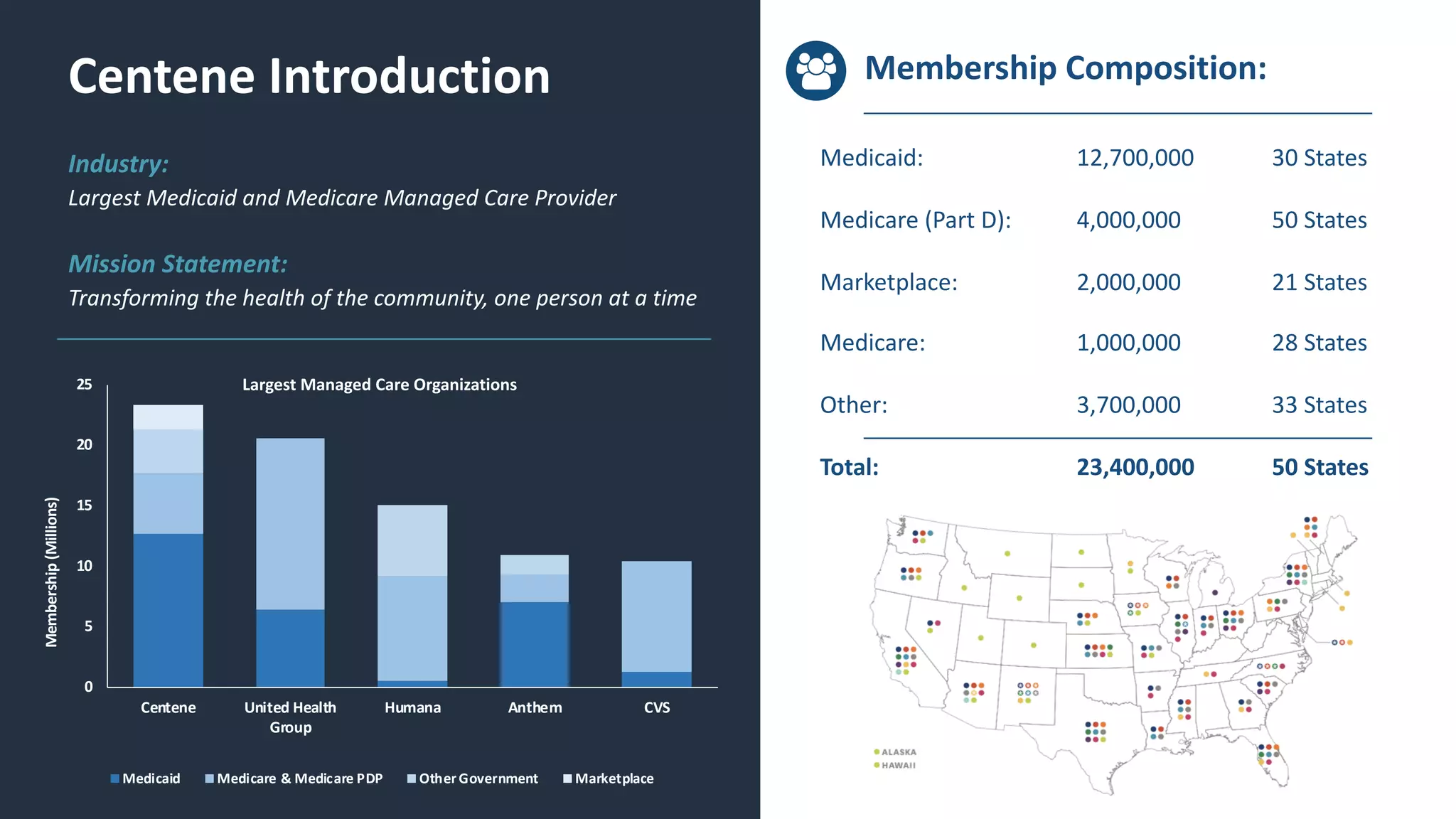
Centene Introduction
Mission Statement:
Transforming the health of the community, one person at a time
Medicaid:
Medicare (Part D):
Marketplace:
Medicare:
Other:
Total:
12,700,000
4,000,000
2,000,000
1,000,000
3,700,000
23,400,000
30 States
50 States
21 States
28 States
33 States
50 States
Membership Composition:
Industry:
Largest Medicaid and Medicare Managed Care Provider
0
5
10
15
20
25
Centene United Health
Group
Humana Anthem CVS
Membership(Millions)
Largest Managed Care Organizations
Medicaid Medicare & Medicare PDP OtherGovernment Marketplace
$-
$10,000
$20,000
$30,000
$40,000
$50,000
$60,000
$70,000
$80,000
$90,000
$100,000
2019 2018 2017 2016 2015 2014 2013 2012 2011 2010 2009 2008 2007 2006 2005
TotalRevenus(millions)
Centene Yearly Revenue
Centene Revenue WellCare Revenue
Summary of Centene’s
Key Challenges in one
word…
Growth
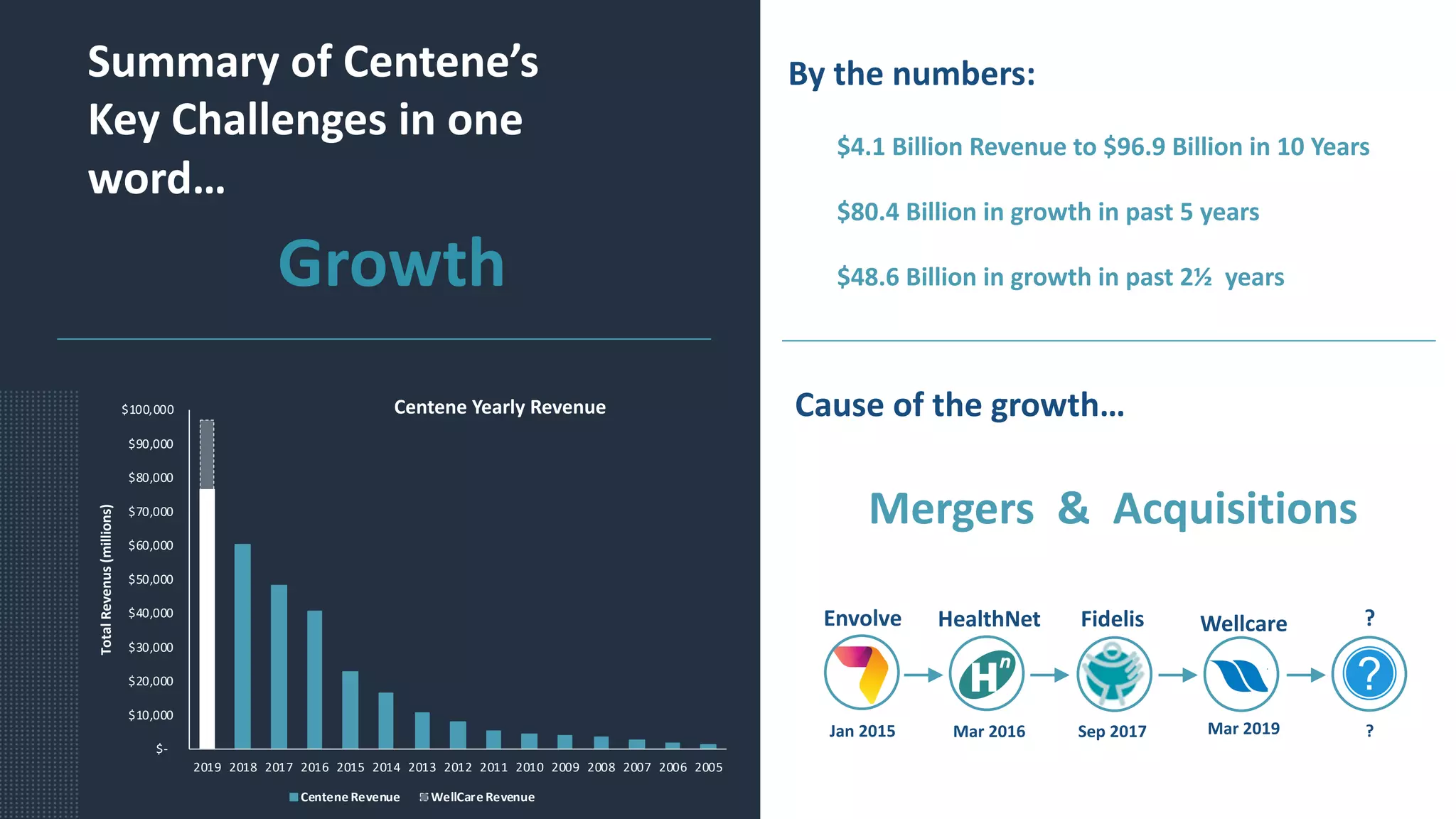
$4.1 Billion Revenue to $96.9 Billion in 10 Years
$80.4 Billion in growth in past 5 years
$48.6 Billion in growth in past 2½ years
Envolve
Jan 2015
Wellcare
Mar 2019
Fidelis
Sep 2017
HealthNet
Mar 2016
?
?
Cause of the growth…
Mergers & Acquisitions
By the numbers:
Medicare
Medicaid
International
Federal
Marketplace
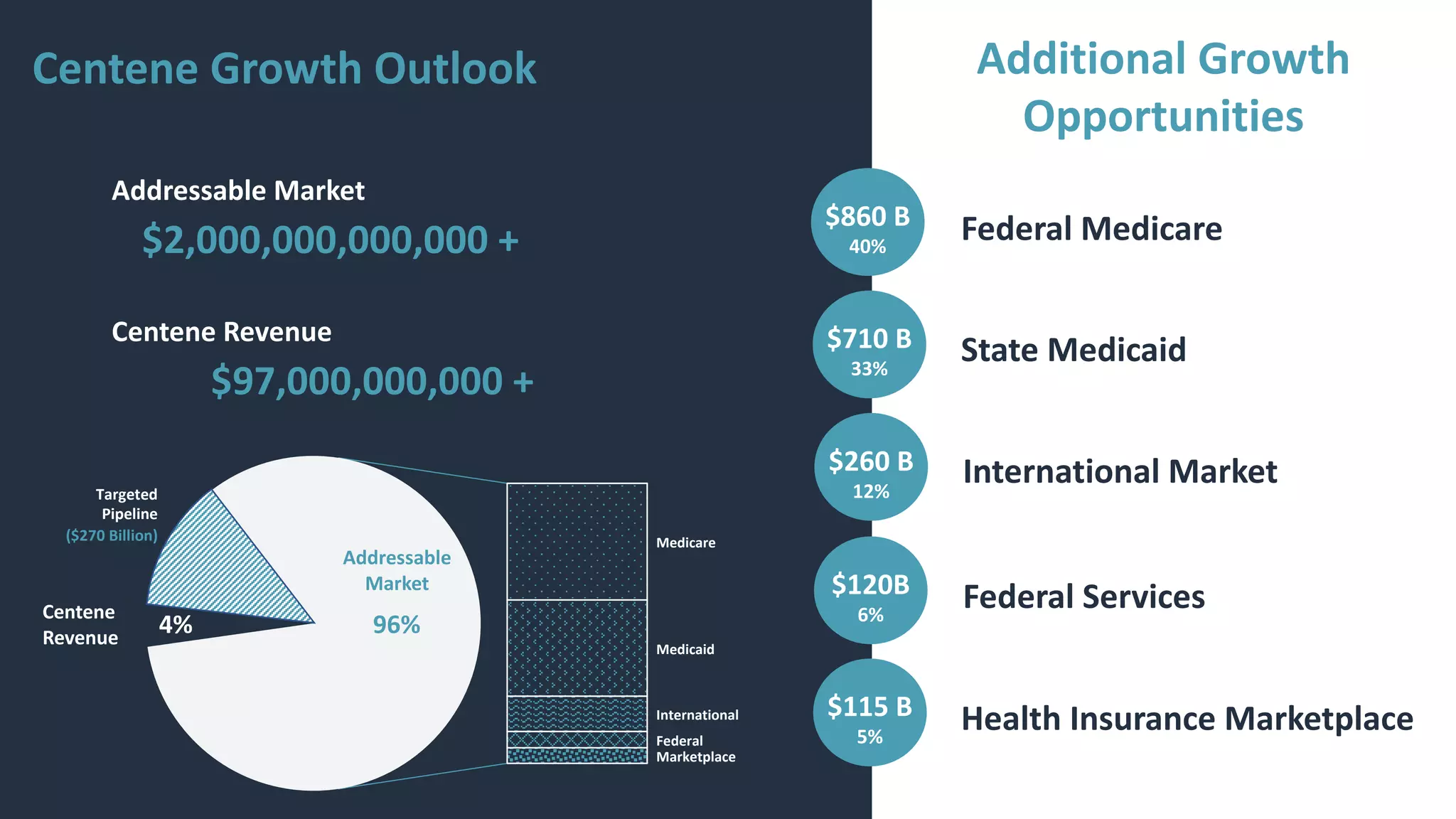
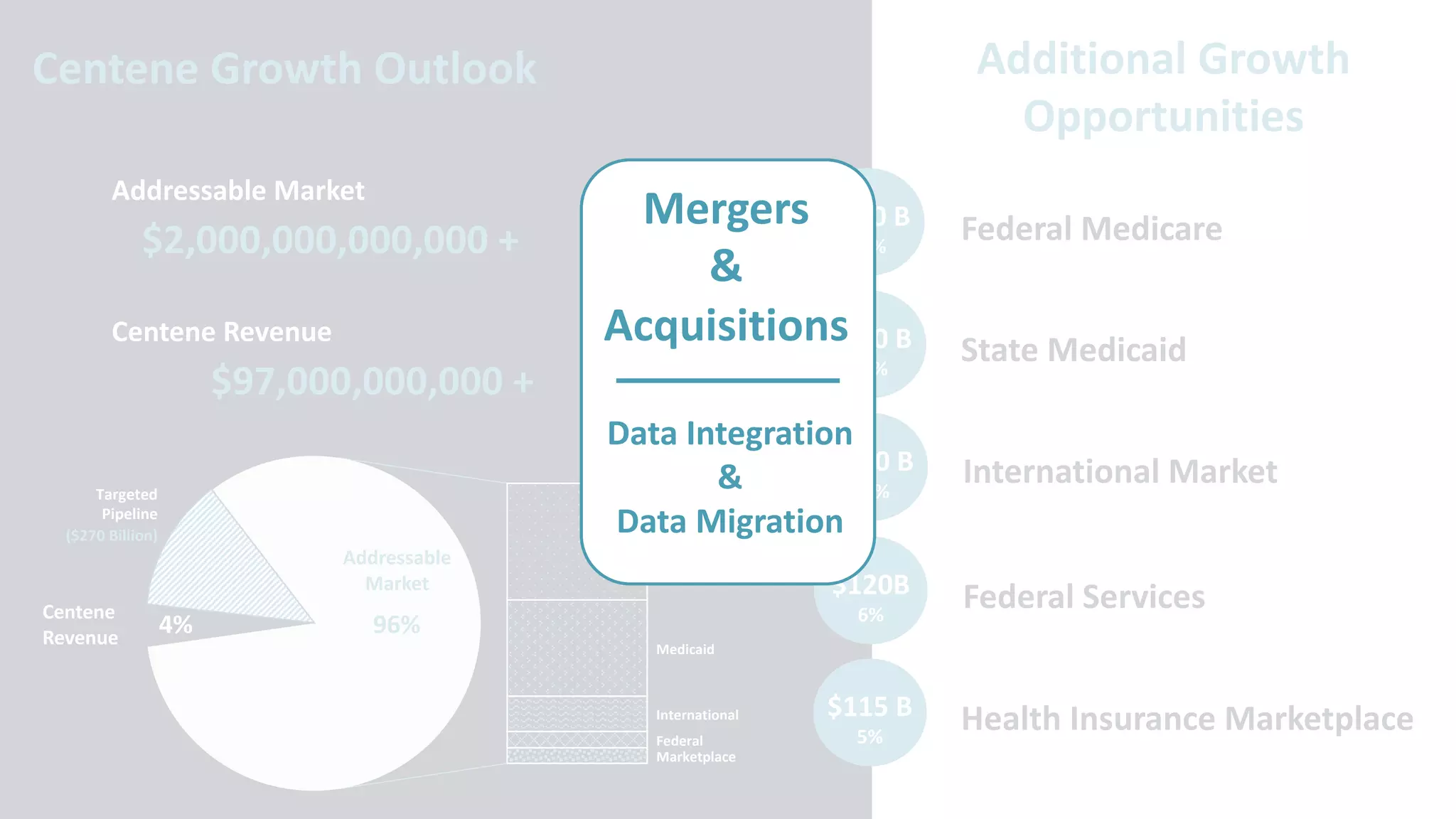
Addressable Market
Federal Medicare$860 B
40%
State Medicaid
International Market
Federal Services
Health Insurance Marketplace
$2,000,000,000,000 +
Centene Revenue
$97,000,000,000 +
Centene
Revenue
4%
Addressable
Market
96%
Additional Growth
Opportunities
$710 B
33%
$260 B
12%
$120B
6%
$115 B
5%
Centene Growth Outlook
Targeted
Pipeline
($270 Billion)
Medicare
Medicaid
International
Federal
Marketplace
Addressable Market
Federal Medicare$860 B
40%
State Medicaid
International Market
Federal Services
Health Insurance Marketplace
$2,000,000,000,000 +
Centene Revenue
$97,000,000,000 +
Centene
Revenue
4%
Addressable
Market
96%
Additional Growth
Opportunities
$710 B
33%
$260 B
12%
$120B
6%
$115 B
5%
Centene Growth Outlook
Targeted
Pipeline
($270 Billion)
Mergers
&
Acquisitions
Data Integration
&
Data Migration
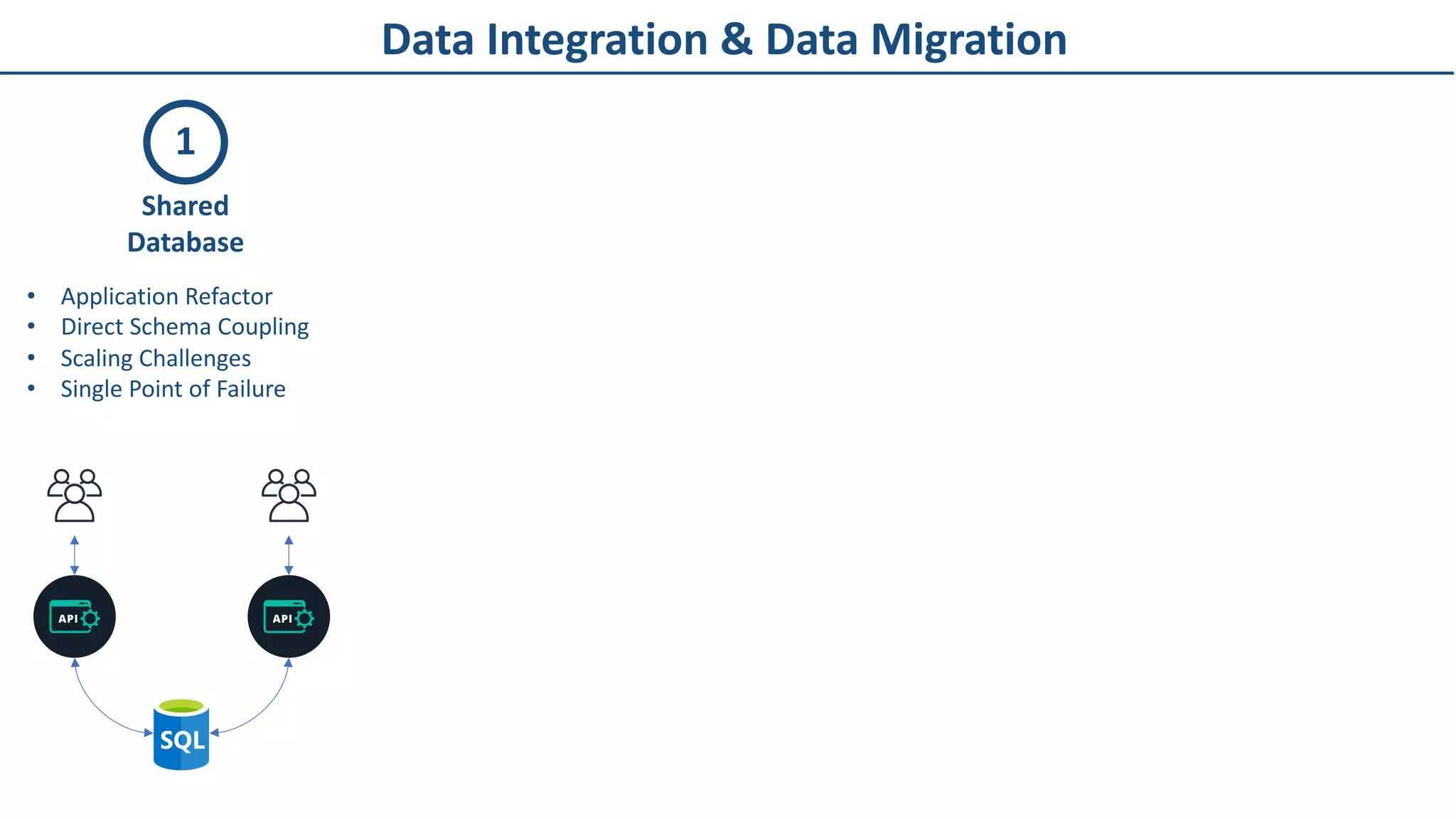
Data Integration & Data Migration
1
Shared
Database
• Application Refactor
• Direct Schema Coupling
• Scaling Challenges
• Single Point of Failure
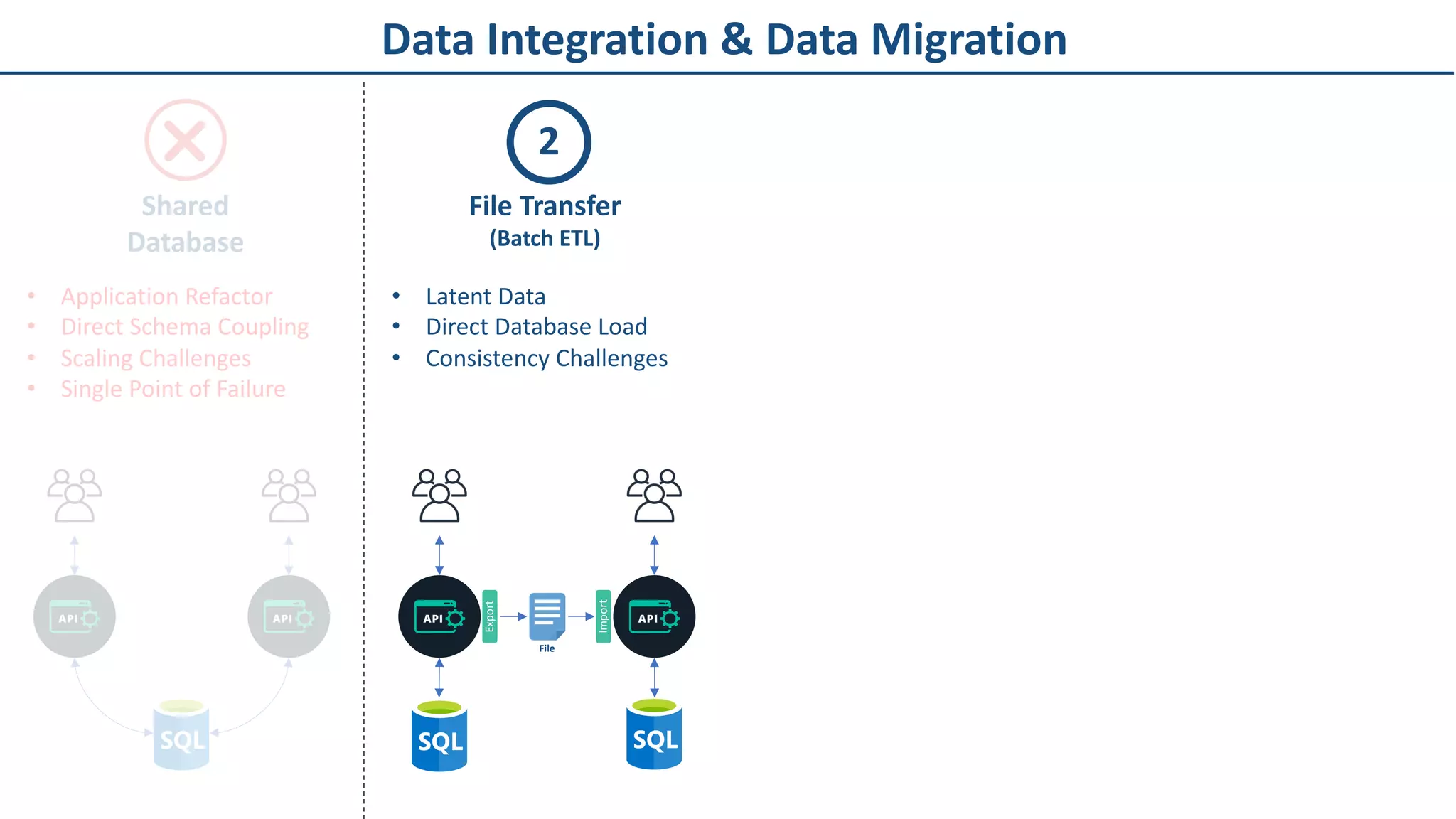
Data Integration & Data Migration
Shared
Database
Export
Import
• Application Refactor
• Direct Schema Coupling
• Scaling Challenges
• Single Point of Failure
File
2
File Transfer
(Batch ETL)
• Latent Data
• Direct Database Load
• Consistency Challenges
Data Integration & Data Migration
Export
Import
Shared
Database
File Transfer
(Batch ETL)
• Application Refactor
• Direct Schema Coupling
• Scaling Challenges
• Single Point of Failure
• Latent Data
• Direct Database Load
• Consistency Challenges
File
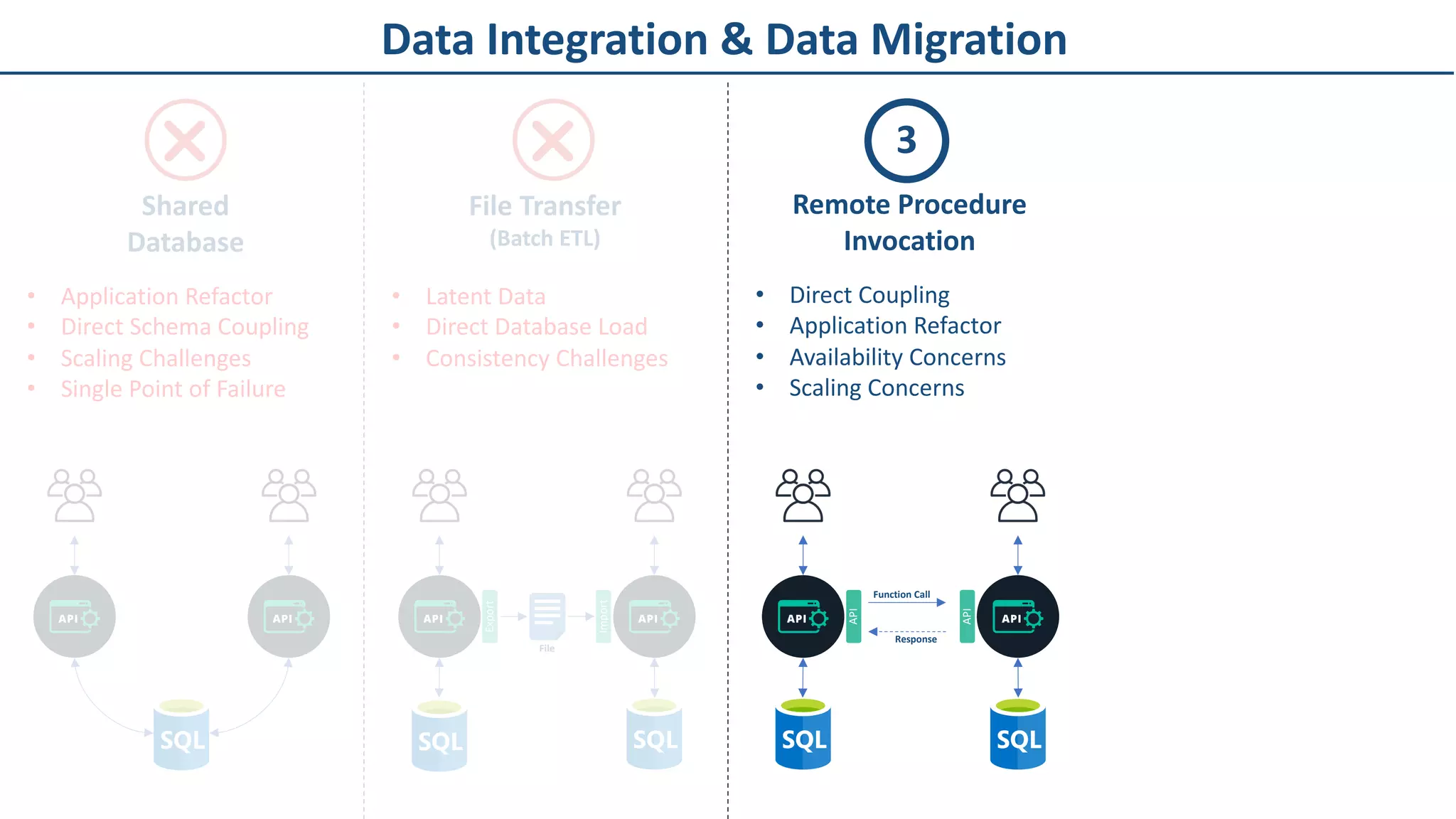
API
API
Function Call
Response
3
• Direct Coupling
• Application Refactor
• Availability Concerns
• Scaling Concerns
Remote Procedure
Invocation
Data Integration & Data Migration
Shared
Database
File Transfer
(Batch ETL)
Export
Import
• Application Refactor
• Direct Schema Coupling
• Scaling Challenges
• Single Point of Failure
File
• Latent Data
• Direct Database Load
• Consistency Challenges
API
API
Function Call
Response
• Direct Coupling
• Application Refactor
• Availability Concerns
• Scaling Concerns
Remote Procedure
Invocation
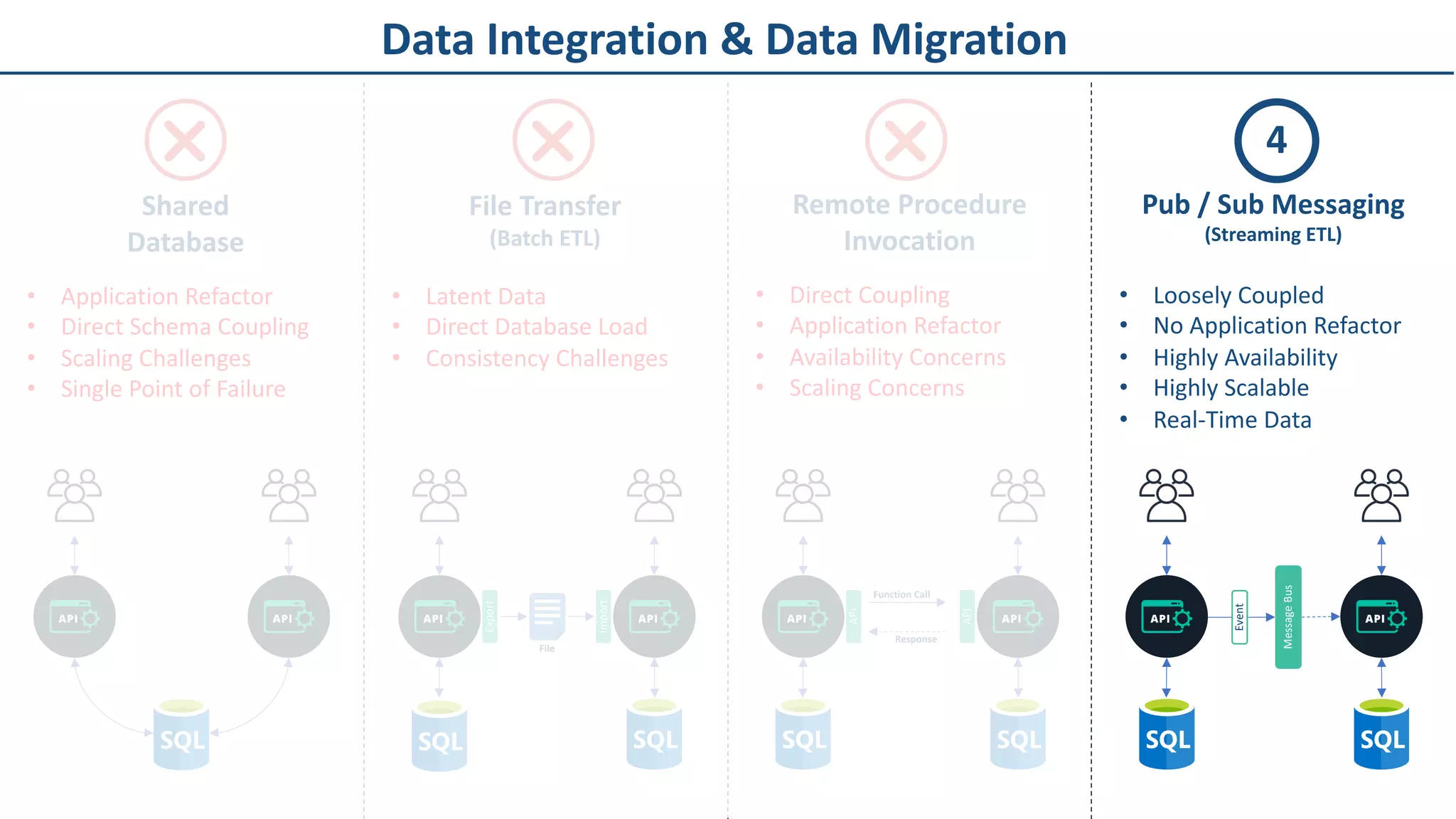
4
Pub / Sub Messaging
(Streaming ETL)
Event
MessageBus
• Loosely Coupled
• No Application Refactor
• Highly Availability
• Highly Scalable
• Real-Time Data
Data Integration & Data Migration
Pub / Sub Messaging
(Streaming ETL)
Event
MessageBus
• Loosely Coupled
• No Application Refactor
• Highly Availability
• Highly Scalable
• Real-Time Data
Shared
Database
File Transfer
(Batch ETL)
Export
Import
• Application Refactor
• Direct Schema Coupling
• Scaling Challenges
• Single Point of Failure
File
• Latent Data
• Direct Database Load
• Consistency Challenges
API
API
Function Call
Response
• Direct Coupling
• Application Refactor
• Availability Concerns
• Scaling Concerns
Remote Procedure
Invocation
*
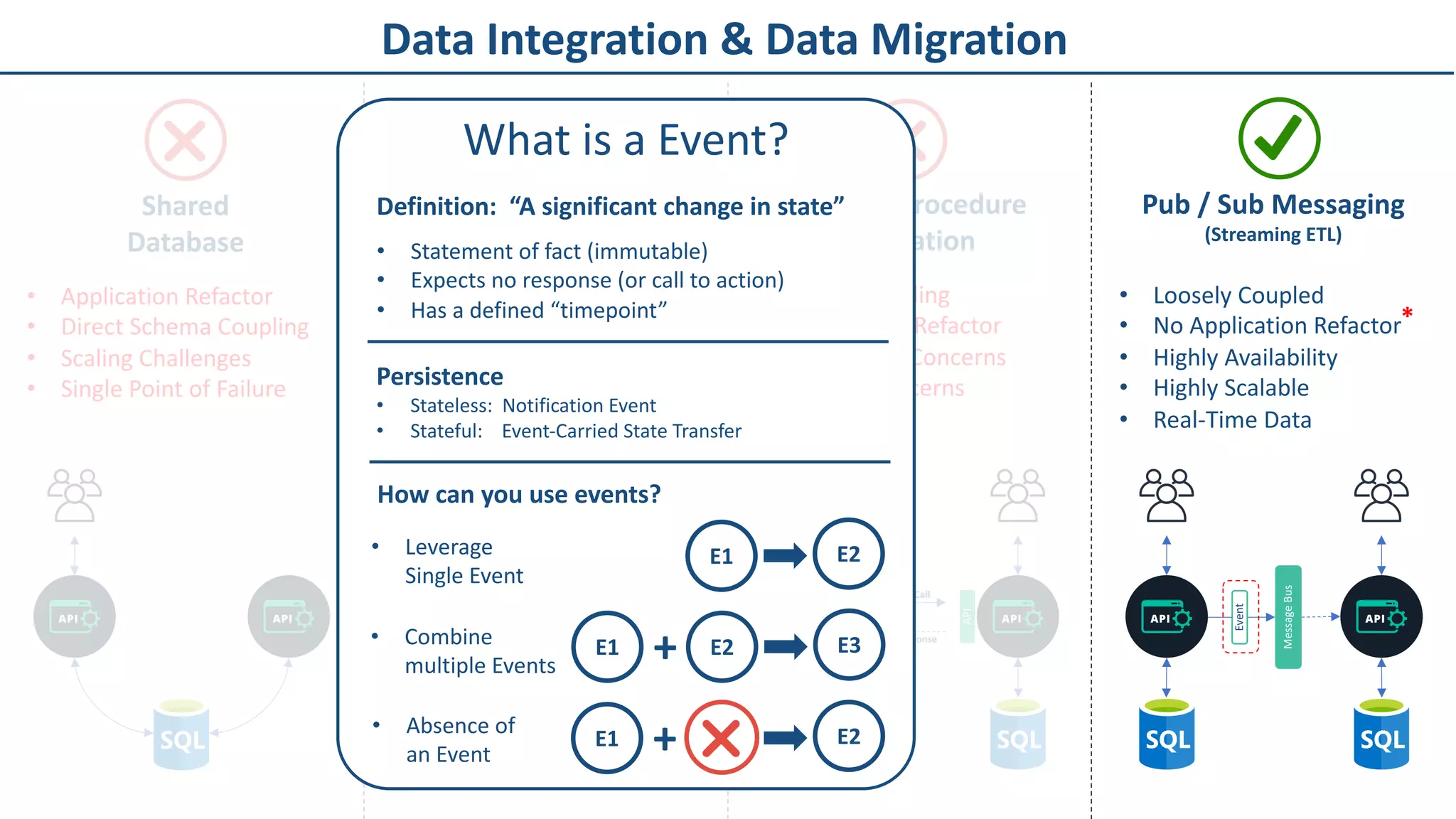
What is a Event?
Definition: “A significant change in state”
• Statement of fact (immutable)
• Expects no response (or call to action)
• Has a defined “timepoint”
Persistence
• Stateless: Notification Event
• Stateful: Event-Carried State Transfer
How can you use events?
E1 E2 E3+• Combine
multiple Events
E1 E2+• Absence of
an Event
E1 E2• Leverage
Single Event
Pub / Sub Messaging
(Streaming ETL)
Event
MessageBus
• Loosely Coupled
• No Application Refactor*
• Highly Availability
• Highly Scalable
• Real-Time Data
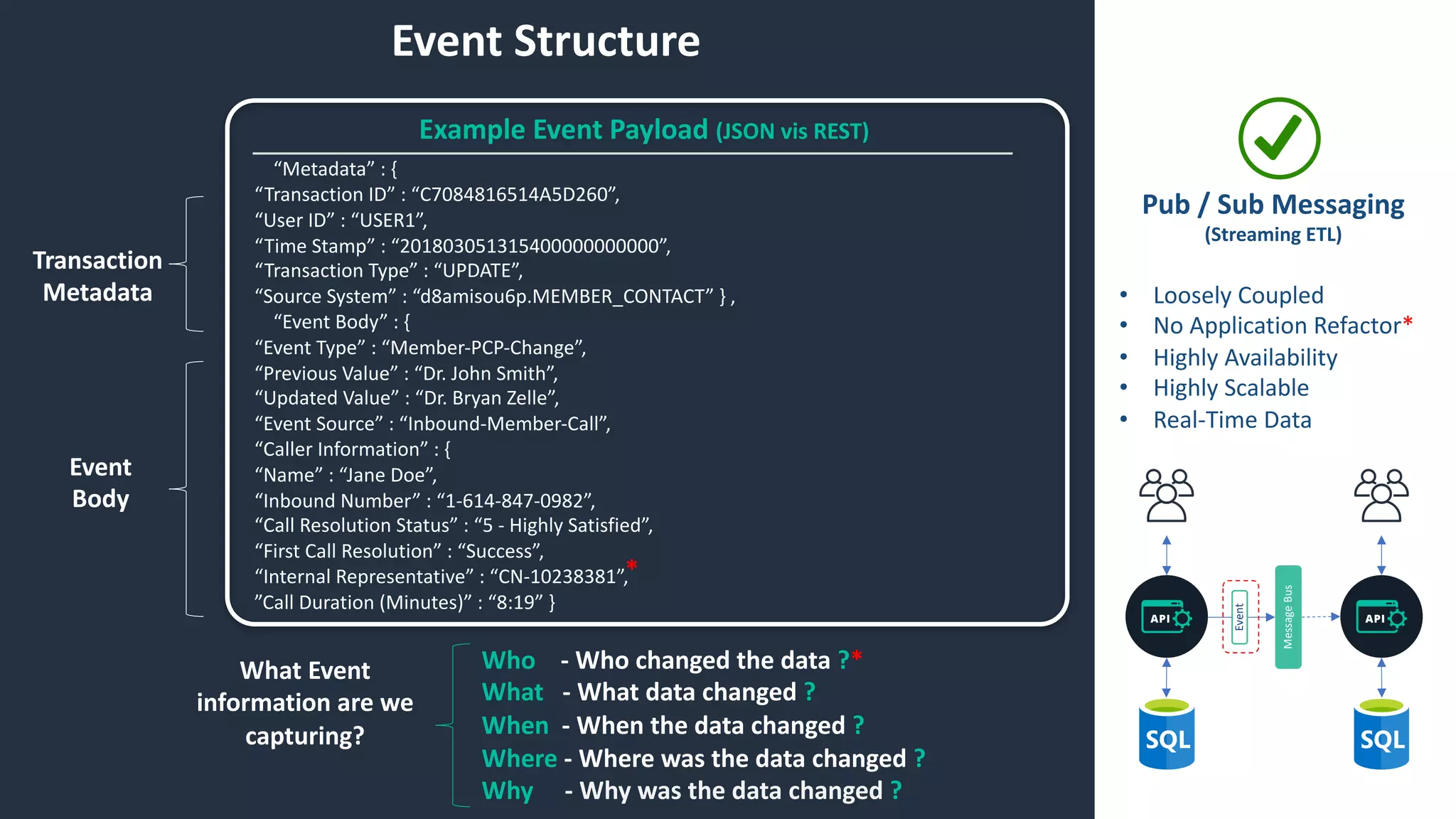
Event Structure
Example Event Payload (JSON vis REST)
“Metadata” : {
“Transaction ID” : “C7084816514A5D260”,
“User ID” : “USER1”,
“Time Stamp” : “201803051315400000000000”,
“Transaction Type” : “UPDATE”,
“Source System” : “d8amisou6p.MEMBER_CONTACT” } ,
“Event Body” : {
“Event Type” : “Member-PCP-Change”,
“Previous Value” : “Dr. John Smith”,
“Updated Value” : “Dr. Bryan Zelle”,
“Event Source” : “Inbound-Member-Call”,
“Caller Information” : {
“Name” : “Jane Doe”,
“Inbound Number” : “1-614-847-0982”,
“Call Resolution Status” : “5 - Highly Satisfied”,
“First Call Resolution” : “Success”,
“Internal Representative” : “CN-10238381”,
”Call Duration (Minutes)” : “8:19” }
Transaction
Metadata
Who - Who changed the data ?*
What - What data changed ?
When - When the data changed ?
Where - Where was the data changed ?
Why - Why was the data changed ?
What Event
information are we
capturing?
Event
Body
*
Data Integration & Data Migration
Pub / Sub Messaging
(Streaming ETL)
Event
MessageBus
• Loosely Coupled
• No Application Refactor
• Highly Availability
• Highly Scalable
• Real-Time Data
Shared
Database
File Transfer
(Batch ETL)
Export
Import
• Application Refactor
• Direct Schema Coupling
• Scaling Challenges
• Single Point of Failure
File
• Latent Data
• Direct Database Load
• Consistency Challenges
API
API
Function Call
Response
• Direct Coupling
• Application Refactor
• Availability Concerns
• Scaling Concerns
Remote Procedure
Invocation
*
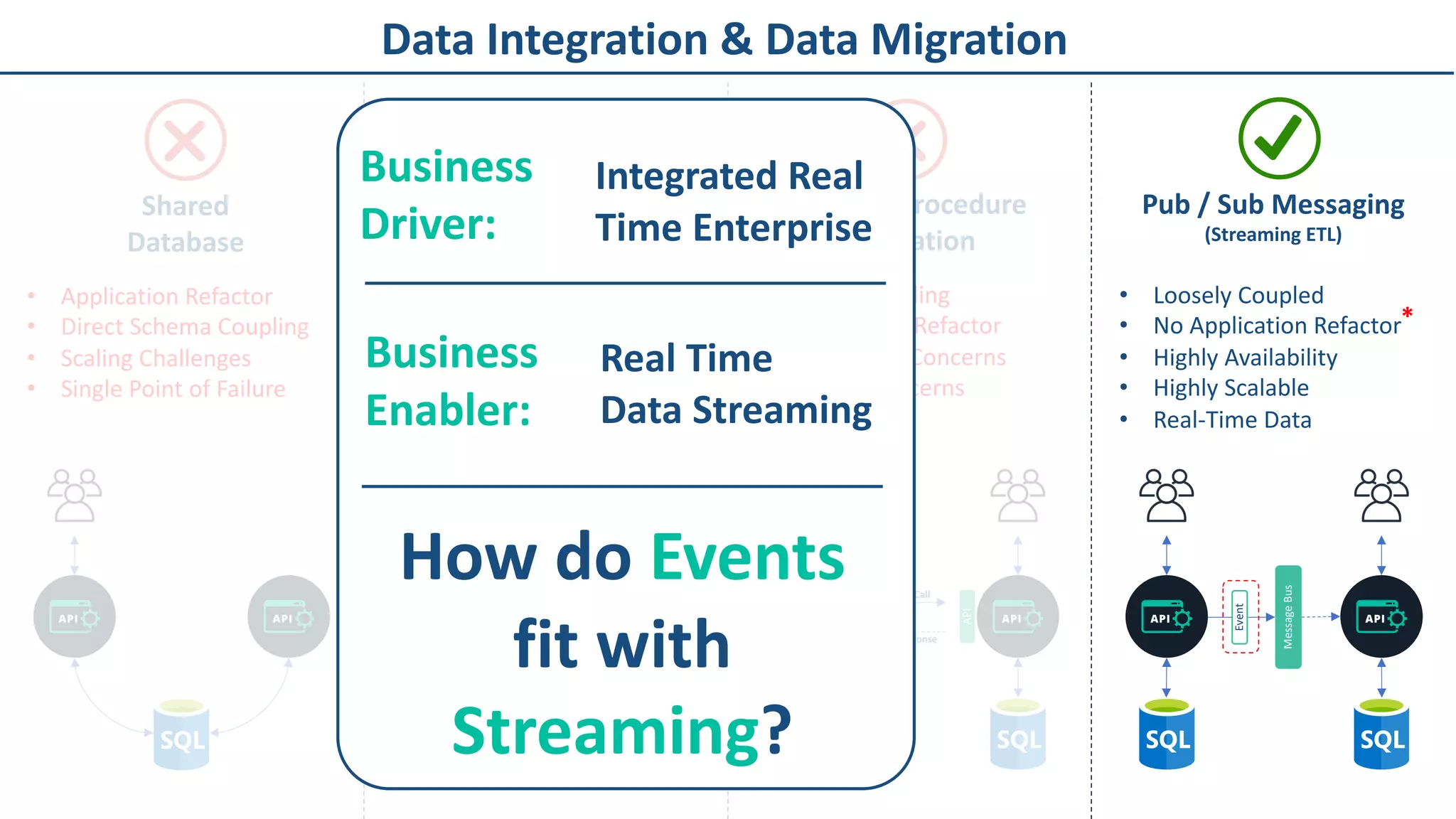
How do Events
fit with
Streaming?
Business
Driver:
Business
Enabler:
Real Time
Data Streaming
Integrated Real
Time Enterprise
Event Driven Apps
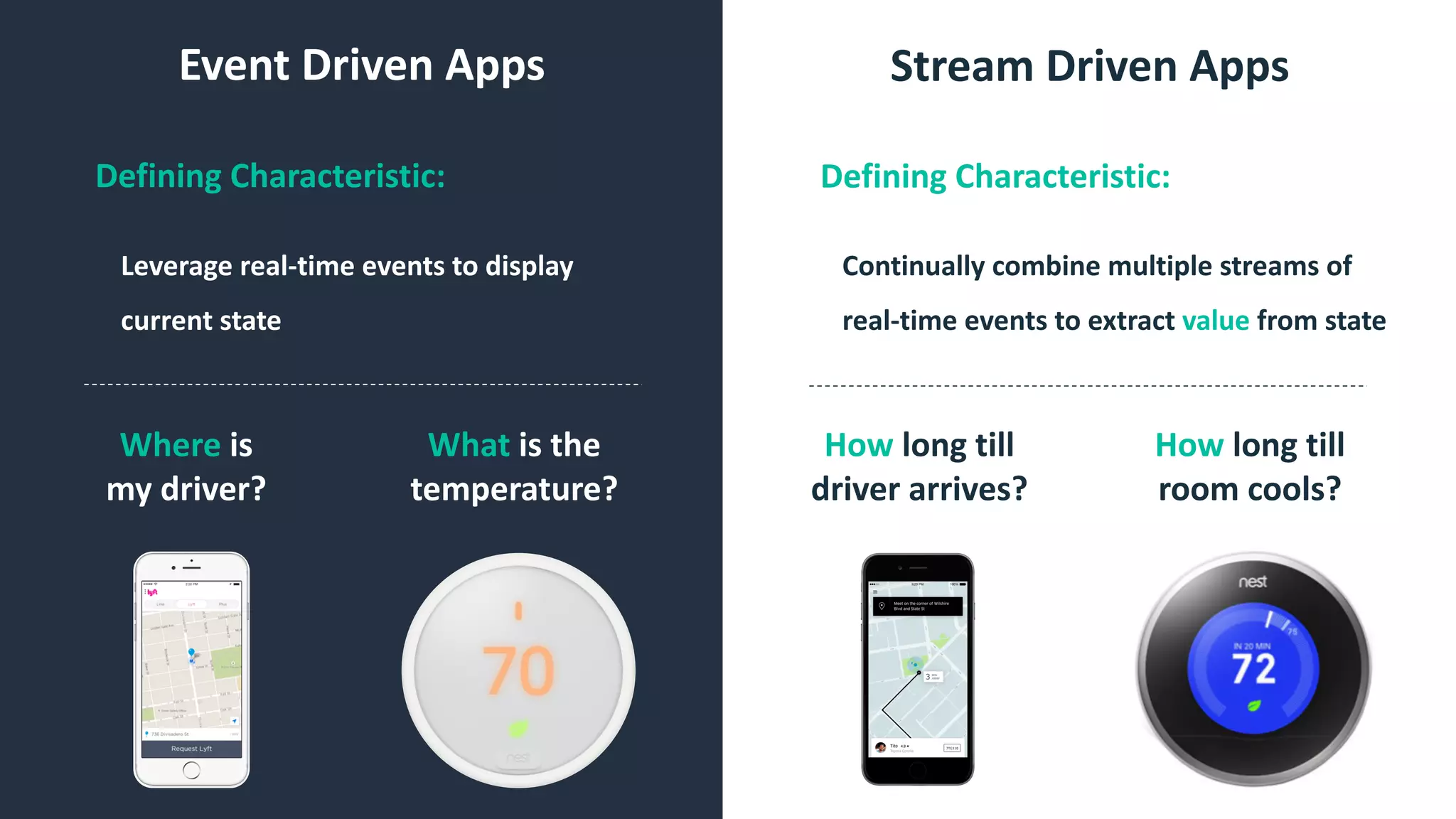
Defining Characteristic:
Stream Driven Apps
Where is
my driver?
What is the
temperature?
How long till
driver arrives?
How long till
room cools?
Leverage real-time events to display
current state
Defining Characteristic:
Continually combine multiple streams of
real-time events to extract value from state
Event Driven Apps
Defining Characteristic:
Stream Driven Apps
Where is
my driver?
What is the
temperature?
How long till
driver arrives?
How long till
room cools?
Leverage real-time events to display
current state
Defining Characteristic:
Continually combine multiple streams of
real-time events to extract value from state
What is the
temperature?
How long till
driver arrives?
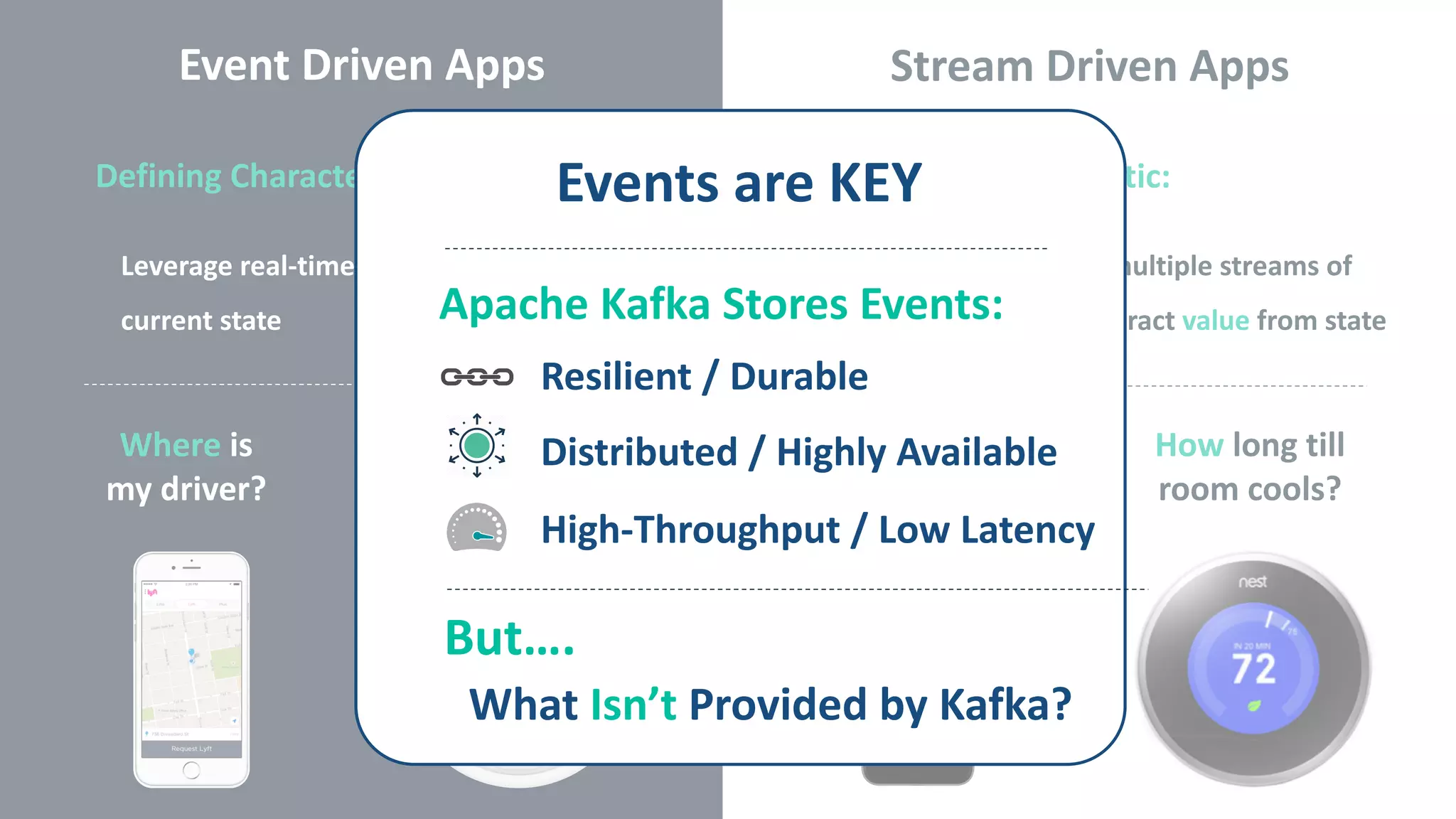
Events are KEY
Apache Kafka Stores Events:
Resilient / Durable
Distributed / Highly Available
High-Throughput / Low Latency
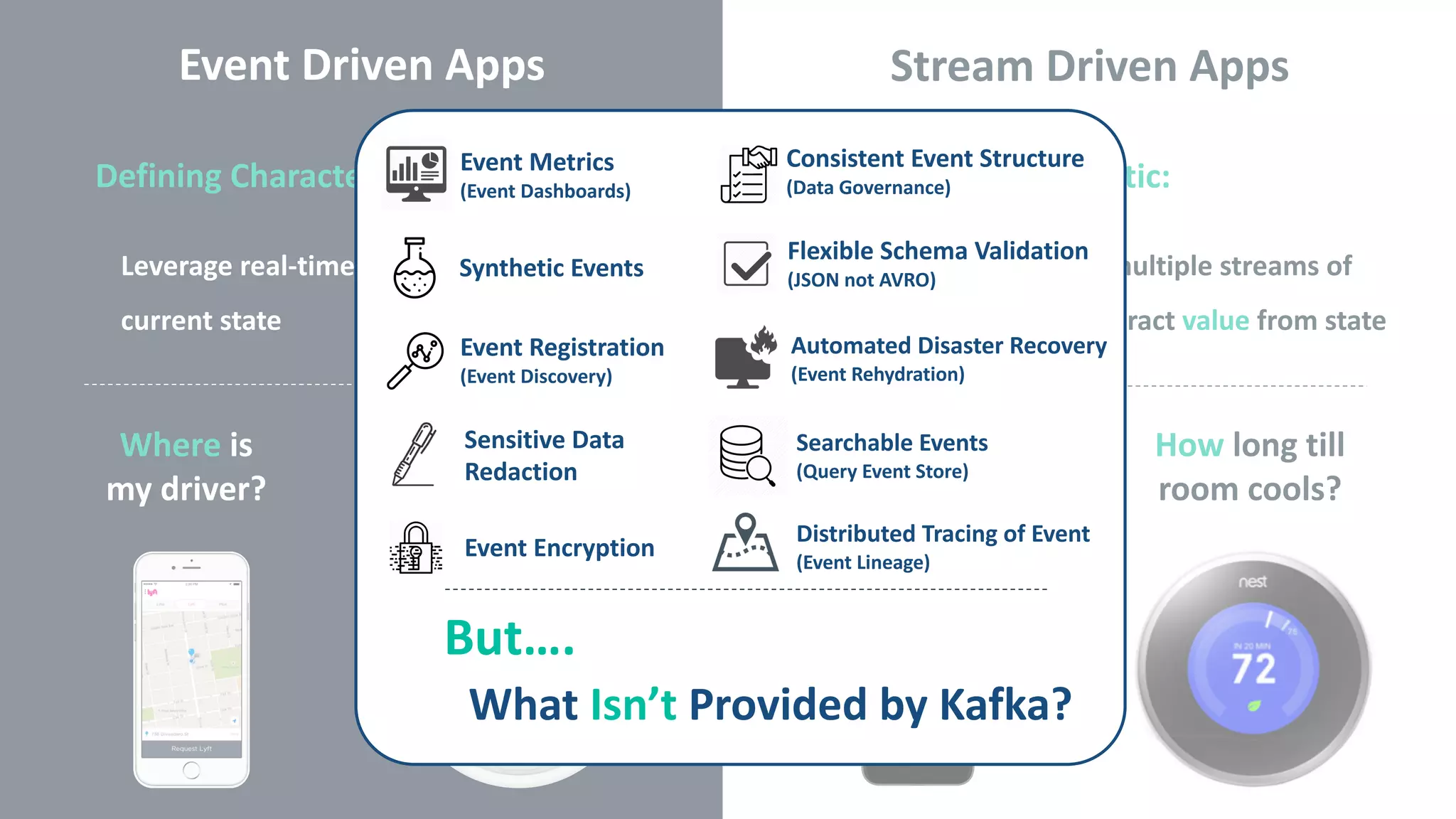
But….
What Isn’t Provided by Kafka?
Event Driven Apps
Defining Characteristic:
Stream Driven Apps
Where is
my driver?
What is the
temperature?
How long till
driver arrives?
How long till
room cools?
Leverage real-time events to display
current state
Defining Characteristic:
Continually combine multiple streams of
real-time events to extract value from state
What is the
temperature?
How long till
driver arrives?
But….
What Isn’t Provided by Kafka?
Synthetic Events
Event Registration
(Event Discovery)
Sensitive Data
Redaction
Event Encryption
Flexible Schema Validation
(JSON not AVRO)
Automated Disaster Recovery
(Event Rehydration)
Searchable Events
(Query Event Store)
Distributed Tracing of Event
(Event Lineage)
Event Metrics
(Event Dashboards)
Consistent Event Structure
(Data Governance)
Pub / Sub Messaging
(Streaming ETL)
Event
MessageBus
• Loosely Coupled
• No Application Refactor*
• Highly Availability
• Highly Scalable
• Real-Time Data
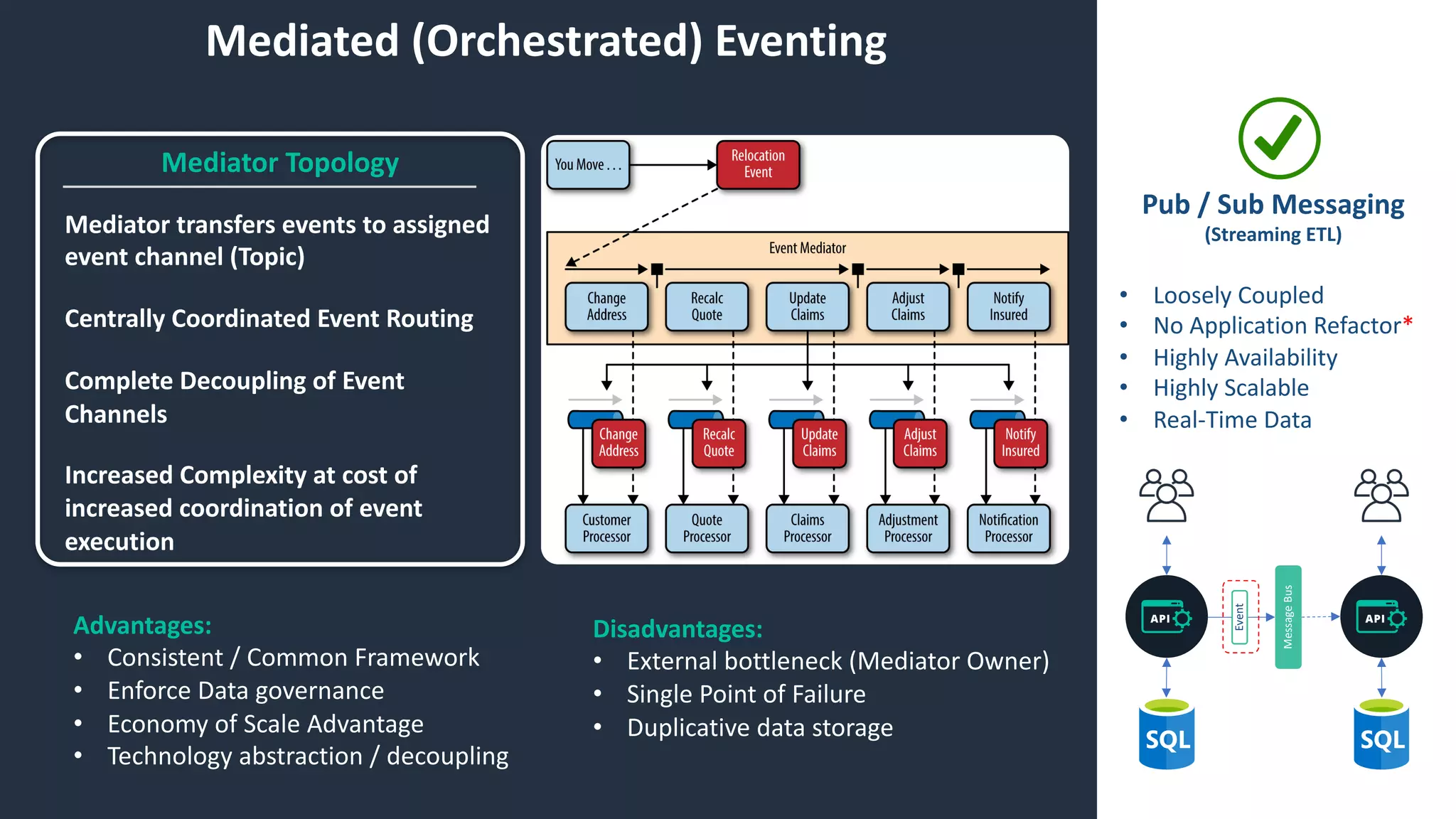
Mediated (Orchestrated) Eventing
Mediator Topology
Mediator transfers events to assigned
event channel (Topic)
Centrally Coordinated Event Routing
Complete Decoupling of Event
Channels
Increased Complexity at cost of
increased coordination of event
execution
Advantages:
• Consistent / Common Framework
• Enforce Data governance
• Economy of Scale Advantage
• Technology abstraction / decoupling
Disadvantages:
• External bottleneck (Mediator Owner)
• Single Point of Failure
• Duplicative data storage
Generic Event
Mediator
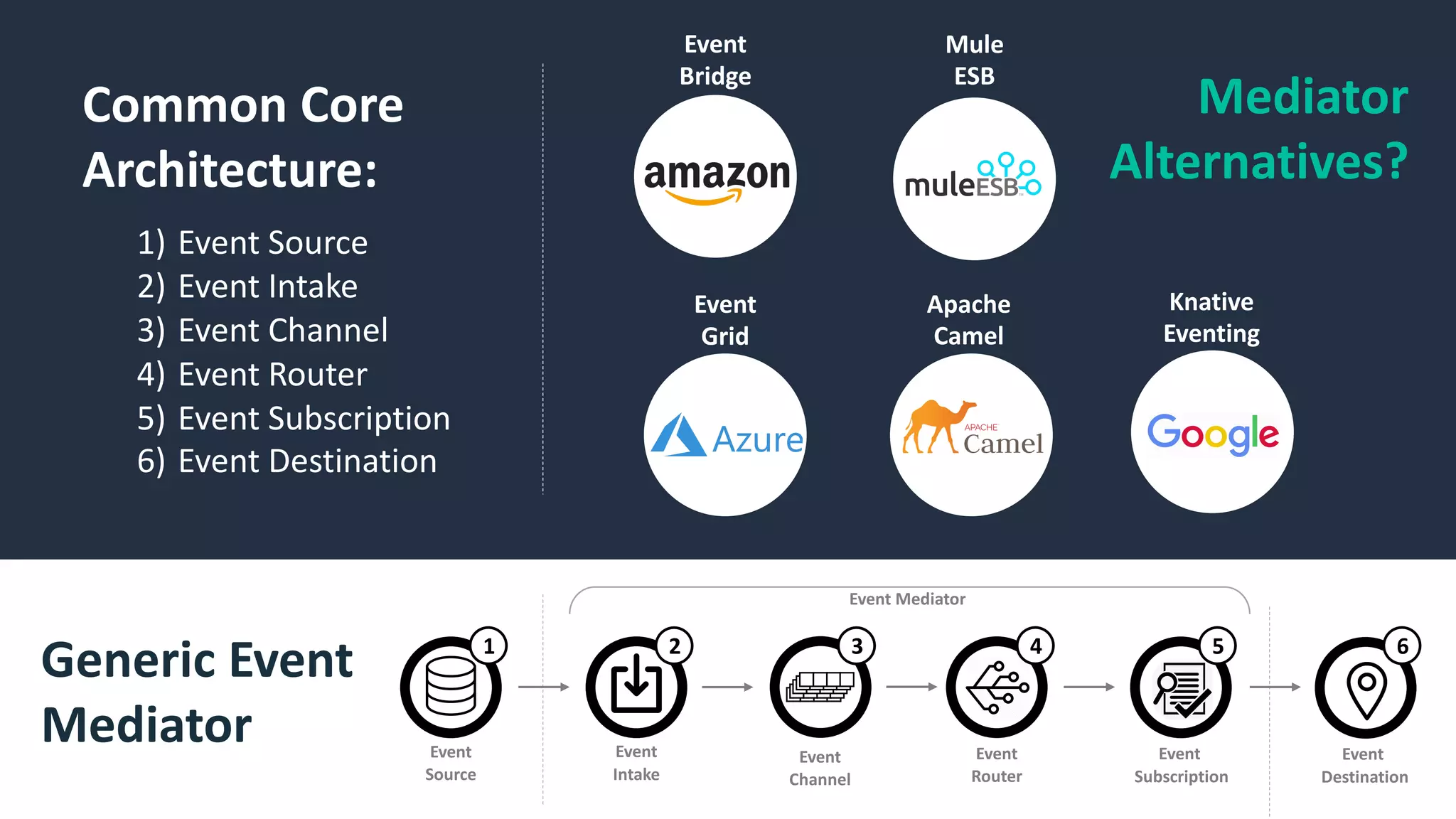
Common Core
Architecture:
1) Event Source
2) Event Intake
3) Event Channel
4) Event Router
5) Event Subscription
6) Event Destination
Event
Channel
Event
Router
Event
Subscription
Event
Destination
Event
Intake
Event
Source
Event Mediator
321 4 5 6
Event
Bridge
Event
Grid
Apache
Camel
Knative
Eventing
Mule
ESB
Mediator
Alternatives?
Generic Event
Mediator
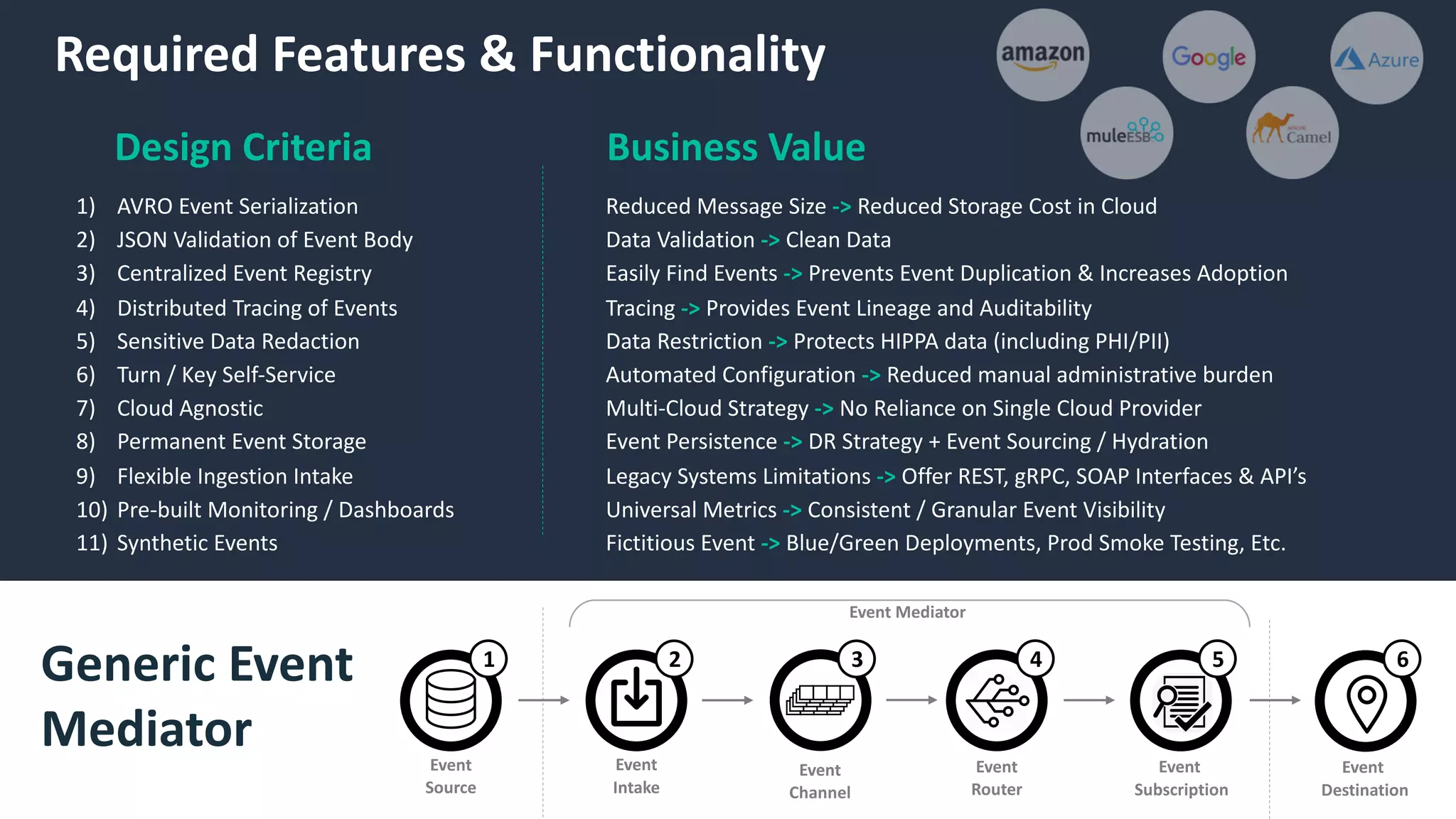
Required Features & Functionality
Event
Channel
Event
Router
Event
Subscription
Event
Destination
Event
Intake
Event
Source
Event Mediator
321 4 5 6
Design Criteria
1) AVRO Event Serialization
2) JSON Validation of Event Body
3) Centralized Event Registry
4) Distributed Tracing of Events
5) Sensitive Data Redaction
6) Turn / Key Self-Service
7) Cloud Agnostic
8) Permanent Event Storage
9) Flexible Ingestion Intake
10) Pre-built Monitoring / Dashboards
11) Synthetic Events
Reduced Message Size -> Reduced Storage Cost in Cloud
Data Validation -> Clean Data
Easily Find Events -> Prevents Event Duplication & Increases Adoption
Tracing -> Provides Event Lineage and Auditability
Data Restriction -> Protects HIPPA data (including PHI/PII)
Automated Configuration -> Reduced manual administrative burden
Multi-Cloud Strategy -> No Reliance on Single Cloud Provider
Event Persistence -> DR Strategy + Event Sourcing / Hydration
Legacy Systems Limitations -> Offer REST, gRPC, SOAP Interfaces & API’s
Universal Metrics -> Consistent / Granular Event Visibility
Fictitious Event -> Blue/Green Deployments, Prod Smoke Testing, Etc.
Business Value
1) AVRO Event Serialization
2) JSON Validation of Event Body
3) Centralized Event Registry
4) Distributed Tracing of Events
5) Sensitive Data Redaction
6) Turn / Key Self-Service
7) Cloud Agnostic
8) Permanent Event Storage
9) Flexible Ingestion Intake
10) Pre-built Monitoring / Dashboards
11) Synthetic Events
Reduced Message Size -> Reduced Storage Cost in Cloud
Data Validation -> Clean Data
Easily Find Events -> Prevents Event Duplication & Increases Adoption
Tracing -> Provides Event Lineage and Auditability
Data Restriction -> Protects HIPPA data (including PHI/PII)
Automated Configuration -> Reduced manual administrative burden
Multi-Cloud Strategy -> No Reliance on Single Cloud Provider
Event Persistence -> DR Strategy + Event Sourcing / Hydration
Legacy Systems Limitations -> Offer REST, gRPC, SOAP Interfaces & API’s
Universal Metrics -> Consistent / Granular Event Visibility
Fictitious Event -> Blue/Green Deployments, Prod Smoke Testing, Etc.
Generic Event
Mediator
Event
Channel
Event
Router
Event
Subscription
Event
Destination
Event
Intake
Event
Source
Event Mediator
321 4 5 6
Required Features & Functionality
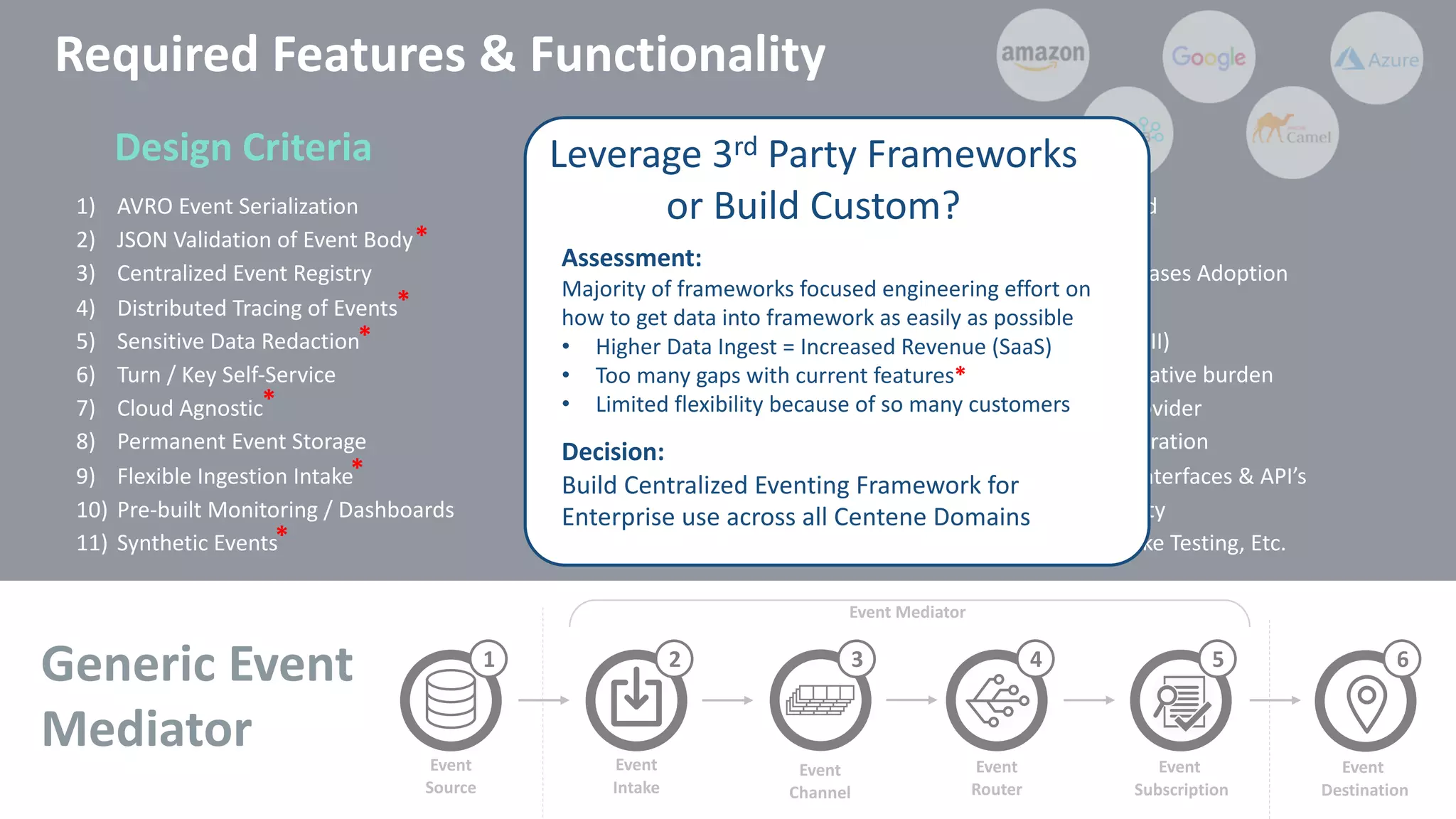
Design Criteria Business ValueLeverage 3rd Party Frameworks
or Build Custom?
Assessment:
Majority of frameworks focused engineering effort on
how to get data into framework as easily as possible
• Higher Data Ingest = Increased Revenue (SaaS)
• Too many gaps with current features*
• Limited flexibility because of so many customers
Decision:
Build Centralized Eventing Framework for
Enterprise use across all Centene Domains
*
*
*
*
*
*
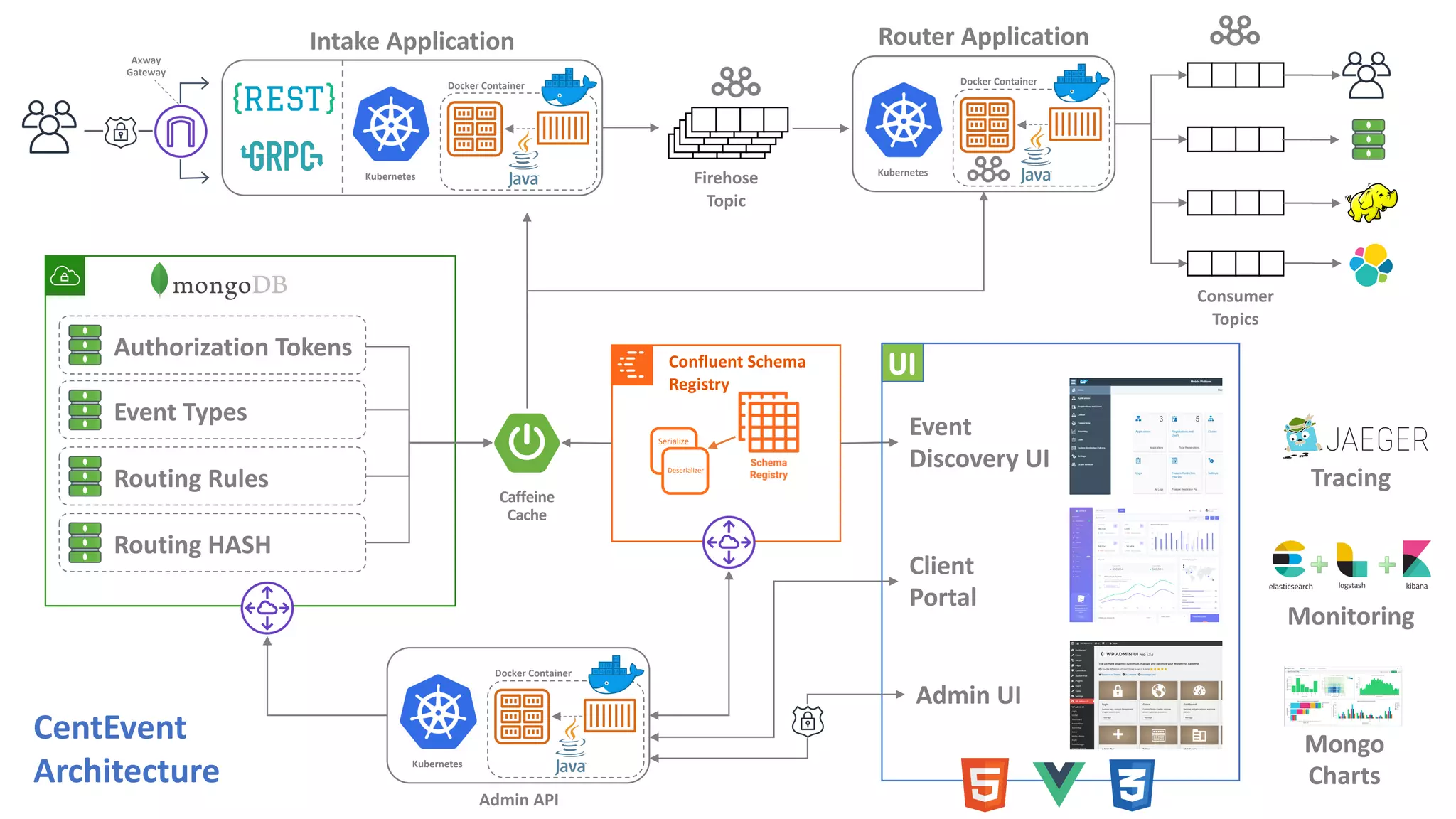
CentEvent
Architecture
Docker Container
Kubernetes
Intake Application
Axway
Gateway
Serialize
Deserializer
Confluent Schema
Registry
Caffeine
Cache
Authorization Tokens
Event Types
Routing Rules
Routing HASH
Firehose
Topic
Docker Container
Kubernetes
Router Application
Consumer
Topics
Client
Portal
Event
Discovery UI
Admin UI
Docker Container
Kubernetes
Admin API
Mongo
Charts
Tracing
Monitoring
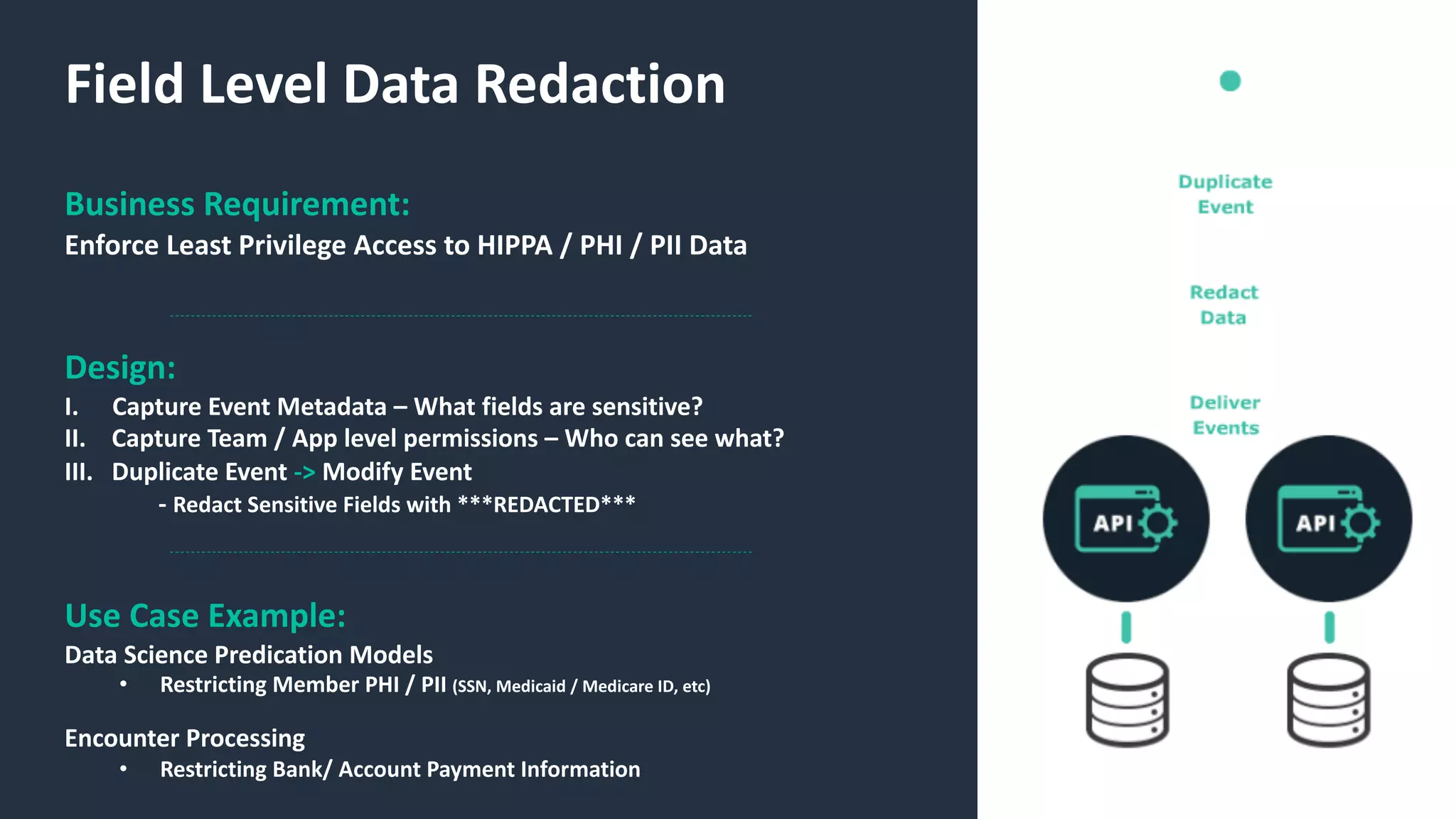
Field Level Data Redaction
Use Case Example:
Data Science Predication Models
• Restricting Member PHI / PII (SSN, Medicaid / Medicare ID, etc)
Encounter Processing
• Restricting Bank/ Account Payment Information
Business Requirement:
Enforce Least Privilege Access to HIPPA / PHI / PII Data
Design:
I. Capture Event Metadata – What fields are sensitive?
II. Capture Team / App level permissions – Who can see what?
III. Duplicate Event -> Modify Event
- Redact Sensitive Fields with ***REDACTED***
Discard
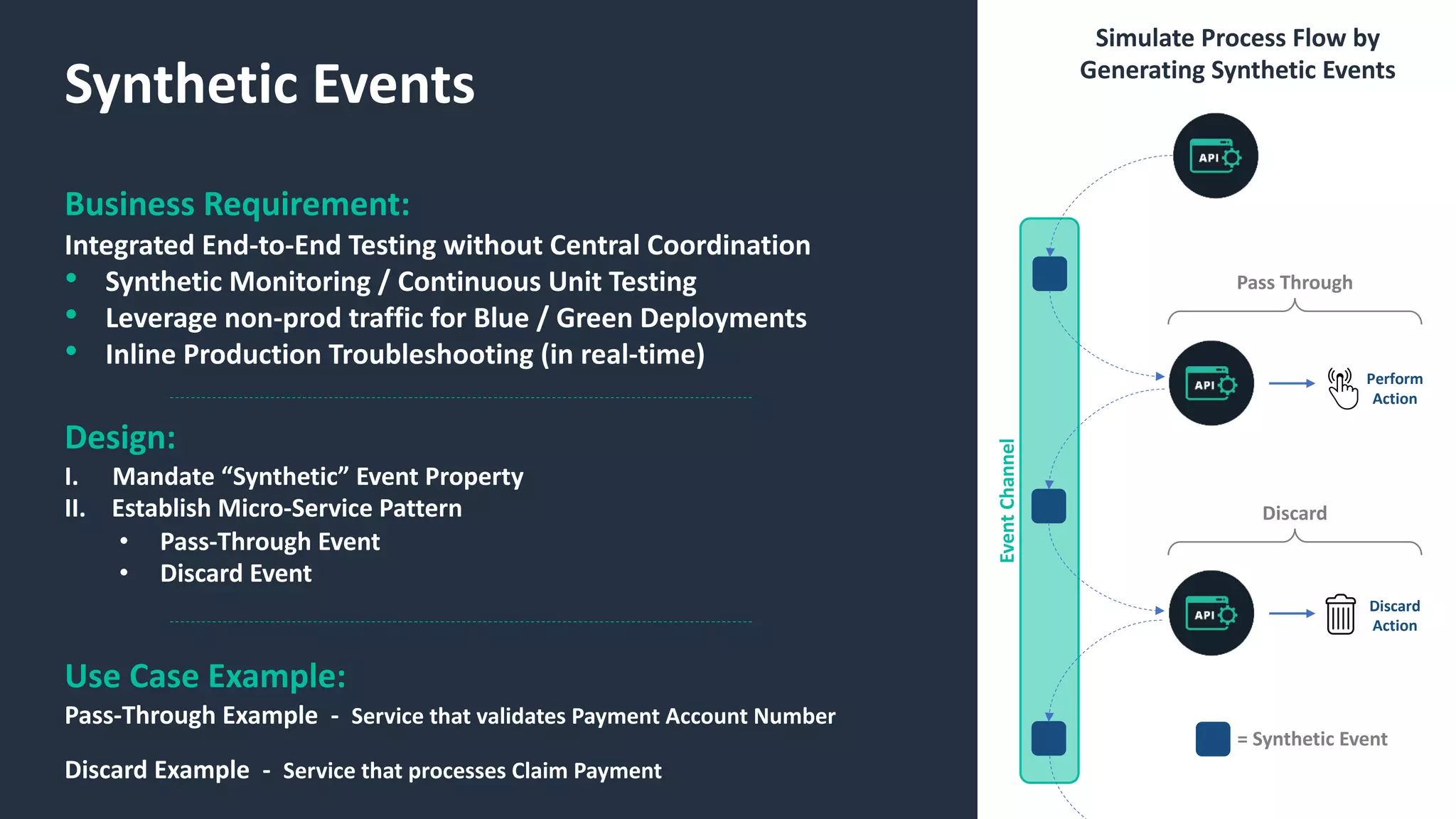
Synthetic Events
Use Case Example:
Pass-Through Example - Service that validates Payment Account Number
Discard Example - Service that processes Claim Payment
Business Requirement:
Integrated End-to-End Testing without Central Coordination
• Synthetic Monitoring / Continuous Unit Testing
• Leverage non-prod traffic for Blue / Green Deployments
• Inline Production Troubleshooting (in real-time)
Design:
I. Mandate “Synthetic” Event Property
II. Establish Micro-Service Pattern
• Pass-Through Event
• Discard Event
Simulate Process Flow by
Generating Synthetic Events
EventChannel
Pass Through
Perform
Action
Discard
Action
= Synthetic Event
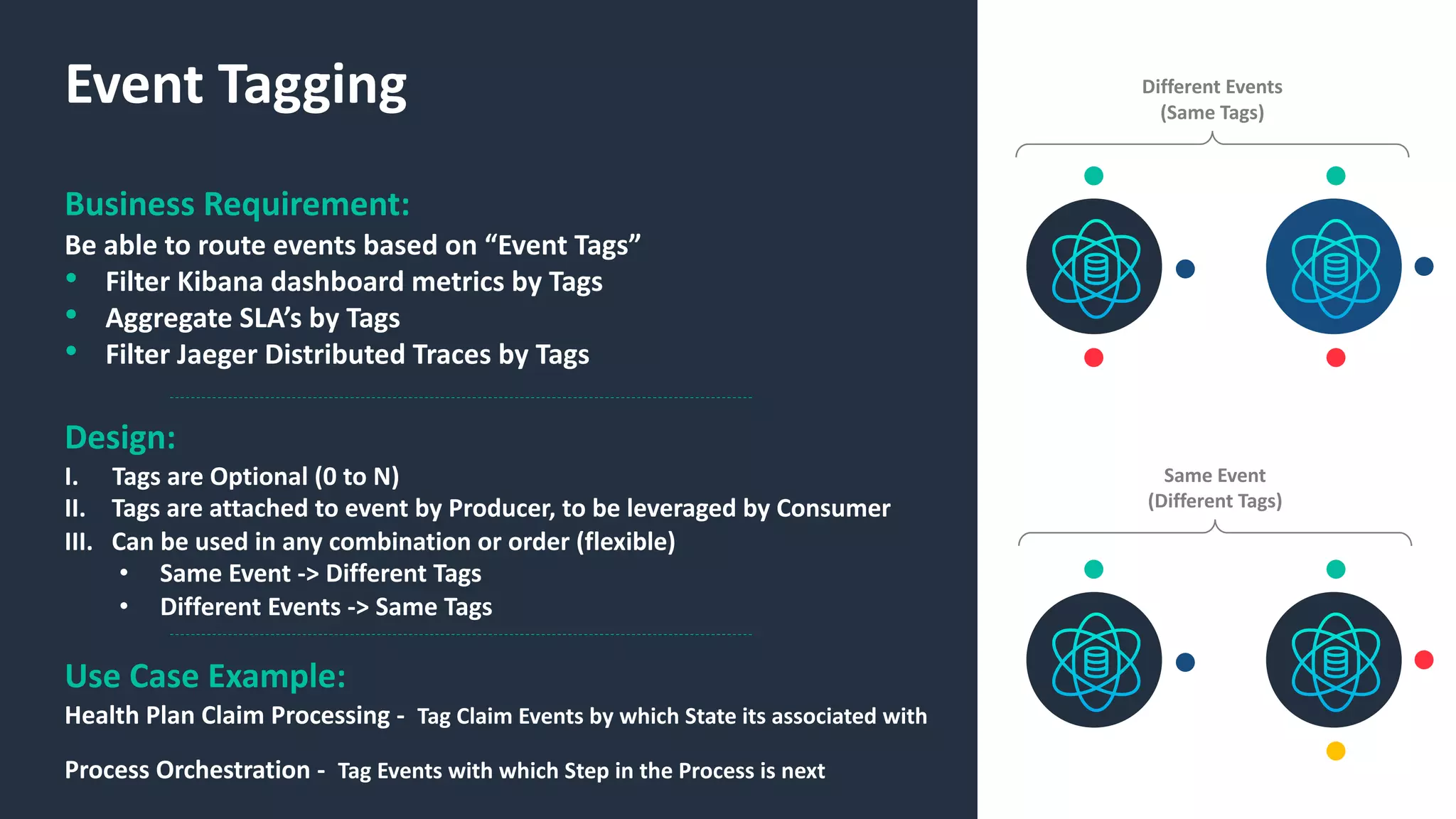
Event Tagging
Use Case Example:
Health Plan Claim Processing - Tag Claim Events by which State its associated with
Process Orchestration - Tag Events with which Step in the Process is next
Business Requirement:
Be able to route events based on “Event Tags”
• Filter Kibana dashboard metrics by Tags
• Aggregate SLA’s by Tags
• Filter Jaeger Distributed Traces by Tags
Design:
I. Tags are Optional (0 to N)
II. Tags are attached to event by Producer, to be leveraged by Consumer
III. Can be used in any combination or order (flexible)
• Same Event -> Different Tags
• Different Events -> Same Tags
Same Event
(Different Tags)
Different Events
(Same Tags)
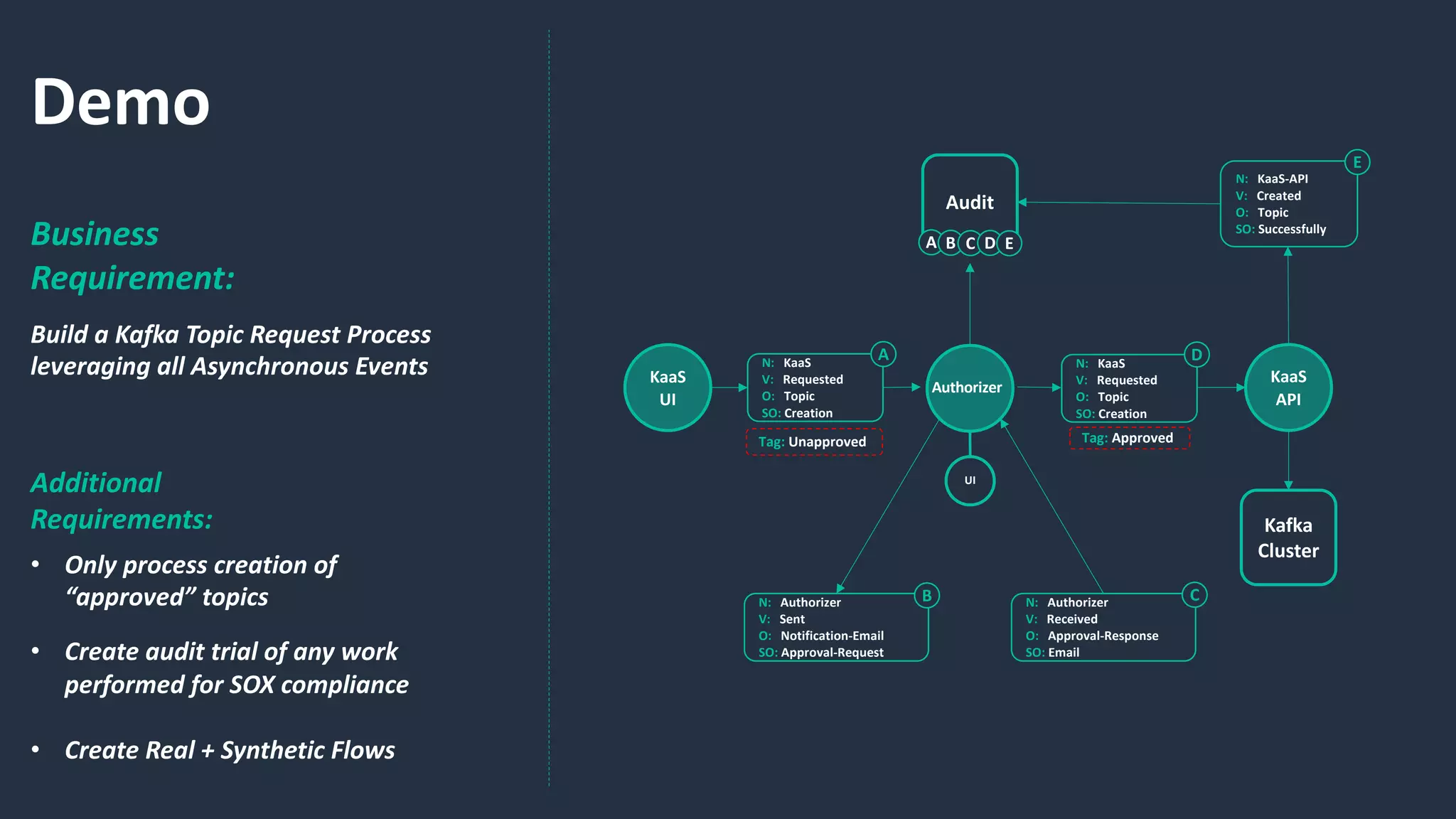
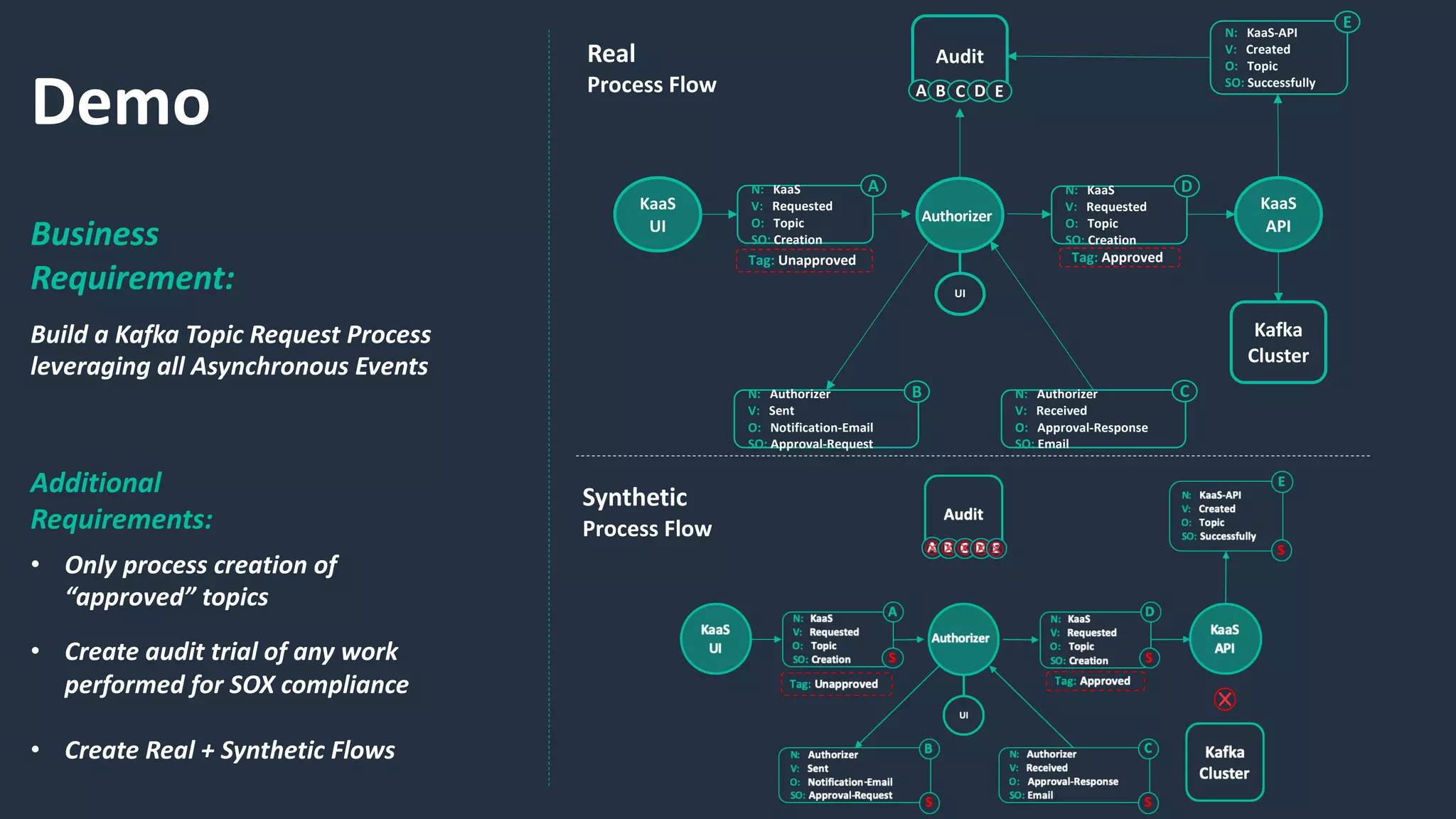
Demo
Build a Kafka Topic Request Process
leveraging all Asynchronous Events
Business
Requirement:
Additional
Requirements:
• Only process creation of
“approved” topics
• Create audit trial of any work
performed for SOX compliance
• Create Real + Synthetic Flows
KaaS
UI
N: KaaS
V: Requested
O: Topic
SO: Creation
Authorizer
N: Authorizer
V: Sent
O: Notification-Email
SO: Approval-Request
N: Authorizer
V: Received
O: Approval-Response
SO: Email
Audit
Tag: Approved
KaaS
API
Kafka
Cluster
N: KaaS-API
V: Created
O: Topic
SO: Successfully
B C
E
A B C D E
UI
Tag: Unapproved
A N: KaaS
V: Requested
O: Topic
SO: Creation
D
Demo
Build a Kafka Topic Request Process
leveraging all Asynchronous Events
Business
Requirement:
Additional
Requirements:
• Only process creation of
“approved” topics
• Create audit trial of any work
performed for SOX compliance
• Create Real + Synthetic Flows
KaaS
UI
N: KaaS
V: Requested
O: Topic
SO: Creation
Authorizer
N: Authorizer
V: Sent
O: Notification-Email
SO: Approval-Request
N: Authorizer
V: Received
O: Approval-Response
SO: Email
Audit
Tag: Approved
KaaS
API
Kafka
Cluster
N: KaaS-API
V: Created
O: Topic
SO: Successfully
B C
E
A B C D E
UI
Tag: Unapproved
A N: KaaS
V: Requested
O: Topic
SO: Creation
D
Synthetic
Process Flow
Real
Process Flow
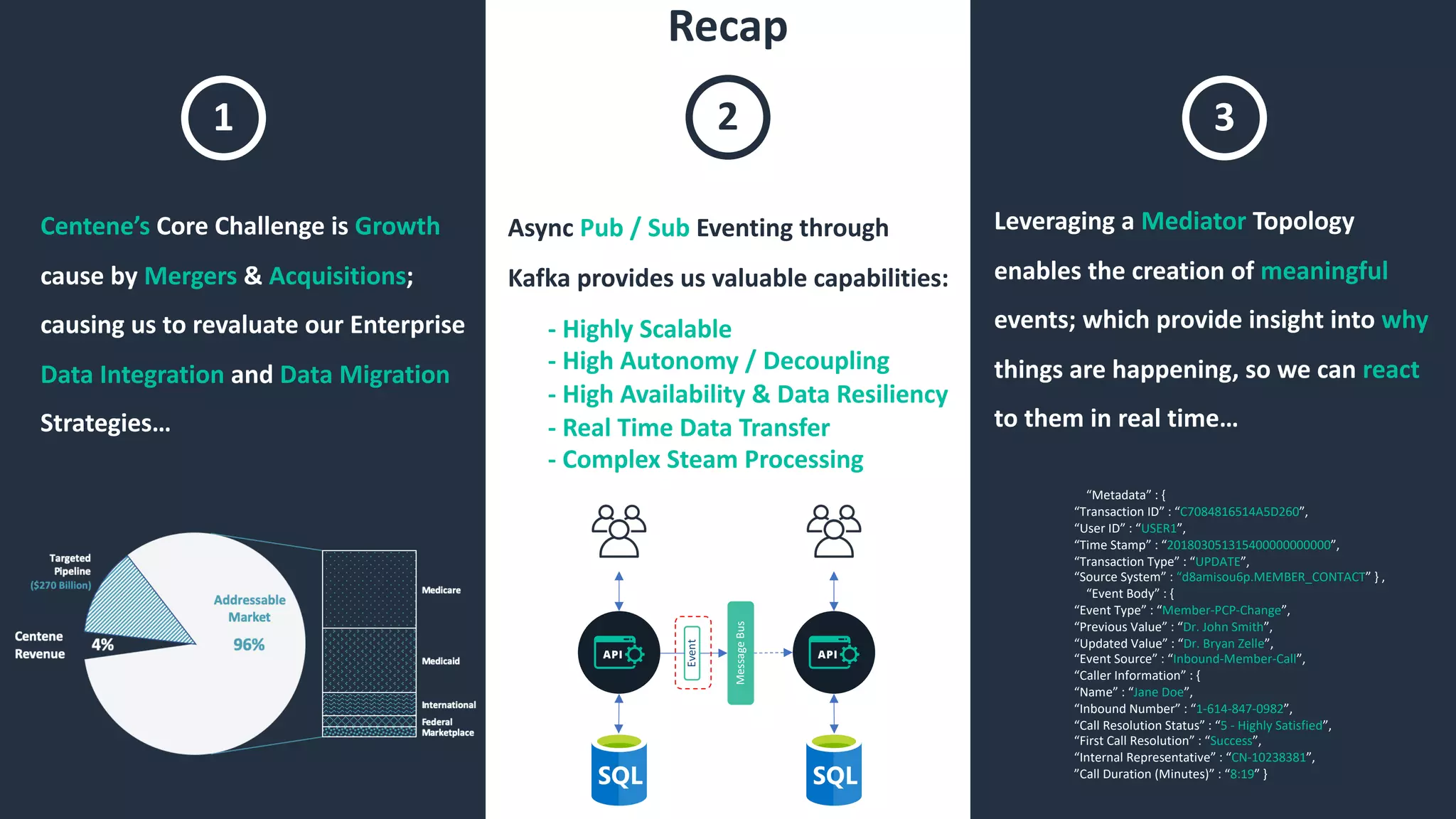
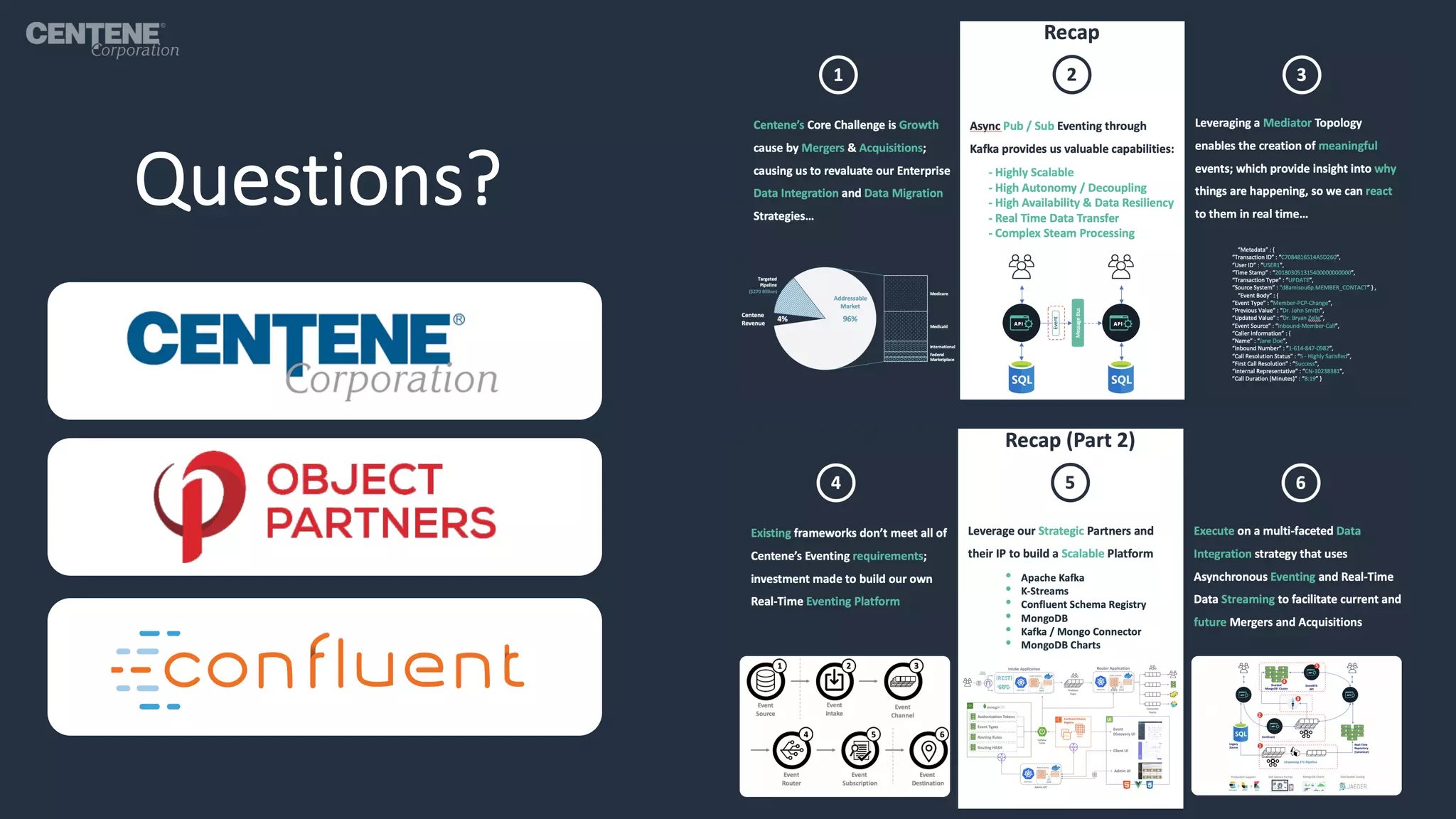
Recap Recap
1
Centene’s Core Challenge is Growth
cause by Mergers & Acquisitions;
causing us to revaluate our Enterprise
Data Integration and Data Migration
Strategies…
Event
MessageBus
2
Async Pub / Sub Eventing through
Kafka provides us valuable capabilities:
- Highly Scalable
- High Autonomy / Decoupling
- High Availability & Data Resiliency
- Real Time Data Transfer
- Complex Steam Processing
“Metadata” : {
“Transaction ID” : “C7084816514A5D260”,
“User ID” : “USER1”,
“Time Stamp” : “201803051315400000000000”,
“Transaction Type” : “UPDATE”,
“Source System” : “d8amisou6p.MEMBER_CONTACT” } ,
“Event Body” : {
“Event Type” : “Member-PCP-Change”,
“Previous Value” : “Dr. John Smith”,
“Updated Value” : “Dr. Bryan Zelle”,
“Event Source” : “Inbound-Member-Call”,
“Caller Information” : {
“Name” : “Jane Doe”,
“Inbound Number” : “1-614-847-0982”,
“Call Resolution Status” : “5 - Highly Satisfied”,
“First Call Resolution” : “Success”,
“Internal Representative” : “CN-10238381”,
”Call Duration (Minutes)” : “8:19” }
3
Leveraging a Mediator Topology
enables the creation of meaningful
events; which provide insight into why
things are happening, so we can react
to them in real time…
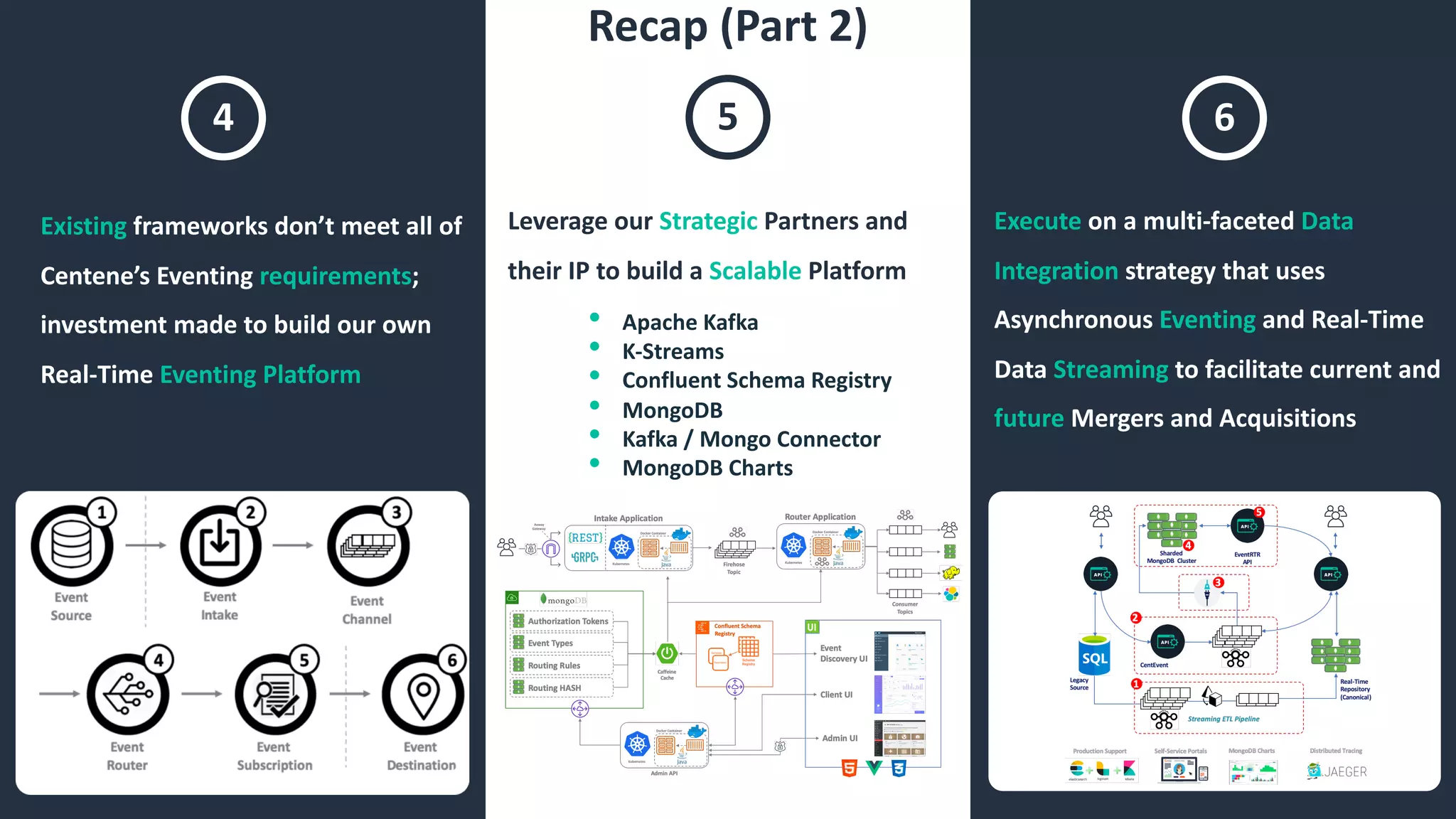
Recap (Part 2)
4
Existing frameworks don’t meet all of
Centene’s Eventing requirements;
investment made to build our own
Real-Time Eventing Platform
5
Leverage our Strategic Partners and
their IP to build a Scalable Platform
• Apache Kafka
• K-Streams
• Confluent Schema Registry
• MongoDB
• Kafka / Mongo Connector
• MongoDB Charts
6
Execute on a multi-faceted Data
Integration strategy that uses
Asynchronous Eventing and Real-Time
Data Streaming to facilitate current and
future Mergers and Acquisitions
28
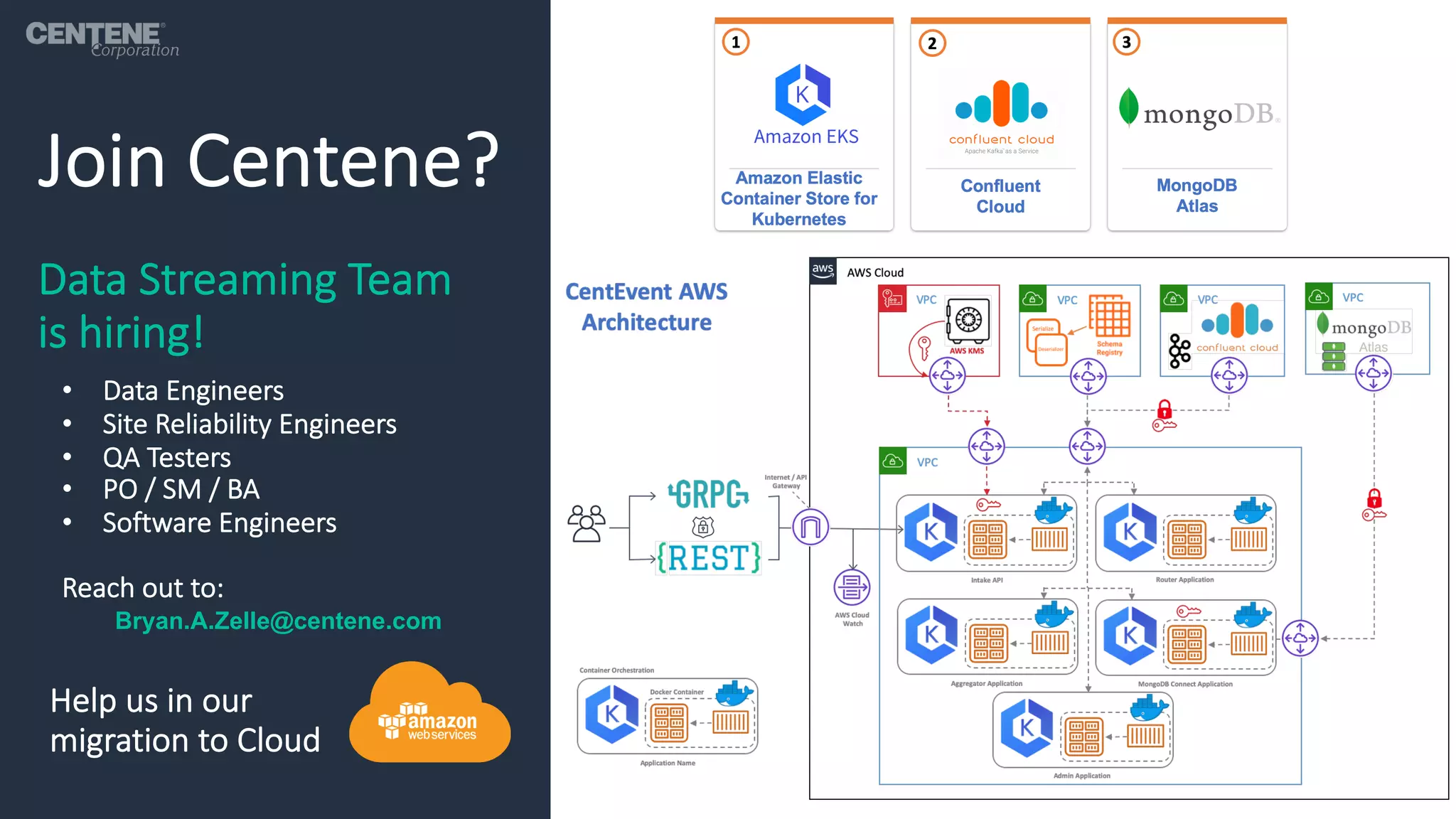
Join Centene?
Help us in our
migration to Cloud
Data Streaming Team
is hiring!
• Data Engineers
• Site Reliability Engineers
• QA Testers
• PO / SM / BA
• Software Engineers
Reach out to:
Bryan.A.Zelle@centene.com
Sara Zeman
sara.zeman@objectpartners.com
1515 Central Ave NE
Suite 100
Minneapolis, MN 55413
Looking for a Real-Time Data
Streaming Partner?
● Minneapolis (HQ), Omaha
● Founded in 1996
● Clients Nationwide
● 150+ Consultants, all full-time
employees
Practice Areas
• Cloud Engineering
• Real-time Data
• Modern APIs
• Mobile and Web
Special Thanks
• Nick Larson
• Ryan Hoffman
• Neil Buesing
30
Questions?

Building an Enterprise Eventing Framework (Bryan Zelle, Centene; Neil Buesing, Object Partners, Inc) Kafka Summit SF 2019

  • 1.
    Building a Enterprise EventingPlatform Bryan Zelle and Neil Buesing
  • 2.
    Centene Introduction Mission Statement: Transformingthe health of the community, one person at a time Medicaid: Medicare (Part D): Marketplace: Medicare: Other: Total: 12,700,000 4,000,000 2,000,000 1,000,000 3,700,000 23,400,000 30 States 50 States 21 States 28 States 33 States 50 States Membership Composition: Industry: Largest Medicaid and Medicare Managed Care Provider 0 5 10 15 20 25 Centene United Health Group Humana Anthem CVS Membership(Millions) Largest Managed Care Organizations Medicaid Medicare & Medicare PDP OtherGovernment Marketplace
  • 3.
    $- $10,000 $20,000 $30,000 $40,000 $50,000 $60,000 $70,000 $80,000 $90,000 $100,000 2019 2018 20172016 2015 2014 2013 2012 2011 2010 2009 2008 2007 2006 2005 TotalRevenus(millions) Centene Yearly Revenue Centene Revenue WellCare Revenue Summary of Centene’s Key Challenges in one word… Growth $4.1 Billion Revenue to $96.9 Billion in 10 Years $80.4 Billion in growth in past 5 years $48.6 Billion in growth in past 2½ years Envolve Jan 2015 Wellcare Mar 2019 Fidelis Sep 2017 HealthNet Mar 2016 ? ? Cause of the growth… Mergers & Acquisitions By the numbers:
  • 4.
    Medicare Medicaid International Federal Marketplace Addressable Market Federal Medicare$860B 40% State Medicaid International Market Federal Services Health Insurance Marketplace $2,000,000,000,000 + Centene Revenue $97,000,000,000 + Centene Revenue 4% Addressable Market 96% Additional Growth Opportunities $710 B 33% $260 B 12% $120B 6% $115 B 5% Centene Growth Outlook Targeted Pipeline ($270 Billion)
  • 5.
    Medicare Medicaid International Federal Marketplace Addressable Market Federal Medicare$860B 40% State Medicaid International Market Federal Services Health Insurance Marketplace $2,000,000,000,000 + Centene Revenue $97,000,000,000 + Centene Revenue 4% Addressable Market 96% Additional Growth Opportunities $710 B 33% $260 B 12% $120B 6% $115 B 5% Centene Growth Outlook Targeted Pipeline ($270 Billion) Mergers & Acquisitions Data Integration & Data Migration
  • 6.
    Data Integration &Data Migration 1 Shared Database • Application Refactor • Direct Schema Coupling • Scaling Challenges • Single Point of Failure
  • 7.
    Data Integration &Data Migration Shared Database Export Import • Application Refactor • Direct Schema Coupling • Scaling Challenges • Single Point of Failure File 2 File Transfer (Batch ETL) • Latent Data • Direct Database Load • Consistency Challenges
  • 8.
    Data Integration &Data Migration Export Import Shared Database File Transfer (Batch ETL) • Application Refactor • Direct Schema Coupling • Scaling Challenges • Single Point of Failure • Latent Data • Direct Database Load • Consistency Challenges File API API Function Call Response 3 • Direct Coupling • Application Refactor • Availability Concerns • Scaling Concerns Remote Procedure Invocation
  • 9.
    Data Integration &Data Migration Shared Database File Transfer (Batch ETL) Export Import • Application Refactor • Direct Schema Coupling • Scaling Challenges • Single Point of Failure File • Latent Data • Direct Database Load • Consistency Challenges API API Function Call Response • Direct Coupling • Application Refactor • Availability Concerns • Scaling Concerns Remote Procedure Invocation 4 Pub / Sub Messaging (Streaming ETL) Event MessageBus • Loosely Coupled • No Application Refactor • Highly Availability • Highly Scalable • Real-Time Data
  • 10.
    Data Integration &Data Migration Pub / Sub Messaging (Streaming ETL) Event MessageBus • Loosely Coupled • No Application Refactor • Highly Availability • Highly Scalable • Real-Time Data Shared Database File Transfer (Batch ETL) Export Import • Application Refactor • Direct Schema Coupling • Scaling Challenges • Single Point of Failure File • Latent Data • Direct Database Load • Consistency Challenges API API Function Call Response • Direct Coupling • Application Refactor • Availability Concerns • Scaling Concerns Remote Procedure Invocation * What is a Event? Definition: “A significant change in state” • Statement of fact (immutable) • Expects no response (or call to action) • Has a defined “timepoint” Persistence • Stateless: Notification Event • Stateful: Event-Carried State Transfer How can you use events? E1 E2 E3+• Combine multiple Events E1 E2+• Absence of an Event E1 E2• Leverage Single Event
  • 11.
    Pub / SubMessaging (Streaming ETL) Event MessageBus • Loosely Coupled • No Application Refactor* • Highly Availability • Highly Scalable • Real-Time Data Event Structure Example Event Payload (JSON vis REST) “Metadata” : { “Transaction ID” : “C7084816514A5D260”, “User ID” : “USER1”, “Time Stamp” : “201803051315400000000000”, “Transaction Type” : “UPDATE”, “Source System” : “d8amisou6p.MEMBER_CONTACT” } , “Event Body” : { “Event Type” : “Member-PCP-Change”, “Previous Value” : “Dr. John Smith”, “Updated Value” : “Dr. Bryan Zelle”, “Event Source” : “Inbound-Member-Call”, “Caller Information” : { “Name” : “Jane Doe”, “Inbound Number” : “1-614-847-0982”, “Call Resolution Status” : “5 - Highly Satisfied”, “First Call Resolution” : “Success”, “Internal Representative” : “CN-10238381”, ”Call Duration (Minutes)” : “8:19” } Transaction Metadata Who - Who changed the data ?* What - What data changed ? When - When the data changed ? Where - Where was the data changed ? Why - Why was the data changed ? What Event information are we capturing? Event Body *
  • 12.
    Data Integration &Data Migration Pub / Sub Messaging (Streaming ETL) Event MessageBus • Loosely Coupled • No Application Refactor • Highly Availability • Highly Scalable • Real-Time Data Shared Database File Transfer (Batch ETL) Export Import • Application Refactor • Direct Schema Coupling • Scaling Challenges • Single Point of Failure File • Latent Data • Direct Database Load • Consistency Challenges API API Function Call Response • Direct Coupling • Application Refactor • Availability Concerns • Scaling Concerns Remote Procedure Invocation * How do Events fit with Streaming? Business Driver: Business Enabler: Real Time Data Streaming Integrated Real Time Enterprise
  • 13.
    Event Driven Apps DefiningCharacteristic: Stream Driven Apps Where is my driver? What is the temperature? How long till driver arrives? How long till room cools? Leverage real-time events to display current state Defining Characteristic: Continually combine multiple streams of real-time events to extract value from state
  • 14.
    Event Driven Apps DefiningCharacteristic: Stream Driven Apps Where is my driver? What is the temperature? How long till driver arrives? How long till room cools? Leverage real-time events to display current state Defining Characteristic: Continually combine multiple streams of real-time events to extract value from state What is the temperature? How long till driver arrives? Events are KEY Apache Kafka Stores Events: Resilient / Durable Distributed / Highly Available High-Throughput / Low Latency But…. What Isn’t Provided by Kafka?
  • 15.
    Event Driven Apps DefiningCharacteristic: Stream Driven Apps Where is my driver? What is the temperature? How long till driver arrives? How long till room cools? Leverage real-time events to display current state Defining Characteristic: Continually combine multiple streams of real-time events to extract value from state What is the temperature? How long till driver arrives? But…. What Isn’t Provided by Kafka? Synthetic Events Event Registration (Event Discovery) Sensitive Data Redaction Event Encryption Flexible Schema Validation (JSON not AVRO) Automated Disaster Recovery (Event Rehydration) Searchable Events (Query Event Store) Distributed Tracing of Event (Event Lineage) Event Metrics (Event Dashboards) Consistent Event Structure (Data Governance)
  • 16.
    Pub / SubMessaging (Streaming ETL) Event MessageBus • Loosely Coupled • No Application Refactor* • Highly Availability • Highly Scalable • Real-Time Data Mediated (Orchestrated) Eventing Mediator Topology Mediator transfers events to assigned event channel (Topic) Centrally Coordinated Event Routing Complete Decoupling of Event Channels Increased Complexity at cost of increased coordination of event execution Advantages: • Consistent / Common Framework • Enforce Data governance • Economy of Scale Advantage • Technology abstraction / decoupling Disadvantages: • External bottleneck (Mediator Owner) • Single Point of Failure • Duplicative data storage
  • 17.
    Generic Event Mediator Common Core Architecture: 1)Event Source 2) Event Intake 3) Event Channel 4) Event Router 5) Event Subscription 6) Event Destination Event Channel Event Router Event Subscription Event Destination Event Intake Event Source Event Mediator 321 4 5 6 Event Bridge Event Grid Apache Camel Knative Eventing Mule ESB Mediator Alternatives?
  • 18.
    Generic Event Mediator Required Features& Functionality Event Channel Event Router Event Subscription Event Destination Event Intake Event Source Event Mediator 321 4 5 6 Design Criteria 1) AVRO Event Serialization 2) JSON Validation of Event Body 3) Centralized Event Registry 4) Distributed Tracing of Events 5) Sensitive Data Redaction 6) Turn / Key Self-Service 7) Cloud Agnostic 8) Permanent Event Storage 9) Flexible Ingestion Intake 10) Pre-built Monitoring / Dashboards 11) Synthetic Events Reduced Message Size -> Reduced Storage Cost in Cloud Data Validation -> Clean Data Easily Find Events -> Prevents Event Duplication & Increases Adoption Tracing -> Provides Event Lineage and Auditability Data Restriction -> Protects HIPPA data (including PHI/PII) Automated Configuration -> Reduced manual administrative burden Multi-Cloud Strategy -> No Reliance on Single Cloud Provider Event Persistence -> DR Strategy + Event Sourcing / Hydration Legacy Systems Limitations -> Offer REST, gRPC, SOAP Interfaces & API’s Universal Metrics -> Consistent / Granular Event Visibility Fictitious Event -> Blue/Green Deployments, Prod Smoke Testing, Etc. Business Value
  • 19.
    1) AVRO EventSerialization 2) JSON Validation of Event Body 3) Centralized Event Registry 4) Distributed Tracing of Events 5) Sensitive Data Redaction 6) Turn / Key Self-Service 7) Cloud Agnostic 8) Permanent Event Storage 9) Flexible Ingestion Intake 10) Pre-built Monitoring / Dashboards 11) Synthetic Events Reduced Message Size -> Reduced Storage Cost in Cloud Data Validation -> Clean Data Easily Find Events -> Prevents Event Duplication & Increases Adoption Tracing -> Provides Event Lineage and Auditability Data Restriction -> Protects HIPPA data (including PHI/PII) Automated Configuration -> Reduced manual administrative burden Multi-Cloud Strategy -> No Reliance on Single Cloud Provider Event Persistence -> DR Strategy + Event Sourcing / Hydration Legacy Systems Limitations -> Offer REST, gRPC, SOAP Interfaces & API’s Universal Metrics -> Consistent / Granular Event Visibility Fictitious Event -> Blue/Green Deployments, Prod Smoke Testing, Etc. Generic Event Mediator Event Channel Event Router Event Subscription Event Destination Event Intake Event Source Event Mediator 321 4 5 6 Required Features & Functionality Design Criteria Business ValueLeverage 3rd Party Frameworks or Build Custom? Assessment: Majority of frameworks focused engineering effort on how to get data into framework as easily as possible • Higher Data Ingest = Increased Revenue (SaaS) • Too many gaps with current features* • Limited flexibility because of so many customers Decision: Build Centralized Eventing Framework for Enterprise use across all Centene Domains * * * * * *
  • 20.
    CentEvent Architecture Docker Container Kubernetes Intake Application Axway Gateway Serialize Deserializer ConfluentSchema Registry Caffeine Cache Authorization Tokens Event Types Routing Rules Routing HASH Firehose Topic Docker Container Kubernetes Router Application Consumer Topics Client Portal Event Discovery UI Admin UI Docker Container Kubernetes Admin API Mongo Charts Tracing Monitoring
  • 21.
    Field Level DataRedaction Use Case Example: Data Science Predication Models • Restricting Member PHI / PII (SSN, Medicaid / Medicare ID, etc) Encounter Processing • Restricting Bank/ Account Payment Information Business Requirement: Enforce Least Privilege Access to HIPPA / PHI / PII Data Design: I. Capture Event Metadata – What fields are sensitive? II. Capture Team / App level permissions – Who can see what? III. Duplicate Event -> Modify Event - Redact Sensitive Fields with ***REDACTED***
  • 22.
    Discard Synthetic Events Use CaseExample: Pass-Through Example - Service that validates Payment Account Number Discard Example - Service that processes Claim Payment Business Requirement: Integrated End-to-End Testing without Central Coordination • Synthetic Monitoring / Continuous Unit Testing • Leverage non-prod traffic for Blue / Green Deployments • Inline Production Troubleshooting (in real-time) Design: I. Mandate “Synthetic” Event Property II. Establish Micro-Service Pattern • Pass-Through Event • Discard Event Simulate Process Flow by Generating Synthetic Events EventChannel Pass Through Perform Action Discard Action = Synthetic Event
  • 23.
    Event Tagging Use CaseExample: Health Plan Claim Processing - Tag Claim Events by which State its associated with Process Orchestration - Tag Events with which Step in the Process is next Business Requirement: Be able to route events based on “Event Tags” • Filter Kibana dashboard metrics by Tags • Aggregate SLA’s by Tags • Filter Jaeger Distributed Traces by Tags Design: I. Tags are Optional (0 to N) II. Tags are attached to event by Producer, to be leveraged by Consumer III. Can be used in any combination or order (flexible) • Same Event -> Different Tags • Different Events -> Same Tags Same Event (Different Tags) Different Events (Same Tags)
  • 24.
    Demo Build a KafkaTopic Request Process leveraging all Asynchronous Events Business Requirement: Additional Requirements: • Only process creation of “approved” topics • Create audit trial of any work performed for SOX compliance • Create Real + Synthetic Flows KaaS UI N: KaaS V: Requested O: Topic SO: Creation Authorizer N: Authorizer V: Sent O: Notification-Email SO: Approval-Request N: Authorizer V: Received O: Approval-Response SO: Email Audit Tag: Approved KaaS API Kafka Cluster N: KaaS-API V: Created O: Topic SO: Successfully B C E A B C D E UI Tag: Unapproved A N: KaaS V: Requested O: Topic SO: Creation D
  • 25.
    Demo Build a KafkaTopic Request Process leveraging all Asynchronous Events Business Requirement: Additional Requirements: • Only process creation of “approved” topics • Create audit trial of any work performed for SOX compliance • Create Real + Synthetic Flows KaaS UI N: KaaS V: Requested O: Topic SO: Creation Authorizer N: Authorizer V: Sent O: Notification-Email SO: Approval-Request N: Authorizer V: Received O: Approval-Response SO: Email Audit Tag: Approved KaaS API Kafka Cluster N: KaaS-API V: Created O: Topic SO: Successfully B C E A B C D E UI Tag: Unapproved A N: KaaS V: Requested O: Topic SO: Creation D Synthetic Process Flow Real Process Flow
  • 26.
    Recap Recap 1 Centene’s CoreChallenge is Growth cause by Mergers & Acquisitions; causing us to revaluate our Enterprise Data Integration and Data Migration Strategies… Event MessageBus 2 Async Pub / Sub Eventing through Kafka provides us valuable capabilities: - Highly Scalable - High Autonomy / Decoupling - High Availability & Data Resiliency - Real Time Data Transfer - Complex Steam Processing “Metadata” : { “Transaction ID” : “C7084816514A5D260”, “User ID” : “USER1”, “Time Stamp” : “201803051315400000000000”, “Transaction Type” : “UPDATE”, “Source System” : “d8amisou6p.MEMBER_CONTACT” } , “Event Body” : { “Event Type” : “Member-PCP-Change”, “Previous Value” : “Dr. John Smith”, “Updated Value” : “Dr. Bryan Zelle”, “Event Source” : “Inbound-Member-Call”, “Caller Information” : { “Name” : “Jane Doe”, “Inbound Number” : “1-614-847-0982”, “Call Resolution Status” : “5 - Highly Satisfied”, “First Call Resolution” : “Success”, “Internal Representative” : “CN-10238381”, ”Call Duration (Minutes)” : “8:19” } 3 Leveraging a Mediator Topology enables the creation of meaningful events; which provide insight into why things are happening, so we can react to them in real time…
  • 27.
    Recap (Part 2) 4 Existingframeworks don’t meet all of Centene’s Eventing requirements; investment made to build our own Real-Time Eventing Platform 5 Leverage our Strategic Partners and their IP to build a Scalable Platform • Apache Kafka • K-Streams • Confluent Schema Registry • MongoDB • Kafka / Mongo Connector • MongoDB Charts 6 Execute on a multi-faceted Data Integration strategy that uses Asynchronous Eventing and Real-Time Data Streaming to facilitate current and future Mergers and Acquisitions
  • 28.
    28 Join Centene? Help usin our migration to Cloud Data Streaming Team is hiring! • Data Engineers • Site Reliability Engineers • QA Testers • PO / SM / BA • Software Engineers Reach out to: Bryan.A.Zelle@centene.com
  • 29.
    Sara Zeman sara.zeman@objectpartners.com 1515 CentralAve NE Suite 100 Minneapolis, MN 55413 Looking for a Real-Time Data Streaming Partner? ● Minneapolis (HQ), Omaha ● Founded in 1996 ● Clients Nationwide ● 150+ Consultants, all full-time employees Practice Areas • Cloud Engineering • Real-time Data • Modern APIs • Mobile and Web Special Thanks • Nick Larson • Ryan Hoffman • Neil Buesing
  • 30.