BUILDING A CHARACTER
When researching methods of building characters, I watched videos from youtube called
“Lessons from the Screenplay” as we'll as screenplay writer, Aaron Sorkin. I made notes on their
views about characters in film as well as their own ways on creating their own characters.
Aaron Sorkin’s Notes:
● Rather than telling the audience who the character is, show them what they want. (Desire >
Intention)
● Present an obstacle. The way in which the character goes about overcoming the obstacle
define the characters true nature.
● Creating a motivated character can create empathy between the audience and the
character
● A sympathetic character has a great bond with the audience. With qualities such as humility,
generosity, honesty, gratitude and commitment, it can make the character more likeable.
● In order to present these character traits visually, the desire
of the characters can be shown on screen and the audience
can use this in order to interpret their personality.
● As a film progresses, the characters personality is presented
through their decisions in order to obtain their desire. Their
opportunity costs are also shown throughout the narrative
(sacrifices and risks).
● The end result is not as important as the audience
understand the decisions made by character in order to
reach the end result.
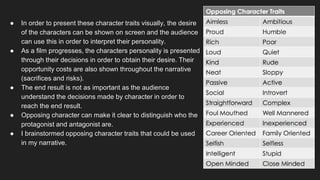
● Opposing character can make it clear to distinguish who the
protagonist and antagonist are.
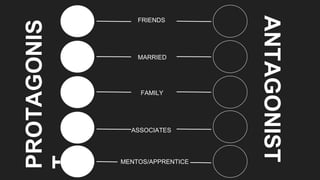
● I brainstormed opposing character traits that could be used
in my narrative.
LESSONS FROM THE SCREENPLAY NOTES:
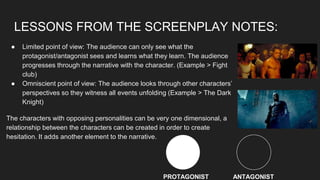
● Limited point of view: The audience can only see what the
protagonist/antagonist sees and learns what they learn. The audience
progresses through the narrative with the character. (Example > Fight
club)
● Omniscient point of view: The audience looks through other characters’
perspectives so they witness all events unfolding (Example > The Dark
Knight)
The characters with opposing personalities can be very one dimensional, a
relationship between the characters can be created in order to create
hesitation. It adds another element to the narrative.
PROTAGONIST ANTAGONIST
PROTAGONIS
T
ANTAGONIST
FRIENDS
MARRIED
FAMILY
ASSOCIATES
MENTOS/APPRENTICE
CONSTRUCTING OUR PROTAGONIST
● Emily will be the main character in my short film. I plan to
use a limited point of view for the narrative so that the
audience are able to follow through Emily’s perspective. By
doing this I will be encouraging enigma codes for the
audience.
● Emily will be a young innocent girl with an opposing
character who may be the antagonist.
● She will be texting another guy which will allow me to add
iphone animation like my target audience suggested in my
survey.
● Possible differences : Nice vs Evil, innocent vs rebellious,
young vs old.

Building a character

  • 1.
    BUILDING A CHARACTER Whenresearching methods of building characters, I watched videos from youtube called “Lessons from the Screenplay” as we'll as screenplay writer, Aaron Sorkin. I made notes on their views about characters in film as well as their own ways on creating their own characters. Aaron Sorkin’s Notes: ● Rather than telling the audience who the character is, show them what they want. (Desire > Intention) ● Present an obstacle. The way in which the character goes about overcoming the obstacle define the characters true nature. ● Creating a motivated character can create empathy between the audience and the character ● A sympathetic character has a great bond with the audience. With qualities such as humility, generosity, honesty, gratitude and commitment, it can make the character more likeable.
  • 2.
    ● In orderto present these character traits visually, the desire of the characters can be shown on screen and the audience can use this in order to interpret their personality. ● As a film progresses, the characters personality is presented through their decisions in order to obtain their desire. Their opportunity costs are also shown throughout the narrative (sacrifices and risks). ● The end result is not as important as the audience understand the decisions made by character in order to reach the end result. ● Opposing character can make it clear to distinguish who the protagonist and antagonist are. ● I brainstormed opposing character traits that could be used in my narrative.
  • 3.
    LESSONS FROM THESCREENPLAY NOTES: ● Limited point of view: The audience can only see what the protagonist/antagonist sees and learns what they learn. The audience progresses through the narrative with the character. (Example > Fight club) ● Omniscient point of view: The audience looks through other characters’ perspectives so they witness all events unfolding (Example > The Dark Knight) The characters with opposing personalities can be very one dimensional, a relationship between the characters can be created in order to create hesitation. It adds another element to the narrative. PROTAGONIST ANTAGONIST
  • 4.
  • 5.
    CONSTRUCTING OUR PROTAGONIST ●Emily will be the main character in my short film. I plan to use a limited point of view for the narrative so that the audience are able to follow through Emily’s perspective. By doing this I will be encouraging enigma codes for the audience. ● Emily will be a young innocent girl with an opposing character who may be the antagonist. ● She will be texting another guy which will allow me to add iphone animation like my target audience suggested in my survey. ● Possible differences : Nice vs Evil, innocent vs rebellious, young vs old.