BUFFER OVERFLOW
Mihir Shah
20th Apr 2019
ABOUT TODAY
x32 Arch Basic
- Basics of Buffer Overflow
- Basics of Immunity Debugger
- Vanilla Buffer Overflow
X32 ARCH BASIC(ASSEMBLY BASIC)
System Organization Basics
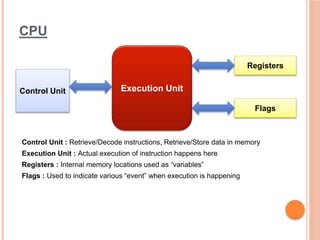
CPU
Execution UnitControl Unit
Registers
Flags
Control Unit : Retrieve/Decode instructions, Retrieve/Store data in memory
Execution Unit : Actual execution of instruction happens here
Registers : Internal memory locations used as “variables”
Flags : Used to indicate various “event” when execution is happening
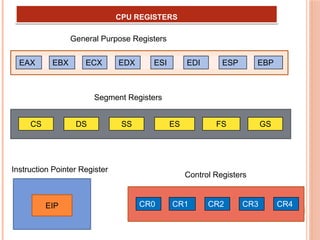
CPU REGISTERS
EAX EBX ECX EDX ESI EDI ESP EBP
General Purpose Registers
CS DS SS ES FS GS
Segment Registers
EIP
Instruction Pointer Register
CR0 CR1 CR2 CR3 CR4
Control Registers
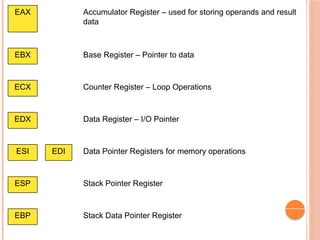
EAX Accumulator Register – used for storing operands and result
data
EBX Base Register – Pointer to data
ECX Counter Register – Loop Operations
EDX Data Register – I/O Pointer
ESI EDI Data Pointer Registers for memory operations
ESP Stack Pointer Register
EBP Stack Data Pointer Register
EAX
31 0
AX
31 16 15 0
AH AL
15 8 7 0
EAX
EBX
31 0
BX
31 16 15 0
BH BL
15 8 7 0
EBX
ECX
31 0
CX
31 16 15 0
CH CL
15 8 7 0
ECX
EDX
31 0
DX
31 16 15 0
DH DL
15 8 7 0
EDX
 Four 32-bit data registers are used for arithmetic, logical, and other operations.
 These 32-bit registers can be used in three ways −
a) As complete 32-bit data registers: EAX, EBX, ECX, EDX
b) Lower halves of the 32-bit registers can be used as four 16-bit data registers: AX, BX, CX and DX
c) Lower and higher halves of the above-mentioned four 16-bit registers can be used as eight 8-bit data
registers: AH, AL, BH, BL, CH, CL, DH, and DL
 Some of these data registers have specific use in arithmetical operations.
AX is the primary accumulator; it is used in input/output and most arithmetic instructions. For example, in
multiplication operation, one operand is stored in EAX or AX or AL register according to the size of the
operand.
BX is known as the base register, as it could be used in indexed addressing.
CX is known as the count register, as the ECX, CX registers store the loop count in iterative operations.
DX is known as the data register. It is also used in input/output operations. It is also used with AX register
along with DX for multiply and divide operations involving large values.
BASIC OF BUFFER OVERFLOW
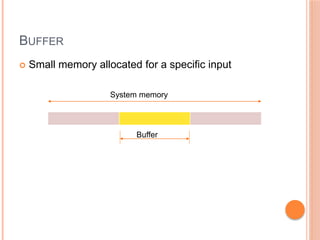
BUFFER
 Small memory allocated for a specific input
System memory
Buffer
void main()
{
char source[ ] = “HELLO”; // HELLO assigned to source
char destination[2]; // destination is 3 bytes
strcpy(destination, source); // copy source to destination
return 0;
}
Buffer (3 bytes) Overflow
H E L L O
0 1 2 3 4
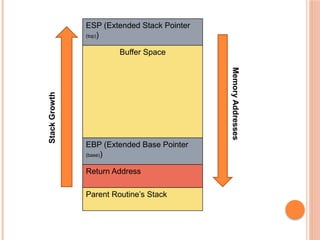
STACK
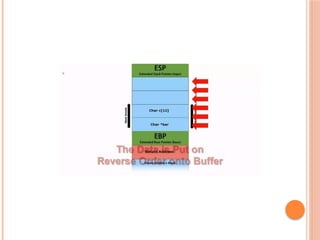
ESP (Extended Stack Pointer
(top))
Buffer Space
EBP (Extended Base Pointer
(base))
Return Address
Parent Routine’s Stack
StackGrowth
MemoryAddresses
STACK IS LIFO (LAST IN FIRST OUT)
0xAAAAAAAA
0x10203040
High Memory
Low Memory
ESP
ESP – Should point to top of Stack
STACK IS LIFO (LAST IN FIRST OUT)
0xAAAAAAAA
0x10203040
0xA0203040
High Memory
Low Memory
ESP
ESP – Should point to top of
Stack
Push – Pushes a value onto the
Stack
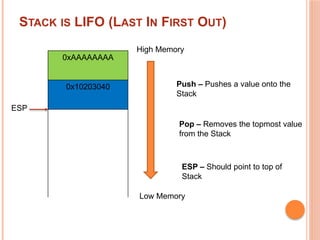
STACK IS LIFO (LAST IN FIRST OUT)
0xAAAAAAAA
0x10203040
High Memory
Low Memory
ESP
ESP – Should point to top of
Stack
Push – Pushes a value onto the
Stack
Pop – Removes the topmost value
from the Stack
Buffer overflow

Buffer overflow

  • 1.
  • 2.
    ABOUT TODAY x32 ArchBasic - Basics of Buffer Overflow - Basics of Immunity Debugger - Vanilla Buffer Overflow
  • 3.
  • 4.
  • 5.
    CPU Execution UnitControl Unit Registers Flags ControlUnit : Retrieve/Decode instructions, Retrieve/Store data in memory Execution Unit : Actual execution of instruction happens here Registers : Internal memory locations used as “variables” Flags : Used to indicate various “event” when execution is happening
  • 6.
    CPU REGISTERS EAX EBXECX EDX ESI EDI ESP EBP General Purpose Registers CS DS SS ES FS GS Segment Registers EIP Instruction Pointer Register CR0 CR1 CR2 CR3 CR4 Control Registers
  • 7.
    EAX Accumulator Register– used for storing operands and result data EBX Base Register – Pointer to data ECX Counter Register – Loop Operations EDX Data Register – I/O Pointer ESI EDI Data Pointer Registers for memory operations ESP Stack Pointer Register EBP Stack Data Pointer Register
  • 8.
    EAX 31 0 AX 31 1615 0 AH AL 15 8 7 0 EAX
  • 9.
    EBX 31 0 BX 31 1615 0 BH BL 15 8 7 0 EBX
  • 10.
    ECX 31 0 CX 31 1615 0 CH CL 15 8 7 0 ECX
  • 11.
    EDX 31 0 DX 31 1615 0 DH DL 15 8 7 0 EDX
  • 12.
     Four 32-bitdata registers are used for arithmetic, logical, and other operations.  These 32-bit registers can be used in three ways − a) As complete 32-bit data registers: EAX, EBX, ECX, EDX b) Lower halves of the 32-bit registers can be used as four 16-bit data registers: AX, BX, CX and DX c) Lower and higher halves of the above-mentioned four 16-bit registers can be used as eight 8-bit data registers: AH, AL, BH, BL, CH, CL, DH, and DL  Some of these data registers have specific use in arithmetical operations. AX is the primary accumulator; it is used in input/output and most arithmetic instructions. For example, in multiplication operation, one operand is stored in EAX or AX or AL register according to the size of the operand. BX is known as the base register, as it could be used in indexed addressing. CX is known as the count register, as the ECX, CX registers store the loop count in iterative operations. DX is known as the data register. It is also used in input/output operations. It is also used with AX register along with DX for multiply and divide operations involving large values.
  • 13.
  • 14.
    BUFFER  Small memoryallocated for a specific input System memory Buffer
  • 15.
    void main() { char source[] = “HELLO”; // HELLO assigned to source char destination[2]; // destination is 3 bytes strcpy(destination, source); // copy source to destination return 0; } Buffer (3 bytes) Overflow H E L L O 0 1 2 3 4
  • 16.
  • 17.
    ESP (Extended StackPointer (top)) Buffer Space EBP (Extended Base Pointer (base)) Return Address Parent Routine’s Stack StackGrowth MemoryAddresses
  • 18.
    STACK IS LIFO(LAST IN FIRST OUT) 0xAAAAAAAA 0x10203040 High Memory Low Memory ESP ESP – Should point to top of Stack
  • 19.
    STACK IS LIFO(LAST IN FIRST OUT) 0xAAAAAAAA 0x10203040 0xA0203040 High Memory Low Memory ESP ESP – Should point to top of Stack Push – Pushes a value onto the Stack
  • 20.
    STACK IS LIFO(LAST IN FIRST OUT) 0xAAAAAAAA 0x10203040 High Memory Low Memory ESP ESP – Should point to top of Stack Push – Pushes a value onto the Stack Pop – Removes the topmost value from the Stack